Category Archives: Journalism

A media roundup

By Chris Daly 

–First, let’s pause a moment and let this sink in: Eastman Kodak has filed for bankruptcy protection.

This is the company that ruled photography in the 20th Century, the company that made photography a popular activity, and the company that really enabled photojournalism by making cheap portable cameras as well as flexible, lightweight film.


–Second, the chips are falling in the online piracy dispute. Regrettably, this issue appears to be turning into a shouting match. For all the advocates of “freedom,” the question remains: What about stealing the work of creative people? To be continued. . .


–Coincidentally, there was also a little-noticed SCOTUS ruling yesterday on copyright. Now, while I favor granting copyright to make sure that content-generators get paid for their work, I have to wonder how much sense it makes to impose new copyright restrictions on the work of dead foreigners. The purpose of the U.S. copyright law is to encourage creative output by giving Americans an economic incentive to write, compose, paint, etc. Putting new restrictions on “Peter and the Wolf” is not going to bring any new work out of Prokofiev (no matter how much his heirs may rake in). This, too, is not the answer.


 –Who knew that Twitter had all these features? (I should have but didn’t.)

–Finally, the gift (to media reporters) that keeps on giving: The Murdoch Hacking Scandal. Jude Law is smiling today because he is among three dozen victims of phone hacking by Murdoch reporters who have extracted “settlements” (i.e., payoffs) from Murdoch’s News Intl. The “nut graf”:

The apparent admission of a cover-up seemed likely to add to the challenges facing Mr. Murdoch in Britain. News International, the British subsidiary of News Corporation said it would not immediately comment, Reuters reported.

Andrew Cowie/Agence France-Presse — Getty Images 


Leave a comment

Filed under business, First Amendment, Journalism, media, Supreme Court

The sorcerer’s apprentice?

By Chris Daly 

I don’t usually take frankly partisan positions in this blog, and I will try not to do that here, even in the midst of the Iowa caucus-ing.

What struck me in the last few days was the lament of Newt Gingrich about the flamethrower approach of the Romney camp, which has bombarded Gingrich with negative TV ads. For a Republican to complain about unrestricted negative campaigning is more than a bit rich. It’s like Dr. Frankenstein complaining about his monster.

Questions for the media to keep in mind:

1. Who elevated the dark art of negative campaigning to its highest level?

[Hint: Lee Atwater, Karl Rove. . .]

2. Who thought is was a good idea to allow unrestricted spending on political ads?

[Hint: Scalia, Thomas, Roberts, Alito, Kennedy.]

In other words, the answer to both questions is REPUBLICANS. To the best of my knowledge, no mainstream media accounts of this election have mentioned this factual matter of background. I would say that reporters and editors should give this some thought. How will the media address this reality? Will journalists explain the factual history of the issue? Will they try to find a way to neutralize or offset it? Will television station owners in Iowa, New Hampshire, South Carolina and elsewhere reject those ads? Will the media interpret non-partisanship to mean that they must look the other way?

To be continued. . .

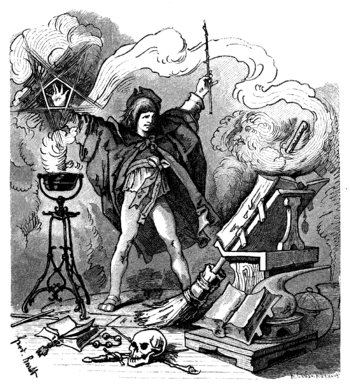
[Illustration of the Goethe figure the Sorcerer’s Apprentice by S. Barth, via Wikimedia]


Leave a comment

Filed under broadcasting, First Amendment, Journalism, Politics

Imagine that!

by Chris Daly

Another aggregagtor, BuzzFeed, has decided that there is a secret formula to getting noticed: generate original content. 

Today’s Times informs that BuzzFeed has hired Ben Smith away from Politico to do just that.

Here’s the plan:

The reporters will be scoop generators, Mr. Peretti said. “By breaking scoops and drawing attention,” he added, they will help increase traffic and, by extension, advertising sales.


Isn’t that pretty much the basic idea since the time of the Penny Press in the 1830s?


Leave a comment

Filed under blogging, Journalism, journalism history, media

Who is a journalist?

By Chris Daly 

The latest round in the debate over “who is a journalist” comes from Oregon. A blogger named Crystal Cox went on a rampage against an Oregon financial company, Obsidian Finance Group. (In fact, in a burst of candor, she named her blog Obsidian Finance Sucks.) One of the firm’s principals sued her for defamation.

Complications ensued, which you can read about here, thanks to Yahoo, which appears to have aggregated this story from its original source, Digital Trends.

All this struck me as a rehash of issues that arose almost a decade ago. So, I decided to re-post an essay I wrote in 2005 on blogging and journalism. Here you go:


ARE BLOGGERS JOURNALISTS?
LET’S ASK THOMAS JEFFERSON

by Christopher B. Daly


Who is a journalist?

In America, where we don’t license journalists, that is not always a simple question. Lately, the issue has come up in a new light because of the claims made by people who post Web logs. Bloggers came to prominence during the 2004 election, often criticizing or correcting the “mainstream media.” Recently, the first blogger in history was issued credentials to cover the White House. And just last month, a California judge was asked to decide whether bloggers who write about Apple computers can enjoy the legal protections of that state’s “shield laws.”

Not surprisingly, most bloggers insist that they are journalists, entitled to equal rights with older media. Others disagree, saying bloggers are not journalists by any stretch. Recently, for example, Los Angeles Times media critic David Shaw argued that bloggers should not be considered journalists because they have no experience, they have no editors, and they have no standards.

Who is to say?

One approach to an answer is historical. In fact, bloggers stand squarely in a long-standing journalistic tradition. In this country, their roots go back to the authors of the often-anonymous writings that helped to found America itself by encouraging the rebellion against Britain.

Beginning around 1760 and continuing at a quickening pace, the colonists began taking part in a great public argument — about the rights of Englishmen, the nature of civil society, and the limits of power. What began as a trickle of protest grew into a torrent of polemic.

Hundreds upon hundreds of pamphlets were printed in the colonies between 1760 and 1776, providing the intellectual setting for the debate over independence. Those writings — and their authors — played a role that was at least as important as established newspapers in giving expression to the growing political crisis.

The pamphlets were crucial to the rebellion because they were cheap, because they presented provocative arguments, and because it was impossible for the royal authorities to find their authors and stop them. The authors of the pamphlets were not professional writers, nor were they printers. They were lawyers, farmers, ministers, merchants, or — in some cases — men whose true identities are still unknown. It was a well-established practice in colonial times for writers to use pen names, even when writing on non-controversial subjects.

With the coming of conflict with England and the fear of reprisals by the authorities, most pamphleteers resorted to writing under a nom de plume such as Cato or Centinel — the “Wonkette” and “Instapundit” of the day.

They would use a sympathetic printer’s press under cover of night, then sneak the pamphlets out for distribution. As a result, the pamphleteer had one great advantage over the printer: he could state the boldest claims against the Crown and not have to fear any penalties. The pamphleteers amounted to the nation’s first version of an underground press, a guerilla counterpart to the established newspapers.


THE GREATEST PAMPHLETEER of the age was certainly Thomas Paine. He arrived in Philadelphia late in 1774. Already 37, Paine was not a terribly impressive figure (you might even call him a “slacker”). Born in England, he had failed in the family’s corset-making business and later got fired as a tax-collector. His first wife had died, and he was separated from his second one. Jobless and nearly penniless, he set sail for a new life in America. On the way, he fell ill and nearly died.

Then his life began to turn. He began writing essays for The Pennsylvania Magazine. He met and became friends with several advocates of independence, including the prominent doctor Benjamin Rush and the visiting Massachusetts lawyer John Adams. After a few months, Paine left the magazine but continued writing. Soon, he wrote a pamphlet of his own.

Titled Common Sense, it appeared on Jan. 10, 1776, and it shook the world. The impact of that pamphlet, out of the hundreds then circulating, was unprecedented. Paine later estimated that some 150,000 copies were sold, so it was probably read by about half a million people — at a time when the entire colonial population was about 2 million.

Like most other pamphleteers, Paine wrote Common Sense anonymously, but his central idea was unmistakable.

Paine embraced republicanism — the idea that people can govern themselves without a hereditary or religious central authority.

His first target was the monarchy itself. In Paine’s view, when stripped of all its ermine robes and gilded scepters, the monarchy consisted of naked power, plain and simple. In language that sounds a lot like ranting, Paine said the English crown could be traced to William the Conqueror, whom he dismissed as “a French bastard landing with an armed banditti.”

He went on to call for “an open and determined declaration for independence,” and he promised his readers that “the sun never shined on a cause of greater worth.” These were radical ideas, and Paine became a wanted man.

Common Sense and other pamphlets like it were precisely the kind of political journalism that Jefferson had in mind when he insisted on a constitutional amendment in 1790 to protect press freedom — anonymous, highly opinionated writing from diverse, independent sources. In historical terms, today’s bloggers are much closer in spirit to the Revolutionary-era pamphleteers than today’s giant, conglomerate mainstream media. On those grounds, blogs deserve the full constitutional blessings that the First Amendment guarantees.


ARE BLOGS IMMUNE FROM LIBEL CLAIMS?

But that is not to say that bloggers have carte blanche. It is important to remember that the First Amendment is a limit on the government’s power to impose prior restraint — that is, to prevent ideas from reaching the public by shutting down a newspaper before publication. It has always left journalists open to consequences that might arise after publication — such as being sued for libel or being ordered by a judge to reveal a confidential source.

It is clear that bloggers enjoy First Amendment rights, which are strongest at protecting opinions.

It is less clear that they should be entitled to the protections of all the other laws that have been passed since the Founding that affect journalists.

Consider, for example, the state and federal “shield laws,” which in general allow journalists to protect confidential sources, as in the Apple case. Many bloggers say they should be covered by those laws.

Here again, history offers a guide. Most laws protecting journalists are much newer than the First Amendment. They were passed in recent decades in order to protect and foster a specific activity called reporting.

What we think of as reporting — the pursuit, on a full-time basis, of verifiable facts and verbatim quotations — was not a significant part of journalism in the time of Jefferson and Paine. In fact, the practice of reporting began around 1833 in New York’s “penny papers” and gradually spread during the 19th Century.

Nowadays, when we ask whether someone is a journalist, we may need to refine the question. We should ask: Is this the kind of journalist who presents analysis, commentary, or political rants? Or, is this the kind of journalist who offers the fruits of reporting? Or some of both? The issue is not the job title but the activity.

Anyone who engages in reporting — whether for newspapers, magazines, radio, television, or blogs — deserves equal protection under those laws, whether the news is delivered with a quill pen or a computer.

“What do we mean by the Revolution? The war? That was no part of the Revolution; it was only an effect and consequence of it. The Revolution was in the minds of the people, and this was effected, from 1760 to 1775, in the course of fifteen years before a drop of blood was shed at Lexington. The records of 13 legislatures, the pamphlets, newspapers in all the colonies, ought to be consulted during that period to ascertain the steps by which the public opinion was enlightened and informed…”

–John Adams, writing to Thomas Jefferson, 1815.


Copyright ©2005 Christopher B. Daly
All Rights Reserved.

[Last modified: April 7, 2005]


Leave a comment

Filed under blogging, First Amendment, Journalism, journalism history, media

Inside the “meme” factory

By Chris Daly 

Kudos to the New York Times for this piece which looks behind the curtain of the Occupy movement. Not to denigrate the movement, but this kind of process pertains to most political movements. The article focuses on the role of Kalle Lasn, the Canadian editor of Adbusters magazine.

I was especially struck by the use of the “meme” idea (or meme). It will be the major focus of my next book, which is coming soon. The working title is:

INSIDE THE MEME FACTORY: The Rise of Conservative Media

The main idea is that the rise of conservative media in America after WWII was not an accident in the specific sense that it arose in tandem with a set of institutions (think tanks, mainly) that supplied the ideas, slogans, and “studies” — in other words, memes — that the conservative media could use to advance the conservative cause. I plan to focus on the semi-hidden history of this movement, which was actually quite intentional.

To be continued. . .


Leave a comment

Filed under Journalism, journalism history

Mean but clever?

Or clever but mean?

You be the judge of this satirical screenplay in today’s NYTimes magazine that imagines the Murdochs going to visit a family therapist.


It’s by Etan Cohen, (not Ethan Coen — one of “the Coen brothers”). ETAN is a screenwriterwho got where he is by the traditional route — go to Harvard, join the Lampoon, sit around and think up funny premises. Someone’s got to do it.


Leave a comment

Filed under Journalism, Uncategorized

Shame!

By Chris Daly

More outrageous behavior by NYPD.

According to my preliminary research, there is no recall mechanism for the people to use to remove the mayor of New York. Even though Michael Bloomberg comes from my hometown (Medford, Mass.), I have had it with him over these attacks on journalists, and I think he should be removed.

My understanding is that the governor of New York state has that power. He should use it.


2 Comments

Filed under Journalism

Another milestone

By Chris Daly

Congrats to the ancient and estimable Atlantic for passing this key milestone on the way to the future: According to today’s NYTimes, the great old magazine now derives more of its in-coming revenues from on-line ads than it does from the advertising in the printed version.

The good news here is that the crossing of those two trend lines virtually assures the Atlantic’s survival well into the digital era. The bad news is that it may hasten the demise of the print edition.


Imagine a magazine that included among its founders a poet (Emerson) who wrote such lines as these:

“Things are in the saddle and ride mankind.”

or,

“All history becomes subjective; in other words, there is properly no history; only biography.”


Leave a comment

Filed under Journalism, journalism history, publishing

“There’s nothing to see here. Move along.”

By Chris Daly 

Just to be clear: It is never OK to arrest a journalist (except in rare cases where the journalist is actively engaged in some activity that is a crime, like committing arson on a day off). When a journalist is working, the police have a positive duty not to interfere. The arrests of the journalists covering the Occupy movement are violations of their Constitutional rights. More importantly, those arrests violate the absolute right of the people to be informed about what John Adams called “the character and conduct of their rulers.”

To repeat, the First Amendment says:

“Congress shall make no law …

abridging the freedom . . . of the press.”

End of story. The founders left no wiggle room there. James Madison did not write, “Make no law unless it would be convenient to impose a news blackout.” He did not write, “Make no law unless you think you can get away with telling the people you are arresting journalists for their own safety.” 

Shame on those cops. Shame on their chiefs. Shame on those mayors.

Discipline the cops. Fire the chiefs. Recall the mayors.

Those things won’t happen, of course, so it’s up to the journalists on scene. Report, report, report. Take names and badge numbers. Call your lawyers. File suit.

Shoot video. Take pictures. Get audio.


[Yes, of course, I realize that there is another side to this argument: It is ludicrous to say that all journalists have an unlimited right to descend en masse on every crime scene, disaster site, drug bust, surveillance stake-out, courtroom, grand jury room, and so on. But that’s not what’s at stake in the Occupy arrests. These are not secret, investigative police actions. These are important public-policy matters, playing out in public (Yes, Zuccotti Park is private, but that seems like a technicality at this point, since the occupation is infused with such a public interest in its outcome). It is also disingenuous for police, when they start making arrests, to declare the area a “crime scene” just because they are making arrests and order all journalists to leave. If the police are allowed to do that, then journalists will never be able to watch the police at work and report about it. That would be a great day for the police but a bad day for everybody else. Even Justice Byron White, no friend of the news media, saw the threat. As he wrote in the majority opinion in the 1972 Branzburg ruling, “Nor is it suggested that news gathering does not qualify for First Amendment protection; without some protection for seeking out the news, freedom of the press could be eviscerated.”]


Leave a comment

Filed under First Amendment, Journalism, Uncategorized

Media bias? Not so much

By Chris Daly 

Michelle Bachmann, a former flavor-of-the-week in the lengthy, fickle Republican primary campaign for the presidential nomination, has a gripe. Not surprisingly, she is complaining about the media.

This, of course, is a time-tested tactic for Republicans, especially when they are feeling politically desperate. Bachmann claims to have caught CBS News in a “gotcha” moment that she believes confirms her suspicions of liberal bias at CBS. Now, it may well be that there are liberals at CBS, but this episode does not prove her point. In fact, I believe it proves the opposite point.

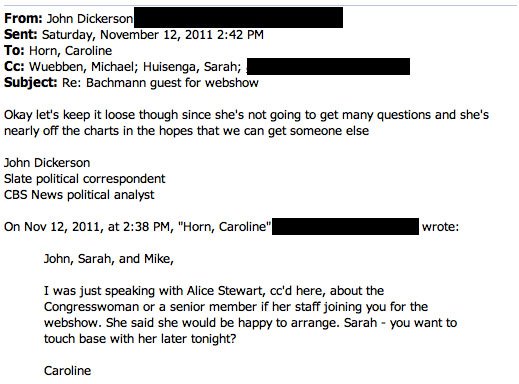
Briefly. . . As recounted in today’s NYTimes, the guy in charge of political coverage at CBS, John Dickerson, was caught doing his job. He was trying to find an online guest for a show he was orchestrating that would follow the latest Republican debate on Saturday night. In an email to colleagues, he said he would rather “get someone else” other than Bachmann.

His reason? She was “not going to get many questions” and “she’s nearly off the charts” in the polling of voters’ preferences.

(Dickerson’s big mistake was that he included a Bachmann aide among the people in the list of addresses for that particular email, so his thinking went unfiltered to the Bachmann communication director, who then did the professional thing and tried to make hay out of it, in a Facebook blast and elsewhere.)


Back to Dickerson’s email.

If we look at what he actually said, it appears that his criteria for choosing the guests to pursue were non-political, non-partisan, and non-ideological.

Like any good producer, he wanted a “hot” guest — hot in the sense of someone who is trending, someone who is going to create or amplify buzz, someone who is going to add to CBS’s ratings. He does not want someone who was last week’s news. Simple as that.

And the facts bear him out: Bachmann did indeed get few questions in the debate and little air time, and she is dying in the latest polls. (CBS’s own latest poll had her in 6th place with just 4% support.) That is not to say that she could not surge again; if she does, Dickerson and every producer, host, and booker in politics will be chasing her. Not because they like or dislike her and not because they agree or disagree with her. It will be all about blowing on the hot coals.

In his email, Dickerson could be properly charged with telling “vicious truths.”

Was he ruthless? Yes.

Was he liberal? No.

Even the awful site Big Journalism almost got this right. In fact, the blogger

p.s. For another day: What about Bachmann’s implicit claim? Do the news media formulate common policies, then execute them in concert? (Hint: people in the news media can’t agree on whether to capitalize “president” !)


1 Comment

Filed under broadcasting, Journalism, media, Politics