Category Archives: journalism history

Book recommendation

By Chris Daly

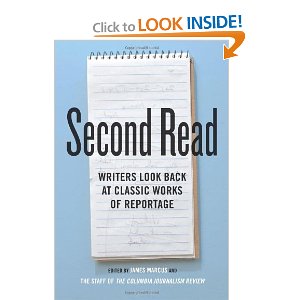
I just finished a book that surprised me — Second Read: Writers Look Back at Classic Works of Reportage.


I found it surprising because when I first picked it up, I thought it would be yet another anthology of great works of journalism, perhaps with brief headnotes introducing each one. Instead, this is a collection of well-considered essays by contemporary writers about some of the great works in the history of (mainly American) journalism. The overall editor is James Marcus of Columbia’s J-School, and he drew on the faculty and the masthead of CJR  for most of the entries.

A few of these essays pointed me to works that I have never read and now want to catch up with (DeFoe’s “A Journal of the Plague Year,” Paul Gallico’s “Farewell to Sport,” Cornelius Ryan’s “The Longest Day”).

Others were meditations on familiar works that made them fresh again (Evan Cornog on Liebling’s “Ear of Louisiana,” Scott Sherman on Frady’s “Wallace,” David Ulian on Didion’s “Slouching Toward Bethlehem”).

My only regret is that this book does not include the originals — or at least significant excerpts — that are being celebrated. I am sure a publisher can explain why this book can make a little money at 184 pages and would lose a fortune at 1,840 pages. Oh, well. Off to the library to hunt down the originals.

If you have any interest in journalism history or “literary journalism,” don’t missSecond Read.


Leave a comment

Filed under Journalism, journalism history, media

Imagine that!

by Chris Daly

Another aggregagtor, BuzzFeed, has decided that there is a secret formula to getting noticed: generate original content. 

Today’s Times informs that BuzzFeed has hired Ben Smith away from Politico to do just that.

Here’s the plan:

The reporters will be scoop generators, Mr. Peretti said. “By breaking scoops and drawing attention,” he added, they will help increase traffic and, by extension, advertising sales.


Isn’t that pretty much the basic idea since the time of the Penny Press in the 1830s?


Leave a comment

Filed under blogging, Journalism, journalism history, media

Who is a journalist?

By Chris Daly 

The latest round in the debate over “who is a journalist” comes from Oregon. A blogger named Crystal Cox went on a rampage against an Oregon financial company, Obsidian Finance Group. (In fact, in a burst of candor, she named her blog Obsidian Finance Sucks.) One of the firm’s principals sued her for defamation.

Complications ensued, which you can read about here, thanks to Yahoo, which appears to have aggregated this story from its original source, Digital Trends.

All this struck me as a rehash of issues that arose almost a decade ago. So, I decided to re-post an essay I wrote in 2005 on blogging and journalism. Here you go:


ARE BLOGGERS JOURNALISTS?
LET’S ASK THOMAS JEFFERSON

by Christopher B. Daly


Who is a journalist?

In America, where we don’t license journalists, that is not always a simple question. Lately, the issue has come up in a new light because of the claims made by people who post Web logs. Bloggers came to prominence during the 2004 election, often criticizing or correcting the “mainstream media.” Recently, the first blogger in history was issued credentials to cover the White House. And just last month, a California judge was asked to decide whether bloggers who write about Apple computers can enjoy the legal protections of that state’s “shield laws.”

Not surprisingly, most bloggers insist that they are journalists, entitled to equal rights with older media. Others disagree, saying bloggers are not journalists by any stretch. Recently, for example, Los Angeles Times media critic David Shaw argued that bloggers should not be considered journalists because they have no experience, they have no editors, and they have no standards.

Who is to say?

One approach to an answer is historical. In fact, bloggers stand squarely in a long-standing journalistic tradition. In this country, their roots go back to the authors of the often-anonymous writings that helped to found America itself by encouraging the rebellion against Britain.

Beginning around 1760 and continuing at a quickening pace, the colonists began taking part in a great public argument — about the rights of Englishmen, the nature of civil society, and the limits of power. What began as a trickle of protest grew into a torrent of polemic.

Hundreds upon hundreds of pamphlets were printed in the colonies between 1760 and 1776, providing the intellectual setting for the debate over independence. Those writings — and their authors — played a role that was at least as important as established newspapers in giving expression to the growing political crisis.

The pamphlets were crucial to the rebellion because they were cheap, because they presented provocative arguments, and because it was impossible for the royal authorities to find their authors and stop them. The authors of the pamphlets were not professional writers, nor were they printers. They were lawyers, farmers, ministers, merchants, or — in some cases — men whose true identities are still unknown. It was a well-established practice in colonial times for writers to use pen names, even when writing on non-controversial subjects.

With the coming of conflict with England and the fear of reprisals by the authorities, most pamphleteers resorted to writing under a nom de plume such as Cato or Centinel — the “Wonkette” and “Instapundit” of the day.

They would use a sympathetic printer’s press under cover of night, then sneak the pamphlets out for distribution. As a result, the pamphleteer had one great advantage over the printer: he could state the boldest claims against the Crown and not have to fear any penalties. The pamphleteers amounted to the nation’s first version of an underground press, a guerilla counterpart to the established newspapers.


THE GREATEST PAMPHLETEER of the age was certainly Thomas Paine. He arrived in Philadelphia late in 1774. Already 37, Paine was not a terribly impressive figure (you might even call him a “slacker”). Born in England, he had failed in the family’s corset-making business and later got fired as a tax-collector. His first wife had died, and he was separated from his second one. Jobless and nearly penniless, he set sail for a new life in America. On the way, he fell ill and nearly died.

Then his life began to turn. He began writing essays for The Pennsylvania Magazine. He met and became friends with several advocates of independence, including the prominent doctor Benjamin Rush and the visiting Massachusetts lawyer John Adams. After a few months, Paine left the magazine but continued writing. Soon, he wrote a pamphlet of his own.

Titled Common Sense, it appeared on Jan. 10, 1776, and it shook the world. The impact of that pamphlet, out of the hundreds then circulating, was unprecedented. Paine later estimated that some 150,000 copies were sold, so it was probably read by about half a million people — at a time when the entire colonial population was about 2 million.

Like most other pamphleteers, Paine wrote Common Sense anonymously, but his central idea was unmistakable.

Paine embraced republicanism — the idea that people can govern themselves without a hereditary or religious central authority.

His first target was the monarchy itself. In Paine’s view, when stripped of all its ermine robes and gilded scepters, the monarchy consisted of naked power, plain and simple. In language that sounds a lot like ranting, Paine said the English crown could be traced to William the Conqueror, whom he dismissed as “a French bastard landing with an armed banditti.”

He went on to call for “an open and determined declaration for independence,” and he promised his readers that “the sun never shined on a cause of greater worth.” These were radical ideas, and Paine became a wanted man.

Common Sense and other pamphlets like it were precisely the kind of political journalism that Jefferson had in mind when he insisted on a constitutional amendment in 1790 to protect press freedom — anonymous, highly opinionated writing from diverse, independent sources. In historical terms, today’s bloggers are much closer in spirit to the Revolutionary-era pamphleteers than today’s giant, conglomerate mainstream media. On those grounds, blogs deserve the full constitutional blessings that the First Amendment guarantees.


ARE BLOGS IMMUNE FROM LIBEL CLAIMS?

But that is not to say that bloggers have carte blanche. It is important to remember that the First Amendment is a limit on the government’s power to impose prior restraint — that is, to prevent ideas from reaching the public by shutting down a newspaper before publication. It has always left journalists open to consequences that might arise after publication — such as being sued for libel or being ordered by a judge to reveal a confidential source.

It is clear that bloggers enjoy First Amendment rights, which are strongest at protecting opinions.

It is less clear that they should be entitled to the protections of all the other laws that have been passed since the Founding that affect journalists.

Consider, for example, the state and federal “shield laws,” which in general allow journalists to protect confidential sources, as in the Apple case. Many bloggers say they should be covered by those laws.

Here again, history offers a guide. Most laws protecting journalists are much newer than the First Amendment. They were passed in recent decades in order to protect and foster a specific activity called reporting.

What we think of as reporting — the pursuit, on a full-time basis, of verifiable facts and verbatim quotations — was not a significant part of journalism in the time of Jefferson and Paine. In fact, the practice of reporting began around 1833 in New York’s “penny papers” and gradually spread during the 19th Century.

Nowadays, when we ask whether someone is a journalist, we may need to refine the question. We should ask: Is this the kind of journalist who presents analysis, commentary, or political rants? Or, is this the kind of journalist who offers the fruits of reporting? Or some of both? The issue is not the job title but the activity.

Anyone who engages in reporting — whether for newspapers, magazines, radio, television, or blogs — deserves equal protection under those laws, whether the news is delivered with a quill pen or a computer.

“What do we mean by the Revolution? The war? That was no part of the Revolution; it was only an effect and consequence of it. The Revolution was in the minds of the people, and this was effected, from 1760 to 1775, in the course of fifteen years before a drop of blood was shed at Lexington. The records of 13 legislatures, the pamphlets, newspapers in all the colonies, ought to be consulted during that period to ascertain the steps by which the public opinion was enlightened and informed…”

–John Adams, writing to Thomas Jefferson, 1815.


Copyright ©2005 Christopher B. Daly
All Rights Reserved.

[Last modified: April 7, 2005]


Leave a comment

Filed under blogging, First Amendment, Journalism, journalism history, media

Barney Flashback: 1989

By Chris Daly 

The news that Barney Frank is retiring from the U.S. House at the end of this term prompted me to think back over the years that I covered him while I was a political reporter in Boston (for the AP, then for The Washington Post). I went to the Post archive, only to be reminded that the Post claims copyright to all my stories, so I had to pay to get access to my own work. (This was all part of the infamous “rights grab” a decade ago by big publishers who used their market power to treat all work as if it were “work for hire” — which, in my case, it was not.)

Anyway, here’s my Barney Frank story from 1989 (free to you, and now free to all comers).

For Now, Constituents Supporting Rep. Frank

The Washington Post

Aug. 31, 1989

By Christopher B. Daly

In the week since Rep. Barney Frank (D-Mass.) acknowledged his involvement with a male prostitute, many of his constituents apparently have decided to stand by their congressman, at least for now.

With a mixture of anger, sympathy and disappointment, voters and public officials in southeastern Massachusetts generally agree that Frank’s record of accomplishment will outweigh the revelation that he paid for sex from a man who later said he had run a prostitution ring out of the congressman’s Capitol Hill apartment. Many of those who still support Frank, an acknowledged homosexual, said they are willing to overlook an isolated lapse in judgment. But even his supporters warn that the fifth-term congressman could be in political jeopardy if there are any more such revelations.

“Because it’s something of a personal nature, not something that happened in the halls of Congress, people don’t know quite how to react to it,” said state Rep. Stephen Karol, a Democrat from Attleboro. “This was something that was done by a public official in his private life. Most reasonable people are being very cautious and making sure they don’t rush to judgment.”

Karol, echoing a sentiment voiced by other Democrats in state government, added that he personally supports Frank and admires the way the congressman has dealt with the reports openly and honestly.

“I was very saddened by the congressman’s difficulty. I think it’s certainly very serious,” said A. Joseph DeNucci, a Democrat from Newton who serves as state auditor, an elected position. “I just happen to believe that he’s one of the best congressmen in the country. He has served his district, where I live, very well and capably. He has provided tremendous constituent services for the people in the district.” DeNucci added, “No question, this is seriously going to offend some people. To be frank, it troubles me somewhat. However, as a public person, separating the incident from his public abilities, I can overlook it.”

Responding to a published report, Frank confirmed last Friday that he paid a male prostitute, Stephen L. Gobie, for sex in 1985. Frank said he also tried to rehabilitate Gobie by hiring him as a personal aide but fired him after hearing complaints about Gobie’s activities in the congressman’s Washington apartment when Frank was out of town. On Monday, Frank asked the House ethics committee to investigate.

Despite extensive coverage in the local newspapers, television and radio, the affair has met with more shrugs than outrage in the 4th Congressional District, where many voters refer to their witty, caustic liberal congressman on a first-name basis. Frank’s district-a product of gerrymandering-runs from Brookline and Newton, two prosperous and politically liberal suburbs just west of Boston, through the wealthy Republican towns of Wellesley and Dover to the distant suburbs, then south to the industrial port city of Fall River, more than 50 miles from Boston.

Considered a brash state legislator, Frank was first elected to Congress in 1980, filling a vacancy created when Rep. Robert Drinan (D-Mass.), a liberal priest, was ordered by the Vatican to renounce political office. In 1982, Frank survived a bruising fight with Rep. Margaret M. Heckler (R) when the two incumbents’ districts were merged. Since 1982, Frank has won handily, even after openly acknowledging his homosexuality. In a 1987 interview with The Boston Globe, Frank confirmed persistent rumors that he was gay, then went on to defeat a Republican supporter of the Rev. Pat Robertson in the 1988 election with 70 percent of the vote.

At the lushly landscaped town dump in Wellesley, a favorite midday meeting place, all the residents in today’s lunch hour crowd had heard the news about their congressman, and most were openly, if somewhat reluctantly, supporting him.

“I like Barney,” said Frank Jones, a retired printer. “He’s a good congressman, but he sure doesn’t use good judgment.” Jones said the disclosures about Frank have been a topic of conversation this week and that his relatives in Fall River feel as he does. On balance, Jones said, he would rather have a gay congressman “than a crook.”

Only Charles Plouffe, a retired insurance salesman and long-time Wellesley resident, said he thought Frank should resign. “I don’t see how they can run in people like {Oliver} North, when this fellow is a disgrace to moral people,” Plouffe said.

“I still say it’s better to keep it in the closet.” Plouffe said the Frank affair was “a main topic of conversation” among his golfing foursome. “Two of them’s Democrats, and they are singing a different tune now,” he said. “Since this thing broke, I don’t hear anybody defending him.”

Still, Frank has many loyal supporters, due in part to his strong backing for Israel in an area with many Jewish voters, his attention to constituent services and his reputation as a brilliant, hard-working advocate for working families and the elderly. Polls conducted for Boston newspapers and television stations immediately after the story broke reported that 65 percent of the district’s voters believed Frank should not resign and that 59 percent of those surveyed said the revelations would have no impact on their voting.

One critical moment for Frank occurred last weekend when the congressman kept a promise to march in a parade in Fall River, home of many Portuguese Americans. Striding alongside the city’s mayor, Frank was greeted with cheers. Doug Cahn, the congressman’s press secretary in Washington, said the office has received “hundreds” of telephone calls from constituents in the past week, and he said they were running 8 to 1 in support of Frank.

State Rep. Marjorie Clapprood, a liberal Democrat from suburban Sharon and a staunch Frank loyalist, said she was at a senior citizens’ center last weekend. “It was being talked about,” Clapprood said. “The comments were, `Isn’t it awful’ and `How do you think his mother feels?’ There was no sniping,” Clapprood said.

Reproduced with permission of the copyright owner. Further reproduction or distribution is prohibited without permission.

The line above appears at the end of the version retrieved from the Post archives. Actually, the “permission” by the copyright owner (me) was coerced. I dispute the Post’s efforts to limit your right to read it.

1 Comment

Filed under journalism history

Inside the “meme” factory

By Chris Daly 

Kudos to the New York Times for this piece which looks behind the curtain of the Occupy movement. Not to denigrate the movement, but this kind of process pertains to most political movements. The article focuses on the role of Kalle Lasn, the Canadian editor of Adbusters magazine.

I was especially struck by the use of the “meme” idea (or meme). It will be the major focus of my next book, which is coming soon. The working title is:

INSIDE THE MEME FACTORY: The Rise of Conservative Media

The main idea is that the rise of conservative media in America after WWII was not an accident in the specific sense that it arose in tandem with a set of institutions (think tanks, mainly) that supplied the ideas, slogans, and “studies” — in other words, memes — that the conservative media could use to advance the conservative cause. I plan to focus on the semi-hidden history of this movement, which was actually quite intentional.

To be continued. . .


Leave a comment

Filed under Journalism, journalism history

Another milestone

By Chris Daly

Congrats to the ancient and estimable Atlantic for passing this key milestone on the way to the future: According to today’s NYTimes, the great old magazine now derives more of its in-coming revenues from on-line ads than it does from the advertising in the printed version.

The good news here is that the crossing of those two trend lines virtually assures the Atlantic’s survival well into the digital era. The bad news is that it may hasten the demise of the print edition.


Imagine a magazine that included among its founders a poet (Emerson) who wrote such lines as these:

“Things are in the saddle and ride mankind.”

or,

“All history becomes subjective; in other words, there is properly no history; only biography.”


Leave a comment

Filed under Journalism, journalism history, publishing

Ernie Pyle: Everyman exalted

By Chris Daly 

Today’s NYTimes brings a dispatch from Dana, Indiana — a dateline that all journalism historians will recognize as the hometown of Ernie Pyle, one of the greatest war correspondents in American history. The piece is by Dan Barry, who occupies a beat that is similar in some ways to the job Pyle had as a domestic columnist before the war — except that Pyle was expected to come up with a new column every day. Pyle once called himself “a tramp with an expense account.”

It’s a fine piece of its kind. But if you want to know more about Pyle, here are some suggestions. One is to skip the dreary slideshow that the Times offers and instead visit this terrific website maintained by the School of Journalism at Indiana University (a school Pyle almost graduated from). Be sure to see the site’s “photo gallery” and “wartime columns.”


Or, you could read the following excerpt about Pyle from my forthcoming book, Covering America.   I have chosen this selection because it gives a glimpse of Pyle before he was famous.


From COVERING AMERICA, by Christopher B. Daly ©


Ernie Pyle, an Unlikely Hero

As the war drew closer, more and more Americans began facing up to it and thinking about their places in it. One of them was a newspaper columnist in his late thirties named Ernie Pyle. The son of farmers, Pyle left his small town in Indiana and, in the space of a few years, became the best-known and most-loved journalist of his generation.

Young Ernie escaped from his hometown of Dana by going to Indiana University in Bloomington, where he studied economics and journalism and came within months of earning a degree. Before that happened, though, he took a job on a newspaper. Thanks to a recommendation from a friend, Nelson Poynter, Ernie hooked up with the powerful Scripps-Howard company. He was offered $30 a week to work for a tabloid that the newspaper chain had recently bought in the nation’s capital.51 In 1925, he married a freespirited woman named Geraldine Siebolds, who was known as Jerry. Soon after, Ernie and Jerry lit out for the territories. In the spring of 1926, they quit their jobs, sold all they had, and bought a Model T, heading west. They lived out of the car, cooking over an open fire and sleeping on the ground as they treated themselves to a long look at the country. Of all the places they visited, the one they liked best was the high, dry Southwest. A friend described them at the time as “young, wild, unconventional and neurotic,” adding that “they were tearing across the country as if someone was after them.”

Broke, they landed in New York, and Ernie went back to work, as a copy editor at the Post. He didn’t like New York, so he jumped when he got a letter from Lee Miller, an editor at his old paper in Washington. Miller, who was on the rise in the Scripps-Howard operation, offered him a spot on the desk at the Washington Daily News. There, just months after Lindbergh’s historic crossing of the Atlantic, Ernie launched the first regular column in the country devoted to the field of aviation. He spent most days at his desk job, then spent most evenings hanging around at the airfields around Washington and writing his column. While he was busy, Jerry began drinking. At one point, Ernie and Jerry took another long trip across the country. When they got back, his newspaper was facing a problem: the syndicated columnist the newspaper usually carried, Heywood Broun, had gone on a vacation and suspended his column. To fill the space, Pyle pitched in and wrote eleven pieces about his recent trip. Those columns caught the eye of the top editors at Scripps-Howard, and Ernie was rewarded by having one of his life’s wishes fulfilled: he was given his own column, to be filled by whatever material he could find by traveling the USA.

From 1935 to 1942, Ernie roamed the country, through the depths of the Depression, “a tramp with an expense account,” and he made his way to all forty-eight states, as well as Alaska, Hawaii, Canada, and Latin America. He met all sorts of people, from all walks of life. He was not seeking news, he was looking for life–and he found it. Along the way, according to his biographer, the character the world would get to know through the byline “Ernie Pyle” emerged: “a figure of warmth and reassurance, a sensitive, self-deprecating, self-revealing, compassionate friend who shared his sadnesses and exhilarations, his daydreams and funny stories, his ornery moods and nonsensical musings, his settled prejudices and deepest meditations.”


His column began modestly, running in most of the twenty-four Scripps-Howard newspapers, although some of the editors shunned him. While columnists like Winchell and Lippmann were reaching millions, Ernie was slowly building an audience in the small towns where Scripps-Howard circulated. “I have no home,” Ernie wrote. “My home is where my extra luggage is, and where the car is stored, and where I happen to be getting mail this time. My home is America.” Like a journalistic Woody Guthrie, he went just about everywhere and talked to just about everyone, celebrating the common people he met. (This came in handy later when he was covering the foot soldiers during the war. Whenever he talked to a sailor or soldier, Pyle would ask the man about his hometown; almost invariably, Pyle had been there, or nearby. Sometimes, he would discover that he knew the man’s relatives or friends.)  His assignment may sound like fun, but it was also hard work, churning out a 1,000-word column every day, week after week. “One story a day sounds as easy as falling off a log,” he once wrote. “Try it sometime.”

Over the years, his columns became more personal, more colloquial, more conversational. An Indiana junk dealer once explained Pyle’s appeal this way: “He comes as near writing like a man talking as anybody I’ve ever read.”

The man who could write like talking was a jumpy bundle of moods, habits, and gifts. He was a scrawny fellow who managed to endure terrible hardships. He had a loveless, childless marriage to a woman he was apparently quite devoted to. He was a hypochondriac who was actually sick a lot. A heavy drinker, he managed to find a wife who drank far more. He was also, curious, sympathetic, and graceful. He could walk up to just about anyone or any group of people and strike up a conversation; he wasn’t interviewing, exactly, he just seemed to be talking, and later on, he would figure out what to use in his columns. He had the reporter’s eye for detail, and a good ear. He was also a self-taught master of simple, direct English prose.

The work on his column was relentless. He was on the hook for 1,000 words a day, which may not sound like that much but is difficult to sustain. It adds up to about twenty-four pages of double-spaced copy a week, or 1,200 pages a year. But that was just the part that showed. To produce that, he usually followed a grinding regimen:

–Go somewhere, find something new, interesting, and original to write about.

–Talk to some people, usually total strangers. Find a quiet place to write. Bang out four pages of copy.

–Find a way to transmit it to the home office.

–Deal with editing changes. Deal with business matters – fan mail, hate mail, expense accounts.

–Check into a motel. Find something to eat.

–Tomorrow, do it all over again.


In 1938, Pyle’s career took a big step when his column went into syndication. This was a business decision that meant more than just business. The Scripps-Howard company owned its own syndicate, known as the United Feature Syndicate. It operated like any other: the company acted as a broker, buying material from writers and selling it to newspapers. Usually, this was done through long-term contracts on both ends of the deal. That is, the writer would be obligated to write on a fixed schedule (whether he or she felt like it or not), and the syndicate would distribute the material on a schedule. At the receiving end, the newspaper customers could use the material or not, and they could display it prominently or not. For all writers who work this way, there are three measures of success: the number of customers who contract with the syndicate to buy your work, the amount of money that contract brings in, and the display (or “play”) that your work gets in the pages of those newspapers. A column about chess or sewing might bring a modest income and receive modest play in a regular corner of an inside page. But a controversial or “hot” column like Winchell’s might get a guy on Page 1 and might even make him rich.

For Scripps-Howard, syndication meant that Ernie’s column would now be for sale to newspapers outside the chain, which might dilute its value to Scripps-Howard editors, but it would also mean that the company could make a lot more money from the words it was already paying Ernie to write anyway. Eventually, they ironed out the terms, and Ernie’s column became available to many, many more readers. In late 1939, Pyle embarked on a long trip, from Seattle to California (where he found a bed-making contest in San Francisco to write about, as well as a chinchilla farm), then to New Orleans and on to Central America. That put him in the vicinity of the Panama Canal, which was emerging as a strategic military chokepoint in the growing world conflict. Ernie wrote about it reluctantly. “I hope the office won’t even suggest that I do any military columns down there,” he wrote a friend, “If there’s one thing in this world I hate and detest, it is writing about the Army” . . . .


Leave a comment

Filed under history, Journalism, journalism history, New York Times

Hearst Heir Dies at 77

By Chris Daly 

Today’s papers bring news of the death of John R. Hearst, Jr., a grandson of media mogul William Randolph Hearst and a key figure in the management of the Hearst Corp., one of the largest privately held news media companies. Known as “Bunky,” the late Mr. Hearst was a member of the Hearst Corp. board of directors, a trustee of the family trust, and a director of the Hearst Foundation. That array of titles meant that Bunky had a hand in how the Hearst empire made its money, how the family controlled it, and how the company gave away some of its extra money.

Here is the AP version (as it appeared the today’s Boston Globe).

Here is the sanitized version released by Hearst Corp.

Here is an unbylined version in the LA Times, which keeps track of the Hearsts, which makes sense, given their vast real estate holdings in California.

"Bunky" Hearst/ photo by AP/ 1962

Leave a comment

Filed under Journalism, journalism history

Another one bites the dust

By Chris Daly

This is not another nostalgic piece about the demise of Filene’s Basement, prompted by today’s stories about the closing of the “legendary” discount retailer. (Fact is: I never really liked the place that much; in order to take full advantage of Filene’s Basement, you had to go there a lot, and I hate shopping, so it was not for me.) For people who care about the news business, the thorn on this withered rose is that there goes another source of display advertising for Boston-area newspapers.

When I was a kid delivering those newspapers in the 1960s, Filene’s department store (and not just the basement) did battle with Jordan Marsh from their proud flagship stores facing each other across Summer Street, and they competed with a slew of other department stores as well, including Gilchrist’s and some others I have forgotten. Back then, when those stores had “white sales” or wanted to tout their new fall fashions, or get ride of some extra mattresses, they took full-page ads in the big dailies.

Now, the area known as Downtown Crossing is literally a hole in the ground, from which no advertising dollars escape.


This is part of the reason that the Globe and the Herald are shells of their former selves. One of their most important revenue streams simply dried up — and shows no signs of ever gushing again.

Footnote: a whimper-out to Globe staff photographer Suzanne Kreiter for having her photo chosen to illustrate today’s story. The last-century photo dates from the heyday: 1988.


Leave a comment

Filed under Boston, business, Journalism, journalism history, publishing

David Carr is right again

By Chris Daly

In his column today, the New York Times media columnist does a brutal take-down of Craig Dubow, the value-destroying former head of the Gannett newspaper chain. (It gives me great pleasure to describe Gannett as a “chain,” because for all the years that I worked at the AP, we were forbidden to refer to any of the big newspaper chains as chains, because they carried such clout on the AP Board that they has succeed in banning the term chain in connection with their own businesses.)

Long story short: Dubow eviscerated the company, then walked off with a $37 million “bonus” package. What a racket.


BTW. . . Here is the company’s updated logo. (To my mind, it carries a kind of creepy aftertaste: What exactly is within reach? Whose reach? Sheesh.)


Leave a comment

Filed under Journalism, journalism history, New York Times, publishing, Tribune Co., Uncategorized