Category Archives: broadcasting

TV in courtrooms? TV in statehouses?

By Christopher B. Daly

In America, where the people attempt to rule themselves, why should we not have access to even the innermost reaches of our executive, legislative and judicial branches of government? It seems to me that if we really believe in transparency, we should demand it. We should operate on the assumption that all government operations are open unless there is a really good case for closing them.

Two cases in point:

–The Whitey Bulger trial in Boston is a matter of intense interest to a couple of million people in eastern Massachusetts and lots of other individuals around the country. But we cannot watch his trial on television, because video cameras are banned from federal courts. Instead, we make do with the daily work of “sketch artists,” pursuing an odd hybrid of fine art and journalism that should have gone out of business by now. TV cameras have been operating for decades in most state-level courts, and guess what? The quality of justice in the state courts has not diminished measurably.

(LEFT TO RIGHT) CHRISTINE CORNELL; JANE FLAVELL COLLINS; MARGARET SMALL Boston Globe

(LEFT TO RIGHT) CHRISTINE CORNELL; JANE FLAVELL COLLINS; MARGARET SMALL
Boston Globe

–The recent filibuster in the Texas Legislature made a hero of state Sen. Wendy Davis (and her pink running shoes). Last week, she borrowed a tactic from conservatives and waged a real, old-fashioned filibuster in order to block a bill that would have seriously rolled back access to abortion in Texas. Yes, she was aligned politically with the liberal agenda. Yes, she was very telegenic. But the only reason that she could rise to her current level of stardom is the presence of television cameras that routinely record and transmit the people’s business being done in the legislature.

Sen. Wendy Davis faces the cameras.

Sen. Wendy Davis faces the cameras.

Obviously, we the people cannot attend every court hearing or legislative debate. For one thing, we are busy. For another, we would never all fit in the tiny public galleries available in most courtrooms or legislative chambers. We need access.

Let those cameras in!

(And if you are worried about the presence of cameras touching off an epidemic of grandstanding, forget it. Our litigators and legislators are already grandstanding every day. We’re just missing a lot of it.)

1 Comment

Filed under broadcasting, Journalism, Politics, Uncategorized

Where Obama is dangerously wrong about journalism

imgres3Don’t miss this excellent piece by Glenn Greenwald, which ran recently in The Guardian. In it, Greenwald — a lawyer, journalist, and prize-winning author — carefully builds a case about what the Obama administration is doing. In short, he argues that the DoJ (with Obama’s certain knowledge) is taking steps to make it a crime to do many of the activities that constitute investigative journalism. The focus is the case involving Fox News’ James Rosen, but most of these thoughts apply to many other cases as well.

This is something that all journalists, all political progressives, and all Obama supporters need to grasp. The president is wrong on this, and his people are out of control.

The take-away:

Under US law, it is not illegal to publish classified information. That fact, along with the First Amendment’s guarantee of press freedoms, is what has prevented the US government from ever prosecuting journalists for reporting on what the US government does in secret. This newfound theory of the Obama DOJ – that a journalist can be guilty of crimes for “soliciting” the disclosure of classified information – is a means for circumventing those safeguards and criminalizing the act of investigative journalism itself. These latest revelations show that this is not just a theory but one put into practice, as the Obama DOJ submitted court documents accusing a journalist of committing crimes by doing this.

That same “solicitation” theory, as the New York Times reported back in 2011, is the one the Obama DOJ has been using to justify its ongoing criminal investigation of WikiLeaks and Julian Assange: that because Assange solicited or encouraged Manning to leak classified information, the US government can “charge [Assange] as a conspirator in the leak, not just as a passive recipient of the documents who then published them.”

1 Comment

Filed under broadcasting, First Amendment, Fox News, Journalism, journalism history, leaks, Obama, Politics, President Obama

Can journalism get by without advertisers?

By Christopher B. Daly 

Why should journalism depend on advertising? There is nothing logical, necessary or inevitable about it.

Originally, advertising was a trivial source of income for 18th Century newspapers. Instead, readers supported those newspapers by subscribing for fixed (and pretty lengthy) periods. there were few if any newsstand sales. That model worked for more than a century.

It was only in the 19th Century that newspaper publishers began seeking and relying on advertising revenues. This coincided with an explosion of spending on ads, so there was plenty of money sloshing around to allow newspapers to expand. By the end of the 19th Century, many newspapers derived half or more of all their revenues from ads.

When broadcasting came along in the 20th Century, most radio and television operations could not find a way to get their audience to pay, so they became almost completely dependent on advertising income. (NPR and PBS are exceptions; they depend on a shifting mix of foundation grants, “sponsors,” a shrinking direct government subsidy, and the direct financial support of “viewers (and listeners) like you.”)

There, in broad strokes, is a big part of the current existential crisis facing all the “legacy” media with a foot in the pre-digital past. They arose under a set of conditions that no longer exist. Advertisers have reduced their spending overall, and they have reallocated the remaining ad buy so that they can buy a growing amount of space online. They are not coming back to print or broadcasting.

So, if advertisers cannot be depended on to fund journalism, who’s left?

One answer is pointed to by David Carr in his column today. Ostensibly, his column is about HBO and the success of such tv “auteurs” as the creators of The Sopranos and The Wire. Carr observes that HBO never depended on ads, so HBO’s executives never had to worry about what kind of programming advertisers would accept. Instead, the only constituency they had to please was viewers, who flocked to the better (if violent) programs. It was a case of “viewers to the rescue.”

From Carr’s column:

As it turned out, what had been holding television back was not the audiences, but the advertisers. HBO, freed of those bonds as a pay TV service, bet on a show about a fat, conflicted gangster who spent time in a shrink’s office when he wasn’t ordering up murders from the back of a strip club called the Bada Bing.

HBO had figured out that the strategy followed by broadcast networks — trying to please all of the people at least part of the time — was a losing formula for a pay service. Instead it began producing remarkable programming for a discrete audience that would pay a premium for quality. That audience has ballooned to some 30 million viewers and turned HBO into an A.T.M. for Time Warner, a lesson that was not lost on other cable channels. This revolution will continue to be televised.

In cable TV, unlike traditional broadcasting, money comes from “subscribers” — i.e., you and me and everyone else who overpays Comcast or Verizon or some other cable provider. All our monthly bills go into a giant pot, and cable providers turn around and dole it out to the suppliers of programming — X for ESPN, Y for all the NBC properties, Z for Fox, and so on. The details are the result of negotiations based mainly on who’s hot and who is bringing in the biggest audience.

HBO is just one example of a model that could be used to pay for all sorts of creative and valuable original materials. Consider: if I buy a song on iTunes, there is no jingle that I have to listen to first (or in the middle!). If I buy a book, there’s no ad on page 178. In those markets, I expect to pay the full amount, without a  subsidy from advertisers.

Can the journalism that has been brought to us by newspapers, magazines, and television be funded without advertising?

Stay tuned.


Leave a comment

Filed under broadcasting, business, CNN

The bombing case: “Total Noise”?

By Christopher B. Daly 

Here is a fine piece that features the author Jim Gleick thinking in print about the coverage of the Boston Marathon bombing and related events. (Full disclosure: I have known Jim since we were in college together, and I admired his books Chaos and The Information; I am not currently in touch with him.)

Gleick’s piece from New York magazine was also noticed by Maureen Dowd in her column today. She added value by actually taking him out for coffee and interviewing him.

Photo montage by New York magazine (including photo by BU student journalism Kenshin Okubo).

Photo montage by New York magazine (including photo by BU student journalism Kenshin Okubo).

Leave a comment

Filed under broadcasting, CNN, Journalism, journalism history, Photography, Photojournalism

CNN gets it wrong

By Christopher B. Daly 

In his column in today’s New York Times, David Carr analyzes CNN’s self-inflicted wound caused by wrongly reporting the arrest of a suspect in the Marathon bombing case. In doing so, Carr makes some of the same points I made here last week in this post. The problem is how to gather news while the public is watching.

There’s no real answer, of course, except for everyone to do better.

CARR-articleLarge


Leave a comment

Filed under broadcasting, CNN, Journalism

Un-bundling the media

By Christopher B. Daly 

In his latest column, the New York Times‘ David Carr makes a smart argument about how the media — both entertainment and news — are coming apart under pressure from the Web. That’s coming apart, not falling apart. They are coming apart in the sense that the “bundles” of material that arose during the pre-digital era no longer make sense. 

Here’s his lead:

For the longest time in the media business, the concept of the bundle has been foundational. Ads go with editorial content in print, commercials go with programming on television and the channels you desire are paired with ones you did not in your cable package.
People were free to shop for what they wanted, as long as they were willing to buy a bunch of other stuff they did not. The box score last night for your home team? It was wrapped inside a bundle of paper that included everything from foreign news to ads for lingerie. If you liked a song, you generally had to buy an album full of others to get the goods.


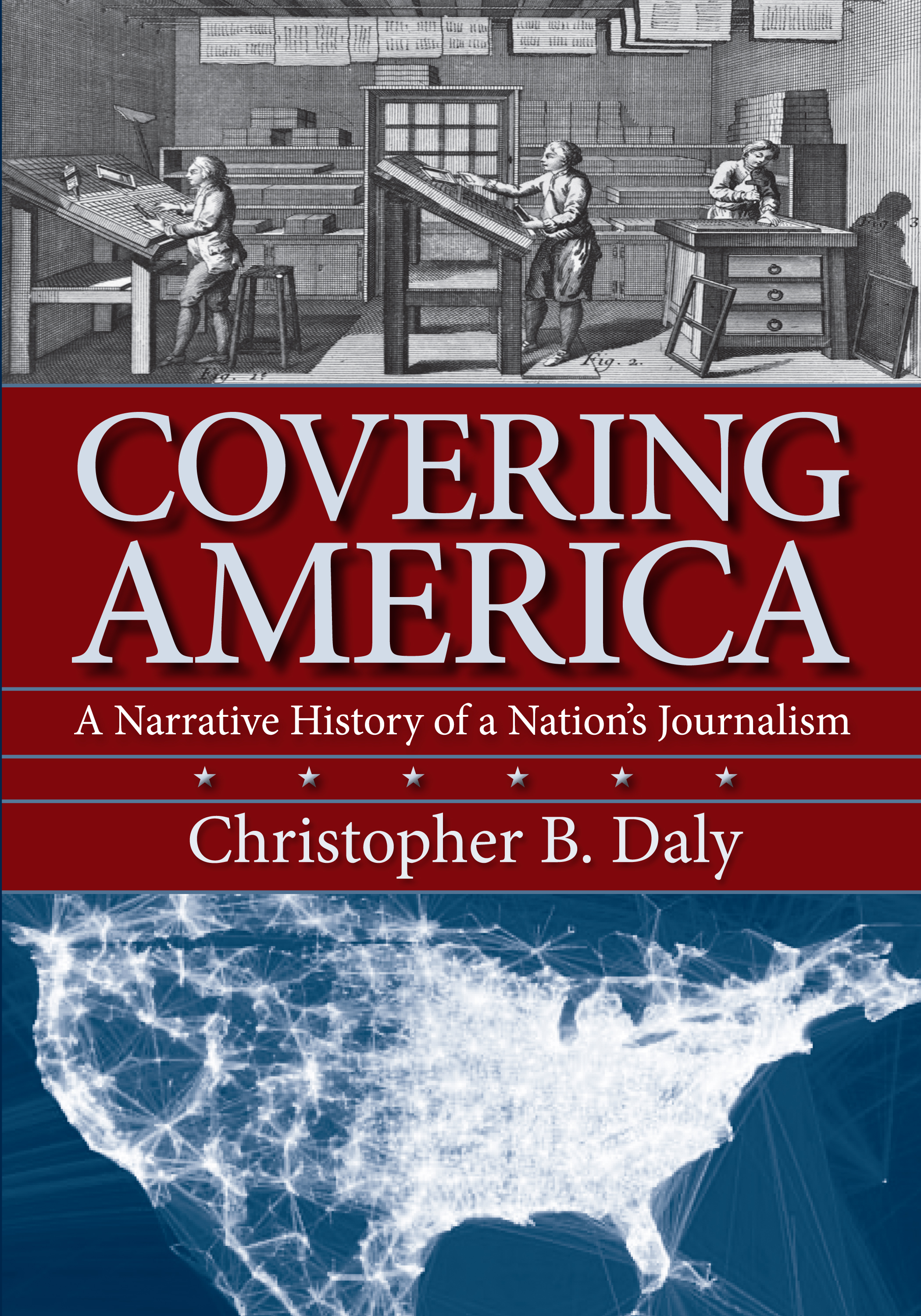
I think he’s on the right track. Consider the newspaper, for example, as I did in my book Covering America. Here’s an excerpt from Chapter 13:

Another problem besetting newspapers (and, to a great extent, magazines and television news as well) was even more existential. When seen against the backdrop of the Internet, one fact about newspapers becomes painfully obvious: a newspaper is a fixed bundle of coverage that is good but ultimately second rate. Offering readers no choice, a newspaper presents coverage of a set matrix of topics: politics, crime, business, sports, arts, and something called lifestyle. In each case, though, people who really know or care about those fields understand that they are not going to find the absolute best, most detailed, most passionate coverage of their favorite topic in a daily newspaper. They know that the best coverage will be in some niche on the Web where obsessive amateurs or professional experts gather. And with the coming of the Web, the absolute best coverage is available to everyone, everywhere, all the time, for free. In politics, for example, readers can find pretty good coverage in the Times or Newsweek. But if they really live and breathe politics, they will want it faster and at a much higher level of granularity, so they will log on to a site like Politico or Real Clear Politics instead and get what they are looking for. The same is true for business, sports, even crosswords and recipes. Thus the question arises: What is the remaining value of reading merely pretty good coverage (and paying for it) when readers can unbundle the newspaper, go online, and plunge into first-rate coverage, written by real aficionados and provided at a price of zero?

One way to understand the decline of the newspaper is to ask the ultimate question: If newspapers did not exist, would it make any sense to invent them?

I wrote that about two years ago. The only change I would make now would be to drop the reference to Newsweek. The venerable weekly print newsmagazine went broke in 2012 trying to sell a fixed bundle of pretty-good coverage and was absorbed into a born-digital enterprise, The Daily Beast. I might also amend the statement that all the high-quality niches are free, since a small but possibly growing number do charge something.

Leave a comment

Filed under broadcasting, Journalism, journalism history, New York Times, publishing, software

The Constitution is for everyone

By Christopher B. Daly 

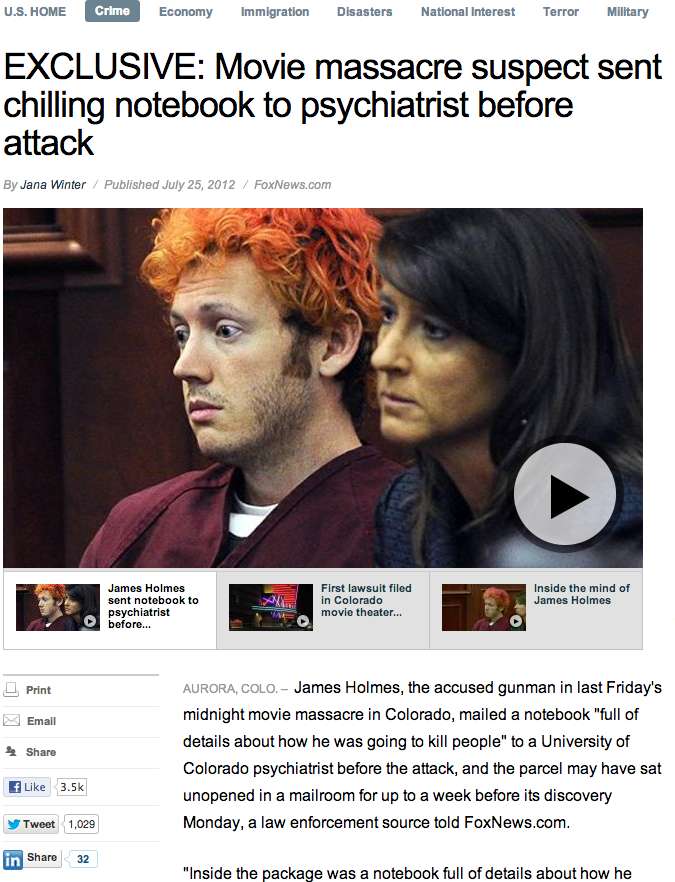
One of the most serious recent threats to press freedom is playing out in Colorado. It involves a reporter for FoxNews.com who is the target of a subpoena by a state prosecutor who is pursuing the case against the suspect in the 2012 mass shooting in Aurora, Colo.

At issue is some reporting done by Jana Winter, who is an investigative reporter at FoxNews.com. In a story labeled EXCLUSIVE, Winter quoted two sources (whom she did not name) telling her that the suspect, James Holmes, had mailed a notebook to a psychiatrist before the shooting. According to one of the sources cited in her story, the notebook was “full of details about how he was going to kill people.”

As so often happens, the prosecutors in Colorado would like to know the identity of her confidential sources. For solid professional reasons, the reporter does not want to divulge those names. (If she did, then all sources would be that much more reluctant to speak to reporters, and — here’s the punchline: the public would be less informed.)

As so often happens, the judge in the case would also like to know the identity of the sources, so he is threatening to hold Winter in contempt of court unless she rats out her sources. That means the judge could send her to prison for up to six months, or until she relents and gives up the names.

This is a classic case of prosecutorial and judicial abuse of power that threatens the public’s right to know. The Constitution’s First Amendment, which guarantees freedom of the press, exists for the benefit of the American people, not just the news business. The people have a right to know things, and it’s for that reason that government is restrained from interfering with news-gathering and news dissemination.

In cases like this, a “shield law” could protect the reporter from such pressure and threats. But a proper reading of the Constitution could serve just as well. In the rare cases where the use of confidential sources gets to the point where jail time is a real threat, most jurisdictions require that prosecutors meet a multi-prong test: the material being sought must be germane to the case, and it must be unavailable in any other way. This case hardly meets either standard. In the criminal case against Holmes, the question for the jury will be, did he kill all those people? Whether he sent a notebook to anyone in advance is irrelevant. (It might be relevant if the survivors of the shooting ever brought a civil suit against the psychiatrist, charging the psychiatrist with failure to warn — but that’s another matter entirely. And even then, the notebook is probably irrelevant, since the psychiatrist did not even open the package it was in until after the shooting.) In the criminal case, finding out Winter’s sources serves no purpose, and the subpoena should be quashed. The judge is probably irked that Winter’s sources violated his gag order in the case, but he never should have issued a gag order in the first place.

Of course, the suspect has rights under the same Constitution that protects the journalist. Holmes is entitled to a fair trial, which includes the right to face his accusers. But Winter’s sources are not his accusers and do not need to be dragged into this case. Holmes’ rights to a fair trial also include the right to be tried by an impartial jury — that is, one that is not inflamed by news reports about the case. But there again, the prosecutor and judge have no leg to stand on. Whether or not there was a notebook and whether Winter was told about it by this person or that person has no bearing on the state of mind of the jurors who will ultimately hear the case and decide Holmes’ fate. My suspicion is that the prosecutor and the judge just want to control all the parties in the case, and they are frustrated that they can’t do so.

0       0        0       0       0

Recently, some people have complained that the liberal media have been slow to rally behind Winter because she works for the media empire of the despised conservative Rupert Murdoch. (According to the Times, she used to work for Murdoch’s New York Post before signing on as an investigative reporter for FoxNews.com, the website associated with Murdoch’s Fox News on cable television.) Today’s Times carried a news story and an op-ed about the case, so it hardly seems that the liberal Times is ignoring the case.

Some folks at  Fox News seem to have a problem with the Constitution, especially when it comes to extending its protections to unpopular causes. But the beauty of the Constitution is that it exists for all of us, without exceptions. So to my colleagues at Fox News, I say welcome to the experience of being a frightened individual, hunted by the powers that be, despised and alone, hoping against hope that some clause in a document drafted in 1789 can save you from unwarranted punishment.

That’s why we have the Constitution, for everyone. 

Screen Shot 2013-04-10 at 10.06.59 AM

Leave a comment

Filed under broadcasting, Fox News, Journalism

Should Murdoch be able to buy the L.A. Times?

By Christopher B. Daly 

Conservative media mogul Rupert Murdoch is not finished trying to acquire more news outlets, despite his unsavory legal problems.

His latest target is the L.A. Times, the paper that the conservative Otis and Chandler families used to spearhead the phenomenal growth of LA (and, not incidentally, their family own’s fortunes). A story in today’s NYTimes provides an1923.04.22-Los_Angeles_Times_Front_Page update.

Here’s the situation: Like most big newspapers, the LATimes is in financial trouble, so its owner (the Tribune Co.) wants to sell it. One of the few buyers of newspapers is Rupert Murdoch.

Here’s the problem: Murdoch already owns two television station in Los Angeles, KTTV and KCOP. Like all holders of broadcast licenses in the United States, the two stations are subject to regulation by the Federal Communications Commission. Decades ago, the FCC idealistically promulgated rules that limit the ownership of tv and radio stations and that limit the “cross-ownership” of broadcast entities and newspapers in the same market. The idealistic impulse was to try to keep ownership diverse and prevent anyone from monopolizing the market for news and opinions in a given part of the country.

Here’s the wrinkle: Murdoch runs his News Corp. by basically using his many profitable broadcasting properties (starting with Fox TV) to subsidize his many money-losing newspapers (starting with the New York Post). His next step is to divide his company in two: a broadcasting division and a print division. If he pulls that off, he may be able to skirt the FCC rules.

Stay tuned.

LATimesBuilding


Leave a comment

Filed under broadcasting, Fox News, Journalism, media, Murdoch scandal, regulation, Tribune Co.

Shameless self-promotion (Journalism history division)

By Christopher B. Daly

Finally, it’s here: the electronic version of my book about the history of U.S. journalism, Covering America.

Just in time for the anniversary of the rollout of the hardback, this prize-winning book is now available in all major formats:

Nook,

Kindle,

Apple iBook, (This is the format I am checking it out on, and it looks great.)

Google Play,

you name it.

I am very pleased because I know that some folks have been waiting for the e-book. These formats make the book quite a bit cheaper and dramatically lighter! For people who don’t feel drawn to the ~$50 hardcover, here’s your chance to read Covering America. The book won the 2012 Prose Award for Media and Cultural Studies, and it has been selling well and drawing rave reviews (except for one stinker on Amazon — sheesh).

Enjoy it, and write to me about your reactions. You can comment here, or email me: chrisdaly44@gmail.com

CA cover final


Leave a comment

Filed under broadcasting, CNN, Covering America, David Halberstam, FCC, First Amendment, Fox News, history, Huffington Post, Journalism, journalism history, leaks, Murdoch scandal, New York Times, NPR, Photography, Photojournalism, Politics, publishing, Supreme Court, The New Yorker

NBC News now a tiny cog in Comcast

By Christopher B. Daly

It is worth noting that the once-mighty NBC News division is now a tiny cog in the giant money-making machine thatimgres-1 is Comcast. Exercising a legal prerogative, the giant cable provider decided to go ahead and gobble up the rest of NBC Universal that it did not already own.

As a result, the entire NBC Universal, including TV news carried by NBC, MSNBC, CNBC, et al, are now owned by the biggest cable provider in the US. So, from one point of view, the journalists at NBC News have a new set of conflicts of interest: how do they cover Comcast and its many problems, regulatory issues, lobbying efforts, etc.?

Before anyone gets too teary-eyed, it should be noted that NBC Universal is a kind of trophy being passed back and forth between multibillion conglomerates. To put it in perspective, NBC News is a tiny part of NBC Universal (which is mainly an entertainment company with a news caboose.) 

imgres-4According to today’s Times, NBC Universal was sold for $17 billion or so from GE (a $147 billion corporation) to Comcast (a $62.5 billion corporation).


Some history of all these players:

imgres-6

(via Wikipedia)

Comcast Cable was originally formed as American Cable Systems in 1963[9] and was founded by Ralph J. Roberts, Daniel Aaron and Julian A. Brodsky based on a recommendation from Pete Musser, who brought the deal to Ralph Roberts to buy his first cable system in Tupelo, Mississippi. The company was incorporated in Pennsylvania in 1969, under the new nameComcast Corporation.[10][dead link] The name “Comcast” is a portmanteau of the words “Communication” and “Broadcast”.[11]

Then, there’s GE:

(via Wikipedia)

Before 1889, Thomas Edison had business interests in many electricity-related companies. . . In 1889, Drexel, Morgan & Co., a company founded by J.P. Morgan and Anthony J. Drexel, financed Edison’s research and helped merging those companies under one corporation to form Edison General Electric Company which was incorporated in New York on April 24, 1889. The new company also acquired Sprague Electric Railway & Motor Company in the same year.[12][13]

At about the same time, Charles Coffin, leading Thomson-Houston Electric Company, acquired a number of competitors and gained access to their key patents.
General Electric was formed by the 1892 merger of Edison General Electric Company of Schenectady, New York and Thomson-Houston Electric Company of Lynn, Massachusetts with the help of Drexel, Morgan & Co.[13] Both plants continue to operate under the GE banner to this day.[14] The company was incorporated in New York, with the Schenectady plant used as headquarters for many years thereafter.

In 1919, GE formed a subsidiary called the Radio Corporation of America (RCA) to get into the new business of imgres-2manufacturing radios. A few years later, RCA executives, led by chief executive David Sarnoff, realized that they could also make money by providing programming to radio (and thereby stimulate further sales of the hardware, too), and they formed the National Broadcasting Company (NBC). In radio, NBC quickly became dominant in entertainment programming and in the brand-news enterprise of putting news on the airwaves.

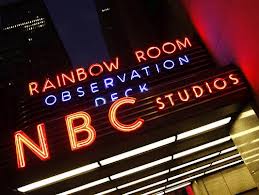
In 1930, GE sold off RCA under antitrust pressure from the government. Operating independently, RCA moved into its new headquarters in the new Rockefeller Center in midtown Manhattan, taking over the most prominent address in the complex, the skyscraper known as “30 Rock.” NBC was so dominant in radioimgres-5 that, again under antitrust pressure in 1943, it spun off a big chunk of its radio operations, which became the core of the new ABC.

Sarnoff pushed RCA and NBC into television after WWII, and NBC News evolved from primarily a radio operation into primarily a tv operation. In the following decades, NBC News grew into a large-scale news-gathering operation, associated with its prominent TV evening news anchors: Chet Huntley & David Brinkley, John Chancellor, and Tom Brokaw.

In 1986, GE bought RCA back and brought into the corporate fold once again, adding broadcasting to its global mix of businesses ranging from lightbulbs to locomotives to jet engines to finance and a lot of other things. So, once again, RCA/NBC was a small part of a big corporation. In that context, NBC News had plenty of conflicts of interest when it came to covering GE, since it was a large defense contractor and had a hand in dozens of industries.

If it is true that “freedom of the press belongs only to those who own one,” we are still a long way from having a truly free and independent NBC News division.

Leave a comment

Filed under broadcasting