Tag Archives: journalism

Gabriel Garcia Marquez: What he learned from journalism

By Christopher B. Daly 

Happy birthday to Gabriel Jose de la Concordia Garcia Marquez!images

The Nobel Prize-winning Colombian novelist turns 87 today.

Here’s a quotation that puts his career in perspective:

“I’ve always been convinced that my true profession is that of journalist.”

“I learned a lot from James Joyce and Erskine Caldwell and of course from Hemingway … [but the] tricks you need to transform something which appears fantastic, unbelievable, into something plausible, credible, those I learned from journalism. The key is to tell it straight. It is done by reporters and by country folk.”

He worked for a newspaper in Bogotá for many years, writing at least three stories a week, as well as movie reviews and several editorial notes each week. Then, when everyone had gone home for the day, he would stay in the newsroom and write his fiction.

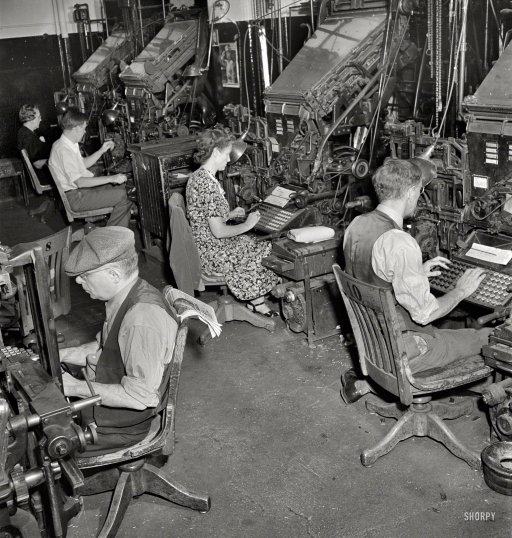
“I liked the noise of the Linotype machines, which sounded like rain. If they stopped, and I was left in silence, I wouldn’t be able to work.”

Who hears the rainy clatter of a Linotype machine any more?

 September 1942. "Linotype operators in composing room of the New York Times newspaper." These machines cast lines of type (Linotype) from molten lead prior to their assembly by compositors into the printing plates that go on the presses. Photo by Marjory Collins for the Office of War Information.

September 1942. “Linotype operators in composing room of the New York Times newspaper.” These machines cast lines of type (Linotype) from molten lead prior to their assembly by compositors into the printing plates that go on the presses. Photo by Marjory Collins for the Office of War Information.


Leave a comment

Filed under Journalism, journalism history

O’Reilly on O’Reilly

By Christopher B. Daly

Not to be missed: this recent commentary by Tim Egan in the NYTimes about Fox News figure Bill O’Reilly and O’Reilly’s recent interview with President Obama. As usual, O’Reilly believes that the key figure in the interview was . . . himself. For days afterward, O’Reilly and his colleagues at Fox milked the interview and scored it a solid win for O’Reilly over the president (as if it were a debate).

Egan makes a good point here:

So, the first point for historians sniffing the odor of O’Reilly’s time capsule in 2114 is that the interview made no news. No ground was broken. It was a journalistic dud. O’Reilly himself spoke for about 40 percent of the time, and devoted 90 percent of the interview to “the full Fox scandal grab bag,” as Jon Stewart called it.

As it happens, I am teaching my students this week about how to conduct interviews in my journalism classes at Boston University (where, yes, I know: Bill O’Reilly attended college). The point I always try to drum into my students about interviewing is simple: It’s not about you. 

Of course, I understand that Bill O’Reilly is not trying to conduct a productive, journalistic interview. He is trying to stage a clash of personalities for television. Like his boss Roger Ailes, O’Reilly is very good at understanding television, even if he seems to have missed class on the day of the lesson about humility.


1 Comment

Filed under broadcasting, Fox News, Journalism

Globe owner John Henry: A man of few words?

By Christopher B. Daly

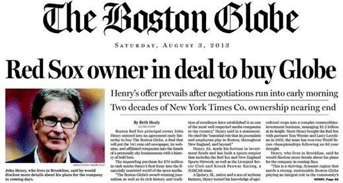
Former commodities trader and current pro-sports franchise owner John Henry has also owned the Boston Globe newspaper since last summer, when he bought it for a mere $70 million. Since then, he has said little about his plans, his political views, or his philosophy of journalism. That’s his prerogative, of course, but all the readers of the Globe around New England and beyond, may start to tire of his taciturn approach.

Boston-Globe-and-Henry


Last October, Henry published a 3,000-word op ed in his own newspaper under the headline “Why I Bought the Globe.” Among other high-minded points he made was this passage:


This much is clear: The overriding mission of The Boston Globe will be to ensure that its readers are getting news they can trust. The Globe will place its emphasis on hard-hitting, investigative accountability that readers can rely on. Not only will the Globe seek to hold people and institutions accountable for their actions, we will hold ourselves accountable for fairness, balance, and fact-checking.

Today, reliable information has never been more valuable. A newspaper needs to provide the breadth of perspective and diligent analysis that gets to the heart of what is going on in our world. The Globe will never be the prisoner of any ideology or political agenda.

Our enterprise reporting will shed new light on important issues of the day, with intellectual honesty and discipline. We will provide our readers with the assurance that if they read the Globe, they will know that time, effort, and thought were put into each and every report.

In this way, Henry sounds like many other American publishers who have issued similar declarations upon taking over newspapers: political independence, a commitment to service, a sense of public trust, etc. His statement was similar in spirit and tone to that of Adolph Ochs when he took over the New York Times in 1896. Here’s the heart of Ochs’ declaration:

It will be my earnest aim that The New-York Times give the news, all the news, in concise and attractive form, in language that is parliamentary in good society, and give it as early, if not earlier, than it can be learned through any other reliable medium; to give the news impartially, without fear or favor, regardless of party, sect, or interests involved; to make of the columns of The New-York Times a forum for the consideration of all questions of public importance, and to that end to invite intelligent discussion from all shades of opinion.

Since his op-ed last fall, Henry has said little, other than a speech to the Greater Boston Chamber of Commerce last month. He has removed the Globe’s publisher, Chris Mayer, and given himself that job. Now comes a bit more insight, in an article from Boston magazine, written by senior editor Jason Schwartz. In the piece, Schwartz reveals that Henry would not grant him an interview, but “instead agreed to exchange emails” — without saying how many. The piece includes interviews from other key players (including Globe editor Brian McGrory) but adds little to our understanding of Henry and his intentions.

One reveal: Henry confirmed that he plans to sell most of the Globe’s property in Dorchester and move the newsroom into a prominent place closer to downtown — a good idea that I have thought the Globe should have done years ago. The sale of all that land should reap at least $70 million, which would mean that Henry got the newspaper as such for free.

Still, questions persist. Here are some I have:

–How can the Globe return to profitability?

–How long will the Globe continue in print?

–When you start to make money from the Globe, what will you do with it?

–Is it important to even try maintaining a separation between the paper’s editorial page and its news pages?

–If you have money to invest in the Globe, what are your top priorities for expanded coverage?

–Is there a comparable news operation anywhere in the world that you admire?

–If you had to choose between watching the Red Sox in the World Series or the Liverpool Football Club in a championship game, which would it be?

BONUS: My estimable colleague Dan Kennedy has written about this same topic today, including a warning about the possible return of Mike Barnicle. Well worth a read.


4 Comments

Filed under Boston, Journalism, journalism history, media, publishing

Boston Globe owner begins making his moves

By Christopher B. Daly 

It’s no great surprise that John Henry, the wealthy former investor who bought the Boston Globe late last October for less than $70 million, has named a new publisher: himself. This is a step that has many precedents in the history of American journalism. And it makes sense: why spend the money to buy a whole newspaper if you don’t plan to run it?

The more interesting development announced by the Globe is that the paper will have a new CEO: veteran ad man Mike Sheehan. A longtime executive with the Boston advertising powerhouse Hill Holliday, Sheehan now takes on the responsibility for making enough money to rebuild the Globe’s reporting strength to the point where it can fulfill its goal of being a robust regional news organization.

Personally, I wish them all the luck. Get cracking, do good work, and start hiring more journalists.

Here's the Globe's caption on this double portrait: John Henry (left) and Mike Sheehan hope to boost ad revenue at the Globe.

Here’s the Globe’s caption on this double portrait: John Henry (left) and Mike Sheehan hope to boost ad revenue at the Globe.


Leave a comment

Filed under Boston, Journalism, journalism history, media

Egypt rounds up journalists

By Christopher B. Daly

[see update below]

Like almost every regime that wants to cling to power, the government in Egypt has decided to attack the news media. Prosecutors announced that they were charging 20 journalists who work for Al Jazeera with consipring with terrorists. Their crime: contacting enemies of the regime as sources and reporting their views. They are also being charged with broadcasting false images of “a civil war that raises alarms about the state’s collpase.” Translation: they called it the way they saw it.

According to the Times:

The charges are the latest turn in a widening clampdown on public dissent by the military-backed government . . .

This is obviously a shameful attempt to intimidate the entire news media, and it should be denounced in the strongest terms by the United States. Here’s what we got, in the daily briefing from the U.S. State Department:

The State Department spokeswoman, Jen Psaki, said Egypt should reconsider the prosecution. “The government’s targeting of journalists and others on spurious claims is wrong and demonstrates an egregious disregard for the protection of basic rights and freedoms,” she said.

Better than nothing.

UPDATE:

Apparently, the regime in Egypt is having second thoughts — not about rounding up their own journalists, but about the unintended consequences of the crackdown on the rest of the world’s press. Their real goal seems to be to insulate their own people from exposure to the ideas of the Muslim Brotherhood. Hence the roundup of Al Jazeera journalists who have Brotherhood sources.

But they seem unprepared for the fallout — which is a natural reluctance of any self-respecting journalist to stick around in Egypt with the threat of arbitrary arrest hanging over them. Any reporter covering Egypt needs to have and use Brotherhood sources. But if that means you can be accused of conspiring with terrorists, it might be time to leave Egypt for a while.

In a statement on Thursday, the State Information Service said Egypt welcomed foreign correspondents to cover even “constructive criticism” of the government, in accordance with its commitments to democracy, freedom of expression and transparent elections.

Alluding to journalists’ fears about being charged for interviewing members of the Brotherhood, the statement said that “mere contact” with any “accused criminal” is not a crime under Egyptian law.

The statement, however, contained caveats. It said that Egyptian law does not protect freedom of “thought and opinion” if it develops into action that violates Egyptian laws, like “crimes that threaten the country’s national security.”

The statement also said that contact with an “accused criminal” may be a punishable offense “if this contact is a sort of assisting or inciting.”

Hmmm… I’d say it might be time to go visit some other hotspot for a while.


1 Comment

Filed under Journalism

NYTimes: Truth in labeling?

By Christopher B. Daly

When I was reading the NYTimes front page this morning, I started reading the paper’s Pg. 1 story about Pete Seeger. As I read, I had a growing sense that something was bugging me. The piece carried the byline of Jon Pareles, the paper’s longtime music critic, which I thought was appropriate. But the piece kept bugging me, until I realized what the problem was: I was not reading the paper’s obituary (also written by Pareles). Instead, I was reading something more like a critical appraisal of Pete’s musical career. Here’s part of it:

That put him at the center of the folk revival of the 1950s and 1960s, in all its idealism, earnestness and contradictions. Collectors found songs that had archetypal resonance, sung in unpretty voices and played with regional quirks, and transcribed them to be learned from sheet music. The folk revival prized authenticity — the work song recorded in prison, the fiddle tune recorded on a back porch — and then diluted it as the making of amateur collegiate strum-alongs.

That’s fine, of course, (although a bit tart for a story about his death) but it should have been labeled as such. There should have been some kind of banner or emblem that says AN APPRECIATION or CRITICISM or something like that which would signal that this is not a factual news story. (Online, the Pg. 1 piece carries the slug MUSIC: AN APPRAISAL, which is just what it needed.)

Inside the paper was Pete’s obit, which had a classical opening:

Pete Seeger, the singer, folk-song collector and songwriter who spearheaded an American folk revival and spent a long career championing folk music as both a vital heritage and a catalyst for social change, died on Monday in Manhattan. He was 94.

His death, at NewYork-Presbyterian Hospital, was confirmed by his grandson Kitama Cahill Jackson.

Mr. Seeger’s career carried him from singing at labor rallies to the Top 10, from college auditoriums to folk festivals, and from a conviction for contempt of Congress (after defying the House Un-American Activities Committee in the 1950s) to performing on the steps of the Lincoln Memorial at an inaugural concert for Barack Obama.

Recently, I had a similar experience with the Times’ coverage. After Obama gave his “big speech” about the NSA scandal back on Jan 17, the Times ran a page 1 story the next day. Actually, the paper ran two stories: one a straightforward factual account of the president’s speech by Mark Landler and Charlie Savage headlined “Obama Outlines Calibrated Curbs on Phone Spying.” Then, there was another story, also on Pg. 1, written by David Sander and Claire Cain Miller headlined “In Keeping Grip on Data Pipeline, Obama Does Little to Reassure Industry.” My problem was that the second story was clearly more analytical, and the authors drew several important conclusions on their own authority — not by quoting experts but by being experts.

Again, that’s fine. But it should be labeled ANALYSIS.

And here’s the kicker. I was staying in a hotel that weekend, and on Sunday I could only get hold of the International New York Times. There were the Saturday stories, recycled a day late, and when I looked at the Sanger and Miller piece, it carried a label that said ANALYSIS.


3 Comments

Filed under Journalism, New York Times

MEDIA: David Carr has seen the future

By Christopher B. Daly 

And the future for journalism is . . .

  DIGITAL. . .

                                           PROFITABLE . . .

                                                                 AND HERE NOW!

Focusing on the recent decision by Ezra Klein to decamp from the old-school Washington Post

Ezra Klein, pointing to his major asset.  AP photo

Ezra Klein, pointing to his major asset.
AP photo

when the legacy medium could not accommodate his demands, Carr sees an array of “digital natives” who are managing to do good (or at least decent) journalism and make money at the same time.


If true, three cheers for those on-line winners!


Here’s Carr’s take:

In making the switch, Mr. Klein is part of a movement of big-name journalists who are migrating from newspaper companies to digital start-ups. Walter Mossberg and Kara Swisher left Dow Jones to form Re/code with NBC. David Pogue left The New York Times for Yahoo and Nate Silver for ESPN. At the same time, independent news sites like Business Insider, BuzzFeed and Vox have all received abundant new funding, while traffic on viral sites like Upworthy and ViralNova has exploded.

All the frothy news has led to speculation that a bubble is forming in the content business, but something more real is underway. I was part of the first bubble as a journalist at Inside.com in 2001 — an idea a decade ahead of its time — and this feels very different.

The web was more like a set of tin cans and a thin wire back then, so news media upstarts had trouble being heard. With high broadband penetration, the web has become a fully realized consumer medium where pages load in a flash and video plays without stuttering. With those pipes now built, we are in a time very similar to the early 1980s, when big cities were finally wired for cable. What followed was an explosion of new channels, many of which have become big businesses today.

Still, some things don’t change all that much. As Carr points out, it still takes some serious money (about $25 million, he says) to launch a big site, and it takes time (5+ years, he estimates) to work out the kinks, find your audience, build a staff, and earn a reputation for being worth a visit.

[FULL DISCLOSURE: David Carr is no longer just the most influential columnist writing about media and the web, but he is also a new colleague of mine on the Journalism faculty at Boston University, where is the new, inaugural Andrew Lack Professor in the economics of journalism.]


Leave a comment

Filed under blogging, Journalism, journalism history, media, publishing

Fox News: is bad news worse than no news at all?

Here is a graphic from a NYTimes op-ed  distilling a 2012 study conducted by researchers in the PublicMind project at Fairleigh Dickinson University. 

No comment.

25blow-ch-master180

1 Comment

Filed under broadcasting, Fox News, Glenn Beck, Journalism

Narrative: how long is too long?

By Christopher B. Daly 

That’s a question raised by a controversial recent piece on the Grantland site and by a critique posted today on the Times op-ed page. As Jonathan Mahler puts it:

There’s a lot of excellent magazine-length journalism being done now, and Grantland publishes plenty of it. The problem is that long-form stories are too often celebrated simply because they exist. And are long. “Long-form, on the web, is in danger of meaning ‘a lot of words,’ ” as James Bennet wrote recently in The Atlantic, the magazine he edits.

Turns out, there are some unknown number of readers who like long articles and books and will hang in there through thousands upon thousands of words (provided, I assume, that the words are actually interesting).

Don’t take my word for it. Look at sites like longform and longreads. Get comfortable.

Leave a comment

Filed under blogging, Journalism, publishing

Roger Ailes revisited

By Christopher B. Daly 

With the release of Gabriel Sherman’s new book about Fox News boss Roger Ailes, there is a lot of commentary about Ailes.

Here’s David Carr. Here’s TNR.

Amid all the commentary and analysis, it’s important to keep some sense of perspective. Fox News reaches a maximum of about 3 million different Americans in a typical day. That’s less than 1% of the population. And the ratings for Fox News are no longer climbing; they appear to have topped out. Not only that, but the Fox News audience is considerably older than the ideal “demographic” for television viewing. (Not to mention that the Fox News audience is whiter than average and much more conservative.)

In other words, it’s unlikely that Roger Ailes is the king-maker in national politics that he would like to be (and to be seen as). More and more, it appears that his television channel preaches to the (aging) choir.

images

Leave a comment

Filed under broadcasting, CNN, Fox News, Journalism, journalism history, Politics