Tag Archives: journalism

Defaming the king

By Christopher B. Daly 

This episode of press intimidation in Thailand — where a journalist was sentenced to 10+ years in prison for insulting the king — may seem like a throwback to journalists in many countries. His crime: Lèse majesté, which to say: an injury to the majesty of the ruler.

imgres


But don’t get too smug too fast. There are similar laws against dissing the king in the following places:

1 Current lese-majesty laws in Europe
1.1 Denmark
1.2 Netherlands
1.3 Norway
1.4 Spain
2 Current lese-majesty laws in the Middle East
2.1 Kuwait
2.2 Jordan
3 Current lese-majesty laws elsewhere
3.1 Morocco
3.2 Thailand

Yikes!

Lese-majesty is an old legal doctrine, which once ruled the British publishing world, including the original publishing efforts that developed into the American press.

Newton_Bull_farts_G3


Leave a comment

Filed under Journalism

One of the greats

Sad news: the death of Eugene Patterson, a member of the “greatest generation” who really was a great journalist. Reading his obituary in the Times and the version in the Post today, I wondered how many tank commanders go into journalism any more. (After facing the Germans at Bastogne, why would he fear the KKK?)

This undated photo made during World War II, shows Eugene Patterson, commander of a tank platoon as Gen. George Patton’s 3rd Army drove through the German ranks. Newspaper editor and columnist Eugene Patterson, who helped fellow Southern whites understand the civil rights movement, has died, Saturday, Jan. 12, 2013. He was 89. Photo: AP.

This undated photo made during World War II, shows Eugene Patterson, commander of a tank platoon as Gen. George Patton’s 3rd Army drove through the German ranks. Newspaper editor and columnist Eugene Patterson, who helped fellow Southern whites understand the civil rights movement, has died, Saturday, Jan. 12, 2013. He was 89. Photo: AP.


Leave a comment

Filed under Journalism, journalism history

The power of story

by Christopher B. Daly

Narratives in the news:

–Here is a smart piece about why some of us are drawn to TV narratives like Downton and other shows with strong narratives.

–Here is a smart piece about the power of narrators (although I think there is a bit of confusion here between narrators and protagonists, which are not the same).

1 Comment

Filed under history, Journalism

Uh-oh. Layoffs loom at NYT

Here’s the New York magazine version, complete with the memo from Jill Abramson.

No matter how you slice it, this is not good news.

NYT executive editor Jill Abramson

NYT executive editor Jill Abramson


4 Comments

Filed under New York Times

Press freedom

It’s hard to see how this is over.

And this one is definitely not over. (Here’s the Guardian’s version, which is a bit clearer.)

And this one won’t be over until you-know-when.


Leave a comment

Filed under Journalism, Murdoch scandal

In China’s censorship struggle, who’s a liberal?

By Christopher B. Daly 

The struggle over censorship continues in China. While it plays out, American journalists are struggling over political nomenclature.

This has been a problem since early in the 20th Century, when first the Russians and later the Chinese and others had communist revolutions. After that point, those former insurgent leftists became the establishment (with a vengeance, to be sure). They often faced right-wing opposition, which wanted to reverse those revolutions and restore the old (dictatorial) regimes.

But at a certain point, those old communist regimes faced a new insurgency — call it “progressive” perhaps? — that was not counter-revolutionary but was not happy either.

In Russia, in eastern Europe and elsewhere and now in China, people began to challenge the regime on the grounds that they wanted real liberation. They demanded such things as:

–rule of law

–accountability of government officials

–free and fair elections

–transparency

–free speech & press

–economic opportunity

Many of these demands overlap with the cluster of values often associated with classical “liberalism” in the West. But the term “liberal” was re-purposed in the 20th Century to refer to people like FDR who support the use of government power to intervene in the industrial economy in the interest of full employment and economic security for all.

So, by either definition, it makes little sense to refer to those brave Chinese demanding press freedom as “liberals.” They are not exactly “leftists” either, at least not by most definitions. (Granted, they are, in some ways, to the left of the putatively leftist regime they are challenging, but in terms of political labels, it’s pretty hard to put these people to the left of Mao.)

They are certainly not Communists or communists, either.

It often makes sense to call them “critics,” but then China has right-wing critics too. Journalists often fall back on the all-purpose “dissident,” which has its uses and may not be the worst label, in a pinch.

But this is not a simple question, and it appears to need an answer, judging from the comments accompanying today’s Times story. But it will have to wait. Far more urgent, of course, is the issue of ending censorship.


2 Comments

Filed under Uncategorized

Legacy media showing signs of life

By Christopher B. Daly

David Carr has a worthwhile column today in the New York Times, making the point that many of the brand-name “legacy media” that were so recently written off are quietly staging a comeback. According to Carr, the dinosaurs are learning to dance. (In the final chapter of my book, COVERING AMERICA, I used a slightly different metaphor: I said the dinosaurs had to learn to ice skate!)

Here’s an excerpt:

In the last year, the Standard & Poor’s 500-stock index was up 13.4 percent, which was a significant advance, but legacy media giants like Comcast, News Corporation and Time Warner absolutely surpassed it in terms of share price.

Viacom, which has had serious ratings trouble with MTV and Nickelodeon, still managed to be up 16.1 percent on the year. We keep hearing how traditional networks are getting clobbered, but Viacom’s sibling, CBS, was up a whopping 40.2 percent.

News Corporation, despite being racked by scandal, was up 43 percent, and fellow global media conglomerates like Disney and Time Warner were up more than 32 percent. And Comcast, which has both the pipes and programming — cable and NBCUniversal — soared 57.6 percent.

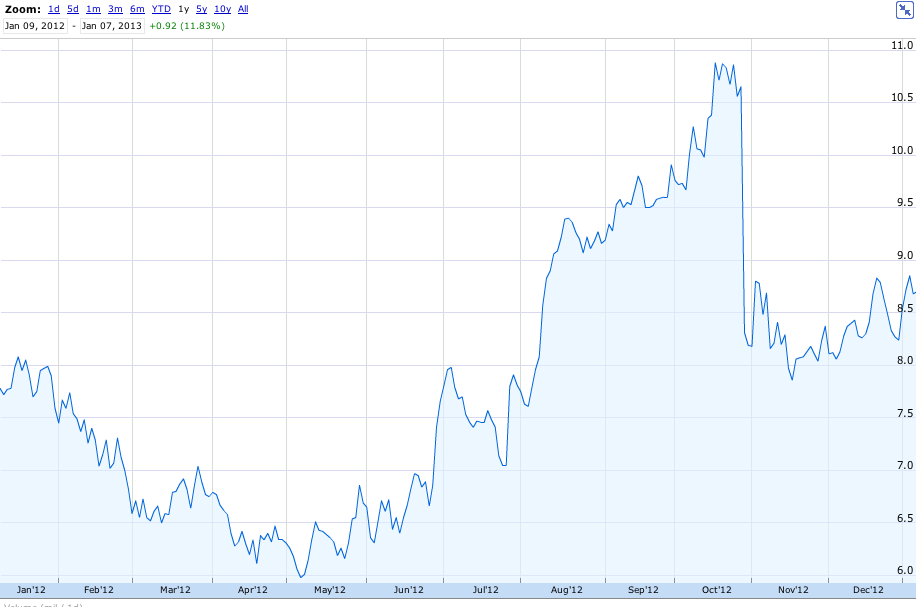
One piece of data that Carr did not cite is the recent history of the market fortunes of his own employer, the New York Times Co. So, here it is:

Screen Shot 2013-01-07 at 12.18.06 PM


Turns out, the value of Times Co. stock has been on a roller-coaster track over the past 12 months. The company had a terrific six months, from May to October, during which the value of a share of NYTCo stock almost doubled. Somewhere around Halloween, the stock cratered, and it has been basically crawling sideways since then. So, the Times Co. experience does not fit Carr’s trend story. I would say that would be a good subject for him to take up next: why doesn’t the Times‘ journalistic excellence translate into financial success?

It’s an important question to answer, because without making money, the Times will not long be able to dance or ice skate. Like other dinosaurs, it will die out.


1 Comment

Filed under Journalism, New York Times

When journalists are captured

By Christopher B. Daly

I am delighted that Richard Engel is safe after being captured and held in Syria. The NBC correspondent has been risking his neck for years in some of the most godforsaken places on earth, just so the rest of can debate what (if anything) we should “do” about those countries.

Here is his appearance (by video) on his network’s ailing “Today” show. (Btw, I still miss Ann Curry.)

Here is the story from today’s Times, which raises the issue of what (if anything) should be reported about missing journalists while they are in captivity. Here’s the takeaway:

NBC’s television competitors and many other major news organizations, including The New York Times, refrained from reporting on the situation, in part out of concern about endangering the crew even more.

In 2008, news outlets similarly refrained from publishing reports about the kidnapping in Afghanistan of David Rohde of The New York Times and a local reporter, Tahir Ludin. The two escaped in June 2009 after seven months in captivity.

In the case of Mr. Engel, Gawker and a number of other Web sites reported speculation about his disappearance on Monday. After he and his crew members returned safely to Turkey, Peter N. Bouckaert, the emergencies director of Human Rights Watch who has been involved in efforts to free captives, criticized the decisions made by those sites. News blackouts, he said, go “against the journalistic instinct to report the news, but in many of these cases it does save lives.”


Leave a comment

Filed under journalism history

Reporting on gun violence and gun control (cont.)

By Christopher B. Daly

This is a huge, sprawling topic that is also something of a moving target. So, here are some more sources for journalists to consult. If you are involved in covering these issues and you come across other helpful sites, please leave a comment below, or email me and I will update.

More from the Journalist’s Resource project at Harvard:

*On gun policies: http://journalistsresource.org/studies/government/criminal-justice/effectiveness-policies-programs-reduce-firearm-violence-meta-analysis

*Global look at gun-homicide connection: http://journalistsresource.org/studies/government/criminal-justice/reassessing-association-gun-availability-homicide-rates-cross-national-level

*On violent video games: http://journalistsresource.org/studies/society/internet/value-violent-video-games-research-roundup

0        0          0           0            0              0               0             0

What do historians make of the whole issue? That is a big, complicated tale. The subject has been almost as controversial among historians as it has been among politicians.

Here’s an intro to a recent controversy in the scholarship over gun ownership.

And here’s the major critic, Clayton Cramer. (But beware of link rot!)

Here is the report by Emory University on its own professor’s work.


Leave a comment

Filed under Journalism

Reporting on gun violence and gun control (cont.)


By Christopher B. Daly 


In the wake of the massacre at the elementary school in Newtown, Conn., here are some more resources for reporters, editors, and users of news sites.


–The Journalist’s Resource at Harvard’s Shorenstein Center has added a new post with many new links.


–Before anyone needlessly piles onto people with Asperger’s Syndrome, here is the website of the Asperger’s Assn of New England, which has lots of resources for learning about the condition. The AANE has also issued a statement specifically addressing the Newtown case.


–Here are some links to research done by researchers at the Berkman Center on meanness and cruelty (in case those issues are relevant here, and they may not be; I am trying to cast a wide net).


–Here is the homepage of the NRA. (Yes, it looks like the opening of the Colbert Report, but that’s Colbert’s point, isn’t it?)


–Here is the homepage for a leading gun-control organization, the Brady Campaign.


Leave a comment

Filed under Journalism