The Constitution is for everyone

By Christopher B. Daly 

One of the most serious recent threats to press freedom is playing out in Colorado. It involves a reporter for FoxNews.com who is the target of a subpoena by a state prosecutor who is pursuing the case against the suspect in the 2012 mass shooting in Aurora, Colo.

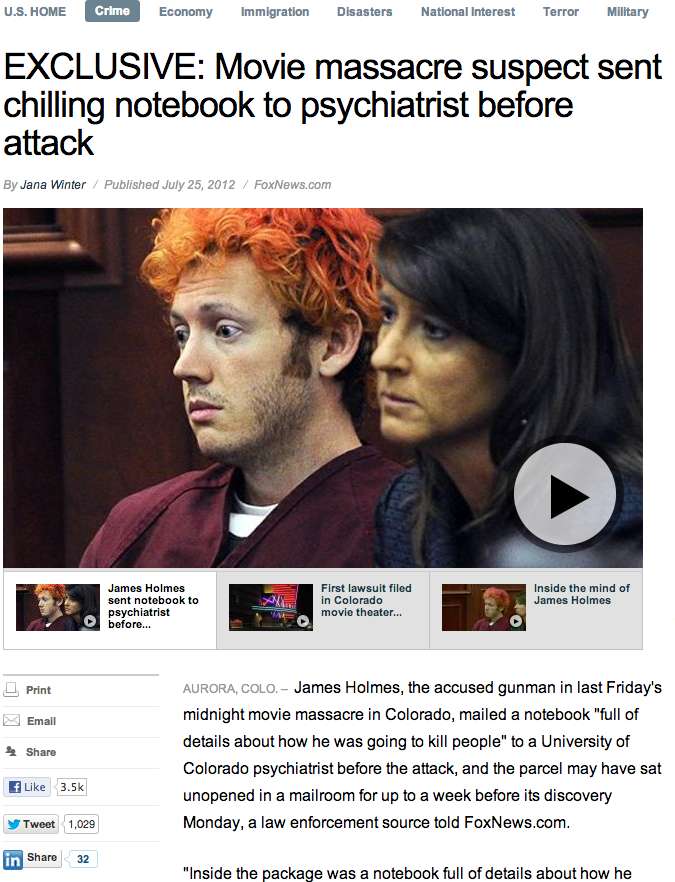
At issue is some reporting done by Jana Winter, who is an investigative reporter at FoxNews.com. In a story labeled EXCLUSIVE, Winter quoted two sources (whom she did not name) telling her that the suspect, James Holmes, had mailed a notebook to a psychiatrist before the shooting. According to one of the sources cited in her story, the notebook was “full of details about how he was going to kill people.”

As so often happens, the prosecutors in Colorado would like to know the identity of her confidential sources. For solid professional reasons, the reporter does not want to divulge those names. (If she did, then all sources would be that much more reluctant to speak to reporters, and — here’s the punchline: the public would be less informed.)

As so often happens, the judge in the case would also like to know the identity of the sources, so he is threatening to hold Winter in contempt of court unless she rats out her sources. That means the judge could send her to prison for up to six months, or until she relents and gives up the names.

This is a classic case of prosecutorial and judicial abuse of power that threatens the public’s right to know. The Constitution’s First Amendment, which guarantees freedom of the press, exists for the benefit of the American people, not just the news business. The people have a right to know things, and it’s for that reason that government is restrained from interfering with news-gathering and news dissemination.

In cases like this, a “shield law” could protect the reporter from such pressure and threats. But a proper reading of the Constitution could serve just as well. In the rare cases where the use of confidential sources gets to the point where jail time is a real threat, most jurisdictions require that prosecutors meet a multi-prong test: the material being sought must be germane to the case, and it must be unavailable in any other way. This case hardly meets either standard. In the criminal case against Holmes, the question for the jury will be, did he kill all those people? Whether he sent a notebook to anyone in advance is irrelevant. (It might be relevant if the survivors of the shooting ever brought a civil suit against the psychiatrist, charging the psychiatrist with failure to warn — but that’s another matter entirely. And even then, the notebook is probably irrelevant, since the psychiatrist did not even open the package it was in until after the shooting.) In the criminal case, finding out Winter’s sources serves no purpose, and the subpoena should be quashed. The judge is probably irked that Winter’s sources violated his gag order in the case, but he never should have issued a gag order in the first place.

Of course, the suspect has rights under the same Constitution that protects the journalist. Holmes is entitled to a fair trial, which includes the right to face his accusers. But Winter’s sources are not his accusers and do not need to be dragged into this case. Holmes’ rights to a fair trial also include the right to be tried by an impartial jury — that is, one that is not inflamed by news reports about the case. But there again, the prosecutor and judge have no leg to stand on. Whether or not there was a notebook and whether Winter was told about it by this person or that person has no bearing on the state of mind of the jurors who will ultimately hear the case and decide Holmes’ fate. My suspicion is that the prosecutor and the judge just want to control all the parties in the case, and they are frustrated that they can’t do so.

0       0        0       0       0

Recently, some people have complained that the liberal media have been slow to rally behind Winter because she works for the media empire of the despised conservative Rupert Murdoch. (According to the Times, she used to work for Murdoch’s New York Post before signing on as an investigative reporter for FoxNews.com, the website associated with Murdoch’s Fox News on cable television.) Today’s Times carried a news story and an op-ed about the case, so it hardly seems that the liberal Times is ignoring the case.

Some folks at  Fox News seem to have a problem with the Constitution, especially when it comes to extending its protections to unpopular causes. But the beauty of the Constitution is that it exists for all of us, without exceptions. So to my colleagues at Fox News, I say welcome to the experience of being a frightened individual, hunted by the powers that be, despised and alone, hoping against hope that some clause in a document drafted in 1789 can save you from unwarranted punishment.

That’s why we have the Constitution, for everyone. 
Screen Shot 2013-04-10 at 10.06.59 AM

Leave a comment

Filed under broadcasting, Fox News, Journalism

Transparency in food production?

By Christopher B. Daly 

Let’s stipulate that killing large animals is probably difficult and bloody.

Let’s stipulate that most of us are not exactly volunteering to slaughter the animals we eat.

Let’s also stipulate that there are probably no trade secrets in any U.S. slaughterhouse that require secrecy.

So, the only reasons for secrecy are to protect consumers from the truth about meat, or to protect shameful practices from public exposure. Either way, there is a case to be made for ending the secrecy that shrouds the practices of agribusiness and large-scale meat production.

That’s what law professor Jedediah Purdy tries to do in an op-ed in today’s Times.

0409OPEDrosen-articleInline

I don’t know if his piece will make any difference, but it’s a welcome pushback to the movement in many states to shield meat processors from the prying cameras of animal-rights activists and journalists. The campaign to pass so-called “ag-gag” laws is a direct assault on the protections granted to news-gathering activities under the First Amendment. Such unconstitutional laws, outlined in the Times three days ago, are exactly the kind of thing that would have prevented one of the classics of the muck-raking movement, Upton Sinclair’s expose of the meat-packing industry in turn-of-the-century Chicago — published as a thinly fictionalized novel, The Jungle

Which raises a question: would we be better off as a society if meat-packers had been able to shield their practices of a century ago and persist in disgusting, inhumane, and literally sickening methods of thejunglepreparing our food?

I say, let the sun shine in. We all should take a look.


images-1


2 Comments

Filed under Uncategorized

Be you.com (but don’t expect you book publisher to help much)

By Christopher B. Daly 

The Monday Times round-up:

There are two interesting pieces about the media businesses, but they appear in different sections and were probably not planned as a package. Nevertheless, these two articles are more informative if read together.

First, I recommend David Carr’s celebration of the business acumen of the recently departed film critic Roger Ebert. Carr points out that Ebert consistently experimented with new outlets for his work and did not shy away from new technologies. In the process, he became a brand name and added to our vocabulary. (Whether he really elevated film criticism is another question)

Extra credit: Carr discovered (remembered?) that Ebert played a key role in the success of another media entrepreneur — Oprah Winfrey. As I explain in my recent book Covering America (p 424 in the print edition), it was Ebert who opened Oprah’s eyes to the power of owning a stake in your own brand. Taking his advice, Oprah went from being a media employee to being a media mogul.

Ebert and Winfrey even dated for a while in Chicago.

Ebert and Winfrey even dated for a while in Chicago.

All that said, Carr’s column should be read in conjunction with an op-ed by the famous (and wealthy) lawyer, legal novelist, and president of the Authors Guild, Scott Turow. In his op-ed, Turow documents the many ways in which publishers and book-sellers worldwide are turning their ingenuity to finding ways to NOT PAY WRITERS. This is a very bad thing, under any circumstances and in any medium. It also undermines the effort of every writer, like Roger Ebert, who wants to escape the hamster wheel of working for someone else and to live independently on the earnings from their own writing (or painting, or photography, or film-making or any creative venture).

Quoting Turow:

And there are many e-books on which authors and publishers, big and small, earn nothing at all. Numerous pirate sites, supported by advertising or subscription fees, have grown up offshore, offering new and old e-books free.

The pirates would be a limited menace were it not for search engines that point users to these rogue sites with no fear of legal consequence, thanks to a provision inserted into the 1998 copyright laws. A search for “Scott Turow free e-books” brought up 10 pirate sites out of the first 10 results on Yahoo, 8 of 8 on Bing and 6 of 10 on Google, with paid ads decorating the margins of all three pages.

If I stood on a corner telling people who asked where they could buy stolen goods and collected a small fee for it, I’d be on my way to jail. And yet even while search engines sail under mottos like “Don’t be evil,” they do the same thing.

Yikes. Someone should get him a lawyer!


Leave a comment

Filed under Journalism, publishing

How do you say “paywall” in German?

By Christopher B. Daly 

The answer is: “paywall” (probably pronounced payvall). That’s according to Google Translate.

The fuller answer is in this piece in the Times, documenting a trend-let in setting up paywalls in Europe.

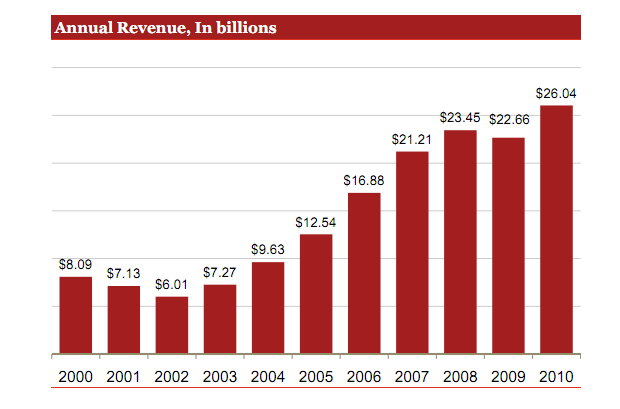
Whatever they are called, paywalls are emerging as the salvation (if there is one) for journalism, because the growth in online advertising is painfully slow.

source: TechCrunch

source: TechCrunch


Leave a comment

Filed under business, Journalism

To Steve Coll: Best wishes at Columbia

By Christopher B. Daly 

I admire Steve Coll.

I rely on David Carr.

I find Michael Wolff consistently annoying. (Also, he is often wrong, as he was in his recent column: The Washington Post is a diminished institution of journalism, but The New Yorker is certainly not.)

So, it seemed like a slim premise for Carr to use a recent snide, totally negative column by Wolff for Carr’s new column about Steve Coll. Wolff is not worth rebutting. But Coll is worth noting.

Steve Coll is the newly named dean of the Columbia Graduate School of Journalism (to use the full name — which signifies several things: it is the only Ivy school to have a real journalism school, and it does not offer a journalism major to undergrads. See pgs 151-156 of my book Covering America for the back story on the founding of the Columbia J-School, through the bequest of newspaper publisher Joseph Pulitzer.)

As the new dean, Coll will occupy the most visible and influential seat in American journalism education, so he will probably be in the spotlight a bit more than he is accustomed to. He may also find it harder to keep writing than he thinks. Many a writer has accepted an administrative position in higher ed with the best of intentions to remain productive, only to disappear into an endless round of meetings. The only writing most deans do extends to letters of recommendation and internal reports for the Provost’s office. Even so, Coll, as a two-time winner of the Pulitzer Prize and author of multiple important books, will do well if he can continue to write while serving as dean.

He succeeds Nick Lemann in that position. (Full disclosure: Nick has been a friend of mine since we were on the Harvard Crimson in the early to mid 1970s.) As Columbia’s dean, Nick did a great job — at least from the perspective of someone teaching at a would-be rival school. During Nick’s 10 years, Columbia remained at the top of the heap and kept improving, so that it kept getting harder and harder to keep up with Columbia — which offers pretty much everything and does so in New York City.

Good luck, Steve Coll.

Good luck, Steve Coll.

Leave a comment

Filed under Journalism, journalism history

More on WWII photo censorship

Here is a new  Times “Lens” blog, with more on LIFE magazine photographer George Strock.

Photo by George Strock/ LIFE magazine.

Photo by George Strock/ LIFE magazine.


1 Comment

Filed under Uncategorized

Should Murdoch be able to buy the L.A. Times?

By Christopher B. Daly 

Conservative media mogul Rupert Murdoch is not finished trying to acquire more news outlets, despite his unsavory legal problems.

His latest target is the L.A. Times, the paper that the conservative Otis and Chandler families used to spearhead the phenomenal growth of LA (and, not incidentally, their family own’s fortunes). A story in today’s NYTimes provides an1923.04.22-Los_Angeles_Times_Front_Page update.

Here’s the situation: Like most big newspapers, the LATimes is in financial trouble, so its owner (the Tribune Co.) wants to sell it. One of the few buyers of newspapers is Rupert Murdoch.

Here’s the problem: Murdoch already owns two television station in Los Angeles, KTTV and KCOP. Like all holders of broadcast licenses in the United States, the two stations are subject to regulation by the Federal Communications Commission. Decades ago, the FCC idealistically promulgated rules that limit the ownership of tv and radio stations and that limit the “cross-ownership” of broadcast entities and newspapers in the same market. The idealistic impulse was to try to keep ownership diverse and prevent anyone from monopolizing the market for news and opinions in a given part of the country.

Here’s the wrinkle: Murdoch runs his News Corp. by basically using his many profitable broadcasting properties (starting with Fox TV) to subsidize his many money-losing newspapers (starting with the New York Post). His next step is to divide his company in two: a broadcasting division and a print division. If he pulls that off, he may be able to skirt the FCC rules.

Stay tuned.

LATimesBuilding


Leave a comment

Filed under broadcasting, Fox News, Journalism, media, Murdoch scandal, regulation, Tribune Co.

A trial about secrets, tried in secret

By Christopher B. Daly 

No getting around it: the Obama administration is badly abusing its power in its handling of the “Wikileaks” case against Army Pfc. Bradley Manning. Forget about Manning for the moment. The issues involved in his case are of great interest to the general public. We have a stake in whether he receives a fair, public trial. If his case were in a civilian court instead of a military court martial, none of the shenanigans outlined in David Carr’s column today in the New York Times would be tolerated — or, at least, they would be corrected on appeal.

The military’s handling of this case is embarrassing our country in the eyes of the world, and it insulting to the citizens of the United States. I don’t know if he is guilty or not; I don’t know if the military is railroading him or not. But I know for sure that it appears as though the military is railroading the guy, and that is bad enough.

Just a sample from today’s Carr column:

imgres3Finally, at the end of last month, in response to numerous Freedom of Information requests from news media organizations, the court agreed to release 84 of the roughly 400 documents filed in the case, suggesting it was finally unbuttoning the uniform a bit to make room for some public scrutiny.

Then again, the released documents contained redactions that are mystifying at best and at times almost comic. One of the redacted details was the name of the judge, who sat in open court for months.

A disgrace.

Update: the AEJMC, the country’s biggest group of journalism scholars and educators, just issued this statement on prosecuting leaks.

1 Comment

Filed under Journalism, media, Politics, President Obama, Wikileaks

Another Newspaper Landmark Closes

By Christopher B. Daly 

Of course, there are sad stories about the closing of the landmark building on Biscayne Bay that has housed the Miami Herald for the past 50 years. 

HERALD-1-articleLarge

BUT, it should also be noted that the hulking Herald building was essentially a factory — a walled-off manufacturing plant. First and foremost, it was designed to receive raw materials (newsprint arrived in barges; hence, the dock) and turn them into finished products (i.e., each day’s paper, which left the plant on trucks).

What is the purpose of such a building in the digital age? Newspapers should be thinking of themselves as being in the information-processing business, not the paper-processing business. They should be in cool, glass offices right in the centers of their cities. They should look like Apple stores, not like power plants or auto factories.

url


Leave a comment

Filed under Journalism, journalism history

Not to be missed

Thanks to the Library of Congress for its National Recording Registry, which is compiling some of the greatest sounds ever recorded. Here is the page for the latest recordings, including Janis Joplin, Ornette Coleman, Junior Wells, Wild Tchoupitoulas and lots of other great stuff.

Be sure to click on link near the top to listen to the audio montage.

Only complaint: it’s going to take a long time to listen to them all.

dlc_victor_18509_01_b22160_07_160


Leave a comment

Filed under Uncategorized