Category Archives: Journalism

“Covering America” reviewed

By Chris Daly

Delighted to see this review just out from Publisher’s Weekly.

Covering America: A Narrative History of a Nation’s Journalism.
Christopher B. Daly. Univ. of Massachusetts, $49.95 (544 p) ISBN 978-1-55849-911-9

In this scholarly yet readable volume, Daly (Like a Family: The Making of a Southern Cotton Mill World), a professor of history and journalism at Boston University, presents a surprisingly spirited and detailed account of American journalism and the many ways in which the press has impacted the trajectory of American history, and vice versa. Beginning in the early 1700s with the institution of a postal service and continuing through the advent of the Internet and its implications for the “dinosaurs” of big media, the book is full of colorful portraits of American media icons such as Benjamin Franklin and late New York Times reporter David Halberstam. Any history book runs the risk of being bland, but Daly peppers the text with amusing anecdotes and intriguing facts (e.g., the idea for the first journalism courses, offered at Washington & Lee University, came from defeated Confederate General Robert E. Lee). Daly divides the major time periods in American journalism into five categories: politicization (1704-1832), commercialization (1833-1900), professionalization (1900-1974), conglomeration (1965-1995), and digitization (1995-present). These divisions make the narrative easy to follow for both students of journalism and casual enthusiasts. In addition to the interesting stories, Daly makes many cogent arguments about what the press has meant to the country’s shared history and identity. Illus.

Reviewed on: 04/09/2012
If you’ve read it, please leave a comment of your own. If you haven’t, get off-line, pick it up, and read!


Leave a comment

Filed under history, Journalism

Shameless promotion

By Chris Daly

Just back from a talk I gave at the Columbia Journalism School on Tuesday. The dean, Nick Lemann, is an old friend who graciously hosted a discussion of my new book, Covering America

The video should be shown on C-Span’s Book TV in a few days. (I will post the link when it’s definite.)

Here’s proof that I was there, standing in front of Joseph Pulitzer himself.

Photo by Anne Fishel

Photo by Anne Fishel

Leave a comment

Filed under Journalism, journalism history

Narrative in journalism’s history

NARRATIVE 

IN THE HISTORY OF

AMERICAN JOURNALISM

BY CHRIS DALY

[Narrative Arc conference, Boston University, March 24, 2012]

I am delighted to speak briefly today about my new book, which is a narrative itself that focuses on the history of journalism in America. It’s called Covering America, and I conceived of it as a narrative from the get-go. That is, the book is a 300-year history of a major institution with a through-story that follows a thread of innovation.

Before writing this book, I had spent 20+ years in the news business, at the AP and at the Washington Post — most of that time banging out bulletins or day stories or updates. So I was ready to try a different mode.

Funny thing: this book took so long to write that there is something of a narrative about the writing process. When I started working on it eight years ago, the news media were still fat and happy and arrogant.  And I thought my narrative arc would end in a critical denunciation of Big Media.

Then, the bottom fell out. For years, Romenesko brought us nothing but news of layoffs and bankruptcies. So, I needed a new ending. For a while, it looked like I might be writing journalism’s obituary.

But then, things started to shift again, in really interesting new ways – all kinds of experiments, new models, new heroes– well, let me just say that it’s covered in the last chapter.

So what did I learn about narrative?

I learned that narrative in American journalism is not a johnny-come-lately, and not a fad. In fact, narrative was right there at the founding.

Here’s an image from the Boston News-Letter of 1704 – the first edition of the first successful newspaper in the New World.

It contains – a narrative! It is a narrative about a certain Captain Toungrello, a pirate who was marauding off Curacao in the Caribbean, then made his way as far north as Rhode Island.  It’s a great story, told in my book.

And narrative remained a persistent feature. For many, many decades, American newspapers were more likely to carry what we might call an account than a report. By account I mean – usually – a first-person narrative: I went here and saw this.

It’s only well into the 19th century that we start to see the emergence of the report (or the reported story) – the dispassionate, impersonal organized by importance rather than chronology – usually devoid of  personality, wit, attitude and drama.

But all along, narrative persisted. In newspapers, magazines, and books.

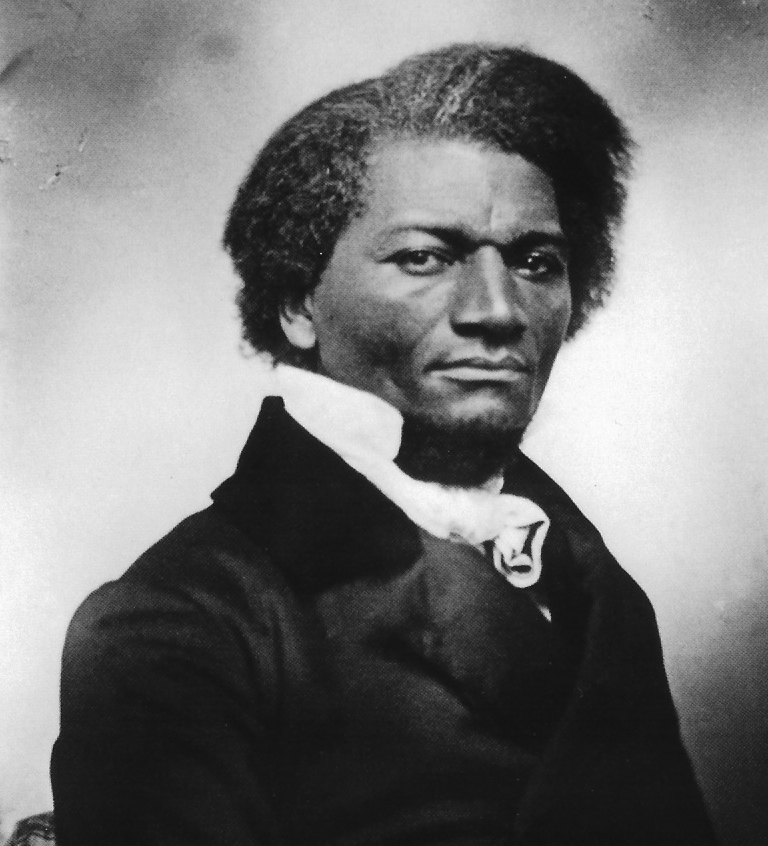
You can see it in Frederick Douglass’ great narrative and in other slave narratives.

Here is his opening, published in 1845.

I was born in Tuckahoe, near Hillsborough, and about twelve miles from Easton, in Talbot county, Maryland. I have no accurate knowledge of my age, never having seen any authentic record containing it. By far the larger part of the slaves know as little of their ages as horses know of theirs, and it is the wish of most masters within my knowledge to keep their slaves thus ignorant. I do not remember to have ever met a slave who could tell of his birthday. They seldom come nearer to it than planting-time, harvest- time, cherry-time, spring-time, or fall-time. . .

My mother was named Harriet Bailey. She was the daughter of Isaac and Betsey Bailey, both colored, and quite dark. My mother was of a darker complexion than either my grandmother or grandfather. . . .

I never saw my mother, to know her as such, more than four or five times in my life; and each of these times was very short in duration, and at night. She was hired by a Mr. Stewart, who lived about twelve miles from my home.

Right there, you can see Douglass grabbing narrative as his tool to tell the world about himself: I was born. . . Then, we can see him link his own story to his people’s story. All in the first three sentences.

You can see narrative again  in Nellie Bly’s great work in the 1880s – her  “Ten Days in a Madhouse”  One of the first undercover exposes.

Or her “Around the World in 72 Days.”

Here’s her very shrewd opening to “72 Days”, published in 1890:

WHAT gave me the idea?

It is sometimes difficult to tell exactly what gives birth to an idea. Ideas are the chief stock in trade of newspaper writers and generally they are the scarcest stock in market, but they do come occasionally,

This idea came to me one Sunday. I had spent a greater part of the day and half the night vainly trying to fasten on some idea for a newspaper article. It was my custom to think up ideas on Sunday and lay them before my editor for his approval or disapproval on Monday. But ideas did not come that day and three o’clock in the morning found me weary and with an aching head tossing about in my bed. At last tired and provoked at my slowness in finding a subject, something for the week’s work, I thought fretfully:

“I wish I was at the other end of the earth!”

“And why not?” the thought came: “I need a vacation; why not take a trip around the world?”

It is easy to see how one thought followed another. The idea of a trip around the world pleased me and I added: “If I could do it as quickly as Phileas Fogg did, I should go.”

There, she is setting the hook. Most readers – most people in America – would have known how this story turns out. The fact that she made the trip was covered obsessively by her own paper, Pulitzer’s New York World. So, what’s left? The narrative that focuses on how. Yes, we know the ending, but this narrative is going to give us something else.

You can see narrative again and again. There it is in the rise of photojournalism: in

LIFE (founded, 1936), which pioneered the photo  essay. Many of those photo essays were often conceived and executed in a narrative mode.


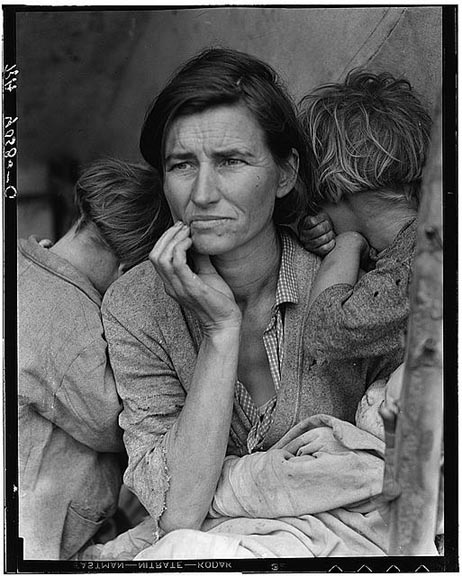
We see narrative again in the FSA photos, telling a narrative about desolation and dislocation. Here’s a rare photo: it shows the photojournalist Dorothea Lange – looking jaunty in her sneakers atop her old woody.
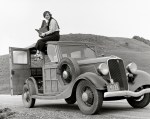


And here’s her classic photo titled Migrant Mother. Although it’s a still image, it certainly tells a story. A tale of dislocation, of loss, of movement.
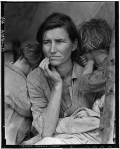


DURING WORLD WAR II , narrative came roaring back. Journalists, in search of powerful storytelling modes for the unbearable stories they had to tell. Just to take a few examples:

–Ernie Pyle’s “The Death of Captain Waskow

–Marguerite Higgins on the liberation of the Dachau concentration camp in April 1945.

–William Laurence on the dropping of the A-bomb on Nagasaki.

And of course, the master: John Hersey.

His Hiroshima, considered a masterpiece of 20th C journalism, has an extraordinarily tight narrative focus:

At exactly fifteen minutes past eight in the morning, on August 6, 1945, Japanese time, at the moment when the atomic bomb flashed above Hiroshima, Miss Toshiki Sasaki, a clerk in the personnel department of the East Asia Tin Works, had just sat down and her place in the plant office and was turning her head to speak to the girl at the next desk. . .

I would argue that Hersey is the key figure here, the one who connects this great tradition to the New Journalists, who in turn have a lot to do with the current resurgence of narrative.


So, today, as we talk about narrative, as we create our own new narratives, as we think about the future of narrative, I would say we are seeing a rebirth. We are seeing the explosion of narrative as a storytelling mode across all platforms.

I would argue that we are even beginning to see the classic news report – the inverted pyramid, the “news from nowhere” — with its flattening of affect and its shattering of time – we are starting to see that as a historical artifact. It is not inevitable, it is not superior, it is not even adequate for so many purposes.

So, here’s my bias: I want all of us to know this history, to claim this legacy. Many of us here today are exploring the outer limits of narrative – across different platforms, lengths, and topics.

And even as we do that work, we should know that we are heirs to a great tradition. That is the legacy that I tried to find, open up, and share in my book, “Covering America.” As I wrote it, I felt so proud of that long line of journalists who had done such wonderful work and so humble in their presence.

–30–

2 Comments

Filed under Journalism, journalism history

A St. Patrick’s Day tribute (part 2)

By Chris Daly 

One of the greatest Irish-Americans in the history of U.S. journalism is one who is not often remembered today: S.S. McClure.

After making money in the syndication business, McClure sent on to found one of the most important magazines in American history, the eponymous McClure’s Magazine. More than any other magazine, his was at the heart of the Muckraking movement at the start of the 20th Century. He hired or published Ida Tarbell, Lincoln Steffens, Ray Stannard Baker, and other pioneers of investigative journalism. The January 1903 issue of McClure’s Magazine was one of the greatest single issues ever published. 

Here is an excerpt from my new book (on sale now!), called Covering America, which is a narrative history of 300+ years in journalism.


As a coherent national movement, muckraking can be traced to the year 1902. The setting was a monthly magazine called McClure’s, which had been founded by S. S. McClure, an Irish-born journalist, in 1893 in New York City. Sam McClure was a pioneer in a new kind of publication then sweeping the country. Although magazines had been published in America for more than a century, they generally steered clear of journalism and focused instead on literature, fiction, ladies’ fashion, or housekeeping hints. Traditional magazines like the Atlantic Monthly, Scribner’s, or Harper’s were also typically quite expensive in price and conservative in outlook. But starting in the 1880s, a new kind of magazine appeared. Thanks to dramatic drops in the cost of paper, magazines could now be priced to reach middle- and working-class audiences. And thanks to the halftone engraving process, they could print extensive displays of photographs. It is also important to note that, unlike even the biggest daily newspapers, which were rarely distributed far beyond their home base, these magazines circulated around the country. The emergence of cheap, well-illustrated monthly magazines created the possibility, for the first time, of a mass national audience focused on news and public affairs. Until the advent of radio networks in the 1920s, such magazines were the only truly national outlet for journalism.

Still, it took some initiative to capitalize on this new possibility and to turn it in a politically progressive direction. That was precisely where Sam McClure, after making a fortune in syndication, led the way. One of McClure’s first hires for his magazine was a young woman named Ida Tarbell, who spent most of the 1890s working on lengthy serialized biographical sketches—first of Napoleon, then of Lincoln. Two other key additions were a contributing editor, veteran Chicago reporter Ray Stannard Baker, and a managing editor, Lincoln Steffens, hired in 1900. In January 1903, McClure’s Magazine assembled an issue that has been called the most famous in American magazine history. It contained three articles that became recognized as classics of modern muckraking: part three of Tarbell’s history of John D. Rockefeller’s Standard Oil trust, Steffens’s exposé of municipal corruption in Minneapolis, and an article by Baker on a brutal coal-mining strike in Pennsylvania—all accompanied by an editorial written by McClure that attempted to frame the entire issue as one that raised serious questions about American society. “Capitalists, workingmen, politicians, citizens—all breaking the law, or letting it be broken. Who is left to uphold it?” he asked. “There is no one left; none but all of us.”

Tarbell’s nineteen-part series on Standard Oil became a sensation and set the standard for the techniques of exposé. Tarbell, who had grown up in the oil fields of western Pennsylvania, where Rockefeller built his business, was a scrupulous researcher, and she relied heavily on official government documents and court records to build the case against him. Rockefeller’s companies had been sued and investigated for many years, and there was an extensive paper record dispersed across dozens of courthouses and state agencies, but no one had committed the time and expense (McClure sank an astonishing $50,000 into the project) to pull it all together in a dramatic narrative for a national audience. Tarbell’s account was quickly published in book form, and two years later, the administration of Theodore Roosevelt filed a federal antitrust suit against Rockefeller’s Standard Oil. For McClure’s Magazine, the impact was also great. From a circulation of about 370,000 in 1900, the magazine shot past half a million after it began running exposés.

Soon, others joined in. Journalists began looking into child labor, race relations, lynching, prostitution, and an array of other social ills. . .


Leave a comment

Filed under history, Journalism, journalism history

A St. Patrick’s Day tribute (part 1)

By Chris Daly

Irish immigrants to the United States, of course, had a large impact on American journalism. Usually landless, they crowded into the growing cities of America in the 19th century, at precisely the same time as the ascendancy of the big-city daily newspapers. Often literate in English, the Irish immigrants found a way to make something (a paycheck) out of nothing (a facility with the language).

One of the greatest was Finley Peter Dunne. (His timeless observation about the purpose of journalism appears on pg. 128 of my new book, Covering America).


Here is the quote:

“The job of a newspaper is to comfort the afflicted and afflict the comfortable.”

Dunne wrote in the guise of “Mr. Dooley,” a thickly accented immigrant, as a columnist for a series of papers in Chicago during the 1890s and early 20th Century.

Finley Peter Dunne (from Wikipedia)


Leave a comment

Filed under history, Journalism, journalism history

Media & politics: France v U.S.

By Chris Daly 

In France, the regulations that guarantee equal time to all major political candidates seem to be taken quite literally. Today’s Times has a story that tells of the lengths that French media regulators go to in order to follow the letter of the law. Candidates’ appearances are timed to the second and compared to each other to ensure that no one gets an unfair advantage.

AFP

The Times story compares this system to the “Fairness Doctrine,” which the FCC used to enforce on American news media. Actually, the French system sounds more like a different FCC policy, the “equal time rule,” which went out in 1960.

Here’s an excerpt from my new book, Covering America, about the end of the “equal time” rule in 1960:

In the fall of 1960, many Americans were still in the process of getting to know Jack Kennedy. Just forty-three years old, he represented the World War II generation, declaring himself ready to take over from Eisenhower, the very man who had commanded the young troops in wartime. Kennedy was not only young, he was also rich, good-looking, and married to a very photogenic wife. With his distinctive accent, his cool demeanor, and his ironic wit, he was well suited to the new medium that was about to make its mark on American politics in a dramatic way—television. Just in time for the 1960 election, Congress had passed a law repealing the FCC’s “equal time” rule, which had required broadcasters to give equal amounts of air time to all candidates for office, including fringe candidates and cranks. In 1960, for example, there were more than a dozen political parties offering candidates for president. It would have been impossible—and perhaps illegal—for a broadcaster to hold a debate that excluded any of them. In a step that went a long way toward perpetuating the dominance of the two major parties, Congress decided to lift that ban for the 1960 campaign and to have the FCC study the issue. When the new law was signed on August 24, 1960, the way was clear for the networks to approach the Democrat Kennedy and the Republican Nixon and offer them an exclusive one-on-one format for the first televised presidential debate in history.

The challenger, Kennedy, promptly agreed. . .


CBS News/Getty


And here’s a longer excerpt that addresses the rationale for using government power to regulating broadcasting in the first place, despite the Constitutional ban on governmental limits on free speech.

Meanwhile, though, with the proliferation of stations sending out signals in the mid-1920s, there arose what some people considered a problem. In more and more places, radio signals were interfering with one another, causing static and defeating the whole purpose of broadcasting. To make matters worse, some broadcasters built supertransmitters intended to overwhelm any weaker signal operating at the same frequency. In response, some broadcasters would move their signal to a different frequency, to avoid being “jammed” by a more powerful rival. As a result, listeners would have to search around the dial to find their favorite station. By 1925 there were some ten thousand stations sending out signals, with no sign of any slowdown. The existing law required a license, but it did not allow the government to deny one to anybody. Hoover and many broadcasters saw this “chaos” on the airwaves as a major crisis. The result was a drive for federal legislation.

But first there was an issue to be addressed: What business did Congress have regulating this area in the first place? Specifically, what about the free speech protections guaranteed by the First Amendment? Didn’t the Constitution explicitly state that Congress shall make no law abridging the freedom of speech or of the press? Certainly, it was argued, when the Founders drafted that language, they meant to protect all speech, in all media. In the 1780s, when Jefferson and his contemporaries used the word “press,” they were referring to the entire array of mass communication then in existence: books, magazines, and newspapers. Now that a new medium had come along, why shouldn’t that technology enjoy the same protections granted the traditional print press, and for the same reasons? Radio could play an equally important role in our constitutional scheme as newspapers or magazines, but only if it was equally free.

By contrast, Hoover and his allies made the case for regulating radio on the basis of what they saw as fundamental differences between the press and radio that placed the two media on different constitutional grounds. First, they said, radio exists as a result of waves that pass through the ether—that is, the electromagnetic spectrum. That spectrum is a unique public resource, and the portion of it that exists above the territory of the United States belongs to the American people. Furthermore, they said, the airwaves were not like the frontier lands of the American past, which were surveyed and sold or given away to settlers. The spectrum could be measured and divided, but it was not for sale. This idea is sometimes referred to as “listener sovereignty,” meaning that the listeners have a collective ownership over the spectrum, which gives the public the right to control it. In addition, said the advocates of regulation, the spectrum has another inherent quality that differentiates it from the traditional press: it has only so much bandwidth. As a result, within any geographic area there is a physical limit on the number of radio signals that can be transmitted without interference. This “spectrum scarcity” means that someone must serve as a gatekeeper, allowing some people to use the spectrum and keeping others out. In radio there is a natural saturation point beyond which no one can enter without harming someone else. For that reason, radio was different from the press, since it is possible to have a practically unlimited number of publications circulating in the same area without impinging on one another. With these arguments, the regulators swept aside any constitutional objections and turned to making laws that would abridge the freedom of the airwaves.

The result was the far-reaching Radio Act of 1927. . .

Leave a comment

Filed under broadcasting, Journalism, journalism history

Inside the Meme Factory

By Chris Daly 

That’s the working title of my next book, which will document the history of the rise of the network of conservative think tanks and conservative news media in post-War America. Now that I have finished Covering America and launched it, I am eager to push ahead with the new book.

A perfect example of one of the major themes in “Inside the Meme Factory” appears in today’s Times on the front page. An article by Eric Lichtblau explores a dispute among the conservatives and libertarians who finance and run the Cato Institute.

Cato is a Washington think tank that lies near the heart of the conservative “intellectual-journalistic complex” that arose after WWII. The growth and activity of Cato and the American Enterprise Institute and others is a fascinating, largely untold story.

To be continued. . .


Industrialist Charles Koch (Mike Burley/Topeka Capital-Journal)

Leave a comment

Filed under Journalism, journalism history, Politics

Elite media?

By Chris Daly 

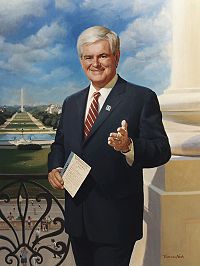
Newt Gingrich has done it again. On Sunday morning, he was the lead-off guest on “Meet the Press.” (So, no whining, Mr. Gingrich, about being ignored by the media.)

The able, veteran host, David Gregory, led off with the kind of question that such a host is supposed to ask on such a show: he asked about the hottest story of the previous 72 hours, the flap over access to contraception in health insurance plans.

Did Gingrich respond? Did he weigh in on the issue that so many Americans were thinking about?

He did not!

He went straight into political jiujitsu mode and tried to attack Gregory. His reply:

“You know, David, I am astonished at the desperation of the elite media…”

Whoa. Stop the video.

ELITE MEDIA?? What is Gingrich talking about. That is, what is he really talking about.

Gingrich flings that term “elite media” around every chance he gets. He must have reason to believe that it helps him with some sub-set of the U.S. electorate.

Here’s the question I wish Gregory had come back to him with: “What do you mean, Mr. Speaker, by elite media? Is there some other kind? Is there a zhlubby, mediocre media that you prefer? Is there a really dopey, terrible media that is somehow not getting its fair shake?”

What, in other words, does the word “elite” add to Gingrich’s sneering, mocking phrase “the elite media”? He protests an awful lot.

Is not Gingrich, a former professor, part of an elite?

Is not Gingrich, an author of multiple books, part of an elite?

Is not Gingrich, former speaker of the U.S. House, part of an elite?

Is not Gingrich, TIME magazine’s 1995 “Man of the Year,” part of an elite?

Is not Gingrich, a multimillionaire consultant, part of an elite?

Just to clarify, I entered the word “elite” into an online antonym finder and came up with the following list: common, low-class, ordinary, poor, worst, commoners, plebites, proletariat, low-born, low-life, poor, unprivileged, vulgar, wanting.

Would Gingrich really prefer a low-class, wanting, vulgar media staffed with ordinary proletariat commoners?

Maybe he would.

The official portrait

2 Comments

Filed under Journalism, media

William Randolph Hearst’s company at 125

By Chris Daly 

The Hearst Corp has decided to give itself a big birthday — 125.

That is predicated on the fairly arbitrary starting point of March 4, 1887, the date on which young William Randolph Hearst took over the management of his father’s newspaper, the San Francisco Examiner. It’s as good a date as any, I suppose, although it was another two decades before WRH really started building the media empire that still endures. Hearst, naturally, looms large in my new book on the history of journalism, Covering America, since his career lasted from 1887 almost to his death in 1951.

Fun fact: Hearst opposed U.S. intervention in WWI, and he came under attack from Wilson and his supporters. On the defensive about his loyalty, Hearst literally became a flag-waver: he ordered the editors of all his newspapers to print little American flags on the upper corners of every front page.

Don’t miss the great visuals in the slideshow and video in the company’s anniversary page. Hearst Corp., by the way, is one of the biggest privately held media companies in the U.S., owning everything from TV stations to Cosmopolitan and O magazines.

Courtesy, Hearst Corp.

Leave a comment

Filed under Journalism, journalism history, media

Obama and Secrets

By Chris Daly 

As is becoming obvious, the Obama administration is developing a disappointment on the promises made by candidate Obama to run an open government. Instead of transparency, we are getting business as usual — or, in some areas, worse than usual.

The New York Times’ David Carr has a helpful update today on the government’s use of the Espionage Act under Obama. More often than not, federal prosecutions are brought against leakers who divulge secrets to the press. Rarely do we see prosecutions of real spies, the kind who steal or buy classified information on behalf of some hostile foreign government that then uses that information to defeat us militarily. Now, that kind of thing would justify the existence and the use of the Espionage Act. But no. The law is usually used to punish the people who are journalists’ sources. Rather than go after the reporters directly, the government (usually) settles for punishing the leaker, who is usually a government employee.


The Espionage Act, as I detail in my new book (which should in bookstores on Friday), Covering America, was passed in 1917 by a Congress that was unsure whether the American people would support a war that the president himself had said was unnecessary until right before the U.S. plunged into the fighting in Europe. Among those prosecuted under the Espionage Act (or its companion law, the Sedition Act of 1918) was the socialist leader Eugene Debs, who was imprisoned for giving a speech.

Carr’s piece, as I mentioned, is valuable, but it raises one beef I have with the Times’ coverage in general – that is, the paper’s use of links. In today’s piece, there are plenty of links, but they are almost all internal; they link to earlier Times stories or to the Times Topics database. There is nothing wrong with those, but the paper consistently misses chances to link to historical materials. There is no reason  the Times couldn’t link to the text of the Espionage Act, for instance. Actually, there may be a reason: these links are not always easy to find. But they would give the Times‘ reporting a lot more authority.


Leave a comment

Filed under First Amendment, history, Journalism, journalism history, leaks, New York Times, President Obama