Category Archives: Journalism

Un-bundling the media

By Christopher B. Daly 

In his latest column, the New York Times‘ David Carr makes a smart argument about how the media — both entertainment and news — are coming apart under pressure from the Web. That’s coming apart, not falling apart. They are coming apart in the sense that the “bundles” of material that arose during the pre-digital era no longer make sense. 

Here’s his lead:

For the longest time in the media business, the concept of the bundle has been foundational. Ads go with editorial content in print, commercials go with programming on television and the channels you desire are paired with ones you did not in your cable package.
People were free to shop for what they wanted, as long as they were willing to buy a bunch of other stuff they did not. The box score last night for your home team? It was wrapped inside a bundle of paper that included everything from foreign news to ads for lingerie. If you liked a song, you generally had to buy an album full of others to get the goods.


I think he’s on the right track. Consider the newspaper, for example, as I did in my book Covering America. Here’s an excerpt from Chapter 13:

Another problem besetting newspapers (and, to a great extent, magazines and television news as well) was even more existential. When seen against the backdrop of the Internet, one fact about newspapers becomes painfully obvious: a newspaper is a fixed bundle of coverage that is good but ultimately second rate. Offering readers no choice, a newspaper presents coverage of a set matrix of topics: politics, crime, business, sports, arts, and something called lifestyle. In each case, though, people who really know or care about those fields understand that they are not going to find the absolute best, most detailed, most passionate coverage of their favorite topic in a daily newspaper. They know that the best coverage will be in some niche on the Web where obsessive amateurs or professional experts gather. And with the coming of the Web, the absolute best coverage is available to everyone, everywhere, all the time, for free. In politics, for example, readers can find pretty good coverage in the Times or Newsweek. But if they really live and breathe politics, they will want it faster and at a much higher level of granularity, so they will log on to a site like Politico or Real Clear Politics instead and get what they are looking for. The same is true for business, sports, even crosswords and recipes. Thus the question arises: What is the remaining value of reading merely pretty good coverage (and paying for it) when readers can unbundle the newspaper, go online, and plunge into first-rate coverage, written by real aficionados and provided at a price of zero?

One way to understand the decline of the newspaper is to ask the ultimate question: If newspapers did not exist, would it make any sense to invent them?

I wrote that about two years ago. The only change I would make now would be to drop the reference to Newsweek. The venerable weekly print newsmagazine went broke in 2012 trying to sell a fixed bundle of pretty-good coverage and was absorbed into a born-digital enterprise, The Daily Beast. I might also amend the statement that all the high-quality niches are free, since a small but possibly growing number do charge something.

Leave a comment

Filed under broadcasting, Journalism, journalism history, New York Times, publishing, software

Literary criticism: a reader writes

By Christopher B. Daly

Recently, a reader posted a largely critical “customer review” of my book Covering America, on the book’s Amazon page. The writer of the criticism, Ralph Poore, is, of course, entitled to his opinion and the free expression thereof. At the same time, I have my right to engage his criticism and explain my views.

First, let me thank Mr. Poore for reading my book and for reading it quite carefully, to judge by the granularity of his comments.

Here’s his review and one of my reactions:

If you like East Coast, elitist views of journalism, then Christopher Daly’s Covering America is the book for you.

Daly focuses mainly on journalism east of the Hudson River. He makes occasional visits to news media along the Potomac River, but he frankly doesn’t find much of value beyond those two regions. He covers a lot of the familiar territory found in other journalism histories by profiling one or more journalists of their time.

Missing is the westward trek of newspapers and editors in the late 18th and 19th centuries. Missing, too, are many publications that have played important roles in the history of journalism and of the country.

To be fair, any book that purports to cover a topic across 320 years of history has to leave something out, else no one would be able to lift it. And Daly makes it clear that his book is a narrative “about the broad scope of journalism in America… [and] not an encyclopedia” (p. 6).
Fair enough.

As I wrote in the preface, my approach was not encyclopedic. My stated criterion for inclusion in my book was innovation — especially in one or more of the following dimensions:

–the economics of news,

–the technology of news gathering and dissemination

–the philosophy of news

–the sociology of the newsroom or the audience

–the politics of the power balance between journalism and other institutions.

As it happened, most of that innovation took place on the East Coast, particularly in New York City. I did not cause that, and I don’t apologize for it. That said, my book does at least mention papers outside the Northeast: the Washington Post, the Chicago Tribune, the Los Angeles Times, the St. Louis Post-Dispatch to name a few, as well as the Atlanta-based CNN.

Here’s the rest of his review. I am not going to reply point-by-point, but I would encourage any readers of this blog who have also read my book to jump in and share your views.

But what Daly leaves out is a lot, and it is often important. For example, in looking at press coverage during the Civil War, Daly’s examination stops at the Mason-Dixon Line. Of the Southern press he says only, “Across the South, many newspapers simply collapsed” (p. 110). The major Southern newspapers didn’t collapse, and never mind that Southern correspondents, including a few women, wrote some of the best war coverage by any reporter North or South.

As Daly’s narrative moves closer in time to the present, its sins of omission and commission, as well as its elitism (and frankly snarky comments about conservatives), become more pronounced. I primarily would like to deal with several examples from the mid-20th to 21st centuries to make my point.

East Coast elitists have an almost cult-like attachment to President Franklin D. Roosevelt and his New Deal programs. It comes as no surprise then that the journalists who Daly profiles in the 1940s for his “broad scope of journalism in America” never raise any questions about the efficacy of New Deal programs.

FDR’s policies cost billions of dollars often with no real benefit to the nation and in some cases caused real harm to real people, including my parents and grandparents. In FDR’s second term, unemployment lines were long and getting longer. Joblessness got worse after almost every New Deal program started.

Instead of an explanation of why journalists let this state of affairs slide, Daly gives us a portrait of gossip columnist and radio host Walter Winchell supporting Roosevelt: “At a time when most American newspapers were published by businessmen who supported the Republican Party and hated Roosevelt, Winchell…was one of the few prominent voices raised in support of fighting fascism” (p. 220).

Republicans, businessmen and Nazis vs. Winchell and Roosevelt. Really? Either this is sloppy writing or a deliberate attempt to associate the GOP with anti-democratic forces. The effect is the same in either case.

Skip ahead to the 1980-1999 period when Daly takes on conservatives directly. He writes: “Conservatives railed against a media system they said favored big government, welfare, immigrants, and alternative lifestyles while denigrating family, country, and God” (396-397).

Daly dismisses these concerns with a sheer nonsensical statement: “In part, many conservative critics were misreading the media–finding an ideological intention where journalists were actually asserting their professional values. Often, critics on the Right interpreted the journalistic ideals of independence and skepticism as political commitments to antiauthoritarianism or partisan liberalism” (397).

It is hard to see how Daly can reconcile conservatives as believing the media both favored “big government” and “antiauthoritarianism.” Those are polar opposites. And it had become clear to almost any observer west of the Hudson River that by this time period elite journalists had merged their ideological and professional values.

Finally, there is the issue of blatantly distorting the facts when it comes to Fox News. Daly cites a 2003 study by the Program on International Policy Attitudes (PIPA) at the University of Maryland that purports that Fox News viewers were more misinformed about the Iraqi war (p. 419-420). PIPA claims “those who watched Fox News almost daily were significantly more likely than those who never watched it to believe….” and then goes on to list a series of supposedly false statements.

Neither PIPA nor Daly cites a single supposedly wrong or misleading fact reported by Fox News.

The Wall Street Journal has examined the clear flaws in PIPA’s methods. The so-called false statements are actually just prejudiced questions about people’s opinions. The opinions just don’t reflect the beliefs of media elites and liberals.

WSJ points to more objective and fact-based surveys by the Pew Research Center for the People and the Press which ranked Fox News viewers as among the most informed. At the bottom of Pew’s list were regular consumers of CBS News, Access Hollywood and the National Enquirer.

All of this was known or should have been known by Daly while he was writing his book. For some reason he chose to ignore it.

Meanwhile, you will look in vain in Covering America for even a brief mention of high-profile cases of deliberate misinformation on the part of the East Coast, elite media. For example, you will NOT find Daly criticizing those media for:

Walter Duranty, the Pulitzer Prize winning Moscow Bureau Chief of The New York Times (1922-36) who lauded Stalin and denied widespread famine and mass starvation in the Ukraine.

Janet Cooke (1980), who fabricated a story about a child drug addict for the Washington Post and won a Pulitzer Prize.

ABC’s 20/20 (1978), CBS’s 60 Minutes (1980) and NBC’s Dateline (1993) all ran stories that fabricated safety problems with cars and trucks.

Christopher Newton, an Associated Press reporter who in at least 40 stories (2000- 2002) quoted sources who did not exist.

Jayson Blair (2003), whose fabricated stories in the New York Times brought down Executive Editor Howell Raines and Managing Editor Gerald Boyd.

CBS’s 60 Minutes host Dan Rather and producer Mary Mapes 60 Minutes who used forged documents (2004) about President George W. Bush’s service in the Air National Guard less than two months before the presidential election.

And Daly worries about Fox News viewers being misinformed? Really?

The flaws in Covering America are unfortunate. Daly was a reporter for the Associated Press and the Washington Post before he began teaching at Boston University. He knows how to tell a good story.

There is much in Daly’s narrative that is solid and even insightful at times. But to get at the good stuff, the careful reader has to constantly act as an investigative reporter, questioning assumptions and checking facts. It is a lot of work.

Leave a comment

Filed under Covering America, Journalism, journalism history

The Constitution is for everyone

By Christopher B. Daly 

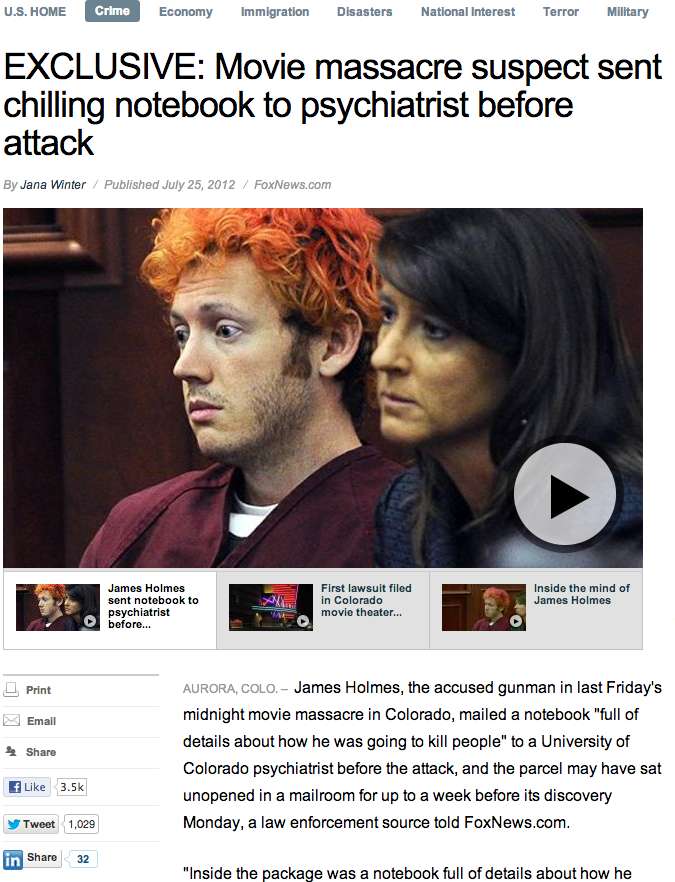
One of the most serious recent threats to press freedom is playing out in Colorado. It involves a reporter for FoxNews.com who is the target of a subpoena by a state prosecutor who is pursuing the case against the suspect in the 2012 mass shooting in Aurora, Colo.

At issue is some reporting done by Jana Winter, who is an investigative reporter at FoxNews.com. In a story labeled EXCLUSIVE, Winter quoted two sources (whom she did not name) telling her that the suspect, James Holmes, had mailed a notebook to a psychiatrist before the shooting. According to one of the sources cited in her story, the notebook was “full of details about how he was going to kill people.”

As so often happens, the prosecutors in Colorado would like to know the identity of her confidential sources. For solid professional reasons, the reporter does not want to divulge those names. (If she did, then all sources would be that much more reluctant to speak to reporters, and — here’s the punchline: the public would be less informed.)

As so often happens, the judge in the case would also like to know the identity of the sources, so he is threatening to hold Winter in contempt of court unless she rats out her sources. That means the judge could send her to prison for up to six months, or until she relents and gives up the names.

This is a classic case of prosecutorial and judicial abuse of power that threatens the public’s right to know. The Constitution’s First Amendment, which guarantees freedom of the press, exists for the benefit of the American people, not just the news business. The people have a right to know things, and it’s for that reason that government is restrained from interfering with news-gathering and news dissemination.

In cases like this, a “shield law” could protect the reporter from such pressure and threats. But a proper reading of the Constitution could serve just as well. In the rare cases where the use of confidential sources gets to the point where jail time is a real threat, most jurisdictions require that prosecutors meet a multi-prong test: the material being sought must be germane to the case, and it must be unavailable in any other way. This case hardly meets either standard. In the criminal case against Holmes, the question for the jury will be, did he kill all those people? Whether he sent a notebook to anyone in advance is irrelevant. (It might be relevant if the survivors of the shooting ever brought a civil suit against the psychiatrist, charging the psychiatrist with failure to warn — but that’s another matter entirely. And even then, the notebook is probably irrelevant, since the psychiatrist did not even open the package it was in until after the shooting.) In the criminal case, finding out Winter’s sources serves no purpose, and the subpoena should be quashed. The judge is probably irked that Winter’s sources violated his gag order in the case, but he never should have issued a gag order in the first place.

Of course, the suspect has rights under the same Constitution that protects the journalist. Holmes is entitled to a fair trial, which includes the right to face his accusers. But Winter’s sources are not his accusers and do not need to be dragged into this case. Holmes’ rights to a fair trial also include the right to be tried by an impartial jury — that is, one that is not inflamed by news reports about the case. But there again, the prosecutor and judge have no leg to stand on. Whether or not there was a notebook and whether Winter was told about it by this person or that person has no bearing on the state of mind of the jurors who will ultimately hear the case and decide Holmes’ fate. My suspicion is that the prosecutor and the judge just want to control all the parties in the case, and they are frustrated that they can’t do so.

0       0        0       0       0

Recently, some people have complained that the liberal media have been slow to rally behind Winter because she works for the media empire of the despised conservative Rupert Murdoch. (According to the Times, she used to work for Murdoch’s New York Post before signing on as an investigative reporter for FoxNews.com, the website associated with Murdoch’s Fox News on cable television.) Today’s Times carried a news story and an op-ed about the case, so it hardly seems that the liberal Times is ignoring the case.

Some folks at  Fox News seem to have a problem with the Constitution, especially when it comes to extending its protections to unpopular causes. But the beauty of the Constitution is that it exists for all of us, without exceptions. So to my colleagues at Fox News, I say welcome to the experience of being a frightened individual, hunted by the powers that be, despised and alone, hoping against hope that some clause in a document drafted in 1789 can save you from unwarranted punishment.

That’s why we have the Constitution, for everyone. 

Screen Shot 2013-04-10 at 10.06.59 AM

Leave a comment

Filed under broadcasting, Fox News, Journalism

Be you.com (but don’t expect you book publisher to help much)

By Christopher B. Daly 

The Monday Times round-up:

There are two interesting pieces about the media businesses, but they appear in different sections and were probably not planned as a package. Nevertheless, these two articles are more informative if read together.

First, I recommend David Carr’s celebration of the business acumen of the recently departed film critic Roger Ebert. Carr points out that Ebert consistently experimented with new outlets for his work and did not shy away from new technologies. In the process, he became a brand name and added to our vocabulary. (Whether he really elevated film criticism is another question)

Extra credit: Carr discovered (remembered?) that Ebert played a key role in the success of another media entrepreneur — Oprah Winfrey. As I explain in my recent book Covering America (p 424 in the print edition), it was Ebert who opened Oprah’s eyes to the power of owning a stake in your own brand. Taking his advice, Oprah went from being a media employee to being a media mogul.

Ebert and Winfrey even dated for a while in Chicago.

Ebert and Winfrey even dated for a while in Chicago.

All that said, Carr’s column should be read in conjunction with an op-ed by the famous (and wealthy) lawyer, legal novelist, and president of the Authors Guild, Scott Turow. In his op-ed, Turow documents the many ways in which publishers and book-sellers worldwide are turning their ingenuity to finding ways to NOT PAY WRITERS. This is a very bad thing, under any circumstances and in any medium. It also undermines the effort of every writer, like Roger Ebert, who wants to escape the hamster wheel of working for someone else and to live independently on the earnings from their own writing (or painting, or photography, or film-making or any creative venture).

Quoting Turow:

And there are many e-books on which authors and publishers, big and small, earn nothing at all. Numerous pirate sites, supported by advertising or subscription fees, have grown up offshore, offering new and old e-books free.

The pirates would be a limited menace were it not for search engines that point users to these rogue sites with no fear of legal consequence, thanks to a provision inserted into the 1998 copyright laws. A search for “Scott Turow free e-books” brought up 10 pirate sites out of the first 10 results on Yahoo, 8 of 8 on Bing and 6 of 10 on Google, with paid ads decorating the margins of all three pages.

If I stood on a corner telling people who asked where they could buy stolen goods and collected a small fee for it, I’d be on my way to jail. And yet even while search engines sail under mottos like “Don’t be evil,” they do the same thing.

Yikes. Someone should get him a lawyer!


Leave a comment

Filed under Journalism, publishing

How do you say “paywall” in German?

By Christopher B. Daly 

The answer is: “paywall” (probably pronounced payvall). That’s according to Google Translate.

The fuller answer is in this piece in the Times, documenting a trend-let in setting up paywalls in Europe.

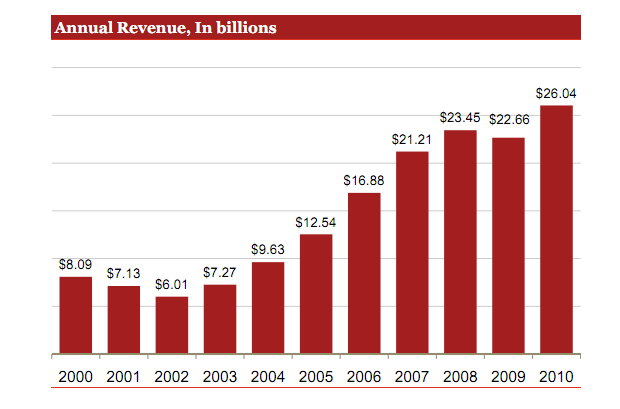
Whatever they are called, paywalls are emerging as the salvation (if there is one) for journalism, because the growth in online advertising is painfully slow.

source: TechCrunch

source: TechCrunch


Leave a comment

Filed under business, Journalism

To Steve Coll: Best wishes at Columbia

By Christopher B. Daly 

I admire Steve Coll.

I rely on David Carr.

I find Michael Wolff consistently annoying. (Also, he is often wrong, as he was in his recent column: The Washington Post is a diminished institution of journalism, but The New Yorker is certainly not.)

So, it seemed like a slim premise for Carr to use a recent snide, totally negative column by Wolff for Carr’s new column about Steve Coll. Wolff is not worth rebutting. But Coll is worth noting.

Steve Coll is the newly named dean of the Columbia Graduate School of Journalism (to use the full name — which signifies several things: it is the only Ivy school to have a real journalism school, and it does not offer a journalism major to undergrads. See pgs 151-156 of my book Covering America for the back story on the founding of the Columbia J-School, through the bequest of newspaper publisher Joseph Pulitzer.)

As the new dean, Coll will occupy the most visible and influential seat in American journalism education, so he will probably be in the spotlight a bit more than he is accustomed to. He may also find it harder to keep writing than he thinks. Many a writer has accepted an administrative position in higher ed with the best of intentions to remain productive, only to disappear into an endless round of meetings. The only writing most deans do extends to letters of recommendation and internal reports for the Provost’s office. Even so, Coll, as a two-time winner of the Pulitzer Prize and author of multiple important books, will do well if he can continue to write while serving as dean.

He succeeds Nick Lemann in that position. (Full disclosure: Nick has been a friend of mine since we were on the Harvard Crimson in the early to mid 1970s.) As Columbia’s dean, Nick did a great job — at least from the perspective of someone teaching at a would-be rival school. During Nick’s 10 years, Columbia remained at the top of the heap and kept improving, so that it kept getting harder and harder to keep up with Columbia — which offers pretty much everything and does so in New York City.

Good luck, Steve Coll.

Good luck, Steve Coll.

Leave a comment

Filed under Journalism, journalism history

Should Murdoch be able to buy the L.A. Times?

By Christopher B. Daly 

Conservative media mogul Rupert Murdoch is not finished trying to acquire more news outlets, despite his unsavory legal problems.

His latest target is the L.A. Times, the paper that the conservative Otis and Chandler families used to spearhead the phenomenal growth of LA (and, not incidentally, their family own’s fortunes). A story in today’s NYTimes provides an1923.04.22-Los_Angeles_Times_Front_Page update.

Here’s the situation: Like most big newspapers, the LATimes is in financial trouble, so its owner (the Tribune Co.) wants to sell it. One of the few buyers of newspapers is Rupert Murdoch.

Here’s the problem: Murdoch already owns two television station in Los Angeles, KTTV and KCOP. Like all holders of broadcast licenses in the United States, the two stations are subject to regulation by the Federal Communications Commission. Decades ago, the FCC idealistically promulgated rules that limit the ownership of tv and radio stations and that limit the “cross-ownership” of broadcast entities and newspapers in the same market. The idealistic impulse was to try to keep ownership diverse and prevent anyone from monopolizing the market for news and opinions in a given part of the country.

Here’s the wrinkle: Murdoch runs his News Corp. by basically using his many profitable broadcasting properties (starting with Fox TV) to subsidize his many money-losing newspapers (starting with the New York Post). His next step is to divide his company in two: a broadcasting division and a print division. If he pulls that off, he may be able to skirt the FCC rules.

Stay tuned.

LATimesBuilding


Leave a comment

Filed under broadcasting, Fox News, Journalism, media, Murdoch scandal, regulation, Tribune Co.

A trial about secrets, tried in secret

By Christopher B. Daly 

No getting around it: the Obama administration is badly abusing its power in its handling of the “Wikileaks” case against Army Pfc. Bradley Manning. Forget about Manning for the moment. The issues involved in his case are of great interest to the general public. We have a stake in whether he receives a fair, public trial. If his case were in a civilian court instead of a military court martial, none of the shenanigans outlined in David Carr’s column today in the New York Times would be tolerated — or, at least, they would be corrected on appeal.

The military’s handling of this case is embarrassing our country in the eyes of the world, and it insulting to the citizens of the United States. I don’t know if he is guilty or not; I don’t know if the military is railroading him or not. But I know for sure that it appears as though the military is railroading the guy, and that is bad enough.

Just a sample from today’s Carr column:

imgres3Finally, at the end of last month, in response to numerous Freedom of Information requests from news media organizations, the court agreed to release 84 of the roughly 400 documents filed in the case, suggesting it was finally unbuttoning the uniform a bit to make room for some public scrutiny.

Then again, the released documents contained redactions that are mystifying at best and at times almost comic. One of the redacted details was the name of the judge, who sat in open court for months.

A disgrace.

Update: the AEJMC, the country’s biggest group of journalism scholars and educators, just issued this statement on prosecuting leaks.

1 Comment

Filed under Journalism, media, Politics, President Obama, Wikileaks

Another Newspaper Landmark Closes

By Christopher B. Daly 

Of course, there are sad stories about the closing of the landmark building on Biscayne Bay that has housed the Miami Herald for the past 50 years. 

HERALD-1-articleLarge

BUT, it should also be noted that the hulking Herald building was essentially a factory — a walled-off manufacturing plant. First and foremost, it was designed to receive raw materials (newsprint arrived in barges; hence, the dock) and turn them into finished products (i.e., each day’s paper, which left the plant on trucks).

What is the purpose of such a building in the digital age? Newspapers should be thinking of themselves as being in the information-processing business, not the paper-processing business. They should be in cool, glass offices right in the centers of their cities. They should look like Apple stores, not like power plants or auto factories.

url


Leave a comment

Filed under Journalism, journalism history

America’s history of censorship

By Christopher B. Daly 

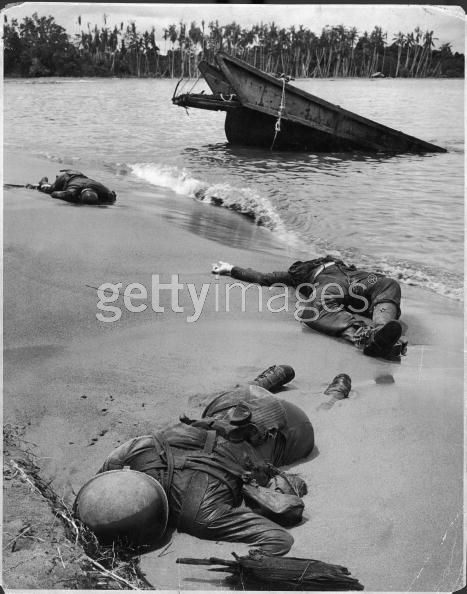
A recent obituary reminds us that during World War II, President Roosevelt created and operated a wide-ranging and largely effective program of censorship of all news media. The news is the death, at age 94, of Cal Whipple, who was a Pentagon correspondent for LIFE magazine during the war. It was Whipple who persuaded the military to re-examine its policy of banning photos of dead U.S. servicemen. Eventually, the top brass referred the matter to the president, and Roosevelt personally intervened. (It might have made more sense, of course, for LIFE’s publisher, Henry Luce, to take up the matter with the president — but for the fact that Luce was a Republican and quite a FDR-basher by 1943.) The result of Whipple’s efforts was this stunning photo by LIFE’s George Strock:

Photo by George Strock/ LIFE magazine.

Photo by George Strock/ LIFE magazine.

That photo (which I paid Getty Images for the right to use) was followed by many more, all of which brought home the reality of war.

Here is an excerpt from my book, Covering America, about the issue:


   Another special case involved war zone photography. Initially, U.S. military and civilian censors banned the publication of photos showing dead American soldiers or sailors. It was assumed that such images would be bad for civilian morale, and they would probably not bring the troops much cheer either. For twenty months after Pearl Harbor, not a single photo depicting a dead U.S. service member appeared in the news media. Much of the initiative for change came from the editors of Life magazine, which, with a circulation of more than 2.5 million a week,23 had emerged since its founding in 1936 as the nation’s premier showcase for photojournalism. Among its wartime staff were Margaret Bourke-White, Carl Mydans, and Robert Capa. With its large format and glossy paper, Life gave photos their greatest possible impact. In a 1942 advertisement for itself, Life expressed its philosophy: “Never has LIFE glossed over the horrors that stalk in the wake of the Axis aggression, but has shown war as it really is . . . stark, brutal, and devastating.” Even so, the censorship guidelines prevented showing dead GIs, so editors at Life and elsewhere pressed their case for greater candor. In mid-1943 the Roosevelt administration reversed its earlier policy, and in September officials began releasing the first of the somber photos. The most famous was the one printed in Life showing three dead soldiers lying where they had been shot on a beach in New Guinea. The photo, by George Strock, was a masterpiece of composition and understatement. The dead men’s faces were not visible, and their wounds were hidden as well. The editors and the military brass all worried about the public reaction, but they need not have: most letters to Life supported the decision, and there was no measurable drop-off in American support for the war. Ever since, readers on the home front have been given a closer and more realistic look at war. . .

Leave a comment

Filed under Journalism, journalism history, Photojournalism