Category Archives: history

A pox on “A pox on both their houses”

By Christopher B. Daly 

I spend a lot of my waking hours at the intersection of Journalism and History, two empirical fields that share a lot of DNA. It’s an interesting place to hang out, and I wish more of the residents of each street would roam around more on the other street.

Today, a story in TPM about an item on a blog known as the 20Committee, nicely frames an issue that highlights one of the distinctions between the disciplines of journalism and history. The upshot is that journalists do us all a disservice when, in the name of non-partisanship or “fairness,” they throw up their hands and blame Democrats and Republicans equally for behaving in ways that are partisan, counter-productive, hypocritical or the like. As a former political journalist myself, I know this phenomenon well, and I know where it comes from: it is an adaptation to the pressure many American journalists feel to write as if they have no stake in the outcome, to show an aloof indifference to cause or candidate or party.

Many journalists, particularly in the mainstream media who work in the reporting tradition, apply this technique to coverage of hard problems like Obamacare or fracking or political spending. This is the problem often referred to as “false equivalence” or “false balance.”

But, I would submit, no historian who studies our current period in the future would be caught dead doing that. Every historian of our present situation will look at essentially the same facts and will exercise judgment.

[I will further predict that 95 percent of them will conclude that our current messes are the fault of Republicans. But, to use another favorite journalistic evasion, Only time will tell.]

Shutterstock/ Christos Georghiou

Shutterstock/
Christos Georghiou


1 Comment

Filed under broadcasting, CNN, Fox News, history, Journalism, journalism history, media, Politics, publishing

Trouble for oral history?

By Christopher B. Daly

As I like to tell my students: History keeps happening.

The past is always with us, and here’s a case in point: the arrest of Irish leader Gerry Adams as a result of an oral history project carried out at Boston College by researchers who promised their interviewees that the contents would remain confidential. As my friend and fellow journalism professor Dan Kennedy points out, the prosecution of this case represents just part of the Obama administration’s campaign to undermine the rights of reporters (and now, researchers too).

More reports keep coming in:


From today’s Boston Globe, stories about the impact on Boston College and on Adams himself, as well as a strong column by Kevin Cullen. (plenty of comments, too, naturally)

From today’s NYTimes, a good overview by Boston correspondent Kit Seelye.

And more, from the Irish Independent and the Irish Times.


3 Comments

Filed under First Amendment, history, Journalism

Inside the meme factory: The Clintons figured this out long ago

By Christopher B. Daly

When Hilary Clinton complained back in 1995 of a “vast right-wing conspiracy” trying to bring down her husband, she was not wrong. In fact, she and her husband’s political advisers were onto something: the interlocking network of conservative institutions set up since WWII to American politics to the right. As the Clintons realized, the right-wing think tanks and the right-wing media were mutually supportive in their campaign to concoct conservative political themes and inject them into the mainstream media. (Whether this system qualifies as a “consipracy” is a fine point, but Hilary was right to be paranoid: people were out to get her.)

A new batch of disclosures from the Clinton presidential library lay out the Clintons’ grasp of this phenomenon, circa 1995. They rightly identified Richard Mellon Scaife as a major source of funding for both conservative think tanks and media.

Scroll down past the heading sheets for a fascinating glimpse inside this usually hidden world.

Screen Shot 2014-04-23 at 9.01.39 AM

Leave a comment

Filed under history, Journalism, journalism history, media, Politics, publishing, Uncategorized

The best book you may never have read (or forgotten about)

By Christopher B. Daly

Thank you, Dwight Garner, for the appreciation in today’s NYTimes for a neglected American classic — the 1974 oral history All God’s Dangers. It’s amazing to think that this wonderful book has fallen below the radar. Even compared to the other books that were finalists that year for the National Book Award, All God’s Dangers deserves to be read, taught, and remembered.

[What were those other books? It was a non-fiction all-star team:

The Power Broker, by Robert A. Caro

All the President’s Men, by Woodward & Bernstein

Working, by Studs Terkel

Zen and the Art of Motorcycle Maintenance, by Robert M. Pirsig.]

Rosengarten’s book, which began life as his dissertation for his doctorate in the History of American Civilization at Harvard, tells the story of an Alabama sharecropper, Ned Cobb, in his own words.

Ned Cobb (aka Nate Shaw)

Ned Cobb (aka Nate Shaw)

It was was an inspiration (and a model, along with Terkel’s book, Working, another oral history) for the book that I and five co-authors began working on in 1982, called Like a Family. Like those two 1974 books, our book focuses on working-class people, telling their own stories in their own voices.


In his piece in the Times, Garner focuses on the book All God’s Dangers and does not pay much attention to whatever happened to the subject, Ned Cobb, or the author, Ted Rosengarten. You can find more about Cobb here and here. And you can find more about Rosengarten, who became a writer in South Carolina, here and here.

Ted Rosengarten

Ted Rosengarten


Leave a comment

Filed under history, Uncategorized

The history of journalism lives on in Worcester, Mass.

By Christopher B. Daly

Here’s a recent article in Worcester magazine introducing readers to the incomparable American Antiquarian Society. It sounds like a museum of antiques, but it is actually the most extensive collection of American newspapers, pamphlets, lithographs, sheet music, and ephemera from the 17th century through the late 19th century.

From the article:

A few of the Society’s most valued materials include a first-edition copy of Lewis and Clark’s journals, printed in the early 1800s; the first printed Bible in British North America, released in 1663; the only known copy of the famous English book “Pamela,” which was the first book printed

COVER_philosophic-cockin the United States, published and sold by Benjamin Franklin; and the only known original copy of the political cartoon “The Philosophic Cock,” which was an early slam of Thomas Jefferson’s relationship with Sally Hemings, depicting Jefferson as a rooster and Hemings as one of his hens. At the end of last year, one of the few remaining copies of the first book ever written and printed in British North America, in 1640, the Bay Psalm Book, sold at auction for $14.2 million – the American Antiquarian Society just so happens to also have an original copy of the book.


The AAS attracts scholars from around the world, including Ken Burns and Jill Lepore, and it is  open to the public.

Here’s a note on the AAS’s history from Wikipedia.

AAS was founded by Isaiah Thomas on October 24, 1812 by an act of the Massachusetts General Court. It is the third oldest historical society and the first to be national in scope.[4]Isaiah Thomas started the collection with approximately 8,000 books from his personal library. The first library building was erected in 1820 in downtown Worcester, Massachusetts. This building was later abandoned and a new building was constructed. It was completed in 1910 and stands on the corner of Park Avenue and Salisbury Street. There have been several additions to this building to accommodate the growing collection, the most recent of which was completed in 2003.

There’s also a story as to why Isaiah Thomas was in Worcester. He was the editor of a Boston newspaper on the patriot side in the American Revolution called The Massachusetts Spy. On April 16, 1775, when the rebels were coming under increasing scrutiny by the British forces occupying Massachusetts, Thomas began to fear that

Isaiah Thomas, rebel printer, by Ethan Alan Greenwood.  Courtesy, AAS

Isaiah Thomas, rebel printer, by Ethan Alan Greenwood.
Courtesy, AAS

the redcoats would soon descend on his Boston print shop and put him out of business. So, under cover of darkness, he loaded his presses onto wagons and piled on as many back copies of his own paper as possible, along with any other newspapers or other printed material that would fit. He moved the whole operation to Worcester, safely remote from the coastal bases of the British forces, and prospered there. He later wrote the landmark book, History of Printing in America.


So, a hat-tip to Isaiah Thomas.


Leave a comment

Filed under history, Journalism, journalism history, publishing

Fun with maps: American history edition

By Christopher B. Daly 

A big hat-tip to The University of Richmond for its excellent work in digitizing an important collection of historical maps of the United States. The source material is the great Atlas of the Historical Geography of the United States, published in 1932 by scholars Charles O. Paullin and John K. Wright. Now, the maps have been digitized, so they are much more accessible and actually more informative, since some of the changes those old maps documented can now be animated.

Credit goes to the Digital Scholarship Lab and the Mellon Foundation.

Here are two of my favorites:

1. This one shows rates of travel as of 1857, taking New York City as the starting point. It allows you to see how far apart different places in America were near the eve of the Civil War.

Screen Shot 2014-01-13 at 1.10.31 PM

2. This one shows how wealth was distributed in 1880. Surprise: Nevada had the highest per-capita wealth, probably because it had so many silver mines and so few people.

Screen Shot 2014-01-13 at 1.16.06 PM

1 Comment

Filed under history, Uncategorized

Jacob Riis showed “How the Other Half Lives”

By Christopher B. Daly 

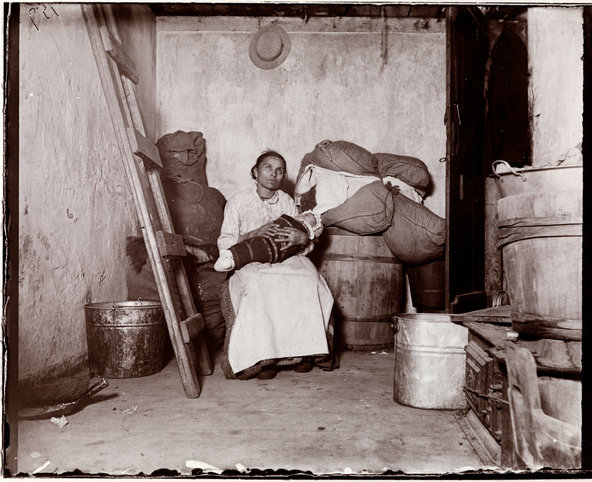
A hat-tip to journalist and educator Ted Gup for a terrific story about his discovery of a classic work of journalism history — the copy of How the Other Half Lives that was owned and annotated by the author himself, Jacob Riis. As I described him in my book, Covering America, Riis (pronounced rees) was a Danish immigrant to New York City who was shocked and outraged by the conditions he found in the city’s many tenements in the late 19th century. Picking up his notebook and a camera (equipped with a then-new technology — the portable flash), he explored the warrens of tiny, windowless rooms where New York’s newest and most miserable found cheap housing. In buildings lacking heat, ventilation and plumbing, the masses huddled while the wealthy were building ever grander pleasure domes uptown on Fifth Avenue and the rest of the Upper East Side. His work also provided a template for the journalists of the classic “muckraking” movement in the first decade of the 20th Century. 

An important thing to know about Riis’ expose, published in 1890, is that it had an impact. His photos and writing contributed to a political demand for improvements in New York City housing codes, which resulted in concrete improvements in the tenements. The city adopted new building codes that required more light, less crowding and, eventually, heat and plumbing.

In his piece in today’s Times, Gup — an investigative journalist himself who now chairs the Journalism Dept at crosstown Emerson College — describes how he stumbled upon a first edition of How the Other Half Lives that contains Riis’ own handwritten comments and marginalia. He also rightly commends Riis as a “multimedia” journalist for his combining of text and photos (and his use of a flash to light up those dark inner rooms of the tenements).

As many have observed (including the city’s new mayor, Bill DeBlasio), Riis is as relevant as ever, now that New York City is living through another Gilded Age in which wealth is as unevenly distributed as it was in the days of Rockefeller, Morgan, and Hearst.

"The Italian Rag-picker," by Jacob Riis, from his book, How the Other Half Lives.  Photo from Museum of the City of New York.

“The Italian Rag-picker,” by Jacob Riis, from his book, How the Other Half Lives.
Photo from Museum of the City of New York.


Leave a comment

Filed under history, Journalism, journalism history, Photojournalism, Politics

Partisanship in journalism: a discussion

By Christopher B. Daly

For readers’ convenience, I am posting some material that airs out the issue of partisanship in the news media. In sequence, here are:

1. A NYTimes invitation to a Sunday Dialogue, a feature of the paper’s Sunday Review section in which readers are asked to respond to a short essay.

2. My reply as published on Dec. 7, 2013.

3. A thoughtful email that I got from a reader, who gave me permission to post his ideas here.

4. The Sunday Dialogue replies by people other than me.

5. The original author’s reply to the replies.

6. My reply to that reply.
08letters-articleLarge


How Fox News, MSNBC and others present the news.

 To the Editor:

An autobiography gives an intimate account of a life, but to get the larger picture, you also need the biography.

The same goes for news. Relying on one source, or even on several sources with the same bias, will leave you with only part of the story.

That’s why the much maligned right-wing media is just as important as the so-called mainstream press. Fox News and others on the right certainly have a deeply embedded conservative bias, but the liberal bias on the other side is just as pervasive. Taken together, they roughly fill each other’s omissions.

Fox, for example, spent a good part of the past year digging into the Benghazi attack and I.R.S. tax-exempt status stories and talking hopefully about smoking guns, while the mainstream press was determined to take the Obama administration’s word for it that it did nothing wrong in either case.

More recently, when the president’s pronouncement about keeping your health insurance proved false, it was reported as a lie by the right and as a simple misstatement by the left.

And when the Obamacare website failed so miserably that not even the mainstream press could cover for it, the networks were obliged to sound like Fox for a while, although noticeably lacking was the appetite for pursuit that characterizes their coverage of Republicans.

Fairness in journalism requires not that every story or point of view receive equal weight but that every valid position receive equal respect. Thus the pro-life position should be treated with the same validity as pro-choice; small-government conservatives with the same respect as tax-and-spend liberals; Republicans as more compassionate than they sound and Democrats as less omniscient than they think.

But since journalists and news organizations are partisan at heart, one must sift through the best reporting and punditry from each side of the journalistic divide and take all the biases and agendas into account to arrive at an informed understanding of any story.

MARK R. GODBURN
North Canaan, Conn., Dec. 2, 2013

The writer is an antiquarian bookseller.

Here’s my comment:

In his lament about bias in the news media, Mr. Godburn assumes that unbiased journalism is possible and desirable. History suggests otherwise.

In the 18th and early 19th centuries, American journalism was highly political, often polemical and openly biased. That was the kind of journalism in which the likes of Sam Adams and Thomas Paine gloriously argued for liberty, and it was the form of journalism that was on the founders’ minds when they enshrined the doctrine of a free press in the First Amendment.

Only later, beginning with Benjamin Day’s Sun newspaper in 1833, did American journalists begin to develop a strong tradition of factual reporting. In part, this was the result of Day’s ambition to sell his paper to every reader (“It Shines for All”) and not limit his audience to members of any one political party.

In the 20th century, the major broadcast network news divisions, first in radio and then in television, reinforced this idea. They not only wanted the highest possible ratings, but were also operating as publicly traded corporations and were regulated by the Federal Communications Commission.

Nowadays, from within the turbulence of the digital age, we can begin to see that the years when big media companies were purveying what they described as nonpartisan, factual reporting were actually a historical period that is already fading into the past. The Internet has reinvigorated the “advocacy tradition” in journalism, and it has also made possible new forms of reporting such as crowd-sourcing, reporting that enlists the audience and the like. The spirit of innovation lives.

CHRISTOPHER B. DALY
Boston, Dec. 4, 2013

The writer is a professor of journalism at Boston University and the author of “Covering America: A Narrative History of a Nation’s Journalism.”

Here’s the email I got from blogger Steve Claflin:

Professor Daly:

Thank you for “Partisanship in the Media” in the December 8 New York Times letters.

The revived “advocacy tradition” problem you mention might be easier to manage if we had a form of majority rule that allows the general public to have more influence.

In the old days, the House was able to vote on any bill and the majority would prevail. Until an important bill recently passed by a wide margin, a Tea Party minority could usually intimidate other members, especially the Speaker, and prevent legislation that would easily pass from even getting to the floor. The minority party in the Senate can routinely block action on bills, because minority rule is built into Senate procedures. 60 votes are needed, with the help of a fickle minority, to pass legislation.

Is there anything more vital to democracy than majority rule? Is this what distinguishes democracy from autocracy? Is this what a democracy needs in order to succeed? We have the elections we normally associate with a democratic process. We reassure ourselves by going through the motions.

But the active ideological minorities in Congress, and the members who are owned and operated by special interests that donate large sums of money, are repeatedly able to slow or block or derail changes those few oppose and the rest of us generally favor. As such repeated occurrences so rudely remind us, we can have the structure, the trappings, the proceedings, the appearance of democracy without having majority rule.

Here are the other comments published in the Times:

Readers React

In an ideal world, graced by Enlightenment ideals, Mr. Godburn’s recommendation that citizens sift through biases of diverse news media outlets to form a complete perspective would be warmly endorsed. However, in this far-from-ideal world, individuals live in media echo chambers, selecting out viewpoints that agree with their own and sometimes avoiding conflicting ones.

Research finds that conservatives gravitate to Fox News and liberals to MSNBC — as well as to like-minded websites. A Pew Research Center study reported that from August to October of 2012, just 6 percent of Fox News’s election stories about President Obama were positive, while only 3 percent of MSNBC stories about the Republican presidential candidate Mitt Romney were positive.

Exposure to biased media strengthens partisan biases, exacerbating political polarization rather than producing the more informed understanding that Mr. Godburn desires.

RICHARD M. PERLOFF
Cleveland, Dec. 4, 2013

The writer is a professor of communication at Cleveland State University.

I read The New York Times every morning. I also watch more MSNBC than I like to admit. Occasionally, for entertainment, I’ll wander to Fox for a Bill O’Reilly moment or two.

Mr. Godburn’s thesis is an example of false equivalence. The Times is real journalism. But even The Times sometimes stretches too far in the service of “journalistic objectivity.” When one perspective is true and the other is propaganda, they should not be presented as equally valid.

As to MSNBC and Fox: The MSNBC host Rachel Maddow, for example, is surely dramatic. But I have never encountered an instance in which she was fundamentally dishonest. On the other hand, Fox is frequently and outrageously untethered from the truth, and its talking heads are attack dogs. Anyone consuming equal doses of this “news” will have intellectual indigestion.

If you bend over too far in the effort to be balanced, you’ll fall flat on your face.

STEVE NELSON
New York, Dec. 4, 2013

Well said, Mr. Godburn. Political correctness and a pervasive left-wing media bias are corrosive and do immense harm to the democratic process. People eventually find out that they have been misled. This breeds cynicism and mistrust. The left and the right learn to develop their own separate versions of the “truth.”

But while most right-wing news sources acknowledge their bias, those on the left deny their bias. Left-wing news sources are suffering a fallout in ratings because people are waking up to these facts and don’t like being manipulated.

FRANK COOK
Wayne, Pa., Dec. 5, 2013

Mr. Godburn makes a telling point, but he doesn’t go nearly far enough. His assertion that liberal and conservative news outlets “roughly fill each other’s omissions” assumes that there are exactly two reasonable points of view toward any given social issue; that these viewpoints are locked in a zero-sum game whereby each one can be validated only to the degree that the opposing one is impeached; and that they happen to correspond to the platforms of our two leading political parties.

Both parties are only too eager to promote this theory themselves, since it implies that together they have a monopoly on the truth. So a responsibility of both a free press and its readers is to examine both contrary viewpoints critically and consider other viewpoints — a third, fourth or fifth perspective — that have not been embraced by either side.

THOMAS LEITCH
Newark, Del., Dec. 4, 2013

Balanced news media is essential in any democracy. But let’s remember what brought us to the present situation — the 1987 repeal of the Fairness Doctrine, which required the airing of contrasting views on public issues, and the loosening of regulations on media concentration, allowing many media outlets to fall under the control of a few corporate-owned conglomerates.

Both have created a situation in which media is not only biased and unbalanced, but overwhelmingly influenced by the opinions and wishes of its corporate masters.

DOMINIC QUINTANA
Astoria, Queens, Dec. 4, 2013

Having recently returned from a trip to Brussels, I found the evening news there to be refreshing and professional. One subject wasn’t beaten to death 24/7 as it is here. You didn’t have to flip from channel to channel to see the “whole” picture, and the news was international in nature. In the United States you rarely hear about what is going on in Africa, Australia and, actually, most of the world.

It is a shame.

BONNIE CHALEK
Ridgewood, N.J., Dec. 4, 2013

I agree with Mr. Godburn that we need different perspectives. I would like to point out that Fox News is the No. 1 news source in America. Surely, that should qualify Fox as “mainstream.”

Studies have also shown that, for many Americans, Fox News is their only source of news. Those viewers are getting a slanted perspective — not balance. Defenders of Fox News often portray it as an underdog struggling to have a voice in the crowd of “mainstream” outlets, but that depiction simply isn’t consistent with its ratings.

I commend Mr. Godburn for admitting that news outlets he identifies as left-leaning did report on the problems with Obamacare. I find that so-called left-leaning news outlets, including The New York Times, are frequently critical of Democrats and their policies.

Mr. Godburn would have a much more difficult time finding comparable examples of Fox News criticizing the G.O.P. — except perhaps when it criticizes moderate Republicans for not being in lock step with the rest of their party.

TOBY PLEWAK
Easton, Mass., Dec. 4, 2013

It may be a fool’s errand to think that we can overcome media bias. The media is ultimately a collection of voices of various people, who generally stick to certain biases and opinions. The answer instead may be to encourage media outlets to be more forthcoming about their biases.

If we, as media consumers, know that a mainstream news outlet typically holds a certain viewpoint, then we can take in the news with a better understanding of what information may be missing or may be shaded one way or another. As it is, given the rather obvious political positions held by certain newspapers and television news divisions, many of us have already begun interpreting the news in this way.

MATTHEW K. KERFOOT
New York, Dec. 4, 2013

Here is Godburn’s last word:

The Writer Responds

Professor Perloff reinforces my point by noting that conservatives gravitate to right-leaning news sources and liberals to left-leaning ones, often without being exposed to contrary views or inconvenient facts.

But then he says that going to such biased sources only exacerbates the problem, as if he thinks there are reliably unbiased sources that one can go to instead. There are not, and that is why it is necessary to mine a variety of biased ones.

Mr. Nelson engages in the cheap liberal tactic of Fox-bashing. If Fox’s talking heads are attack dogs, they are poodles compared with the pit bulls he favors at MSNBC. Simply calling one’s favored sources true journalism and the other side propaganda doesn’t make it so. And if too much news causes intellectual indigestion, too little causes intellectual blinders.

Mr. Leitch is correct that there are more than two points of view. And examining all of them will not necessarily allow one to arrive at some desired middle ground. Just because you have one foot in hot water and the other in cold doesn’t mean you’re comfortable.

Professor Daly’s claim that I assume unbiased journalism is possible and desirable may have been a good lead-in for his journalistic history lesson, but that’s not what I said. The problem is not that journalists are biased — it’s that they claim they aren’t.

MARK R. GODBURN
North Canaan, Conn., Dec. 5, 2013

And, of course, since this is my blog, here’s my final, final word:

I will grant that maybe I misread his original post. When he wrote that all journalists and news organizations are partisan at heart, I thought he considered that a flaw. Perhaps inevitable, perhaps correctable (by reading multiple sources from different perspectives) but still a problem. If he says he doesn’t think so, then who am I to argue? I would say that many people (including a lot of journalists) do consider partisanship some kind of original sin of journalism.

Comments?

Leave a comment

Filed under blogging, broadcasting, First Amendment, history, Journalism, journalism history, media, New York Times, Politics

Surveillance state: The rationale for secrecy is, of course, SECRET

By Christopher B. Daly

top-secret-stampYou may think you are a sovereign citizen of a free country. You may think that “we, the people” rule through elected representatives who are accountable to us. But that would be wrong.

The latest affront to self-government is a ruling issued by a federal appeals court on Friday (beware of Friday rulings). Here’s the background:

Thanks to accused leaker Edward Snowden, we know that the U.S. government runs a secret program in which the government calls on the telephone companies to hand over information about you without a court order or subpoena, even if you are not suspected of any wrongdoing. You were not supposed to know about it, but that cat is now out of the bag.

So, you might want to know where the government gets off concocting such a scheme and how it could possibly square such massive, secret, peacetime spying on law-abiding citizens with the Constitution. Well, too bad. The Obama administration’s lawyers, who wrote a memo in 2010 attempting to justify the whole thing, decided that the memo itself should be kept secret, and President Obama agrees.

The Electronic Frontier Foundation and others filed suit seeking to get access to the memo. The government refused. On Friday, Judge Harry T. Edwards said no. EFF can’t see it and neither can we, the people. According to a link-rich story in today’s Times by the redoubtable Charlie Savage, the ruling seems likely to stand.

This is just the latest cause for disappointment in President Obama when it comes to transparency and press freedom. If he wanted to really serve those great causes, he could:

–stop prosecuting and issuing subpoenas to reporters at an unprecedented pace

–stop over-classifying new material as “secret”

–begin reducing the backlog of classified materials that can be de-classified with no harm

–adopt the common-sense reforms recommended by his own task force on surveillance issues.

There are many things to admire about Barack Obama, but his record in this area is not one of them Perhaps it confirms that the Founders were right to be suspicious of executive power per se, regardless of the individual wielding that power. They saw, rightly, that power is by its very nature aggressive, always seeking to expand and never yielding unless forced to do so.

Leave a comment

Filed under First Amendment, history, Journalism, journalism history, leaks, New York Times, Politics, President Obama, Uncategorized

Million+ historic photos put online

By Christopher B. Daly 

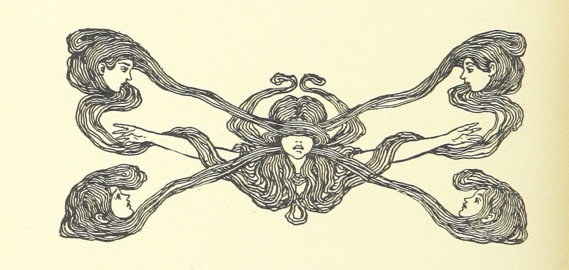
Don’t miss: if you are a historian, researcher, or dedicated browser, visit the new flickr site of The British Library. The library recently made news by posting more than 1 million historic images — all digitized, all in the public domain, and all available for use now. Plus, there’s metadata for each one. The site is not as easy to navigate (it’s actually a bit overwhelming) as the U.S. Library of Congress site for the Prints & Photographs Division, but I’m hardly complaining.

It’s also based on flickr, so you need to have an account to take full advantage. (I tried to re-activate my old Yahoo account — Yahoo bought flickr a few years ago — but it was so cumbersome and annoying that I gave up, for now. I got these images by dragging them in from news sites.)

British Library Flickr


blflickr5_0

Leave a comment

Filed under history, journalism history, Photography, Photojournalism, Uncategorized