Monthly Archives: February 2013

Free speech in India

Here is a view from Suketu Mehta, the author of the wonderful book Maximum City, about Bombay.

The takeaway:

This year, the world’s largest democracy ranked a miserable 140th out of 179 countries in the Reporters Without Borders Press Freedom Index— falling nine places from last year. Today, Afghanistan and Qatar have a freer press than India.

In recent years, the government has cast a watchful eye on the Internet, demanding that companies like Google and Facebook prescreen content and remove items that might be deemed “disparaging” or “inflammatory,” according to technology industry executives there.

In November, police in Mumbai arrested a 21-year-old woman for complaining on Facebook about the shutdown of the city after the death of the nativist politician Bal K. Thackeray; another Facebook user was arrested for “liking” the first woman’s comment. The grounds for the arrests? “Hurting religious sentiments.”

Leave a comment

Filed under Uncategorized

Obama and secrecy

By Christopher B. Daly 

Sadly, the Obama administration is continuing to drag its heels in releasing the rationale for its policy of killing people — including American citizens — with drones. No one is asking Obama to reveal any operational secrets. But every American, including every member of the Democratic Party, should demand the instant release of the policy, which is still being kept an official secret. If Obama and his team can find a justification for his policy under the U.S. Constitution and/or international law, so be it. I want to examine it and decide for myself.

What is intolerable is the idea that the president can assume the power to order executions without bringing charges, holding a trial, or offering any other safeguards. His policy, so far, is “trust me” — which is tantamount to repealing the rule of law and substituting personal power. He is taking on the role of the tyrant who says of his perceived enemies, “Off with his head!” Obviously, if George W. Bush did something like this, liberals would react with outrage. For the same reasons, Obama’s actions to date have been equally outrageous. The American people have not only a right but a responsibility to know what is being done in our name.

It doesn’t matter if the cause is just or if his intentions are good. If he operates outside the law, then he’s a tyrant.

Luckily, someone leaked the Justice Dept “white paper” about drone executions to NBC News. That is a description of the policy, not the policy itself.

Today’s Times has a good package of pieces, including:

–a triple-byline page 1 lead story, (dateline: SANA, Yemen),

–a double-byline analysis of the legal situation (in which the Times downplays its own FOIA suit), a note from the paper’s Public Editor,

–a full-blown expert debate,

–graphics, video, and more.
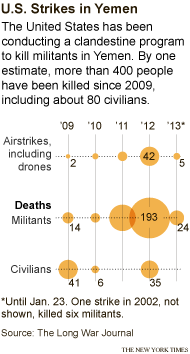
Source: The Long War Journal

Source: The Long War Journal


It should also be noted that many others are reporting on this (a hat-tip to the Washington Post), or suing over it (a hat-tip to the ACLU), or waging a political fight against the administration (oh, wait: no one is!).


This is not over.


Here is the main takeaway from the legal piece, which begins by noting that Obama rejected the Bush administration’s decision to shroud its torture policy in secrecy:


In the case of his own Justice Department’s legal opinions on assassination and the “targeted killing” of terrorism suspects, however, Mr. Obama has taken a different approach. Though he entered office promising the most transparent administration in history, he has adamantly refused to make those opinions public — notably one that justified the 2011 drone strike in Yemen that killed an American, Anwar al-Awlaki. His administration has withheld them even from the Senate and House intelligence committees and has fought in court to keep them secret, making any public debate on the issue difficult.


Leave a comment

Filed under Journalism, President Obama

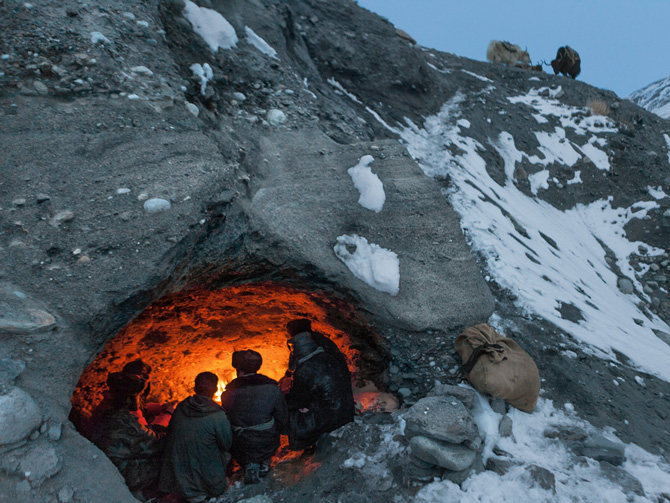
Great photos from “the Roof of the World”

By Christopher B. Daly

Thanks to Matthieu Paley, a French photojournalist, we can sit in our warm homes and offices and see these amazing images from what is perhaps the most godforsaken corner of

Wakhan Corridor

Wakhan Corridor

Afghanistan. This is where, basically, if you felt the urge to walk from Afghanistan to China, you would have to go.

Thanks also to the NYTimes‘ valuable Lens blog, which is where the Times features a lot of its best visual journalism in photos, slides, and video.

Here’s the link.

[Two gripes: The Times should make it easier to find this stuff on its homepage.

The Times should stop blocking the copying of these images. (I realize that a lot of the contributors are not Times employees and that many of these projects are sponsored by someone else — such as, in this case, National Geographic. Still, in the long run, I think it’s more valuable to reach out than to keep out.)]

Oddly, the photos are readily available at the NatGeo site. So, thanks very much to NatGeo.

Here are two:

08-seeking-shelter-in-shepherds-cave-670

15-kyrgyz-horsemen-buzkashi-670


Leave a comment

Filed under Journalism, Photography, Photojournalism

Tyler Hicks: photos from Timbuktu

By Christopher B. Daly

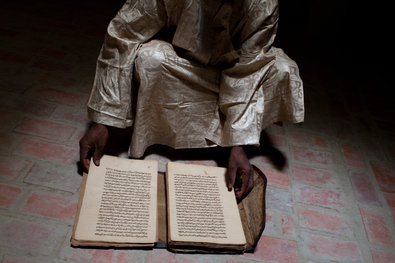
The intrepid Tyler Hicks, conflict photographer for The New York Times, has made it to Timbuktu, recording the campaign to oust the Islamic militants who briefly held the remote city and the aftermath of the city’s liberation. Hicks (a graduate of the program where I teach at Boston University) has been to all the major hot spots in recent years and has survived a number of threats, including kidnapping. We should all treasure his work:

An ancient manuscript saved from destruction. Photo by Tyler Hicks / NYT

An ancient manuscript saved from destruction.
Photo by Tyler Hicks / NYT


2 Comments

Filed under Journalism, New York Times, Photography, Photojournalism

Civil War at 150

By Christopher B. Daly

Among the many worthwhile efforts to recall the U.S. Civil War on its 150th anniversary is an attempt to add a visual dimension. The “Civil War 150 Pinhole Project” is reviving the technology of the pinhole camera to make dramatic images of re-enactors and others. A hat-tip to Michael Falco, a photographer based in NYC for making this happen.

Some results:

Antietam cornfield

Antietam cornfield

crossing_artillary

Leave a comment

Filed under history

Obama: Wrong on secrecy (cont.)

By Christopher B. Daly

Bully for the NYTimes for continuing to try to pry out the details of the Obama administration’s secret policy governing the secret use of drone weapons.

Shame on the Obama administration for continuing to try to stonewall the rationale for the policy. As a citizen, I feel entitled to see the argument for doing this. imgres3

Leave a comment

Filed under Journalism, President Obama, Uncategorized

How many Stonehenges in Boston?

By Christopher B. Daly 

Here’s a really cool idea: there are certain days of the year when the sun sets at an exact point such that it aligns with some of the long avenues or whole chunks of gridded streets in Boston. This is a natural fact, based on the fact that the point on the horizon where the sun disappears marches with regularity from what appears to be the southwest to the northwest as the days lengthen from the winter solstice, on ~Dec. 21, until the summer solstice ~June 21. At that point, the process goes into reverse as the days shorten again.

This insight is not new. In fact, it was the basis for many ancient time-keeping schemes, notably Stonehenge in England, where the massive stones are aligned to measure the return of the sun to particular spots in the sky at regular intervals.

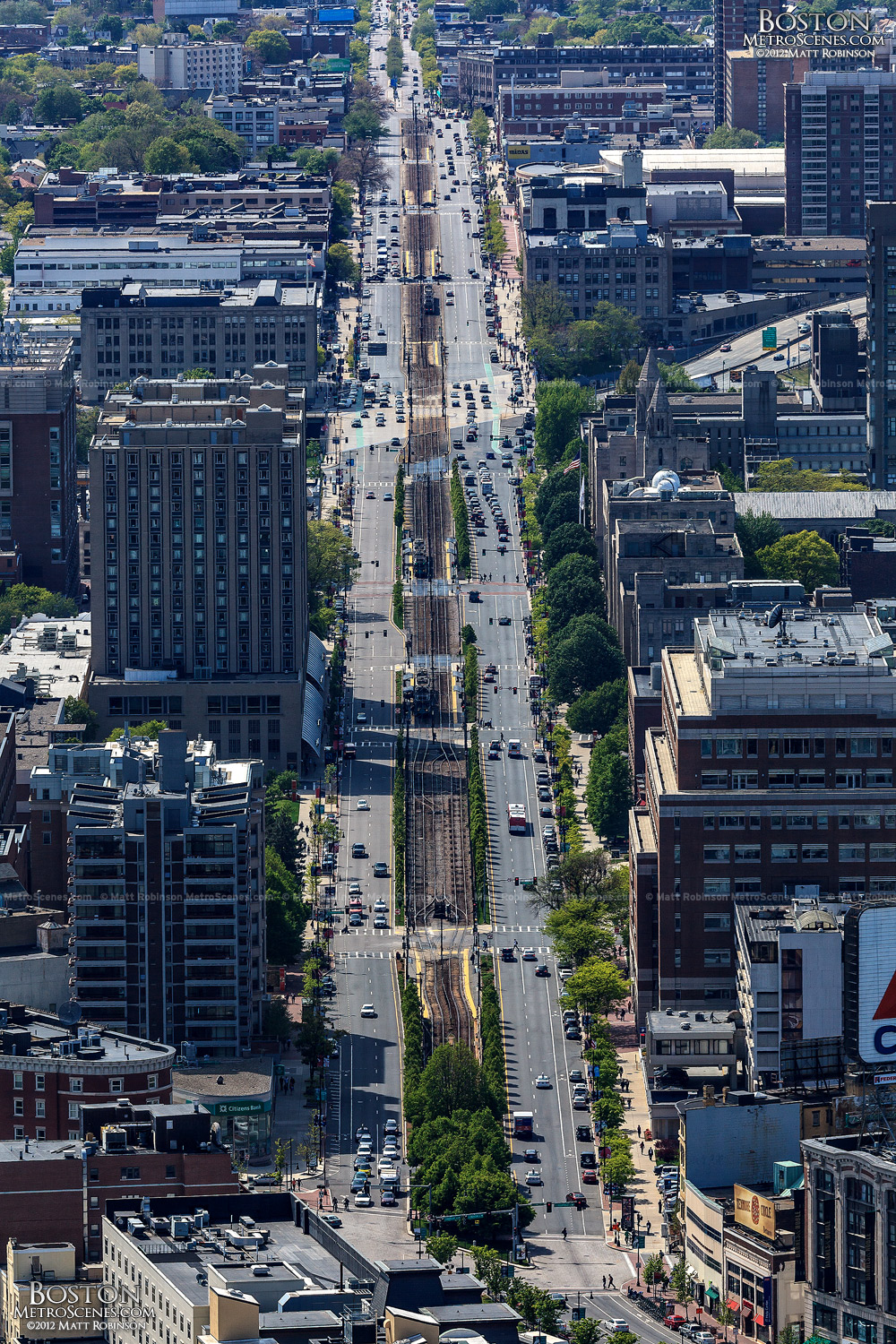
According to mapmaker Andrew Woodruff, writing in today’s Boston Globe, the same phenomenon plays out in several obvious places in the Boston area — notably, by own campus bostonhenge_for_WEB900px2at Boston University. One such alignment involves Commonwealth Avenue, a very wide boulevard, which heads straight west from Kenmore Square to Packard’s Corner with great unobstructed views. The next alignment of the setting sun is due to occur on April 4-5, followed by another shot on Sept. 6-7. (The same thing works in reverse for sunrises, but I am omitting those because I have no intention of getting to work that early and neither, apparently, do the overwhelming majority of my students.)

According to this sunset calculator, the sun should be setting on April 4 at 7:14 p.m. Since it’s a Thursday, I will be in class until 5 p.m., then back in my office, which is actually on Comm Ave. So, to be on the safe side, I plan to step out onto the avenue around 7:00. I plan to turn left and start shooting photos. If I make it to the high point where Comm Ave crosses over the Mass Pike in time, I should have a great vantage point, about a mile east and west.

See you there. I’m just hoping it’s not raining.

url


On April 4, I

Leave a comment

Filed under Boston

The Times loses institutional memory

By Christopher B. Daly 

New York Times public editor Margaret Sullivan, who is supposed to be looking out for us readers, acknowledges in her column today what many have long suspected — that is, the current round of staff reductions in the Times newsroom would target the older (higher cost) reporters and editors. That, in turn, means that the newsroom is losing some folks with some special virtues that are hard to make up for in younger hires.

1. They remember stuff. Even while older people start forgetting this and that (and I put my forefront of this trend), we have been around so long that we remember things that are hard to know any other way but by living through them. Does Ed Koch deserve a big send-off? Was he a jerk? Is something that just happened really “unprecedented” or just unusual? Should a newspaper publish everything it can get its hands on, or are some things better left alone?

2. Odds are, the older people are a little less intimidated by the people who hold formal power. They are the kind of people who (might) speak up in a meeting and say “So what?” or “Why?” Usually, the younger people are eager to agree and just want to know how high to jump. Case in point: Jonathan Landman. When he was on the Times city desk a decade ago, he had the nerve to doubt one of the paper’s rising stars — Jayson Blair. He tried to stop Blair from his serial inventions and plagiarism, and that is no easy thing to do in any newsroom.

So as they shuffle off to early retirements, a tip of the hat to some of those newsroom veterans. It will take a long time to replace them.

Leave a comment

Filed under Journalism, New York Times

On covering Ed Koch

By Christopher B. Daly 

Ed Koch, who died this week, was the mayor of NYC while I lived there, from the fall of 1976 to January of 1980. He was never my favorite politician, but he must have been fun to cover. Here is a collection of tales form the City Hall pressroom.

Ed Koch talking to reporters at Gracie Mansion, the city's official mayoral residence.

Ed Koch talking to reporters at Gracie Mansion, the city’s official mayoral residence.


Leave a comment

Filed under Journalism, journalism history

Washington Post downsizes

By Christopher B. Daly 

Seeing that the Washington Post is planning to sell its downtown D.C. headquarters, I guess I feel like a kid whose parents sell the old family home to move into a condo. It was such a thrill to go there for meetings when I was the paper’s New England correspondent during the 1990s. The Post was still printing money in those days, and there was a great feeling of energy and clout about the place. 

Actually, I remember my very first visit. I was seriously disappointed about the drab appearance of the exterior. It met the street like a cheap commercial building — all concrete and shadows. It made me wish that Mrs. Graham had struck a deal with I.M. Pei to design a headquarters in the shape of a typewriter!

Anyway, all things must pass. And I am sure that the Post offices in DC are more valuable as real estate than as a home for a shrinking workforce.

imgres

Leave a comment

Filed under Journalism, journalism history, Uncategorized