Tag Archives: journalism

Presidential debate: The global perspective

By Christopher B. Daly

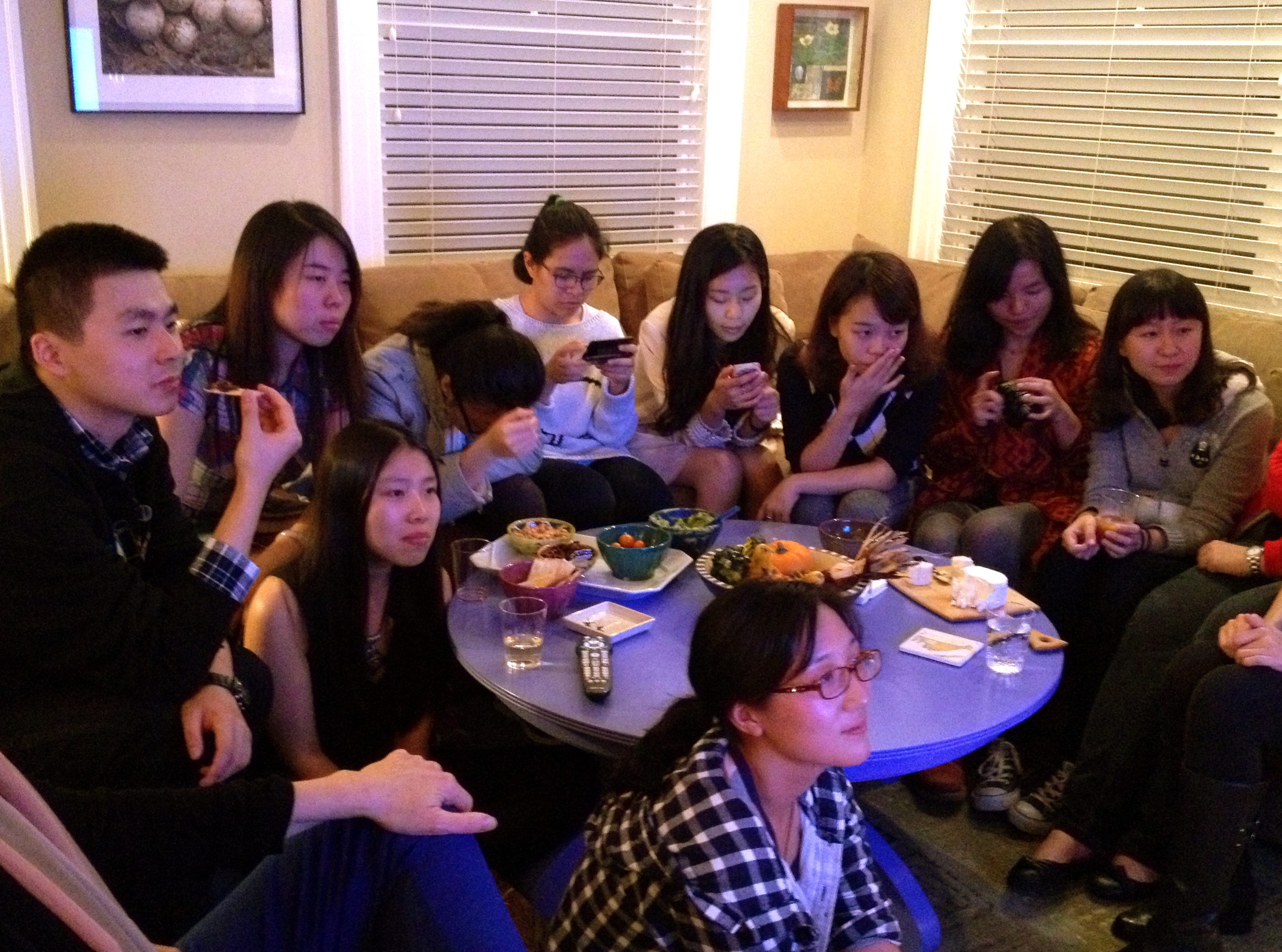
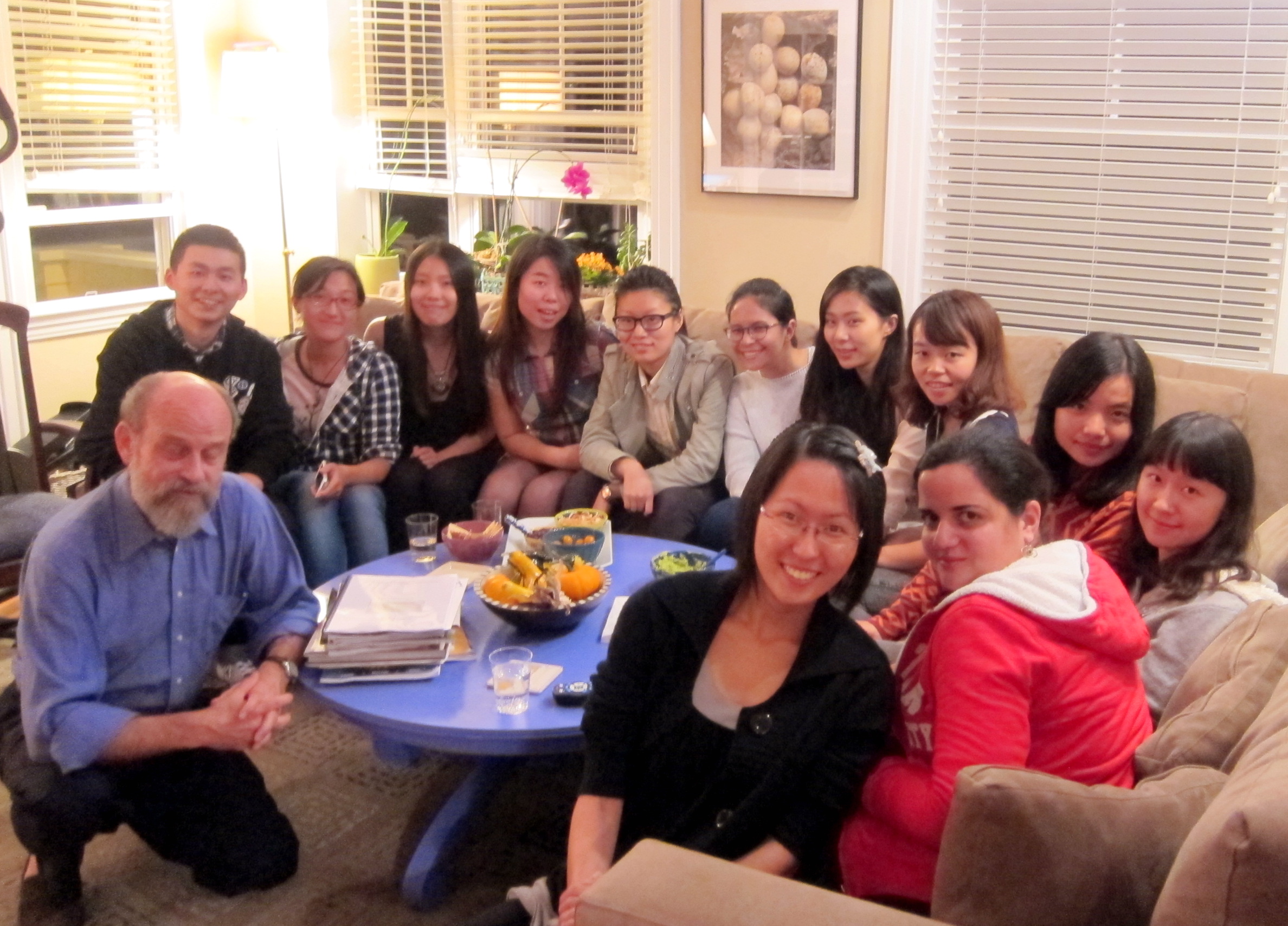
I had the opportunity to watch the presidential debate last night with a unique group of non-voters: a dozen grad students enrolled in the Journalism Dept at Boston University. I teach all of these great young people in a special class for the new students from overseas.


As you can see, they were really dialed in and asked great questions.


I think quite a few of them were perplexed by Obama’s disappointing performance (but were too polite to dump on him!).

Note to academic advisers: tell your students not to take classes with professors whose eyes are shut.

Leave a comment

Filed under Journalism, Politics

Journalism history: a personal note

By Christopher B. Daly 

The Times has a piece today in the Science section about the downside of not drinking alcohol in certain professions. Speaking for the news business, I would say that would be a definite drawback — or at least it was, back in the 1970s, when I was breaking in. Without taking a position on the merits of drinking, I will say I was taken back by the photo that illustrates today’s Times piece: it shows the Pig ‘N’ Whistle, a bar on W. 48th St. in Manhattan, just south of Rockefeller Center. That’s the place where I and my colleagues at The Associated Press (50 Rock) went to drink (ahem, after work), joined by our colleagues from NBC News (30 Rock) and the various media over on 6th Ave.

It’s good to know that “the Pig” is still in business, quenching journalists’ thirsts.


Leave a comment

Filed under Journalism, journalism history

Quote Approval: NYTimes bans it

By Christopher B. Daly 

It was the only decision they could have made, but credit New York Times executives with deciding to ban the pernicious practice of “quote approval.”

In an announcement made Thursday, the paper said it would no longer allow its reporters to grant their sources the power to approve their own quotes before they appear in news stories. The Times was slow in figuring this out, but a right decision is always welcome.

Here’s the takeaway:

. . .starting now, we want to draw a clear line on this. Citing Times policy, reporters should say no if a source demands, as a condition of an interview, that quotes be submitted afterward to the source or a press aide to review, approve or edit.

That should have been self-evident.

Leave a comment

Filed under Journalism, New York Times, Uncategorized

Quote approval: Threat or menace?

By Christopher B. Daly

Now comes word that no less a journalist than the estimable Michael Lewis (of Moneyball and The Big Short) bowed to demands that he grant the White House approval over any quotes in exchange for some pretty unusual access to President Obama.

Although this is not a simple question, I believe it has a simple answer: don’t do it.

Journalists should help each other to stand firm against this pernicious practice.

Think about it this way: Everything always comes out eventually.

Accepting grounds rules like quote approval just corrupts journalism and gives readers another reason not to trust us.

In the latest case, Michael Lewis should have kept in mind that Obama needs him every bit as much as he needs Obama — maybe more. Sheesh.

Photo by Pete Souza (Official White House photographer -- and B.U. alum)

Photo by Pete Souza (Official White House photographer — and B.U. alum)


Leave a comment

Filed under Journalism

Clay Shirky on the journalism business model

By Christopher B. Daly

The new issue of the Columbia Journalism Review has a terrific piece by Clay Shirky about the current efforts to rescue journalism by finding a new business model for the news business. (Don’t get discouraged by the misleading — confusing? — headline.)

Shirky, who teaches about these issues at NYU’s Carter Institute of Journalism, compresses a lot of the points I made in my recent book, Covering America, in chapter 3 (about the rise of the Penny Press) and in chapter 13 (about the collapse of the “dual revenue stream” that financed journalism from the 1830s to the 1990s). In my book, the final chapter adds some recent success stories, showing how some digital natives are making a go of it in the new environment — doing great, serious journalism and, importantly, making money at the same time.

In my view, too many of us suffer from the historical fallacy of thinking that the present is “normal” and reflects the way things have always been. A lot of people, especially those over 35 or so, operate on the assumption that it is normal for journalism to be practiced by full-time employees of large, profitable corporations. In fact, by taking the long view, as I do in my book, it can be seen that the way journalism was practiced in the late 20th Century was not inevitable, not necessary, and certainly not permanent. It is already fading into the past as a distinct historical period, giving way to a present in which people are still figuring out the future.

1 Comment

Filed under business, Covering America, Journalism, journalism history

The digital future is here

By Christopher B. Daly

Exhibit A: today’s New York Times politics section.

The on-line version shows the rapid evolution of a news organization from what used to be a print-only operation into a full-fledged multimedia operation.
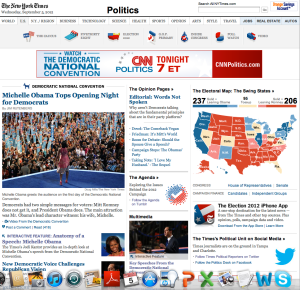
Among the many features:

–A dynamic map of the Electoral College vote totals.

–Many color photos, including a slideshow. Plus, a trip through the Times photo archives with a b&w slideshow from 1968.

–Videos of the key speeches.

–Blog posts by beat reporters discussing their specialties.

–An old-fashioned “lede-all” main story, but one that has 416 comments (and counting).

–A behind-the scenes “TimesCast” in which a Times editor interviews a Times reporter.

–More than a dozen sidebars.

–Lots of old-fashioned “eat-your-peas” civics information, including a helpful side-by-side comparison of the two party platforms.

–Material carried forward from the GOP convention (which newspapers could never do when they were print-only).

–An interactive feature about undecided voters.

–An iPhone App, twitter feeds, a Facebook page. . .

It just goes on and on. All of which raises a question: which business is the New York Times really in? After more than 150 years in the newspaper business, I would say the Times can say it is in the news business, period.

Well, almost. That politics homepage that has so many features (and which reflects the work of I don’t know how many trained professionals — many dozens, certainly, maybe in the low hundreds) has mighty few ads. I see:

–a banner near the top from CNN,

–a second ad from CNN in a box in the right column.

–a couple of “house ads” touting NYTimes services, which bring in no money.

–a small ad from Corcoran Real Estate about waterfront estates in Delray Beach

–A “GoogleAd” for Trader Joe’s coupons.

I have no idea how much revenue those ads are bringing in. All told, however, I  am sure that they don’t amount to a fraction of the cost of putting all those reporters and editors in Charlotte, NC, plus the cost of the team in NYC who are helping out.

For now, then, it must be acknowledged: the tools and the philosophy of online news have outrun the business model. This is impressive but not sustainable. Yet.

Will it be self-supporting by 2016?


Leave a comment

Filed under Journalism, New York Times, Uncategorized

Journalism issues galore

By Christopher B. Daly

Lots to catch up with this Labor Day:

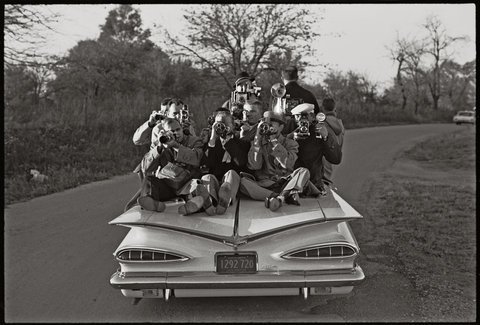
–A very thoughtful piece by Sasha Issenberg from the Sunday Timesabout a possible skills gap between political reporters and political operatives.

Nice slideshow goes with it, including this photo from the 1960 Kennedy campaign:

Paul Schutzer/Time & Life Pictures — Getty Images

Paul Schutzer/Time & Life Pictures — Getty Images


I wonder what Nate Silver thinks of all this?


–A new David Carr column about Reddit. (which may be the ugliest site on the Web.)


–A look at the top lawyer at Twitter, who makes the day-to-day calls on freedom of speech.


–A fascinating peek at how the New Orleans Times-Picayune is tip-toeing across the scary rope bridge to the future. Here’s a prior post.


Leave a comment

Filed under Journalism, journalism history, Politics

Clint Eastwood: Questions for journalists

By Christopher B. Daly 

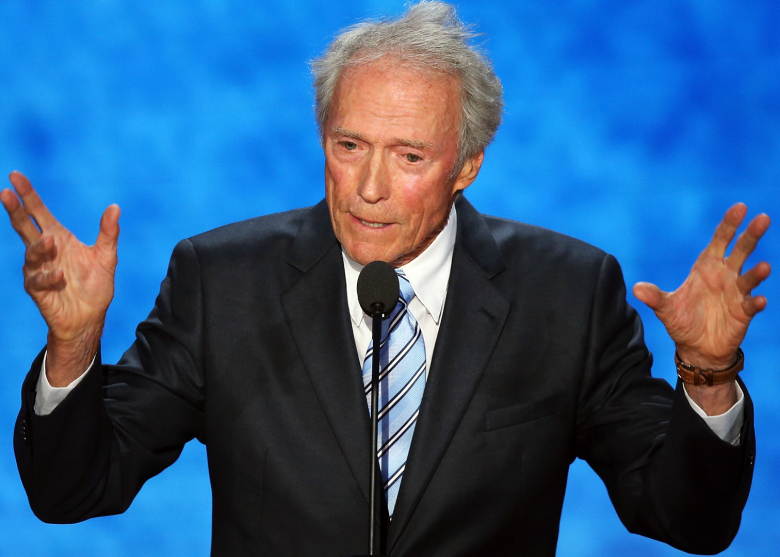
In the aftermath of the Republicans’ “big night,” two questions occur to me about the appearance by the actor Clint Eastwood. These questions seem worth raising, but I have not seen any traces in the mainstream coverage:

1. Who approved the decision to put Eastwood on the GOP convention schedule? Who allowed Eastwood to hijack the agenda at that critical moment of prime-time exposure? Did Romney do so himself? If so, what kind of judgment does that show? What political aim was advanced (or meant to be advanced)? Was it presidential?

Clint Eastwood / CBS News

Clint Eastwood / CBS News

2. A useful thought exercise: when covering politics in a two-party system, it is often useful to turn the mirror around and ask, “What would happen if the other party did this?” In this case, you would have to ask, What would happen if the Democrats chose to spotlight a left-wing Hollywood figure in prime time? Furthermore, what would happen if that left-winger had a reputation for menace and incipient mayhem? And what if that figure showed up apparently disheveled and engaged in a vulgar, intermittently incoherent rant? What if that person disrespected the office of the presidency by talking down (literally) to a seated imaginary president?

1 Comment

Filed under Journalism, Politics

Obama: Media Critic?

By Christopher B. Daly

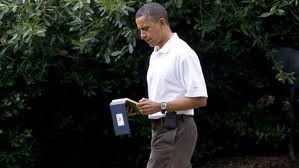
Even on vacation, I couldn’t help noticing this piece in today’s Times about President Obama’s news-reading habits and his criticisms of some of the coverage. 

As a media critic myself, I am not sure how I feel about adding this new guy to the ranks. But he does seem to have a grasp on some major issues. From the Times:

The news media have played a crucial role in Mr. Obama’s career, helping to make him a national star not long after he had been an anonymous state legislator. As president, however, he has come to believe the news media have had a role in frustrating his ambitions to change the terms of the country’s political discussion. He particularly believes that Democrats do not receive enough credit for their willingness to accept cuts in Medicareand Social Security, while Republicans oppose almost any tax increase to reduce the deficit.

Privately and publicly, Mr. Obama has articulated what he sees as two overarching problems: coverage that focuses on political winners and losers rather than substance; and a “false balance,” in which two opposing sides are given equal weight regardless of the facts.

Mr. Obama’s assessments overlap with common critiques from academics and journalism pundits, but when coming from a sitting president the appraisal is hardly objective, the experts say.

Irony alert: after quoting Obama on the problem of false balance and explaining the concept, the piece goes on to engage in the very practice.

To his credit, Obama seems to read a lot, and that can’t be a bad thing.

Now, back to the beach.

Obama reads his iPad while walking. ABC News.com

Obama reads his iPad while walking. ABC News.com

Leave a comment

Filed under broadcasting, Journalism, Politics, President Obama

Murdoch scandals (cont.)

The estimable John F. Burns updates the unfolding Murdoch meltdown in today’s Times.

Question: will we ever see Murdoch in handcuffs, or slinking into a courthouse with a trenchcoat over his head?

Here’s the takeaway:

What is becoming clear, media analysts say, is that the push-the-legal-limits newsroom culture that has gone untrammeled for years at the British tabloids and has even found its way into some of the country’s upmarket broadsheets, including Mr. Murdoch’s Times and Sunday Times, could be a casualty of a new culture of caution.


Already, some who work at British newspapers say, the scandal has had a chilling effect on newsrooms, with editors, reporters and their proprietors less eager to trumpet splashy exposes that might involve, or be perceived to involve, less than ethical standards of news gathering.

One tabloid journalist, who insisted on anonymity because of concern for his job, lamented what he called the end of the “anything goes” era. “Before, it was a case of ‘Don’t tell me how you get it, just get it,’ ” he said. “Now things are looked at differently.”


l-r: Coulson, Murdoch, Brooks, shown in a church service in 2005. Photo by Graeme Robertson/Getty

l-r: Coulson, Murdoch, Brooks, shown in a church service in 2005. Photo by Graeme Robertson/Getty


Leave a comment

Filed under Journalism, Murdoch scandal