Tag Archives: journalism

Bezos to Post: “Don’t be boring!”

By Christopher B. Daly 

This seems like good news: Jeff Bezos, the new owner of The Washington Post, went into the lions’ den to greet the news staff and came out a hero. By the Post’s own account, Bezos made a hit during his day of meetings.

Among his thoughts:

–“Don’t be boring.” (Good advice for a newspaper, but too often honored in the breach.)

–“What has been happening over the last several years can’t continue to happen,” he said. “If every year we cut the newsroom a little more and a little more and a little more, we know where that ends.”

— “All businesses need to be forever young.. . ”

The Bezos visit caused an explosion on Twitter, including many posts by Posties. See #bezospalooza

Is this man ready for the Style section?  Post photo

Is this man ready for the Style section?
Post photo

Leave a comment

Filed under Journalism, journalism history, publishing, Uncategorized

Glass half full: NYT posts a profit due to online readers

By Christopher B. Daly 

The NYTimes Co. reports some good news: the company operated in the black last quarter, and it did so no thanks to advertising. What carried the news operation into profitability was the surge in online readers who are actually paying for content. Here are the key results:

Circulation revenue rose 5.1 percent, to $245.1 million, from $233.3 million. But that gain was largely offset by a 5.8 percent decline in advertising revenue, to $207.5 million.

The number of paid subscribers to the Web site, e-reader and other digital editions of The Times and The International Herald Tribune grew to 699,000, a jump of more than 35 percent from the period a year earlier. Digital subscriptions to The Boston Globe and BostonGlobe.com rose to 39,000, an increase of nearly 70 percent from 23,000 a year earlier.

If you are a paying customer of the Times, pat yourself on the back. If not, PAY UP!

Leave a comment

Filed under Uncategorized

Historic journalism: 1852 edition

By Christopher B. Daly

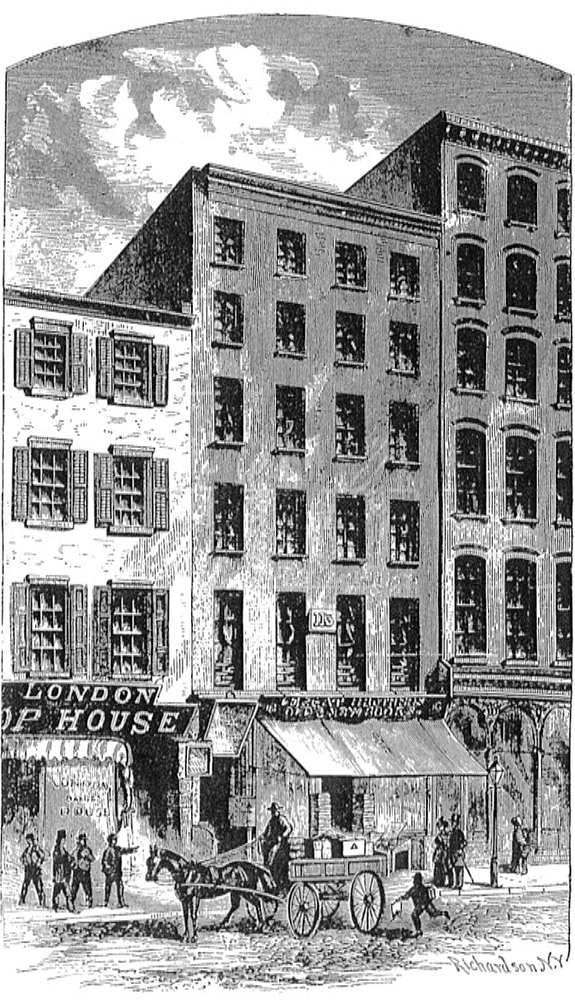
Don’t miss: a lovely piece of journalism history in today’s NYTimes, above coverage of an earlier heat wave — in 1852.

x1xThe Streets in Midsummer.jpg

Today’s piece captures the novel sense that New Yorkers were feeling that summer heat in the city was somehow worse and harder to bear than summer heat in the country. The build environment was beginning to capture and radiate heat. The unnatural concentration of horses and other animals added to the stink and pestilence. The physical crowding of people in the streets and in the tenements. The air pollution caused by the aerosolization of manure and other waste — all these things were creating a new kind of misery. And, through the mediation of the newspaper, perhaps a new solidarity among city-dwellers as fellow survirors of this new challenge of living.

Thank you, NYT.

First offices of the New York Times, starting in 1851. 113 Nassau St.

First offices of the New York Times, starting in 1851.
113 Nassau St.


Leave a comment

Filed under Journalism, journalism history, New York Times

What China really needs: press freedom

By Christopher B. Daly 

What ails the Chinese economy? According to a recent story and column in the NYTimes, it’s a lack of confidence among Chinese consumers in the safety of the products — from baby formula to cars to pork — made in their own country. They lack confidence for good reasons, but they lack the means to do much about it other than smuggle in substitutes.

I would submit that one missing ingredient is a free press that could reveal the abuses, shortcuts, and shoddy practices that undermine Chinese products. In his column, Joe Nocera gave this idea a quick nod.

In the United States, of course, it has become religion among conservatives to denounce regulation, saying it stifles business and hinders economic growth. But consider: At the turn of the last century, America was as riddled with scam artists as China is today. Snake oil salesmen — literally — abounded. Food safety was a huge issue. In 1906, however, Upton Sinclair published “The Jungle,” his exposé-novel about the meatpacking industry. That book, pointed out Stanley Lubman, a longtime expert in Chinese law, in a recent blog post in The Wall Street Journal, is what propelled Theodore Roosevelt to propose the Food and Drug Administration. Which, in turn, reformed meat-processing — among many other things — and gave consumers confidence in the food they ate and the products they bought.

That is fine as far as it goes, but it’s a bit reductionist. The fact is, it took a sustained campaign by a lot of muckraking journalists to build public support for reform, and it took a political system that could (with sufficient effort) bring about change, and it took a political movement (Progressivism) that was poised to mobilize that public sentiment into electoral and legislative results.

Ironically, the same issue of the NYTimes has a roundabout confirmation of the virtue of regulation: the red-state folks who raise catfish are worried that Washington will fail to fund the federal office that oversees inspections of catfish. No inspectors, no public confidence, no sales.

CATFISH-articleInline


Leave a comment

Filed under Journalism, journalism history

Charlie Savage dominates NYT coverage

By Christopher B. Daly 

Is there only one Charlie Savage? The New York Times reporter, who patrols the intersection of national security and legal issues, has no fewer than three bylines in today’s paper. Whew! He is on a tear trying to keep up with — and propel — the cascade of disclosures coming out about the apparatus of the surveillance state.

topics-savage-pic-articleInlineSavage, a Harvard grad and former editor of the Harvard Crimson, earned his stripes at the Boston Globe,where he won a Pulitzer Prize for reporting that called out President George W. Bush for his abuse of the presidential power to ignore the will of Congress by issuing “signing statements.”


Here are today’s offerings from Charlie Savage (great by-line, btw).

–Chief Justice Roberts has been packing the secret FISA court with conservatives. Hardly a surprise, but it needed to be documented.

–As part of his continuing coverage of the Wikileaks case involving the court martial of Pfc. Bradley Manning, Savage gives us a glimpse of the military’s approach to justice:

While Major Fein made his arguments, reporters watched the trial on a closed-circuit feed at the media center. Two military police officers in camouflage fatigues and armed with holstered handguns paced behind each row there, looking over the journalists’ shoulders, which had not happened during the trial. No explanation was given.

Yikes.

–Savage also shared a byline with legal correspondent Adam Liptak on a piece about the Justice Dept’s plans to enforce voting rights. (BTW, I think the Justice Dept should just lay back and wait for some racist, right-wing legislature to write some horrible law, then sue them so fast their heads spin. That way, minority voters can see who is really on the side — and who is not.)

UPDATE: Just in the last two hours, Charlie Savage struck again: Turns out, the top Pentagon guy in charge of GITMO is stepping down.


Leave a comment

Filed under Journalism, journalism history, media, New York Times

Does James Risen need a “shield law”?

By Christopher B. Daly 

The New York Times has an editorial worth reading today about one of its reporters, James Risen, who is facing a court order to reveal his confidential source for a book that he wrote in 2006. At issue is a ruling by the 4th U.S. Circuit Court of Appeals late last week that explains the whole case. The upshot: based on the Supreme Court’s erroneous ruling in the 1972 Branzburg case, the Circuit Court said the journalist has no choice: when the government demands to know who your source was, you have to spill the beans, or go to jail (and then spill the beans, I guess, unless the government plans to jail journalists for life).

As I have argued here and here and here, SCOTUS got Branzburg wrong, so it is hardly surprising that its progeny are similarly wrong. In my view, the First Amendment, when properly understood, would provide journalists all the protection they need to protect their sources. Until that 1972 error is corrected, we will continue to see these kind of rulings, and journalists — regrettably — will have to go to jail.

Here’s the Times editorial:

A Terrible Precedent for Press Freedom

By 

An egregious appeals court ruling on Friday has dealt a major setback to press freedoms by requiring the author of a 2006 book to testify in the criminal trial of a former Central Intelligence Agency official charged with leaking classified information. The ruling and the Justice Department’s misplaced zeal in subpoenaingJames Risen, the book’s author and a reporter for The Times, carry costs for robust journalism and government accountability that should alarm all Americans.

A federal district judge, Leonie Brinkema, was mindful of those costs two years ago when she ruled that a qualified reporters’ privilege to protect confidential sources, grounded in the First Amendment, applies in criminal cases and declined to compel Mr. Risen to reveal a confidential source in the trial of Jeffrey Sterling, a former C.I.A. employee. The 2-to-1 ruling by the United States Court of Appeals for the Fourth Circuit, which overturned Judge Brinkema’s sound decision, relied on an overly sweeping reading of a murky 41-year-old Supreme Court decision that has been rejected by other federal appellate courts. The ruling also failed to respect the nearly universal consensus among states that there is a common law privilege for protection of reporters’ confidential sources.

The third member of the panel, Judge Roger Gregory, got it right, calling his colleagues decision a real threat to investigative journalism. “Under the majority’s articulation of the reporter’s privilege, or lack thereof, absent a showing of bad faith by the government, a reporter can always be compelled against her will to reveal her confidential sources in a criminal trial,” Judge Gregory wrote in a forceful dissent. “The majority exalts the interests of the government while unduly trampling those of the press, and, in doing so, severely impinges on the press and the free flow of information in our society.” Judge Gregory found that the government has ample evidence to proceed with the prosecution without forcing a reporter to choose between protecting sources or going to jail.

The precedent set here is especially troubling since the Fourth Circuit, where the ruling applies, includes Maryland and Virginia, home to most national security agencies. If left to stand, it could significantly chill investigative reporting, especially about national security issues.

It was dismaying that the Justice Department issued a statement approving of the court’s wrongheaded legal conclusion barely a week after Attorney General Eric Holder Jr. announced new guidelines that are supposedly designed to better protect the news media from federal investigators in leak cases. But the department also said it was “examining the next steps in the prosecution of this case.” That should include withdrawing its demand that Mr. Risen testify about his sources.

This issue tests the new guidelines and their promise not to threaten journalists with jail for doing their jobs, except in “extraordinary” circumstances. If he has any intention to live up to that pledge, Mr. Holder should reopen the question of Mr. Risen’s subpoena.

4 Comments

Filed under Journalism, journalism history, Uncategorized

For Hemingway’s birthday, visit his papers

By Christopher B. Daly 

This Sunday, July 21, is the birthday of Ernest Hemingway — journalist, novelist, man of letters, beau ideal of a certain interpretation of masculinity. He would have been 114.

There are probably lots of ways to observe his birthday: you could go out and kill a top predator (like a lion or marlin), or you could go drinking and get a bartender at a famous bar to name a drink after you, or you could run with the bulls at San Fermin, or you could try to write ten simple declarative sentences in a row.

Alternatively, you could “visit” with Hemingway by rummaging around in his vast trove of papers and photos, which are archived as the Ernest Hemingway Collection at the John F. Kennedy Presidential Library and Museum in Boston. Much of the Hemingway collection remains to be digitized, so the only way to see most of those documents and objects is to visit the JFK Library, which would not be the worst thing — it sits right over Boston Harbor. But if you visit the website, you can click on the “media gallery” and cruise through Hemingway’s own photos.

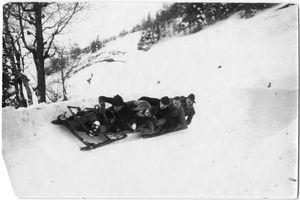
If the heatwave continues, try looking through the photos that feature Hemingway in the Alps. He is somewhere in this group bobsledding in Montreux. Enjoy.

EHPH-06901_lres

[Postscript: The Hemingway Collection site also offers an explanation for why the collection is housed at the JFK Library, which is not an obvious connection. I have not done any research into this question, so I can’t evaluate the accuracy or completeness of this version, but it’s worth reading.]

Update: The Boston Globe reports that the JFK Library has digitized the scrapbooks kept by Hemingway’s mother, which document his childhood. The Library has posted them on the website, too.

scrapbookcover2

Leave a comment

Filed under history, Journalism, journalism history

Review of “Covering America” in Journalism History

I am posting this review of my book in the scholarly journal Journalism History here, because the journal charges a lot for access.

Journalism History 

Vol 13 (4), Winter 2013, p254-255

CA cover final 2Daly, Christopher B.

Covering America: A Narrative History of a Nation’s Journalism.

Amherst and Boston: UMass Press, 2012. 535 pp. $49.95.


Many a teacher of journalism history has heard students complain about how dull or inaccessible they find any one of several available media history textbooks. And many a journalism instructor has agreed with his or her students’ complaints about de-contextualized dates and names of publishers and their historically significant newspapers strung through those tomes. Covering America: A Narrative History of a Nation’s Journalism addresses these complaints. In Covering America, Christopher Daly has wrapped the story of American journalism from the colonial period through the digital age into a carefully researched, beautifully written, and memorable account of how news reporting mostly has grown as well as improved during the span of three centuries as innovators have exploited new technologies, constitutional protections, government subsidies, cultural trends, and business formulae to maintain their financial independence and journalistic standards while serving their readers and audiences ever more efficiently.

            Daly, an associate professor of journalism at Boston University with twenty years of experience covering New England for the Washington Post and writing for the Associated Press, concentrates in Covering America on newspaper, television, and digital news with only occasional references to early twentieth-century magazines and rare mentions of public relations and advertising. His focus is the changing and expanding definition of news over time. Daly admits that in Covering America, unlike Frank Luther Mott’s or Edwin Emery’s geographically broader approaches to journalism history, he emphasizes journalism originating in New York— although Boston, Philadelphia, Washington, D.C., and Chicago receive some attention when media in these cities contribute to the overall narrative. This exclusion of examples of western and southern journalism, however, contributes in two ways to the success of Covering America. It greatly reduces the clutter and detail that overwhelms so many students, and it allows Daly to hold the social, political, economic, and technological context constant as he explains the challenges and opportunities printers, for example, faced at roughly the same time and place. Rather than grasping at data, the reader finds the overall historical patterns of journalism more apparent and memorable.

            In describing his history as narrative, Daly accurately describes his method of organizing this book, which is apparent from the opening paragraph of his introduction through his final chapter on “Going Digital.” Covering America, not unlike other journalism history texts, begins with Benjamin Franklin, but does so with a narrative lead one might expect from a short story or magazine feature:

             On an early spring night in 1722, a young man hurried along the narrow streets of Boston, trying not to be seen. He was not a spy or a thief. He only wanted to be a writer. Just sixteen years old, Ben Franklin was hoping to get his writing published for the first time, and he had chosen a risky, roundabout route to do so.

 Daly then notes that young Franklin was “skulking” around the shop of the New England Courant, owned by his brother James, in order to slip a manuscript under the door for his older brother to discover and, he hoped, to print. In this description of Franklin’s actions, Daly finds several defining characteristics of American journalism still at work today: printing was a private business, journalism was open to the young with raw talent, and the pleasure of publication drives journalists into the field.

            In the first chapter on the “Foundations of the American Press, 1704-1763,” after explaining the organization of the print shop, its products, and its method of production, Daly returns to Franklin as an example of printers during this period of six decades before the American Revolution, devoting eleven of the chapter’s twenty pages to detailing his biography, readings, head for business, popular writings, and principles of journalism in his “Apology for Printers.” Within this chapter, Daly also describes the John Peter Zenger trial and acquittal for seditious libel, noting that Franklin helped Zenger obtain his attorney. Franklin receives briefer mentions in several more chapters, reminding readers the interconnections always present as journalism is transformed over time. This pattern of focusing on one or two individuals as representative of journalists from particular periods is a device of narrative compression that Daly uses in each of the chapters in Covering America. As Daly develops an overarching narrative to describe 300 years in the development of American journalism, he inserts short narratives of innovative journalists and publishers who exemplify traits of the period being described. This is how readers receive substantial information about Benjamin Day, James Gordon Bennett, William Lloyd Garrison, Frederick Douglass, Thomas Paine, Horace Greeley, Joseph Pulitzer, Ida B. Wells, William Randolph Hearst, Adolph Ochs, Henry Luce, Harold Ross, David Sarnoff, William Paley, Walter Winchell, Walter Lippmann, Dorothy Thompson, Edward R. Murrow, Ernie Pyle, John Hersey, A.J. Leibling, David Halberstam, Truman Capote, Gloria Steinem, Katherine Graham, Ted Turner, Al Neuharth, and other journalistic innovators who so comfortably populate Daly’s story of the news.

             Covering America would vastly improve the student experience of an often unappreciated journalism history course, particularly at the undergraduate and master’s levels. Journalism students will leave a class after reading Daly’s book with a clear understanding of the methods and values of the field they will soon enter. They will also gain some confidence that journalism will continue even if paper and ink disappear.

 Joseph Bernt, Ohio University

Leave a comment

Filed under broadcasting, Covering America, First Amendment, history, Journalism, Photojournalism, Uncategorized

Death of a Cold War spy/”journalist”

By Christopher B. Daly 

As if we needed any reminders that it is not a good idea to mingle spying and journalism, the recent death of Austin Goodrich is a good example. It was true during the Cold War that the U.S. spy agencies and American foreign correspondents often cooperated.

The spies offered briefings to U.S. foreign correspondents as they headed abroad — all very chummy and gratis — and they expected to “debrief” those journalists when they returned home.

At the same time, real spies sometimes used a journalistic position as “cover” for

U.S. spy masquerading as a journalist.

U.S. spy masquerading as a journalist.

their espionage. That appears to have been the case with Goodrich.

Either way, these are bad practices, which the journalistic establishment eventually came to recognize. For one thing, it is dangerous to the health of journalists if other peoples have reason that we are all spies and should be treated as such.

During the 1970s, thanks to the Senate special committee known as the “Church Committee” (for its chair, Frank Church), a lot of secrets about American spy agencies came to light. Among them was the cozy relationship between some journalists and some spies.

The Church Committee’s findings deserve to be reviewed today. I assume that over the course of the intervening decades all of the abuses exposed by the committee have been resumed, along with new ones. I would say it’s time for a new Church Committee to try once again to get to the bottom of the spy game.


Leave a comment

Filed under Journalism, journalism history

New rules for spying on journalists

By Christopher B. Daly 

No surprise. The government has decided that it does not want to completely retreat from the field of spying on, investigating, and prosecuting journalists who seek and report the truth about our government’s operations. The Justice Dept is willing to make a few concessions, in acknowledgement that it recently got caught over-reaching in a number of cases. But it is nowhere near saying that the First Amendment’s guarantee of press freedom means what it says.

That’s my understanding of what AG Eric Holder announced yesterday in compliance with a demand from his boss, President Obama.

–Here’s coverage by the Times and the Post. (Complete with lots of comments that should not be missed.)

–Here’s the text of the Justice Dept report. (I am posting this in good faith; I hope the Justice Dept is doing the same and is not hiding some classified, redacted version in which they take it all back.)

Essentially, it amounts to this: Trust us. In the future, the attorney general will continue to make judgment calls and do all the balancing of press freedom and national security. If you don’t like it, tough. There’s no appeal, no remedy, no oversight.

If in the future, we have more secrecy and less transparency, this will be part of the reason.

1 Comment

Filed under Uncategorized