Whose press freedom?

By Chris Daly

Today’s Times includes a “sidebar” piece (column?) by legal correspondent Adam Liptak. I found it frustrating for a couple of reasons. For one thing, it is a bit of a mystery why it is running now (except for the thin reed of the anniversary of the Citizens United ruling from the Supreme Court). There is no discernible “news peg.” But that’s not really important.

What is more frustrating is that the piece provides so few links to the scholarly literature on this vast subject. That’s where the Times could have really used the Web to help its readers go deeper. I am going to try to find some of this material and post those links here.

Meanwhile, let me throw out a thought: At the time the Founders enshrined the idea of “freedom of the press” in the Bill of Rights, the press of the day was small, local, independent, and opinionated. The typical form of ownership was a “sole proprietorship” — that is, the printer who ran the press owned the business entirely himself. But even then, many “job printers” handled printing chores for all manner of customers, including customers whom they disagreed with. So, in that scenario, who enjoyed press freedom? The owner of the business that facilitated the mass communication? The author of the words? Both?

Keep in mind, the main goal of the founders was to prevent “prior restraint” — the use of government power to prevent certain facts or ideas from ever getting published in the first place. That seems like as worthy a goal as ever. Therefore, the rights of all individual human beings who want to communicate with other individual human beings should be protected from government interference. That, it seems to me, ought to be the operating principle here.

Comments?


Leave a comment

Filed under history, Journalism, media, New York Times, Supreme Court

How the Lawyers Stole Winter

By Chris Daly

By popular demand, I am re-posting the following essay I wrote, which is about skating on ponds outside Boston when I was a kid. Every winter, I get asked about it, and I am delighted to share it. The essay was originally published in The Atlantic in March, 1995 (just before the point at which the magazine arbitrarily decided to start routinely putting its contents online). It has also been anthologized in several “readers” intended to help high school and college-age students learn to write essays. It also used to appear on my old blog, but when I switched blog hosts last year, my old content did not follow into my new home. Thus, it is impossible to find a complete copy on the Web.

So, here goes:


HOW THE LAWYERS STOLE WINTER

Pond skating in the changed context of childhood

By Christopher B. Daly

© 1995


When I was a boy, my friends and I would come home from school each day, change our clothes (because we were not allowed to wear “play clothes” to school) and go outside until dinnertime. In the early 1960s in Medford, a city on the outskirts of Boston, that was pretty much what everybody did. Sometimes, there might be flute lessons or an organized Little League game, but usually not. Usually, we kids went out and played.

In winter, on our way home from the Gleason School, we usually went past Brooks Pond to check the ice. By throwing heavy stones onto it, hammering it with downed branches and, finally, jumping on it, we could figure out if the ice was ready for skating. If it was, we would hurry home, grab our skates, our sticks, and whatever other gear we had, and then return to play hockey for the rest of the day. When the streetlights came on, we knew it was time to jam our cold, stiff feet back into our green rubber snow boots and get home for dinner.

I had all these memories in mind recently when I moved, with my wife and our two young boys, into a house near a lake even closer to Boston, in the city of Newton. As soon as Crystal Lake froze over, I grabbed my skates and headed out. I was not the first one there, though: the lawyers had beaten me to the lake. They had warned the town Recreation Department to put it off limits. So I found a sign that said:


DANGER

THIN ICE

NO SKATING


Knowing a thing or two about words myself, I put my own gloss on the sign. I took it to mean, When the ice is thin, then there is danger, and there should be no skating.

Fair enough, I thought, but I knew that the obverse was also true: When the ice is thick, then it is safe, and there should be skating.

Finding the ice plenty thick, I laced up my skates and glided out onto the miraculous glassy surface of a frozen lake. My wife, a native of Manhattan, would not let me take our two boys with me. But for as long as I could, I enjoyed the free, open-air delight of skating as it should be. After a few days, others joined me, and we became an outlaw band of skaters.

What we were doing was once the heart of winter in New England – and a lot of other places, too. It was clean, free exercise that needed no Stairmasters, no health clubs, no appointments, and hardly any gear. Sadly, it is in danger of passing away. Nowadays it seems that every city and town and almost all property holders are so worried about liability and lawsuits that they simply throw up a sign or a fence and declare that henceforth there shall be no skating, and that’s the end of it.

As a result, kids today live in a world of leagues, rinks, rules, uniforms, adults, and rides – rides here, rides there, rides everywhere. It is not clear that they are better off, and in some ways they are clearly not better off.


*      *     *

When I was a boy skating on Brooks Pond, there were no grown-ups around. Once or twice a year, on a weekend day or a holiday, some parents might come by, with a thermos of hot cocoa. Maybe they would build a fire — which we were forbidden to do — and we would gather round.

But for the most part the pond was the domain of children. In the absence of adults, we made and enforced our own rules. We had hardly any gear – just some borrowed hockey gloves, some hand-me-down skates, maybe an elbow pad or two – so we played a clean form of hockey, with no high-sticking, no punching, and almost no checking. A single fight could ruin the whole afternoon. Indeed, as I remember it 30 years later, it was the purest form of hockey I ever saw – until I got to see the Russian national team play the game.

But before we could play, we had to check the ice. We became serious junior meteorologists, true connoisseurs of cold. We learned that the best weather for pond skating is plain, clear cold, with starry nights and no snow. (Snow not only mucks up the skating surface but also insulates the ice from the colder air above.) And we learned that moving water, even the gently flowing Mystic River, is a lot less likely to freeze than standing water. So we skated only on the pond. We learned all the weird whooping and cracking sounds that ice makes as it expands and contracts, and thus when to leave the ice.

Do kids learn these things today? I don’t know. How would they? We don’t even let them. Instead, we post signs. Ruled by lawyers, cities and towns everywhere try to eliminate their legal liability. But try as they might, they cannot eliminate the underlying risk. Liability is a social construct; risk is a natural fact. When it is cold enough, ponds freeze. No sign or fence or ordinance can change that.

In fact, by focusing on liability and not teaching our kids how to take risks, we are making their world more dangerous. When we were children, we had to learn to evaluate risks and handle them on our own. We had to learn, quite literally, to test the waters. As a result, we grew up to be more savvy about ice and ponds than any kid could be who has skated only under adult supervision on a rink.

When I was a boy, despite the risks we took on the ice no one I knew ever drowned. The only people I ever heard about who drowned were graduate students at Harvard or MIT who came from the tropics who were living through their first winters. Not knowing about how ice forms on moving water (After all, how could they?), they would innocently venture out onto the half-frozen Charles River, fall through, and die. They were literally out of their element.

Are we raising a generation of children who will be out of their element? And if so, what can we do about it? We cannot just roll back the calendar. I cannot tell my six-year-old to head down to the lake by himself to play all afternoon – if for no other reason, he will not find twenty or thirty other kids there, full of the collective wisdom about cold and ice that they have inherited from their older brothers and sisters. Somewhere along the line that link got broken.

The whole setting of childhood has changed. We cannot change it again overnight. I cannot send them out by themselves yet, but at least some of the time, I can go out there with them. Maybe that is a start.


*       *      *


As for us, last winter was a very unusual one. We had ferocious cold (near-zero temperatures on many nights) and tremendous snows (about a hundred inches in all). Eventually a strange thing happened. The city gave in – sort of. Sometime in January, the recreation department “opened” a section of the lake, and even dispatched a snowplow truck to clear a good-sized patch of ice. I brought the boys, and we skated the rest of winter. Ever vigilant, the city officials kept the “Thin Ice” signs up, even though their own truck could safely drive on the frozen surface. And they brought in “lifeguards” and all sorts of rules about the hours we could skate and where we had to stay.

But at least we were able to skate in the open air, on real ice.

And it was still free.


–30—


[© copyright by Christopher B. Daly. To re-publish, contact the author: chrisdaly44@gmail.com.

First published in The Atlantic Monthly in March 1995]


16 Comments

Filed under Boston, history

What is wrong with these people?

By Chris Daly

The Times brings us a story today on the shoddy behavior of people who should know better: Justices Thomas and Scalia. The upshot is that those two conservative justices think nothing of accepting the largesse of the vast, conservative idea-generating industry.

Shame on them, of course. But more disappointing is that the story points up the limits of the supposed remedy: disclosure. Disclosure is often put forward as the answer to our ills, and I think journalists are especially drawn to it as a remedy — given our belief in the curative powers of information.

But, what happens when people don’t disclose? (Because they couldn’t figure out the disclosure requirements? Come on.)


Or, what happens when they do disclose and nothing happens? (I guess Scalia figures there is nothing wrong with letting the Federalist Society pay for him to go to a retreat organized by Charles Koch and speak to a dinner of rich, powerful conservatives.)

They don’t seem to get the simple idea that they are supposed to BE impartial and APPPEAR impartial. Call me naive, but I would have thought that would be the minimum standard for a Supreme Court justice. At least, the coverage allows us to keep track of how they are performing.


2 Comments

Filed under Supreme Court

Free(r) Radio

By Chris Daly

Radio in the United States has not really been free since Congress passed the Radio Act of 1927 and got in to the business of regulating over-the-air broadcasting.

In a little-noticed good move, President Obama recently signed the Local Community Radio Act, which does not take us all the way back to the wide-open early days of radio but at least makes it possible for people of modest means to get back into the business of radio. The FCC can now start issuing licenses for 100-watt stations.

So, push those buttons on your radio that say “scan” or “search” or whatever and see if you can find some programming not cooked up by some corporate radio giant like Clear Channel.

Leave a comment

Filed under broadcasting, FCC, regulation, Uncategorized

Future of local news?

By Chris Daly


A must-read: Ken Auletta’s new piece in The New Yorker about AOL’s venture into local news, Patch.

One eye-popping fact:

“In the past year, AOL has hired nine hundred journalists, and each week it hires forty more.”

There’s lots more in the full article.

Leave a comment

Filed under AOL, local news, Patch, The New Yorker

The “psycho killer” problem

By Chris Daly

Today’s NYTimes has a piece that tries to address an issue that I believe was raised by the Tucson shootings: What are people supposed to do when they think a young man is losing his grip on reality and appears headed toward some violent act.? Turns out, there is not a really good answer — at least in most states, most of the time, with most cases.

This is an issue that I raised last week, shortly after the shootings in an op-ed I wrote in the Boston Globe.

Regrettably, though, the Globe editing process knocked out a key point I was trying to make. Midway through the op-ed, I wrote:

For one thing, the age at which both men are thought to have committed violent acts — their early 20s — is around the time when men tend to experience the onset of schizophrenia, a major mental illness that affects less than 1 percent of the population, most of whom will never commit an act of violence.

The regrettable part is that an editor at the Globe cut the final phrase — “. . . most of whom will never commit an act of violence.” — leaving the impression that some, most, or all schizophrenics are dangerous, which is not true and not my point. The editor who accepted the piece and saw it through most of the editing process agreed that it was an editorial mistake to have cut that phrase.

The major point: A lot more people need to learn a lot more about effective interventions for people suffering major mental illnesses.

Leave a comment

Filed under mental illness, New York Times, schizophrenia, Tucson, Tucson shooting

Watchdog or cheerleader?

By Chris Daly 

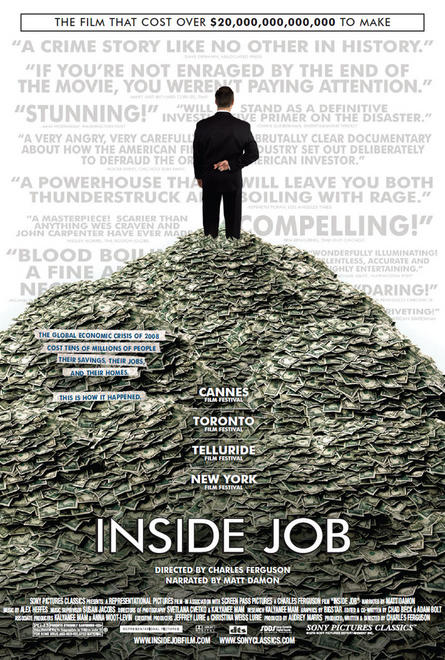
After watching the recent documentary “Inside Job,” about the U.S. economic collapse in 2008, I couldn’t help wondering: Where was the business press during all the run-up to the edge of the cliff?

The film is not shy about pointing fingers at villains: greedy bankers, revolving-door  government officials who go to Washington to look out for Wall Street, academic economists who write “studies” that “show” that whatever Wall Street wants to do is rational, efficient, etc.

But while the film allocates plenty of blame to markets and to feckless regulators, it says nothing about an institution that is supposed to help protect consumers, investors, and the general public: the media that cover business. The well-paid reporters and editors work for newspapers, magazines, television and websites — everybody from the NYT and WSJ to the Economist and Forbes to CNBC. Where were they?

–Did they explain the rotten core of CDO’s before they imploded (i.e., when the information would have been really timely and useful)?

–Did they spot the housing bubble?

–Did they reveal how bogus the standards had become for subprime loans?

Or, did they do what they usually do — admire executives who had a good quarter, cheer for the Dow to rise, and repeat pro-business dogmas about low taxes?

Hmm… If any academics are looking for a topic to study, that might be a good place to start.


Leave a comment

Filed under business, CNBC, media, New York Times

2010 in review

The stats helper monkeys at WordPress.com mulled over how this blog did in 2010, and here’s a high level summary of its overall blog health:

Healthy blog!

The Blog-Health-o-Meter™ reads Fresher than ever.

Crunchy numbers

Featured image

A Boeing 747-400 passenger jet can hold 416 passengers. This blog was viewed about 3,700 times in 2010. That’s about 9 full 747s.


In 2010, there were 46 new posts, growing the total archive of this blog to 47 posts. There were 41 pictures uploaded, taking up a total of 17mb. That’s about 3 pictures per month.

The busiest day of the year was December 15th with 144 views. The most popular post that day was Covering America, Chap 12.

Where did they come from?

The top referring sites in 2010 were bu.edu, spjchapters.org, Google Reader, twitter.com, and facebook.com.

Some visitors came searching, mostly for chris daly, journalism professor, chris daly blog, wikileaks prosecution, and boston university narrative conference.

Attractions in 2010

These are the posts and pages that got the most views in 2010.

1

Covering America, Chap 12 December 2010

2

About December 2008
1 comment

3

Wikileaks and the Pentagon Papers October 2010
1 comment and 1 Like on WordPress.com,

4

Narrative Conference March 2010
2 comments

5

WikiLeaks prosecution? December 2010
1 comment

Leave a comment

Filed under Uncategorized

Keller on WikiLeaks

By Chris Daly

Bill Keller, the top editor of The New York Times, explained his view today of his newspaper’s role in the latest WikiLeaks release of classified government secrets.

Speaking on the Harvard campus, Keller maintained his distance from WikiLeaks founder Julian Assange and said that, so far at least, Obama administration officials have behaved like “grown-ups” – in contrast to the previous administration.

Keller spoke for about an hour Thursday afternoon at the Nieman Foundation for Journalism at Harvard. He was the keynote speaker for the foundation’s day-long conference, “From Watergate to WikiLeaks:  Secrecy and Journalism in the New Media Age.”


Here is most of what he said, including most of the Q+A:


Since he took over the Times in 2003, Keller said no issue has provoked a higher pitch of “indignation” than publishing secrets.

And at least until this year, nothing done by the Times has ever caused so much consternation. That includes the paper’s story about the secret NSA wiretapping program and the 2006 revelations about the Treasury Department’s international program of surveillance of financial transaction.

Both those programs, Keller noted, were designed to catch terrorists – “and, by the way, I am in favor of that.”

Both programs were secret. In both cases, government officials requested that the Times withhold publication.

How rough did they play?

Keller said Bush told him that if the Times went ahead, the editor should “be prepared to be responsible for the next terror attack on America.”
Keller took issue with Bush’s description of the same events, which appears in Bush’s recently released memoir, “Decision Points.”

When the Times went ahead and published anyway, the White House reaction was “predictably fierce.” On the Treasury story, for example, Cheney and others denounced the Times and hinted at criminal charges. Members of Congress piled on, and one right-wing radio talk host suggested that the world would be a better place without Keller.

Reactions like these, Keller said, “may be hysterical but they are heartfelt.” He said there is “real confusion” as to why a newspaper editor should be allowed to disagree with the president in matters of national security.

Then the talk turned to WikiLeaks.

[Humor alert: “When I first heard of it, I thought it sounded like a brand of adult diaper!” Keller said to polite chuckles from about 100 journalists, academics and others in a conference room at Lippmann House, the home of the Nieman program.]

This time around, Keller said the administration’s reaction was quite different from what he had gotten used to under Bush. The Obama officials they consulted in advance of publication were “sober, responsible and grown up.” There was “no orgy of press-bashing.” Except for Joe Lieberman, no one has hinted at prosecution of the newspaper.

Still, he said there are critics. The criticism falls along three main lines:

1.            The documents are of dubious value.

2.            The disclosures put lives at risk.

3.            By dealing with WikiLeaks, the Times has compromised its impartiality.


Addressing each, Keller went on.

1. He is puzzled by the complaint that the documents do not do more to rock our world. “The fact is, 99 percent of the news does not profoundly change our understanding.” The value of these documents is that they provide nuance, texture and drama. He said that if the stories about the diplomatic cables gets people more interested in foreign affairs, “then I believe we have performed a public service.

2.            As for the risks of collaboration with WikiLeaks, Kelle said, “They are real.” Earlier, in the disclosures of the Iraq and Afghan war documents, WikiLeak named many names. With the diplo-cables, he said Wiki did a better job. It’s beyond Keller’s power to influence Wiki. “I can only answer for the Times.”

3.            Does it complicate diplomacy? “I’m skeptical,” Keller said. He cited recent comments by Defense Secretary Gates to the effect that other countries cooperate with the U.S, “because they need us.” [Keller’s implication was that since they still need us, they will continue to talk to us, even in confidential cables.]


As for Julian Assange, founder of WikiLeaks, Keller did not seem ready to grant him the status of a full-fledged journalist and partner:


“We regard Julian Assange as a source. I will not say a source pure and simple, because sources are rarely pure or simple.”

“You don’t always agree with them.

“Your obligation is to verify, to supply context, and to make sense of it. That is what we attempted to do, as we would do with any documents that came into our possession.”


Currently, Keller noted, the Times has 9 staffers assigned to Iraq and Afghanistan – not including freelancers and support staff.

“There are few places you can go to find honest, on-the-scene reporting about what is happening.”

He also noted that the Times has suffered two deaths and four kidnappings. Most recently, a contract photographer, Joao Silva, lost both legs when an IED exploded while he was photographing U.S. troops on patrol in Afghanistan.

Consequently, he said, “We are invested in the struggle against murderous extremism.” He said the Times is struggling against it directly (in terms of threats to journalists’s safety) and indirectly (in terms of threats to free expression).


In recent years, Keller said journalists have revealed lots of things – about Abu Gharib, “black sites,” eavesdropping, extreme rendition, etc. Quoting his colleague Bob Kaiser of The Washington Post, Keller asked if anyone seriously would rather not know these things.

“Government wants it both ways: keep their secrets, but trumpet their successes.”


Keller also invoked the Pentagon Papers case of 1971, referring to the affidavit filed in the case by Max Frankel, then the Times’ bureau chief in Washington. Frankel observed that presidents create secrets in order to use them. Same with cabinet members, military service chiefs, even mid-level bureaucrats. Almost no one plans to keep a secret forever. They are used tactically.

“One man’s security breach is another man’s public realations campaign.”

Recently, Frankel commented on WikiLeaks for the Guardian (which was given the diplo-cables directly from WikiLeaks and shared them with the NYTimes). In that piece, Frankel said that any time 3 million people have access to a “secret,” it’s not much of a secret.


Keller then asked how editors reconcile the urge to inform people with the need to protect legitimate secrets.

“Sometimes it’s easy. Our reporters in Iraq and Afghanistan take care not to divulge operational intelligence.”

“In handling the WikiLeak documents, we excised names.”


Often, though, he said it’s not easy. “There is no neat metric. We make our best considered judgment.”


The Times does not always decide to publish.

“When we come down in favor of publishing, of course, everyone hears about it.”

But sometimes, the paper withholds information. Then, of course, no one knows what they don’t know.


Looking ahead, Keller said editors will continue to have to decide on a case-by-case basis.

“Frankly, I don’t see a way to alter journalistic practices unless we just defer to the government. Our responsibility is to publish information of interest to the public.

“We have a duty to be careful.”

“There is one thing we can do: we can be a little more judicious in our use of anonymous sources.”


Eliminating them is “high-minded foolishness” that would result in “press-conference stenography.” But cutting back on anonymous sources would improve credibility. Overuse adds to the suspicion that journalists make things up.


In legal terms, Keller said some people (he mentioned Gabriel Schoenfeld, who wrote in the WSJ.) want to use the Espionage Act of 1917 to punish the Times and other news organizations. Keller said the Espionage Act has never been applied that way.

“The main practical legal threat facing journalists these days is.. the subpoena.”

In the decades after the 1972 Branzburg case left journalists vulnerable, there were relatively few cases. Since 2000, according to the Minnesota Law Review, it has risen to hundreds a year.”

He said many journalists hope for a federal “shield law” – comparable to those that provide testimonial privilege for lawyers, ministers, and doctors. But Keller said passage does not seem imminent and, in any case, is likely to deny reporters any protection when their reporting involves national security.


Keller acknowledged that “the Internet has transformed landscape of journalism” – by bringing new levels of speed and openness.

He said this is “healthy change,” bringing new voices and new audiences.

But, he said, it has “blurred the definition of who is a journalist.”

“Personally I would urge a fairly expansive definition.” But he would not include everyone.

A real journalist (he did not use that term) is someone who spends a lot of time and energy checking things out. On those rare occasions when the Times gets sensitive secrets, the paper’s reporters spend a lot of effort verifying them – without security clearances, subpoena power, wiretaps or any other special power. He suggested that WikiLeaks is not that kind of outfit – at least not yet.


“The mainstream press may not enjoy the hegemony it had before the Internet.”


He said the current administration has been reacting calmly and professionally. “The previous administration? Not so much.”

“I’d like to turn the telescope around and ask: what are the security implications if we became MORE secretive? Would we be safer?”


Independent news coverage is “not just something to defend, it’s something to be celebrated.”


*     *      *    *    *    *    *

Q & A:


Q. What is the vetting process?

A. We put them into a database. We conducted keyword searches. Could be a country, a leader, a phrase. We searched. Consulted reporters who were experts. They gave us search terms.

That produced clumps of cables. Someone was assigned to go through them for stories. . .


The vetting had to establish, is this stuff ereal?

A number of reporters had seen the real thing before. They could confirm. No one has yet come forward (to dispute authenticity of these cables)

We went to government agencies. Let them raise any objections.  Obviously, we did not offer them the right ro decide. We heard them out  respectfully. I describe it as professional and grown-up. A lot of times, they wanted us to omit things that were just embaraassing. We said, ‘Sorry.’


Q.  What is the schedule for publishing the other 99 percent?

A:  There’s no schedule. The first two dumps (Iraq and afg war logs), WikiLeaks posted, after we had time. Essentially, it was an embargo. (a familiar if loathed practice)

The embassy cables were more complicated. The range was so broad, the volume so enormous. The different interests of different news organizations were large.

He said the Times held discussion with the European partners – The Guardian in the U.K. and Der Spiegel in Germany. Among them, they agreed on a calendar by which they would all write on the same topic on the same day.

“We agreed: day 1 would be ‘Pakistan day.’ Day 2 would be ‘Russia day.’ We agreed to give WikiLeaks the documents we planned to post with each day’s stories. (with redactions)

We have basically done the major stories that we plan do do.

I expect we will post future documents as we think of more stories that we want  to do.

I have no idea what WikiLeaks intends to do.

We don’t  intend to post the whole batch. Most of them are not very interesting.

Many of them are the diplomatic equivalent of  “laundry lists”


Q. Relation with Assange?


A: Assange never said explicitly why he cut the New York Times off. But he has said some things.

Keller said Assange has said or implied that he is miffed because the Times did not link to WikiLeaks online. He said Assange was also unhappy about two Times stories: the reporting about suspected leaker Bradley Manning and the Times’s profile of Assange himself.


Q. Would you work with them again?

A. “They were a source, not a partner.

“I have no idea whether WikiLeaks will offer us anything again. I would accept it on the same terms – raw material that we would take a look at and publish if its interesting.”


Q. This is all about government information. What about private or corporate information, like banking?

A. Keller said he is not sure that would change anything.

“One thing I omitted is that we had lawyers involved along the way – very good lawyers, the kind who see it is their responsibility to see how we can get things INTO the paper.

“We discussed possible jeopardy. Reviewed British law. We ascertained that what we were doing was legal.

“I’m not sure it would be with a private entity.

In that case, Keller said, the charge to the lawyers would be to find a way.

“Beyond that, I don’t see a qualitative difference between government information and information from other powerful institutions.

“I might feel qualms about a private individual. But in the case of a major American bank. . .  I’d be very interested in that.”

[Keller made clear that he would not be interested in just dumping bank account numbers online but he would be interested in secret memo that showed, for example, a particular bank’s role in the financial crisis and bailout.]


Q. Would you be troubled by a prosecution of Assange?  How is the Times different from him?

A.

I’m not a lawyer.  I think our lawyers would  kill me if I offered an answer.

Is WikiLeaks a journalistic organization? I am humble about who gets to be called a journalist.

There are two things I would say: I don’t regard Julian Assange as a kindred spirit. If he’s a journalist, he is is not the kind of journalist I am.”


But Keller says WikiLeaks has already evolved into something more like a journalistic organization, abandoning its original position of total transparency.

“As an editor I find the Espionage Act a scary thing in the wrong hands. It’s an abuse-able law.”


Leave a comment

Filed under Journalism, journalism history, leaks, media, New York Times, President Obama, Wikileaks

U.S. Journalism Timeline

American Journalism: A Timeline

By Christopher B. Daly

Boston University

1704 First American newspaper published. (In Boston)

1729       Benjamin Franklin begins publishing

1735 Sedition trial of printer John Peter Zenger.

1776 Start of American Revolution. Thomas Paine writes

pamphlet called “Common Sense.”

1789-91 Adoption of Constitution and First Amendment.

1790-1830 Partisan and commercial press period.

1798 Sedition Act passed by Federalists and used against

Republican editors; allowed to expire under Jefferson.


1833 Founding of first Penny Press paper in New York,

making newspapers cheap enough for the masses.

1844 Invention of telegraph, by Samuel F.B. Morse.

1846            The Associated Press founded, in New York City.

1854              The New-York Daily Times founded.

1861-65        U.S. Civil War.

1880s-90s Rise of “new journalism.” Introduction of photographs                                  into newspapers. Era of “Press Barons” William                                           Randolph Hearst and Joseph Pulitzer.

1898                Spanish-American War.

1904-12 Period of investigative reporting known as

“Muckraking.”

1917-18 U.S. role in WWI (censorship + propaganda)


1923 Henry Luce founds TIME magazine.

1925 Harold Ross founds The New Yorker.

1926 Radio Corp. of America creates NBC network.

1927 Congress creates commission to regulate radio.

CBS network founded by William Paley.

1930s Economic depression. Pres. Franklin D. Roosevelt                                                               delivers “fireside chats” on radio.

1941-45 U.S. role in WWII. (censorship + propaganda)

1945-89         Cold War

1948 First regular television news.

1954               Edward R. Murrow attacks Sen. McCarthy

1960 Television shows Kennedy-Nixon debate.

1960-75 U.S. involvement in Vietnam War.

1963 Television covers Kennedy assassination.

1964               NYTimes v. Sullivan (Supreme Court libel case)

1968 In Vietnam, Tet Offensive; My Lai massacre.

CBS launches “60 Minutes” TV news magazine

1970                NPR begins.

1971                Pentagon Papers case.

1972-74         Watergate scandal.

1980               CNN founded by Ted Turner

1982               USA Today newspaper launched by Gannett Co.

1987 Broadcasting de-regulation begins.

1988 Rush Limbaugh goes national with conservative talk

radio.

1991 U.S.-led war in Persian Gulf.

1995                World Wide Web begins to spread to public.

1996 Fox News debuts.


2001 On Sept. 11, terrorists attack U.S.

2005 NYTimes reporter Judith Miller serves 85 days in jail

to protect a confidential source.

2007 On-line journalist Joshua Micha Marshall, founder of TPM,                                wins a Polk award for journalistic excellence.


1 Comment

Filed under journalism history