Westminister dog show gets it wrong, again

By Christopher B. Daly

Well, they’ve done it again. The judges at the Westminster Kennel Club have chosen a silly, small breed of dog as this year’s “Best in Show.” They picked an “affenpinscher.” An affenpinscher? What is that? It sounds like some kind of

A silly small dog.

A silly small dog.

Austrian pastry, not a dog. 

Next time I’m in the Demel in Vienna, I will ask if I can have an affenpinscher. Mit schlag. 

Sheesh.

To be taken seriously, a dog should at least be bigger than a cat. There is something seriously wrong when the judges could have picked a golden retriever and failed to do so. I am through with Westminster until they come to their senses and pick a golden (or at least a Lab or some other real dog).

Cody (a real dog) Photo by Fred Conrad/NYT

Cody (a real dog)
Photo by Fred Conrad/NYT

3 Comments

Filed under Uncategorized

The media and the murderer

By Christopher B. Daly

It’s a busy season in Boston media circles for works about the city’s most notorious gangster, Whitey Bulger.

The Boston Globe has a special page devoted to all things Whitey. Amazon can fill a page with Whitey books. Bulger, who is accused of 19 murders and other crimes, is in prison in Massachusetts awaiting his trial in U.S. District Court in Boston, due to start this spring, but he must be the most written-about gangster since Capone.

Right now, the Globe is throwing its institutional support behind the new hardcover Whitey Bulger: America’s Most Wanted Gangster and the Manhunt that Brought Him to Justice. It is written by two Globe reporters, Kevin Cullen and Shelley Murphy, with long years of experience covering cops, courts, and criminals.

Next up (due out next week) is a book by two former Globe reporters — my friend and Boston University colleague Dick Lehr and veteran courts reporter Gerard O’Neill (who also teaches part-time at BU). Their book, titled Whitey:  The Life of America’s Most Notorious Mob Boss, is expected to be the definitive biography of Bulger, featuring lots of new material about his childhood and his years in the federal prison system. Lehr and O’Neill are old Bulger hands, having written the landmark Black Mass in 2000, the book that grew out of their reporting while on the staff at the Globe. That was the book that first definitively ripped back the curtain and revealed the corrupt relationship between Bulger and his FBI “handler” John Connolly.
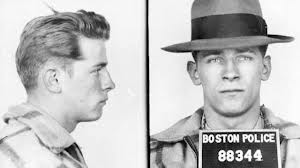
Whitey Bulger, courtesy of Boston PD. One of the greatest mugshots in the history of the genre.

Whitey Bulger, courtesy of Boston PD. One of the greatest mugshots in the history of the genre.

For hard-core Whitey fans, today’s Globe also offers a column by Kevin Cullen about Whitey’s views on politics. No surprise: Whitey is a Reagan Democrat, sort of. Here’s the column.

For the sake of comprehensiveness, the Globe also has a review today of the Cullen-Murphy book. The review is written by Sean Flynn, a former reporter at the Boston Herald and Boston magazine who now writes for GQ.

An excerpt from the review:

There was a time, long ago, when the legend of Whitey Bulger seemed nearly Shakespearean. His was the story of two brothers who rose from the Old Harbor housing project to rule the city, Billy its politics and Whitey its rackets. It was the story, too, of that neighborhood, where the greatest sin was disloyalty, and how that sense of allegiance entangled a third son of Old Harbor — FBI special agent John Connolly — who recruited Whitey as an informant, then protected him beyond the bounds of good sense or the law. The saga was often cast by Whitey’s loyalists and enablers in a haze of noir romance.

It was never that simple or that majestic, of course, and history and voluminous testimony have revealed as much. But Whitey is a product of a particular time and place, and he cannot be understood apart from either. Cullen and Murphy know this, and they reveal the complicated man amid the swirls and crosscurrents of Boston’s peculiar past.

Still to come: the movies. In Boston, it’s fun to speculate about who would make the better Whitey — Johnny Depp (pirate)  or Matt Damon (homey).

l to r: Depp, Affleck, Damon, Facinelli

l to r: Depp, Affleck, Damon, Facinelli

If you can’t get enough, here’s a reading list to help you feel more knowledgable about all things Bulger and Boston:

The Brothers Bulger (2006), by Herald political columnist Howie Carr.

–A literary curio: While the Music Lasts (1996), a memoir by Whitey’s brother Billy Bulger, the conservative Democrat who dominated the Massachusetts Senate during the 1980s and 1990s. (Fun fact: Billy’s memoir is “A Richard Todd Book” — one of the tonier imprints in American publishing.)

–There is also a shelf of books written by former Whitey confederates, starting with Brutal (2007), by former Bulger henchman Kevin Weeks and the writer Phyllis Karas (who also teaches at BU.)

–Then there are the first-hand accounts by law enforcement veterans who had a hand in stopping or capturing Bulger. You can start with Most Wanted (2012) by Thomas J. Foley, a former colonel in the Mass. State Police, who kept trying to bust Whitey only to be thwarted by corrupt FBI agents. Foley’s book is co-written (which means in all likelihood, actually written) by John Sedgwick, a real writer.

–Finally, it’s worth putting all this in some kind of historical context, and there are two places to start:

The Rascal King (1992), by Jack Beatty, about the life and times of Boston mayor James Michael Curley, and The Boston Irish: A Political History, (1995) by the late Boston College historian Thomas H. O’Connor.

And, from the fiction shelf, two great novels: The Last Hurrah (1956) by Edwin O’Connor and the the marvelous The Given Day (2008) by novelist Dennis Lehane.

Stop me!

Just remembered: if you want to know how to talk like Whitey, it’s always a good idea to brush up on the noir masterpiece The Friends of Eddie Coyle, (1970) by the late George V. Higgins (who also used to teach at BU!).

Class dismissed!

Leave a comment

Filed under Boston, Uncategorized

The war on drone secrecy (cont.)

By Christopher B. Daly

The use of unmanned drones may be a good thing or a bad thing (or, of course, something more complicated). Because that’s the case, the United States needs to conduct a big, loud debate about them — in hearings, in editorials and blogs, in speeches, in debates, on the airwaves, and online. After that, we need to have some elections that will clarify where the people stand.

None of that can happen, of course, if the whole program is a big secret. That is a point being made by a rising chorus of voices. The NYTimes Public Editor, Margaret Sullivan, is stressing it.

And today, NYT media columnist David Carr joins the crowd.

Carr’s column refers to a recent study by Harvard’s Shorenstein Center on the Press, Politics, and Public Policy. If ever there was an issue involving press, politics and public policy, the drone campaign is it. And the report, by Tara McKelvey, is a great primer on the whole issue and the coverage thereof.

Under the Obama administration, the targeted-killing program has
become the centerpiece of U.S. counterterrorism strategy. The Obama White House
program of targeted killing is unprecedented in its mission and scope; moreover, the
administration’s approach to fighting terrorists is likely to be adopted by presidents in
the future, whether Democratic or Republican. For these reasons, it makes sense to
examine the role of media in the public debate about the program and moreover to see
how journalists have fared in their efforts to cover the story of the targeted-killing
program.


imgres

3 Comments

Filed under Uncategorized

Fox News discovers Latinos

By Christopher B. Daly 

From TNR comes a story about Roger Ailes, the CEO of Fox News, and his newfound concern for the Latino viewer/voter.

“The fact is, we have a lot—Republicans have a lot more opportunity for them,” Ailes says. “If I’m going to risk my life to run over the fence to get into America, I want to win. I think Fox News will articulate that.”

This new policy will require some pivoting by some of Fox’s top stars — notably Bill O’Reilly and Sean Hannity. Both of them were waging war on the air against immigrants for years, right up until the last election proved that there are not enough angry old white people in the United States to win national elections for the Republican Party.

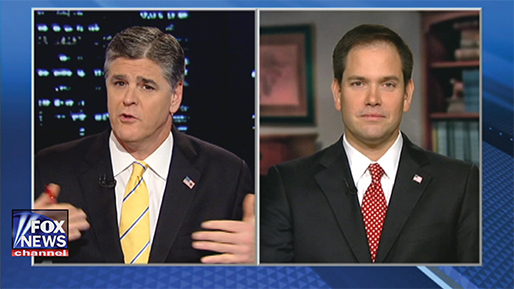
Sean Hannity, appearing with Marco Rubio, now accepts a "path to citizenship" for Latinos and other immigrants.

Sean Hannity, appearing with Marco Rubio, now accepts a “path to citizenship” for Latinos and other immigrants.

In a sense, Fox is in the position that the “party papers” of the early Federal period were in. When a new kind of non-partisan paper came along in the 1830s trying to appeal to everyone, the editors of the party papers realized that their partisanship was placing an arbitrary ceiling on the universe of readers they could possibly appeal to. Therein lay the real origins of “neutral” or “objective” news — the desire to reach larger audiences. If Fox limits itself to Republicans, there is no room for growth. (Similarly, if the GOP limits itself to Fox viewers, there is no room for growth.)

Can moderate Latinos save them both?


Leave a comment

Filed under Uncategorized

Times’ paywall is paying very well

By Christopher B. Daly

Buried in the business section of today’s New York Times is a story with some very encouraging news about the future of quality journalism. The story concerns the New York Times Company itself. There’s a lot of noise in there about the sales of assets such as About.com. There’s also the usual gloomy news about the continuing declines in print advertising (down 5.6 percent).

But there are also two positive signals in all the details:

1. Digital advertising revenues rose 5.1 percent. That’s the money the Times makes from selling the electronic ads that appear in the online version. They are rising from a small base, to be sure, but they represent the ad dollars of the future.

2. The biggest good news: revenue from circulation grew 16.1 percent. In other words, the Times‘ paywall is paying very well. I would say this story “buried the lead” — because this is the biggest news in a while. The increase in circulation revenue is certainly not coming from a surge in subscriptions to the old-fashioned print version of the paper; nor is it from an upswing in newstand sales. It is coming from people who bump into the Times‘ online “paywall” and decide that it’s worth paying for the Times‘ content online. That may well turn out to be the paper’s salvation: the readers.

Here’s an excerpt from the NYTCo official earnings statement:

Paid subscribers to The New York Times and the International Herald Tribune digital subscription packages, e-readers and replica editions totaled approximately 640,000 as of the end of the fourth quarter of 2012, an increase of approximately 13 percent since the end of the third quarter of 2012.

That’s impressive. Readers in those numbers (plus some more, of course) could carry the paper into the digital future.

Can a restored dividend be far behind?


Here’s a chart of the company’s stock performance. NYTCo stock is up today, but it has a long way to go to get back to the glory days of a decade ago.

NYTCo stock

NYTCo stock

Leave a comment

Filed under Journalism, New York Times, publishing

Obama wavering on secrecy

By Christopher B. Daly

Slowly, but perhaps inevitably, President Obama is yielding to public pressure and taking baby steps toward the transparency he promised all along. He has said he will allow the leaders of the House andimgres3 Senate Intelligence Committees to look at the legal memo that purports to justify the administration’s policy of killing Americans overseas under certain conditions using unmanned drones.

Can a leak of the document be far behind?

Even after that happens (as seems equally inevitable), I want to know:

–What authorizes Obama to make this policy on his own?

–What authorizes Obama to pick the targets for assassination?

–What authorizes Obama to hide this policy and dribble it out only when cornered by the people?

He was supposed to be a leader in the campaign for transparency, not a reluctant truant. Oh, well. Sometimes the people have to lead the leaders.

Famous drone target.

Famous drone target.

Leave a comment

Filed under Journalism, President Obama

How to break into the news business

By Christopher B. Daly

Well, here’s one way:

1. Start off with a career in modeling.

2. Become a Republican.

3. Never work as a reporter/editor/photographer.

4. Join FOX News as a highly paid on-air commentator.

That is the path reportedly being pursued by Scott Brown, according to a story in today’s Boston Globe and elsewhere. Now that Brown, the Republican who lost the 2012 race for U.S. Senate to Democrat Elizabeth Warren, is getting out of politics and becoming a big media star, he don’t need to talk to no stinkin’ reporters:

A Fox spokesman confirmed Brown is in talks to appear on the network, which recently announced it is not renewing contracts with big-name political commentators Sarah Palin and Dick Morris. It was unclear, however, what role Brown might have on the network. Though Brown has told several Republicans that he will have a gig on Fox, the spokesman said the talks are not final.

Brown would not comment to the Globe. When reached Wednesday night, he said, “I am right in the middle of dinner,” and hung up the phone.

All in all, Brown appears to be an example of the power of failing upward. Way to go, Scott.

Unknown

2 Comments

Filed under broadcasting, Uncategorized

Free speech in India

Here is a view from Suketu Mehta, the author of the wonderful book Maximum City, about Bombay.

The takeaway:

This year, the world’s largest democracy ranked a miserable 140th out of 179 countries in the Reporters Without Borders Press Freedom Index— falling nine places from last year. Today, Afghanistan and Qatar have a freer press than India.

In recent years, the government has cast a watchful eye on the Internet, demanding that companies like Google and Facebook prescreen content and remove items that might be deemed “disparaging” or “inflammatory,” according to technology industry executives there.

In November, police in Mumbai arrested a 21-year-old woman for complaining on Facebook about the shutdown of the city after the death of the nativist politician Bal K. Thackeray; another Facebook user was arrested for “liking” the first woman’s comment. The grounds for the arrests? “Hurting religious sentiments.”

Leave a comment

Filed under Uncategorized

Obama and secrecy

By Christopher B. Daly 

Sadly, the Obama administration is continuing to drag its heels in releasing the rationale for its policy of killing people — including American citizens — with drones. No one is asking Obama to reveal any operational secrets. But every American, including every member of the Democratic Party, should demand the instant release of the policy, which is still being kept an official secret. If Obama and his team can find a justification for his policy under the U.S. Constitution and/or international law, so be it. I want to examine it and decide for myself.

What is intolerable is the idea that the president can assume the power to order executions without bringing charges, holding a trial, or offering any other safeguards. His policy, so far, is “trust me” — which is tantamount to repealing the rule of law and substituting personal power. He is taking on the role of the tyrant who says of his perceived enemies, “Off with his head!” Obviously, if George W. Bush did something like this, liberals would react with outrage. For the same reasons, Obama’s actions to date have been equally outrageous. The American people have not only a right but a responsibility to know what is being done in our name.

It doesn’t matter if the cause is just or if his intentions are good. If he operates outside the law, then he’s a tyrant.

Luckily, someone leaked the Justice Dept “white paper” about drone executions to NBC News. That is a description of the policy, not the policy itself.

Today’s Times has a good package of pieces, including:

–a triple-byline page 1 lead story, (dateline: SANA, Yemen),

–a double-byline analysis of the legal situation (in which the Times downplays its own FOIA suit), a note from the paper’s Public Editor,

–a full-blown expert debate,

–graphics, video, and more.

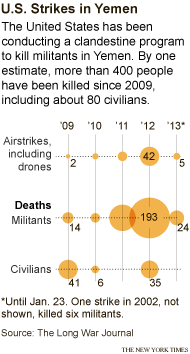
Source: The Long War Journal

Source: The Long War Journal


It should also be noted that many others are reporting on this (a hat-tip to the Washington Post), or suing over it (a hat-tip to the ACLU), or waging a political fight against the administration (oh, wait: no one is!).


This is not over.


Here is the main takeaway from the legal piece, which begins by noting that Obama rejected the Bush administration’s decision to shroud its torture policy in secrecy:


In the case of his own Justice Department’s legal opinions on assassination and the “targeted killing” of terrorism suspects, however, Mr. Obama has taken a different approach. Though he entered office promising the most transparent administration in history, he has adamantly refused to make those opinions public — notably one that justified the 2011 drone strike in Yemen that killed an American, Anwar al-Awlaki. His administration has withheld them even from the Senate and House intelligence committees and has fought in court to keep them secret, making any public debate on the issue difficult.


Leave a comment

Filed under Journalism, President Obama

Great photos from “the Roof of the World”

By Christopher B. Daly

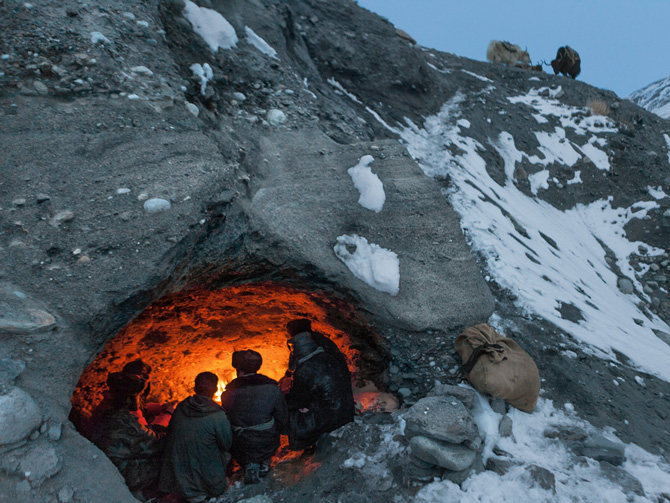
Thanks to Matthieu Paley, a French photojournalist, we can sit in our warm homes and offices and see these amazing images from what is perhaps the most godforsaken corner of

Wakhan Corridor

Wakhan Corridor

Afghanistan. This is where, basically, if you felt the urge to walk from Afghanistan to China, you would have to go.

Thanks also to the NYTimes‘ valuable Lens blog, which is where the Times features a lot of its best visual journalism in photos, slides, and video.

Here’s the link.

[Two gripes: The Times should make it easier to find this stuff on its homepage.

The Times should stop blocking the copying of these images. (I realize that a lot of the contributors are not Times employees and that many of these projects are sponsored by someone else — such as, in this case, National Geographic. Still, in the long run, I think it’s more valuable to reach out than to keep out.)]

Oddly, the photos are readily available at the NatGeo site. So, thanks very much to NatGeo.

Here are two:

08-seeking-shelter-in-shepherds-cave-670

15-kyrgyz-horsemen-buzkashi-670


Leave a comment

Filed under Journalism, Photography, Photojournalism