The power of narrative: NPR tells the tale of a T-shirt

A hat-tip to the talented team at NPR’s “Planet Money.” They are spinning a yarn this week about how a T-shirt is made, from start to finish. Best of all, they decided to actually make a specific T-shirt of their own, and reporters worldwide are contributing to a narrative that traces the arc of that T-shirt from the cotton fields of the Deep South to a robotic yarn-spinning factory in Indonesia and god-knows-where next.

Great idea, great sound, intelligent reporting. Way to go.

machines-callout_custom-f6c175d992dc3a44e766a669252f32b8afdfb30d-s3-c85

Read. Listen. Enjoy.


Leave a comment

Filed under broadcasting, business, Journalism, NPR

Surveillance state: Why it’s wrong

Here is a letter to the NYTimes from someone I have probably never agreed with before about anything. But it points up some of our universal interests as citizens of a free country.

The National Security Agency’s indiscriminate surveillance of American citizens contradicts the Constitution’s moral cornerstones: It is better to be the victim of injustice than to be complicit in it; we knowingly take risks under the Fourth Amendment to avoid injuring the innocent; the right to be left alone is the most cherished right among civilized peoples; and every citizen is crowned with a strong presumption of loyalty and love of country. When these cornerstones are chronically flouted, liberty withers and dies.

BRUCE FEIN
Washington, Nov. 26, 2013

The writer, a former associate deputy attorney general in the Reagan administration, is the author of “American Empire Before the Fall.”


Leave a comment

Filed under Uncategorized

New York mag cuts back on print edition

By Christopher B. Daly 

[Update: Here is a glass-half-full response to Carr, which I think makes a lot of sense.]

David Carr uses his NYTimes “Media Equation” column today to describe the changes going on at New York magazine under its phenomenally successful current editor, Adam Moss. The magazine is scaling back its print version from nearly weekly now to

“You can’t help but get wistful about it,” said Adam Moss, the editor in chief of New York. Photo: Fred R. Conrad/NYT

“You can’t help but get wistful about it,” said Adam Moss, the editor in chief of New York.
Photo: Fred R. Conrad/NYT

every other week. The culprit: the high cost of printing and distribution versus the dropping value of print advertising.

The good news: the printing cutback is being done in service of strengthening the online version, which is the magazine’s future.

Meanwhile, New York is actually thriving by some measures: the website is going gangbusters and is considered must reading among younger “readers” in Manhattan and Brooklyn (as well as aspirational districts around the rest of the world).

As a supplement to Carr’s column, I am offering a couple of excerpts from my book Covering America that touch on the early days of New York, under its founding editor, Clay Felker:

. . . Another reason for the success of the New Journalism was institutional. Like the innovators of any new creative movement, the practitioners of this hybrid form of journalism needed patrons. They did not find them among the lords of the newsroom, the editors of America’s daily newspapers, who mostly thought these writers had lost their bearings (and maybe their sanity). Instead the New Journalists found sympathy, encouragement, expense accounts, and pretty good pay at a handful of magazines with extraordinary editors. One of the most influential was Clay Felker, who edited the Sunday supplement published by the Herald Tribune. It was an incubator for the talents of the young Tom Wolfe and a columnist named Jimmy Breslin. Felker, who had previously worked at Esquire, stayed at the Trib, cultivating good new writers—such as Gloria Steinem—wherever he could find them, until the newspaper folded in 1967. Then he took the nameplate of the Trib’s Sunday magazine, New York, and turned it into the prototype “city magazine.” In the early days, New York magazine also served as one of the unofficial headquarters of the New Journalism. A second clubhouse was not far away in Manhattan, at the offices of Esquire magazine. Under editor Harold Hayes, Esquire published many of the foundational pieces of the New Journalism, including Norman Mailer’s 1960 meditation on JFK, “Superman Comes to the Supermart,” and Gay Talese’s famous profiles of Joe DiMaggio and Frank Sinatra. Elsewhere in Manhattan, literary agents and editors at book publishing houses were starting to talk to some of these hotshot young writers, and some of those journalists quit their newspaper jobs to become full-time writers. . . 

Here’s another excerpt, about Felker and Gloria Steinem:

. . . One of the most prominent and influential women who changed the perception of feminism was a journalist and political activist who helped found a magazine that captured the new zeitgeist—Gloria Steinem. With obvious talent, intelligence, and (as was always remarked) good looks, Steinem became a highly visible figure who helped to lead both a magazine and a movement.

After a difficult childhood in Toledo, where she saw firsthand the vulnerability of women in traditional roles after her father left her mother, Steinem went to Smith College. Following her graduation in 1956, she traveled around India before landing in New York City, where she began to work as a freelance magazine writer. She worked hard and took all kinds of assignments. In an effort worthy of Nellie Bly, Steinem even went undercover for an article about working as a Playboy bunny. She thrived as a freelance writer, and she became a rising star. But still, as a “girl reporter,” she knew there were limits. (The low point: a piece for the New York Times magazine about textured stockings.) Over the course of the decade, even as she kept writing, Steinem became an activist in the civil rights, antiwar, and farm workers’ movements.

She found a congenial base at New York magazine, where editor Clay Felker allowed Steinem to tackle bigger and better assignments. Eventually she wrote the magazine’s “City Politic” column, which meant she was covering national politics and all the major issues. She liked Felker, and he advanced her career immeasurably, but in the end they came to an impasse: he was interested in pro-feminist articles only if they were paired with articles from an opposing point of view. “That’s why I gradually stopped writing for New York,” Steinem later explained. “It was just too painful to be only able to do it in the context of two women fighting.” . . .

1 Comment

Filed under Journalism, journalism history, Uncategorized

Ted Williams and his feud with baseball writers

By Christopher B. Daly

The Boston Globe is running a series of excerpts from a new book about Ted Williams, written by Ben Bradlee Jr., a former Globe editor and son of the great Washington Post editor. Today’s installment focuses on Ted’s testy relationship with the press corps, particularly the large gang of baseball writers who worked for the Boston dailies in the 1940s and 50s. Fun fact: Boston had nine daily newspapers back then, with separate sports staffs. Here’s the line-up:

Between 1939 and 1960, the years spanning Ted’s career with the Red Sox, Boston had eight major newspapers, or nine if one counted both the morning and evening editions of The Boston Globe, which had separate staffs and circulations. The morning papers were the Post, the Herald, the Record, the Daily Globe and the Christian Science Monitor. The evening journals were the American, the Transcript, the Traveler, and the Evening Globe. The Post and the Record dominated the city in 1940 with circulations of 369,000 and 329,000 respectively.

Here’s an excerpt from the excerpt:

In the ’30s, ’40s, and ’50s, major league baseball was by far the dominant sport in the country, and would often take up a third of the front page of newspapers in Boston, New York, Chicago, and Philadelphia. To be a baseball writer assigned to cover one of the big league teams was a highly prized assignment.

The writers wore suits. On long road trips, they’d play poker on the trains with the players and among themselves. Some great yarns came out of those trips, but in the fraternal milieu, it was understood that the stories would stay in-house, never to turn up in print.

On average, the writers were a generation-or-more older than the players they covered. Before World War II, the vast majority had not gone to college, and in the ’40s, their salaries ranged between $5,000 and $7,000 a year. But you couldn’t beat the perks. In what seems a quaint anachronism today, it was common practice at least into the ’60s for the ball clubs to pay all the expenses of the writers when the teams traveled. The reporters would stay at the best hotels, order from room service, and eat at fine restaurants. Moreover, they spent six weeks in Florida for Spring Training on the teams’ tab as well. In return for such largesse, the clubs of course expected, even demanded, favorable coverage, and they received it. On the rare occasions they did not, the teams would not hesitate to assert their economic leverage over the papers.

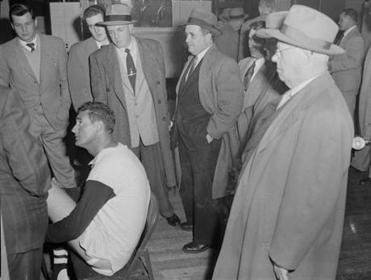
Does any sportswriter still wear a suit? (or a fedora?)

Ted Williams surrounded by the gentlemen of the press.  (via Boston Globe)

Ted Williams surrounded by the gentlemen of the press.
(via Boston Globe)


2 Comments

Filed under Boston, Journalism, journalism history, Red Sox

Fun with maps: A U.S. map with equal pop.s

What if the United States still had 50 states but they all had a roughly equal population?

It might look something like this fantastic map, drawn by mapmaker Neil Freeman.

From Pocono to Shasta, from Atchafalaya to Mesabi, this land is made for you and me. electoral10-1100


Funny thing: in this map, the big states in the West are even bigger, because NOBODY LIVES THERE. In this map, places like Boston and Throgs Neck and San Fran get their own pairs of senators, because people actually live here. If the map looked like this, maybe presidential campaigns would be about mass transit instead of guns.


2 Comments

Filed under Politics

Fall leaves: let’s leave them where they fall

By Christopher B. Daly 

Ah, another late-fall day here in New England. Full of watching the winter juncoes arrive, harvesting the last root vegetables, and listening to the roar of the leaf-blower. Sure enough, where I live just outside Boston, Monday mornings in fall bring an invading army of landscapers. Just after most of my neighbors have started their commute to work, those of us who work at home bear the brunt of the commercial landscapers’ day-long assault.

I am not advocating a radical, tear-up-your-lawn, no-mow approach (although there’s no harm in that, either.) Nor am I advocating a ban on lawn mowers and a return to hand-powered mowers (although there too, I think we could do a lot better).

I am calling for a deep reconsideration of a practice that has become de rigueur here in the suburbs, but which our ancestors would have considered demented. That is the compulsion to remove every fallen leaf from our lawns, driveways, and walks.

According to an article in the New York Times, there is a growing trend (is there any other kind?) toward re-thinking the assumption that all leaves must be whisked “away” to somewhere else. As an ecologist could tell you, there is no such place as “away.” Everything goes somewhere.

Let’s consider the leaf.

A leaf is part of a plant that allows it to live by conducting photosynthesis, converting sunlight into energy, which fuels the plant. In doing so, plants take in carbon dioxide through their leaves and emit oxygen. In this way, leaves do an enormous amount of good for the planet and for each one of us — also known as “ecosystem services.”

So far, so good.

In this part of the world, though, most plants drop their leaves in the fall to prepare for the rigors of a snowy, icy winter in which there may be no liquid water available for many months. The leaves fall to the ground, where they form “leaf litter,” a mat of leaves that — if left alone — would eventually decompose and join the soil, enriching it with organic material. The leaf litter is the plant’s attempt to shape the environment in its favor, as for example, when a pine tree drops some of its needles to form a dense, acidic mat below that discourages other plants but favors more pine trees. (I suspect that almost every plant harbors a secret plan to take over the world.)

This is what brings some plants into conflict with some humans. The conflict is particularly acute between the deciduous trees (like oaks and maples) and the suburban homeowner. Suburban homeowners are, by definition, also suburban landowners, so they are involved whether like it or not in land-use policy.

Overwhelmingly, suburban landowners are putting their land to use in the same way: growing grass for lawns. They are, in other words, farmers who grow a single crop, which is to say that they are involved in “mono-culture.” Oddly, suburbanites devote a lot of time and money to raising that one crop, only to cart it away and pay to dispose of it. They do not eat it, and they do not feed it to any livestock (rabbits do not count).

Part of the expense in maintaining a grassy lawn is the cost of protecting that lawn from the leaf litter. If all the trees in all the yards in an area like the one where I live in New England were allowed to drop their leaves undisturbed, our yards would soon begin to look like the forest floor rather than a grassy lawn. The leaves in the leaf litter layer would overlap and smother most grasses.

Hence, the great fall mania for leaf clean-up.

Originally, most Europeans who settled in this part of the world did not bother with a lawn. They sensibly built their houses close to the road, leaving just enough room for a front garden. In back, most people would have had a historic_societybarnyard — a patch of hard-packed dirt between the house and the barn. Most of the rest of the land would be fields and orchards or it would be left more or less wild as a living resource for harvesting wood and foraging all kinds of useful things. Those ancestral New Englanders had real outdoor chores demanding their time and strength, and they could not possibly have squandered any time raking leaves just for the hell of it.

In the 19th century, the lawn made its debut, and in the 20th century, the lawn conquered millions of acres of U.S. land.

At mid-century, when I was a child, most suburbanites handled their own yard care. In my neighborhood in Medford, Mass., I can recall only one family that hired a landscape service, and they were the wealthiest folks around. Everyone else just got out there and took care of their yards, or else they hired a teenager to do it for them. People like my father waited until the trees had dropped nearly all their leaves, then he started raking at the point farthest from the street. He raked the leaves into a long mound at the edge of the street. Then he did what everyone else did: he took  some matches out of his pocket (where he kept them because he was a smoker) and set the leaves on fire.

For a child, this was one of the great rituals of the year, a communal festival of sorts, with great sounds and smells and the infinitely absorbing allure of an open fire. As children, we tended those leaf fires, blowing on them, feeding them with dry leaves, trying to build the biggest fire the adults would tolerate. photo-chicago-boys-raking-and-burning-leaves-wilmette-street-1955Yes, there was some danger involved, I suppose, but at that stage in our national evolution, children were expected to learn to handle risk, not to avoid it. If the tail of your jacket happened to get burned while you were squatting to blow on some nearby embers, that was a lesson learned.

Sometime in the 1970s or 80s, under the banner of the environmentalist goal of clean air, every town I know of in New England banned the practice of open burning of leaves. (Yes, the air is cleaner, but, of course, something was lost in the process, too, and that needs to be acknowledged.)

Which brings us to the present. Nowadays, a dwindling number of suburban homeowners continue to do their own gardening and yard work. More and more, my neighbors summon commercial landscapers (and not the kid down the block, who is too busy anyway). This brings us an odd sight: like soldiers before battle, the landscape workers, who are engaged in a supposedly healthful form of outdoor exercise, first gear up with headphones, surgical masks, and sunglasses. After all, they know better than anyone just how obnoxious the portable, gas-powered leaf-blower is, and they want to protect their ears, their lungs, and their eyes.
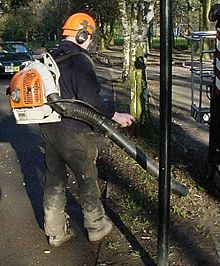
220px-Aa_backpackleafblowerThey need protection, too. The average leaf-blower emits up to 70 or more decibels of noise along with some amount of smoke from its unmuffled, two-stroke, gas-fueled motor. But that decibel rating is a figure for a single well-maintained blower. The ones I experience are often old and banged up, and the guys who use them often gang together forming sonic artillery three to four abreast. Motors roaring, they wave their tubes from side to side, like a sci-fi elephant.

If it’s wet, they just redouble their efforts, roaring longer and louder to try to move those wet leaves from here to there. If it’s dry, watch out. Blasting away with their jets of air leaving the nozzle at nearly 200 mph, the leaf-blowers move more than leaves. They also pulverize and aerosolize pretty much every other small thing on the ground: bird shit, mouse dung, mold, cigarette butts, dust, allergens, pollen, weed seeds — it all swirls together in a choking, irritating mini-cyclone of detritus. And, oh yes — if your landscaper sold you an application of a herbicide or pesticide, then some of those poisons are going up in the toxic swirl, too. No wonder the guys on the crew try to protect themselves.

Usually, they blow the leaves onto a huge tarp, which they haul to the street. Then, they use a giant vacuum cleaner to lift the leaf pile into the back of their truck. What happens next is another ecological crime.

They haul all the leaves away. In other words, they deplete the yard of a significant amount of organic material that would otherwise rot and recycle into the soil. So, the removal of the leaves seriously depletes the land of its natural fertility. This is clearly a demented activity. Why do homeowners let the landscapers pilfer this valuable material?

Then comes the kicker: the landscapers will be back in the spring to sell the homeowner a treatment with . . . artificial fertilizer! This is to compensate for loss of the free, natural fertilizer that the yard would enjoy if the leaves were left in place. This is the equivalent of a burglar selling you your own stuff back!

To make matters worse, the removal of all those leaves means that the landscaped yard has no leaf litter. That is, there is no part of the yard in which certain organisms can winter over and carry on their lives. Many beneficial insects depend on the leaf litter for food and shelter. Without it, the yard is nearly barren, featuring only the useless lawn. And of course, no bugs means no birds (unless the suburbanite also hangs a bird-feeder — another unnatural act; don’t get me started on that one!) as well as no toads or all kinds of other creatures that were here before us.

All in all, the landscaped suburban lawn is pretty much an ecological disaster. Too often, it is a wasteland of clipped grass and exotic ornamental shrubs, shaded by a couple of non-native trees like Norway maples. This is a high-maintenance, expensive, inefficient approach that alienates the homeowner from nature, exposes the landscaping crew and the neighbors to noise and air pollution, and impoverishes our landscape.

We can do better.

[In another post, I will try to suggest some ideas for bringing some ecological sanity to the suburbs. Meanwhile, get a rake and a broom.]


1 Comment

Filed under Environment, history, Politics, Wildlife

Journalism internships

By Christopher B. Daly 

Once again, NYTimes media columnist David Carr has put his finger on an issue that deserves more attention: the unpaid internship.

The practice of granting internships to college students for no pay has become rampant in the news business. Some journalistic organizations offer academic credit — or, more precisely, they insist that the student’s university award academic credit for the internship, so that the internship is not technically un-compensated.

In practice, we all know that many internships are worthwhile, for both parties. The intern gets some valuable experience, a list of professional contacts, and a line on his/her resume. The sponsoring newsroom gets some eager, bright help. That’s why they are so difficult to eliminate.

It’s also far from the whole story.

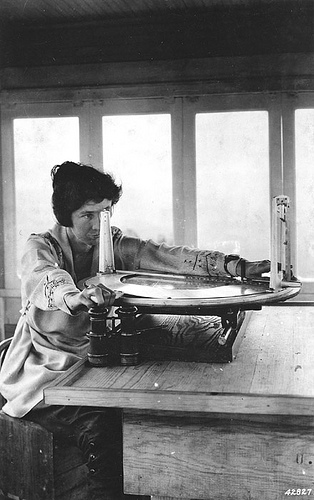
We also know that many internships are exploitative. The students may be relegated to delivering lattes to the boss, and they are passing up the opportunity to do something else. (In many cases, I think my students would be better off getting a real, paid  job doing something out of their realm — being a firespotter in a National Forest (Kerouac),

3663060280_3881ee68c3


or working on a tramp steamer (E.B. White),

imgres

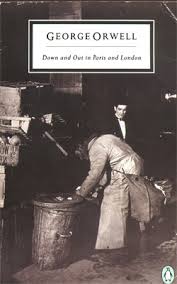
or washing dishes in a restaurant (Orwell).

imgres-1


What writers need above all is material, the kind you can only get from life itself.


Leave a comment

Filed under Uncategorized

Journalists and drones

By Christopher B. Daly 

As with any new technology, aerial drones can be put to many uses, as a story in today’s Times details. They were introduced as a high-tech supplement to America’s military and spy arsenal. DRONE-popupBut now, some clever journalists are coming up with ways to turn drones to their own needs. After all, they are comparatively cheap (relative to, say, the cost of buying or renting a helicopter), highly effective, and in many cases, still legal.

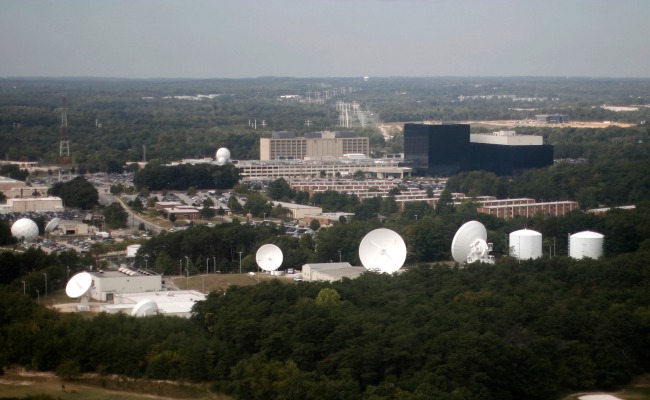
I think it would be poetic justice if the NYTimes bought a drone and stationed it above the CIA headquarters in Langley, Va., or if the Guardian bought one and parked it above the NSA. Just to keep an eye on things and “watch the watchers.”

(note to spymasters and prosecutors: Just kidding!)

Secret stuff. You probably shouldn't even be looking at this.

Secret stuff. You probably shouldn’t even be looking at this.

Leave a comment

Filed under Uncategorized

Abolish the NCAA (cont.)

By Christopher B. Daly

Mark me as skeptical on this one. Today’s NYTimes is declaring that the NCAA is on the verge of epochal change. I’ll believe it when I see it.

If more professional sports want to establish farm leagues and pay young athletes, so be it.

If more college students want to get out and exercise, so much the better.

The fact is, the NCAA has never come up with an answer to this question: what educational purpose does inter-collegiate athletics serve?

imgres-1


1 Comment

Filed under NCAA

White House photogs demand access

And they should get it (much as I would like to side with B.U. alum Pete Souza, the official White House photographer).

Here’s a version.

sub-photographers-1-articleInline


photographers-2-articleInline

Leave a comment

Filed under Journalism, journalism history, New York Times, Obama, Photography, Photojournalism, Politics, President Obama, publishing