Category Archives: Uncategorized

China’s clean-air subsidy

By Christopher B. Daly 

Having just returned from two weeks in China, I can confirm the point made in a story in today’s New York Times: China’s air is filthy. People routinely wear surgical masks just to avoid breathing in all the particulates. It feels like Pittsburgh or Manchester of the late 19th Century.

Two points:

–China’s energy companies are as short-sighted as our own, lobbying to continue polluting the air. But at least on CCTV I did not see any ads touting the oxymoronic “clean coal.” Coal is coal, and coal is dirty. From today’s Times piece by Edward Wong:

Even as some officials push for tighter restrictions on pollutants, state-owned enterprises — especially China’s oil and power companies — have been putting profits ahead of health in working to outflank new rules, according to government data and interviews with people involved in policy negotiations.

Sheesh.

–We in the States should be aware that China is subsidizing our own clean skies by putting up with the pollution that makes their products so cheap. Walmart and other retailers could not stock their shelves with such low-priced goods if China took the necessary steps to clear its own skies. If they really insisted on air that is as clean as that in the US or Europe, China would have to install scrubbers, switch to cleaner fuels, and invest in a lot of new greener technology. In that case, the price of manufacturing would go up, and we would have to pay a bit more for all the cheap stuff we import. Which would not be the worst thing.

Here’s a photo I took in Xi’an, a city of about 10 million in east-central China:

Power plant in Xi'an, China.

Power plant in Xi’an, China.

And here’s a Beijing sunrise:

IMG_1969

It really is that bad.


Leave a comment

Filed under Uncategorized

Hey, Fuck-head: Go fuck yourself!

By Christopher B. Daly

That’s about the state of certain comments by certain people. This piece in today’s Times labors to try to make this sound new. As anyone knows who has gotten involved with a dispute on-line, the comments tend to go straight downhill. I’m not sure what that tells us — except maybe that it stands as confirmation that life really is like high school.

It brings to mind the original comment by the original blogger, Dave Winer. Early in his career as a founding blogger, Dave announced that he would not allow comments on his blog. His reason: If you have something to say, start your own damn blog! The web allows everyone to speak their mind. So there is absolutely no moral imperative to open your site to trolls.

Right here, on my own blog, I say (as we used to say at Medford High) to all trolls:

Ah, go fuck yourself!

soxfan6


Leave a comment

Filed under Uncategorized

The Oscars: revisionist history on film?

By Christopher B. Daly 

Hooray that more than half of the leading contenders for Best Picture at this year’s Academy Awards have historical themes.

A question that always hangs over such films is: how accurate are they? Accuracy, of course, is often in the eye of the beholder, but a more useful question might be: do any of these films revise history in a way that improves our historical understanding, warps our historical understanding, or makes no difference?

Keep that in mind tonight when watching the Oscars show a propos the following:

–Les Miz (just how often do the poor break into song?) imgres


imgres-1–Argo (does it matter that the character played by Ben Affleck was really Hispanic? If you don’t think so, then Ah, go fuck yourself!)


imgres-2–Zero Dark Thirty (who says that torture “worked”?)


imgres-3–Lincoln (did one weary, kindly man “free the slaves” all by himself?)


imgres-4–Django Unchained (was the past an orgy of stylized violence?)


3 Comments

Filed under Uncategorized

Press freedom: A new “Ken Burns effect”?

By Christopher B. Daly 

Thanks to documentary film-maker Ken Burns, a federal magistrate has struck a blow for press freedom that strengthens the legal protections for documentary film-makers, journalists, all sorts of people who prepare non-fiction for audiences, and — not least — those audiences themselves. In this case, everyone wins except the government lawyers who wanted to rummage through Burns’ outtakes from a controversial film.

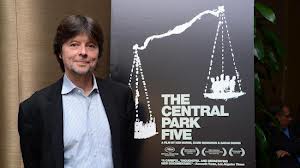
Briefly, the case involves a 2012 film made by Burns and his daughter, Sarah Burns. The film, titled “The Central Park Five,” tells the true story of imgres-1a notorious 1989 rape that occurred in New York’s Central Park. It tells of the fateful rush to judgment by law enforcement officials and the railroading of five young African-American men who were sentenced to long jail terms, even though they were innocent of the crime. Eventually, the men sued the city of New York.

Then, the city’s lawyers, presumably seeking some exculpatory material, decided to go fishing in the Burnses’ raw footage. They probably hoped to get lucky and find something that would let the city off the hook or at least muddy the waters. The city’s lawyers demanded access to the Burnses’ notes and outtakes. Right there, they should have known better. What could be more chilling to the practice of journalism (or documentary film-making, or history, for that matter) than having government lawyers picking through the material that doesn’t meet the standard of truth and accuracy. (I know that I have cartons full of notes of material that never saw the light of day because I considered that stuff wrong, unfair, or simply incomprehensible.)

To his credit, Ken Burns resisted that demand and hired lawyers of his own. This week, Magistrate Judge Ronald L. Ellis of United States District Court in Manhattan threw out the government lawyers’ request.

imgres 

[Before any journalists reading this get too smug, “The Central Park Five” is also a cautionary tale about the news media’s own rush to judgment in the case, which was just as grotesque as that of law enforcement — indeed it may have been a driver of the ultimate injustice.]


So, congrats to Ken and Sarah Burns for standing up for freedom. In the rape case, it turns out the authorities had the wrong guys. In the subpoena for outtakes, it also turns out the authorities had the wrong guys. 

From today’s New York Times:

Judge Ellis also ruled that the city failed to meet the requirements for subpoenas to journalists for nonconfidential material: that the material would be significant and relevant to its case and was unavailable elsewhere. He said pretrial depositions would give the city’s lawyers ample opportunity to question the five men.

“It’s a marvelous decision for documentary filmmakers and point-of-view journalists,” Mr. Burns’s lawyer, John Siegal, said. “And it’s an important victory for the media industry generally.”


Leave a comment

Filed under First Amendment, Journalism, Uncategorized

Essaying the essay

By Christopher B. Daly

Don’t miss this marvelous essay about essays by one who knows — Philip Lopate. He is the editor of The Art of the Personal Essay and a prolific essayer in his own right. I love his emphasis on doubt and on the use of the essay to explore doubt. In an age of assertion, this seems worth remembering, or at least I think so.

17DRAFT-blog427


Now, time to get back to that biography of Montaigne, the ur-essayist.

As Montaigne himself put it, the starting point of the essay is this: What do I know? roll that around in your head, or on your tongue, putting the emphasis on each word in turn.

Leave a comment

Filed under Uncategorized

Using research in journalism

By Christopher B. Daly

This column by James B. Stewart in today’s Times is a good example of the power of using research. When journalists avail themselves of expertise and data, they can get past myths, slogans, and he-said/she said. In the column, Stewart examines the claim that rich people move to avoid income taxes. That claim, a favorite of tax-cutters, is an assertion that should be testable by facts. Turns out, it has been tested — multiple times — by social scientists. What did they find?

Here’s Stewart’s take-away:

It turns out that a large majority of people move for far more compelling reasons, like jobs, the cost of housing, family ties or a warmer climate. At least three recent academic studies have demonstrated that the number of people who move for tax reasons is negligible, even among the wealthy.

Cristobal Young, an assistant professor of sociology at Stanford, studied the effects of recent tax increases in New Jersey and California.

“It’s very clear that, over all, modest changes in top tax rates do not affect millionaire migration,” he told me this week. “Neither tax increases nor tax cuts on the rich have affected their migration rates.”

The notion of tax flight “is almost entirely bogus — it’s a myth,” said Jon Shure, director of state fiscal studies at the Center on Budget and Policy Priorities, a nonprofit research group in Washington. “The anecdotal coverage makes it seem like people are leaving in droves because of high taxes. They’re not. There are a lot of low-tax states, and you don’t see millionaires flocking there.”

Despite the allure of low taxes, Mr. Depardieu hasn’t been seen in Russia since picking up his passport and seems to be hedging his bets by maintaining a residence in Belgium. Meanwhile, Russian billionaires are snapping up trophy properties in high-tax London, New York and Beverly Hills, Calif.

“I don’t hear about many billionaires moving to Moscow,” said Robert Tannenwald, a lecturer in economic policy at Brandeis University and former Federal Reserve economist.

Far too often, journalists fall for the anecdote, such as the noisy departure of Gerard Depardieu from high-tax France. 

(pool photo)GD embraces Putin, leader of his "adoptive" country -- or is he evaluating Putin as a possible hors d'oeuvre?

(pool photo)
GD embraces Putin, leader of his “adoptive” country — or is he evaluating Putin as a possible hors d’oeuvre?

Or else, they repeat the assertion unexamined, or “balance” it with an offsetting comment by someone from the other side.


5 Comments

Filed under Uncategorized

Tesla v. NYTimes

By Christopher B. Daly

I have been hanging fire on this one, but now comes a terrific blogpost by Dave Weinberger that not only has a wise take on the whole thing, but it also contains most of the relevant links. That way, you can see all the original contributions to this fascinating dust-up between  the New York Times and Tesla Motors. My problem is, I want them both to be right (and adult about it), so I am waiting for more data to emerge.

Vroom or bust?

Vroom or bust?

Leave a comment

Filed under Journalism, New York Times, Uncategorized

Minimum wage: international comparisons

By Christopher B. Daly

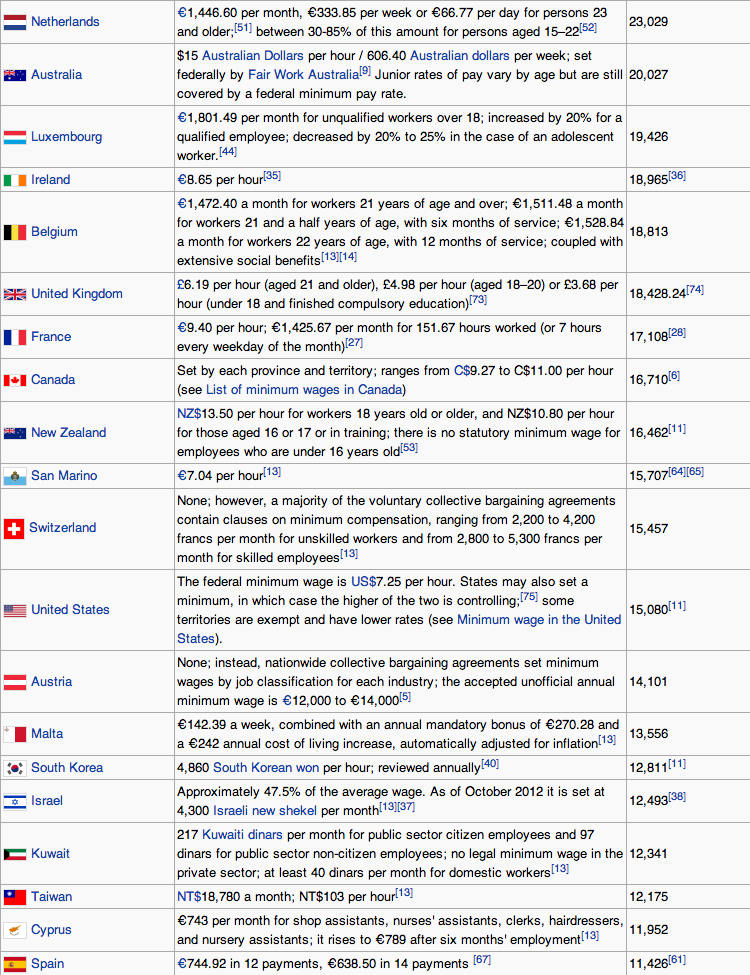
Thanks to Wikipedia, here is a chart showing how the current U.S. minimum wage compares to the minima in other countries (at least, those that have a minimum.)

For handy reference, below is the same chart reorganized a bit. What I did was to sort the annual wage column (the amount a person in a given country would earn by toiling at the minimum for an entire year) in a descending fashion. So here you can see, already converted into US$, how we stack up. We are #12 on the list.

(Note: some countries were excluded for various reasons; if they were counted here, I bet that Sweden, Norway, and Germany would all rank ahead of the USA.)

Screen Shot 2013-02-13 at 1.27.34 PM


The list goes on and on, but I could only capture so much in a single screen shot.


Leave a comment

Filed under Uncategorized

Westminister dog show gets it wrong, again

By Christopher B. Daly

Well, they’ve done it again. The judges at the Westminster Kennel Club have chosen a silly, small breed of dog as this year’s “Best in Show.” They picked an “affenpinscher.” An affenpinscher? What is that? It sounds like some kind of

A silly small dog.

A silly small dog.

Austrian pastry, not a dog. 

Next time I’m in the Demel in Vienna, I will ask if I can have an affenpinscher. Mit schlag. 

Sheesh.

To be taken seriously, a dog should at least be bigger than a cat. There is something seriously wrong when the judges could have picked a golden retriever and failed to do so. I am through with Westminster until they come to their senses and pick a golden (or at least a Lab or some other real dog).

Cody (a real dog) Photo by Fred Conrad/NYT

Cody (a real dog)
Photo by Fred Conrad/NYT

3 Comments

Filed under Uncategorized

The media and the murderer

By Christopher B. Daly

It’s a busy season in Boston media circles for works about the city’s most notorious gangster, Whitey Bulger.

The Boston Globe has a special page devoted to all things Whitey. Amazon can fill a page with Whitey books. Bulger, who is accused of 19 murders and other crimes, is in prison in Massachusetts awaiting his trial in U.S. District Court in Boston, due to start this spring, but he must be the most written-about gangster since Capone.

Right now, the Globe is throwing its institutional support behind the new hardcover Whitey Bulger: America’s Most Wanted Gangster and the Manhunt that Brought Him to Justice. It is written by two Globe reporters, Kevin Cullen and Shelley Murphy, with long years of experience covering cops, courts, and criminals.

Next up (due out next week) is a book by two former Globe reporters — my friend and Boston University colleague Dick Lehr and veteran courts reporter Gerard O’Neill (who also teaches part-time at BU). Their book, titled Whitey:  The Life of America’s Most Notorious Mob Boss, is expected to be the definitive biography of Bulger, featuring lots of new material about his childhood and his years in the federal prison system. Lehr and O’Neill are old Bulger hands, having written the landmark Black Mass in 2000, the book that grew out of their reporting while on the staff at the Globe. That was the book that first definitively ripped back the curtain and revealed the corrupt relationship between Bulger and his FBI “handler” John Connolly.
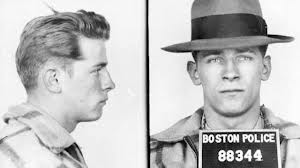
Whitey Bulger, courtesy of Boston PD. One of the greatest mugshots in the history of the genre.

Whitey Bulger, courtesy of Boston PD. One of the greatest mugshots in the history of the genre.

For hard-core Whitey fans, today’s Globe also offers a column by Kevin Cullen about Whitey’s views on politics. No surprise: Whitey is a Reagan Democrat, sort of. Here’s the column.

For the sake of comprehensiveness, the Globe also has a review today of the Cullen-Murphy book. The review is written by Sean Flynn, a former reporter at the Boston Herald and Boston magazine who now writes for GQ.

An excerpt from the review:

There was a time, long ago, when the legend of Whitey Bulger seemed nearly Shakespearean. His was the story of two brothers who rose from the Old Harbor housing project to rule the city, Billy its politics and Whitey its rackets. It was the story, too, of that neighborhood, where the greatest sin was disloyalty, and how that sense of allegiance entangled a third son of Old Harbor — FBI special agent John Connolly — who recruited Whitey as an informant, then protected him beyond the bounds of good sense or the law. The saga was often cast by Whitey’s loyalists and enablers in a haze of noir romance.

It was never that simple or that majestic, of course, and history and voluminous testimony have revealed as much. But Whitey is a product of a particular time and place, and he cannot be understood apart from either. Cullen and Murphy know this, and they reveal the complicated man amid the swirls and crosscurrents of Boston’s peculiar past.

Still to come: the movies. In Boston, it’s fun to speculate about who would make the better Whitey — Johnny Depp (pirate)  or Matt Damon (homey).

l to r: Depp, Affleck, Damon, Facinelli

l to r: Depp, Affleck, Damon, Facinelli

If you can’t get enough, here’s a reading list to help you feel more knowledgable about all things Bulger and Boston:

The Brothers Bulger (2006), by Herald political columnist Howie Carr.

–A literary curio: While the Music Lasts (1996), a memoir by Whitey’s brother Billy Bulger, the conservative Democrat who dominated the Massachusetts Senate during the 1980s and 1990s. (Fun fact: Billy’s memoir is “A Richard Todd Book” — one of the tonier imprints in American publishing.)

–There is also a shelf of books written by former Whitey confederates, starting with Brutal (2007), by former Bulger henchman Kevin Weeks and the writer Phyllis Karas (who also teaches at BU.)

–Then there are the first-hand accounts by law enforcement veterans who had a hand in stopping or capturing Bulger. You can start with Most Wanted (2012) by Thomas J. Foley, a former colonel in the Mass. State Police, who kept trying to bust Whitey only to be thwarted by corrupt FBI agents. Foley’s book is co-written (which means in all likelihood, actually written) by John Sedgwick, a real writer.

–Finally, it’s worth putting all this in some kind of historical context, and there are two places to start:

The Rascal King (1992), by Jack Beatty, about the life and times of Boston mayor James Michael Curley, and The Boston Irish: A Political History, (1995) by the late Boston College historian Thomas H. O’Connor.

And, from the fiction shelf, two great novels: The Last Hurrah (1956) by Edwin O’Connor and the the marvelous The Given Day (2008) by novelist Dennis Lehane.

Stop me!

Just remembered: if you want to know how to talk like Whitey, it’s always a good idea to brush up on the noir masterpiece The Friends of Eddie Coyle, (1970) by the late George V. Higgins (who also used to teach at BU!).

Class dismissed!

Leave a comment

Filed under Boston, Uncategorized