Category Archives: publishing

Poll: Americans back AP

By Christopher B. Daly

OK, that’s not exactly what this new Pew poll shows. But it does indicate that a healthy plurality “get it” when it comes to government spying on journalists.

5-20-13-3

Here’s the take-away:

Criticism of the DOJ is substantially higher among those who are paying attention to the story. By a 55% to 35% margin people who have followed reports about the AP phone records at least fairly closely disapprove of the DOJ’s actions. Attentive Republicans are particularly critical: they disapprove by a 66% to 28% margin.

2 Comments

Filed under First Amendment, Journalism, journalism history, Obama, Politics, President Obama, publishing

Un-bundling the media

By Christopher B. Daly 

In his latest column, the New York Times‘ David Carr makes a smart argument about how the media — both entertainment and news — are coming apart under pressure from the Web. That’s coming apart, not falling apart. They are coming apart in the sense that the “bundles” of material that arose during the pre-digital era no longer make sense. 

Here’s his lead:

For the longest time in the media business, the concept of the bundle has been foundational. Ads go with editorial content in print, commercials go with programming on television and the channels you desire are paired with ones you did not in your cable package.
People were free to shop for what they wanted, as long as they were willing to buy a bunch of other stuff they did not. The box score last night for your home team? It was wrapped inside a bundle of paper that included everything from foreign news to ads for lingerie. If you liked a song, you generally had to buy an album full of others to get the goods.


I think he’s on the right track. Consider the newspaper, for example, as I did in my book Covering America. Here’s an excerpt from Chapter 13:

Another problem besetting newspapers (and, to a great extent, magazines and television news as well) was even more existential. When seen against the backdrop of the Internet, one fact about newspapers becomes painfully obvious: a newspaper is a fixed bundle of coverage that is good but ultimately second rate. Offering readers no choice, a newspaper presents coverage of a set matrix of topics: politics, crime, business, sports, arts, and something called lifestyle. In each case, though, people who really know or care about those fields understand that they are not going to find the absolute best, most detailed, most passionate coverage of their favorite topic in a daily newspaper. They know that the best coverage will be in some niche on the Web where obsessive amateurs or professional experts gather. And with the coming of the Web, the absolute best coverage is available to everyone, everywhere, all the time, for free. In politics, for example, readers can find pretty good coverage in the Times or Newsweek. But if they really live and breathe politics, they will want it faster and at a much higher level of granularity, so they will log on to a site like Politico or Real Clear Politics instead and get what they are looking for. The same is true for business, sports, even crosswords and recipes. Thus the question arises: What is the remaining value of reading merely pretty good coverage (and paying for it) when readers can unbundle the newspaper, go online, and plunge into first-rate coverage, written by real aficionados and provided at a price of zero?

One way to understand the decline of the newspaper is to ask the ultimate question: If newspapers did not exist, would it make any sense to invent them?

I wrote that about two years ago. The only change I would make now would be to drop the reference to Newsweek. The venerable weekly print newsmagazine went broke in 2012 trying to sell a fixed bundle of pretty-good coverage and was absorbed into a born-digital enterprise, The Daily Beast. I might also amend the statement that all the high-quality niches are free, since a small but possibly growing number do charge something.

Leave a comment

Filed under broadcasting, Journalism, journalism history, New York Times, publishing, software

Be you.com (but don’t expect you book publisher to help much)

By Christopher B. Daly 

The Monday Times round-up:

There are two interesting pieces about the media businesses, but they appear in different sections and were probably not planned as a package. Nevertheless, these two articles are more informative if read together.

First, I recommend David Carr’s celebration of the business acumen of the recently departed film critic Roger Ebert. Carr points out that Ebert consistently experimented with new outlets for his work and did not shy away from new technologies. In the process, he became a brand name and added to our vocabulary. (Whether he really elevated film criticism is another question)

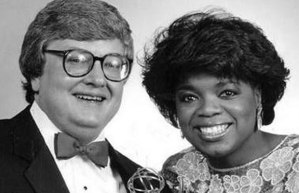
Extra credit: Carr discovered (remembered?) that Ebert played a key role in the success of another media entrepreneur — Oprah Winfrey. As I explain in my recent book Covering America (p 424 in the print edition), it was Ebert who opened Oprah’s eyes to the power of owning a stake in your own brand. Taking his advice, Oprah went from being a media employee to being a media mogul.
Ebert and Winfrey even dated for a while in Chicago.

Ebert and Winfrey even dated for a while in Chicago.

All that said, Carr’s column should be read in conjunction with an op-ed by the famous (and wealthy) lawyer, legal novelist, and president of the Authors Guild, Scott Turow. In his op-ed, Turow documents the many ways in which publishers and book-sellers worldwide are turning their ingenuity to finding ways to NOT PAY WRITERS. This is a very bad thing, under any circumstances and in any medium. It also undermines the effort of every writer, like Roger Ebert, who wants to escape the hamster wheel of working for someone else and to live independently on the earnings from their own writing (or painting, or photography, or film-making or any creative venture).

Quoting Turow:

And there are many e-books on which authors and publishers, big and small, earn nothing at all. Numerous pirate sites, supported by advertising or subscription fees, have grown up offshore, offering new and old e-books free.

The pirates would be a limited menace were it not for search engines that point users to these rogue sites with no fear of legal consequence, thanks to a provision inserted into the 1998 copyright laws. A search for “Scott Turow free e-books” brought up 10 pirate sites out of the first 10 results on Yahoo, 8 of 8 on Bing and 6 of 10 on Google, with paid ads decorating the margins of all three pages.

If I stood on a corner telling people who asked where they could buy stolen goods and collected a small fee for it, I’d be on my way to jail. And yet even while search engines sail under mottos like “Don’t be evil,” they do the same thing.

Yikes. Someone should get him a lawyer!


Leave a comment

Filed under Journalism, publishing

Shameless self-promotion (Journalism history division)

By Christopher B. Daly

Finally, it’s here: the electronic version of my book about the history of U.S. journalism, Covering America.

Just in time for the anniversary of the rollout of the hardback, this prize-winning book is now available in all major formats:

Nook,

Kindle,

Apple iBook, (This is the format I am checking it out on, and it looks great.)

Google Play,

you name it.

I am very pleased because I know that some folks have been waiting for the e-book. These formats make the book quite a bit cheaper and dramatically lighter! For people who don’t feel drawn to the ~$50 hardcover, here’s your chance to read Covering America. The book won the 2012 Prose Award for Media and Cultural Studies, and it has been selling well and drawing rave reviews (except for one stinker on Amazon — sheesh).

Enjoy it, and write to me about your reactions. You can comment here, or email me: chrisdaly44@gmail.com

CA cover final


Leave a comment

Filed under broadcasting, CNN, Covering America, David Halberstam, FCC, First Amendment, Fox News, history, Huffington Post, Journalism, journalism history, leaks, Murdoch scandal, New York Times, NPR, Photography, Photojournalism, Politics, publishing, Supreme Court, The New Yorker

Times’ paywall is paying very well

By Christopher B. Daly

Buried in the business section of today’s New York Times is a story with some very encouraging news about the future of quality journalism. The story concerns the New York Times Company itself. There’s a lot of noise in there about the sales of assets such as About.com. There’s also the usual gloomy news about the continuing declines in print advertising (down 5.6 percent).

But there are also two positive signals in all the details:

1. Digital advertising revenues rose 5.1 percent. That’s the money the Times makes from selling the electronic ads that appear in the online version. They are rising from a small base, to be sure, but they represent the ad dollars of the future.

2. The biggest good news: revenue from circulation grew 16.1 percent. In other words, the Times‘ paywall is paying very well. I would say this story “buried the lead” — because this is the biggest news in a while. The increase in circulation revenue is certainly not coming from a surge in subscriptions to the old-fashioned print version of the paper; nor is it from an upswing in newstand sales. It is coming from people who bump into the Times‘ online “paywall” and decide that it’s worth paying for the Times‘ content online. That may well turn out to be the paper’s salvation: the readers.

Here’s an excerpt from the NYTCo official earnings statement:

Paid subscribers to The New York Times and the International Herald Tribune digital subscription packages, e-readers and replica editions totaled approximately 640,000 as of the end of the fourth quarter of 2012, an increase of approximately 13 percent since the end of the third quarter of 2012.

That’s impressive. Readers in those numbers (plus some more, of course) could carry the paper into the digital future.

Can a restored dividend be far behind?


Here’s a chart of the company’s stock performance. NYTCo stock is up today, but it has a long way to go to get back to the glory days of a decade ago.

NYTCo stock

NYTCo stock

Leave a comment

Filed under Journalism, New York Times, publishing

Collecting journalism history

By Christopher B. Daly 

For those who want to understand America’s history through the legacy of printed materials, there is a terrific new exhibit at the Grolier Club, a leading institution for bibliophiles (who knew?), located at 47 E60th St. in Manhattan. According to the NYTimes, the exhibit shows the importance of collecting historical materials while history is being made, rather than waiting and hoping to find them later.

The exhibit, titled “In Pursuit of a Vision,” features some of the gems from the estimable American Antiquarian Society.

The AAS (which is not as stuffy as its name might imply) is located in Worcester, Mass., and it serves as the greatest repository of original newspapers, magazines and ephemera from early America through the 19th century. It was founded by Isaiah Thomas, a Revolutionary War-era printer/editor who put out a paper called The Massachusetts Spy. When he thought the Redcoats might be about to shut him down, he fled from Boston to Worcester, and he brought with him his own collection of newspapers, which formed the core of the AAS collection.


Leave a comment

Filed under Journalism, journalism history, publishing

Leaks (cont.)

By Christopher B. Daly

The able legal-affairs reporter Charlie Savage and Scott Shane have an interesting update in today’s Times about the issue of national-security leaks. The upshot is that the Obama administration has (surprisingly perhaps) emerged as the all-time record-holder among all U.S. presidential administrations for prosecuting leaks. (The piece has a helpful sidebar — which was better looking in print than online — that summarizes nine known leaks cases.)

A couple of related questions:

–Which administration holds the record for generating leaks? (probably a two-term president like Nixon, Reagan, G.W.Bush? or like Clinton?)

–Isn’t it worthwhile to distinguish between different types of leaks?

A. We might differentiate between authorized and unauthorized leaks.

B. We might differentiate between leaks to journalists and leaks to others.

C. We might differentiate between leaks that do harm and those that do not.

For example, it is one thing for a traitor to steal operational secrets and sell or give them to agents of a hostile power. That’s the kind of leak that should properly trigger Congressional outrage and lead to criminal prosecutions. That kind of leak raises no First Amendment issues.

It is quite a different thing for a troubled official to tell a journalist about a secret policy so that the public can debate whether that policy is a good idea. It is this kind of leak that usually induces partisan posturing and leak investigations that fizzle. It is also the kind of leak that requires a careful weighing of the First Amendment implications.

Leave a comment

Filed under First Amendment, Journalism, leaks, New York Times, publishing

Another view on the Times-Picayune layoffs

Here’ s an analysis by Rick Edmonds (via Poynter).

Worth considering.

Leave a comment

Filed under Journalism, publishing, Uncategorized

News about the News

By Christopher B. Daly

As so often happens, the Monday business section of the New York Times delivers an array of stories about journalism and media worth reading. (Why doesn’t the paper have a “media” tab on its homepage?)

1. David Carr reports on talks between CNN, the ratings-challenged cable news pioneer, and Anthony Bourdain, the macho chef/traveler of Travel Channel fame. CNN execs are trying to address a problem I discuss in my new book (Covering America), which is much easier to formulate than to solve: what can a news-oriented cable channel do to fill all those hours when all hell is not breaking loose?

Bourdain could be part of the answer.

What else might help CNN? You comment; you decide!


2. Following up on the recent cutback in printing by the New Orleans Times-Picayune, comes a look at the broader trend, including some pros and cons.

3. From London, word that Rupert Murdoch’s troubles extend into an area he really cares about: the circulation figures of his newspapers.

4. From Shantou, a piece about how tricky it can be for Westerners to teach journalism to Chinese students in China. As a Westerner who teaches journalism to Chinese students in Boston, I can certainly sympathize. This piece also includes a bonus: an answer to the question of what Peter Arnett has been up to since he was forced out of CNN (in a failed attempt to pump up CNN’s prime-time audience ratings — see item #1 above).

So, there you go. (Just a typical Monday at the Times: four original, reported stories from across the globe that other people will be talking about for a week. )

Leave a comment

Filed under CNN, Journalism, publishing

Buffett on newspapers

By Chris Daly

Guess what super-investor Warren Buffett thinks about the future of newspapers?

Hint: he’s buying them. (And not just copies of papers; he’s buying whole newspaper companies.)

 Via Omaha.com

Warren Buffett’s letter to publishers and editors

p. 1

«

AP Photo

AP Photo


Leave a comment

Filed under Journalism, local news, publishing