Category Archives: publishing

Narrative: how long is too long?

By Christopher B. Daly 

That’s a question raised by a controversial recent piece on the Grantland site and by a critique posted today on the Times op-ed page. As Jonathan Mahler puts it:

There’s a lot of excellent magazine-length journalism being done now, and Grantland publishes plenty of it. The problem is that long-form stories are too often celebrated simply because they exist. And are long. “Long-form, on the web, is in danger of meaning ‘a lot of words,’ ” as James Bennet wrote recently in The Atlantic, the magazine he edits.

Turns out, there are some unknown number of readers who like long articles and books and will hang in there through thousands upon thousands of words (provided, I assume, that the words are actually interesting).

Don’t take my word for it. Look at sites like longform and longreads. Get comfortable.

Leave a comment

Filed under blogging, Journalism, publishing

New biography of Roger Ailes

By Christopher B. Daly 

Looking forward to reading the new biography of Roger Ailes, the driving force behind Fox News, by Gabriel Sherman. It sounds like this is the one worth waiting for, rather than the earlier version published last year by Zev Chafets, which had Ailes’ cooperation (which can only mean one thing).

Sherman, a contributing editor at New York mag (and Newton, Mass. native), has been working on this book for years, and he certainly has the journalistic credentials to pull it off.

Today’s story in the Times features this quote from Ailes:

“I want to elect the next president.”

As if that were a shocking ambition for a news executive. The same could have been said of Benjamin Bache at the Philadelphia Aurora in the election of 1796 or of Henry Raymond of the The New-York Daily Times (as it was originally known) in 1856 or William Randolph Hearst every year from 1896 to his death in 1951. American publishers and broadcasters have usually seen themselves as king-makers (it not candidates, a la Hearst). It appears to be one of the major appeals of the job.

Another curious passage from today’s story:

Last year, lawyers from Fox News met with lawyers from Random House to discuss Mr. Sherman’s book. Fox requested the meeting because it had heard about allegations that might be in the book that it said were inaccurate, and to emphasize that the book had not been fact-checked by Fox News.

Well, why would the book be “fact-checked by Fox News”? It should be fact-checked by its own publisher, Random House, not the subject. Isn’t that the essence of editorial responsibility? Sheesh.

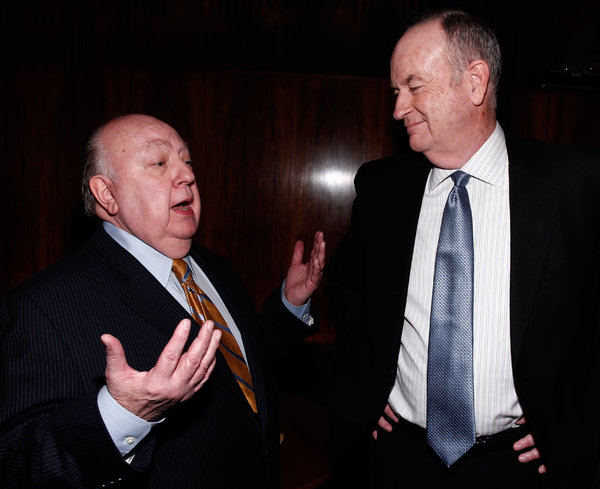
Fun fact: Ailes is quoted as calling Bill O'Reilly "a book salesman with a TV show."

Fun fact: Ailes is quoted as calling Bill O’Reilly “a book salesman with a TV show.”

Photo: Brian Ach/Associated Press Images for The Hollywood Reporter

Leave a comment

Filed under broadcasting, Fox News, Journalism, journalism history, media, Politics, publishing

A new New York Times online

By Christopher B. Daly

Today brings a long-awaited redesign of the New York Times online in all its various incarnations — desktop, laptop, tablet and mobile.

An overall first impression: it’s clean, smart, fast, and user-friendly. A clear winner. 

Screen Shot 2014-01-08 at 11.11.00 AM

To learn more, here’s an article by former Times media reporter Brian Stelter.

Some concerns:

–In the mobile version I am seeing on my iPhone, one screenful displays only 1.5 stories. It feels a bit like following a flashlight beam. I get no sense of the overall news picture.

–I am, of course, concerned about the simultaneous introduction of “native advertising” — which I consider an insidious erosion of the separation of  “church and state” within news organizations. I don’t care that everybody’s doing it. (On the other hand, I was just roaming around the site on my desktop computer, and I saw zero ads of any kind: is that courtesy of my ad-blocker?)

Your thoughts?


For comparison, here’s the way the Times looked when it made its debut in 1851 (price, 1 cent):

The_New-York_Daily_Times_first_issue


Leave a comment

Filed under Journalism, New York Times, publishing

Hyper-local news: a $300 million bust?

By Christopher B. Daly

Now comes word that AOL’s CEO, Tim Armstrong, is putting the finishing touches on the finale of Patch.com, the online local news sites. In his column today, NYTimes‘ David Carr reports that Armstrong is throwing in the towel on what used to be his baby. Too bad it didn’t work out.

There was a time when Patch looked like it might be an important part of the journalistic future. It was based on a key insight: more people were getting their news and information online, so why not local news? (Plus, there are a lot of local pizza parlors and nail salons that might advertise in such a site but would not be bothered advertising on a bigger site, because they would be paying to reach a lot of people who would never wander into their shops.)

While it lasted, Patch was a source of entry-level jobs for our journalism students, and I am worried about what will replace it.

Here’s Carr’s take:


The theory was that Patch would use a single news person and a single advertising person, at least initially, to create a digital maypole in hundreds of communities at a cost of about $100,000 annually per site. Patch sites popped up across the country, like Calabasas, Calif., and Nashua, N.H., covering high school sports, city elections and other local fare.

The execution risk was large — Patch was all moving parts, many undermanaged. At its peak, some 900 sites employed 1,400 people. Much of the journalism was pedestrian, while some of it, especially during Hurricane Sandy, was deeply important, but the decision to start at such a large scale was crippling. And all local efforts, digital or not, confront the tyranny of small numbers. Both the journalism and the ad sales were hand-to-hand, a retail effort that required spending a lot of money to go after pretty small revenue.

In August, it was clear that the math would not work. More than 350 people at Patch were laid off and hundreds of sites were shuttered.

What strikes me is the amount of money Armstrong was able to shovel into it — $300 million. Even for corporate moguls, that’s not nothing. Maybe that’s what was wrong all along: if you want to live online, keep your costs down.

I look forward to the experiment in this space that gets it right.


1 Comment

Filed under business, Journalism, publishing

NY court issues a major ruling for press freedom

By Christopher B. Daly 

Invoking journalism history, New York state’s highest court has ruled that under New York’s state constitution and the state’s version of a “shield law,” a journalist cannot be forced to divulge the identity of a confidential source — even if another U.S. state is trying to extract the information. The ruling, issued Tuesday, was a major victory for press freedom, and not just in New York. But it will have its greatest impact in New York, where so much of the news media operate, because now the highest court in that state has ruled that New York’s own laws grant complete immunity to journalists from any attempts to force them to reveal their sources. Since that court is the ultimate interpreter of the New York state constitution, it is a landmark.

It remains to be seen if a New York journalist can use this new ruling as a shield against federal prosecutors. Federal courts are not obligated to follow the New York state court ruling, of course, but any person who gains more rights under a state constitution or law does not forfeit those rights just because federal law has not caught up. The U.S. Constitution and federal laws establish legal minimums that must be afforded to all Americans, but they do not establish maximums. When it comes to our rights, federal law is a floor, not a ceiling.

Briefly, the case involves Jana Winter, a reporter for FoxNews.com. She went to Colorado in 2012 to report on the horrific mass shooting at a movie theater in Aurora. Expecting a media frenzy, the local Colorado court imposed a “gag order” — that is, a pre-trial order that tries to limit disclosures to the news media in advance of a trial. During the investigation into the crime, police got hold of a notebook that belonged to the suspect, James Holmes, which he had shared with his psychiatrist. Someone divulged the existence of the notebook to the reporter, along with a summary or description of its contents. Colorado authorities consider that a breach of the gag order, and they are stamping their feet to see who disobeyed. All the cops in Colorado say “it wasn’t me,” so the authorities are turning to the journalist and demanding that she rat out her source so they can punish that person. For that, they want to make her travel 2,000 miles to violate a promise she made to her source(s). If she stands firm and refuses to name names, she goes to jail. If she gives them up, she is ruined as a reporter, and the whole enterprise of news-gathering is undermined because all sources will doubt all reporters when they promise confidentiality. [Winter has absolutely no information that is exclusive to her and based on confidential sources that has any bearing on the commission of the crime itself. All she knows about is which Colorado cop (or cops) violated the gag order. Please.]

Many, many courts would rule against the journalist in these circumstances. Judges normally sympathize with their fellow judges and see things their way. Judges normally do not like to see anyone violate their rulings and get away with it. Judges like the idea that what they say, goes. All of which makes this ruling even more remarkable. It was a win-win: the court expanded legal protections for reporters, and it relied in part on a famous case involving an 18th-century partisan journalist to do so.

Here are versions by the New York Times (which should have put this on page 1, not inside the business section) The New Yorker, TVNewser, and Poynter. (Even Fox News had to come down on the side of press freedom in this case.)

Here is the text of the decision, written by Judge Victoria Graffeo. Among the stories I saw, only Poynter actually linked to the decision, which is disappointing — hey, people, there’s this thing called the Internet; let’s take advantage of it. Besides, the decision is well worth reading in full. It is a pro-freedom primer on the history of the freedom to gather news. Here are some key excerpts:

New York has a long tradition, with roots dating back to the colonial era, of providing the utmost protection of freedom of the press. Our recognition of the importance of safeguarding those who provide information as part of the newsgathering function can be traced to the case of “John Peter Zenger who . . . was prosecuted for publishing articles critical of the New York colonial Governor after he refused to disclose his source” (Matter of Beach v Shanley, 62 NY2d 241, 255 [1984] [Wachtler concurrence]). A jury comprised of colonial New Yorkers refused to convict Zenger — an action widely viewed as one of the first instances when the connection between the protection of anonymous sources and the maintenance of a free press was recognized in the new world. In acknowledging the critical role that the press would play in our democratic society, New York became a hospitable environment for journalists and other purveyors of the written word, leading the burgeoning publishing industry to establish a home in our state during the early years of our nation’s history.

That is an important point: New York did indeed become the nation’s media capital. I doubt that the New York State Constitution was much of a causal factor (compared to all the economic ones), but the fact that the industry is now centered in New York City means that many, many journalists enjoy the favored status granted by this new ruling. And the ruling holds that a New York-based journalist is protected by New York’s constitution even when he or she roams into another state or online to do reporting. What remains to be seen is what might happen when a New York-based journalist attempts to use the new ruling in the Winter case against a federal prosecutor who comes around with a subpoena seeking to force a journalist to name a confidential source in a federal investigation or trial.

Judge Graffeo wrote that the protections offered to journalists in New York are ancient, robust, and multiply determined.

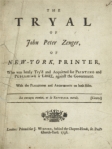
To begin with, she wrote, there is the matter of common law. Before New York was even a state, the jury in the 1735 image-crown-zenger-tryal-pageseditious libel case against the printer John Peter Zenger  established through its not-guilty verdict that Zenger did not have to reveal the identity of the author of the offending article. The Zenger case is usually cited as a precedent for the idea that truth is a valid defense in libel cases, but if Judge Graffeo finds the germ of a “shield law” in there, so be it. (For more on Zenger, see “Covering America,” chap 1)
 

Later, New York citizens wrote and ratified a state constitution. It says, in part:

“Every citizen may freely speak, write and
publish his or her sentiments on all subjects
. . . and no law shall be passed to restrain
or abridge the liberty of speech or of the
press” (NY Const, art I, § 8).

In her reading, that language from 1831 constitutes a shield for journalists all by itself, saying it is more expansive than even the First Amendment to the U.S. Constitution and thus affords more protections to New Yorkers than other Americans enjoy under the First Amendment alone.

In addition, Graffeo cites New York state law. In 1970, the New York Legislature adopted a “shield law” that includes an absolute legal privilege for journalists who want to protect the identity of their confidential sources. She said that after considering the views of the likes of Walter Cronkite and Mike Wallace, the Legislature decided to throw its weight into the balance on the side of reporters. The relevant part of that law says:

no professional journalist or newscaster . . .
shall be adjudged in contempt by any court in
connection with any civil or criminal
proceeding . . . for refusing or failing to
disclose any news obtained or received in
confidence or the identity of the source of
any such news coming into such person’s
possession in the course of gathering or
obtaining news for publication

So, Judge Graffeo concludes, journalists in New York are protected by common law, constitutional law, and statutory law. Now, how hard was that? Why do so many judges fail to understand this reasoning? The ruling holds that all these sources of protection for journalists combine to provide evidence of a clear “public policy” in New York state to encourage the practice of journalism within its borders.

But Judge Graffeo was not finished. She noted that the testimony of the journalists that the New York legislators relied upon arose from another case — that of NYTimes reporter Earl Caldwell. In a footnote, she observed

The affidavits were prepared in connection with a motion
to quash a subpoena in a case that was pending when the Shield
Law was under consideration by the Legislature and which involved
an investigative reporter from the New York Times who was
subpoenaed by a Federal Grand Jury in California to testify
concerning knowledge he obtained about the Black Panther
organization. Two lower courts held that the First Amendment
protected the reporter from being compelled to reveal his sources
or disclose information provided to him in confidence, differing
only on whether the reporter could avoid appearing at the Grand
Jury altogether (Caldwell v United States, 434 F2d 1081 [9th Cir
1970] [reporter could not be compelled to appear at Grand Jury],
vacating 311 F Supp 358 [ND Cal 1970][although required to appear
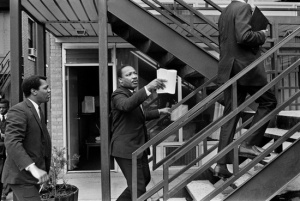
Caldwell, left, with MLK in Memphis, 1968.

Caldwell, left, with MLK in Memphis, 1968.

at Grand Jury, reporter was entitled to protective order
precluding questioning concerning confidential sources or

information]). However, deciding the case with Branzburg v Hayes
(408 US 665 [1972]), the United States Supreme Court disagreed,
holding that the reporter could not rely on the First Amendment
to avoid appearing and giving evidence in response to a Grand
Jury subpoena.

That was a regrettable decision that journalists lost by an eyelash, only because five judges on the U.S. Supreme Court did not understand the U.S. Constitution as well as these New York judges understand the New York constitution. For more on Caldwell, see Covering America, chap 12. For more on the Supreme Court’s ruling, see earlier blog posts here and here.)


The new ruling also sends a message to prosecutors in all the other states: don’t bother going on fishing expeditions. If you send us requests to compel a New York journalist to appear in your state’s courts, those will be denied. The opinion says New York will not tolerate harassment of journalists by subpoenaing them to show up halfway across the country just to assert their immunity under the New York shield law. That would be terribly disruptive to their work. Just leave them alone, the court said. Quoting an earlier case, the ruling states:

“Journalists should be spending their time in newsrooms, not in courtrooms as participants in the litigation process”

It’s thrilling to read a judicial opinion written by a judge who actually understands the meaning of a free press and appreciates its value to society. It’s rare — and therefore, I suppose, all the more thrilling.

0      0       0       0       0       0


Finally, a hat-tip to the judge, Victoria Graffeo, the former solicitor general for the state of New York who was appointed to the Court of Appeals by Republican Gov. George Pataki to a 14-year term in 2000. No liberal, Graffeo was expected to be a moderate conservative voice on that important bench. Labels aside, she gets credit for getting the point.

1 Comment

Filed under blogging, broadcasting, Covering America, First Amendment, Fox News, Journalism, journalism history, leaks, media, New York Times, publishing, Supreme Court

White House photogs demand access

And they should get it (much as I would like to side with B.U. alum Pete Souza, the official White House photographer).

Here’s a version.

sub-photographers-1-articleInline


photographers-2-articleInline

Leave a comment

Filed under Journalism, journalism history, New York Times, Obama, Photography, Photojournalism, Politics, President Obama, publishing

Bezos to Post: “Don’t be boring!”

By Christopher B. Daly 

This seems like good news: Jeff Bezos, the new owner of The Washington Post, went into the lions’ den to greet the news staff and came out a hero. By the Post’s own account, Bezos made a hit during his day of meetings.

Among his thoughts:

–“Don’t be boring.” (Good advice for a newspaper, but too often honored in the breach.)

–“What has been happening over the last several years can’t continue to happen,” he said. “If every year we cut the newsroom a little more and a little more and a little more, we know where that ends.”

— “All businesses need to be forever young.. . ”

The Bezos visit caused an explosion on Twitter, including many posts by Posties. See #bezospalooza

Is this man ready for the Style section?  Post photo

Is this man ready for the Style section?
Post photo

Leave a comment

Filed under Journalism, journalism history, publishing, Uncategorized

The re-making of the news media

By Christopher B. Daly 

We are living through a period of great flux in the news business. There are new ventures, new hybrids, new devices for gathering and disseminating information, documents, and polemics. It’s a treat to have a front-row seat (Goodbye, Google Reader! Hello, Feedly!), but it can be disorienting at times.

To wit: the decision by the mighty Time Warner media conglomerate to abandon its shiny, still-new namesake building at Columbus Circle in Manhattan and decamp to a still-unfinished tower in a lower-rentPennStation district the developers refer to as Hudson Yards. (Does anybody really call it that? It’s really a vast wasteland on the Far West Side between Chelsea and Hells Kitchen, but it is slowly becoming a new media hub within Manhattan.)

But not to be missed is a more powerful trend sweeping through much of Big Media: the break-up of many of the big conglomerates. At Time Warner, at News Corp., and at Tribune Co., the same de-conglomeration process is underway: the division of those big companies into a print division and a (for lack of a better word) video division.

–Time Warner is spinning off its magazine division, which has been the cornerstone of the Time empire since Henry Luce founded Time magazine in 1923.

–News Corp. took out a double-truck ad in the NYTimes on Monday to signal its separation into two divisions. One made up of the Wall Street Journal, the NYPost and many, many other newspapers along with some magazines, almost all of which lose money. The other is a new company (called “21st Century Fox”) made up of the highly profitable television, cable, and movie-making subsidiaries. (The new video division began trading on the stock market on July 1; shares opened at $29 and basically stayed there all day. The new print division has not started trading yet.)

–Tribune Co., which traces its roots to the Chicago newspaper empire founded by Joseph Medill and taken over by his grandson, Col. Robert R. McCormick, announced this week that it is going to spend $2.7 billion to buy 19 local television stations around the country. At the same time, Tribune Co. is trying to sell “some or all of its newspaper properties,” including the cornerstone Chicago Tribune, according to a story in today’s NYT business section.

–The New York Times Co., which traces its roots to the founding of the New-York Daily Times newspaper in 1851, began selling off its broadcast units about six years ago and completed the process a few years later. The Times Co. is apparently pursuing a strategy of shrinking to its core business and trying to defend the castle keep with a paywall.

The big open question: What will any of this mean for the quality of the journalism that is carried out by these companies?

Stay tuned.

Leave a comment

Filed under broadcasting, Journalism, journalism history, New York Times, publishing

Who will own the Boston Globe?

An update on the bidding for the Boston Globe (and other properties being sold by the New York Times Co.).

The deadline for bidding was yesterday. The Globe itself reports that there were at least six bids submitted — including one that I did not preview in my earlier post: Red Sox co-owner John Henry and his Fenway Sports Group. (Wow — could the Globe pay any more attention to the Sox than they do now?)

According to the Globe, the Kraft group dropped out of the bidding, which means the region’s newspaper will not be owned by the region’s NFL franchise owner. Phew.

Here’s the Reuters version.

Stay tuned.

3 Comments

Filed under media, New York Times, publishing

Politico goes on a hiring spree

By Christopher B. Daly 

imagesWith all due respect, I think the Times “buried the lead” in today’s story about Politico. The story focuses on the hiring of Susan Glasser, who, the Times notes diplomatically, “was known as a polarizing figure among national reporters during her tenure at The Washington Post.”

I don’t know. I was a regional correspondent for the Post, covering New England, from 1989 to 1997. Glasser did not join the Post until 1998, so we did not overlap. What I do know is that at the Post, she would have had few role models for images-1newsroom management, because the Post newsroom was terribly mismanaged during that period. With one notable exception (the estimable Bill Elsen), the editors I had to work with at the Post were not up to the job.

In a story from 2008, the Times described with happened to Glasser when she crashed as an AME (asst. managing editor, a powerful job at the Post) in charge of national news and had to be sacked by Len Downie.

When she was named an assistant managing editor in November 2006, Ms. Glasser was praised by Mr. Downie as “one of our most talented and visionary journalists.” Several Post reporters who spoke about Ms. Glasser on Tuesday said that they agreed with that description, and that Ms. Glasser, while often demanding, recognized that newspapers had to think more imaginatively had the era of declining circulation and the rise of the Internet.

But morale suffered under Ms. Glasser’s leadership, to the extent that in recent weeks a high-ranking Post editor surveyed people on the national staff to gauge just how bad feelings were running, people at the newspaper said. The morale report was conveyed recently to Mr. Downie, who was said to have been dismayed by the findings.

What is not to be missed there and what is so typical of the Post is that things were allowed to get so bad in the first place.

It’s also a bit of a mystery to me how Glasser was supposed to oversee national news when the Post had closed all its domestic bureaus.

Anyway, she left the Post later in 2008 and became the editor in chief of Foreign Policy. Now, she is jumping to Politico, where she will be in charge of two initiatives: long-form non-fiction (a new area for Politico, which has the journalistic equivalent of ADHD) and posting of opinion pieces by outside contributors. Both of those are welcome experiments for Politico, in my book, and I wish them well.

But the real headline in the Times story about Politico was in the literally final graf:

Mr. VandeHei said the site was putting “several million” dollars behind the new operations and would seek to hire a dozen new reporters.

Now, that is definitely good news. A serious digital news source is making enough money to expand and hire more reporters. Bravo.

Here is Politico’s own coverage of the move.

0          0        0        0       0

FYI, here’s what Susan Glasser said about herself on the Foreign Policy website:

Susan Glasser is editor in chief of Foreign Policy, the magazine of global politics, economics, and ideas. A longtime foreign correspondent and editor for the Washington Post, Glasser joined Foreign Policy in 2008 and has been spearheading the magazine’s ambitious expansion in print and online at ForeignPolicy.com. During her tenure, the magazine has won numerous awards for its innovative coverage, including the 2012 award for online general excellence from the Overseas Press Club and three National Magazine Awards, for digital excellence in reporting, blogging, and multimedia. FP’s ten nominations for the awards including being a 2011 finalist for “Magazine of the Year,” the industry’s highest honor.

Glasser spent four years as co-chief of the Post‘s Moscow bureau and covered the wars in Afghanistan and Iraq for the Post in the immediate aftermath of 9/11, including the battle of Tora Bora and the invasion of Iraq. After returning to Washington, she edited the Post’s weekly Outlook section and led its national news coverage. Together with her husband, New York Times White House correspondent Peter Baker, she wrote Kremlin Rising: Vladimir Putin’s Russia and the End of Revolution. Glasser previously worked for eight years at the Capitol Hill newspaper Roll Call, where she rose to be the top editor. She has served as chair of the Pulitzer Prize jury for international reporting and is a member of the World Economic Forum’s Global Agenda Council on the United States. A graduate of Harvard University, Glasser lives in Washington with Baker and their son.

Leave a comment

Filed under Journalism, journalism history, New York Times, Politics, publishing