Category Archives: Politics

The Warren-Brown Senate Race: “Organized Hatred”?

By Christopher B. Daly

The 19th Century historian Henry Adams – who was no dope – once shrewdly described Massachusetts politics as “the systematic organization of hatreds.” That was certainly true in his day. A question raised by the current U.S. Senate campaign is whether it is still true today.

Here’s why I say that. The presumptive Democrat, Elizabeth Warren, has had to spend weeks defending herself from the revelation by the Boston Herald that she once, long ago, gave the impression that she was part Cherokee.  The resulting brouhaha has changed the subject in the campaign and presumably worked to the advantage of the presumptive Republican candidate, Scott Brown.

Where did the original disclosure come from?

Let me emphasize that I don’t know what happened.

In fact, it is probably unknowable at present, due to the code of omerta that prevails among political operatives and political reporters. That code is something I do know a little about, having spent a few years as a political reporter covering Massachusetts politics.

In that role, I was the recipient of calls from parties unknown who, for reasons best known to them, decided to “drop a dime” into an untraceable payphone (I am dating myself here, I realize) and share some precious intelligence. I was sometimes invited to “take a walk” by a gimlet-eyed young operative; we would end up on a bench on the Common, and the guy would lean in close and give me the phone number of a divorce lawyer representing some disgruntled ex-spouse of a politician or cabinet member. I was invited to lunch at restaurants in the vicinity of Beacon Hill and slipped manila envelopes with documents inside, detailing the names of political donors whose relationships to each other were not obvious but turned out to be quite interesting once the tipster connected the dots. I got to know the system, thanks to these then-young political operatives.

So, here is what I surmise happened in the Senate race.

The Brown campaign did what all well-financed modern campaigns do: the candidate took a sliver of the millions he has raised and hired a team tasked with conducting “opposition research.” That is, you get a bunch of brainy young people together and you tell them to research everything about the political opposition.

And when they say everything, they mean everything: every indiscretion and every discrepancy. Every tax or mechanic’s lien. Every divorce, adoption, or inheritance. Every real estate transaction, including mortgage notes. Every arrest and every traffic violation. Every grade in school, every bad date, every expensive hairdo – EVERYthing.

The fruits of all that research are then handed over to the campaign’s senior aides and advisers, who stockpile them like ammunition. When they see an opportunity to use the information to their tactical advantage, they fire away. The campaign has some options. In one scenario, they can use the material directly and have their own candidate make a public accusation.

Or, they can play it “cute” and aim for a bank shot. They might decide to “leak” the information to the news media. That approach has several advantages. One is that the damaging material has the added credibility of reaching the public in the form of a news story. Another advantage of the leak is that the campaign can deny involvement or feign ignorance, safe in the knowledge that the reporter they went to will never rat them out.

           This can be especially effective if the campaign aides don’t even tell the candidate. Then, when the “news” breaks in the media, the candidate can act sincerely shocked and outraged and call for further investigations into the “troubling questions” raised by the news reports. That way, the story gains what we call “legs” – that is, it has the capacity to sustain itself as a continuing “story” involving denials, “fresh details,” and so on.

Did that happen in the case of the disclosure about Warren’s heritage? As I said, I don’t know. But it has all the hallmarks.

And what’s troubling about it is this: somebody knows. Quite likely, somebody in the campaign knows. If that’s the case, then there’s your real scandal right there. I say that because it points a finger at someone on Brown’s staff who must have gone through a thought process something like this:

            Oh, boy! This is great. We can leak this baby to the Herald, which we can depend on to slap it on Page 1. It will look on the surface like a “gotcha” story about a candidate’s hypocrisy. But as an added bonus, this story comes with a dog whistle: For those who can hear it, this is really a story about affirmative action. It’s a smear, intended to leave the impression that Elizabeth Warren is some kind of race whore, who gamed the system that so many white ethnics still hate.

            In their view, affirmative action is a big con game designed to put unqualified blacks, Hispanics and other minorities in line ahead of qualified white ethnics for the few good things in life. If we can get Warren associated with affirmative action, we can stir up those resentments, organize those hatreds, and peel off a couple thousand white ethnics who are independents or even some who are still Democrats. If we’re lucky, the “story” will get picked up by the echo chamber of right-wing talk radio. The eight ball drops into the corner pocket.


Did all that happen? I don’t know.

But someone does.

Leave a comment

Filed under Journalism, Politics, Uncategorized

A new series: Money in politics

By Chris Daly 

I am launching a new series of posts (like the “Math for Journalists” series) to focus on the impact of money in politics.

I first started paying attention to this issue in the 1980s, when I was covering politics full-time for The Associated Press. My perch was the Massachusetts Statehouse. As the chief of a small bureau there, I lead a team of four who covered government and politics — including elections. Most of those elections were for state office (including the U.S. Senate and House races), but they also included a presidential race in 1987-88 when former Gov. Mike Dukakis took it into his head to run for president. That race, just six election cycles ago, now seems quaint in light of the Supreme Court rulings that have since unleashed spending of a type and scale unknown before. We are in uncharted waters here.

Today’s Times brings a story about a hidden reality of the new Super PACs. For the top guns in political consulting, the Super PACs are, in many ways, more desirable as clients than are actual candidates. When you work for a candidate, you have to travel, you have to deal with volatile spouses and staffers, you have to obey campaign-finance laws that force you to raise money in small amounts from large numbers of individuals.

What the Times story doesn’t say but seems equally important is this: if you work for a candidate, there is a good chance your candidate will lose. The voters can reject the campaign or the campaigner, and the whole staff — including consultants — is, in effect, fired, by the people. Not so with the Super PACs. They don’t ever “lose” in the same sense that a candidate does. They can just hang around forever, banging away at the donors’ pet priorities. In political terms, they are immortal.

Consider “Americans for Rick Perry.” This was a Super PAC that was run by a Republican strategist named Bob Schuman. When Perry dropped out of the Republican presidential primary, Schuman — to use a Texas metaphor — had his horse shot out from under him. No matter. Schuman just got a fresh mount and reorganized as the Restoring Prosperity Fund, pushing the same agenda on behalf of many of the same donors.

One way to look at all this: money is, in effect, dis-enfranchising voters. If you don’t agree with a particular office-holder or candidate, you can vote against him or her. If enough of your fellow citizens agree, then that candidate is done.

But not so with the Super PACs. You can never vote to get rid of them.

Your view? Leave a comment.

(To be continued. . .)


Leave a comment

Filed under Politics

Inside the Meme Factory

By Chris Daly 

That’s the working title of my next book, which will document the history of the rise of the network of conservative think tanks and conservative news media in post-War America. Now that I have finished Covering America and launched it, I am eager to push ahead with the new book.

A perfect example of one of the major themes in “Inside the Meme Factory” appears in today’s Times on the front page. An article by Eric Lichtblau explores a dispute among the conservatives and libertarians who finance and run the Cato Institute.

Cato is a Washington think tank that lies near the heart of the conservative “intellectual-journalistic complex” that arose after WWII. The growth and activity of Cato and the American Enterprise Institute and others is a fascinating, largely untold story.

To be continued. . .


Industrialist Charles Koch (Mike Burley/Topeka Capital-Journal)

Leave a comment

Filed under Journalism, journalism history, Politics

Reporting challenge

By Chris Daly

During the run-up to the Michigan primary, many news sources have repeated the observation that Michigan is Mitt Romney’s “home state.” He is often referred to as a “native son.”

We know that he has not lived there since he was 18, so any use of those cliches should involve an asterisk. In any case, I have yet to see an answer from the press corps to these questions:

–in how many states does Mitt Romney currently own property (addresses, please)?

–in which state is he registered to vote?

Any answers?


(This is an image I found on Google Images. Are any of these accurate?)

1 Comment

Filed under Politics

Campaign watch

In light of Mitt Romney’s verbal stumble this week, it is worth remembering this political definition from journalist Michael Kinsley:

A gaffe is when a politician tells the truth.

Brilliant.


Leave a comment

Filed under Politics

Romney coverage

By Chris Daly 

I am trying to resist the temptation to pile on Mitt Romney (Oh, all right: I am not trying very hard!).

When journalists assess his claims to be a job-creator through his work at Bain Capital, they need to dig a little. The important issue, of course, is whether Bain was a net job creator.

Take one case: Understandably, Romney is fond of citing his role in launching the office supply superstore chain Staples. His campaign boasts that Staples “created” 90,000 jobs (and sometimes 100,000 jobs). That may be true, although journalists should still check it. But even if true, it is not the whole story. Staples is what is sometimes called a “category killer.” That means that its success depends on — or at least results in — the elimination of a whole category of existing businesses. In the Staples case, the rise of all those superstores did not occur in a vacuum. Their growth came at the expense of many, many little mom&pop stationers that used to occupy storefronts in many downtown areas. Those independent small businesses are now almost completely gone from the American scene.

It’s the same process you see with Home Depot. As they grow, there go the little, local hardware stores that used to be everywhere. Same with WalMart and other “category killers.”

So, the question that journalists should pursue about Romney is: how many jobs were left after Staples wiped out the category known as the independent stationer?

Particularly in a party that venerates small businesses, that is a question that should have some political salience.


1 Comment

Filed under business, Politics

The sorcerer’s apprentice?

By Chris Daly 

I don’t usually take frankly partisan positions in this blog, and I will try not to do that here, even in the midst of the Iowa caucus-ing.

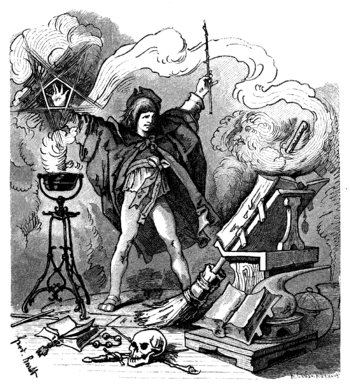
What struck me in the last few days was the lament of Newt Gingrich about the flamethrower approach of the Romney camp, which has bombarded Gingrich with negative TV ads. For a Republican to complain about unrestricted negative campaigning is more than a bit rich. It’s like Dr. Frankenstein complaining about his monster.

Questions for the media to keep in mind:

1. Who elevated the dark art of negative campaigning to its highest level?

[Hint: Lee Atwater, Karl Rove. . .]

2. Who thought is was a good idea to allow unrestricted spending on political ads?

[Hint: Scalia, Thomas, Roberts, Alito, Kennedy.]

In other words, the answer to both questions is REPUBLICANS. To the best of my knowledge, no mainstream media accounts of this election have mentioned this factual matter of background. I would say that reporters and editors should give this some thought. How will the media address this reality? Will journalists explain the factual history of the issue? Will they try to find a way to neutralize or offset it? Will television station owners in Iowa, New Hampshire, South Carolina and elsewhere reject those ads? Will the media interpret non-partisanship to mean that they must look the other way?

To be continued. . .

[Illustration of the Goethe figure the Sorcerer’s Apprentice by S. Barth, via Wikimedia]


Leave a comment

Filed under broadcasting, First Amendment, Journalism, Politics

Boo who?

By Chris Daly


Of course, right-wingers have the right to boo Michelle Obama and Jill Biden (as can be heard on this CNN clip from a recent NASCAR event).

But folks on the right should have the decency to acknowledge that when other people do the same thing to “their” first families, it is hypocritical to denounce that booing as “unpatriotic” (a favorite right-wing meme) or “disrespectful of the office.”

Either our leaders are fair game or they are not.


Leave a comment

Filed under Politics, President Obama

Media bias? Not so much

By Chris Daly 

Michelle Bachmann, a former flavor-of-the-week in the lengthy, fickle Republican primary campaign for the presidential nomination, has a gripe. Not surprisingly, she is complaining about the media.

This, of course, is a time-tested tactic for Republicans, especially when they are feeling politically desperate. Bachmann claims to have caught CBS News in a “gotcha” moment that she believes confirms her suspicions of liberal bias at CBS. Now, it may well be that there are liberals at CBS, but this episode does not prove her point. In fact, I believe it proves the opposite point.

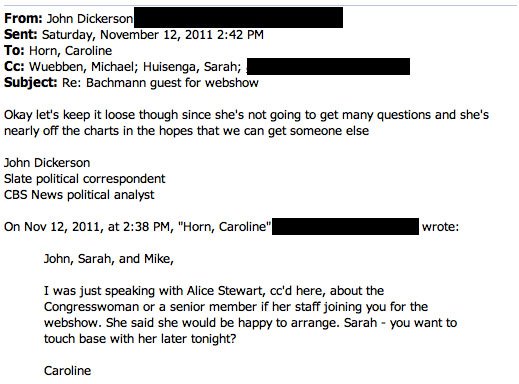
Briefly. . . As recounted in today’s NYTimes, the guy in charge of political coverage at CBS, John Dickerson, was caught doing his job. He was trying to find an online guest for a show he was orchestrating that would follow the latest Republican debate on Saturday night. In an email to colleagues, he said he would rather “get someone else” other than Bachmann.

His reason? She was “not going to get many questions” and “she’s nearly off the charts” in the polling of voters’ preferences.

(Dickerson’s big mistake was that he included a Bachmann aide among the people in the list of addresses for that particular email, so his thinking went unfiltered to the Bachmann communication director, who then did the professional thing and tried to make hay out of it, in a Facebook blast and elsewhere.)


Back to Dickerson’s email.

If we look at what he actually said, it appears that his criteria for choosing the guests to pursue were non-political, non-partisan, and non-ideological.

Like any good producer, he wanted a “hot” guest — hot in the sense of someone who is trending, someone who is going to create or amplify buzz, someone who is going to add to CBS’s ratings. He does not want someone who was last week’s news. Simple as that.

And the facts bear him out: Bachmann did indeed get few questions in the debate and little air time, and she is dying in the latest polls. (CBS’s own latest poll had her in 6th place with just 4% support.) That is not to say that she could not surge again; if she does, Dickerson and every producer, host, and booker in politics will be chasing her. Not because they like or dislike her and not because they agree or disagree with her. It will be all about blowing on the hot coals.

In his email, Dickerson could be properly charged with telling “vicious truths.”

Was he ruthless? Yes.

Was he liberal? No.

Even the awful site Big Journalism almost got this right. In fact, the blogger

p.s. For another day: What about Bachmann’s implicit claim? Do the news media formulate common policies, then execute them in concert? (Hint: people in the news media can’t agree on whether to capitalize “president” !)


1 Comment

Filed under broadcasting, Journalism, media, Politics

Brilliant

I have now seen what the Internet was made for! You have to see these political parodies offered up by Bad Lip Reading. (check out Perry, Bachman, Obama, etc.)

The Cain video is my favorite (so far). “nachos and hogwash” . . . “sing, sing, sing” . . . “baby your breath is killing me”. . . spiders, big potato moths, lice and tiger DNA, cowboys & anthrax. . .  it’s all there. Give that woodchuck a tunamelt!

This guy has the answers.

Now, what are the questions?

Leave a comment

Filed under Politics