Category Archives: Politics

Death penalty for Marathon bomber: A reluctant “NO”

By Christopher B. Daly 

[Update, 2.4.14: A new study shows a surge in exonerations.]

I was opposed to the death penalty last April 14, the day before two immigrant brothers allegedly set off two homemade bombs near the finish line of the Boston Marathon, causing death, grievous wounds, maiming,and mayhem. It was a despicable act, and it made me furious (not terrified, by the way).

In the heat of the moment, I wanted to find the perpetrators and punish them. I thought maybe they should be put into stocks on Boston Common and subject to whatever vengeance the public wanted to wreak. I think they would not have lasted long.

The Boston case – in which Attorney General Eric Holder announced on Thursday that federal prosecutors would seek the death penalty – illustrates exactly why we have laws. It strikes me that we make these laws as much for ourselves as we do for the criminals. When we are not furious, we have the chance to deliberate and to make wise laws that we agree to abide by even when all hell is breaking loose.

Before the Marathon Bombing, I thought the death penalty was a bad idea, for several reasons. It has become so rare in the United States — especially in Massachusetts, where the first execution took place in 1630 and the last execution took place in 1947 — that it could be seen as so “unusual” that it is unconstitutional on those grounds alone.

What I find even more compelling is the experience of the Innocence Project at the Cardozo Law School at Yeshiva University and similar efforts carried out by journalists and journalism students. For lots of reasons — racism, inadequate public defenders, bogus confessions, and more — there are a horrifying number of people in America who have been placed on Death Row only to be exonerated before execution. (As of today, the Innocence Project tallies 312 cases of exoneration of prisoners slated to be put to death.) And of course, some innocent people have certainly been wrongfully killed by the state — which is to say, by all of us, through our laws and our taxes.

Ultimately, the problem is this: the death penalty is an irreversible climax to an imperfect system of justice. If we could be absolutely sure that our courts never made a mistake, then the death penalty might be worth considering. But the fact is that we know that our courts (and our cops and our prosecutors) sometime make mistakes. So, it is illogical and immoral to cap off such a system with a penalty that has no remedy.

For these reasons, as someone who was born in Boston and works here I am pleased that the Massachusetts Legislature has repeatedly refused to reinstate the death penalty. The last time the issue came up for a vote, in 2001, the Legislature rejected it by a vote of 94-60. Even in the aftermath of the Marathon Bombing, a large majority of Bostonians said they opposed capital punishment. And I am glad that in a time of peaceful deliberation, the people of Massachusetts were able to listen to the angels of our better nature and put in place restraints on ourselves.

In the Marathon bombing, the would-be terrorists used death as the instrument of their purpose. Let us not sink to their level.

3 Comments

Filed under Politics

Surveillance state: NSA chief sees threats everywhere

By Christopher B. Daly 

In what universe does it make sense that DNI James Clapper still has his job?

He should have been charged with contempt of Congress for lying under oath and sacked by his boss, President Obama. Instead, there he was yesterday testifying to Congress.

He used the platform Congress gave him to denounce Edward Snowden, the former NSA contractor who spilled the beans on the illegal and questionable programs and tactics run by imgres3our intelligence agencies. Of course, he blamed Snowden for serious but vague damage done to America. On examination, what he really means is that Snowden made life difficult for our spy agencies. Whether he caused any other kind of damage is unclear. (transcript, anyone?)

To quote the Times:

Mr. Clapper did not give specific examples to bolster his assessment about the damage Mr. Snowden had done. He also did not say whom he believed Mr. Snowden’s accomplices to be.

But he wasn’t finished. Turns out, he sees “threats” everywhere. There are bogeymen all over Asia, the Mideast and Africa. Everywhere he looks, he sees nukes, bio-chem weapons, conspiracies, and an ever-mutating array of threats. Most of these threats are either hypothetical, localized in some faraway place, or intramural disputes between people who are no friends of ours. At the risk of sounding like some kind of neo-isolationist (which I am not), I have to observe that almost none of the threats hinted at by Clapper involve real, credible, imminent attacks on the territory of the United States.

But that’s not the standard for our military-intelligence complex. There, the issue is whether someone presents a threat (of any kind) to something known as “American interests” — a term that has no specific definition. It is so vague and all-encompassing that it could mean almost anything — a kidnapping threat against a U.S. citizen anywhere in the world, for example, or an apolitical piracy operation that menaces U.S. shipping anywhere in the world.

The fact is, not every problem in the world is an American problem, and not every problem in the world has an American solution. But if you are seeking to justify the existence of your agency and get more money for your budget, it behooves you to play up all these “threats.”

Thanks to Sen. Ron Wyden, D-Oregon, who has emerged as the great skeptic in Congress. (He’s the one Clapper lied to, face to face, last year.) At this week’s hearing, Wyden

said that the dealings between spy agencies and their congressional overseers were crippled by a “culture of misinformation.”

Speaking of executive actions, this is one problem Obama could solve today, without needing an act of Congress. Fire Clapper.


Leave a comment

Filed under Journalism, leaks, media, Politics, President Obama, surveillance

Surveillance state: What Obama should have said about NSA

By Christopher B. Daly

President Obama had an opportunity today to say (and thereby do) something meaningful about reining in the surveillance state and re-asserting the Constitution. Disappointingly, he whiffed. 

Here’s what I think he should have said:

1. First and foremost, he should have said, I’m sorry. He should have expressed regret that since taking office, he has fallen under the spell of all the people in the Pentagon and White House whose job it is to tell goblin stories every day to the president. He showed far more common sense when he was a private citizen and even as a U.S. senator than he has been showing since he began starting each day listening to the presidential Daily Briefing, which is basically a  serial horror story told by the surveillance/security apparatus.

2. He should have made a pledge. He should have said that if you are a U.S. citizen living in the United States and you are not a suspect in a crime, then you have an absolute right to be left alone. The government has no business spying on you. He could have quoted the Fourth Amendment of the Bill of Rights, which says, in part:

The right of the people to be secure in their persons, houses, papers, and effects, against unreasonable searches and seizures, shall not be violated, 

He could have explained that in a modern context, your house means not only your literal house but also your apartment and your office and your motor vehicle. Cops and spies cannot enter those places without your leave. Extracting information from me without my permission outside of a criminal investigation is, on the face of it, an unreasonable search.

3. He should have added, If you are a U.S. citizen who is not suspected in a crime, then you have the right to be left alone not just by the NSA but by the whole government — the NSA, the CIA, the FBI, the IRS, the DOJ, the DEA, your state police, everybody.

4. He should have announced a policy that needs no Congressional approval: No more secret policies about secrets. He should have handed out copies of his administration’s legal memorandum laying out its constitutional rationale for its current practices. He should have said (as he did) that we cannot just get out of the spy business. We have legitimate reasons for spying on other countries and on terrorists. And we will need to keep the operational details of those operations secret. That’s obvious, and I know of no one who disagrees. But the president should have gone further and said, Under the Constitution, any president needs to go to Congress and say, in a general way, Here’s what we need to do … here’s why … here’s how much it will cost. Please vote for it.

5. He should have said that if you are a U.S. citizen who is suspected of a crime, you have an array of legal protections under the Constitution, under state and federal laws, and under case law, and we have no intention of messing with those.

6. If you are not a U.S. citizen, you’re on your own.

7. If you are a terrorist, watch your back.

In short, he should have said: Under our precious Constitution, the government should be transparent to the people, and the people should be opaque to the government.

Instead, he cherry-picked incidents from U.S. history to try to establish the idea that massive secret spying on law-abiding Americans in peacetime is somehow normal. He made it clear that he thinks no one did anything wrong (including Clapper, who blatantly lied to Congress under oath) except for Edward Snowden. And he offered some half-measures and said on anything difficult I am either going to punt or send it to a committee. Disappointing.

Here are other takes, by Jeffrey Rosen and Geoffrey Stone and John Cassidy.

Here’s the president’s text. You decide.


1 Comment

Filed under Obama, Politics, President Obama, surveillance

Roger Ailes revisited

By Christopher B. Daly 

With the release of Gabriel Sherman’s new book about Fox News boss Roger Ailes, there is a lot of commentary about Ailes.

Here’s David Carr. Here’s TNR.

Amid all the commentary and analysis, it’s important to keep some sense of perspective. Fox News reaches a maximum of about 3 million different Americans in a typical day. That’s less than 1% of the population. And the ratings for Fox News are no longer climbing; they appear to have topped out. Not only that, but the Fox News audience is considerably older than the ideal “demographic” for television viewing. (Not to mention that the Fox News audience is whiter than average and much more conservative.)

In other words, it’s unlikely that Roger Ailes is the king-maker in national politics that he would like to be (and to be seen as). More and more, it appears that his television channel preaches to the (aging) choir.

images

Leave a comment

Filed under broadcasting, CNN, Fox News, Journalism, journalism history, Politics

Jacob Riis showed “How the Other Half Lives”

By Christopher B. Daly 

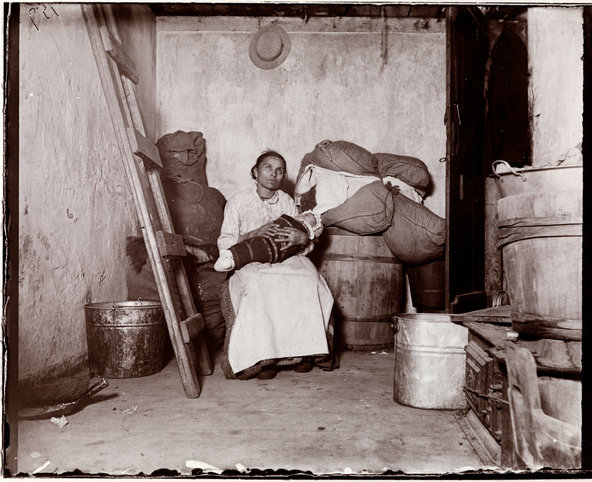
A hat-tip to journalist and educator Ted Gup for a terrific story about his discovery of a classic work of journalism history — the copy of How the Other Half Lives that was owned and annotated by the author himself, Jacob Riis. As I described him in my book, Covering America, Riis (pronounced rees) was a Danish immigrant to New York City who was shocked and outraged by the conditions he found in the city’s many tenements in the late 19th century. Picking up his notebook and a camera (equipped with a then-new technology — the portable flash), he explored the warrens of tiny, windowless rooms where New York’s newest and most miserable found cheap housing. In buildings lacking heat, ventilation and plumbing, the masses huddled while the wealthy were building ever grander pleasure domes uptown on Fifth Avenue and the rest of the Upper East Side. His work also provided a template for the journalists of the classic “muckraking” movement in the first decade of the 20th Century. 

An important thing to know about Riis’ expose, published in 1890, is that it had an impact. His photos and writing contributed to a political demand for improvements in New York City housing codes, which resulted in concrete improvements in the tenements. The city adopted new building codes that required more light, less crowding and, eventually, heat and plumbing.

In his piece in today’s Times, Gup — an investigative journalist himself who now chairs the Journalism Dept at crosstown Emerson College — describes how he stumbled upon a first edition of How the Other Half Lives that contains Riis’ own handwritten comments and marginalia. He also rightly commends Riis as a “multimedia” journalist for his combining of text and photos (and his use of a flash to light up those dark inner rooms of the tenements).

As many have observed (including the city’s new mayor, Bill DeBlasio), Riis is as relevant as ever, now that New York City is living through another Gilded Age in which wealth is as unevenly distributed as it was in the days of Rockefeller, Morgan, and Hearst.

"The Italian Rag-picker," by Jacob Riis, from his book, How the Other Half Lives.  Photo from Museum of the City of New York.

“The Italian Rag-picker,” by Jacob Riis, from his book, How the Other Half Lives.
Photo from Museum of the City of New York.


Leave a comment

Filed under history, Journalism, journalism history, Photojournalism, Politics

New biography of Roger Ailes

By Christopher B. Daly 

Looking forward to reading the new biography of Roger Ailes, the driving force behind Fox News, by Gabriel Sherman. It sounds like this is the one worth waiting for, rather than the earlier version published last year by Zev Chafets, which had Ailes’ cooperation (which can only mean one thing).

Sherman, a contributing editor at New York mag (and Newton, Mass. native), has been working on this book for years, and he certainly has the journalistic credentials to pull it off.

Today’s story in the Times features this quote from Ailes:

“I want to elect the next president.”

As if that were a shocking ambition for a news executive. The same could have been said of Benjamin Bache at the Philadelphia Aurora in the election of 1796 or of Henry Raymond of the The New-York Daily Times (as it was originally known) in 1856 or William Randolph Hearst every year from 1896 to his death in 1951. American publishers and broadcasters have usually seen themselves as king-makers (it not candidates, a la Hearst). It appears to be one of the major appeals of the job.

Another curious passage from today’s story:

Last year, lawyers from Fox News met with lawyers from Random House to discuss Mr. Sherman’s book. Fox requested the meeting because it had heard about allegations that might be in the book that it said were inaccurate, and to emphasize that the book had not been fact-checked by Fox News.

Well, why would the book be “fact-checked by Fox News”? It should be fact-checked by its own publisher, Random House, not the subject. Isn’t that the essence of editorial responsibility? Sheesh.

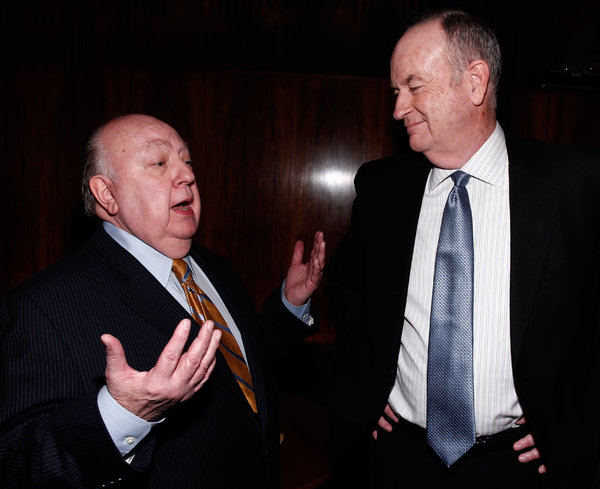
Fun fact: Ailes is quoted as calling Bill O'Reilly "a book salesman with a TV show."

Fun fact: Ailes is quoted as calling Bill O’Reilly “a book salesman with a TV show.”

Photo: Brian Ach/Associated Press Images for The Hollywood Reporter

Leave a comment

Filed under broadcasting, Fox News, Journalism, journalism history, media, Politics, publishing

Partisanship in journalism: a discussion

By Christopher B. Daly

For readers’ convenience, I am posting some material that airs out the issue of partisanship in the news media. In sequence, here are:

1. A NYTimes invitation to a Sunday Dialogue, a feature of the paper’s Sunday Review section in which readers are asked to respond to a short essay.

2. My reply as published on Dec. 7, 2013.

3. A thoughtful email that I got from a reader, who gave me permission to post his ideas here.

4. The Sunday Dialogue replies by people other than me.

5. The original author’s reply to the replies.

6. My reply to that reply.

08letters-articleLarge


How Fox News, MSNBC and others present the news.

 To the Editor:

An autobiography gives an intimate account of a life, but to get the larger picture, you also need the biography.

The same goes for news. Relying on one source, or even on several sources with the same bias, will leave you with only part of the story.

That’s why the much maligned right-wing media is just as important as the so-called mainstream press. Fox News and others on the right certainly have a deeply embedded conservative bias, but the liberal bias on the other side is just as pervasive. Taken together, they roughly fill each other’s omissions.

Fox, for example, spent a good part of the past year digging into the Benghazi attack and I.R.S. tax-exempt status stories and talking hopefully about smoking guns, while the mainstream press was determined to take the Obama administration’s word for it that it did nothing wrong in either case.

More recently, when the president’s pronouncement about keeping your health insurance proved false, it was reported as a lie by the right and as a simple misstatement by the left.

And when the Obamacare website failed so miserably that not even the mainstream press could cover for it, the networks were obliged to sound like Fox for a while, although noticeably lacking was the appetite for pursuit that characterizes their coverage of Republicans.

Fairness in journalism requires not that every story or point of view receive equal weight but that every valid position receive equal respect. Thus the pro-life position should be treated with the same validity as pro-choice; small-government conservatives with the same respect as tax-and-spend liberals; Republicans as more compassionate than they sound and Democrats as less omniscient than they think.

But since journalists and news organizations are partisan at heart, one must sift through the best reporting and punditry from each side of the journalistic divide and take all the biases and agendas into account to arrive at an informed understanding of any story.

MARK R. GODBURN
North Canaan, Conn., Dec. 2, 2013

The writer is an antiquarian bookseller.

Here’s my comment:

In his lament about bias in the news media, Mr. Godburn assumes that unbiased journalism is possible and desirable. History suggests otherwise.

In the 18th and early 19th centuries, American journalism was highly political, often polemical and openly biased. That was the kind of journalism in which the likes of Sam Adams and Thomas Paine gloriously argued for liberty, and it was the form of journalism that was on the founders’ minds when they enshrined the doctrine of a free press in the First Amendment.

Only later, beginning with Benjamin Day’s Sun newspaper in 1833, did American journalists begin to develop a strong tradition of factual reporting. In part, this was the result of Day’s ambition to sell his paper to every reader (“It Shines for All”) and not limit his audience to members of any one political party.

In the 20th century, the major broadcast network news divisions, first in radio and then in television, reinforced this idea. They not only wanted the highest possible ratings, but were also operating as publicly traded corporations and were regulated by the Federal Communications Commission.

Nowadays, from within the turbulence of the digital age, we can begin to see that the years when big media companies were purveying what they described as nonpartisan, factual reporting were actually a historical period that is already fading into the past. The Internet has reinvigorated the “advocacy tradition” in journalism, and it has also made possible new forms of reporting such as crowd-sourcing, reporting that enlists the audience and the like. The spirit of innovation lives.

CHRISTOPHER B. DALY
Boston, Dec. 4, 2013

The writer is a professor of journalism at Boston University and the author of “Covering America: A Narrative History of a Nation’s Journalism.”

Here’s the email I got from blogger Steve Claflin:

Professor Daly:

Thank you for “Partisanship in the Media” in the December 8 New York Times letters.

The revived “advocacy tradition” problem you mention might be easier to manage if we had a form of majority rule that allows the general public to have more influence.

In the old days, the House was able to vote on any bill and the majority would prevail. Until an important bill recently passed by a wide margin, a Tea Party minority could usually intimidate other members, especially the Speaker, and prevent legislation that would easily pass from even getting to the floor. The minority party in the Senate can routinely block action on bills, because minority rule is built into Senate procedures. 60 votes are needed, with the help of a fickle minority, to pass legislation.

Is there anything more vital to democracy than majority rule? Is this what distinguishes democracy from autocracy? Is this what a democracy needs in order to succeed? We have the elections we normally associate with a democratic process. We reassure ourselves by going through the motions.

But the active ideological minorities in Congress, and the members who are owned and operated by special interests that donate large sums of money, are repeatedly able to slow or block or derail changes those few oppose and the rest of us generally favor. As such repeated occurrences so rudely remind us, we can have the structure, the trappings, the proceedings, the appearance of democracy without having majority rule.

Here are the other comments published in the Times:

Readers React

In an ideal world, graced by Enlightenment ideals, Mr. Godburn’s recommendation that citizens sift through biases of diverse news media outlets to form a complete perspective would be warmly endorsed. However, in this far-from-ideal world, individuals live in media echo chambers, selecting out viewpoints that agree with their own and sometimes avoiding conflicting ones.

Research finds that conservatives gravitate to Fox News and liberals to MSNBC — as well as to like-minded websites. A Pew Research Center study reported that from August to October of 2012, just 6 percent of Fox News’s election stories about President Obama were positive, while only 3 percent of MSNBC stories about the Republican presidential candidate Mitt Romney were positive.

Exposure to biased media strengthens partisan biases, exacerbating political polarization rather than producing the more informed understanding that Mr. Godburn desires.

RICHARD M. PERLOFF
Cleveland, Dec. 4, 2013

The writer is a professor of communication at Cleveland State University.

I read The New York Times every morning. I also watch more MSNBC than I like to admit. Occasionally, for entertainment, I’ll wander to Fox for a Bill O’Reilly moment or two.

Mr. Godburn’s thesis is an example of false equivalence. The Times is real journalism. But even The Times sometimes stretches too far in the service of “journalistic objectivity.” When one perspective is true and the other is propaganda, they should not be presented as equally valid.

As to MSNBC and Fox: The MSNBC host Rachel Maddow, for example, is surely dramatic. But I have never encountered an instance in which she was fundamentally dishonest. On the other hand, Fox is frequently and outrageously untethered from the truth, and its talking heads are attack dogs. Anyone consuming equal doses of this “news” will have intellectual indigestion.

If you bend over too far in the effort to be balanced, you’ll fall flat on your face.

STEVE NELSON
New York, Dec. 4, 2013

Well said, Mr. Godburn. Political correctness and a pervasive left-wing media bias are corrosive and do immense harm to the democratic process. People eventually find out that they have been misled. This breeds cynicism and mistrust. The left and the right learn to develop their own separate versions of the “truth.”

But while most right-wing news sources acknowledge their bias, those on the left deny their bias. Left-wing news sources are suffering a fallout in ratings because people are waking up to these facts and don’t like being manipulated.

FRANK COOK
Wayne, Pa., Dec. 5, 2013

Mr. Godburn makes a telling point, but he doesn’t go nearly far enough. His assertion that liberal and conservative news outlets “roughly fill each other’s omissions” assumes that there are exactly two reasonable points of view toward any given social issue; that these viewpoints are locked in a zero-sum game whereby each one can be validated only to the degree that the opposing one is impeached; and that they happen to correspond to the platforms of our two leading political parties.

Both parties are only too eager to promote this theory themselves, since it implies that together they have a monopoly on the truth. So a responsibility of both a free press and its readers is to examine both contrary viewpoints critically and consider other viewpoints — a third, fourth or fifth perspective — that have not been embraced by either side.

THOMAS LEITCH
Newark, Del., Dec. 4, 2013

Balanced news media is essential in any democracy. But let’s remember what brought us to the present situation — the 1987 repeal of the Fairness Doctrine, which required the airing of contrasting views on public issues, and the loosening of regulations on media concentration, allowing many media outlets to fall under the control of a few corporate-owned conglomerates.

Both have created a situation in which media is not only biased and unbalanced, but overwhelmingly influenced by the opinions and wishes of its corporate masters.

DOMINIC QUINTANA
Astoria, Queens, Dec. 4, 2013

Having recently returned from a trip to Brussels, I found the evening news there to be refreshing and professional. One subject wasn’t beaten to death 24/7 as it is here. You didn’t have to flip from channel to channel to see the “whole” picture, and the news was international in nature. In the United States you rarely hear about what is going on in Africa, Australia and, actually, most of the world.

It is a shame.

BONNIE CHALEK
Ridgewood, N.J., Dec. 4, 2013

I agree with Mr. Godburn that we need different perspectives. I would like to point out that Fox News is the No. 1 news source in America. Surely, that should qualify Fox as “mainstream.”

Studies have also shown that, for many Americans, Fox News is their only source of news. Those viewers are getting a slanted perspective — not balance. Defenders of Fox News often portray it as an underdog struggling to have a voice in the crowd of “mainstream” outlets, but that depiction simply isn’t consistent with its ratings.

I commend Mr. Godburn for admitting that news outlets he identifies as left-leaning did report on the problems with Obamacare. I find that so-called left-leaning news outlets, including The New York Times, are frequently critical of Democrats and their policies.

Mr. Godburn would have a much more difficult time finding comparable examples of Fox News criticizing the G.O.P. — except perhaps when it criticizes moderate Republicans for not being in lock step with the rest of their party.

TOBY PLEWAK
Easton, Mass., Dec. 4, 2013

It may be a fool’s errand to think that we can overcome media bias. The media is ultimately a collection of voices of various people, who generally stick to certain biases and opinions. The answer instead may be to encourage media outlets to be more forthcoming about their biases.

If we, as media consumers, know that a mainstream news outlet typically holds a certain viewpoint, then we can take in the news with a better understanding of what information may be missing or may be shaded one way or another. As it is, given the rather obvious political positions held by certain newspapers and television news divisions, many of us have already begun interpreting the news in this way.

MATTHEW K. KERFOOT
New York, Dec. 4, 2013

Here is Godburn’s last word:

The Writer Responds

Professor Perloff reinforces my point by noting that conservatives gravitate to right-leaning news sources and liberals to left-leaning ones, often without being exposed to contrary views or inconvenient facts.

But then he says that going to such biased sources only exacerbates the problem, as if he thinks there are reliably unbiased sources that one can go to instead. There are not, and that is why it is necessary to mine a variety of biased ones.

Mr. Nelson engages in the cheap liberal tactic of Fox-bashing. If Fox’s talking heads are attack dogs, they are poodles compared with the pit bulls he favors at MSNBC. Simply calling one’s favored sources true journalism and the other side propaganda doesn’t make it so. And if too much news causes intellectual indigestion, too little causes intellectual blinders.

Mr. Leitch is correct that there are more than two points of view. And examining all of them will not necessarily allow one to arrive at some desired middle ground. Just because you have one foot in hot water and the other in cold doesn’t mean you’re comfortable.

Professor Daly’s claim that I assume unbiased journalism is possible and desirable may have been a good lead-in for his journalistic history lesson, but that’s not what I said. The problem is not that journalists are biased — it’s that they claim they aren’t.

MARK R. GODBURN
North Canaan, Conn., Dec. 5, 2013

And, of course, since this is my blog, here’s my final, final word:

I will grant that maybe I misread his original post. When he wrote that all journalists and news organizations are partisan at heart, I thought he considered that a flaw. Perhaps inevitable, perhaps correctable (by reading multiple sources from different perspectives) but still a problem. If he says he doesn’t think so, then who am I to argue? I would say that many people (including a lot of journalists) do consider partisanship some kind of original sin of journalism.

Comments?

Leave a comment

Filed under blogging, broadcasting, First Amendment, history, Journalism, journalism history, media, New York Times, Politics

Surveillance state: The rationale for secrecy is, of course, SECRET

By Christopher B. Daly

top-secret-stampYou may think you are a sovereign citizen of a free country. You may think that “we, the people” rule through elected representatives who are accountable to us. But that would be wrong.

The latest affront to self-government is a ruling issued by a federal appeals court on Friday (beware of Friday rulings). Here’s the background:

Thanks to accused leaker Edward Snowden, we know that the U.S. government runs a secret program in which the government calls on the telephone companies to hand over information about you without a court order or subpoena, even if you are not suspected of any wrongdoing. You were not supposed to know about it, but that cat is now out of the bag.

So, you might want to know where the government gets off concocting such a scheme and how it could possibly square such massive, secret, peacetime spying on law-abiding citizens with the Constitution. Well, too bad. The Obama administration’s lawyers, who wrote a memo in 2010 attempting to justify the whole thing, decided that the memo itself should be kept secret, and President Obama agrees.

The Electronic Frontier Foundation and others filed suit seeking to get access to the memo. The government refused. On Friday, Judge Harry T. Edwards said no. EFF can’t see it and neither can we, the people. According to a link-rich story in today’s Times by the redoubtable Charlie Savage, the ruling seems likely to stand.

This is just the latest cause for disappointment in President Obama when it comes to transparency and press freedom. If he wanted to really serve those great causes, he could:

–stop prosecuting and issuing subpoenas to reporters at an unprecedented pace

–stop over-classifying new material as “secret”

–begin reducing the backlog of classified materials that can be de-classified with no harm

–adopt the common-sense reforms recommended by his own task force on surveillance issues.

There are many things to admire about Barack Obama, but his record in this area is not one of them Perhaps it confirms that the Founders were right to be suspicious of executive power per se, regardless of the individual wielding that power. They saw, rightly, that power is by its very nature aggressive, always seeking to expand and never yielding unless forced to do so.

Leave a comment

Filed under First Amendment, history, Journalism, journalism history, leaks, New York Times, Politics, President Obama, Uncategorized

Fun with maps: A U.S. map with equal pop.s

What if the United States still had 50 states but they all had a roughly equal population?

It might look something like this fantastic map, drawn by mapmaker Neil Freeman.

From Pocono to Shasta, from Atchafalaya to Mesabi, this land is made for you and me. electoral10-1100


Funny thing: in this map, the big states in the West are even bigger, because NOBODY LIVES THERE. In this map, places like Boston and Throgs Neck and San Fran get their own pairs of senators, because people actually live here. If the map looked like this, maybe presidential campaigns would be about mass transit instead of guns.


2 Comments

Filed under Politics

Fall leaves: let’s leave them where they fall

By Christopher B. Daly 

Ah, another late-fall day here in New England. Full of watching the winter juncoes arrive, harvesting the last root vegetables, and listening to the roar of the leaf-blower. Sure enough, where I live just outside Boston, Monday mornings in fall bring an invading army of landscapers. Just after most of my neighbors have started their commute to work, those of us who work at home bear the brunt of the commercial landscapers’ day-long assault.

I am not advocating a radical, tear-up-your-lawn, no-mow approach (although there’s no harm in that, either.) Nor am I advocating a ban on lawn mowers and a return to hand-powered mowers (although there too, I think we could do a lot better).

I am calling for a deep reconsideration of a practice that has become de rigueur here in the suburbs, but which our ancestors would have considered demented. That is the compulsion to remove every fallen leaf from our lawns, driveways, and walks.

According to an article in the New York Times, there is a growing trend (is there any other kind?) toward re-thinking the assumption that all leaves must be whisked “away” to somewhere else. As an ecologist could tell you, there is no such place as “away.” Everything goes somewhere.

Let’s consider the leaf.

A leaf is part of a plant that allows it to live by conducting photosynthesis, converting sunlight into energy, which fuels the plant. In doing so, plants take in carbon dioxide through their leaves and emit oxygen. In this way, leaves do an enormous amount of good for the planet and for each one of us — also known as “ecosystem services.”

So far, so good.

In this part of the world, though, most plants drop their leaves in the fall to prepare for the rigors of a snowy, icy winter in which there may be no liquid water available for many months. The leaves fall to the ground, where they form “leaf litter,” a mat of leaves that — if left alone — would eventually decompose and join the soil, enriching it with organic material. The leaf litter is the plant’s attempt to shape the environment in its favor, as for example, when a pine tree drops some of its needles to form a dense, acidic mat below that discourages other plants but favors more pine trees. (I suspect that almost every plant harbors a secret plan to take over the world.)

This is what brings some plants into conflict with some humans. The conflict is particularly acute between the deciduous trees (like oaks and maples) and the suburban homeowner. Suburban homeowners are, by definition, also suburban landowners, so they are involved whether like it or not in land-use policy.

Overwhelmingly, suburban landowners are putting their land to use in the same way: growing grass for lawns. They are, in other words, farmers who grow a single crop, which is to say that they are involved in “mono-culture.” Oddly, suburbanites devote a lot of time and money to raising that one crop, only to cart it away and pay to dispose of it. They do not eat it, and they do not feed it to any livestock (rabbits do not count).

Part of the expense in maintaining a grassy lawn is the cost of protecting that lawn from the leaf litter. If all the trees in all the yards in an area like the one where I live in New England were allowed to drop their leaves undisturbed, our yards would soon begin to look like the forest floor rather than a grassy lawn. The leaves in the leaf litter layer would overlap and smother most grasses.

Hence, the great fall mania for leaf clean-up.

Originally, most Europeans who settled in this part of the world did not bother with a lawn. They sensibly built their houses close to the road, leaving just enough room for a front garden. In back, most people would have had a historic_societybarnyard — a patch of hard-packed dirt between the house and the barn. Most of the rest of the land would be fields and orchards or it would be left more or less wild as a living resource for harvesting wood and foraging all kinds of useful things. Those ancestral New Englanders had real outdoor chores demanding their time and strength, and they could not possibly have squandered any time raking leaves just for the hell of it.

In the 19th century, the lawn made its debut, and in the 20th century, the lawn conquered millions of acres of U.S. land.

At mid-century, when I was a child, most suburbanites handled their own yard care. In my neighborhood in Medford, Mass., I can recall only one family that hired a landscape service, and they were the wealthiest folks around. Everyone else just got out there and took care of their yards, or else they hired a teenager to do it for them. People like my father waited until the trees had dropped nearly all their leaves, then he started raking at the point farthest from the street. He raked the leaves into a long mound at the edge of the street. Then he did what everyone else did: he took  some matches out of his pocket (where he kept them because he was a smoker) and set the leaves on fire.

For a child, this was one of the great rituals of the year, a communal festival of sorts, with great sounds and smells and the infinitely absorbing allure of an open fire. As children, we tended those leaf fires, blowing on them, feeding them with dry leaves, trying to build the biggest fire the adults would tolerate. photo-chicago-boys-raking-and-burning-leaves-wilmette-street-1955Yes, there was some danger involved, I suppose, but at that stage in our national evolution, children were expected to learn to handle risk, not to avoid it. If the tail of your jacket happened to get burned while you were squatting to blow on some nearby embers, that was a lesson learned.

Sometime in the 1970s or 80s, under the banner of the environmentalist goal of clean air, every town I know of in New England banned the practice of open burning of leaves. (Yes, the air is cleaner, but, of course, something was lost in the process, too, and that needs to be acknowledged.)

Which brings us to the present. Nowadays, a dwindling number of suburban homeowners continue to do their own gardening and yard work. More and more, my neighbors summon commercial landscapers (and not the kid down the block, who is too busy anyway). This brings us an odd sight: like soldiers before battle, the landscape workers, who are engaged in a supposedly healthful form of outdoor exercise, first gear up with headphones, surgical masks, and sunglasses. After all, they know better than anyone just how obnoxious the portable, gas-powered leaf-blower is, and they want to protect their ears, their lungs, and their eyes.
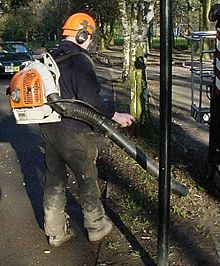
220px-Aa_backpackleafblowerThey need protection, too. The average leaf-blower emits up to 70 or more decibels of noise along with some amount of smoke from its unmuffled, two-stroke, gas-fueled motor. But that decibel rating is a figure for a single well-maintained blower. The ones I experience are often old and banged up, and the guys who use them often gang together forming sonic artillery three to four abreast. Motors roaring, they wave their tubes from side to side, like a sci-fi elephant.

If it’s wet, they just redouble their efforts, roaring longer and louder to try to move those wet leaves from here to there. If it’s dry, watch out. Blasting away with their jets of air leaving the nozzle at nearly 200 mph, the leaf-blowers move more than leaves. They also pulverize and aerosolize pretty much every other small thing on the ground: bird shit, mouse dung, mold, cigarette butts, dust, allergens, pollen, weed seeds — it all swirls together in a choking, irritating mini-cyclone of detritus. And, oh yes — if your landscaper sold you an application of a herbicide or pesticide, then some of those poisons are going up in the toxic swirl, too. No wonder the guys on the crew try to protect themselves.

Usually, they blow the leaves onto a huge tarp, which they haul to the street. Then, they use a giant vacuum cleaner to lift the leaf pile into the back of their truck. What happens next is another ecological crime.

They haul all the leaves away. In other words, they deplete the yard of a significant amount of organic material that would otherwise rot and recycle into the soil. So, the removal of the leaves seriously depletes the land of its natural fertility. This is clearly a demented activity. Why do homeowners let the landscapers pilfer this valuable material?

Then comes the kicker: the landscapers will be back in the spring to sell the homeowner a treatment with . . . artificial fertilizer! This is to compensate for loss of the free, natural fertilizer that the yard would enjoy if the leaves were left in place. This is the equivalent of a burglar selling you your own stuff back!

To make matters worse, the removal of all those leaves means that the landscaped yard has no leaf litter. That is, there is no part of the yard in which certain organisms can winter over and carry on their lives. Many beneficial insects depend on the leaf litter for food and shelter. Without it, the yard is nearly barren, featuring only the useless lawn. And of course, no bugs means no birds (unless the suburbanite also hangs a bird-feeder — another unnatural act; don’t get me started on that one!) as well as no toads or all kinds of other creatures that were here before us.

All in all, the landscaped suburban lawn is pretty much an ecological disaster. Too often, it is a wasteland of clipped grass and exotic ornamental shrubs, shaded by a couple of non-native trees like Norway maples. This is a high-maintenance, expensive, inefficient approach that alienates the homeowner from nature, exposes the landscaping crew and the neighbors to noise and air pollution, and impoverishes our landscape.

We can do better.

[In another post, I will try to suggest some ideas for bringing some ecological sanity to the suburbs. Meanwhile, get a rake and a broom.]


1 Comment

Filed under Environment, history, Politics, Wildlife