Category Archives: media

It’s raining leaks!

By Christopher B. Daly 

imgres3Today’s news brings a very curious twist on the theme of national-security leaks. This time, the suspected leaker is not a low-level functionary like Bradley Manning or Edward Snowden but a high-ranking military official — in fact, the former No. 2 in the entire military command structure. According to a report first broken by NBC News, retired Marine Gen. James E. “Hoss” Cartwright is under investigation in connection with the leak of classified information about American cyberattacks against Iran, intended to disable or slow down Iran’s program to build a nuclear weapon. (The coverage in today’s NYTimes is rather circumspect, which makes sense, considering that the Times was the recipient of the leak. The paper quotes NYT executive editor Jill Abramson saying she doesn’t discuss such things.)

I wonder if Cartwright’s rank will make any difference here. After all, he’s not some some “29-year-old hacker,” — as President Obama pooh-poohed Snowden on Thursday, while adroitly trying to keep the Snowden/NSA leak from screwing up great-power relations with China and Russia. (Funny thing: at other times, Obama is quite willing to characterize Snowden as a threat to our very existence. Also, an update: Snowden turned 30 last week.)

Back to Cartwright. Far from being a hacker, Cartwright, who was named vice chairman of the Joint Chiefs by President28stuxnet1-img-articleInline Bush and who served under Obama as well, was at the epicenter of the military/national security power structure. I wonder how the top brass and the national-security establishment feel about leaks now, when one apparently came from one of their own. Where’s the outrage? Will we be seeing Sens. McCain and Graham or former veep Cheney going on Sunday TV talk shows demanding his head?

We might also ask: Why would Hoss Cartwright do such a thing? He’s not commenting, but we can just imagine. Maybe he wanted to see the U.S. get credit for “doing something” about the Iranian threat. Maybe he wanted to let Americans know that we had the technical means to mess up their weapons program without having to attack or invade Iran by conventional means. Maybe he was ordered to make the leak by someone who out-ranked him (perhaps the Chair of the Joint Chiefs, or the National Security Adviser, or the Secretary of Defense, or the President himself?)

The Washington Post, after pointing out that the cyberattack on Iran included a computer virus named Stuxnet and was part of a broader program code-named “Olympic Games,” adds this tantalizing hint:

Cartwright, who helped launch that campaign under President Bush and pushed for its escalation under Obama. . .

Maybe Cartwright thought his favored program was threatened in some way by someone else in the national security apparatus.

As I have long maintained, the reaction to leaking is very much in the eye of the beholder. If the leaker is powerful enough, the act of leaking is not a crime but just politics by another means.

For the record: As far as we know, Cartwright would be the eighth target of an Espionage Act investigation undertaken in the Obama administration’s record-breaking campaign to punish leakers.

Speaking of cyberattacks, U.S. officials seems to be scrambling to find a path through this 28cyber1-img-popuppolicy thicket. On the one hand, Joint Chiefs Chairman Martin Dempsey is hurrying to write new rules for warfare in cyberspace, according to another article in today’s NYTimes. (Don’t hold your breath waiting to participate in this process yourself: any such rules are classified. So there!) Here’s the takeaway:

[Dempsey] said that, globally, new regulations were needed to govern actions by the world community in cyberspace. He said that the Chinese did not believe that hacking American systems violated any rules, since no rules existed.

And, finally, for an example of what’s at stake in terms of commerce, today’s Boston Globe has an eye-popping story about how the Chinese allegedly steal commercial secrets. If you thought they just stole plans for making plastic tschotschkes, think again. This one involved the design for wind turbines, which the Chinese had the nerve to sell back to us!

It’s enough to make the head spin. How am I supposed to keep up with the Whitey Bulger trial, the Hernandez case, or the trade of both Paul Pierce and Kevin Garnett to the Brooklyn Nets????

p.s. For a fun and puzzling exercise in mind-games, go to the NYT homepage and enter the term “stuxnet” in the search box. If you can figure out the results, please explain in a comment below. 

1 Comment

Filed under Journalism, journalism history, leaks, media, New York Times, Obama, Politics, President Obama, Wikileaks

NYTimes videos revisit recent past

By Christopher B. Daly 

Without much fanfare, the New York Times has been engaging in an interesting experiment that revisiting old news stories to address the ageless qusetion: “Oh, yeah . . . whatever happened to that?”

Rev. Al, back in the day.

Rev. Al, back in the day.

The service is a partnership between the Times video section and a private non-profit called “RetroReport.” (It’s not that easy to find on the Times site, but here is the link to the page that lists all seven such reports done to date.) According to the partner’s website, RetroReport’s mission is to produce video follow-ups to big stories from a decade or more ago that dropped off the radar of the news business. Recent examples include revisiting the Tawana Brawley case, the Biosphere 2 experiment, and the Y2K hubbub. The folks at RetroReport seem to be a mix of young documentarians and some heavy-hitting alumni of top-shelf operations like 60 Minutes, the Ken Burns films, and PBS.

This is a potentially great idea that brings the Times into the realm of creating the second draft of history as well as the first. In a sense, the Times has entered the field

Biosphere 2. Remember?

Biosphere 2. Remember?

of historical revisionism, giving its audience the chance to re-evaluate stories that once seemed to have one point or significance only to find that new evidence or new concerns have cast the recent past in a different light.

One theme that emerges from these early versions: a lot of stories are wrong the first time around.

Another theme: Despite the predictions, the sky rarely falls.

History keeps happening.


1 Comment

Filed under history, Journalism, journalism history, media, New York Times, Photojournalism

The case against Obama on secrecy

By Christopher B. Daly

imgres3It gives me no satisfaction to say that President Obama has been worse than disappointing when it comes to his treatment of journalists (and their sources) or his retreat from transparency (and thus accountability) in government.

It has to be said: The president has engaged in “a long train of abuses . . . pursuing invariably the same Object.”

The case against him is laid out in this open letter from whistleblowers, posted in the Guardian. This is the most comprehensive indictment I have seen to date.

In his lengthy speech yesterday about how he sees the war on terror, Obama threw in a brief passage near the end about the collateral damage that the war on terror is doing to the news media. It strikes me as too little, too late. Here it is:

The Justice Department’s investigation of national security leaks offers a recent example of the challenges involved in striking the right balance between our security and our open society. As Commander-in Chief, I believe we must keep information secret that protects our operations and our people in the field. To do so, we must enforce consequences for those who break the law and breach their commitment to protect classified information. But a free press is also essential for our democracy. I am troubled by the possibility that leak investigations may chill the investigative journalism that holds government accountable.

Journalists should not be at legal risk for doing their jobs. Our focus must be on those who break the law. That is why I have called on Congress to pass a media shield law to guard against government over-reach. I have raised these issues with the Attorney General, who shares my concern. So he has agreed to review existing Department of Justice guidelines governing investigations that involve reporters, and will convene a group of media organizations to hear their concerns as part of that review. And I have directed the Attorney General to report back to me by July 12th.

We’ll see what Eric Holder comes up with. But based on his record, I don’t expect much. So far, Holder has been part of the problem, not part of the solution.


Leave a comment

Filed under Fox News, Journalism, journalism history, media

Should Murdoch be able to buy the L.A. Times?

By Christopher B. Daly 

Conservative media mogul Rupert Murdoch is not finished trying to acquire more news outlets, despite his unsavory legal problems.

His latest target is the L.A. Times, the paper that the conservative Otis and Chandler families used to spearhead the phenomenal growth of LA (and, not incidentally, their family own’s fortunes). A story in today’s NYTimes provides an1923.04.22-Los_Angeles_Times_Front_Page update.

Here’s the situation: Like most big newspapers, the LATimes is in financial trouble, so its owner (the Tribune Co.) wants to sell it. One of the few buyers of newspapers is Rupert Murdoch.

Here’s the problem: Murdoch already owns two television station in Los Angeles, KTTV and KCOP. Like all holders of broadcast licenses in the United States, the two stations are subject to regulation by the Federal Communications Commission. Decades ago, the FCC idealistically promulgated rules that limit the ownership of tv and radio stations and that limit the “cross-ownership” of broadcast entities and newspapers in the same market. The idealistic impulse was to try to keep ownership diverse and prevent anyone from monopolizing the market for news and opinions in a given part of the country.

Here’s the wrinkle: Murdoch runs his News Corp. by basically using his many profitable broadcasting properties (starting with Fox TV) to subsidize his many money-losing newspapers (starting with the New York Post). His next step is to divide his company in two: a broadcasting division and a print division. If he pulls that off, he may be able to skirt the FCC rules.

Stay tuned.

LATimesBuilding


Leave a comment

Filed under broadcasting, Fox News, Journalism, media, Murdoch scandal, regulation, Tribune Co.

A trial about secrets, tried in secret

By Christopher B. Daly 

No getting around it: the Obama administration is badly abusing its power in its handling of the “Wikileaks” case against Army Pfc. Bradley Manning. Forget about Manning for the moment. The issues involved in his case are of great interest to the general public. We have a stake in whether he receives a fair, public trial. If his case were in a civilian court instead of a military court martial, none of the shenanigans outlined in David Carr’s column today in the New York Times would be tolerated — or, at least, they would be corrected on appeal.

The military’s handling of this case is embarrassing our country in the eyes of the world, and it insulting to the citizens of the United States. I don’t know if he is guilty or not; I don’t know if the military is railroading him or not. But I know for sure that it appears as though the military is railroading the guy, and that is bad enough.

Just a sample from today’s Carr column:

imgres3Finally, at the end of last month, in response to numerous Freedom of Information requests from news media organizations, the court agreed to release 84 of the roughly 400 documents filed in the case, suggesting it was finally unbuttoning the uniform a bit to make room for some public scrutiny.

Then again, the released documents contained redactions that are mystifying at best and at times almost comic. One of the redacted details was the name of the judge, who sat in open court for months.

A disgrace.

Update: the AEJMC, the country’s biggest group of journalism scholars and educators, just issued this statement on prosecuting leaks.

1 Comment

Filed under Journalism, media, Politics, President Obama, Wikileaks

Tough call

By Christopher B. Daly 

I’m not sure why, but I am finding it hard to sort out the issues in the flap over CNN’s use of the diary of the late U.S. ambassador J. Christopher Stevens.

I guess it’s because I cannot reconcile these two imperatives:

1. Never violate someone else’s privacy — by, for example, reading a private diary. As a sporadic diarist myself, I know that I would be appalled by any reading of my diary that I did not personally approve. Private is private. If CNN were to cover a fire or explosion at a U.S. Post Office, would the reporter have a green light to start opening mail and reading private correspondence?

2. Never withhold useful, verified information from your audience. If you’ve got it, use it. CNN did not divulge any information that the average person would consider personal or intimate, and it did find other sorts of observations in Stevens’s diary that have a bearing on important public issues. What if CNN found the diary of the leader of Iran (who can spell Ahmadinejad?) and therefore could say definitively what his intentions are?


What’s your view?

Please leave your comments below (with your full name, please).


Leave a comment

Filed under broadcasting, CNN, media

“Forgive us our press passes”

By Christopher B. Daly

I heard a fantastic story yesterday on the “This American Life” radio program. It was about the business/ethics/professional issues raised for the field of journalism by a new-ish company called Journatic. The story, by producer Sarah Koenig had the brilliant memorable headline “Forgive us our press passes.” It explained the creepy side of how out-sourcing has arrived, almost completely under the radar, in the American newspaper business. Turns out, lots of the routine fillers (school lunches, ordinary obits, etc.) that fill up small-town and suburban newspapers are actually “written” by worker bees in the Philippines, Eastern Europe, and Africa. They toil away for peanuts, then transmit their “stories” to editors in the states, who get paid next to nothing to “edit” those “stories,” even though the editor could be more than 1,000 miles away from the community being “covered” in this way. The whole operation seems to make a mockery of the idea of “hyper-local” news. 

Sheesh.

To her credit, Koenig really pursues the issue in great depth and nuance.

Also, a note to journalism teachers: you should share this piece with your classes. It is really a two-fer: it tells some important truths about the direction the news business is heading in, and it is a model of how to use audio to tell a complicated story. It is must-listen journalism.


2 Comments

Filed under broadcasting, Journalism, local news, media, NPR

Inside the Meme Factory

By Christopher B. Daly

That phrase, Inside the Meme Factory, is the working title of my next book. It refers to an idea that is well illustrated in a piece on page 1 of today’s Times by the estimable James B. Stewart (lawyer, book author, contributor to both the New Yorker and the Times — is there more than one of him?). In his article, Stewart seizes on a comment made by Supreme Court Justice Antonin Scalia and tries to walk it back to its origins. The phrase involved a rhetorical question raised from the bench by Scalia during arguments over the national health care law, asking whether the government could make Americans do other things that are good for them, such as eating broccoli. Here’s the nub:

It turns out that broccoli did not spring from the mind of Justice Scalia. The vegetable trail leads backward through conservative media and pundits. Before reaching the Supreme Court, vegetables were cited by a federal judge in Florida with a libertarian streak; in an Internet video financed by libertarian and ultraconservative backers; at a Congressional hearing by a Republican senator; and an op-ed column by David B. Rivkin Jr., a libertarian lawyer whose family emigrated from the former Soviet Union when he was 10.

 Stewart’s painstaking track-back shows that the idea of challenging the limits of the Commerce Clause originated with libertarian thinkers and was sustained in a series of hand-offs by other libertarians and conservatives, all working within the universe of conservative institutions (Cato, Reason, Limbaugh, the Wall Street Journal op-ed page, Reagan-appointed judges, a former Clarence Thomas law clerk, et al.) And, as so often happens, several of those institutions get crucial amounts of funding from the Kochs and the Scaifes.

The “broccoli” story exemplifies a much larger truth: most of the themes, slogans, argument-stoppers, images, and jokes that shape our politics and much of our public conversation don’t come from nowhere. Many of them are the fruits of deliberate efforts, especially among conservatives, and many of those efforts take place in a nearly hidden network of institutions. Those institutions include an array of think tanks, publishers, and conservative media outlets that generate and amplify conservative “memes.” In my book, I trace the deliberate campaign to fund and build this network of interlocking conservative institutions in the decades after World War II.

Stay tuned.

Leave a comment

Filed under Journalism, journalism history, media, New York Times, Supreme Court

Newsroom half empty?

By Christopher B. Daly 

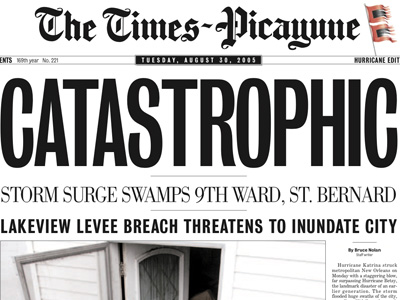
No one said this would be easy. The threatened layoffs have hit the newsroom of the New Orleans Times-Picayune (and other papers owned by the Advance Publications chain).

Things to keep in mind:

–Not all the layoffs are in the newsroom.

–Some of these folks will be replaced.

–The alternative could well be bankruptcy.


1 Comment

Filed under Journalism, media

On national security leaks

By Christopher B. Daly

Here we go again.

According to today’s Times, members of Congress (especially Republicans?) are outraged at the leaks on national security matters that they believe the administration is committing. Not only that, they are shocked (shocked, I tell ya) that such leaks might be carried out to advance the president’s political fortunes. Reading between the lines, it appears that they are upset that Obama officials go off the record and whisper disclosures to the Times and other news media informing the media and thus, the public as well, of their successes in the secret drone campaign and in the secret cyberwarfare we are apparently waging against Iran.

Imagine that: Could it really be that the Obama administration has invented a tactic that no other president (such as his immediate predecessor) ever thought of? Hmmm… Ever since the passage of the Espionage Act in 1917 and especially since the rise of the National Security state after WWII, this issue has been a chronic point of friction at the intersection of law, military operations, spying, and politics.

In all these situations, I believe the first question that any honest citizen should ask is this: Where is the harm?

Who, exactly, is harmed by knowing what the government is doing in our name around the world? There is no indication that any operational details have been compromised. (Surely, the remnants of al Qaeda know that we are gunning for them; just as surely, the Iranians know that we are trying to mess up the computers that run their nuclear program. So what?)

Look at it this way: with the leaks, the American people know enough to debate whether these are good ideas or not (and whether we want to re-hire the guy who is ordering them).

Without the leaks, we would be ignorant.

Leave a comment

Filed under Journalism, journalism history, media, New York Times, Wikileaks