Category Archives: Journalism

“Things went wrong. . .”

by Chris Daly 

So said James Murdoch on Thursday in his second round of questioning before a Parliamentary committee investigating his management of part of the News Corp. empire. At the same time, Murdoch insists that he was not in the loop and did not know that phone hacking and other forms of journalistic skullduggery were rampant at the now-shuttered Murdoch-owned tabloid News of the World. (“My goodness, James, where do your reporters get all that material?”) Hmmm. . . .

So far, the younger Murdoch seems to be toughing it out.


Here are accounts by the NYTimes, the British Guardian, and (from way, way down the page), the Murdoch-owned Wall Street Journal

Key question: Can everyone in this story be telling the truth?


Leave a comment

Filed under Fox News, Journalism

Ernie Pyle: Everyman exalted

By Chris Daly 

Today’s NYTimes brings a dispatch from Dana, Indiana — a dateline that all journalism historians will recognize as the hometown of Ernie Pyle, one of the greatest war correspondents in American history. The piece is by Dan Barry, who occupies a beat that is similar in some ways to the job Pyle had as a domestic columnist before the war — except that Pyle was expected to come up with a new column every day. Pyle once called himself “a tramp with an expense account.”

It’s a fine piece of its kind. But if you want to know more about Pyle, here are some suggestions. One is to skip the dreary slideshow that the Times offers and instead visit this terrific website maintained by the School of Journalism at Indiana University (a school Pyle almost graduated from). Be sure to see the site’s “photo gallery” and “wartime columns.”


Or, you could read the following excerpt about Pyle from my forthcoming book, Covering America.   I have chosen this selection because it gives a glimpse of Pyle before he was famous.


From COVERING AMERICA, by Christopher B. Daly ©


Ernie Pyle, an Unlikely Hero

As the war drew closer, more and more Americans began facing up to it and thinking about their places in it. One of them was a newspaper columnist in his late thirties named Ernie Pyle. The son of farmers, Pyle left his small town in Indiana and, in the space of a few years, became the best-known and most-loved journalist of his generation.

Young Ernie escaped from his hometown of Dana by going to Indiana University in Bloomington, where he studied economics and journalism and came within months of earning a degree. Before that happened, though, he took a job on a newspaper. Thanks to a recommendation from a friend, Nelson Poynter, Ernie hooked up with the powerful Scripps-Howard company. He was offered $30 a week to work for a tabloid that the newspaper chain had recently bought in the nation’s capital.51 In 1925, he married a freespirited woman named Geraldine Siebolds, who was known as Jerry. Soon after, Ernie and Jerry lit out for the territories. In the spring of 1926, they quit their jobs, sold all they had, and bought a Model T, heading west. They lived out of the car, cooking over an open fire and sleeping on the ground as they treated themselves to a long look at the country. Of all the places they visited, the one they liked best was the high, dry Southwest. A friend described them at the time as “young, wild, unconventional and neurotic,” adding that “they were tearing across the country as if someone was after them.”

Broke, they landed in New York, and Ernie went back to work, as a copy editor at the Post. He didn’t like New York, so he jumped when he got a letter from Lee Miller, an editor at his old paper in Washington. Miller, who was on the rise in the Scripps-Howard operation, offered him a spot on the desk at the Washington Daily News. There, just months after Lindbergh’s historic crossing of the Atlantic, Ernie launched the first regular column in the country devoted to the field of aviation. He spent most days at his desk job, then spent most evenings hanging around at the airfields around Washington and writing his column. While he was busy, Jerry began drinking. At one point, Ernie and Jerry took another long trip across the country. When they got back, his newspaper was facing a problem: the syndicated columnist the newspaper usually carried, Heywood Broun, had gone on a vacation and suspended his column. To fill the space, Pyle pitched in and wrote eleven pieces about his recent trip. Those columns caught the eye of the top editors at Scripps-Howard, and Ernie was rewarded by having one of his life’s wishes fulfilled: he was given his own column, to be filled by whatever material he could find by traveling the USA.

From 1935 to 1942, Ernie roamed the country, through the depths of the Depression, “a tramp with an expense account,” and he made his way to all forty-eight states, as well as Alaska, Hawaii, Canada, and Latin America. He met all sorts of people, from all walks of life. He was not seeking news, he was looking for life–and he found it. Along the way, according to his biographer, the character the world would get to know through the byline “Ernie Pyle” emerged: “a figure of warmth and reassurance, a sensitive, self-deprecating, self-revealing, compassionate friend who shared his sadnesses and exhilarations, his daydreams and funny stories, his ornery moods and nonsensical musings, his settled prejudices and deepest meditations.”


His column began modestly, running in most of the twenty-four Scripps-Howard newspapers, although some of the editors shunned him. While columnists like Winchell and Lippmann were reaching millions, Ernie was slowly building an audience in the small towns where Scripps-Howard circulated. “I have no home,” Ernie wrote. “My home is where my extra luggage is, and where the car is stored, and where I happen to be getting mail this time. My home is America.” Like a journalistic Woody Guthrie, he went just about everywhere and talked to just about everyone, celebrating the common people he met. (This came in handy later when he was covering the foot soldiers during the war. Whenever he talked to a sailor or soldier, Pyle would ask the man about his hometown; almost invariably, Pyle had been there, or nearby. Sometimes, he would discover that he knew the man’s relatives or friends.)  His assignment may sound like fun, but it was also hard work, churning out a 1,000-word column every day, week after week. “One story a day sounds as easy as falling off a log,” he once wrote. “Try it sometime.”

Over the years, his columns became more personal, more colloquial, more conversational. An Indiana junk dealer once explained Pyle’s appeal this way: “He comes as near writing like a man talking as anybody I’ve ever read.”

The man who could write like talking was a jumpy bundle of moods, habits, and gifts. He was a scrawny fellow who managed to endure terrible hardships. He had a loveless, childless marriage to a woman he was apparently quite devoted to. He was a hypochondriac who was actually sick a lot. A heavy drinker, he managed to find a wife who drank far more. He was also, curious, sympathetic, and graceful. He could walk up to just about anyone or any group of people and strike up a conversation; he wasn’t interviewing, exactly, he just seemed to be talking, and later on, he would figure out what to use in his columns. He had the reporter’s eye for detail, and a good ear. He was also a self-taught master of simple, direct English prose.

The work on his column was relentless. He was on the hook for 1,000 words a day, which may not sound like that much but is difficult to sustain. It adds up to about twenty-four pages of double-spaced copy a week, or 1,200 pages a year. But that was just the part that showed. To produce that, he usually followed a grinding regimen:

–Go somewhere, find something new, interesting, and original to write about.

–Talk to some people, usually total strangers. Find a quiet place to write. Bang out four pages of copy.

–Find a way to transmit it to the home office.

–Deal with editing changes. Deal with business matters – fan mail, hate mail, expense accounts.

–Check into a motel. Find something to eat.

–Tomorrow, do it all over again.


In 1938, Pyle’s career took a big step when his column went into syndication. This was a business decision that meant more than just business. The Scripps-Howard company owned its own syndicate, known as the United Feature Syndicate. It operated like any other: the company acted as a broker, buying material from writers and selling it to newspapers. Usually, this was done through long-term contracts on both ends of the deal. That is, the writer would be obligated to write on a fixed schedule (whether he or she felt like it or not), and the syndicate would distribute the material on a schedule. At the receiving end, the newspaper customers could use the material or not, and they could display it prominently or not. For all writers who work this way, there are three measures of success: the number of customers who contract with the syndicate to buy your work, the amount of money that contract brings in, and the display (or “play”) that your work gets in the pages of those newspapers. A column about chess or sewing might bring a modest income and receive modest play in a regular corner of an inside page. But a controversial or “hot” column like Winchell’s might get a guy on Page 1 and might even make him rich.

For Scripps-Howard, syndication meant that Ernie’s column would now be for sale to newspapers outside the chain, which might dilute its value to Scripps-Howard editors, but it would also mean that the company could make a lot more money from the words it was already paying Ernie to write anyway. Eventually, they ironed out the terms, and Ernie’s column became available to many, many more readers. In late 1939, Pyle embarked on a long trip, from Seattle to California (where he found a bed-making contest in San Francisco to write about, as well as a chinchilla farm), then to New Orleans and on to Central America. That put him in the vicinity of the Panama Canal, which was emerging as a strategic military chokepoint in the growing world conflict. Ernie wrote about it reluctantly. “I hope the office won’t even suggest that I do any military columns down there,” he wrote a friend, “If there’s one thing in this world I hate and detest, it is writing about the Army” . . . .


Leave a comment

Filed under history, Journalism, journalism history, New York Times

Why everybody gets a lawyer

By Chris Daly 

Here’s the latest from the Globe about yesterday’s day in court for an accused “terrorist” — a U.S. citizen named Tarek Mehanna.

Personally, I would put these “day stories” from Mehanna’s trial on Page 1, but it’s not my call.

As far as I can tell, the Herald is, regrettably, not covering the trial on a daily basis.


Leave a comment

Filed under Journalism

The Murdoch hearing (cont.)

By Chris Daly 

James Murdoch, son of media mogul Rupert Murdoch, is set to appear again Thursday before a committee of the British Parliament to answers about the behavior of Murdoch employees in Britain.


The NYTimes has a preview today, along with a couple of sidebars.


But the most extensive coverage I have found is in the Guardian, which seems determined to try to topple the entire Murdoch empire.

He has already been asked so many questions on so many subjects that it seems unlikely he could avoid making mistakes and possibly worse. He may want to bring a bodyguard (like his dad’s wife, Wendi — shown below waging a counter-attack against a prankster who tried to “pie” Rupert during an earlier round of Parliamentary hearings.)


Leave a comment

Filed under Fox News, Journalism

Access to courtrooms?

By Chris Daly 

There is a fascinating experiment going on near Boston that is an attempt to provide public access to the least transparent branch of government — the courts. Known as OpenCourt, the project is a collaboration between the Knight Foundation and the excellent news-and-public-affairs NPR affiliate WBUR.

(Full disclosure: WBUR’s broadcasting license granted by the FCC is held by the trustees of Boston University, which is my employer.)

OpenCourt streams live video to the Web of the proceedings of one court in Massachusetts, the Quincy District Court. As a free-speech advocate, I find it difficult to acknowledge, but the fact is that once in a great while, material arises in court that actually might be appropriate to suppress. Who should decide? On what criteria?

If a judge orders OpenCourt not to stream or post or archive a particular hearing, doesn’t that amount to “prior restraint” on the news media? Isn’t prior restraint the whole point of the First Amendment?

That was the issue yesterday in the Supreme Judicial Court of Massachusetts. Here’s the docket info. Here’s the coverage in the Globe. 

The state’s highest court did not rule immediately.

Stay tuned.


Leave a comment

Filed under broadcasting, First Amendment, Journalism

Hearst Heir Dies at 77

By Chris Daly 

Today’s papers bring news of the death of John R. Hearst, Jr., a grandson of media mogul William Randolph Hearst and a key figure in the management of the Hearst Corp., one of the largest privately held news media companies. Known as “Bunky,” the late Mr. Hearst was a member of the Hearst Corp. board of directors, a trustee of the family trust, and a director of the Hearst Foundation. That array of titles meant that Bunky had a hand in how the Hearst empire made its money, how the family controlled it, and how the company gave away some of its extra money.

Here is the AP version (as it appeared the today’s Boston Globe).

Here is the sanitized version released by Hearst Corp.

Here is an unbylined version in the LA Times, which keeps track of the Hearsts, which makes sense, given their vast real estate holdings in California.

"Bunky" Hearst/ photo by AP/ 1962

Leave a comment

Filed under Journalism, journalism history

Keep hope alive!

The latest annual survey of job prospects in journalism, conducted by the Grady College at the University of Georgia, is out.

Here’s the take-away:


The job market for graduates of journalism and mass communication programs around the country showed signs of improvement in 2010 and the first half of 2011, though the improvements are tentative and the market has not yet returned even to the level of two years ago.

The 2010 graduates were more likely than graduates of 2009 to report having at least one job offer on graduation, more likely to report being employed at the benchmark date of the end of October of last year, and more likely to hold a fulltime job six to eight months after completing university studies. The jobs the graduates held were more likely to be in the field of communication in 2010 than they were in 2009.

Been down so long it looks like up to me!


Leave a comment

Filed under Journalism, media

Another one bites the dust

By Chris Daly

This is not another nostalgic piece about the demise of Filene’s Basement, prompted by today’s stories about the closing of the “legendary” discount retailer. (Fact is: I never really liked the place that much; in order to take full advantage of Filene’s Basement, you had to go there a lot, and I hate shopping, so it was not for me.) For people who care about the news business, the thorn on this withered rose is that there goes another source of display advertising for Boston-area newspapers.

When I was a kid delivering those newspapers in the 1960s, Filene’s department store (and not just the basement) did battle with Jordan Marsh from their proud flagship stores facing each other across Summer Street, and they competed with a slew of other department stores as well, including Gilchrist’s and some others I have forgotten. Back then, when those stores had “white sales” or wanted to tout their new fall fashions, or get ride of some extra mattresses, they took full-page ads in the big dailies.

Now, the area known as Downtown Crossing is literally a hole in the ground, from which no advertising dollars escape.


This is part of the reason that the Globe and the Herald are shells of their former selves. One of their most important revenue streams simply dried up — and shows no signs of ever gushing again.

Footnote: a whimper-out to Globe staff photographer Suzanne Kreiter for having her photo chosen to illustrate today’s story. The last-century photo dates from the heyday: 1988.


Leave a comment

Filed under Boston, business, Journalism, journalism history, publishing

David Carr is right again

By Chris Daly

In his column today, the New York Times media columnist does a brutal take-down of Craig Dubow, the value-destroying former head of the Gannett newspaper chain. (It gives me great pleasure to describe Gannett as a “chain,” because for all the years that I worked at the AP, we were forbidden to refer to any of the big newspaper chains as chains, because they carried such clout on the AP Board that they has succeed in banning the term chain in connection with their own businesses.)

Long story short: Dubow eviscerated the company, then walked off with a $37 million “bonus” package. What a racket.


BTW. . . Here is the company’s updated logo. (To my mind, it carries a kind of creepy aftertaste: What exactly is within reach? Whose reach? Sheesh.)


Leave a comment

Filed under Journalism, journalism history, New York Times, publishing, Tribune Co., Uncategorized

Hub Man Dies in L.A.

By Chris Daly

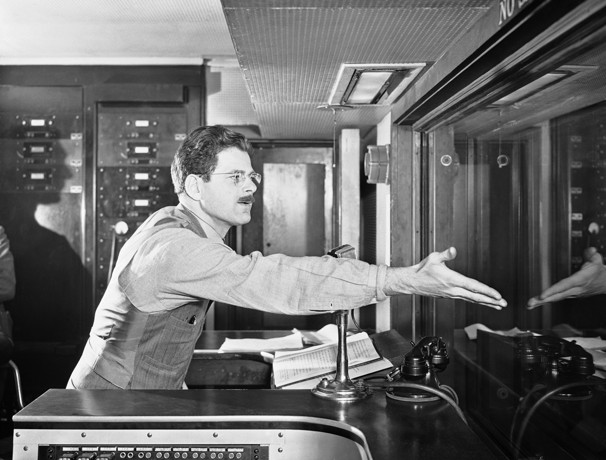
Norman Corwin, a Boston native who was not as well known here as he deserved to be, has died at the age of 101 after a long career in radio. Corwin, whose life spanned the birth, rise and decline of radio as a medium for serious popular drama, was a writer, producer, and director.

Erwin Corwin (photo by Carl Nesensohn/AP, via Washington Post)

You can read about him in these places:

The L.A. Times, which has the longest version (typical). Includes a photo gallery.

The New York Times, which includes some useful links.

The Washington Post, which also includes a photo gallery.

And NPR, which carries on the best traditions of American radio more or less alone, also has several sound galleries where you can hear Corwin or his works.


(Note to my students: we are going to see Corwin in a video next week in class. He appears in the Ken Burns film “Empire of the Air” about the history of radio.)


Leave a comment

Filed under Boston, broadcasting, Journalism, journalism history