Category Archives: Journalism

Inside the Meme Factory: Conservatives gin up “studies” to suit needs

By Christopher B. Daly 

Here’s a peek inside what I call “the Meme Factory” — the interlocking set of institutions that conservatives built, mainly since WWII, to manufacture “studies,” slogans, and ideas that could probably not pass muster at most universities or scholarly journals but are very useful to the conservative movement. Briefly, the way it often works is that a conservative funder or activist has a notion. The notion is taken to a conservative “think tank,” where it can be refined, simplified, and outfitted with some academic-sounding “research.” The whole package can be offered to sympathetic conservative “journalists” who work at conservative media outlets like Fox, National Review, Newsmax, Breitbart, etc. Then, when real scholars and responsible journalists ignore it, conservatives can cry foul and denounce everyone else as “biased.”

Today’s case in point: a story in the NYTimes not about this phenomenon but which nevertheless reveals a bit of how this system operates. The story naturally focuses on the latest developments. Igt is essentially a “stage-setter” for a hearing set for Tuesday in a federal court in Detroit over the suitability of same-sex couples as parents. But it’s the backstory that really deserves equal attention:

–To start at the beginning, in August 2010, a federal judge in a different federal court in California writes in a ruling that he found “no reliable evidence that allowing same-sex couples to marry will have any negative effects on society.”

–Alarmed, conservatives swing into action.

–In late 2010, they gather at the Heritage Foundation in Washington, one of the central nodes in the Meme Factory. According to the Times, “opponents of same-sex marriage discussed the urgent need to generate new studies on family structures and children.” In other words, they wanted to commission studies whose outcome was pre-determined.

–Result: “the marshaling of $785,000 for a large-scale study by Mark Regnerus, a meeting participant and a sociologist at the University of Texas who will testify in Michigan.” The money comes from two conservative foundations: Witherspoon and Bradley.

–His study comes out in 2012 in the journal Social Science Research, and conservatives immediately start citing it. No surprise: the study “finds” that children do best when raised by their own straight, married, monogamous parents.

–Scholars criticize his methods and motives, prompting the journal to launch an internal audit of its own procedures. Basically, the folks at Social Science Research need to determine how they got so badly used in this case.

–No matter. The Meme Factory has delivered: a study, a controversy, victim status, and news coverage.

Who says American manufacturing is dying?

Below, as a public service, I offer a version of a work in progress. It’s a timeline of the interlocking institutions that make up the Meme Factory — think tanks and media outlets. You’ll notice that some names crop up again and again: Scaife, Mellon, Murdoch, Kristol.

(Please help me fill in any blanks.)

CONSERVATIVE MEDIA AND INSTITUTIONS


A TIMELINE


Compiled by Christopher B. Daly

MEDIA OUTLETS


Debut              Name                                                   Owner/Founder

(not to mention: WSJ, Chi Tribune, LA Times, US News, Reader’s Digest, Forbes, etc)

1944                Human Events                                        Henry Regnery et al.

1955                National Review                                 William F. Buckley Jr.

 1965                Public Interest                                        Irving Kristol  (folded, 2005)

1967                American Spectator                             R. Emmett Tyrrell Jr./Regnery

196?                Commentary (turns right)                 Norman Podhoretz/

1968                Reason  (libertarian)                            Robert W. Poole Jr.   

1975                Conservative Digest                           Richard Viguerie

1982                Washington Times                              Rev. Moon/Unification Church

1985                The National Interest                         Irving Kristol

1988                Rush Limbaugh                                     Limbaugh/Clear Channel

1995                Weekly Standard                                 Murdoch/News Corp/ Wm Kristol

1995                Townhall.com                                      offshoot of Heritage

1996                Fox News                                                Ailes/ News Corp. (Murdoch)

1996                The Drudge Report                             Matt Drudge

 1996                Free Republic (website)                   James C. “Jim” Robinson

1997                World Net Daily                                 Jos.&Eliz. Farah

1998                Newsmax Media                                 Christopher W. Ruddy  (Scaife)

2001                InstaPundit                                         Glenn Reynolds

2002                The American Conservative (mag)     Pat Buchanan, Taki, et al.

2002                Glenn Beck Radio Program                 Glenn Beck

 2007                Breitbart.com                                      Andrew Breitbart

INSTITUTIONS                 [major donors: Olin, Coors, Scaife, Richardson, Bradley]

1943                American Enterprise Institute                        big business

1947                Regnery Publishing                             Eagle Publishing

1957                Hoover Institution                              ?????/ Stanford

1960                Young Americans for Freedom           William F. Buckley

1961                Christian Broadcasting Network        Pat Robertson

1963                Oral Roberts University                     Oral Roberts

1969                AIM                                                    Reed Irvine

1973                Heritage Foundation                           Paul Weyrich             (Coors)

1975                Eagle Forum                                        Phyllis Schlafly  (radio, Web)

1977                Cato Institute                                      Edward H. Crane                                                                                       (Koch, Olin, Scaife, Bradley)

1977                Focus on the Family                           Dr. James Dobson

1977                National Journalism Center                M. Stanton Evans (Buckley; YAF))

1978                Inst. for Educational Affairs               Irving Kristol/William E. Simon                                                (Olin, Scaife, Richardson)

1979                Moral Majority (thru 1989)               Weyrich, Viguerie, Falwell.

1982                Federalist Society                               Edwin Meese, Robert Bork, Olson

1987                Media Research Center                       L. Brent Bozell III

1997                Project for  New American Century         Wm. Kristol / Robert Kagan 


Leave a comment

Filed under Fox News, Glenn Beck, Journalism, media

O’Reilly on O’Reilly

By Christopher B. Daly

Not to be missed: this recent commentary by Tim Egan in the NYTimes about Fox News figure Bill O’Reilly and O’Reilly’s recent interview with President Obama. As usual, O’Reilly believes that the key figure in the interview was . . . himself. For days afterward, O’Reilly and his colleagues at Fox milked the interview and scored it a solid win for O’Reilly over the president (as if it were a debate).

Egan makes a good point here:

So, the first point for historians sniffing the odor of O’Reilly’s time capsule in 2114 is that the interview made no news. No ground was broken. It was a journalistic dud. O’Reilly himself spoke for about 40 percent of the time, and devoted 90 percent of the interview to “the full Fox scandal grab bag,” as Jon Stewart called it.

As it happens, I am teaching my students this week about how to conduct interviews in my journalism classes at Boston University (where, yes, I know: Bill O’Reilly attended college). The point I always try to drum into my students about interviewing is simple: It’s not about you. 

Of course, I understand that Bill O’Reilly is not trying to conduct a productive, journalistic interview. He is trying to stage a clash of personalities for television. Like his boss Roger Ailes, O’Reilly is very good at understanding television, even if he seems to have missed class on the day of the lesson about humility.


1 Comment

Filed under broadcasting, Fox News, Journalism

Globe owner John Henry: A man of few words?

By Christopher B. Daly

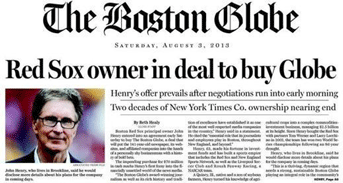
Former commodities trader and current pro-sports franchise owner John Henry has also owned the Boston Globe newspaper since last summer, when he bought it for a mere $70 million. Since then, he has said little about his plans, his political views, or his philosophy of journalism. That’s his prerogative, of course, but all the readers of the Globe around New England and beyond, may start to tire of his taciturn approach.

Boston-Globe-and-Henry


Last October, Henry published a 3,000-word op ed in his own newspaper under the headline “Why I Bought the Globe.” Among other high-minded points he made was this passage:


This much is clear: The overriding mission of The Boston Globe will be to ensure that its readers are getting news they can trust. The Globe will place its emphasis on hard-hitting, investigative accountability that readers can rely on. Not only will the Globe seek to hold people and institutions accountable for their actions, we will hold ourselves accountable for fairness, balance, and fact-checking.

Today, reliable information has never been more valuable. A newspaper needs to provide the breadth of perspective and diligent analysis that gets to the heart of what is going on in our world. The Globe will never be the prisoner of any ideology or political agenda.

Our enterprise reporting will shed new light on important issues of the day, with intellectual honesty and discipline. We will provide our readers with the assurance that if they read the Globe, they will know that time, effort, and thought were put into each and every report.

In this way, Henry sounds like many other American publishers who have issued similar declarations upon taking over newspapers: political independence, a commitment to service, a sense of public trust, etc. His statement was similar in spirit and tone to that of Adolph Ochs when he took over the New York Times in 1896. Here’s the heart of Ochs’ declaration:

It will be my earnest aim that The New-York Times give the news, all the news, in concise and attractive form, in language that is parliamentary in good society, and give it as early, if not earlier, than it can be learned through any other reliable medium; to give the news impartially, without fear or favor, regardless of party, sect, or interests involved; to make of the columns of The New-York Times a forum for the consideration of all questions of public importance, and to that end to invite intelligent discussion from all shades of opinion.

Since his op-ed last fall, Henry has said little, other than a speech to the Greater Boston Chamber of Commerce last month. He has removed the Globe’s publisher, Chris Mayer, and given himself that job. Now comes a bit more insight, in an article from Boston magazine, written by senior editor Jason Schwartz. In the piece, Schwartz reveals that Henry would not grant him an interview, but “instead agreed to exchange emails” — without saying how many. The piece includes interviews from other key players (including Globe editor Brian McGrory) but adds little to our understanding of Henry and his intentions.

One reveal: Henry confirmed that he plans to sell most of the Globe’s property in Dorchester and move the newsroom into a prominent place closer to downtown — a good idea that I have thought the Globe should have done years ago. The sale of all that land should reap at least $70 million, which would mean that Henry got the newspaper as such for free.

Still, questions persist. Here are some I have:

–How can the Globe return to profitability?

–How long will the Globe continue in print?

–When you start to make money from the Globe, what will you do with it?

–Is it important to even try maintaining a separation between the paper’s editorial page and its news pages?

–If you have money to invest in the Globe, what are your top priorities for expanded coverage?

–Is there a comparable news operation anywhere in the world that you admire?

–If you had to choose between watching the Red Sox in the World Series or the Liverpool Football Club in a championship game, which would it be?

BONUS: My estimable colleague Dan Kennedy has written about this same topic today, including a warning about the possible return of Mike Barnicle. Well worth a read.


4 Comments

Filed under Boston, Journalism, journalism history, media, publishing

The history of journalism lives on in Worcester, Mass.

By Christopher B. Daly

Here’s a recent article in Worcester magazine introducing readers to the incomparable American Antiquarian Society. It sounds like a museum of antiques, but it is actually the most extensive collection of American newspapers, pamphlets, lithographs, sheet music, and ephemera from the 17th century through the late 19th century.

From the article:

A few of the Society’s most valued materials include a first-edition copy of Lewis and Clark’s journals, printed in the early 1800s; the first printed Bible in British North America, released in 1663; the only known copy of the famous English book “Pamela,” which was the first book printed

COVER_philosophic-cockin the United States, published and sold by Benjamin Franklin; and the only known original copy of the political cartoon “The Philosophic Cock,” which was an early slam of Thomas Jefferson’s relationship with Sally Hemings, depicting Jefferson as a rooster and Hemings as one of his hens. At the end of last year, one of the few remaining copies of the first book ever written and printed in British North America, in 1640, the Bay Psalm Book, sold at auction for $14.2 million – the American Antiquarian Society just so happens to also have an original copy of the book.


The AAS attracts scholars from around the world, including Ken Burns and Jill Lepore, and it is  open to the public.

Here’s a note on the AAS’s history from Wikipedia.

AAS was founded by Isaiah Thomas on October 24, 1812 by an act of the Massachusetts General Court. It is the third oldest historical society and the first to be national in scope.[4]Isaiah Thomas started the collection with approximately 8,000 books from his personal library. The first library building was erected in 1820 in downtown Worcester, Massachusetts. This building was later abandoned and a new building was constructed. It was completed in 1910 and stands on the corner of Park Avenue and Salisbury Street. There have been several additions to this building to accommodate the growing collection, the most recent of which was completed in 2003.

There’s also a story as to why Isaiah Thomas was in Worcester. He was the editor of a Boston newspaper on the patriot side in the American Revolution called The Massachusetts Spy. On April 16, 1775, when the rebels were coming under increasing scrutiny by the British forces occupying Massachusetts, Thomas began to fear that

Isaiah Thomas, rebel printer, by Ethan Alan Greenwood.  Courtesy, AAS

Isaiah Thomas, rebel printer, by Ethan Alan Greenwood.
Courtesy, AAS

the redcoats would soon descend on his Boston print shop and put him out of business. So, under cover of darkness, he loaded his presses onto wagons and piled on as many back copies of his own paper as possible, along with any other newspapers or other printed material that would fit. He moved the whole operation to Worcester, safely remote from the coastal bases of the British forces, and prospered there. He later wrote the landmark book, History of Printing in America.


So, a hat-tip to Isaiah Thomas.


Leave a comment

Filed under history, Journalism, journalism history, publishing

Boston Globe owner begins making his moves

By Christopher B. Daly 

It’s no great surprise that John Henry, the wealthy former investor who bought the Boston Globe late last October for less than $70 million, has named a new publisher: himself. This is a step that has many precedents in the history of American journalism. And it makes sense: why spend the money to buy a whole newspaper if you don’t plan to run it?

The more interesting development announced by the Globe is that the paper will have a new CEO: veteran ad man Mike Sheehan. A longtime executive with the Boston advertising powerhouse Hill Holliday, Sheehan now takes on the responsibility for making enough money to rebuild the Globe’s reporting strength to the point where it can fulfill its goal of being a robust regional news organization.

Personally, I wish them all the luck. Get cracking, do good work, and start hiring more journalists.

Here's the Globe's caption on this double portrait: John Henry (left) and Mike Sheehan hope to boost ad revenue at the Globe.

Here’s the Globe’s caption on this double portrait: John Henry (left) and Mike Sheehan hope to boost ad revenue at the Globe.


Leave a comment

Filed under Boston, Journalism, journalism history, media

Egypt rounds up journalists

By Christopher B. Daly

[see update below]

Like almost every regime that wants to cling to power, the government in Egypt has decided to attack the news media. Prosecutors announced that they were charging 20 journalists who work for Al Jazeera with consipring with terrorists. Their crime: contacting enemies of the regime as sources and reporting their views. They are also being charged with broadcasting false images of “a civil war that raises alarms about the state’s collpase.” Translation: they called it the way they saw it.

According to the Times:

The charges are the latest turn in a widening clampdown on public dissent by the military-backed government . . .

This is obviously a shameful attempt to intimidate the entire news media, and it should be denounced in the strongest terms by the United States. Here’s what we got, in the daily briefing from the U.S. State Department:

The State Department spokeswoman, Jen Psaki, said Egypt should reconsider the prosecution. “The government’s targeting of journalists and others on spurious claims is wrong and demonstrates an egregious disregard for the protection of basic rights and freedoms,” she said.

Better than nothing.

UPDATE:

Apparently, the regime in Egypt is having second thoughts — not about rounding up their own journalists, but about the unintended consequences of the crackdown on the rest of the world’s press. Their real goal seems to be to insulate their own people from exposure to the ideas of the Muslim Brotherhood. Hence the roundup of Al Jazeera journalists who have Brotherhood sources.

But they seem unprepared for the fallout — which is a natural reluctance of any self-respecting journalist to stick around in Egypt with the threat of arbitrary arrest hanging over them. Any reporter covering Egypt needs to have and use Brotherhood sources. But if that means you can be accused of conspiring with terrorists, it might be time to leave Egypt for a while.

In a statement on Thursday, the State Information Service said Egypt welcomed foreign correspondents to cover even “constructive criticism” of the government, in accordance with its commitments to democracy, freedom of expression and transparent elections.

Alluding to journalists’ fears about being charged for interviewing members of the Brotherhood, the statement said that “mere contact” with any “accused criminal” is not a crime under Egyptian law.

The statement, however, contained caveats. It said that Egyptian law does not protect freedom of “thought and opinion” if it develops into action that violates Egyptian laws, like “crimes that threaten the country’s national security.”

The statement also said that contact with an “accused criminal” may be a punishable offense “if this contact is a sort of assisting or inciting.”

Hmmm… I’d say it might be time to go visit some other hotspot for a while.


1 Comment

Filed under Journalism

Surveillance state: NSA chief sees threats everywhere

By Christopher B. Daly 

In what universe does it make sense that DNI James Clapper still has his job?

He should have been charged with contempt of Congress for lying under oath and sacked by his boss, President Obama. Instead, there he was yesterday testifying to Congress.

He used the platform Congress gave him to denounce Edward Snowden, the former NSA contractor who spilled the beans on the illegal and questionable programs and tactics run by imgres3our intelligence agencies. Of course, he blamed Snowden for serious but vague damage done to America. On examination, what he really means is that Snowden made life difficult for our spy agencies. Whether he caused any other kind of damage is unclear. (transcript, anyone?)

To quote the Times:

Mr. Clapper did not give specific examples to bolster his assessment about the damage Mr. Snowden had done. He also did not say whom he believed Mr. Snowden’s accomplices to be.

But he wasn’t finished. Turns out, he sees “threats” everywhere. There are bogeymen all over Asia, the Mideast and Africa. Everywhere he looks, he sees nukes, bio-chem weapons, conspiracies, and an ever-mutating array of threats. Most of these threats are either hypothetical, localized in some faraway place, or intramural disputes between people who are no friends of ours. At the risk of sounding like some kind of neo-isolationist (which I am not), I have to observe that almost none of the threats hinted at by Clapper involve real, credible, imminent attacks on the territory of the United States.

But that’s not the standard for our military-intelligence complex. There, the issue is whether someone presents a threat (of any kind) to something known as “American interests” — a term that has no specific definition. It is so vague and all-encompassing that it could mean almost anything — a kidnapping threat against a U.S. citizen anywhere in the world, for example, or an apolitical piracy operation that menaces U.S. shipping anywhere in the world.

The fact is, not every problem in the world is an American problem, and not every problem in the world has an American solution. But if you are seeking to justify the existence of your agency and get more money for your budget, it behooves you to play up all these “threats.”

Thanks to Sen. Ron Wyden, D-Oregon, who has emerged as the great skeptic in Congress. (He’s the one Clapper lied to, face to face, last year.) At this week’s hearing, Wyden

said that the dealings between spy agencies and their congressional overseers were crippled by a “culture of misinformation.”

Speaking of executive actions, this is one problem Obama could solve today, without needing an act of Congress. Fire Clapper.


Leave a comment

Filed under Journalism, leaks, media, Politics, President Obama, surveillance

NYTimes: Truth in labeling?

By Christopher B. Daly

When I was reading the NYTimes front page this morning, I started reading the paper’s Pg. 1 story about Pete Seeger. As I read, I had a growing sense that something was bugging me. The piece carried the byline of Jon Pareles, the paper’s longtime music critic, which I thought was appropriate. But the piece kept bugging me, until I realized what the problem was: I was not reading the paper’s obituary (also written by Pareles). Instead, I was reading something more like a critical appraisal of Pete’s musical career. Here’s part of it:

That put him at the center of the folk revival of the 1950s and 1960s, in all its idealism, earnestness and contradictions. Collectors found songs that had archetypal resonance, sung in unpretty voices and played with regional quirks, and transcribed them to be learned from sheet music. The folk revival prized authenticity — the work song recorded in prison, the fiddle tune recorded on a back porch — and then diluted it as the making of amateur collegiate strum-alongs.

That’s fine, of course, (although a bit tart for a story about his death) but it should have been labeled as such. There should have been some kind of banner or emblem that says AN APPRECIATION or CRITICISM or something like that which would signal that this is not a factual news story. (Online, the Pg. 1 piece carries the slug MUSIC: AN APPRAISAL, which is just what it needed.)

Inside the paper was Pete’s obit, which had a classical opening:

Pete Seeger, the singer, folk-song collector and songwriter who spearheaded an American folk revival and spent a long career championing folk music as both a vital heritage and a catalyst for social change, died on Monday in Manhattan. He was 94.

His death, at NewYork-Presbyterian Hospital, was confirmed by his grandson Kitama Cahill Jackson.

Mr. Seeger’s career carried him from singing at labor rallies to the Top 10, from college auditoriums to folk festivals, and from a conviction for contempt of Congress (after defying the House Un-American Activities Committee in the 1950s) to performing on the steps of the Lincoln Memorial at an inaugural concert for Barack Obama.

Recently, I had a similar experience with the Times’ coverage. After Obama gave his “big speech” about the NSA scandal back on Jan 17, the Times ran a page 1 story the next day. Actually, the paper ran two stories: one a straightforward factual account of the president’s speech by Mark Landler and Charlie Savage headlined “Obama Outlines Calibrated Curbs on Phone Spying.” Then, there was another story, also on Pg. 1, written by David Sander and Claire Cain Miller headlined “In Keeping Grip on Data Pipeline, Obama Does Little to Reassure Industry.” My problem was that the second story was clearly more analytical, and the authors drew several important conclusions on their own authority — not by quoting experts but by being experts.

Again, that’s fine. But it should be labeled ANALYSIS.

And here’s the kicker. I was staying in a hotel that weekend, and on Sunday I could only get hold of the International New York Times. There were the Saturday stories, recycled a day late, and when I looked at the Sanger and Miller piece, it carried a label that said ANALYSIS.


3 Comments

Filed under Journalism, New York Times

MEDIA: David Carr has seen the future

By Christopher B. Daly 

And the future for journalism is . . .

  DIGITAL. . .

                                           PROFITABLE . . .

                                                                 AND HERE NOW!

Focusing on the recent decision by Ezra Klein to decamp from the old-school Washington Post

Ezra Klein, pointing to his major asset.  AP photo

Ezra Klein, pointing to his major asset.
AP photo

when the legacy medium could not accommodate his demands, Carr sees an array of “digital natives” who are managing to do good (or at least decent) journalism and make money at the same time.


If true, three cheers for those on-line winners!


Here’s Carr’s take:

In making the switch, Mr. Klein is part of a movement of big-name journalists who are migrating from newspaper companies to digital start-ups. Walter Mossberg and Kara Swisher left Dow Jones to form Re/code with NBC. David Pogue left The New York Times for Yahoo and Nate Silver for ESPN. At the same time, independent news sites like Business Insider, BuzzFeed and Vox have all received abundant new funding, while traffic on viral sites like Upworthy and ViralNova has exploded.

All the frothy news has led to speculation that a bubble is forming in the content business, but something more real is underway. I was part of the first bubble as a journalist at Inside.com in 2001 — an idea a decade ahead of its time — and this feels very different.

The web was more like a set of tin cans and a thin wire back then, so news media upstarts had trouble being heard. With high broadband penetration, the web has become a fully realized consumer medium where pages load in a flash and video plays without stuttering. With those pipes now built, we are in a time very similar to the early 1980s, when big cities were finally wired for cable. What followed was an explosion of new channels, many of which have become big businesses today.

Still, some things don’t change all that much. As Carr points out, it still takes some serious money (about $25 million, he says) to launch a big site, and it takes time (5+ years, he estimates) to work out the kinks, find your audience, build a staff, and earn a reputation for being worth a visit.

[FULL DISCLOSURE: David Carr is no longer just the most influential columnist writing about media and the web, but he is also a new colleague of mine on the Journalism faculty at Boston University, where is the new, inaugural Andrew Lack Professor in the economics of journalism.]


Leave a comment

Filed under blogging, Journalism, journalism history, media, publishing

Fox News: is bad news worse than no news at all?

Here is a graphic from a NYTimes op-ed  distilling a 2012 study conducted by researchers in the PublicMind project at Fairleigh Dickinson University. 

No comment.

25blow-ch-master180

1 Comment

Filed under broadcasting, Fox News, Glenn Beck, Journalism