Category Archives: broadcasting

The sorcerer’s apprentice?

By Chris Daly 

I don’t usually take frankly partisan positions in this blog, and I will try not to do that here, even in the midst of the Iowa caucus-ing.

What struck me in the last few days was the lament of Newt Gingrich about the flamethrower approach of the Romney camp, which has bombarded Gingrich with negative TV ads. For a Republican to complain about unrestricted negative campaigning is more than a bit rich. It’s like Dr. Frankenstein complaining about his monster.

Questions for the media to keep in mind:

1. Who elevated the dark art of negative campaigning to its highest level?

[Hint: Lee Atwater, Karl Rove. . .]

2. Who thought is was a good idea to allow unrestricted spending on political ads?

[Hint: Scalia, Thomas, Roberts, Alito, Kennedy.]

In other words, the answer to both questions is REPUBLICANS. To the best of my knowledge, no mainstream media accounts of this election have mentioned this factual matter of background. I would say that reporters and editors should give this some thought. How will the media address this reality? Will journalists explain the factual history of the issue? Will they try to find a way to neutralize or offset it? Will television station owners in Iowa, New Hampshire, South Carolina and elsewhere reject those ads? Will the media interpret non-partisanship to mean that they must look the other way?

To be continued. . .

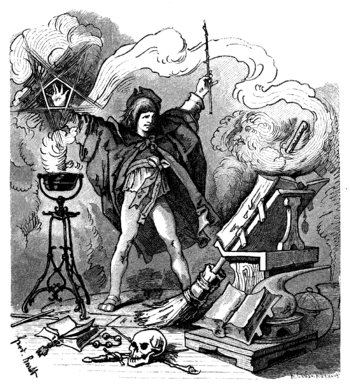
[Illustration of the Goethe figure the Sorcerer’s Apprentice by S. Barth, via Wikimedia]


Leave a comment

Filed under broadcasting, First Amendment, Journalism, Politics

Media bias? Not so much

By Chris Daly 

Michelle Bachmann, a former flavor-of-the-week in the lengthy, fickle Republican primary campaign for the presidential nomination, has a gripe. Not surprisingly, she is complaining about the media.

This, of course, is a time-tested tactic for Republicans, especially when they are feeling politically desperate. Bachmann claims to have caught CBS News in a “gotcha” moment that she believes confirms her suspicions of liberal bias at CBS. Now, it may well be that there are liberals at CBS, but this episode does not prove her point. In fact, I believe it proves the opposite point.

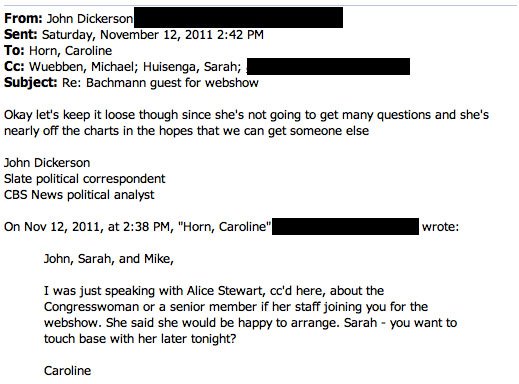
Briefly. . . As recounted in today’s NYTimes, the guy in charge of political coverage at CBS, John Dickerson, was caught doing his job. He was trying to find an online guest for a show he was orchestrating that would follow the latest Republican debate on Saturday night. In an email to colleagues, he said he would rather “get someone else” other than Bachmann.

His reason? She was “not going to get many questions” and “she’s nearly off the charts” in the polling of voters’ preferences.

(Dickerson’s big mistake was that he included a Bachmann aide among the people in the list of addresses for that particular email, so his thinking went unfiltered to the Bachmann communication director, who then did the professional thing and tried to make hay out of it, in a Facebook blast and elsewhere.)


Back to Dickerson’s email.

If we look at what he actually said, it appears that his criteria for choosing the guests to pursue were non-political, non-partisan, and non-ideological.

Like any good producer, he wanted a “hot” guest — hot in the sense of someone who is trending, someone who is going to create or amplify buzz, someone who is going to add to CBS’s ratings. He does not want someone who was last week’s news. Simple as that.

And the facts bear him out: Bachmann did indeed get few questions in the debate and little air time, and she is dying in the latest polls. (CBS’s own latest poll had her in 6th place with just 4% support.) That is not to say that she could not surge again; if she does, Dickerson and every producer, host, and booker in politics will be chasing her. Not because they like or dislike her and not because they agree or disagree with her. It will be all about blowing on the hot coals.

In his email, Dickerson could be properly charged with telling “vicious truths.”

Was he ruthless? Yes.

Was he liberal? No.

Even the awful site Big Journalism almost got this right. In fact, the blogger

p.s. For another day: What about Bachmann’s implicit claim? Do the news media formulate common policies, then execute them in concert? (Hint: people in the news media can’t agree on whether to capitalize “president” !)


1 Comment

Filed under broadcasting, Journalism, media, Politics

Access to courtrooms?

By Chris Daly 

There is a fascinating experiment going on near Boston that is an attempt to provide public access to the least transparent branch of government — the courts. Known as OpenCourt, the project is a collaboration between the Knight Foundation and the excellent news-and-public-affairs NPR affiliate WBUR.

(Full disclosure: WBUR’s broadcasting license granted by the FCC is held by the trustees of Boston University, which is my employer.)

OpenCourt streams live video to the Web of the proceedings of one court in Massachusetts, the Quincy District Court. As a free-speech advocate, I find it difficult to acknowledge, but the fact is that once in a great while, material arises in court that actually might be appropriate to suppress. Who should decide? On what criteria?

If a judge orders OpenCourt not to stream or post or archive a particular hearing, doesn’t that amount to “prior restraint” on the news media? Isn’t prior restraint the whole point of the First Amendment?

That was the issue yesterday in the Supreme Judicial Court of Massachusetts. Here’s the docket info. Here’s the coverage in the Globe. 

The state’s highest court did not rule immediately.

Stay tuned.


Leave a comment

Filed under broadcasting, First Amendment, Journalism

The business end

of the media business is at stake in a new auction being planned by the FCC. Here’s an update from today’s Boston Globe.

Here is a link to the FCC website (which should have been supplied by the Globe but was not).

Here is a pretty good Wikipedia backgrounder (which also should have been a link in the Globe article; Sheesh, don’t they realize they are publishing on the web?).

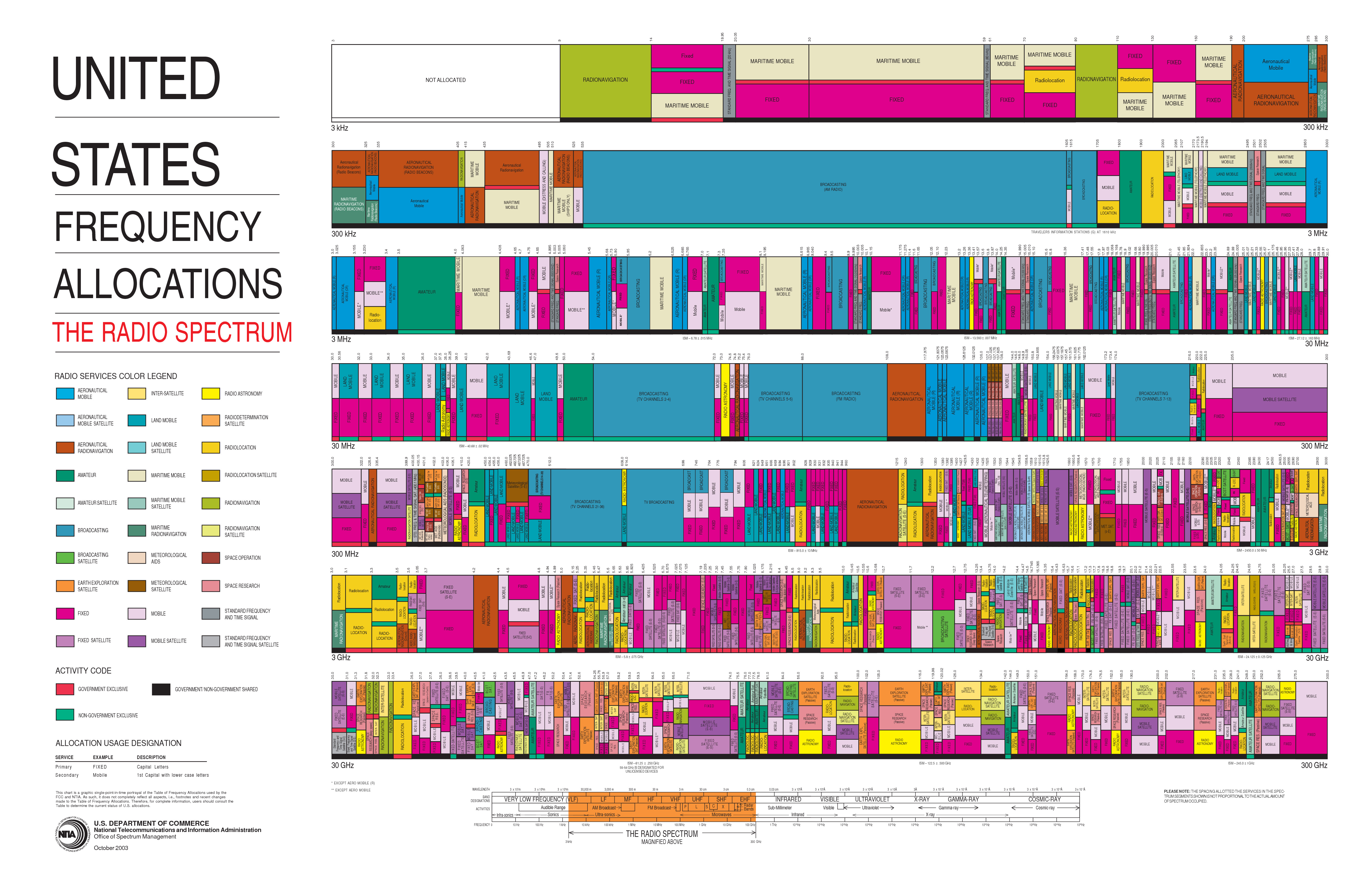
Here’s an incredibly complicated visual rendering of spectrum allocation.


Leave a comment

Filed under broadcasting, FCC, regulation

Hub Man Dies in L.A.

By Chris Daly

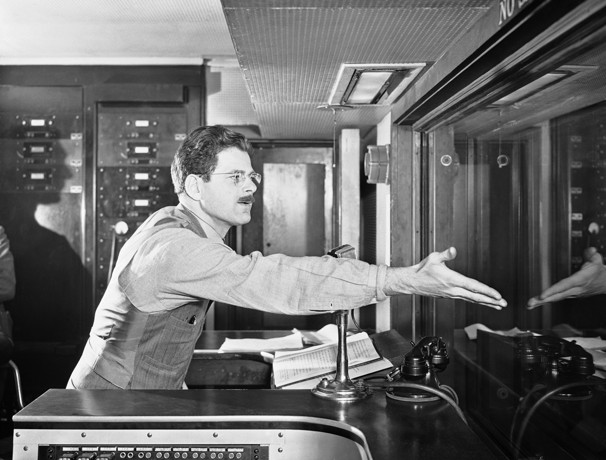
Norman Corwin, a Boston native who was not as well known here as he deserved to be, has died at the age of 101 after a long career in radio. Corwin, whose life spanned the birth, rise and decline of radio as a medium for serious popular drama, was a writer, producer, and director.

Erwin Corwin (photo by Carl Nesensohn/AP, via Washington Post)

You can read about him in these places:

The L.A. Times, which has the longest version (typical). Includes a photo gallery.

The New York Times, which includes some useful links.

The Washington Post, which also includes a photo gallery.

And NPR, which carries on the best traditions of American radio more or less alone, also has several sound galleries where you can hear Corwin or his works.


(Note to my students: we are going to see Corwin in a video next week in class. He appears in the Ken Burns film “Empire of the Air” about the history of radio.)


Leave a comment

Filed under Boston, broadcasting, Journalism, journalism history

Whither MSNBC?

New York Times television reporter Bill Carter has a good piece today on MSNBC — not least because he quoted me.

[Fun fact: my quote includes an odd mistake. I sent him my quote by email. I meant to write that the size of the audience is “capped” by the size of the universe of people who agree with you. But I must have made a typo, and my computer auto-corrected it to “cajoled” — which is actually nonsensical in that context. Odder still: no one caught it. Well, at least, they spelled my name right. . . ]

MSNBC Is Close to Falling to Third Place in Cable News Ratings

By 
Published: September 26, 2011

How badly has MSNBC been hurt by the loss of Keith Olbermann? Enough, apparently, to be on the verge of falling back into third place among the cable news networks.

Justin Stephens/Current TV, via Associated Press

The time slot held by Keith Olbermann lost viewers.

Bennett Raglin/Getty Images

Anderson Cooper’s move seems to be working for CNN.

The ratings results for the month of September show that CNN, long relegated to third place in the prime-time cable news competition, is edging its way back up, while MSNBC is moving in the other direction.

For the month, CNN averaged 257,000 viewers in prime time in the category that counts most to the networks — viewers between the ages of 25 and 54 — because that is where the advertising money goes for news programming. MSNBC was just barely ahead with 269,000 viewers. (Neither approached the leader, Fox News, with 526,000).

Both CNN and MSNBC had one especially strong night because of the Republican presidential debates. With those excluded, however, CNN beat MSNBC, 219,000 to 207,000. A year ago, when Mr. Olbermann still occupied the 8 p.m. hour, MSNBC edged CNN by 83,000 viewers, with 256,000 viewers for MSNBC to 173,000 for CNN.

The change in the September ratings was most noticeable at 8 p.m., where CNN has moved its best-known host, Anderson Cooper. The network’s performance during that hour has improved by 38 percent over last year, growing to 215,000 viewers from 156,000.

On MSNBC, meanwhile, Lawrence O’Donnell has lost 100,000 viewers from the numbers Mr. Olbermann posted last September, with 185,000 viewers in the 25-to-54 age group, a drop of 35 percent. (Bill O’Reilly on Fox, as always, dwarfs his competitors with about three times as many viewers, 611,000.)

More ominously, the falloff for Mr. O’Donnell seems to be affecting MSNBC’s biggest name, Rachel Maddow. Her audience dropped 15 percent this year, to 245,000 from 289,000. She still beats Piers Morgan on CNN in the 9 p.m. hour, but his show has improved 18 percent over Larry King’s ratings last year, with 193,000 viewers to Mr. King’s 164,000.

MSNBC executives endured a contentious parting with Mr. Olbermann last January. Phil Griffin, the president of MSNBC, had a succinct answer to the question of whether the network is feeling the impact of Mr. Olbermann’s departure: “No.”

He added, “I’m confident that we will increase our ratings as politics become the dominant story over the next year.”

Mr. Olbermann is now on the air head-to-head against Mr. O’Donnell. The channel he appears on, Current TV, is not in the league of either CNN or MSNBC in terms of national profile, and his audience totals do not approach any of the other 8 p.m. competitors.

Mr. Olbermann averaged just over 50,000 viewers in the 25-to-54 measure in September, or less than 20 percent of what he attracted on MSNBC. Still, many of those 50,000 may have previously been viewers of MSNBC — and Mr. O’Donnell was 30,000 viewers behind Mr. Cooper in September.

Some industry analysts said the loss of viewers for MSNBC may have to do with strategic changes the network made in recent years.

“MSNBC may be rediscovering the downside of partisan news,” said Chris Daly, a professor of journalism at Boston University. “That is, the size of your audience is essentially cajoled by the size of the electorate that already agrees with you.”

Mr. Cooper is being compared at 8 p.m. against what was hardly a powerhouse CNN entry last year — “Rick’s List,” which featured Rick Sanchez, who was subsequently fired. But Mr. Cooper’s move to 8, which was questioned by some critics, seems to be paying off for CNN. He has made the network much more competitive in that time slot while not losing any momentum for the second show he hosts at 10 p.m.

Ken Jautz, the head of CNN’s domestic news operation, said the network had “been making changes to several hours of our programming in order to grow CNN’s audience during both breaking news and nonbreaking news periods. The fact that our prime-time audience increased this month by 49 percent is certainly gratifying.”

The replay of “Anderson Cooper 360,” which includes news updates but mostly material from the 8 p.m. show, remains CNN’s strongest hour, with 274,000 viewers, well ahead of “The Ed Show” on MSNBC with 200,000 (though both also are well behind Greta Van Susteren on Fox, who had 415,000.)


Leave a comment

Filed under broadcasting, Journalism, media, MSNBC, New York Times, Olbermann, Politics

Free Speech and its limits

By Chris Daly 

Here’s a story that nicely illustrates the limits of the First Amendment. Many people wrongly think that the First Amendment guarantees freedom of speech (and of “the press”) in all settings, all the time. Not so.

The First Amendment is written so that it prevents the government from censoring speech before it can reach its intended audience. The First Amendment says nothing about private parties, like Fox or News Corp. Private parties are free to censor their employees, and they are not shy about doing so.

Thus, it should come as no surprise that News Corp. would choose to censor Alec Baldwin. He has no recourse against News Corp. under the First Amendment, because there was no government action involved. His best revenge is to shout about it to every other news outlet he can find.

So, a hat tip to the NYTimes‘ Brian Stelter for giving this story some attention.

(At the same time, the whole episode implicitly makes the case for having diversity in the news media, so that even Rupert Murdoch cannot control absolutely everything.)


Leave a comment

Filed under broadcasting, Fox News, Journalism, New York Times

Advocacy IN journalism

By Chris Daly 

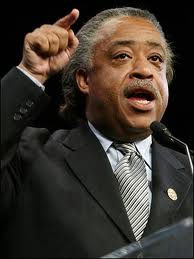
Now comes Al Sharpton. His recent appointment as the anchor for an MSNBC program that airs at 6 p.m. raises questions about whether Sharpton is a journalist or an activist. Today’s NYTimes diplomatically called him “a hybrid like no other.”


Evidence that he is a journalist:

–MSNBC hired him. End of story.

Evidence that he is not a journalist:

–He has never worked full-time as a journalist.

–He gets to the MSNBC studio at about 4:15 p.m. for his 6 p.m. show.  Hmmm. . . that would not seem to leave a whole lot of time for doing any journalism.


In my view, the question of whether Sharpton is a journalist or an activist is the wrong question. He is, obviously, both an activist and a journalist. So what?

There is a long tradition of activist-journalists in this country — beginning at least in the late 18th century with Thomas Paine, continuing through the 19th century with William Lloyd Garrison and Frederick Douglass as well as women’s rights advocates like Susan B. Anthony, and continuing in the 20th century with muckrakers and the many “movement” journalists affiliated with activism on behalf of stopping the Vietnam War, protecting the environment, or asserting gay rights.

The question about Sharpton is: is he any good? From what I have seen of Sharpton in the past, one thing is hard to miss: he is naturally telegenic. His voice is instantly recognizable, and he seems to be in his element when people disagree. In television terms, those are important credentials.

Ultimately, the people will decide this one, by watching or not.


1 Comment

Filed under broadcasting, MSNBC

More news about the news

By Chris Daly

More news today about journalism.

~First, an update from the NYTimes about the harrowing captivity of four of its own journalists (including Tyler Hicks, a BU alum who will be the commencement speaker this spring at BU’s College of Communication — assuming he stays out of any further serious trouble). And thanks to Joe Klein, on today’s “Morning Joe” on MSNBC, for pointing out that when certain people (he mentioned Sarah Palin) whine about the “lame-stream media,” they should realize that they are disrespecting people who deserve better. 


Photo by John Moore/Getty Images


~Whither Glenn Beck? Who the heck knows?


~Thanks to Michael Miller for pointing this out, here are some interesting further thoughts on the NYTimes pay model (including bold assertions about the future) from John Gruber at Daring Fireball. (With a name like Daring Fireball, no wonder he’s so confident about his predictions…)


~A happy prospect: help-wanted from Talking Points Memo, which is seeking to fill a new position, that of associate editor for Washington news. Here’s the take-away:

Crackerjack news judgment, experience as an editor and deep familiarity with politics and political news are each a must. Competitive salary for qualified applicants; health care, three weeks annual vacation and 401k benefits provided.


Glad to see health care benefits being offered. Wonder what is meant by “competitive salary”. . .


Leave a comment

Filed under broadcasting, Fox News, Glenn Beck, Journalism, New York Times

Free(r) Radio

By Chris Daly

Radio in the United States has not really been free since Congress passed the Radio Act of 1927 and got in to the business of regulating over-the-air broadcasting.

In a little-noticed good move, President Obama recently signed the Local Community Radio Act, which does not take us all the way back to the wide-open early days of radio but at least makes it possible for people of modest means to get back into the business of radio. The FCC can now start issuing licenses for 100-watt stations.

So, push those buttons on your radio that say “scan” or “search” or whatever and see if you can find some programming not cooked up by some corporate radio giant like Clear Channel.

Leave a comment

Filed under broadcasting, FCC, regulation, Uncategorized