Category Archives: broadcasting

NBC News Losing Lead

By Christopher B. Daly

I don’t write much about network television news, because I never worked in that part of the news business. But a story in today’s Times about the challenges piling up at NBC News prompt some thoughts, from the point of view of a consumer.

First, some context: NBC was the original pioneer of news on television, thanks to its mid-20th Century chief executive, David Sarnoff. A Russian immigrant, Sarnoff had the kind of rise in broadcasting that Pulitzer had had in newspapers. He made NBC Radio so powerful in the 1930s that the government pressured it to divide in half in the 1940s. Going forward, Sarnoff pushed hard for NBC to add television to its remaining radio division. In both media, NBC showcased news as both a loss leader and as a way to impress the FCC with its fulfillment of the obligation to broadcast “in the public interest.”

Flash forward: NBC Nightly News with Brian Williams is the top-rated evening news show on TV (far ahead of anything on cable). Meet the Press with David Gregory is the top serious Sunday morning interview show. The Today Show is the top “news” show in the morning. But the daily programs, both morning and evening, are hearing footsteps. (This is not to mention Rock Center with Brian Williams, which appears to be a vanity program destined for cancellation soon.)

IMHO, the problems NBC is having in the morning and the evening have different sources. In the evening, the problem appears to be Brian Williams. With each passing year in the anchor chair (the one once shared by Huntley and Brinkley), he becomes more pompous, ponderous, and insufferable. He cannot help himself from making unctuous comments on the news, or applauding his correspondents for merely workmanlike stories. His own segments, though rare, are particularly revolting — softball time-shares with celebs or heads of state, wounded vets, found dogs, etc. The Nightly News has a pretty impressive team of correspondents and camera-persons. Williams should shut up and let them do their jobs.

In the morning, the Today Show has figured out a way to generate $200 million  a year in profit, which goes directly to the bottom line of NBCUniversal, which means it goes 51% to Comcast and 49% to GE. The show has come a long way from its debut in 1952, when it was cooked up by NBC exec Pat Weaver (father of Sigourney). The original host was Dave Garroway, who shared the responsibilities with a pet chimp named J. Fred Muggs.

From what I observe by watching the program a lot, the formula seems to be this: forget about men, who apparently do not watch television in the morning; instead, appeal to women with a daily diet of the stuff that NBC presumes is of interest to women: domestic abuse nightmares, celebrity marriage stories, missing children, missing blonde women, the British royals, recipes, fashion, and all the rest. (All of which has made me a convert to Morning Joe on another NBC channel, MSNBC.)

If the Today Show wants to innovate and expand, here’s a thought: go beyond women.

And keep Ann Curry. She’s adorable.


3 Comments

Filed under broadcasting, MSNBC

“Fox & Friends”

By Christopher B. Daly 

In reading today’s Times story about the Fox News morning program “Fox & Friends,” I found it difficult to decide which of these facts was more startling:

____ Gretchen Carlson graduated from Stanford University, with honors no less!

____ Gretchen Carlson plays classical violin.

____ Gretchen Carlson was Miss America in 1989.

It has been reported. Now you decide.

Leave a comment

Filed under broadcasting, Glenn Beck, Journalism

News beyond newspapers

By Chris Daly

I heard a terrific piece today on WBUR, the local NPR affiliate. It was about “Toys for Elephants” — a project by students from the Massachusetts College of Art who took up the challenge of designing play objects for two mature elephants who live at the Buttonwood Park Zoo in New Bedford.

Here’s a link to the story by reporter Vicki Croke and producer George Hicks. (I hope I have that division of labor right, but it’s probably murkier than that.) It presents a really rich blend of multi-media: sound, still photos, video, and words.

Try that with your print newspaper!

[Actually, the Boston Globe did a version of the same story back in April, then posted a video version on the paper’s website. It’s a fine piece, too, but not as rich as the ‘BUR version.)

I don’t know anything about elephants, but these seem like two happy, engaged creatures.

Ruth and Emily /  photo by Susan Hagner for WBUR

Ruth, 54, and Emily, 49. / photo by Susan Hagner for WBUR

Leave a comment

Filed under broadcasting, Journalism

Is Google a publisher? Are you?

By Chris Daly 

What is Google?

Of course, it’s a search engine. But is it also a “common carrier” type of utility like the phone company or a bus company?

Or, is it a publisher like the old Yellow Pages or Consumer Reports? Does it organize, rank, and highlight certain information?

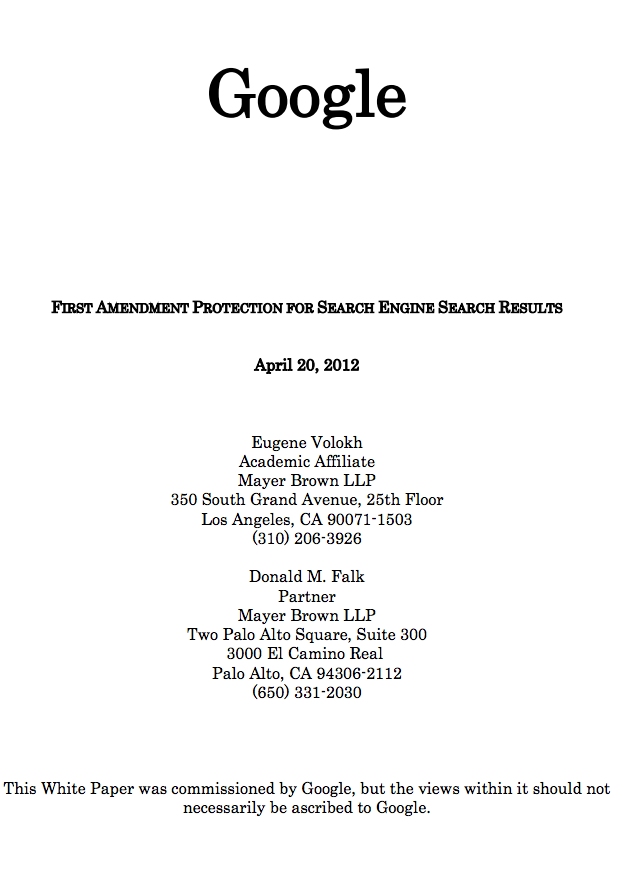
That’s a question that many folks are wrestling with. One, highlighted in today’s Times (as a result of an editorial decision, to be sure), is Eugene Volokh, the UCLA law professor behind the popular blog, the Volokh Conspiracy. According to the Times, Volokh took money from Google to write an “article” that argued — surprise! — just what Google wanted him to argue, which is that Google deserves just as much First Amendment protection as it wants.

BTW, if you blog, you are definitely considered a “publisher” in the eyes of the law, and you are just as responsible for the contents of your blog as a traditional publisher or broadcaster.

Leave a comment

Filed under broadcasting

Another view of Murdoch

By Chris Daly

Don’t say this blog is one-sided, even on the subject of Rupert Murdoch. The British writer William Shawcross recently stuck up for Murdoch in this piece in the Guardian.

Shawcross, who wrote a 1992 biography of Murdoch, is in a position to comment. I just disagree.

Here’s the take-away from Shawcross:

Rupert Murdoch has been the bravest and most radical media owner in Britain in the last 40 years.

There are caveats. It is insupportable for any tabloid, whether the Sun, the NoW, the Mirror or the Mail to “monster” individuals. But tabloids are an essential part of a vibrant market and the Sun is an excellent paper, catering well to its audience.

Without Murdoch there could never have been such a varied newspaper market in Britain during the last 25 years. Newspapers were dying until he confronted and defeated the greedy print unions. Only after his victory at Wapping did newspapers – on the left as well as on the right – have the chance to flourish. Murdoch’s purchase of Times Newspapers saved that company. It’s hard to think of any other proprietor who would have sustained its huge losses year after year.

Leave a comment

Filed under broadcasting, Journalism, journalism history, publishing

CNN: the “E.R.” of TV news?

By Chris Daly

Insightful piece today by Brian Stelter in the Times. It raises the question: Is CNN like the emergency room of a hospital that cannot fill its inpatient beds? CNN is very busy during crises, but it becomes a lonely place during periods of routine news. That certainly rings true in my experience: on an election night, I’m a visitor of CNN for sure. If I hear a snatch of something startling on the radio and want to hear/see more right away, I will snap on CNN. If all hell is breaking loose somewhere, it’s usually my top choice (certainly far ahead of cable-news leader Fox News, which has so few correspondents who can jump on breaking news).

Fundamentally, this problem has been with CNN almost from the get-go. Here’s an excerpt from my book, Covering America, about the founding of CNN and its basic business problem. 

. . .By approaching cable news this way, [CNN founder Ted] Turner was coincidentally creating a new business model for TV journalism. Unlike the networks, CNN did not plan to build a huge entertainment division that would have to create or bid for programs. And unlike public television, CNN was not dependent on public subsidies, foundation grants, or donations from the audience. Instead, Turner was adapting an older business model from newspapers. In the CNN approach, TV news would be paid for through a “dual revenue stream.” Just as newspapers made money from two sources—advertising and subscriptions—so would CNN. The company would sell ads, and it would also have a steady stream of revenue coming in from the cable operators, who had to pay CNN a few pennies per customer per month, reflecting CNN’s share of the monthly cable TV bills that Americans were getting used to paying. With low costs and two fairly reliable streams of revenue, news on cable just might work.

Ready or not, on June 1, 1980, CNN made its debut. There were the inevitable mishaps (the cleaning lady who walked across the set behind the anchor while the cameras were rolling), but the impressive thing was that it worked. CNN started covering the news that day and has done so continuously ever since—days, nights, weekends, holidays. Only the AP could make a similar claim, (though it supplies news to the industry rather than directly to the public). Soon, Turner was showing the skeptics that it was in fact possible to put news on television round the clock. Yes, it was sometimes raggedy. And yes, there was a lot still to accomplish—including hammering out reciprocal video-sharing agreements with affiliates, hiring more and more staff, opening bureaus around the world. But it worked.

By the end of 1981, CNN was getting established. It was reaching 10 million households and was clawing its way to journalistic parity with the network news divisions.18 One key issue was what is known as “pool coverage.” This occurs in many settings when there is not enough room to accommodate all the media people who wish to cover some location or event, such as a courtroom, a presidential appearance with limited access, or the like. In those cases, the answer is a pool, in which all the journalists in each medium agree to cooperate. Typically, each medium gets to put one representative at the scene. In return for that access, the chosen journalist agrees to share the results with all the other members of the pool in the same medium. In addition, each member of the pool agrees to take a turn in providing the feed. This arrangement assumes, of course, that anyone participating in the pool will produce work of high enough quality to satisfy all the others. CNN was originally scorned by the networks, which refused to let CNN crews participate in the White House television pool coverage. It took a lawsuit (which cost Turner another $1 million), but eventually CNN was allowed in.

One of the early tests of CNN as a news organization came on March 30, 1981. President Reagan gave a speech that day to the AFL-CIO at the Washington Hilton. CNN covered the speech live and then, when it was over, switched to some filler material, about sewing in China. While that was airing, the police scanner in CNN’s Washington bureau barked: “Shots fired . . . Hilton Hotel.” Almost immediately, the veteran newscaster Bernard Shaw sat down in the anchor chair in the CNN Washington bureau and began reporting that shots had been fired at the president—a full four minutes before the networks. Shaw stayed in the chair for more than seven hours, and, with help from Dan Schorr, proved that the fledgling news service could keep up with the established networks. Through the evening, CNN kept breaking in with new details: a picture of the shooter’s home, a report on his motive, pictures of the vice president in Texas heading to Washington. According to one account of that day: “Such details were hitting the air in no particular sequence. CNN’s viewers got the story in the jumbled way a journalist receives fragments of information before transforming them into an orderly, polished report. The ‘process’ of gathering news determined the form in which that news was delivered.” Before CNN, viewers had received their news in measured doses at fixed times; now they were drinking straight from the fire hose.

For years, CNN cost more to produce than it brought in through the combined revenues of cable subscriptions and advertising. The network was burning through Ted Turner’s personal wealth at an unsustainable rate. The early years were a desperate race to get CNN included in enough viewers’ basic cable packages to pay for itself. Most of the costs of gathering and disseminating the news by cable were fixed; the great variable was the size of the audience. Beginning in 1978, from the pre-launch investments in people, property, satellite time, and equipment, CNN lost an estimated $77 million through 1984.20 But then in 1985, CNN began posting profits: $20 million that year and more in the coming years. In the grow-or-die spirit of modern capitalism, Turner soon started thinking about acquiring other businesses. At the same time, a profitable CNN was looking more attractive to other investors, who might try to take it over. By the end of the decade, CNN was earning almost $90 million a year and had an estimated value of $1.5 billion. At the decade mark, on June 1, 1990, it could be seen in 53 million homes in the United States and in eighty-four countries worldwide. CNN had nine U.S. bureaus and another eighteen overseas, with a global total of some 1,800 employees. CNN had arrived. . .


Leave a comment

Filed under broadcasting, CNN, Fox News, Journalism, journalism history, media

“Not a Fit Person”

By Chris Daly 

Well, now it’s official. Something that many people have thought for a long time is now part of the findings of a British parliamentary report: Rupert Murdoch is “not a fit person” to run a globe-straddling, influence-buying, phone-hacking, official-bribing media conglomerate.

Actually, the report released Tuesday may not be Murdoch’s biggest problem. He is already under investigation in the United States as well. Murdoch became a U.S. citizen in the mid-1980s, a move that facilitated his move into American broadcasting (since U.S. law requires that broadcasting remain in the hands of U.S. citizens). Perhaps more serious for Murdoch is the fact that his News Corp. (parent company of the British unit that is in trouble in Parliament) is a U.S. corporation, registered on the New York Stock Exchange. That means that News Corp. is subject to all the laws and regulations of the United States — including the Foreign Corrupt Practices Act. That law, dating to the 1970s, forbids U.S. companies from using their assets to pay bribes to officials in other countries. On the face of it, that would appear to make it a crime in the U.S. for News Corp. employees to do what they have already admitted under oath in Parliament: for years, they paid British police police officials for tips about their investigations.

If I were Murdoch (or even a shareholder in News Corp., which operates Fox News and the Wall Street Journal, among many others), that’s what I would be really worried about.

Recent stories are here, here and here.

News Corp. world headquarters in Manhattan / Kathy Willens (AP)

Leave a comment

Filed under broadcasting, Fox News, Journalism, journalism history

Titanic’s role in journalism

By Chris Daly 

On the eve of the centennial of the sinking of the Titanic, I am posting an excerpt from my new book, Covering America, about the impact of the Titanic on the emerging field of “wireless telegraphy.”

First, here is an image of a wireless distress signal sent that night from the Titanic to the Marconi company.

Telegram from the Titanic: "require assistance. . . struck iceberg"
(Courtesy: Museum of the History of Science, Oxford)

From Covering America: A Narrative History of Nation’s Journalism, chap 7:

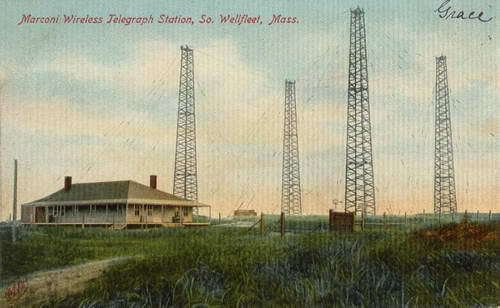
In the decades following its invention, the telegraph became a fact of life and an indispensable tool in business, in the military, and in journalism. Still, it had some drawbacks: it could carry a message, but the contents had to be sent in code; messages could be sent only from one point to another, and those two points had to be connected by a copper wire. For these reasons among others, the telegraph was not a popular means of communication but remained a special tool used mainly by businesses.42 In the late nineteenth century, a flurry of scientific and engineering breakthroughs started to overcome those limitations. In 1876 a Boston University professor named Alexander Graham Bell invented a machine, the telephone, which allowed the human voice to be carried over a wire. Nikola Tesla, a Serbian immigrant to America and the inventor of the alternating-current electric motor, contributed the idea that electromagnetic waves could carry messages. Soon it was proven that such waves could pass through walls. They could scale mountains, even cross the ocean. This created the promise of an amazing possibility: a telegraph without wires! A young Italian, Guglielmo Marconi, became a pioneer in the new field, devoting himself to working on a way to use radio waves to transmit signals carrying Morse code.43 Marconi had the resources to tinker with the idea; his mother was an heir to the Jameson family Irish whisky fortune. Rebuffed at home, Marconi went to England, where he formed the Wireless Telegraph Signal Company in 1897, to be followed by an American division of British Marconi a few years later. In 1901, Marconi even managed to send a wireless signal across the Atlantic Ocean, but he struggled to find a business model for his invention. The early applications of the new technology were in the military and in the shipping business, where the ability to send messages without wires had an obvious appeal. At first the technology was referred to as wireless telegraphy, or simply “wireless,” but a new term—radio—first popularized in the U.S. Navy, soon won out. In 1906 an American inventor named Reginald Fessenden demonstrated that radio signals could transmit more than just long and short pulses. They could carry music and even the human voice. In the end, that discovery proved indispensable for making radio a truly popular medium. One of the first big tests of radio, one that made a lasting impact on the public imagination, came in 1912, when the world’s greatest luxury ocean liner, the state-of-the-art Titanic, made its initial voyage from England to New York.44 As the great ship crossed the North Atlantic on April 14, it struck an iceberg, and the crew immediately used the ship’s wireless equipment to call for help. Some of the other ships in the vicinity had wireless equipment that was turned on and monitored at all times; others had turned their sets off for the night. As a result, Copyright 2012 NOT FOR SALE [ 204 ] CHAPTER 7 the closest ship, the Californian, which could have saved all of the Titanic’s 1,522 passengers, lay at anchor just nineteen miles away and never responded. The Carpathia, which was fifty-eight miles away when the Titanic started sinking, took two hours to arrive, and by then, many passengers had drowned in the frigid waters of the North Atlantic. Rescue efforts were also hampered by the many amateur radio operators who filled the airwaves that night with rumors, questions, and interference from their overlapping signals. In the aftermath of the Titanic disaster, the U.S. Congress quickly adopted legislation requiring that all American oceangoing ships and all those entering U.S. ports be equipped with radios, and that the radios be kept on and staffed at all times. Congress also required radio operators to get a license from the U.S. Department of Commerce, and it relegated amateur operators to the bottom of the radio spectrum (the shortwave end) while giving priority to the navy and to commercial companies like Marconi’s.45 Significantly, Congress chose not to follow the European model, in which new technologies including telegraph, telephone, and radio were successively grafted onto a government monopoly such as the postal service, resulting in public communication monopolies like the BBC. In the United States, Congress operated on the principle that radio would be a private enterprise—regulated, to be sure, but private nonetheless. In retrospect, this was one of the constitutive moments shaping the eventual architecture of broadcasting in America, combining elements of technology, law, and economics into a new model.46 On the night of the Titanic disaster, one of the radio operators in New York handling reports of the sinking was a young man named David Sarnoff. (He was not the only one, as he often claimed.) A Russian immigrant who never made it past the eighth grade, Sarnoff would become one of the titans of broadcasting in the twentieth century as president of RCA, the Radio Corporation of America.47 While working for Marconi, Sarnoff demonstrated great foresight. In 1915, when he was just twenty-four years old, Sarnoff wrote a memo to his boss, giving his thoughts on the business. He envisioned a future for radio that went far beyond transmitting coded messages from point to point. “I have in mind,” he wrote, “a plan of development which would make radio a ‘household utility’ in the same sense as the piano or the phonograph. The idea is to bring music into the home by wireless. . . . The same principle can be extended to numerous other fields as, for example, receiving lectures at home which can be made perfectly audible; also, events of national importance can be simultaneously announced and received.”48 Sarnoff projected a market of 15 million American families. The Marconi company did not think much of Sarnoff’s scheme, but Sarnoff clung to the idea that radios could be a popular mass commodity, provided they became easier to use. Never much of engineer, Sarnoff was already showing his true talent: marketing. He switched to management. While Sarnoff and others were pondering the future of radio, most Americans Copyright 2012 NOT FOR SALE Jazz Age Journa lism, 1920–1929 [ 205 ] still had never heard a radio broadcast. A few license-holders were beginning to transmit signals through the airwaves (or into “the ether,” as it was called), where they could be heard by anyone with a receiving set. But hardly anyone had one yet. A few corporations, such as United Fruit, were using radio to coordinate their shipping fleets. And of course the army and navy remained deeply involved in radio. But before about 1920, radio remained largely in the hands of the amateurs— most of them young men who were inclined to tinker. Those early adapters usually built their own radio sets. They set up friendly competitions to see who could pull in the faintest or most distant signal (which they called “DXing”). They often traded information and parts in a wave of enthusiasm that had nothing to do with patents, profits, or licenses. Participants in the new movement sometimes referred to what they were doing as “citizen radio.”49 An editorial in one of the first radio journals put it this way: “Do you realize that our radio provides about the only way by which an individual can communicate intelligence to another beyond the sound of his own voice without paying tribute to a government or a commercial interest?”50 Soon others joined in—women as well as men, universities, stores, even the famous Dr. Brinkley of Kansas, who used radio to promote his theory that implanting goat glands would cure “male trouble.” Radio was wide open— diverse, local, nonprofit, and utterly unpredictable. But not for long. World War I transformed radio, as it did so many other institutions.

Leave a comment

Filed under broadcasting, Journalism, journalism history

Media & politics: France v U.S.

By Chris Daly 

In France, the regulations that guarantee equal time to all major political candidates seem to be taken quite literally. Today’s Times has a story that tells of the lengths that French media regulators go to in order to follow the letter of the law. Candidates’ appearances are timed to the second and compared to each other to ensure that no one gets an unfair advantage.

AFP

The Times story compares this system to the “Fairness Doctrine,” which the FCC used to enforce on American news media. Actually, the French system sounds more like a different FCC policy, the “equal time rule,” which went out in 1960.

Here’s an excerpt from my new book, Covering America, about the end of the “equal time” rule in 1960:

In the fall of 1960, many Americans were still in the process of getting to know Jack Kennedy. Just forty-three years old, he represented the World War II generation, declaring himself ready to take over from Eisenhower, the very man who had commanded the young troops in wartime. Kennedy was not only young, he was also rich, good-looking, and married to a very photogenic wife. With his distinctive accent, his cool demeanor, and his ironic wit, he was well suited to the new medium that was about to make its mark on American politics in a dramatic way—television. Just in time for the 1960 election, Congress had passed a law repealing the FCC’s “equal time” rule, which had required broadcasters to give equal amounts of air time to all candidates for office, including fringe candidates and cranks. In 1960, for example, there were more than a dozen political parties offering candidates for president. It would have been impossible—and perhaps illegal—for a broadcaster to hold a debate that excluded any of them. In a step that went a long way toward perpetuating the dominance of the two major parties, Congress decided to lift that ban for the 1960 campaign and to have the FCC study the issue. When the new law was signed on August 24, 1960, the way was clear for the networks to approach the Democrat Kennedy and the Republican Nixon and offer them an exclusive one-on-one format for the first televised presidential debate in history.

The challenger, Kennedy, promptly agreed. . .


CBS News/Getty


And here’s a longer excerpt that addresses the rationale for using government power to regulating broadcasting in the first place, despite the Constitutional ban on governmental limits on free speech.

Meanwhile, though, with the proliferation of stations sending out signals in the mid-1920s, there arose what some people considered a problem. In more and more places, radio signals were interfering with one another, causing static and defeating the whole purpose of broadcasting. To make matters worse, some broadcasters built supertransmitters intended to overwhelm any weaker signal operating at the same frequency. In response, some broadcasters would move their signal to a different frequency, to avoid being “jammed” by a more powerful rival. As a result, listeners would have to search around the dial to find their favorite station. By 1925 there were some ten thousand stations sending out signals, with no sign of any slowdown. The existing law required a license, but it did not allow the government to deny one to anybody. Hoover and many broadcasters saw this “chaos” on the airwaves as a major crisis. The result was a drive for federal legislation.

But first there was an issue to be addressed: What business did Congress have regulating this area in the first place? Specifically, what about the free speech protections guaranteed by the First Amendment? Didn’t the Constitution explicitly state that Congress shall make no law abridging the freedom of speech or of the press? Certainly, it was argued, when the Founders drafted that language, they meant to protect all speech, in all media. In the 1780s, when Jefferson and his contemporaries used the word “press,” they were referring to the entire array of mass communication then in existence: books, magazines, and newspapers. Now that a new medium had come along, why shouldn’t that technology enjoy the same protections granted the traditional print press, and for the same reasons? Radio could play an equally important role in our constitutional scheme as newspapers or magazines, but only if it was equally free.

By contrast, Hoover and his allies made the case for regulating radio on the basis of what they saw as fundamental differences between the press and radio that placed the two media on different constitutional grounds. First, they said, radio exists as a result of waves that pass through the ether—that is, the electromagnetic spectrum. That spectrum is a unique public resource, and the portion of it that exists above the territory of the United States belongs to the American people. Furthermore, they said, the airwaves were not like the frontier lands of the American past, which were surveyed and sold or given away to settlers. The spectrum could be measured and divided, but it was not for sale. This idea is sometimes referred to as “listener sovereignty,” meaning that the listeners have a collective ownership over the spectrum, which gives the public the right to control it. In addition, said the advocates of regulation, the spectrum has another inherent quality that differentiates it from the traditional press: it has only so much bandwidth. As a result, within any geographic area there is a physical limit on the number of radio signals that can be transmitted without interference. This “spectrum scarcity” means that someone must serve as a gatekeeper, allowing some people to use the spectrum and keeping others out. In radio there is a natural saturation point beyond which no one can enter without harming someone else. For that reason, radio was different from the press, since it is possible to have a practically unlimited number of publications circulating in the same area without impinging on one another. With these arguments, the regulators swept aside any constitutional objections and turned to making laws that would abridge the freedom of the airwaves.

The result was the far-reaching Radio Act of 1927. . .

Leave a comment

Filed under broadcasting, Journalism, journalism history

An Auction or a Giveaway?

By Chris Daly

Let me see if  I have this right:

The Federal Communications Commission is planning to hold an auction to sell off chunks of bandwidth in the electromagnetic spectrum. Specifically, the FCC is proposing to sell off the segment that was used for decades by television broadcasters, in the era when they sent their signals through the air (or through the “ether,” as an earlier generation referred to it) and their viewers pulled those signals out of the air with set-top or roof-top antennas.

That seems like a fine idea.

The part I don’t get is this: As I explain in my new book, Covering America, (see chapter 7), the FCC was established in 1927 to represent the interests of the American people as a whole.

The idea was that the American people had an undivided ownership stake in the spectrum and that they therefore needed a way to manage it for the public benefit. In its early years, the FCC designated certain frequencies in the electromagnetic spectrum for radio transmissions; after WWII, the agency did the same for television. In doing so, the FCC essentially gave broadcasters that precious public resource.

Now, the broadcasters want to be reimbursed for their “loss” of the spectrum that they have been using for free for decades — never mind that they never owned it.

Today’s Times front-page story puts it this way:

The measure would be a rare instance of the government compensating private companies with the proceeds from an auction of public property — broadcast licenses — once given free.

 So, it appears that it is going to cost the American people something close to $2 billion to get back something that belonged to them all along. That sounds like a shake-down to me.


1 Comment

Filed under broadcasting