
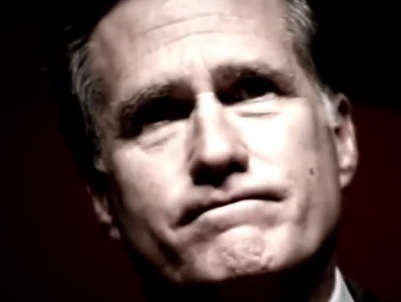
In light of Mitt Romney’s verbal stumble this week, it is worth remembering this political definition from journalist Michael Kinsley:
A gaffe is when a politician tells the truth.
Brilliant.
In light of Mitt Romney’s verbal stumble this week, it is worth remembering this political definition from journalist Michael Kinsley:
A gaffe is when a politician tells the truth.
Brilliant.
Filed under Politics
By Chris Daly
I am trying to resist the temptation to pile on Mitt Romney (Oh, all right: I am not trying very hard!).
When journalists assess his claims to be a job-creator through his work at Bain Capital, they need to dig a little. The important issue, of course, is whether Bain was a net job creator.
Take one case: Understandably, Romney is fond of citing his role in launching the office supply superstore chain Staples. His campaign boasts that Staples “created” 90,000 jobs (and sometimes 100,000 jobs). That may be true, although journalists should still check it. But even if true, it is not the whole story. Staples is what is sometimes called a “category killer.” That means that its success depends on — or at least results in — the elimination of a whole category of existing businesses. In the Staples case, the rise of all those superstores did not occur in a vacuum. Their growth came at the expense of many, many little mom&pop stationers that used to occupy storefronts in many downtown areas. Those independent small businesses are now almost completely gone from the American scene.

It’s the same process you see with Home Depot. As they grow, there go the little, local hardware stores that used to be everywhere. Same with WalMart and other “category killers.”
So, the question that journalists should pursue about Romney is: how many jobs were left after Staples wiped out the category known as the independent stationer?
Particularly in a party that venerates small businesses, that is a question that should have some political salience.

By Chris Daly
I don’t usually take frankly partisan positions in this blog, and I will try not to do that here, even in the midst of the Iowa caucus-ing.
What struck me in the last few days was the lament of Newt Gingrich about the flamethrower approach of the Romney camp, which has bombarded Gingrich with negative TV ads. For a Republican to complain about unrestricted negative campaigning is more than a bit rich. It’s like Dr. Frankenstein complaining about his monster.

Questions for the media to keep in mind:
1. Who elevated the dark art of negative campaigning to its highest level?
[Hint: Lee Atwater, Karl Rove. . .]
2. Who thought is was a good idea to allow unrestricted spending on political ads?
[Hint: Scalia, Thomas, Roberts, Alito, Kennedy.]
In other words, the answer to both questions is REPUBLICANS. To the best of my knowledge, no mainstream media accounts of this election have mentioned this factual matter of background. I would say that reporters and editors should give this some thought. How will the media address this reality? Will journalists explain the factual history of the issue? Will they try to find a way to neutralize or offset it? Will television station owners in Iowa, New Hampshire, South Carolina and elsewhere reject those ads? Will the media interpret non-partisanship to mean that they must look the other way?
To be continued. . .
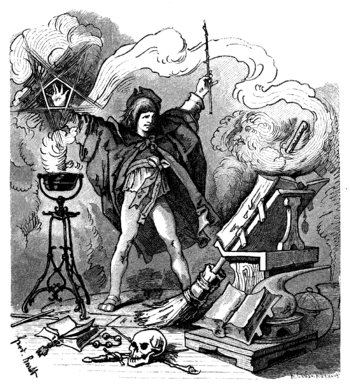
[Illustration of the Goethe figure the Sorcerer’s Apprentice by S. Barth, via Wikimedia]
Filed under broadcasting, First Amendment, Journalism, Politics
By Chris Daly
Michelle Bachmann, a former flavor-of-the-week in the lengthy, fickle Republican primary campaign for the presidential nomination, has a gripe. Not surprisingly, she is complaining about the media.
This, of course, is a time-tested tactic for Republicans, especially when they are feeling politically desperate. Bachmann claims to have caught CBS News in a “gotcha” moment that she believes confirms her suspicions of liberal bias at CBS. Now, it may well be that there are liberals at CBS, but this episode does not prove her point. In fact, I believe it proves the opposite point.
Briefly. . . As recounted in today’s NYTimes, the guy in charge of political coverage at CBS, John Dickerson, was caught doing his job. He was trying to find an online guest for a show he was orchestrating that would follow the latest Republican debate on Saturday night. In an email to colleagues, he said he would rather “get someone else” other than Bachmann.
His reason? She was “not going to get many questions” and “she’s nearly off the charts” in the polling of voters’ preferences.
(Dickerson’s big mistake was that he included a Bachmann aide among the people in the list of addresses for that particular email, so his thinking went unfiltered to the Bachmann communication director, who then did the professional thing and tried to make hay out of it, in a Facebook blast and elsewhere.)
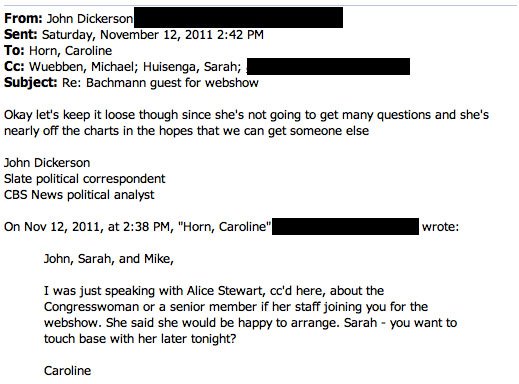
Back to Dickerson’s email.
If we look at what he actually said, it appears that his criteria for choosing the guests to pursue were non-political, non-partisan, and non-ideological.
Like any good producer, he wanted a “hot” guest — hot in the sense of someone who is trending, someone who is going to create or amplify buzz, someone who is going to add to CBS’s ratings. He does not want someone who was last week’s news. Simple as that.
And the facts bear him out: Bachmann did indeed get few questions in the debate and little air time, and she is dying in the latest polls. (CBS’s own latest poll had her in 6th place with just 4% support.) That is not to say that she could not surge again; if she does, Dickerson and every producer, host, and booker in politics will be chasing her. Not because they like or dislike her and not because they agree or disagree with her. It will be all about blowing on the hot coals.
In his email, Dickerson could be properly charged with telling “vicious truths.”
Was he ruthless? Yes.
Was he liberal? No.
Even the awful site Big Journalism almost got this right. In fact, the blogger
p.s. For another day: What about Bachmann’s implicit claim? Do the news media formulate common policies, then execute them in concert? (Hint: people in the news media can’t agree on whether to capitalize “president” !)
Filed under broadcasting, Journalism, media, Politics
I have now seen what the Internet was made for! You have to see these political parodies offered up by Bad Lip Reading. (check out Perry, Bachman, Obama, etc.)
The Cain video is my favorite (so far). “nachos and hogwash” . . . “sing, sing, sing” . . . “baby your breath is killing me”. . . spiders, big potato moths, lice and tiger DNA, cowboys & anthrax. . . it’s all there. Give that woodchuck a tunamelt!
This guy has the answers.
Now, what are the questions?
Filed under Politics
By Chris Daly
The NYTimes spots (yet another) new trend: younger and younger correspondents hitting the presidential campaign trail.
Any why not? Covering presidential campaigns requires mainly stamina, energy, and curiosity. The place where experience counts is on the desk where the correspondents’ work is edited. By this time next year, we should have a good idea who has a strong desk and who doesn’t.

Filed under Uncategorized
By Chris Daly
Today’s New York Times features a story and charts on the findings of the latest Times/CBS News poll — this one about the demographics of the Tea Party movement.
One finding that caught my eye had to do with where Tea Party members get their news. No surprise, they get “most” of their news from Fox News. In fact, the preference for Fox News was the biggest skew in all the findings that I could find. Comparing Tea Party members to a category defined as “all adults” (is this like contrasting them to “normal Americans”?), there was a 40-point spread in news consumption. Even compared to Republicans, the Tea Party folks favor Fox over other news sources.
Maybe we should just call it the Fox Party.
Filed under Politics
 Prof Chris Daly's Blog