
Margaret Fuller pioneered the role of war correspondent in the 1840s.
Here’s an excerpt from my forthcoming book, The Democratic Art: the Role of Journalism in the Rise of American Culture. In honor of women’s history month, here is a history-making woman journalist.
. . . Finally, in early spring of 1847, Fuller and the Springs headed southward across France and down the Italian peninsula, then a hodge-podge of separate states. On arrival, Fuller felt an instant and deep connection to Italy, the home of Virgil and Dante, of Michael Angelo and Titian. As she wrote to Emerson at this time, “Had I only come ten years earlier! Now my life must be a failure, so much strength has been wasted on abstractions, which only came because I grew not in the right soil.” As her letter indicated, she felt that she had now found her real work – and perhaps her real self – in Italy. Indeed, as a writer, she was at her best. She gave up all plans to travel elsewhere. She was, in a sense, home. She had also found her true calling. “Margaret had become a journalist,” biographer Megan Marshall concluded, “whose trademark was experiencing reality firsthand and recording the truth as she saw it.” Fuller’s love for Italy soared when she finally reached Rome, the Eternal City she had read so much about. For the rest of her stay abroad, she would report only from Italy, sending Horace Greeley, the publisher of the biggest newspaper in the U.S., some two dozen dispatches between May 1847 and January 1850.
As Easter approached in the spring of 1847, Fuller and the Springs made their way to the epicenter of the Roman Catholic religion on April 1, Maundy Thursday, to attend the evening Vespers service at St. Peter’s. Afterward, they slipped into a huge throng of pilgrims in the streets around the Basilica. Somehow, Fuller got separated from the Springs and found herself alone in the jostling crowd. Suddenly, a handsome young Roman appeared and offered his arm to Margaret. Although he spoke no English, he managed to indicate that he was concerned for her safety and was offering his help. Using her Italian, Margaret accepted his offer, which she would later call a “singular, fateful” moment. Thus, Margaret Fuller, 36, an American Protestant, met Giovanni Angelo Ossoli, 26, an Italian Catholic. Soon, she would learn that Giovanni was something of an aristocrat. He came from a noble Italian family, but since he was not the oldest son, he did not stand to inherit the either the family’s wealth or property. Nevertheless, he was formally a Marquis – penniless, to be sure, but titled.
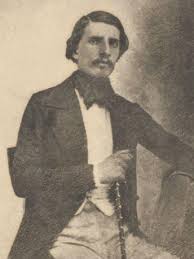
Giovanni Angelo Ossoli
For the time being, Fuller wrote little about Ossoli for public consumption, and even in her letters to friends, she was rather evasive. In late spring, she traveled with the Springs as far as Venice. From there, the Springs headed north to visit Germany before heading back to America. Fuller decided to stay in Italy, having to make do without the Springs’ generosity; a single woman, she now had to fend for herself. She headed next to Florence, (which she found “too busy . . . more in its spirit like Boston, than like an Italian city”) and then to Milan. Broke, she wrote to Greeley, asking him for $600 for living expenses. Originally, the Tribune editor had advanced her $120 for 15 columns; she assumed, mistakenly, that that was all he wanted or would pay for. He wrote her immediately to correct her, saying “All the letters you see fit to send us at $10 each will be more than welcome.”[i] Fuller extended her travels that early fall of 1847 to take in the lakes at the top of Italy and the bottom of the Alps. Having traveled the Great Lakes back home, she had to admit that they could not compare with the Italian lakes.
In early October, she returned to Rome, and Giovanni helped her find an apartment on the busy Via del Corso, not far from the Piazza Popolo and the Borghese Gardens. For Fuller, this was something of an idyll, and it appears that she fell deeply in love with Ossoli. But could she marry him? She could not resolve her feelings about marriage, which she considered a “corrupt social contract.” At the same time, she was drawn to Ossoli and may have been considering giving up her virginity. She had known several great men and declined them all. Ossoli, however, presented her with another kind of man: simple, kind, loving. Besides, he wanted to marry her. Fuller wrote to her mother at this time: “My life in Rome is thus far all I had hoped. I have not been so well since I was a child, nor as happy ever as during the last six weeks.”[ii] All the evidence suggests that sometime in early December, Fuller overcame her doubts, and the couple engaged in intercourse. Margaret was thirty-seven and a virgin when it came to sex with men; Giovanni was ten years younger and probably not a virgin. She was a Protestant; he was a Catholic. They faced almost insurmountable obstacles to marriage, especially a public one, since Italy forbade such “mixed marriages.” The couple were sure that the Ossolis would reject them; they assumed that her family and friends would frown too. So they kept mum.
Immediately, Fuller’s dispatches showed a freshness and liveliness – probably a mixture of her newfound joy in her private life and a rising optimism about the republican movements growing across Europe. A landmark new history of the revolutions of 1848 praises Fuller for “the most evocative and insightful eyewitness accounts of Roman events.”[iii] In a column she finished in December, Fuller described three “types” of America visitors to Europe, then turned to continental politics. After 1800 years of Christianity, she asks, what does Europe have to show for it? “Where is the genuine Democracy to which the rights of all men are holy?” The dispatch goes on to point out the widespread misery in Europe and the refusal of the dictatorial monarchs to address the people’s needs. Increasingly, she points to “associationism” as the radical remedy for industrial poverty – without going into great detail. Evidently, Fuller assumed that readers were familiar with associationism, the social theory put forth by Charles Fourier and embraced by Greeley that called for workers to jointly own the factories and workshops where they toiled. In the same column, Fuller turns to the recent U.S. war with Mexico, which threatened to expand slavery into a vast new territory. “I listen to the same arguments against the emancipation of Italy, that are used against the emancipation of our blacks; the same arguments in favor of the spoliation of Poland as for the conquest of Mexico.” On a hopeful note (yet with an ominous undertone), she added that perhaps the younger generation could make a better world. “I have witnessed many shipwrecks,” she added, “yet still beat noble hearts.”
Soon, though, Fuller began suffering symptoms that added up to morning sickness. It is not known if she even contemplated an abortion, but it would have been virtually impossible to obtain one in Italy. Her status as an unwed mother brought with it another raft of problems. If the baby were born out of wedlock, it could be considered a “foundling” in Italy and snatched away from her. Should they marry? Should they wait and see if the baby lived? While Margaret was facing such problems, her finances remained precarious. Nevertheless, Fuller persisted. Indeed, in the coming months, she would prove herself as a successful foreign correspondent and as a terrifically resourceful woman – a single mother, supporting herself financially through her professional work and witnessing a violent revolution. It is fair to say that the privileged ladies of her Conversations back in Boston and the young Harvard-trained ministers she knew at home would be astounded to see her in Rome.
As the year 1848 began, Fuller remained engaged in her work – covering Europe for the largest-circulating newspaper in America. With Greeley’s support, she was well positioned to cover the growing discontent across the continent and the rising calls for democracy and social reform. Revolution was in the air, as insurgent leaders rose up to protest the devastating new impacts of industrialization and the infuriating old insults of autocracy. Greeley had other correspondents in Europe, all men, but none wrote as often, or as well, as Fuller. As the demands for change grew – led by radicals like Mazzini and Mickiewicz – Fuller did her best to cover the great developing story. Broke again, she was stranded in Rome because it was becoming too dangerous to travel and cross contested borders. By now, she was collecting material for a work of history that would capture the great events of 1848.[iv]
Still, she needed to keep working as a journalist. To overcome the many handicaps, she pioneered an array of techniques that would be used by generations of foreign correspondents to come. She kept up with developments by reading the European press – after all, she could read not only English but German, French, and Italian as well. She also interviewed visitors as they passed through Italy, bringing her insights from Vienna to London. And, she cultivated sources close at hand among the American officials posted in Rome, especially the U.S. diplomat Lewis Cass Jr.. In addition, she roamed on foot around Rome, making conversation with Romans from all walks of life. Fuller also had to another issue familiar to all foreign correspondents – staying in contact with the home office. In the late 1840s, telegraph service was becoming established, but it would be two more decades before a reliable telegraphic connection spanned the Atlantic Ocean. So, Fuller had to be sure to get her handwritten dispatches to an ocean-going steamship, which could take it to Boston or New York. To send a message to Greeley and get an answer could take two months.
While restricted in her movements, Fuller read widely among European newspapers, so she was hardly cut off from the wider world. And, as it happened, the momentous events of 1848 would bring one great revolutionary movement right to her doorstep – that was the uprising against papal rule over Italy. In one dispatch early in 1848, Fuller denounced the conservative influence of the Catholic priesthood and the Jesuits in particular. She believed that they were scheming to maintain their traditional powers and prerogatives in Italy and other Catholic countries. “How any one can remain a Catholic . . . after seeing Catholicism here in Italy I cannot conceive,” she wrote in Dispatch No. 22. This column, as well as others, antagonized the growing number of Catholic readers of the Tribune in America, especially Bishop Hughes of New York, who denounced Fuller in print and damned the rebels for imposing “a reign of terror over the Roman people.”
Around the end of her first trimester in late March, Fuller bemoaned the chilly rain and her recent ill health. “Now this long dark dream – to me the most idle and most suffering season of my life – seems past,” she confided to her readers, while keeping her pregnancy secret, of course. She then pivoted to a roundup of news from that revolutionary season: rebellions in Sicily and Naples, the dethronement of King Louis Phillipe in France, the forced resignation of Metternich in Austria, the uprising in Venice, and more. “With indescribable raptures these news were received in Rome,” prompting dancing in the streets. In a postscript dated April 1, Fuller mentioned that she took a brief trip outside Rome. While she was away, one of the last holdouts of Hapsburg rule capitulated in Verona. It now appeared that Mazzini’s dream was becoming real. “Returning to Rome, I find the news . . . that Italy is free, independent, and One.”[v]
A few days later, more good news. In April, she received a letter from Greeley in which she learned of a major subsidy from the publisher, who confided that he had had to sell part of his stake in the Tribune to raise the funds to keep her on the newspaper’s payroll. Now, the air was not only clear between herself and her lifeline, but she could also look forward to an easing of her pinched circumstances. That same month, she wrote a column expressing again her disappointment in Pope Pius IX, saying he had betrayed the cause of Italian unification, which he had supported the previous year. Now, the pope was urging Catholics across Europe to submit to “their respective sovereigns.” Near the end of that column, she added a fresh denunciation of the U.S. conquest of Mexico, which she saw as another sad episode of one nation robbing another one of its right to self-determination. Turning to Europe, she added: “Here things are before my eyes worth recording, and if I cannot help this work, I would gladly be its historian.” [vi]
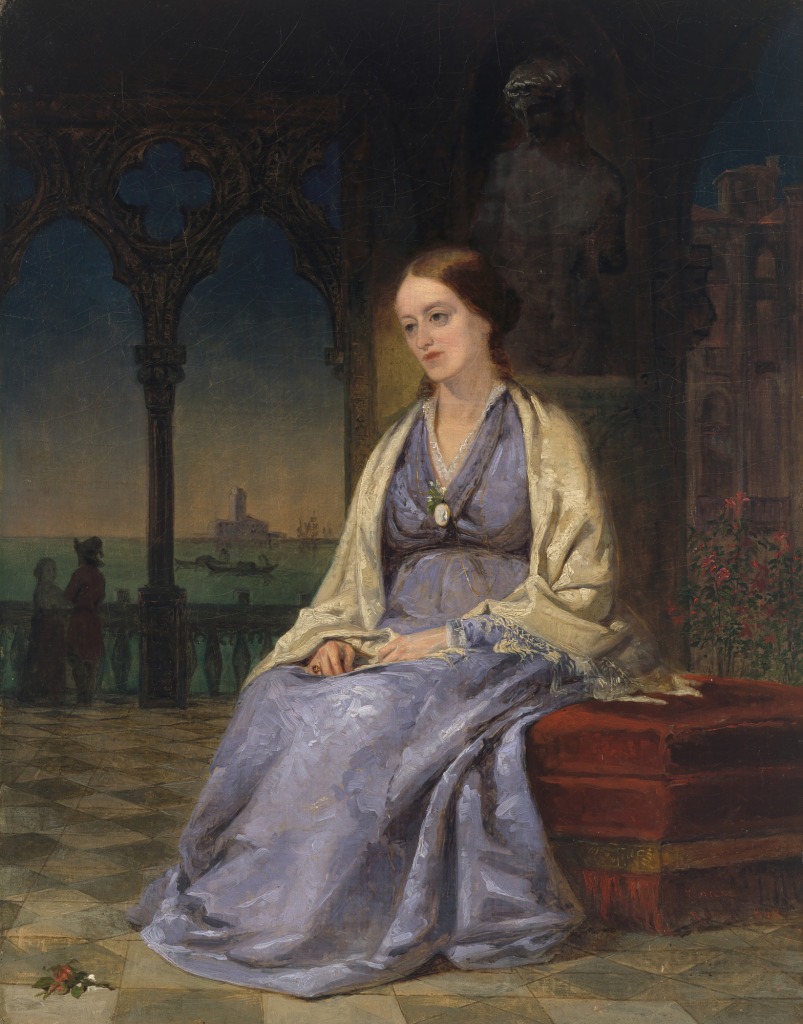
Portrait of Fuller by Thomas Hicks, from life, May 1848. U.S. National Portrait Gallery.
Around this time, despite the news of political upheaval across Europe, Fuller made plans to go into seclusion in L’Aquila, a small town in the mountainous Abruzzi region. She felt she had to stay away from the popular summer resort towns to avoid running into any Americans or Britons who might recognize her and spot her growing pregnancy. Emerson wrote to her that month, urging Fuller to return to America with him, but she replied evasively, trying to throw him off the scent: “I have much to do and learn in Europe yet,” she wrote. “I am deeply interested in this public drama, and wish to see it played out. Methinks I have my part therein, either as actor or historian.”[vii]
The radical part of the campaign to re-unify Italy, the Risorgimento, echoed certain themes from the American Revolution. One goal was to rid Italy of royal rule from outside the territory, just as the Americans had thrown off rule by the king of England, and unify the newly independent states into a territorial federation. That goal would involve winning independence from France, Spain, Austria, and others – all at the same time. Some who supported that goal were willing to replace outside rule with a home-grown royal family under a new King of Italy. The other faction had a more radical agenda. This group, which included Mazzini, wanted a new democratic republic, where the Italian people would govern themselves. Like Thomas Paine in 1776, they wanted to rid Italy of all rule from above, including the Pope. The new republic they envisioned would be a secular one, even in an overwhelmingly Catholic country. In the 1840s, this was indeed a radical agenda, and Fuller embraced it passionately and publicly.[1]
Meanwhile, Fuller remained at work on her history project. She continued gathering material: notes, pamphlets, newspapers, and letters she exchanged with friends across Europe. Of course, her own dispatches for Greeley were part of the process; those columns were what a later journalist would refer to as “the first rough draft of history.”[viii] As two Fuller scholars have noted: “The relationship she envisioned between the dispatches and her “History” was that between sketches and an oil painting; the first done quickly and impressionistically with the scene before her eyes; the second created in the studio and showing the effects not only of contemplation and reflection, but also of selection and arrangement.”[ix] This approach describes much the same technique that Winslow Homer would use a decade later in covering the U.S. Civil War as a sketch artist for a weekly news magazine before turning certain of his “first draft” images into masterpieces of oil painting.
Fuller arrived in L’Aquila on May 29. Later, she would tell Tribune readers of this period: “I have been away . . . during the Summer months, in the quiet valleys, on the lonely mountains.” In the heat and isolation, it was indeed lonely for the American fugitive. What’s more, Fuller was missing the landmark gathering of feminists that took place in late July at Seneca Falls, New York. Led by Susan B. Anthony, Elizabeth Cady Stanton, and Lucretia Mott, the gathering marked a bold and concrete step toward addressing many of the issues Fuller had raised in her foundational book Woman in the Nineteenth Century. Fuller herself would have to settle for reading about the Seneca Falls convention and its “Declaration of Sentiments,” many weeks later, when she caught up with copies of the Tribune.
At the same time, she found a reason to relocate again. L’Aquila was in the territory of the conservative King of Sicily, and he had started arresting republicans. Fuller could not be sure that her American citizenship would protect her, so she moved out of his territory, to the town of Rieti, which was then part of the Papal States. The move placed her closer to Rome as well, and now Ossoli could visit her. One biographer believes that Margaret and Giovanni quietly married during this period, if only because it would make life much simpler for them as a family, especially when it came to crossing Italy’s many borders.[x] Still, Ossoli had his duties in the Civic Guard, so he could not stay long. Fuller stayed in Rieti and kept working on her history, but it was a difficult time. As her pregnancy advanced, she had no companions or friends to help her. “I feel lonely, imprisoned, too unhappy,” she lamented to Ossoli.
Then, on September 5, while Ossoli was with her in Rieti, Margaret Fuller gave birth, at age 38. They named the baby Angelino Eugene Philip Ossoli and they started calling him “Nino,” a common Italian nickname Together, the new family enjoyed a happy interval, though brief. Giovanni insisted that the boy have the Catholic sacrament of baptism, but that would require waiting 40 days in Rieti. Married or not, Fuller could not wait that long; she needed to get back to work, and she wanted to keep the baby secret for at least a while longer. So, she arranged for Nino to be cared for in Rieti by a wetnurse. Then, she headed back to Rome. By mid-November, 1848, she was back at work. Still, around Christmas she made a trip to Rieti to see Nino, who “seems to be well,” although, as she wrote somewhat ominously to Giovanni, “not much bigger than when I left him.”
Nearing forty, she was managing as a virtual single mother, covering a story of historical importance. “Now, a new hard-hitting tone found its way into her correspondence,” according to one analysis. “She was a different woman by the time she returned to Rome – more militant, more Italian, more certain than ever that her hopes were bound up with the fate of the revolutionary cause in Europe.”[xi] Her dispatches about the tumultuous year just ending were having an impact. She was having the kind of career a few American women journalists (among them, Martha Gellhorn, Lee Miller, and Christiane Amanpour) would follow in the coming centuries. Among Fuller’s many readers back in the United States was Walt Whitman, now approaching thirty, working as a journalist. Later, he would reflect on the hopes he felt were raised by 1848, calling the uprisings: “That brief, tight, glorious grip / Upon the throats of kings.”[xii]
At year’s end, Fuller dashed off two dispatches to the Tribune. She wrote that when she had seen the first signs of snow in the mountains, she had returned to Rome. “I left what was most precious that I could not take with me,” she told her readers, in a veiled reference to her infant boy; Nino, she believed, was safe in the countryside. Because of the growing tension around whether the young Roman Republic would long survive, Rome was now “empty of foreigners.” As a result, rents were plunging, and she could afford a sunny and spacious room at 60 Piazza Barberini (now marked by a wall plaque), from which she could see the magnificent Barberini Palace, home of popes. In her column, she noted the election of the new Whig president Zachary Taylor at home and urged him to send a “good ambassador” to Rome. “Another century, and I might ask to be made Ambassador myself . . . but woman’s day has not come yet.”[xiii]
While still bracing for a counter-strike, Fuller told her readers about the official proclamation of the Roman Republic, on February 8, 1849. As a candid supporter of the new republic, she greeted it with admiration. She reported that she went into the streets and joined a procession heading to Rome’s magnificent Campodoglio. With banners flying, the new leaders mounted the steps to the high square and one read the manifesto aloud. It had four main provisions:
- Popes shall have no role in government.
- There will be freedom of religion.
- The new Roman Republic shall be “a pure Democracy.”
- The Roman Republic will join the new nation of Italy.
In this dispatch, Fuller was already expressing fear of a French intervention to roll back the republican victory. Louis-Napoleon Bonaparte was the new president of France, and, while he was an elected public servant, Fuller believed that in his heart, he was a monarchist. Fearing an attack, she pleaded for American support for the fledgling Roman Republic.
In a dispatch written on March 20, she opened with this lead sentence: “The Roman Republic moves on better than could have been expected.” This is typical of her evolving literary style. Her opening sentences (what journalists would call her leads, or “ledes”) went right to the heart of the matter, introducing the general topic, establishing a mood or tone, and advancing the story without giving it all away. In the same dispatch, she praised her dear friend Mazzini – now the de facto head of state of the Roman Republic – as “the idol of the people” and “a man of genius.” She also managed to slip away again to Rieti and spent nearly two months with Nino before returning to Rome, a city on the brink of crisis.
On April 25, 1849, the blow she feared fell. French forces landed at Civita Vecchia, a port city 37 miles northwest that had served Rome for centuries. Fuller wrote about the early stages of the invasion in a dispatch she finished on May 6. Her lead was another gem:
I write you from barricaded Rome. The Mother of Nations is now at bay against them all.[xiv]
The French forces were led by Generale Nicolas Charles Victor Oudinot, who proved be a cruel and pompous scoundrel. He claimed that he was coming as a friend, to restore “order” to the Papal States, a French ally. Fuller saw right through him. “No one was, no one could be, deceived as to the scope of this expedition,” she warned Tribune readers. “It was intended to restore the Pope to the temporal sovereignty, from which the People, by use of suffrage, had deposed him.” In his pursuit of order, Oudinot marched on Rome and proceeded to bombard it with cannon fire, inevitably causing a fair amount of disorder. In the early stages of the siege of Rome, Fuller publicly criticized the American charge d’affaires, Lewis Cass Jr., for continuing the policy of not officially recognizing the new Roman Republic. How, she demanded, could the United States not salute a fellow republic?
While continuing to write for Greeley, Fuller became more and more committed to the republican cause. Giovanni was stationed with his Civic Guard unit in the Vatican gardens, and she visited him there when she could. On April 30, at the invitation of an acquaintance, the Princess Belgioioso, Fuller became the director of the Fate Bene Fratelli hospital on Tiber Island, where she organized the nurses and tended the wounded herself (as Whitman would do in the U.S. Civil War). “I have, for the first time, seen what wounded men suffer,” she wrote in a dispatch in late May. Fuller was also fretting about Nino, who she believed was at least safe in Rieti. As the French drew near the city, she worried more and more about Giovanni, whose regiment was coming under fire. She was now, according to her biographer, the last American journalist remaining in Rome. After more than a month of battles, the French arrived at the gates of Rome in early June and began shelling the city.
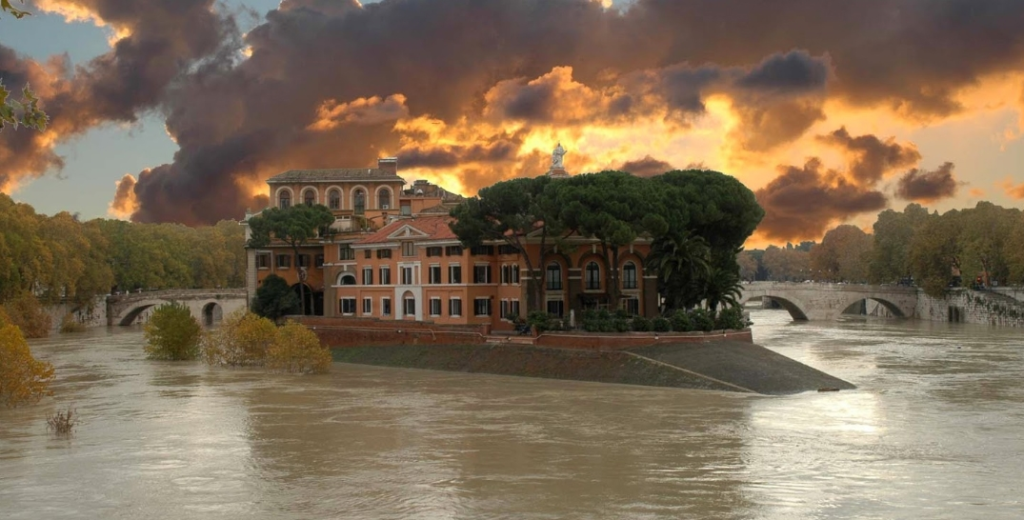
Fate Bene Fratelli Hospital.
Now, for the first time, Fuller endured the multiple terrors of being part of a civilian population under bombardment. French cannons hurled bombs into the midst of the urban population by day and night. “War near at hand seems to me even more dreadful than I had fancied it.”[xv] On Sunday, June 3, the French assaulted the barricades surrounding the city. “The attack began before sunrise and lasted all day. I saw it from my window,” Fuller reported, adding: “The Italians fought like lions.” On June 10, she finished a somber dispatch, opening with a question lede:
What shall I write of Rome in these sad but glorious days? Plain facts are the best; for my feelings I could not find fit words.
For the time being, the French were content to stand off and shell the city into submission, inflicting casualties among civilians as well as among the new recruits and volunteers of the young Republic. Fuller noted the “frightful sacrifices” made across the city, including the reduction of the famed Villa Borghese to rubble. Her hero Mazzini was standing “firm as a rock,” she claimed, then asked: “Yet how long, O Lord, shall the few trample on the many?”[xvi]
On June 21, three weeks into the siege, she filed another dispatch. (Although filled with fresh news, the logistics of trans-Atlantic communication meant that it would not be printed and read in New York for more than a month.) The French bombardment was taking its toll. More and more often, the French bombs would open hole in the city’s defenses, and the Roman militia would rush to the spot, rebuild the barricades, and fire back. Fuller reported the story of one woman in the Trastevere district who saw one of the French bombs land near her. The bomb had a lit fuse, but the woman bravely picked it up and extinguished the fuse before it could cause mayhem. Fuller wrote that her example caught on quickly, and Romans learned to put out the fuses. They gathered the unexploded cannon balls and hauled them to the Roman forces to use against the French.
Fuller was also working almost every day at the hospital, seeing for herself the grisly toll of the bombardment on the bodies of republican soldiers, many of them young students from across Italy who had rallied to Rome’s cause. Many endured gruesome amputations. “One kissed an arm which was cut off,” Fuller reported. She described another soldier who collected the pieces of his own bones being extracted from his wounds, to save as relics. “I suffer to see these temples of the soul thus broken . . . but I would not, for much, have missed seeing it at all,” Fuller wrote in what could be a motto of all war correspondents – from Herodotus to Martha Gellhorn to reporters unborn. They all seem to know or say: war is horrible, but I had to bear witness. In another trope of war reporting that would become a classic, Fuller also reported that the bombs had a terrible beauty. “In the evening ‘tis pretty, though a terror, to see the bombs, fiery meteors, springing from the horizon line upon their bright path to do their wicked message.”
On the night of June 21-22, the bombing reached a crescendo around 2 a.m. “We were all alarmed by a tremendous cannonade. It was the moment when the breach was finally made by which the French entered. . . That was the fatal hour for the city,” Fuller reported in prose that she had now mastered – a vigorous style, using short sentences and active verbs. The result was writing that was vivid, specific, concrete. “Those who were brought into the Hospitals were generally grievously wounded, very commonly subjects for amputation. My heart bled daily more and more at these sights, and I could not feel much for myself, though now the balls and bombs began to fall round me also. The night of the 28th the effect was truly fearful, as they whizzed and burst near me.”[xvii]
On July 1, 1849, the Roman Republic fell.[2]
LEAVING JOURNALISM
In a day, the city became a vast camp of refugees, fugitives, and wounded. The press came under censorship; a curfew was imposed; and the Ossolis were wanted figures. She ventured out for one last survey of the ruin.
I entered the French ground, all hollowed and mapped like a honey-comb. A pair of skeleton legs protruded from the bank of one barricade; lower, a dog had scratched away its light covering from the body of a man, and discovered it lying face upward all dressed; the dog stood gazing on it with an air of stupid amazement.
Afterward, Margaret would no longer go out in public for fear of retribution. But in her latest dispatch, she offered a bold prediction: “The fruits of all this will be the same as elsewhere: temporary repression will sow the seeds of perpetual resistance.” She went swiftly to see the American diplomat Cass and prevailed on him to supply two fake American passports – one for Mazzini and one for Ossoli. On July 8, with more help from Cass, Fuller left Rome in a carriage and headed to Rieti for a reunion with her son. To her horror, she found Nino failing to thrive and near death. She discovered that the hired “wet nurse” had been ordered by her own husband to breastfeed only their child. Nino had been kept alive on a diet of bread soaked in wine. He had lost weight and became alcohol-dependent until his mother showed up, took him back, and supervised his care and feeding. With the help of a new nurse, Nino began to improve.
At the end of August, Fuller wrote a dispatch looking back over those “sad but glorious days” of the Republic. It began with this mournful lede: “To write from Italy is now become a sorrowful business.” (She wrote “Italy” rather than “Rome” because she was hiding out in Rieti.) She accused the French commander of sacking Rome and said his denials were flat lies. “They [French bombs] fell in the Vatican quarter; often on the Quirinal, on the Capital, on the Pincian. I am eye-witness that they did.” She went on to rebut another theme of French propaganda – that they occupied Rome to bring order. Before the occupation, Fuller had felt safe and free in republican Rome.
I, a woman, walked alone at all hours, in all quarters of Rome; I stood alone amid the throng of soldiers and of citizens; I took with me little girls to help me at the hospitals, and their parents thought my protection sufficient; I was at the gates, at the post office, in the nearer quarters of Trastevere, in the Vatican gardens – I never saw an act of violence, was never even jostled in the excitement of the crowd; I do not believe ever people or soldiery showed a finer spirit.
Notably, she could still write long sentences, but now they have energy and clarity. According to Reynolds and Smith, on this same day, Fuller wrote a letter to her mother, telling her that she had both a husband and a son and that they hoped to reach America in the summer.[xviii]
Fuller and Ossoli made their way to Florence, where they settled into a small apartment on the Piazza of Santa Maria Novella. Some speculate that this is when they quietly got married. Nino was gaining weight, and they often took him on strolls along the Arno or to museums. On November 15, she filed a dispatch from Florence, confiding to her readers that the defeat of the republic was hitting her hard.
I have begun to write, yet little do I feel inclined . . . I take long walks into the country, I gaze on the beauty of nature, and seek thus to strengthen myself . . . I look again upon art, and solace myself in its calm. . . .
To find out what happened to Margaret Fuller as she headed back to the United States in 1850 with her son and the boy’s father, the rest of the story will be told in my next book, The Demoratic Art.
[1] Rome in 1848 is the place and time chosen by Willa Cather (chapter 9) for the prologue to her novel Death Comes for the Archbishop, but Cather makes no mention of the political revolution and repression that Fuller saw.
[2] The leader, Garibaldi, departed on July 2 on horseback with four thousand men, trying to evade all the anti-democratic occupying forces in Italy. By August, all were dead, except for Garibaldi and one follower. Garibaldi went into exile in London and New York City. Ten years after fleeing Rome, he returned and achieved his ultimate goal – the unification of Italy. As for Mazzini, he escaped and made his way to England. He remained committed to the cause, but he later broke with Garibaldi over the issue of establishing a monarchy for the newly unified Italy (King Victor Emmanuel II). Mazzini held out for the twin goals of unification and democracy.
[i] More than welcome . . . Greeley’s letter is quoted in Dispatches, p 21.
[ii] Last six weeks . . . See Dispatches, fn p 167.
[iii] eyewitness accounts of Roman events.” Christopher Clark, Revolutionary Spring, (Crown, 2023) p 254.
[iv] For a penetrating history of the continent-wide upheavals, see Clark.
[v] Dispatch 23.
[vi] Dispatch 24.
[vii] Fuller Letters, Vol 5, p 66.
[viii] Often attributed to Philip Graham, the former publisher of The Washington Post.
[ix] Dispatches intro p 28.
[x] Marshall, p 355.
[xi] Dispatches, intro p 26.
[xii] WW quoted in Sad but Glorious Days, 1-2.
[xiii] Dispatch 26.
[xiv] Dispatch 30.
[xv] Dispatch 31.
[xvi] Dispatch 32.
[xvii] Dispatch 34.
[xviii] Dispatches, fn p 316.

 profits above all, for lacking candor at every step of the way.

 Prof Chris Daly's Blog