Tag Archives: journalism

Doris Kearns Goodwin turns to journalism history

By Christopher B. Daly 

In her newest book, presidential historian Doris Kearns Goodwin takes a turn toward the history of journalism. Actually, she is working at the intersection of Presidential History and Journalism History in The Bully Pulpit: TR, Taft and the Golden Age of Journalism. In any case, I am happy to welcome her to the ranks of journalism 9781416547860_custom-cbfa6372bc5fbe63f5a575b089d8f201e92d1c0b-s2-c85historians, and I am always glad to see any professional historian from another specialty stray into journalism’s past.
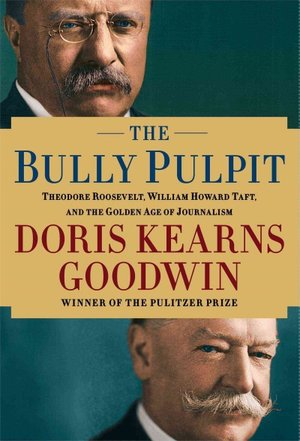
I am also intrigued by her discovery of a “golden age” in the journalism at the turn of the last century. It was certainly a time of great achievement, thanks to the “Muckrakers” who investigated so much wrong-doing, corruption, and squalor. I look forward to reading the book and seeing why she considers that period so wonderful. (Personally, I would nominate the period from about 1968-74: rise of rock journalism/ heyday of “new journalism”/ Pentagon Papers / Watergate. Your nomination?)

Until then, here’s an interview Goodwin did recently with NPR.

One stunning excerpt: Goodwin recounts that the great muckraking journalist Lincoln Steffens decided to examine the performance of the U.S. government. So, Steffens wrote to the head of the outfit — none other than President Theodore Roosevelt.

“Mr. President, I want to investigate corruption in the federal government.”

According to Goodwin, TR’s reply was quite a stunner. He gave Steffens a calling card that he could use in his reporting and present to government officials as needed, which read, in part:

“Please tell Mr. Lincoln Steffens anything whatever about the running of the government that you know (not incompatible with the public interest) and provided only that you tell him the truth.”

Now, that‘s the way to treat a reporter! Just tell the truth.
 

1 Comment

Filed under history, Journalism, journalism history, Politics

David Carr on the media: Content for sale

By Christopher B. Daly 

In his latest weekly column, David Carr identifies a growing trend: the paid creation of “content” (formerly known as stories, pieces, etc.) for clients who want to “tell a story” that also happens to advance their commercial interests. He highlights a leader in this new mutation, a website called Contently, which functions as a kind of dating service for journalists and companies. If you visit

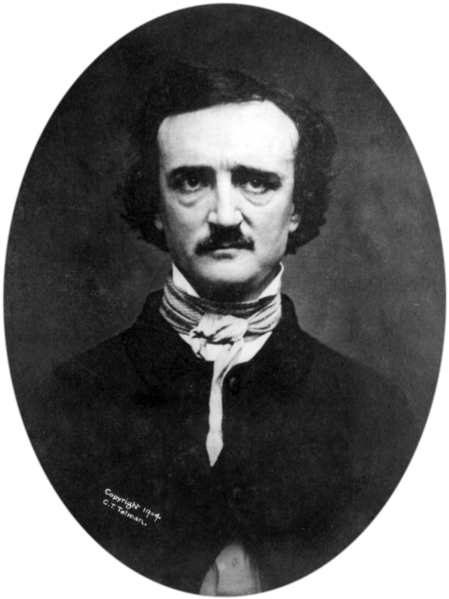
Poe (minus the sunglasses)

Poe (minus the sunglasses)

the homepage, which features a full-screen background image of Edgar Allan Poe in aviator sunglasses, you are invited to proceed through one of two portals: “Journalist” or “Company.” In the “manifesto,” the founders explain their win-win proposition:

Those who tell and promote the best stories—in the best ways—will increase in reputation and trust, fans and influence. Journalists will build their personal brands. Businesses will make a difference. Media companies will thrive.

In writing about this phenomenon, Carr shrewdly sidesteps a category problem: what is this kind of material, exactly?

It’s not journalism, that’s for sure. It’s not journalism because it is not produced by independent people who are working for the good of their audience. They are hired guns working for the good of whoever is paying them.

It’s not P.R., exactly, either, because it appears in disguise — sporting a trenchcoat and a fedora borrowed (or stolen, if you will) from journalism. The reason to look and feel like journalism, of course, is to try to cadge some of journalism’s credibility, to bolster the sales pitch buried in these messages. I suppose it is the inevitable result of an over-supply of writers and the ceaseless demand for material that can fool people into buying stuff.

I am inclined to say “Judge not” when anybody can find a way to get a paycheck into a writer’s hands, but I have to say that I don’t have a good feeling about how this story ends.


1 Comment

Filed under Journalism, journalism history, media, New York Times

JFK shooting: TV news grows up fast

By Christopher B. Daly 

With the approach of the 50th anniversary of that fateful day in Dallas, I thought it might be worth re-visiting my account of the assassination. Here is an excerpt from Covering America that looks at the media response to the shooting:

During the Kennedy presidency, television news became more powerful than ever. In the years since the quiz show scandals of the 1950s, television executives had been atoning by lavishing resources on their news divisions. Television sets were in the vast majority of homes by 1960, and the audience for the TV networks dwarfed that of any newspaper and even the readership of the entire Time-Life empire. The media president, Jack Kennedy, also introduced live television coverage of presidential news conferences and proceeded to thrive in the new forum. Television carried more news than ever, to more people.

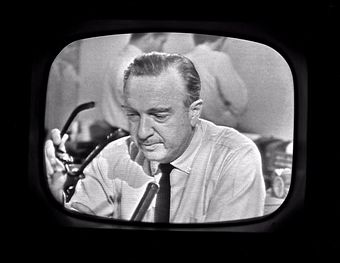
On November 22, 1963, television was the medium by which many Americans first got the news about the shooting. There it was, right on TV. The president and his wife were in a motorcade with Governor John Connally and his wife. Shots rang out, and the president was rushed to the hospital. No word on the shooter’s identity. It may not have been apparent to viewers, but television executives were scrambling to keep up. The networks did not have the equipment and staff needed to “go live” and put news on the air as it was unfolding. Just off camera it was pandemonium, as executives met to decide how to cover a presidential shooting in the new medium. Eventually they reached a consensus: they would stay with the story, without interruptions and without ads, for the duration. So it was that for three or four days the American people did something they had never done before: they stayed home and attended a funeral via television. If they were watching CBS, they saw Walter Cronkite dab at his eye when he announced the bulletin confirming Kennedy’s death. No matter what network they watched, viewers saw Jack Ruby shoot Lee Harvey Oswald; they saw the flag-draped caisson and the riderless horse; and they saw the salute given by the president’s young son. For the first time (and almost the last, as it happened), nearly the entire country had nearly the same experience at the same time.

CBS News anchor Walter Cronkite struggles to keep his composure on-camera as he announces the news of the death of President John F. Kennedy live on the air on November 22, 1963.     —Getty Images.

CBS News anchor Walter Cronkite struggles to keep his composure on-camera as he announces the news of the death of President
John F. Kennedy live on the air on November 22, 1963.
—Getty Images.


In the New York Times, on Monday, November 25, 1963, the front page featured a banner headline across the entire page, stacked three decks deep:

PRESIDENT’S ASSASSIN SHOT TO DEATH

IN JAIL CORRIDOR BY A DALLAS CITIZEN;

GRIEVING THRONGS VIEW KENNEDY BIER

The funeral was planned for later that day. Below the big headline was a photo (from the AP) of Jackie Kennedy and Caroline kneeling next to the president’s flag-draped casket. Underneath was a little single-column story headlined:

JOHNSON AFFIRMS

AIMS IN VIETNAM

Then, this ominous subhead:

Retains Kennedy’s Policy

of Aiding War on Reds


[To read my book, order Covering America from Amazon.]


Leave a comment

Filed under broadcasting, history, Journalism, journalism history, media, New York Times

Long live the obit!

By Christopher B. Daly 

An often under-appreciated journalistic form is the humble obituary, known as the obit. The best kind of obit, when well done, is a kind of snap profile. The subject of the ideal profile is a person you did not know when alive but should have — or whom you now wish you had known before it was too late.

These are not to be confused with paid death notices, which are horribly formulaic. (I know, obits can be formulaic too, but I am not talking about those here.)  A true obituary, by definition, is a story about a dead person written by a journalist. The best ones convey the news about the timing and manner of death, then go on to tell a story about an interesting life.

I wish to celebrate two obits that appear by coincidence today.

In the Boston Globe, Bryan Marquard salutes the late Sam McCracken — a obit-big“character” of the first order. I did not know McCracken despite his many years at Boston University, but now I wish I had.


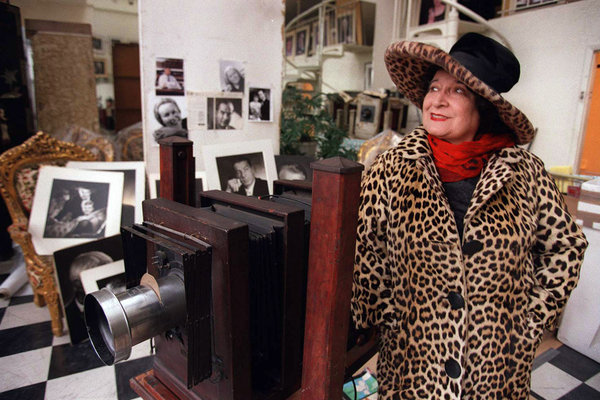
In the New York Times, the redoubtable Robert D. McFadden opens a world — that of the favored few who not only lived in the apartments at Carnegie Hall SHERMAN1-obit-articleLargebut paid almost no rent for the privilege. The occasion is the recent death of another “character,” Editta (cq) Sherman, who made it to age 101.


Either of these obits could have stood on its own as a feature story in either paper. These sorts of efforts renew my faith in the obit, which is under pressure from the hollowing out of newspaper staffs and from the relentless pressure of the Internet. They remind me why we continue to teach our students in journalism schools how to write obits — and why they should want to.

Leave a comment

Filed under Journalism, journalism history, media, New York Times, Uncategorized

Keller v. Greenwald debate: Reporting v. Advocacy

By Christopher B. Daly

Bill Keller, former executive editor of The New York Times and keeper of the flame of traditional reporting, has squared off with Glenn Greenwald, the journalist who disclosed the Snowden leaks and an avatar of advocacy, in a debate over the meaning and future of journalism. Their debate is well worth reading and contemplating. 

Here’s my take: they are actually talking past each other. Each participant represents a different definition of journalism and cannot fathom the other’s values. As I argue in my book, Covering America, they come from competing visions of the essence of journalism, each of which has a long record.

Keller stands squarely for the tradition of responsible, dispassionate, nonpartisan, factual reporting. This was articulated forcefully by Adolph Ochs, the great-grandfather of the current Times publisher, when he bought the Times in 1896. Keller seems to believe that this tradition is the only legitimate one and that all others represent a deformation or corruption of “real” journalism.

Greenwald stands squarely for the tradition of journalism that prizes journalism for its ability to change the world. This is the polemical, analytical, interpretive form of journalism that considers advocacy the essence of journalism. Practitioners like Greenwald often look down on the reporting tradition as a weak, hypocritical, trouble-avoiding compromise.

It may come as a surprise that the advocacy tradition is actually older (much older) than the reporting tradition. In America, the first newspaper launched in 1704, and for more than a century after that, most journalism in America was a fact-free zone of argument and advocacy carried out by the likes of Sam Adams and Tom Paine.

The first full-time reporter in America (the obscure figure George Wisner of the New York Sun– pgs 61-62 in Covering America) wasn’t hired until 1833, and it took decades to establish the idea that the proper contents of a newspaper were value-free “facts” gathered by non-partisan professionals.

Personally, I don’t think one tradition is inherently more virtuous or more valuable than the other. I admire the best in both worlds.


2 Comments

Filed under blogging, history, Journalism, journalism history, media, New York Times, Politics

Who owns the Boston Globe? John Henry does.

By Christopher B. Daly 

No surprise: the deal announced last summer has finally closed. The NYT Co. has sold the Boston Globe (and a bundle of other New England news properties) to the wealthy investor John Henry. The price was $70 million, or 6.3% of the $1.1 billion that the New York Times paid for the Globe 20 years ago.

Henry, who made a fortune in commodity trading, already owns several important sports ventures —

imgresnotably the hometown MLB franchise, the Boston Red Sox. (How the Globe sports department will cover the Sox remains a touchy, unresolved issue that will not go away.)

Henry also owns the Liverpool Football Club, which is ranked third in the English Premier League of the sport we commonly call soccer. Here’s a page of links to Henry-related stories from the British newspaperGooglepluscrest The Guardian. Here’s the comparable page from the Liverpool Echo, consisting mainly of sports stories that say little about Henry.

The reason that I am searching British media for information about Henry is that he is rarely written about here. Although he has been one of the principal owners of the Boston Red Sox for years now, he is still pretty much of an enigma. He shows up in photos at the occasional charity or celebrity event, and his courtship and marriage of Linda Pizzutti (who hails from my hometown — Medford, Mass.) in 2009 produced a portfolio of rather icky photos.

Boston magazine has attempted to cover Henry, and I hope they continue to do so.

The question that awaits an answer is: how will the Globe cover its new owner? This is an inherently awkward (and possibly impossible) assignment for any news organization, since readers will always have to wonder whether any punches were pulled. To report fully and write honestly about the person who signs your paycheck is hard enough; to convince people that you are really telling the whole story means somehow overcoming the apparent conflict of interest involved. It will be a test of the Globe’s independence and its credibility as a journalistic enterprise if it even attempts to cover the new owner.

As for Henry, much remains to be seen. Here are some questions I have:

Will he be an engaged owner?

Will he keep the valuable Brian McGrory as top editor?

Will he endorse political candidates?

Will he stand by the paper’s metered pay system for online access?

Will he order up expanded coverage of English soccer?

Will he tolerate critical coverage of the Red Sox?

Will he sell the land and buildings at Morrissey Boulevard?

Will he sell the printing presses and trucks and take the Globe into a post-print future?

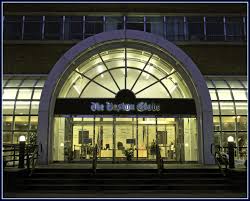
In this photo, what time is it? After sundown, or pre-dawn?

In this photo, what time is it? After sundown, or pre-dawn?

Leave a comment

Filed under business, Journalism, journalism history, New York Times, Red Sox, Uncategorized

To all student journalists: Stay Safe!

By Christopher B. Daly 

Are you a student journalist? Are you being asked to get out of the classroom and “learn by doing” through street reporting?

Are you a journalism professor? Do you send your students out to cover real events?

If so, you should know about a program we are developing in the Journalism Department at Boston University called “Stay Safe.”

Screen Shot 2013-09-20 at 11.01.42 AM


Here’s an introduction, based on a panel discussion we held in September for more than 100 students.

The idea is simple: When the April 2013 Boston Marathon turned in an instant from a feel-good feature story into a violent tragedy, many of us on the Journalism faculty realized that we need to do a better job to train our students in basic safety techniques. Working with veteran correspondents from our own faculty, as well as front-line professional reporters and photographers, we are trying to distill the hard-won experience of covering wars, riots, fires, blizzards, and other forms of mayhem into a set of practical guidelines. Before our students venture out again, we want to make sure they go out there equipped with the “best practices” we can share with them.

Have a look at the video. Still to come: a permanent space on the BU Journalism website with guidelines, training videos, links, and a display of recommended gear for all student journalists.

If you have suggestions, please leave them in the comments here, or email Chris Daly: chrisdaly44@gmail.com.

Thanks. . .  and stay safe!

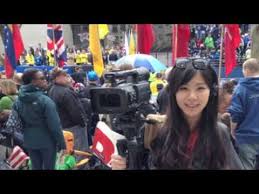
Boston University journalism student Kiva Liu, working near the finish line of the Boston Marathon, moments before two bombs exploded.

Boston University journalism student Kiva Liu, working near the finish line of the Boston Marathon, moments before two bombs exploded. She survived.

1 Comment

Filed under Boston, broadcasting

A history of journalism in two minutes?

By Christopher B. Daly

That’s what the new film “The Fifth Estate” promises in its opening sequence. According to a story in the NYTimes, a specialty production company in Venice, Calif., known as Prologue, has done just that. Since it takes me 15 weeks, lecturing twice a week for 80 minutes at a pop (or, about 2,400 minutes a semester) and I don’t get through all my material, I guess my hat’s off to them.

Can’t wait to see “The Fifth Estate,” which is a dramatization of the story of Wikileaks founder Julian Assange. I better not be at the popcorn stand or in the bathroom when the movie starts, or I could miss the whole history of journalism.

A still from the opening sequence of "The Fifth Estate"

A still from the opening sequence of “The Fifth Estate”

If you’ve seen it, please leave a comment and let us all know what you thought.

Leave a comment

Filed under Journalism, journalism history, Wikileaks

Ted Cruz, meet Ted Geisel (aka, Dr. Seuss)

By Christopher B. Daly 

imgres

When Sen. Ted Cruz conducted his semi-filibuster in the Senate the other day, I wondered if he had any idea who he was quoting when he read from Green Eggs and Ham. Cruz, the conservative Republican from Texas who holds two Ivy League degrees (Princeton and Harvard Law), chose an unexpected author — not because Dr. Seuss wrote what are ostensibly children’s books. But because Dr. Seuss was actually Theodore Geisel, a staunch left-winger.

In the early years of his career, Geisel drew political cartoons for the left-wing daily newspaper PM, which I have written about here. He attacked not only Hitler but also those Americans who wanted to downplay the threat posed by the Nazi dictator.

seuss-5

As Dr. Seuss, the cartoonist went on to write dozens of books that, like the best children’s books, speak to many audiences on several levels. In most of his books, the recurring themes are hardly those favored by the Tea Party, whose support Cruz is seeking. Dr. Seuss emphasized such subversive and radical ideas as tolerance, mutual respect, sharing, not judging people by their appearance, nuclear disarmament, and open-mindedness.

When Cruz was speaking, I hope his followers were listening.


1 Comment

Filed under Uncategorized

Most important media story of the year?

By Christopher B. Daly

this oneIt may well turn out to be , announced with little fanfare a few days ago:

New York Times Company to Pay a 4-Cent Dividend

What that means is that the NYTimes newspaper has become profitable again — so profitable that the folks who run the company feel they have enough cash to pay their stockholders again. Most importantly, that means that the cousins of the current publisher, Arthur Sulzberger Jr., will once again benefit financially from owning the NYT Company. For the past five years, that has been a losing proposition for them. The value of their shares of stock crashed, and the stock stopped paying a dividend.

Cousin Arthur has been in the same boat. But in his case, he at least has the fun and challenge of trying to run the world’s greatest news operation every day. The others, who are mostly not involved with the paper, had to just sit and wait. How long they would be content to do so was a question of some urgency for those who care about the Times.  

imgres

Leave a comment

Filed under Uncategorized