Tag Archives: journalism history

Titanic’s role in journalism

By Chris Daly 

On the eve of the centennial of the sinking of the Titanic, I am posting an excerpt from my new book, Covering America, about the impact of the Titanic on the emerging field of “wireless telegraphy.”

First, here is an image of a wireless distress signal sent that night from the Titanic to the Marconi company.

Telegram from the Titanic: "require assistance. . . struck iceberg"
(Courtesy: Museum of the History of Science, Oxford)

From Covering America: A Narrative History of Nation’s Journalism, chap 7:

In the decades following its invention, the telegraph became a fact of life and an indispensable tool in business, in the military, and in journalism. Still, it had some drawbacks: it could carry a message, but the contents had to be sent in code; messages could be sent only from one point to another, and those two points had to be connected by a copper wire. For these reasons among others, the telegraph was not a popular means of communication but remained a special tool used mainly by businesses.42 In the late nineteenth century, a flurry of scientific and engineering breakthroughs started to overcome those limitations. In 1876 a Boston University professor named Alexander Graham Bell invented a machine, the telephone, which allowed the human voice to be carried over a wire. Nikola Tesla, a Serbian immigrant to America and the inventor of the alternating-current electric motor, contributed the idea that electromagnetic waves could carry messages. Soon it was proven that such waves could pass through walls. They could scale mountains, even cross the ocean. This created the promise of an amazing possibility: a telegraph without wires! A young Italian, Guglielmo Marconi, became a pioneer in the new field, devoting himself to working on a way to use radio waves to transmit signals carrying Morse code.43 Marconi had the resources to tinker with the idea; his mother was an heir to the Jameson family Irish whisky fortune. Rebuffed at home, Marconi went to England, where he formed the Wireless Telegraph Signal Company in 1897, to be followed by an American division of British Marconi a few years later. In 1901, Marconi even managed to send a wireless signal across the Atlantic Ocean, but he struggled to find a business model for his invention. The early applications of the new technology were in the military and in the shipping business, where the ability to send messages without wires had an obvious appeal. At first the technology was referred to as wireless telegraphy, or simply “wireless,” but a new term—radio—first popularized in the U.S. Navy, soon won out. In 1906 an American inventor named Reginald Fessenden demonstrated that radio signals could transmit more than just long and short pulses. They could carry music and even the human voice. In the end, that discovery proved indispensable for making radio a truly popular medium. One of the first big tests of radio, one that made a lasting impact on the public imagination, came in 1912, when the world’s greatest luxury ocean liner, the state-of-the-art Titanic, made its initial voyage from England to New York.44 As the great ship crossed the North Atlantic on April 14, it struck an iceberg, and the crew immediately used the ship’s wireless equipment to call for help. Some of the other ships in the vicinity had wireless equipment that was turned on and monitored at all times; others had turned their sets off for the night. As a result, Copyright 2012 NOT FOR SALE [ 204 ] CHAPTER 7 the closest ship, the Californian, which could have saved all of the Titanic’s 1,522 passengers, lay at anchor just nineteen miles away and never responded. The Carpathia, which was fifty-eight miles away when the Titanic started sinking, took two hours to arrive, and by then, many passengers had drowned in the frigid waters of the North Atlantic. Rescue efforts were also hampered by the many amateur radio operators who filled the airwaves that night with rumors, questions, and interference from their overlapping signals. In the aftermath of the Titanic disaster, the U.S. Congress quickly adopted legislation requiring that all American oceangoing ships and all those entering U.S. ports be equipped with radios, and that the radios be kept on and staffed at all times. Congress also required radio operators to get a license from the U.S. Department of Commerce, and it relegated amateur operators to the bottom of the radio spectrum (the shortwave end) while giving priority to the navy and to commercial companies like Marconi’s.45 Significantly, Congress chose not to follow the European model, in which new technologies including telegraph, telephone, and radio were successively grafted onto a government monopoly such as the postal service, resulting in public communication monopolies like the BBC. In the United States, Congress operated on the principle that radio would be a private enterprise—regulated, to be sure, but private nonetheless. In retrospect, this was one of the constitutive moments shaping the eventual architecture of broadcasting in America, combining elements of technology, law, and economics into a new model.46 On the night of the Titanic disaster, one of the radio operators in New York handling reports of the sinking was a young man named David Sarnoff. (He was not the only one, as he often claimed.) A Russian immigrant who never made it past the eighth grade, Sarnoff would become one of the titans of broadcasting in the twentieth century as president of RCA, the Radio Corporation of America.47 While working for Marconi, Sarnoff demonstrated great foresight. In 1915, when he was just twenty-four years old, Sarnoff wrote a memo to his boss, giving his thoughts on the business. He envisioned a future for radio that went far beyond transmitting coded messages from point to point. “I have in mind,” he wrote, “a plan of development which would make radio a ‘household utility’ in the same sense as the piano or the phonograph. The idea is to bring music into the home by wireless. . . . The same principle can be extended to numerous other fields as, for example, receiving lectures at home which can be made perfectly audible; also, events of national importance can be simultaneously announced and received.”48 Sarnoff projected a market of 15 million American families. The Marconi company did not think much of Sarnoff’s scheme, but Sarnoff clung to the idea that radios could be a popular mass commodity, provided they became easier to use. Never much of engineer, Sarnoff was already showing his true talent: marketing. He switched to management. While Sarnoff and others were pondering the future of radio, most Americans Copyright 2012 NOT FOR SALE Jazz Age Journa lism, 1920–1929 [ 205 ] still had never heard a radio broadcast. A few license-holders were beginning to transmit signals through the airwaves (or into “the ether,” as it was called), where they could be heard by anyone with a receiving set. But hardly anyone had one yet. A few corporations, such as United Fruit, were using radio to coordinate their shipping fleets. And of course the army and navy remained deeply involved in radio. But before about 1920, radio remained largely in the hands of the amateurs— most of them young men who were inclined to tinker. Those early adapters usually built their own radio sets. They set up friendly competitions to see who could pull in the faintest or most distant signal (which they called “DXing”). They often traded information and parts in a wave of enthusiasm that had nothing to do with patents, profits, or licenses. Participants in the new movement sometimes referred to what they were doing as “citizen radio.”49 An editorial in one of the first radio journals put it this way: “Do you realize that our radio provides about the only way by which an individual can communicate intelligence to another beyond the sound of his own voice without paying tribute to a government or a commercial interest?”50 Soon others joined in—women as well as men, universities, stores, even the famous Dr. Brinkley of Kansas, who used radio to promote his theory that implanting goat glands would cure “male trouble.” Radio was wide open— diverse, local, nonprofit, and utterly unpredictable. But not for long. World War I transformed radio, as it did so many other institutions.

Leave a comment

Filed under broadcasting, Journalism, journalism history

“Covering America” reviewed

By Chris Daly

Delighted to see this review just out from Publisher’s Weekly.

Covering America: A Narrative History of a Nation’s Journalism.
Christopher B. Daly. Univ. of Massachusetts, $49.95 (544 p) ISBN 978-1-55849-911-9

In this scholarly yet readable volume, Daly (Like a Family: The Making of a Southern Cotton Mill World), a professor of history and journalism at Boston University, presents a surprisingly spirited and detailed account of American journalism and the many ways in which the press has impacted the trajectory of American history, and vice versa. Beginning in the early 1700s with the institution of a postal service and continuing through the advent of the Internet and its implications for the “dinosaurs” of big media, the book is full of colorful portraits of American media icons such as Benjamin Franklin and late New York Times reporter David Halberstam. Any history book runs the risk of being bland, but Daly peppers the text with amusing anecdotes and intriguing facts (e.g., the idea for the first journalism courses, offered at Washington & Lee University, came from defeated Confederate General Robert E. Lee). Daly divides the major time periods in American journalism into five categories: politicization (1704-1832), commercialization (1833-1900), professionalization (1900-1974), conglomeration (1965-1995), and digitization (1995-present). These divisions make the narrative easy to follow for both students of journalism and casual enthusiasts. In addition to the interesting stories, Daly makes many cogent arguments about what the press has meant to the country’s shared history and identity. Illus.

Reviewed on: 04/09/2012
If you’ve read it, please leave a comment of your own. If you haven’t, get off-line, pick it up, and read!


Leave a comment

Filed under history, Journalism

Narrative in journalism’s history

NARRATIVE 

IN THE HISTORY OF

AMERICAN JOURNALISM

BY CHRIS DALY

[Narrative Arc conference, Boston University, March 24, 2012]

I am delighted to speak briefly today about my new book, which is a narrative itself that focuses on the history of journalism in America. It’s called Covering America, and I conceived of it as a narrative from the get-go. That is, the book is a 300-year history of a major institution with a through-story that follows a thread of innovation.

Before writing this book, I had spent 20+ years in the news business, at the AP and at the Washington Post — most of that time banging out bulletins or day stories or updates. So I was ready to try a different mode.

Funny thing: this book took so long to write that there is something of a narrative about the writing process. When I started working on it eight years ago, the news media were still fat and happy and arrogant.  And I thought my narrative arc would end in a critical denunciation of Big Media.

Then, the bottom fell out. For years, Romenesko brought us nothing but news of layoffs and bankruptcies. So, I needed a new ending. For a while, it looked like I might be writing journalism’s obituary.

But then, things started to shift again, in really interesting new ways – all kinds of experiments, new models, new heroes– well, let me just say that it’s covered in the last chapter.

So what did I learn about narrative?

I learned that narrative in American journalism is not a johnny-come-lately, and not a fad. In fact, narrative was right there at the founding.

Here’s an image from the Boston News-Letter of 1704 – the first edition of the first successful newspaper in the New World.

It contains – a narrative! It is a narrative about a certain Captain Toungrello, a pirate who was marauding off Curacao in the Caribbean, then made his way as far north as Rhode Island.  It’s a great story, told in my book.

And narrative remained a persistent feature. For many, many decades, American newspapers were more likely to carry what we might call an account than a report. By account I mean – usually – a first-person narrative: I went here and saw this.

It’s only well into the 19th century that we start to see the emergence of the report (or the reported story) – the dispassionate, impersonal organized by importance rather than chronology – usually devoid of  personality, wit, attitude and drama.

But all along, narrative persisted. In newspapers, magazines, and books.

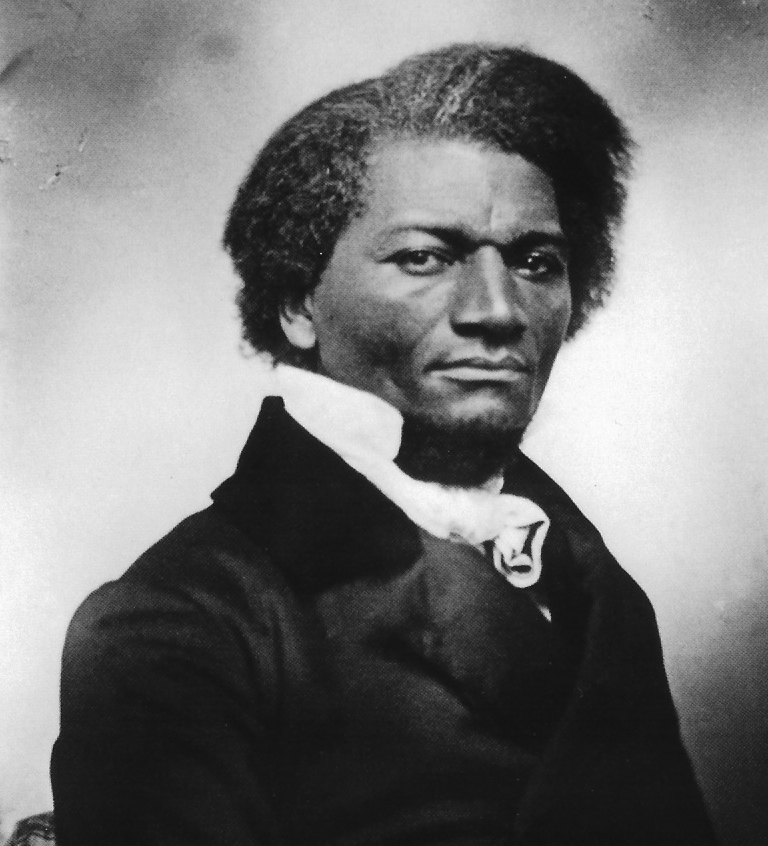
You can see it in Frederick Douglass’ great narrative and in other slave narratives.

Here is his opening, published in 1845.

I was born in Tuckahoe, near Hillsborough, and about twelve miles from Easton, in Talbot county, Maryland. I have no accurate knowledge of my age, never having seen any authentic record containing it. By far the larger part of the slaves know as little of their ages as horses know of theirs, and it is the wish of most masters within my knowledge to keep their slaves thus ignorant. I do not remember to have ever met a slave who could tell of his birthday. They seldom come nearer to it than planting-time, harvest- time, cherry-time, spring-time, or fall-time. . .

My mother was named Harriet Bailey. She was the daughter of Isaac and Betsey Bailey, both colored, and quite dark. My mother was of a darker complexion than either my grandmother or grandfather. . . .

I never saw my mother, to know her as such, more than four or five times in my life; and each of these times was very short in duration, and at night. She was hired by a Mr. Stewart, who lived about twelve miles from my home.

Right there, you can see Douglass grabbing narrative as his tool to tell the world about himself: I was born. . . Then, we can see him link his own story to his people’s story. All in the first three sentences.

You can see narrative again  in Nellie Bly’s great work in the 1880s – her  “Ten Days in a Madhouse”  One of the first undercover exposes.

Or her “Around the World in 72 Days.”

Here’s her very shrewd opening to “72 Days”, published in 1890:

WHAT gave me the idea?

It is sometimes difficult to tell exactly what gives birth to an idea. Ideas are the chief stock in trade of newspaper writers and generally they are the scarcest stock in market, but they do come occasionally,

This idea came to me one Sunday. I had spent a greater part of the day and half the night vainly trying to fasten on some idea for a newspaper article. It was my custom to think up ideas on Sunday and lay them before my editor for his approval or disapproval on Monday. But ideas did not come that day and three o’clock in the morning found me weary and with an aching head tossing about in my bed. At last tired and provoked at my slowness in finding a subject, something for the week’s work, I thought fretfully:

“I wish I was at the other end of the earth!”

“And why not?” the thought came: “I need a vacation; why not take a trip around the world?”

It is easy to see how one thought followed another. The idea of a trip around the world pleased me and I added: “If I could do it as quickly as Phileas Fogg did, I should go.”

There, she is setting the hook. Most readers – most people in America – would have known how this story turns out. The fact that she made the trip was covered obsessively by her own paper, Pulitzer’s New York World. So, what’s left? The narrative that focuses on how. Yes, we know the ending, but this narrative is going to give us something else.

You can see narrative again and again. There it is in the rise of photojournalism: in

LIFE (founded, 1936), which pioneered the photo  essay. Many of those photo essays were often conceived and executed in a narrative mode.


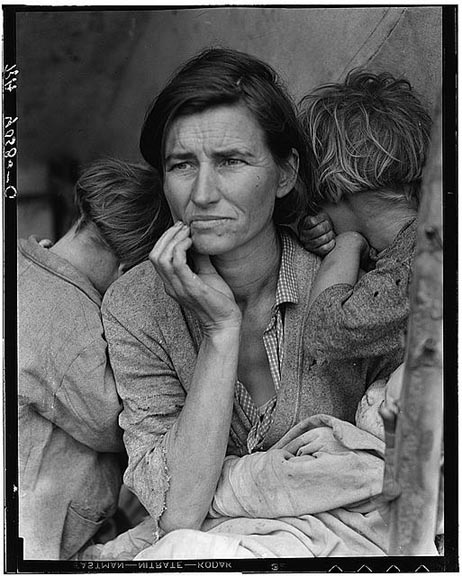
We see narrative again in the FSA photos, telling a narrative about desolation and dislocation. Here’s a rare photo: it shows the photojournalist Dorothea Lange – looking jaunty in her sneakers atop her old woody.


And here’s her classic photo titled Migrant Mother. Although it’s a still image, it certainly tells a story. A tale of dislocation, of loss, of movement.


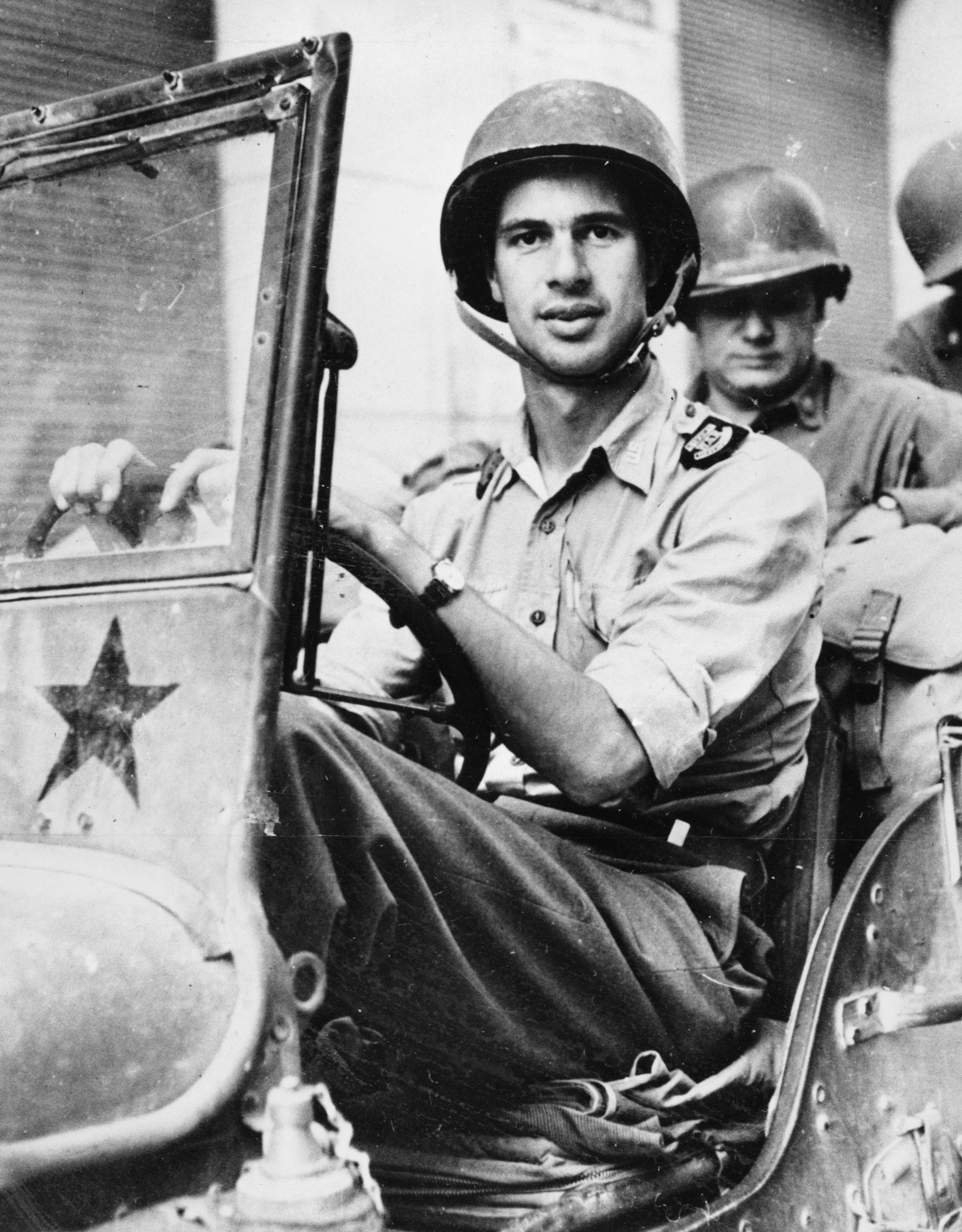
DURING WORLD WAR II , narrative came roaring back. Journalists, in search of powerful storytelling modes for the unbearable stories they had to tell. Just to take a few examples:

–Ernie Pyle’s “The Death of Captain Waskow

–Marguerite Higgins on the liberation of the Dachau concentration camp in April 1945.

–William Laurence on the dropping of the A-bomb on Nagasaki.

And of course, the master: John Hersey.

His Hiroshima, considered a masterpiece of 20th C journalism, has an extraordinarily tight narrative focus:

At exactly fifteen minutes past eight in the morning, on August 6, 1945, Japanese time, at the moment when the atomic bomb flashed above Hiroshima, Miss Toshiki Sasaki, a clerk in the personnel department of the East Asia Tin Works, had just sat down and her place in the plant office and was turning her head to speak to the girl at the next desk. . .

I would argue that Hersey is the key figure here, the one who connects this great tradition to the New Journalists, who in turn have a lot to do with the current resurgence of narrative.


So, today, as we talk about narrative, as we create our own new narratives, as we think about the future of narrative, I would say we are seeing a rebirth. We are seeing the explosion of narrative as a storytelling mode across all platforms.

I would argue that we are even beginning to see the classic news report – the inverted pyramid, the “news from nowhere” — with its flattening of affect and its shattering of time – we are starting to see that as a historical artifact. It is not inevitable, it is not superior, it is not even adequate for so many purposes.

So, here’s my bias: I want all of us to know this history, to claim this legacy. Many of us here today are exploring the outer limits of narrative – across different platforms, lengths, and topics.

And even as we do that work, we should know that we are heirs to a great tradition. That is the legacy that I tried to find, open up, and share in my book, “Covering America.” As I wrote it, I felt so proud of that long line of journalists who had done such wonderful work and so humble in their presence.

–30–

2 Comments

Filed under Journalism, journalism history

A great experiment

by Chris Daly 

For years, I had heard about a newspaper that once existed in New York City that carried no advertising.

How could this be? I wondered.

Years later, I had the chance to explore the history of that newspaper, which was called PM. For eight madcap years during the 1940s, PM defied many of the assumptions about the news media and offered New Yorkers a daily paper that was smart, funny, and avowedly left-wing.

As it turned out, the paper’s founding editor was Ralph Ingersoll — one of the most important journalists of the 20th Century whom no one has ever heard of. To my great good fortune, it also turned out that Ingersoll decided to donate all his papers to Boston University. That’s where I caught up with them and discovered that Ingersoll was a great keeper of records and a serial drafter of his own memoir.

The result is an article that I wrote for the Columbia Journalism Review, which posted it to the CJR website today. Enjoy.

(BTW: In the CJR piece, I did not write the headline!)

1 Comment

Filed under Journalism, journalism history, publishing, Uncategorized

Book recommendation

By Chris Daly

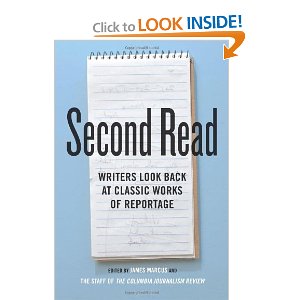
I just finished a book that surprised me — Second Read: Writers Look Back at Classic Works of Reportage.


I found it surprising because when I first picked it up, I thought it would be yet another anthology of great works of journalism, perhaps with brief headnotes introducing each one. Instead, this is a collection of well-considered essays by contemporary writers about some of the great works in the history of (mainly American) journalism. The overall editor is James Marcus of Columbia’s J-School, and he drew on the faculty and the masthead of CJR  for most of the entries.

A few of these essays pointed me to works that I have never read and now want to catch up with (DeFoe’s “A Journal of the Plague Year,” Paul Gallico’s “Farewell to Sport,” Cornelius Ryan’s “The Longest Day”).

Others were meditations on familiar works that made them fresh again (Evan Cornog on Liebling’s “Ear of Louisiana,” Scott Sherman on Frady’s “Wallace,” David Ulian on Didion’s “Slouching Toward Bethlehem”).

My only regret is that this book does not include the originals — or at least significant excerpts — that are being celebrated. I am sure a publisher can explain why this book can make a little money at 184 pages and would lose a fortune at 1,840 pages. Oh, well. Off to the library to hunt down the originals.

If you have any interest in journalism history or “literary journalism,” don’t missSecond Read.


Leave a comment

Filed under Journalism, journalism history, media

Are Journalists Always Wrong?

That’s a question I raised in the following article, which was published today in a British academic journal called Journalism Practice. I am posting it here so you don’t have to pay $35 to read it. I had to reformat in in Word, so I apologize if I missed anything:


ARE JOURNALISTS ALWAYS WRONG? 

And are historians always right?


Christopher B. Daly


[This piece focuses on a seminar which is currently taught at Boston University which draws on the insights of a conference held at the same university in autumn 2009. The conference brought together leading historians and journalists to explore the ground shared by the disciplines and, it is fair to say, sometimes divides them. The article argues that there is much need for an approach which draws on the strengths of both traditions while remaining aware of the shortcomings of each discipline. Drawing on debates within the historiography of both journalism history and mainstream history, it demonstrates the intellectual underpinning of the seminar which aims to point students to a wider array of the challenges, successes and reversals experienced by journalists and historians. It hopes to provide a method of investigating core questions about the journalism of the past in order to better inform the practice of journalism in the future. Furthermore, it extends this ambition to providing a collegial model for the exploration of other societies or periods of time which can be adapted at other universities.]


KEYWORDSerror; historiography; history; interdisciplinarity; journalism history


Introduction: Are Journalists Always Wrong?

That is a question that I raise, only half in jest, in a new seminar being offered at Boston University. The seminar represents the fruits of a conference held on our campus in the fall of 2009 in which we brought together panels of accomplished journalists and historians to explore common ground. Much of the discussion focused on shared concerns involving research and writing, since both fields involve the creation of non-fiction texts for an audience of some size.

Part of our discussion extended to teaching. I pursued that discussion with my colleague Bruce Schulman, who is a historian, an Americanist, and chair of the Boston University History Department. The two of us*one a former journalist and current professor of journalism, the other a prominent historian*began to zero in on the question of what happens when journalists ‘‘cover’’ an event or issue, then move on, leaving the field to later waves or generations of historians. We wanted to know what drove the process of historical revision. (We also wanted to know whether any students shared our interests, and we were not sure through the many months of planning.) Eventually, we decided to examine about a dozen major events in US history. First, we looked at each one through the lens of the journalists of the period, those reporters who wrote what has been called ‘‘the first rough draft of history’’ (Shafer, 2010). Next, we looked at those same events through the lenses of the historians who followed and wrote the subsequent drafts.

We decided that this might make for a lively course.


The Institutional Context

At Boston University, the president and provost have embarked on a campaign to encourage interdisciplinary efforts of all kinds. So, based on our joint interest in the issues and on our school’s manifest support for inter-disciplinary work, we launched the course for the Fall semester of 2010. Hoping to encourage discussion, we organized it as a seminar, with a target enrollment of 20 students. We allocated 10 seats to the Journalism Department and 10 to the History Department, and we hoped to get a mix of graduate students and advanced undergraduates. In the end, we came very close to those targets.

In the readings we have used and in the discussions in class, we have found a familiar dynamic: journalists report some version of the facts, and then after a few years, historians take charge and set about working over the ground already covered by journalists. Often, after the passage of decades, the original version is hardly recognizable.


A Version of History in the Press

One case in point, among several, involved the war fought in 1898 between the United States and Spain. The first version of this historical episode, now largely discredited by scholars, was written by the newspapers themselves. The headliners in this tale were Joseph Pulitzer, publisher of the New York World, and William Randolph Hearst, his arch- rival and publisher of the New York Journal. Their newspapers were initially credited–and blamed–for fomenting the war. By the late 1890s, the two publishers were locked in a furious circulation war, throwing all their ingenuity and resources into devising more and more dramatic, shocking, and scandalous headlines, culminating in a set of practices known as ‘‘Yellow Journalism’’ (Campbell, 2001; Hamilton, 2009).

The publishers’ eagerness for war is best illustrated in the year or two preceding the official declaration of war by the United States. Hearst and Pulitzer both sent correspondents to Cuba, literally looking for trouble, which they readily found (Lubow, 1992). Correspondents described the brutal treatment of Cubans by their colonial occupiers, including the use of ‘‘concentration camps’’ to round up and subdue Cubans.

In the summer of 1897, a story unfolded that met the publishers’ needs exactly. A young woman named Evangelina Cisneros (invariably described as ‘‘raven-haired’’), the daughter of a jailed Cuban rebel, was thrown into prison in Havana, on the grounds that she had dared to defend her honor against a rapacious Spanish colonel. Hearst’s Journal editorially demanded her release–in headlines, news stories, line drawings, and editorials. Hearst personally led a campaign for her release, ordering his correspondents around the United States to call on prominent women to sign a petition to be sent to the Queen Regent of Spain.

From Hearst’s point of view, the Cisneros story became more appealing when the Spanish refused to release the young woman. The editor dispatched a reporter named Karl Decker to Cuba, equipped with bribe money, and Decker managed to help the damsel escape to New York, where she could be feted and displayed. That allowed the Journal to crow, in decks of headlines arrayed as an inverted pyramid:


MISS EVANGELINA CISNEROS RESCUED BY THE JOURNAL.

An American Newspaper Accomplishes at a Single

Stroke What the Best Efforts of Diplomacy

Failed Utterly to Bring About in

Many Months.


Similarly, when a ‘‘visiting’’ US battleship, the USS Maine, blew up in Havana Harbor on February 15, 1898, both of the Yellow papers jumped to the conclusion that the deed was the fault of Spanish saboteurs. Even over the objections of the ship’s captain, Pulitzer and Hearst presented the sinking of the Maine as a work of Spanish perfidy and called for the United States to retaliate. Just over two months later, the United States declared war on Spain.

According to the newspapers themselves, the cause of the war was their own coverage of Spanish abuses. In the first draft of this history, the Yellow papers rushed to take credit. A few days after the declaration of war, Hearst’s paper even ran the following gloating headline:


HOW DO YOU LIKE THE JOURNAL’S WAR? 

(New York Journal, May 1, 1989, p. 1)


For decades, that view prevailed. As late as 1947, it was at the heart of the analysis of the war presented by Stanford University historian Thomas A. Bailey in the chapter about 1898 in his book, A Diplomatic History of the American People, long a standard work. But by the 1960s, that interpretation was coming under attack. One milestone was the publication of the work of the Cornell University historian Walter LaFeber, who argued for an economic interpretation of the motives of US policy-makers in his 1963 study, The New Empire: An Interpretation of American Expansion, 1860-1898. Yet another approach emerged in the 1990s from the ‘‘culture studies’’ movement when Kristin L. Hoganson published her study of the war of 1898 titled Fighting for American Manhood: how gender politics provoked the Spanish􏰀American and Philippine􏰀American wars. She attributed the war mainly to the perception among that generation of American men of a need to assert their masculinity by going to war. In the later tellings, the activities of the Yellow Press fade or disappear altogether. In this episode, as in many others, the pattern is clear: journalists present one version of events, only to see that draft corrected, revised, or reinterpreted by historians.

Thus, the question persists: Are journalists always wrong?


Are Journalists Always Wrong?

In one, perhaps trivial, sense, the answer is obviously, No. Collectively, journalists gather, check, and disseminate vast amounts of information, ranging from the week’s menu in the local school cafeteria, to the closing price of a share of stock, to the outcome of a football game, and on to topics that are more complicated and even interpretive. If one measure of the ‘‘rightness’’ of journalists is factual accuracy, then it must be acknowledged that most of the material in most news stories is right, at least in the sense that it is ‘‘not wrong.’’ Most stories, after all, are never corrected because the factual material contained in them was accurate to begin with. They stand un-corrected.

Moreover, there is another sense in which journalists are ‘‘not wrong.’’ That is, an old newspaper or news broadcast (like almost any text) can be used by a skillful historian as a source of inadvertent testimony about all sorts of things. Most journalists do not set out to provide a window into the workings of their society for the benefit of historians who will come along hundreds of years later. Yet, their work can serve that very purpose. For example, any historian who reads newspapers from the eighteenth or nineteenth century quickly realizes that even if the newspapers are inaccurate about this or that detail, they are unerring in their power to reflect the zeitgeist of their era.


Historians of the Press

As several leading historians have emphasized, newspapers reflect their societies even as they shape them. David Paul Nord (2001) has argued that early newspapers played a key role in building communities by giving readers common materials to reflect on. Michael Schudson has shown how newspapers embodied the competitive, commercial spirit of the nineteenth century, until a cultural shift sent many editors in search of a more professional mode in the twentieth century (Schudson, 1978). And James Carey, in defining the social role of newspapers in history, identified them as carriers of ‘‘consciousness in the past’’*as opposed to contemporary historians, who one would expect to have a consciousness of the past (1974, emphasis added). ‘‘When we study changes in journalism over time, we are grasping a significant portion of the changes that have taken place in modern consciousness since the Enlightenment,’’ Carey wrote in a landmark essay.

Indeed, in this sense, journalists cannot be wrong. Readers who skim just a few old stories can quickly see answers not only to the question of what happened on a given day but also to questions the journalist was not asking himself or herself:


  • .What does this society consider important enough to write about and pay for? In the early eighteenth-century newspapers, there is evidence that the topics people would pay to read about included piracy in the Atlantic trading world and legislative proclamations. A century later, news of the captures of runaway slaves swelled in frequency and in poignancy.
  • .How does the journalist conceive of the basic work product called a story? Early newspapers in America were often discursive, and even epistolary. Later, they became more partisan and eventually more dispassionate and ‘‘professional.’’
  • .What attitudes are prevalent about topics like race, class, gender? Some subjects, of course, remain so taboo that they never appear in the ‘‘public prints.’’
  • .What is the quality of the ‘‘public sphere’’ created by the uncoordinated actions of hundreds or thousands of journalists, each following his or her own lights?


These are subjects that every journalist ‘‘testifies’’ about through the work itself, even if the journalist never self-consciously tries to penetrate or analyze the surrounding society. This is one reason why many historians, especially social historians, are so intent on finding newspapers from the era they are studying and so happy when they find them. Wittingly or not, journalists always provide material that reflects something about their era.

More common, though, are those instances where journalists are wrong in a significant sense. One category of significant journalistic error involves information that has been suppressed. The history of the Cold War, for example, is rife with instances where one or more governments deliberately withheld information for years. The gradual release of Soviet archives and the sporadic revelations of programs like the Venona Project (Haynes and Klehr, 2000) have given historians access to documents that while sometimes problematic, were not even available to journalists of the 1940s and 1950s. Journalists cannot be blamed for failing to report secrets, but their work in such an area is still incomplete and therefore misleading.


The Russian Revolution: Reassessment of Journalism’s Role

Another category of journalistic error involves a more serious failure by journalists themselves–the sin of omission. A dramatic case that we examine in our course involves coverage of the Allied invasion of the new Soviet Union almost 100 years ago. In a little- known but far-reaching episode, US and British leaders decided to invade Russia–their recent ally in the Great War–in 1918 and stayed for almost two years (Knightley, 2004 [1975]). Few Americans ever heard of this mission, nor did they ever find much useful information about Russia in their newspapers during the war and for many years afterward. During the fateful convulsions of the Russian Revolution and its immediate aftermath, American journalists failed their readers–with few exceptions, miserably. Most simply failed to show up; most of the rest willfully misinterpreted the things they saw and heard.

Initially, czarist Russia had been a participant in the Great War, fighting against Germany from the start in 1914. As the war dragged on, however, Russian sentiment turned against the Czar, the entire Romanov family, and the war. In the spring of 1917, the Czar was overthrown, and that fall the Bolsheviks (led by Lenin and Trotsky) toppled the new government and began installing the Communist dictatorship. In the spring of 1918, the new Soviet government in Moscow negotiated a separate peace with Germany, based on the communist view that the war was a brawl among capitalist powers.

American publishers–successful capitalists themselves, for the most part–did not generally consider the Russian Revolution a big enough story to bother covering. As a result, their papers did little to inform Americans about the new society forming in the old Russia–neither the idealism of some of its followers nor the brutality of most of its leaders. The coverage only worsened in the following months. When the Soviets dropped out of the war on February 12, 1918, American newspapers denounced the move as a double-cross to the Allies (who would now have to bear the full brunt of the German military machine on the Western Front), and some went so far as to suspect that the Bolsheviki were really German agents. Aside from the young American John Reed, the correspondent for the socialist magazine The Masses and author of the classic book Ten Days that Shook the World, there were almost no American correspondents present in Russia to do any first-hand reporting (Reed, 1919). In their absence, American papers felt free to run stories predicting the Communists’ imminent demise.

On the whole, the reporting in America about the Russian Revolution and the Allied expedition was so deplorable that it prompted a remarkable study by two young journalists the following year. They epitomized the drive to professionalize American journalism that was then gaining ground in the United States in the new university-level journalism programs at Missouri and Columbia, in the fledgling professional organizations like Sigma Delta Chi (which became the Society of Professional Journalists), and in the emerging trade press. The leaders of this movement, usually well-educated and ambitious young journalists, were dissatisfied with the field’s raffish and blue-collar milieu; they wanted to set standards and measure performance. Among them were two of the most ambitious of the new professional journalists, both working at a remarkable young magazine of progressive outlook called The New Republic. One of the authors was Charles Merz, a Yale University graduate who later worked as a reporter at the New York World, then became the influential editor of the New York Times editorial page during World War II and the Cold War. The other author was Walter Lippmann, a Harvard University graduate who went on to become the most prominent and respected US journalist of the middle twentieth century, the country’s unofficial foreign minister, a prolific author, and a syndicated whirlwind (Daly, forthcoming, chap 8). In August 1920, they teamed up on an impressive pioneering work of journalism criticism, which appeared as a supplement to The New Republic headlined ‘‘A Test of the News’’ (The New Republic, August 4, 1920).1

Lippmann and Merz conducted a comprehensive analysis of the coverage of Russia from the news pages of the New York Times, looking at more than 3000 news stories from March 1917 to March 1920. By design, they ignored the newspaper’s editorials and focused exclusively on what should have been factual news accounts. They asked a very simple question: in light of the already known facts, how reliable had the reporting been just a few years earlier? From a reader’s point of view, how factual and useful was it? In their judgment, the coverage was almost ludicrously bad.

To illustrate their point, the authors cited case after case where the Times correspondents were fanciful at best or deluded at worst. ‘‘News reports in 1917, 1918, 1919, and early 1920 that the Soviets are about to collapse, or have collapsed, or will collapse within a few weeks is false news,’’ they pointed out, at a time when the regime was consolidating the power that would endure for most of the century. In the 24 months between November 1917 and November 1919, Lippmann and Merz documented 91 occasions when the Times news pages ‘‘stated that the Soviets were nearing their rope’s end, or had actually reached it’’ (The New Republic, August 4, 1920, p. 10).

Four times Lenin and Trotzky were planning flight. Three times they had already fled. Five times the Soviets were ‘‘tottering.’’ Three times their fall was ‘‘imminent.’’ Once, desertions in the Red army had reached proportions alarming to the government. Twice Lenin planned retirement; once he had been killed; and three times he was thrown in prison (The New Republic, August 4, 1920, pp. 10􏰀11).

Such coverage, which borders on farce, would have been hilariously bad but for one fact: the treatment of Russia by the Wilson administration during this period and the coverage of Russia by American newspapers affected relations between both peoples and their governments for the next 75 years or so. Again and again, the coverage in the Times featured wild speculation, blatant wishful thinking, and unsourced diplo-military mumbo- jumbo. In the end, Lippman and Merz concluded the typical US correspondent in Russia was about as useful as ‘‘an astrologer or an alchemist’’ (The New Republic, August 4, 1920, p. 42).

At root, Lippmann and Merz found that US reporters were too credulous, too tied to official sources, and too willing to write what they hoped rather than what they saw. ‘‘From the point of view of professional journalism the reporting of the Russian Revolution is nothing short of a disaster. On the essential questions, the net effect was almost always misleading,’’ they wrote (The New Republic, August 4, 1920, p. 3). In the period in 1917 between the overthrow of the Czar in March and the success of the Bolsheviks in November, Lippmann and Merz found a cheerleading quality in the coverage: the new Russian government would stand firm with the Allies against Germany and never seek a separate peace. Even after Lenin and Trotsky came to power in the fall, the optimism kept up–not just in isolated mistakes but in dozens of front-page stories:


WE CAN DEPEND ON RUSSIA . . .

(New York Times, August 9, 1917, p. 1)


RUSSIA WILL FIGHT ON . . .

(New York Times, August 15, 1917, p. 1)


In the months following the Bolshevik victory, the collapse of the new regime was likewise predicted, regularly and confidently. Thus, it came as a substantial surprise to American readers when the Bolshevik regime survived and signed a peace treaty with Germany in February 1918.

Allied leaders suddenly sensed a new threat, and the coverage nimbly changed direction. Following the separate peace signed by the Bolsheviks, the dominant theme in the US coverage turned to the German Peril. Germany no longer faced an army in the East, so the path was clear for German expansion as far as India or even Japan; besides, without having to fight the Russians any more in the East, Germany could now throw its full might against the British, French and US troops on the Western Front. Logic dictated that the Allies open an Eastern Front themselves, by invading Russia. They did so, in several places. Then came the armistice, and with it any further rationale for positioning foreign troops on Russian soil expired. Just at that moment, however, the coverage revealed a new menace: the Red Peril. Three days after the armistice, the Times offered these headlines:


BOLSHEVISM IS SPREADING IN EUROPE; 

ALL NEUTRAL COUNTRIES NOW

FEEL THE INFECTION 

(New York Times, November 14, 1919)


What had been described not much earlier as a bankrupt system on the verge of collapse was suddenly rampant. With the new threat came a new rationale for the Allied invasion. From three directions, British, American and other troops, linking up with leaders of various White Russian military units, attempted in 1919 and 1920 to march to Moscow and depose Lenin. In each case, the Times correspondents foresaw ultimate victory–right up until the moment of defeat.

Part of the reason that the Times’ correspondents may have been able to sustain such high morale is due to the fact that they were not slogging through Siberia with the counter-revolutionary armies. Far from being ‘‘embedded’’ with the expeditionary forces, most of the correspondents were hundreds, or thousands of miles away. Judging by the datelines on their dispatches, they were quite toasty and safe in Moscow, Paris, and London. For example, Lippmann and Merz cite this story from the spring 1919 offensive, touting the progress of Admiral Aleksandr Kolchak (who, although a Navy man, was not leading the White forces in a land campaign):


KOLCHAK PURSUES BROKEN RED ARMY

London, March 26 (via Montreal)–The troops of

the Kolchak government who pierced the Bolshevist

front on a thirty-mile sector on March 11, continue

their progress and the position of the Bolsheviki is precarious . . .


Within months, the admiral had fallen back a distance of some 2000 miles. (In fact, there was also a fourth invasion of the Soviet Union–heading south from Archangel—but Lippmann and Merz simply threw up their hands on that one. The news blackout was so effective about the US Russian Expedition that there simply were not enough stories to analyze.)

Part of the problem, the authors wrote, involved the reporters’ methods. Time and again, the sources of the dispatches from Russia were not only unidentified, they were so vague as to be barely worth mentioning: ‘‘allied diplomatic circles,’’ ‘‘well-informed diplomats’’ or simply ‘‘It is understood . . .’’ or, perhaps the ultimate, ‘‘It is asserted . . .’’ How could anybody ever check these reports? How could these sources (if they even existed) or the reporters themselves ever be held accountable? Another shortcoming that Lippmann and Merz could have stressed more was the failure of those reporters to get out of the diplomatic swirl and go see things for themselves. A week or two of eye-witness reporting could have cured most of the worst stories. Ultimately, Lippmann and Merz concluded that ‘‘the professional standards of journalism are not high enough’’ and were not being enforced strictly enough.

If only the US correspondents had been as definite about a remedy as they were about the diagnosis. Among the results of such reporting were the chronic misleading of the American people. In the ensuing confusion, the government vacillated between a laissez-faire attitude toward Moscow and a secretive invasion. Another result was the poisoning of US􏰀Soviet relations: the Soviet leaders could see for themselves that the capitalist powers had tried to overthrow them, and they could read for themselves that the capitalist newspapers had gone right along with the program.

From this episode it is clear to see that journalists can indeed be wrong at least some of the time. Moreover, when they are wrong in ways that are not trivial, those errors or omissions can in fact be quite consequential. Such errors can distort contemporary perceptions of politics and society in significant ways, and they can put the first few squads of historians on the wrong track. These are the cases that compel the process of revisionism.

On the other hand, it must be noted that there are cases where an original work of journalism resists revision for good reason. One example we consider in our class is that of John Hersey’s classic work Hiroshima (1946). Is there anything ‘‘wrong’’ with it that must be corrected? Is it missing something important that has subsequently come to light? Has something else happened that makes us put Hiroshima (the event) in a different light? Is it no longer a singular episode of world-historical significance? The answer to all these questions appears to be no. Hersey appears to have been especially well prepared for the assignment. He had spent years working as a journalist for Time magazine and for the New Yorker, practicing the skills of interviewing and reporting. He was also an accomplished novelist, having won the Pulitzer Prize for fiction for his wartime novel, A Bell for Adano. In Hiroshima, he combined meticulous, first-hand reporting with the novelist’s techniques of scene-setting and character development to create a masterpiece of non-fiction narrative. The book has been in print continuously for more than 60 years. In 1999, Hiroshima was judged the greatest single work of journalism in America in the twentieth century (Barringer, 1999).

Hersey did something quite innovative by the standards of American news-writing. He told the story of the Hiroshima survivors entirely from their point of view. As readers, we experience the day much as if we were standing right behind the survivors, passing through each scene in sequence. Almost never does Hersey break from that narrative perspective to pull back to the typical journalistic perspective of the distant, neutral observer. Instead, he presents a tight-focus, ultimately human answer to the question: what is it like to live through the worst violence the planet has ever known?

It was his use of such literary techniques that prompted some later critics to hail Hersey as the true inventor of the ‘‘New Journalism’’ that burst onto the American scene in the early 1960s (Weingarten, 2005). Hersey showed other journalists that it was possible to use literary techniques while sticking to matters of fact.

Historians have, of course, pursued the general topic of the atomic bombing at the end of World War II. Books have been written examining and debating the process that yielded the decision to drop the bombs and on many aspects of the world-changing event. But no significant effort has been put into revising Hersey’s coverage of the question of what the experience of being bombed felt like and meant to those who survived it.

In a few cases, we have been forced to address a variation on this theme: are there times when historical revision is counterproductive? Sometimes the answer seems to be yes. There are instances when revision distorts the journalistic record or introduces error. Consider the curious case of America’s third president.


A New Species of American Journalist: Callender

In the late 1790s, Thomas Jefferson was in the thick of the maneuvers that produced the ‘‘party system’’ of politics and governing in the United States. But at the beginning of the new nation, there were no political parties to speak of. Indeed, the founders, in writing the Constitution in 1787, had not even mentioned the word ‘‘party’’ in the document, reflecting the prevailing hope that permanent divisions–or ‘‘factions’’–would not exist.

Into that vacuum stepped newspaper editors (Pasley, 2001). As Jeffrey Pasley has shown, editors played an indispensable role in building the parties, at a time when they had no legal existence, no rolls of registered voters, no slates of candidates, no nominating conventions, no money–none of the trappings of the full-grown political party. In the absence of the machinery of partisan electioneering, newspapers were the means for letting readers know which candidates held which views. By endorsing a candidate, or simply by informing readers whether a candidate was a Federalist or an Anti-Federalist, newspaper editors began to give voting an ideological coherence that it would otherwise lack. In turn, the nascent parties enlisted newspaper editors to help spread their views and tout their candidates. In the first few decades of the United States, partisan papers even printed ballots that voters could fill out and take with them to the polling places.

Like many of the other Founders, Jefferson was working hard to promote himself and his views, sometimes using a political ally as his agent and often enlisting a newspaper editor as his cat’s paw. In one case, though, a cat’s paw turned on Jefferson and mauled him. That was Jefferson’s experience with one of the most vicious and dangerous of all the partisan writers and editors: the hard-drinking Scottish immigrant James Thomson Callender, perhaps the ultimate example of the partisan polemicist and scandal-monger, a mutant offshoot of the new species of American journalist then emerging at the dawn of the era of the Party Press.

Callender had a nose for trouble. Born in Scotland in 1758, he worked for a while as a clerk, got fired, and took up the cause of Scottish nationalism, quickly becoming a militant. In 1792, he was charged with sedition. Hunted by the Edinburgh deputy sheriff, Callender bade farewell to his wife and four children, and fled to America. He arrived in Philadelphia in May 1793–alone and nearly penniless. Within months, he was offered a job reporting on the debates in the Congress for the Philadelphia Gazette, which gave him a toe-hold. Soon, Callender’s family had crossed the Atlantic and joined him. Struggling to make ends meet, he moved his family onto Philadelphia’s docks and began drinking heavily.

Nevertheless, he managed to make himself useful to the Republican cause, writing pamphlets in support of Jefferson and his allies. In July 1797, Callender tackled one of the stars of the Federalist camp, Treasury Secretary Alexander Hamilton. In a lengthy pamphlet, Callender revealed that Hamilton had transferred money to a convicted swindler named James Reynolds, insinuating that Hamilton and Reynolds were scheming to speculate in Treasury certificates, which were under Hamilton’s supervision. The charge forced Hamilton to defend himself, but his reputation was ruined and his career, effectively, capped.

In the aftermath of his victory in the election of 1800–which featured the first peaceful transfer of power between political parties–Jefferson faced the novel issue of how many positions in the national government should be taken away from their Federalist occupants and turned over to Republicans. One of those who came calling after the election was none other than Callender, who had his eye on the plum position of postmaster in Richmond, Virginia, but Jefferson sent him away empty-handed.

Callender set out to get even. He promptly switched parties, and, in February 1802, he became a partner with a Federalist editor in running the Richmond Recorder newspaper. Callender assigned himself the job of bringing down Jefferson. Acting on the basis of rumors that he had picked up from anonymous sources, Callender let fly in print with the accusation that Jefferson had engaged in sexual relations with one of his slaves, later identified as Sally Hemings.


It is well known that the man, whom it delighteth the people to honor, keeps and for many years has kept, as his concubine, one of his slaves. Her name is SALLY. The name of her eldest son is TOM. His features are said to bear a striking though sable resemblance to those of the president himself . . .


The Federalist press had what it was looking for. The story was repeated in other newspapers, sometimes accompanied by lurid speculation about the ‘‘black Venus’’ at Monticello.

As for Callender, he was nearly finished. Having set the bar in the practice of scandal- mongering about the sex lives of the president, his own life quickly went downhill. In December, he was the victim of a public beating and again succumbed to his great thirst. The following summer, in July 1803, during another of his periods of heavy drinking, James Callender was found floating in Virginia’s James River, dead at age 45.

Callendar was highly partisan and sloppy, yet he was almost certainly correct about Jefferson. In Callender’s case, however, subsequent generations of historians revised his reporting into oblivion. He was denigrated as a scoundrel and relegated to the dustbin. It may be worth noting that he was not actually refuted (in what journalists would call a ‘‘knock-down’’) so much as he was denounced, pooh-poohed, or ignored. Captivated by their own admiration for the Founders, the eminent American historians–white men all–built Jefferson into a paragon, tailored for each subsequent period (Malone, 1948). Eventually and very gradually, the process of revisionism began to take hold. In 1974, historian Fawn Brodie published a best-selling ‘‘psycho-biography’’ of Jefferson that was the first book to take the Jefferson-Hemings liaison seriously (Brodie, 1974). Brodie, the first female scholar to tackle the controversy, made a much bigger impact on the public than she did on the historical profession. Most scholars continued to defend their conception of Jefferson’s honor by minimizing or rejecting the Hemings tale (Ellis, 1997).

In 1997, the scholar Annette Gordon-Reed took up the case. She brought a unique set of credentials: she was not only a historian but also a lawyer; she was not only female but also African-American. In her Thomas Jefferson and Sally Hemings (1999 [1997]), she presents an argument, almost like a pleading in a lawsuit, asking readers to treat the evidence in the matter more fairly than most historians had done to that point. Gordon- Reed argued, inter alia, that historians should stop granting all white witnesses more credibility than all black witnesses. Looking at all the evidence in this new light, she made a persuasive case.

Still, skeptics wanted convincing evidence. That came in the following year, when white descendants of Jefferson and black descendants of Hemings underwent DNA testing that indicated an overwhelming likelihood that Jefferson had been the father of at least two of the Hemings descendants. The new, scientific finding not only vindicated Brodie, it also vindicated Callender–the drunken, ‘‘irresponsible,’’ partisan journalist of nearly 200 years earlier. In the end, it turned out that the initial reporting was on the right track and that racial and ideological assumptions sent historians off on a lengthy detour. The truth was there all along, but historians willfully did not see it.


Are Historians Always Right?

The Jefferson-Hemings case prompted us to turn the debate around and ask another question: Are historians always right? In one sense, of course, the answer is obviously not. Some historians make errors some of the time. There is another sense in which historians are not always right. That is evident from the fact that some historians revise others. Indeed, in this sense, one might conclude that historians are never right.

Both fields have some common properties: they have a methodology for approximating truth. In journalism, the methods for approaching the truth are manifold: they begin with the process of editing and the discipline of competition with other news sources. They involve devices to insure independence and to avoid conflicts of interest. They include transparency (ideally) about methods and sources. They ultimately involve legal and even criminal sanctions. If a journalist makes a factual assertion that is both false and damaging to an individual’s reputation (and causes some measurable harm), then the journalist can be sued in civil court for libel. In rare cases, if a journalist divulges certain kinds of military or state secrets, the journalist can be tried in US criminal courts for espionage or perhaps even treason.

In the historical profession, the mechanisms for approaching the truth are somewhat different. They typically begin with a lengthy, formal apprenticeship that culminates in a doctorate degree. They extend to academic tenure, a system that is intended to guarantee the scholar’s independence. At the heart of the discipline’s practices are those associated with publication: peer review, inclusion of scholarly devices such as endnotes, and the system of reviewing new books. In the United States, historians appear in court so rarely (as defendants) that it is not really relevant to consider legal sanctions. In both cases, though, it may be that both journalists and historians face the same ultimate bench of justice: the evolving judgment about their work as expressed by their readers. In the end, readers far outnumber editors, and due to their collective wisdom, it is difficult (though not impossible) to mislead them for very long.


Common Ground or Friction?

Yet, for all that historians and journalists have in common, there is also a fair amount of skepticism and even mistrust between the two fields. Historians, in my experience, read a lot of journalism in the natural course of things. They also rejoice when they can find any kind of periodical in the era they are studying. Yet, historians often look down on journalists as a grubby, ignorant lot–hustlers who exaggerate, prevaricate, or simply scavenge randomly from what Thoreau called each day’s ‘‘froth and scum’’ (Thoreau, 1991 [April 24, 1852]).

Journalists, for their part, commonly read a lot of history, sometimes as recreation, sometimes as ‘‘background’’ for their work. Yet, many journalists feel a sense of unease about history, especially about the variety of history now practiced in universities. They feel disappointed by many academic historians, blaming them for taking perfectly good ‘‘material’’ and robbing it of its inherent color, drama, and energy in order to advance ceaseless argument or ‘‘discourse.’’

Part of the friction between journalists and historians arises from the fact that the two kinds of non-fiction inquiries are asking different questions. Almost always, the foremost question on the journalist’s mind is: what happened? At the moment when that question is first asked, no one knows the answer, so any answer–even one that is fragmentary, tendentious, or cliche ́d–can be quite compelling. Immediately after that question has been answered, however, the answer begins to lose salience. The characteristic response of the professional journalist is to move on to the next event or surprise, leaving others to mull over matters of interpretation and analysis.

Most of the time, historians are not particularly interested in the question of what happened, because it is pretty well settled by the time they begin their work. They are more interested in asking how or why something happened, or what it means for later generations. Questions of interpretation and causation are paramount. Regrettably, these concerns are often emphasized over the story-telling skills of scene-setting, character development, and textual pleasure.


Conclusion

Thus, we might hazard a reply to the question, Are journalists always wrong? That answer seems to be: yes, no, and it depends. At the same time, we might venture to ask, Are historians always right? In that case, the answer also seems to be yes, no, and it depends.

In our course at Boston University, we believe we have begun to explore these questions in a way that can be easily adopted to fit other universities and to study other societies or time periods. In our experience to date, the effort to examine journalism and history at the same time is both fruitful and suggestive. By putting both fields into a critical tension with each other, we can point our students toward a wider array of challenges, successes, and reversals experienced by journalists and historians. We have tried to put these two fields–each proud of itself and wary of the other–into a more productive relationship. Such a cross-disciplinary approach holds out the promise of illuminating something essential about both journalism and history.


NOTE

1.At this vantage point, of course, it seems a fair question to ask: how well were Russian readers served during the same period by their own news media? Such a study remains to be done, to the best of my knowledge.


REFERENCES

BARRINGER, FELICITY (1999) ‘‘Journalism’s Greatest Hits’’, The New York Times, 1 March.

BRODIE, FAWN (1974) Thomas Jefferson: an intimate history, New York: Norton.

CAMPBELL, W. JOSEPH (2001) Yellow Journalism: puncturing the myths, defining the legacies, Westport, CT: Praeger.

CAREY, JAMES (1974) ‘‘The Problem of Journalism History’’, in: James Carey: a critical reader, Minneapolis: University of Minnesota Press.

DALY, CHRISTOPHER B. (forthcoming) Covering America: a narrative history of a nation’s journalism, Amherst, MA: UMass Press.

ELLIS, JOSEPH (1997) American Sphinx: the character of Thomas Jefferson, New York: Knopf.

GORDON-REED, ANNETTE (1999 [1997]) Thomas Jefferson and Sally Hemings: an American controversy, Charlottesville: University of Virginia Press.

HAMILTON, JOHN MAXWELL (2009) Journalism’s Roving Eye: a history of American foreign reporting, Baton Rouge, LA: LSU Press.

HAYNES, JOHN EARL and KLEHR, HARVEY (1999) Venona: decoding Soviet espionage in America, New Haven: Yale University Press.

HERSEY, JOHN (1946) Hiroshima, New York: Knopf.

KNIGHTLEY, PHILLIP (2004 [1975]) The First Casualty: the war correspondent as hero and myth-maker from the Crimea to Iraq,

Baltimore, MD and London: The Johns Hopkins University Press.

LUBOW, ARTHUR (1992) The Reporter Who Would Be King: a biography of Richard Harding Davis, New York: Scribners.

MALONE, DUMAS (1948) Jefferson and his Time, Vol. 1, Jefferson the Virginian, Charlottesville: University of Virginia Press.

NORD, DAVID PAUL (2001) Communities of Journalism: a history of American newspapers and their readers, Urbana and Chicago: University of Illinois Press.

PASLEY, JEFFREY (2001) The Tyranny of Printers: newspaper politics in the early American republic, Charlotesville: University of Virginia Press.

REED, JOHN (1919) Ten Days that Shook the World, New York: The Modern Library.

SCHUDSON, MICHAEL (1978) Discovering the News: a social history of American newspapers, New York: Basic Books.

SHAFER, JACK (2010) ‘‘Who Said It First? Journalism is the ‘first rough draft of history’’’, Slate, 30 August, http://www.slate.com/id/2265540/pagenum/all/#p2, accessed 22 November

2010.

THOREAU, HENRY DAVID (1991) Journals, Vol. 4. Princeton, NJ: Princeton University Press.

WEINGARTEN, MARC (2005) The Gang that Wouldn’t Write Straight: Wolfe, Thompson, Capote and The New Journalism revolution,

New York: Three Rivers Press.


Christopher B. Daly, Journalism Department, Boston University, 640 Comm Ave, Boston, MA 02215, USA. E-mail: chrisdaly44@gmail.com


Leave a comment

Filed under history, Journalism, journalism history, New York Times, The New Yorker

TIME magazine’s new “scrapbook”

By Chris Daly 

I can’t really make heads nor tails of TIME’s recent announcement, but the venerable news weekly seems to be trying to do something about its own history in journalism, by creating a new tumblr site. Check it out.

I wish them well. And I hope to figure out what they have in mind by watching it unfold. Meanwhile, you can always use the TIME archive. The archive is pretty good, but the articles appear in the backdrop of the current website, so they are all ripped from the context of the original issues in which they appeared. The results can be pretty disorienting, but still. . . it is free.

Leave a comment

Filed under Journalism, journalism history, Uncategorized

Leaks, cont.

By Chris Daly

Here is a reminder that when elected officials denounce “leaks” to the news media, what they are usually talking about are unauthorized leaks. Every elected official that I ever covered or researched used leaks when they considered them advantageous. When a leak occurred that proved disadvantageous, they usually denounced those disclosures as horrendous ethical breaches that threatened the integrity of government, blah, blah, blah…

In this case, there is an added bonus: seeing Cheney have to acknowledge that leaking is a tactic (not a matter of principle) and as a super-bonus, seeing Cheney out of the loop.

Plus, a hat-tip to Dave Ignatius.


3 Comments

Filed under Journalism, journalism history, leaks, Uncategorized

Visualizing journalism’s history

By Chris Daly 

Not to be missed is this fantastic-looking new study from Stanford. It pulls together a tremendous amount of data to create a series of maps of the U.S. that depict the growth of the newspaper business at key intervals. At a glance, the whole thing seems very smart and beautiful.

I thought the unfiltered version was a bit overwhelming, so I started playing around with it. Try screening just for daily newspapers. You can also use it to track the rise of Spanish papers, and a lot more.

Thanks to all involved.

Leave a comment

Filed under journalism history

Pentagon Papers, at 40

By Chris Daly

As a public service, I am once again making public my history of the Pentagon Papers case. On the 40th anniversary of the publication of the first story about the “massive leak” of top-security government documents, it is a good time to brush up on the issues, the characters, and the law involved in this constitutional crisis. The case remains a landmark and remains as relevant as the latest headline about WikiLeaks.

The following is an excerpt from my book, which is now due out in February. Until then, here is the latest draft. If you have corrections/suggestions, please leave them in the comments.

========================================================

From COVERING AMERICA: A Narrative History of a Nation’s Journalism

(Forthcoming, UMass Press)

By Christopher B. Daly

VIETNAM (Part 3): The Pentagon Papers

By the late 1960s more and more people were asking new and troubling questions about the war in Southeast Asia. No longer was the issue, How are we doing in Vietnam? Now, the question was, What are we doing in Vietnam? Even the secretary of Defense had questions. Robert McNamara, the ultimate whiz-kid, the brightest of the best and brightest, was determined to get answers. He fell back on the tools he knew best: data, reason, and analysis. In 1967, he commissioned an internal study of U.S. involvement in Vietnam, tapping vast archives of government documents and a large team of military veterans, historians, security experts, and analysts. Among those recruited to work on the secret project–known by its nickname, the Pentagon Papers–was a former Marine with a Harvard doctorate named Daniel Ellsberg.[i]


Ellsberg, an expert in decision-making theory, was a civilian working at the Rand Corporation, a private think-tank that did a lot of analytical work for the U.S. government, especially the Defense Department. While he was working on the Pentagon Papers, Ellsberg underwent a profound personal conversion about he war–from enthusiastic hawk to passionate dove. Part of the reason for this change lay in the Papers themselves. In the mountains of documents (which he read in their entirety, even in areas where he was not tasked to contribute) Ellsberg came to believe that the problem was not the one he expected–that presidents lacked solid information about Vietnam. They had plenty of information. The problem was, those presidents had all chosen to lie about it. At the same time, Ellsberg was meeting leaders of the growing and increasingly vocal antiwar movement, who were posing questions that he found troubling: What right does the U.S. have to intervene in the lives of far-away peoples who pose us no threat? What is the moral justification for planning a war in which the deaths of Asian people are not even a factor?

In his new-found determination to help stop the war, Ellsberg began to think that perhaps the Pentagon Papers themselves could make the difference. If the American public only knew what was in that study, they would see what he had seen – that Vietnam was a disaster, one that president after president had led us deeper and deeper into, always while claiming that victory or “peace with honor” was just around the corner. With the idea of divulging the study’s contents, he began secretly photocopying in October 1969. It was a daunting task. With help from a friend, Ellsberg developed a system. He put as many pages as he could carry in his briefcase at Rand’s office in Santa Monica, California. At the end of the day, he would wave to the security guard and leave with the briefcase, then head to another friend’s advertising agency, where he had permission to use the Xerox machine all night. That meant that Ellsberg had to lay each page face-down on the glass plate, push a button, wait, remove the original, replace it with another, push the button again, and so on. Each night he would wrap up, catch some sleep, and return that night’s batch of documents to Rand.  “I took it for granted that what I was doing violated some law, perhaps several,” Ellsberg recalled years later. As a contributor to the study, Ellsberg had a top-security clearance, and he was authorized to have access to the set of the Pentagon Papers at Rand. Whether he had any right to make copies and distribute them remained to be seen.[1]

Aside from the legal issues, copying the Pentagon Papers was a physical challenge. The study was massive. Each set ran to forty-seven volumes, about 7,000 pages in all. Just fifteen official copies had been made, and most of those were stored in a vault at the Pentagon. The whole thing was classified “TOP SECRET-SENSITIVE” and bore warning stamps on the front and back covers and on every page. Under the protocols of the federal classification system, a document must be classified at the highest level of its most sensitive contents. Thus, if a volume of the Pentagon Papers consisted of a mix of analysis written by a historian buttressed by secret diplomatic cables or orders to units in the field, then the whole volume was treated the same as its most sensitive part. As Ellsberg well knew, the Pentagon Papers were packed with secrets–everything from the fruits of U.S. spy agencies to private exchanges between world leaders, from plots to carry out coups to estimates of other countries’ intentions.

In terms of domestic U.S. politics, the Pentagon Papers also posed a threat. Only a handful of people had read the whole study in 1969, but Ellsberg was one of them.[2] He saw document after document proving that one American president after another had lied to the American people by telling them that the U.S. role in Vietnam was minimal and successful, when in fact that role was growing and stalemated. The study also cast major doubts about the U.S. role in the Tonkin Gulf Incident of 1964, which had provided the justification for the congressional resolution authorizing a U.S. combat role in Vietnam. The Pentagon Papers provided a detailed, damning indictment of a generation of policy and policy-makers about a war that was still very much in progress. It was never meant to be read by more than a couple of dozens of people at the very summit of power. What Ellsberg was contemplating was, according to a leading expert, “probably the single largest unauthorized disclosure of classified documents in the history of the United States.”[ii]

As Ellsberg considered his options in late 1969 and early 1970, his first thought was to try releasing the Papers through a member of Congress. He hit upon Sen. J. William Fulbright, the Arkansas Democrat who chaired the Foreign Relations Committee and who was the most prominent congressional critic of U.S. involvement in Vietnam. Ellsberg also approached Senators McGovern, Gravel, and Mathias, hoping that one of them could use his congressional immunity to introduce the Papers into the Congressional Record. In the end, after taking more than a year, they all found reasons to decline. So, Ellsberg went to his fall-back position and thought about giving a set of the Papers to the press. In his mind, there was one obvious choice, one newspaper with the resources, the sense of history, the track record: The New York Times. And at the Times, there was an obvious choice: Neil Sheehan. Sheehan, who had been the Saigon bureau chief for UPI in the early 1960s, knew as much about Vietnam as anyone. He had since joined the Times, where he was a Washington correspondent, still very much involved in covering the war. One thing that impressed Ellsberg about Sheehan was a piece Sheehan had recently written for the Times’ Book Review on the subject of war crimes and the application of war crimes doctrine to U.S. actions in Vietnam. Ellsberg was struck by the passion Sheehan showed in his writing, the urgent desire to end the fighting and bombing.

So, late in the evening of March 2, 1971, during a visit to Washington, Ellsberg called Sheehan at his home. Sheehan invited him over, and they stayed up all night while Ellsberg described the mammoth McNamara study and drew Sheehan into the plan. The journalist could not promise that his newspaper would use it just as Ellsberg wished, but Sheehan himself was eager to see it and optimistic about publishing. What happened next remains a bit shrouded. Sheehan, in keeping with the reporter’s code of omerta in protecting confidential sources, never identified Ellsberg as his source and has never explained in detail how he acquired the Papers for the Times. In all his public statements, he has said simply that he “got” or “obtained” the study – which is true as far as it goes. According to Ellsberg, it was more like a dance.[iii]

Around this time, Ellsberg left California for Cambridge, to begin a fellowship at MIT, and he continued making more photocopies of the Pentagon Papers.[3] Ellsberg assumed that the FBI was watching his apartment, on a side street just off Harvard Square, so he kept his set of the Papers nearby, in a box at the apartment of his brother-in-law. While Ellsberg organized the contents of the box, his wife, Patricia, took batches to several copy shops in Harvard Square. These shops had fairly powerful, commercial copiers, but it still took a long time; all the while, Ellsberg had to wonder what might happen if a clerk at a copy shop read some of the contents and decided to drop a dime into a pay phone and call the authorities to see if they’d like their secrets back.

Ellsberg and Sheehan continued to discuss the ground rules for a handoff of the giant secret study. Oddly, perhaps, one issue they did not discuss was confidentiality. Ellsberg just assumed that Sheehan would protect his identity, but nothing was ever spelled out. Of greater concern to Ellsberg was the political goal of stopping the war. To that end, he wanted a commitment that the Times would definitely publish and that the newspaper would include in its reports some of the actual documents contained within the Pentagon Papers. As a mere reporter, Sheehan was in no position to make promises that would bind the newspaper, but he pledged to do his best. Ellsberg met him halfway, saying Sheehan could inspect the Papers[4] and take notes on them, to give Sheehan the evidence he would need to try to persuade his superiors at the Times. On that basis, Ellsberg let Sheehan into the apartment and gave him a key so he could come and go as he went about the tedious business of reading and taking notes. Sheehan asked for photocopies, but Ellsberg was not ready yet to take that step. After a few days, Sheehan headed back to Washington to begin the process of pitching the idea to his editors.

Not too long after that, it appears that, unbeknownst to Ellsberg, Sheehan returned to Cambridge, this time with his wife, the journalist Susan Sheehan. On a weekend when they knew that Ellsberg would be away, the Sheehans checked in under fake names to a hotel near Harvard Square. Using the key to the apartment that Neil had held onto, the Sheehans (according to Ellsberg) let themselves in and removed an entire set of the Papers. At some point, Sheehan used a pay phone to call the Boston bureau of the Times and asked the local correspondent, Bill Kovach, for some of the paper’s money. Kovach, in turn, called New York and got $1,500 wired to him.[iv] The Sheehans took the study to a nearby copy shop and got a complete duplicate made. Then, they returned the first set to the apartment and slipped out of town.[5]

After several weeks of examining the Papers in Washington, Sheehan was making headway in getting the newspaper’s top executives to commit. The most important figure on the news side was the managing editor, A.M. “Abe” Rosenthal, who was no dove when it came to the war in Vietnam. Rosenthal, however, determined that the project was potentially significant and took over close supervision himself. He had Sheehan’s photocopied set brought to the Times’ newsroom on West 43rd St.  in Manhattan, but soon thought better of it. He did not want the FBI storming that hallowed journalistic ground to seize files. Instead, Rosenthal ordered the establishment of a separate command post in several suites at the midtown Hilton Hotel. Everyone involved (which ultimately ran to about seventy-five reporters, editors, clerks, and design personnel) was ordered to keep mum about “Project X.”[v] They had reason to be careful.

The set held by the Times represented an unprecedented breach of the national classification system, and anyone in possession of it could face criminal charges, not only of stealing government property but perhaps espionage or, ultimately, treason. Indeed, that was the opinion reached by the Times’ long-time law firm, Lord Day & Lord. Senior partner Louis M. Loeb objected to the idea of publishing leaked military secrets in wartime, which he considered irresponsible and unpatriotic, and he warned that the government would be sure to prosecute the newspaper and its top executives. He urged the editors to return the Papers to the government.[6] Sulzberger decided to listen instead to the company’s in-house counsel, Jim Goodale, who was more sanguine about staying out of jail. With that question still unresolved, Sulzberger decided to let the project move forward but to proceed carefully. By now, he had eight years under his belt as publisher, and he felt a lot more confident than he had in his first year, when JFK had tried to bully him into transferring Halberstam out of Saigon. Still, confronting the president of the United States would be a challenge.

In one room at the hotel, Sulzberger assembled the newspaper’s lawyers to help him decide whether to publish anything at all. They argued over issues of sedition, corporate liability, and professional responsibility. In another room, he assembled a select group of the paper’s senior editors and top reporters to wade into the documents and help him determine what to publish. It was tough going in both rooms. In the roomful of journalists, the Papers were providing dozens of leads and tantalizing revelations. But the report as a whole was so vast that it would take a long time to find a story line in there. What was the upshot? What was the headline? Week after week, debates raged in both rooms. Was the Times about to break the law by giving away classified information during wartime? Would the government bring a charge of treason? If so, could the paper survive? Finally, the stories were ready.

It all came down to Punch Sulzberger. It was time to say yes or no, time to put all his chips–the paper he loved, his family’s legacy, the good of his country–on the table. His answer was yes. So, on Saturday, June 12, 1971, while President Nixon was dancing in the White House at the wedding of his daughter and enjoying what he called the happiest day of his presidency, the typesetters and pressmen at the Times began printing the stories that would bring about a first-order constitutional crisis.[7]

<>

Early on June 13, the first edition of the Sunday New York Times began to circulate. In Harvard Square, after seeing a late movie, Daniel Ellsberg went to an all-night news kiosk and bought a couple of copies. As he walked home, he smiled. In 24-point type over the four columns on the upper right of Page 1, ran this headline:

VIETNAM ARCHIVE: PENTAGON STUDY TRACES

3 DECADES OF GROWING U.S. INVOLVEMENT

The lead article, written by Neil Sheehan, said that a “massive” study commissioned by Defense Secretary Robert McNamara showed that four presidential administrations “progressively developed a sense of commitment to a non-Communist Vietnam, a readiness to fight the North to protect the South, and an ultimate frustration with this effort to a much greater extent than their public statements acknowledged at the time.” The story went on in that vein–not exactly a bombshell, more like the pebble that starts the landslide. The Times promised more stories and more documents in the following days.

The stories caught the White House off guard. In all the months of deliberations at the Times, no one had contacted the White House for comment, so the initial story came out of the blue. At first, the president decided to do nothing. In telephone calls he had on Sunday with Gen. Alexander Haig and Secretary of State William Rogers, Nixon said he had not even read the Times story, and he seemed more interested in the political impact than in the security breach, although he did call it “treasonable action on the part of the bastards that put it out.”[vi] To Nixon’s mind, the important thing seemed to be that the series criticized Democrats–Kennedy and Johnson–and not him. Then, his national security adviser, Henry Kissinger, went to work on him. Kissinger, even though he was one of the most astute and prolific leakers in history, argued that the conduct of U.S. diplomacy depended on plugging the leaks. Then he played his trump card, warning Nixon that if he tolerated this massive security breach, “it shows you’re a weakling.”[vii] That did it. If there was one thing Nixon feared, it was vulnerability. So, he began to weigh other options.

On Tuesday, June 15, 1971, government lawyers went into federal court in Manhattan and asked the court to enjoin the Times from publishing anything further about the Pentagon Papers. That was a momentous step. It was the first time since the adoption of the U.S. Constitution that the federal government had tried to impose “prior restraint” on a newspaper, based on grounds of national security. Not since the British crown ruled over the land had a publisher of a newspaper been told by the government in advance what it might or might not print. That was the essence of the constitutional crisis. Did the president have such power? If so, the Constitution did not grant it explicitly. From the newspaper’s point of view, the issue was the plain meaning of the First Amendment, with its sweeping ban on abridging the freedom of the press. From the president’s point of view, the issue was his duty as commander in chief to safeguard the nation by keeping its military, intelligence, and diplomatic secrets, particularly in time of war. Citing the Constitution, both sides prepared for a legal showdown.

At the outset, the case did not look promising for the newspaper. The matter was assigned to Judge Murray Gurfein, a veteran of Army intelligence in World War II and a Republican who had just been appointed by Nixon himself.[8] It was Gurfein’s very first case as a judge. After a brief hearing, Gurfein granted the government’s request for a temporary restraining order and set a hearing for Friday. Significantly, the Times obeyed the court order and suspended the series about the Pentagon Papers. For the time being at least, the government had in fact imposed prior restraint.[9]

<>

At the Washington Post, editor Ben Bradlee and his team had been hearing rumors of a big project at the Times but could not crack the secret. When the Pentagon Papers story hit on Sunday, Bradlee was beside himself. His immediate goal was to match what the Times had. He threw all his resources at it. Meanwhile, with the Times now enjoined from publishing anything further, Ellsberg became concerned that the momentum of the initial disclosures would evaporate and that the remaining documents might be successfully suppressed in court. Using a series of intermediaries and pay phones, he placed a call on Wednesday to an editor he knew at the Washington Post, Ben Bagdikian.[viii] If the Post could commit to publishing, Ellsberg said Bagdikian should fly to Boston to get a set–and bring a large suitcase. So, Bagdikian flew to Boston on Wednesday and got his own set of most of the documents.

Wednesday was also the day Ellsberg and his wife, Patricia, went on the lam–at first moving in and out of a series of motels in the Boston area. Ellsberg also worked feverishly to stash more copies of the Papers in various locations, to prevent FBI agents from gathering them, and he contacted more newspapers to offer them copies, on the theory that if more papers published the documents, the government would have a harder and harder time trying to persuade a court to attempt to put the milk back in the bottle.[ix]

With a version of the Papers in hand, the Post now swung into action, setting up a command center at Bradlee’s house in the Georgetown section of Washington. In one room, the writers got to work. In another room, the editors and lawyers got busy trying to decide whether to publish. They had twelve hours to do what the Times had done in three months. In some ways, their challenge was more difficult than the one faced by the Times. For one thing, the lawyers pointed out, the Post (unlike the Times) was contemplating publication in an environment in which a federal court had already issued a restraining order. The order did not apply to the Post, but that was something of a technicality; the lawyers could hardly maintain that they did not know how the executive and judiciary felt about publication. Post executives also had another worry that had not concerned the Times: the Post company owned several television stations, and the Nixon administration could be expected to seek revenge by using its majority in the FCC to block the renewal of those lucrative broadcasting licenses. What’s more, the Post company, strapped for cash, had just decided to join the trend toward selling stock to the general public. If the publisher, Katharine Graham, were charged with a felony for publishing the Pentagon Papers, the brokerage house underwriting the sale of the stock could back out of the deal; if convicted of a felony, she could be stripped of her television licenses. Either one might mean the end of the Post as a business enterprise.[10]

Finally, after frantic debate, the editors reached Mrs. Graham, who was hosting a dinner party at her home. On a conference call, she was told that it was now or never. She quickly gave her answer: “Go ahead, go ahead, go ahead. Let’s go. Let’s publish.”[11] Like Arthur Sulzberger, Katharine Graham was betting the house–the company, the newspaper, the family’s reputation. Like Sulzberger, she did so not only because she had good journalistic instincts but for another key reason. The fact was, she could. She owned enough of the paper to do whatever she wished. For better or worse, the publishers of the Times and the Post were answerable to no one. No less than Pulitzer, Hearst, or Luce, they were at the peak of their personal power. They were operating at a period in which their newspapers were profitable and the publishers were about as autonomous as they ever were. If they chose, they could stand up to the president himself.

<>

So, the copies of the Washington Post that appeared on Friday morning carried a front-page story about the massive Vietnam study, revealing that the Post had obtained the same classified materials as the Times. Government lawyers swiftly went into U.S. District Court in Washington seeking to impose prior restraint on the Post. Judge Gerhard Gesell refused to issue a restraining order, prompting the government to appeal. The appellate court reversed, and the Post was now in the same position as the Times – possessing the classified documents but muzzled from sharing them with the American public.

Meanwhile, all eyes were on the U.S. District Court in Manhattan, with Judge Gurfein presiding over a session to argue the merits of continuing the injunction against the Times. The newspaper’s  lead attorney was Alexander Bickel, a Yale Law professor.[x] He opened by noting that the Washington Post had published details from the secret report that very day and shared the story with the clients of the Post’s syndicated news service. The cat was out of the bag. There was no reason to continue enjoining the Times. Besides, Bickel continued, even after the disclosures by the two newspapers from the secret report, the sky had not fallen. “The Republic still stands,” he declared, drawing cheers from the crowd in the courtroom cheered. Gurfein banged his gavel for order and later cleared the courtroom entirely for a closed session to hear the substance of the government’s claim that the Pentagon Papers contained secrets that, if disclosed, would threaten national security. The hearing went on for hours, followed by more arguments in open court until well past 11 p.m.

The next day, Gurfein issued a ruling that shocked just about everyone. He ruled against the government. He said the Justice Department had failed to offer any “cogent reasons” for continued secrecy, and he went on to offer a stirring defense of press freedom:

The security of the Nation is not at the ramparts alone. Security also lies in the value of our free institutions. A cantankerous press, an obstinate press, a ubiquitous press must be suffered by those in authority in order to preserve the even greater values of the freedom of expression and the right of the people to know . . .


In one concession to the government, however, the judge extended the restraining order against the Times until the government had a chance to appeal.

<>

On Friday evening, ruling in the government’s case against the Post, Judge Gerhard Gesell in Washington, had reached a similar conclusion and refused to impose prior restraint on the Post. The government promptly appealed (and secured a temporary restraining order against the Post), which meant that the two cases went to different circuits of the U.S. Court of Appeals. While lawyers argued, Ellsberg’s strategy of diversifying the outlets for publication bore fruit, and parts of the Pentagon Papers began appearing in some twenty newspapers nationwide, including the Boston Globe, the St. Louis Post-Dispatch, and the Christian Science Monitor.[12] Meanwhile, the Times and the government both appealed to the U.S. Supreme Court. The legal stakes were as high as they get. There was essentially no case law on this legal question, so the judges lacked almost all precedent. On Friday, June 25, the high court, acting with rare speed, agreed to review both cases and ordered oral arguments the very next morning.

On Saturday morning, the nine justices of the Supreme Court assembled in an open session, and lawyers for both sides were invited to make their oral arguments. As each side did so, the justices peppered them with questions. The interchanges went on for hours. At the end, Chief Justice Warren Burger thanked the lawyers, then adjourned.

On Wednesday, June 30, just fifteen days after the government had initiated the case, the justices assembled again. The chief justice read the court’s ruling. Although the justices wrote nine separate opinions, it was a clear-cut victory for press freedom. By a 6-3 margin, a majority had decided that the Times and the Post could resume publication of their series. When word reached the two newsrooms, reporters broke into cheers (which they don’t do very often), champagne flowed, and stories that had been frozen by the Nixon administration were quickly readied for publication in the next day’s papers.

<>


Because of the stakes involved, the high court’s ruling deserves close attention.[xi] Among the nine justices, there were three distinct schools of thought. One group of three (Justices Hugo Black, William O. Douglas, William J. Brennan Jr.) took a view sometimes known as “First Amendment absolutism.” That is, they believed that when the Constitution says “make no law . . . abridging the freedom of the press,” it means just that–the government may not restrain the press, no matter what. According to Black, “every moment’s continuance of the injunctions against these newspapers amounts to a flagrant, indefensible, and continuing violation of the First Amendment.” In this view, press freedom exists to serve the American people, the ultimate sovereigns in a system of self-government. “The press [is] to serve the governed, not the governors,” Black wrote. If the press causes some harm, then the remedies have to come after publication and not before.

Another group of three (Chief Justice Warren Burger, along with Justices John Marshall Harlan and Harry Blackmun) sided with the government. Burger objected on procedural grounds; he thought the court was being stampeded and wanted more time. Harlan objected to the rush as well, but he went to the merits anyway. His main point was that the president has the exclusive power to handle foreign relations for the United States and therefore must have the power to maintain secrets. In his opinion, Blackmun wrote that the case required balancing different parts of the Constitution:

The First Amendment, after all, is only one part of an entire Constitution. Article II of the great document vests in the Executive Branch primary power over the conduct of foreign affairs, and places in that branch the responsibility for the Nation’s safety. Each provision of the Constitution is important, and I cannot subscribe to a doctrine of unlimited absolutism for the First Amendment at the cost of downgrading other provisions.

With such a 3-3 split, the three remaining justices (Potter Stewart, Byron White, Thurgood Marshall) held the balance. In answer to the question of whether the government could ever impose prior restraint, they said, in effect, it depends. To begin with, the government faces a heavy burden of proof in such cases. More important, they went on to spell out the conditions under which prior restraint might be justified in the future: the government would have to show that publication would present an immediate, serious, and irreparable harm to the national security. The threat could not be far-off or hypothetical; it could not be a matter of politics, or mere inconvenience or embarrassment. In the case at hand, they ruled, the government had not met the standard they had just invented. On that basis, they joined with the absolutists and held that publication could resume.

Naturally, the press hailed the ruling as a great victory, which it indeed was. But newspapers, which are averse to stories about complicated legal issues and allergic to stories about themselves, quickly changed the subject and moved on. In that, they may have been hasty, because the consequences of the Pentagon Papers case were many, sometimes subtle and sometimes roundabout.

First and foremost, of course, the 6-3 ruling was a tremendous legal win for the news media, on the scale of an earthquake that reshapes the landscape for a long time to come. The verdict remains the law of the land more than three decades later and may stand for a good deal longer. In the first showdown over prior restraint, the press won and the government lost, an outcome that pretty thoroughly repudiated the whole idea of prior restraint and created a de facto moratorium on its use.[13] That much is clear. What is more difficult to measure is the psychological impact. But judging by the record, it seems fair to say that the press as an institution was emboldened by the Pentagon Papers case. The experience of taking on the president (which, in this case, also meant Defense, Justice, and State) and coming out on top was a heady one. It would be only natural for a publisher, editor, or reporter to think that maybe the press really was some kind of Fourth Estate, that the media could tackle other powerful institutions, that journalism could do more than record the things that other people say and do.

The Pentagon Papers also vindicated the early reporting out of Vietnam, by Halberstam and others, which had tried to point out that the war effort was not working. Particularly when the Papers were printed in book form (as they quickly were), the government’s own documents could be used to settle some of the debates over the war. All the reporting that had caused so much controversy and bitterness for the Saigon press corps in the 1962-65 period was fully documented. In fact, if anything, the Papers indicated that the situation had been even worse (and more duplicitous) than even the most critical reporting had indicated. If they were going to report on the government, reporters concluded, they were going to have to become a lot more cynical.

The Pentagon Papers case also had an impact on American culture and politics. In terms of the “credibility gap,” the Pentagon Papers blew it wide open. The gap now became a chasm that threatened to swallow up every powerful institution in the country. No one could read the documents, or even the stories about them, without taking away the deeper message: the officials who run the White House and the Pentagon do not level with the American people. They exaggerate, they prevaricate, they even lie – all in pursuit of their own agendas. In terms of domestic politics, the Pentagon Papers provided fresh fuel for the antiwar movement. The release of the Papers also provided evidence that the government routinely abused the power to classify information, hiding materials from the public based on convenience or politics rather than national survival, and it showed that officials rarely caught up with the need to de-classify information.

In a narrower political sense, the Pentagon Papers had the effect of ratcheting up the war between Nixon and the press. Nixon had always resented and loathed the press, and the outcome in this case left him apoplectic. One result was a desperate attempt to control information by plugging “leaks.” Nixon had found that the FBI did not share his sense of urgency about the problem, so he started to demand new ways of stopping leaks. In doing so, he was heading down a road to perdition, one that would ultimately doom his presidency at a place called Watergate.

It is also important to note what the Pentagon Papers case did not do. One thing it did not do was to affect combat operations. Not a single U.S. casualty in Vietnam was ever blamed on any of the revelations. The Papers did not contain current, operational details. If they had, it is almost certain–based on a track record stretching over decades–that the press would have voluntarily censored anything of the kind.

In terms of defining the relationship between government and the press, the court ruling left many questions unanswered. It did not define what legal protections, if any, might be enjoyed by government employees who divulge secret or classified information. Were these “leakers” to be treated like villains or heroes? Were they reformist “whistle-blowers” … or disloyal sneak-thiefs? The case also did not address the status of the journalists who collaborate with leakers. Do the journalists have any legal claim of confidentiality? Do they enjoy any of the privileges that protect clergymen or doctors from having to testify about the things people tell them in confidence? On these matters, the court was silent, leaving them to future courts and Congress to argue over.

Specifically, the high court also sidestepped the matter of the leaker Daniel Ellsberg, whose case was not before them. Instead, he was facing criminal charges, which had been brought just one day before the Supreme Court ruling.[14] Nixon was furious at Ellsberg and wanted him destroyed. “Let’s get the son-of-a-bitch in jail,” Nixon told aides on the afternoon of June 30 as he began to outline a smear campaign against Ellsberg. “Don’t worry about his trial. Just get everything out. Try him in the press. Everything . . . get it out, leak it out. We want to destroy him in the press. Press. Is that clear?” Nixon, a lawyer, had little use for the law. To him, it was all politics. And in politics, what better weapon than a leak?[15]

As it turned out, though, Nixon’s determination to play rough with Ellsberg backfired. Eventually, Ellsberg was brought to trial in a federal court in California, represented by radical attorney Leonard Boudin. Ellsberg was charged with stealing government property, conspiracy, and violating the Espionage Act. After months of proceedings, his trial was suddenly halted. Judge Matthew Byrne got word from the government’s lawyers about something he just could not stomach. Not only had the Nixon administration tapped Ellsberg’s phones. Not only had the government hired goons to break up a rally where Ellsberg was speaking. Not only did the White House dangle the offer of making Judge Byrne the head of the FBI, while he was still presiding over the trial. The real bombshell was that two men hired by the White House to plug leaks for Nixon–known by the nickname “Plumbers”–had taken the president at his word that they should find a way to disgrace Ellsberg. What these plumbers, ex-CIA man Howard Hunt and ex-FBI man G. Gordon Liddy, decided to do was to burglarize the office of Ellsberg’s psychiatrist in hopes of finding something they could use against him. When Judge Byrne heard about the burglary carried out by government agents, he had had enough. “The totality of the circumstances of this case,” he declared, “offend ‘a sense of justice’.”

Case dismissed.[16]


[1] Under the circumstances, however, it is debatable whether Ellsberg “stole” anything.


[2] Others included the main authors, Morton Halperin and Leslie Gelb.

[3] Since he first started photocopying in 1969, he had made several sets, for the senators he hoped would make them public. He also decided later to salt several extra sets away in the apartments of various friends, to thwart any attempt by the government to silence him. During the copying process, Ellsberg decided that it might be intimidating for a recipient of a leaked copy to see the stamp TOP SECRET on each page. So, he embarked on what he referred to sardonically as “instant declassification”–going through all 7,000 pages and using a scissor to cut out the classification stamp. From that adulterated copy he made further copies which bore (almost) no indication of their secret status. Despite his best efforts, though, even late “editions” still included a page here and there with the TOP SECRET legend.


[4] In fact, Ellsberg made available only forty-three of the forty-seven volumes, withholding four volumes of diplomatic history that contained many still-important secrets.


[5] In this way, Sheehan may have broken trust with Ellsberg, but he may also have done him a big favor. If it ever all came out in a criminal trial, Ellsberg could assert that he had not actually “given” the study to Sheehan. The reporter was, in other words, taking the whole potential liability upon himself. According to Times editor Max Frankel, “Neil was never given the material, and Ellsberg never authorized its duplication. This was not the kind of deal anticipated in Journalism 101, but it was hardly shocking to me and other reporters who had often trafficked in top secret military and diplomatic information.” (See Rudenstine, pg. 53.)


[6] At one meeting, Loeb was accompanied by another of his firm’s senior partners, Herbert Brownell, who had been attorney general under Eisenhower and who had drafted the Executive Order that established the federal system for classifying information. Brownell warned Sulzberger that he would probably go to jail.


[7] When he retired in October 1997, after thirty-four years of publishing the Times, Sulzberger was asked what had been his toughest decision. Without hesitation, he said it had been the Pentagon Papers case.


[8] According to the tape recordings of Nixon’s phone call to Mitchell on June 15, the attorney general and the president were feeling confident.

Mitchell: “We got a good judge on it – uh, Murray Gurfein . . . ”

Nixon: “I know him well – smart as hell.”

Mitchell: “Yeah, and – uh, he’s new, and – he’s appreciative, so . . . ”

Nixon: [laughing] “Good!”

Mitchell: “We ought to work it out.”


[9] Some members of the Times staff wanted to print the following day’s paper with a big chunk of white space where the Pentagon Papers story would have appeared as a mute protest against censorship, but the paper appeared as usual.


[10] In the end, the stock offering went ahead, along lines similar to those used by the Times in 1969. The Post offered about 1 million Class A shares, which were all owned by members of the Graham family, and about 10 million Class B shares, which could be bought by the public. Two years later, a big chunk of the Class B shares were bought by investor Warren Buffett, who became an important friend and adviser to Kay Graham. The date of the initial public offering was June 15, 1971, the day before Bagdikian got his copy of the Pentagon Papers.


[11] In this trial by fire, many see the forging of an important bond of trust and mutual respect between Kay Graham and Ben Bradlee that would help them through the Watergate crisis a year later. (See Katharine Graham, Personal History, pg. 450.)


[12] Ellsberg explained later that he picked most of the newspapers based on their degree of opposition to the war.


[13] The most notable exception since 1971 came in 1979, when the government attempted to stop a magazine called The Progressive from printing what the magazine called “the H-Bomb Secret.” Citing the standard for prior restraint articulated in the Pentagon Papers case, the federal judge in the Progressive case ruled that the government had met its burden of showing “grave, direct, immediate and irreparable harm to the United States” and granted a TRO. While the case was pending, however, others published details about H-bomb construction, forcing the government to drop its case against the Progressive on the grounds that it was now moot because the secrets were tumbling out in a variety of public forums.


[14] Ellsberg was almost immediately “outed” by a journalist who was not involved in the Pentagon Papers case: Sidney Zion, a former Times reporter who had left the paper in 1970 to found Scanlan’s Monthly magazine. Although Zion had no first-hand information, he publicly identified Ellsberg on a radio show in New York. (See Arthur Gelb, City Room, pgs. 563-4) Ellsberg fully expected that the FBI would know it was he who had leaked, so he was not particularly upset with Zion. (See Ellsberg, pgs. 393-4.)


[15] Nixon always seemed to make a major distinction between authorized leaks and unauthorized leaks. The former was a tool of governance; the latter was a personal affront and an abomination.


[16] Erwin Griswold, who, as the solicitor general of the United States in 1971, had argued the government’s side in the Pentagon Papers before the Supreme Court, may deserve the last word. Writing an op-ed essay in 1989 (in, of all places, the Washington Post), Griswold observed:

I have never seen any trace of a threat to the national security from the publication. Indeed, I have never seen it even suggested that there was such an actual threat . . . It quickly becomes apparent to any person who has considerable experience with classified material that there is massive overclassification and that the principal concern of the classifiers is not with national security, but rather with governmental embarrassment of one sort or another. There may be some basis for short-term classification while plans are being made, or negotiations are going on, but apart from details of weapons systems, there is very rarely any real risk to current national security from the publication of facts relating to transactions in the past, even the fairly recent past. This is the lesson of the Pentagon Papers experience, and it may be relevant now.


[i] This section is based on the masterful account of the Pentagon Papers by law professor David Rudenstine, The Day the Presses Stopped. Also essential are some other secondary sources, including Halberstam, Powers that Be, 564-86; Stone, Perilous Times, 500-25; Tifft and Jones, The Trust, chap. 32; Ritchie, Reporting from Washington, 254-7. In addition, several of the principals have written memoirs of the case. The most detailed is Ellberg’s Secrets. Also valuable are the relevant portions of Graham’s Personal History, Bradlee’s A Good Life, and Max Frankel’s The Times of My Life. In addition to the court rulings in the case, the briefs (including the “secret brief” made available by the National Security Archives) also proved indispensable. For an excellent collection of documents and analysis, see the National Security Archive website devoted to the case, edited by Tom Blanton. http://www.gwu.edu/~nsarchiv/NSAEBB/NSAEBB48/

[ii] Rudenstine, 2.

[iii] Ellsberg, chap 26.

[iv] Max Frankel, who was the Washington bureau chief at the time and, thus, Sheehan’s immediate boss, says it was $2,000. See Frankel The Times of My Life, 325.

[v] Halberstam, Powers that Be, 565-86.

[vii] Quoted in Frankel, 335.

[viii] Later a journalism professor and author of the influential book The New Media Monopoly.


[ix] For Ellsberg’s version, see Secrets, chap. 32.

[x] When the Times’ long-time laws firm balked, Goodale recruited Bickel and a young First Amendment expert, Floyd Abrams, to help with the case.


[xi] New York Times v. United States. 403 U.S. 713 (1971).


3 Comments

Filed under Covering America, history, Journalism, journalism history, New York Times, Wikileaks