Tag Archives: journalism history

A history of journalism in two minutes?

By Christopher B. Daly

That’s what the new film “The Fifth Estate” promises in its opening sequence. According to a story in the NYTimes, a specialty production company in Venice, Calif., known as Prologue, has done just that. Since it takes me 15 weeks, lecturing twice a week for 80 minutes at a pop (or, about 2,400 minutes a semester) and I don’t get through all my material, I guess my hat’s off to them.

Can’t wait to see “The Fifth Estate,” which is a dramatization of the story of Wikileaks founder Julian Assange. I better not be at the popcorn stand or in the bathroom when the movie starts, or I could miss the whole history of journalism.

A still from the opening sequence of "The Fifth Estate"

A still from the opening sequence of “The Fifth Estate”

If you’ve seen it, please leave a comment and let us all know what you thought.

Leave a comment

Filed under Journalism, journalism history, Wikileaks

Ted Cruz, meet Ted Geisel (aka, Dr. Seuss)

By Christopher B. Daly 

imgres

When Sen. Ted Cruz conducted his semi-filibuster in the Senate the other day, I wondered if he had any idea who he was quoting when he read from Green Eggs and Ham. Cruz, the conservative Republican from Texas who holds two Ivy League degrees (Princeton and Harvard Law), chose an unexpected author — not because Dr. Seuss wrote what are ostensibly children’s books. But because Dr. Seuss was actually Theodore Geisel, a staunch left-winger.

In the early years of his career, Geisel drew political cartoons for the left-wing daily newspaper PM, which I have written about here. He attacked not only Hitler but also those Americans who wanted to downplay the threat posed by the Nazi dictator.

seuss-5

As Dr. Seuss, the cartoonist went on to write dozens of books that, like the best children’s books, speak to many audiences on several levels. In most of his books, the recurring themes are hardly those favored by the Tea Party, whose support Cruz is seeking. Dr. Seuss emphasized such subversive and radical ideas as tolerance, mutual respect, sharing, not judging people by their appearance, nuclear disarmament, and open-mindedness.

When Cruz was speaking, I hope his followers were listening.


1 Comment

Filed under Uncategorized

New AP book of Vietnam War photos

By Christopher B. Daly

Thanks to The Associated Press, there’s a new book of news photographs from the American war in Vietnam that will remind us of all the chaos, confusion, heroism, beauty, and tragedy of those years — as seen through the eyes of AP photographers and correspondents.

From today’s preview in the NYTimes:

Now, amid a flurry of anniversary commemorations of that tumultuous era and a surge of interest in war photography, The A.P. has, for the first time, culled its estimated 25,000 Vietnam photographs and reprinted some 250 in a book, “Vietnam: The Real War,” with an introduction by Pete Hamill, to be published by Abrams on Oct. 1.

Chuck Zoeller, the agency’s manager of special projects, said the dozens of rarely seen photographs in this collection include color plates of United States prisoners of war in a Hanoi prison in 1972 and historical images from the French colonial period. There is a photo of President John F. Kennedy in Florida, reviewing a commando unit back from action as early as 1962. And there are troubling scenes: Vietcong prisoners being kicked and subjected to water torture by South Vietnamese troops. A Vietnamese family of four, dead on a blanket, killed in a stampede as panicked refugees fled the advancing North Vietnamese in 1975.

Several of the most powerful photos from the era appear in my 2012 book, Covering America, because they not only documented the news but in several cases they also made news. They were that powerful. I am thinking of Mal Browne’s photo of a Buddhist monk burning himself to death in 1963 or the photo of the “napalm girl” in 1972 by Nick Ut. 

Here’s another heart-breaking photo from the new compilation, taken by the AP’s photo editor in Vietnam, Horst Faas (who died last year, as did Browne):

A Vietnamese farmer holds the body of his dead child while a group of South Vietnamese soldiers looks on.  Photo: Horst Faas.

A Vietnamese farmer holds the body of his dead child while a group of South Vietnamese soldiers looks on.
Photo: Horst Faas.

4 Comments

Filed under Photojournalism, Uncategorized

Historic journalism: 1852 edition

By Christopher B. Daly

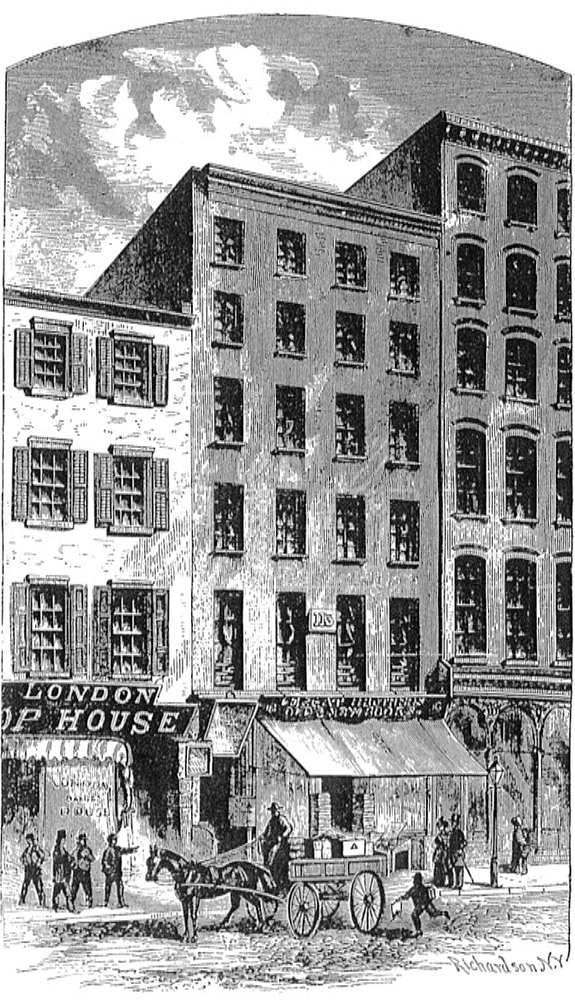
Don’t miss: a lovely piece of journalism history in today’s NYTimes, above coverage of an earlier heat wave — in 1852.

x1xThe Streets in Midsummer.jpg

Today’s piece captures the novel sense that New Yorkers were feeling that summer heat in the city was somehow worse and harder to bear than summer heat in the country. The build environment was beginning to capture and radiate heat. The unnatural concentration of horses and other animals added to the stink and pestilence. The physical crowding of people in the streets and in the tenements. The air pollution caused by the aerosolization of manure and other waste — all these things were creating a new kind of misery. And, through the mediation of the newspaper, perhaps a new solidarity among city-dwellers as fellow survirors of this new challenge of living.

Thank you, NYT.

First offices of the New York Times, starting in 1851. 113 Nassau St.

First offices of the New York Times, starting in 1851.
113 Nassau St.


Leave a comment

Filed under Journalism, journalism history, New York Times

For Hemingway’s birthday, visit his papers

By Christopher B. Daly 

This Sunday, July 21, is the birthday of Ernest Hemingway — journalist, novelist, man of letters, beau ideal of a certain interpretation of masculinity. He would have been 114.

There are probably lots of ways to observe his birthday: you could go out and kill a top predator (like a lion or marlin), or you could go drinking and get a bartender at a famous bar to name a drink after you, or you could run with the bulls at San Fermin, or you could try to write ten simple declarative sentences in a row.

Alternatively, you could “visit” with Hemingway by rummaging around in his vast trove of papers and photos, which are archived as the Ernest Hemingway Collection at the John F. Kennedy Presidential Library and Museum in Boston. Much of the Hemingway collection remains to be digitized, so the only way to see most of those documents and objects is to visit the JFK Library, which would not be the worst thing — it sits right over Boston Harbor. But if you visit the website, you can click on the “media gallery” and cruise through Hemingway’s own photos.

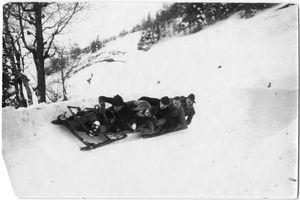
If the heatwave continues, try looking through the photos that feature Hemingway in the Alps. He is somewhere in this group bobsledding in Montreux. Enjoy.

EHPH-06901_lres

[Postscript: The Hemingway Collection site also offers an explanation for why the collection is housed at the JFK Library, which is not an obvious connection. I have not done any research into this question, so I can’t evaluate the accuracy or completeness of this version, but it’s worth reading.]

Update: The Boston Globe reports that the JFK Library has digitized the scrapbooks kept by Hemingway’s mother, which document his childhood. The Library has posted them on the website, too.

scrapbookcover2

Leave a comment

Filed under history, Journalism, journalism history

Review of “Covering America” in Journalism History

I am posting this review of my book in the scholarly journal Journalism History here, because the journal charges a lot for access.

Journalism History 

Vol 13 (4), Winter 2013, p254-255

CA cover final 2Daly, Christopher B.

Covering America: A Narrative History of a Nation’s Journalism.

Amherst and Boston: UMass Press, 2012. 535 pp. $49.95.


Many a teacher of journalism history has heard students complain about how dull or inaccessible they find any one of several available media history textbooks. And many a journalism instructor has agreed with his or her students’ complaints about de-contextualized dates and names of publishers and their historically significant newspapers strung through those tomes. Covering America: A Narrative History of a Nation’s Journalism addresses these complaints. In Covering America, Christopher Daly has wrapped the story of American journalism from the colonial period through the digital age into a carefully researched, beautifully written, and memorable account of how news reporting mostly has grown as well as improved during the span of three centuries as innovators have exploited new technologies, constitutional protections, government subsidies, cultural trends, and business formulae to maintain their financial independence and journalistic standards while serving their readers and audiences ever more efficiently.

            Daly, an associate professor of journalism at Boston University with twenty years of experience covering New England for the Washington Post and writing for the Associated Press, concentrates in Covering America on newspaper, television, and digital news with only occasional references to early twentieth-century magazines and rare mentions of public relations and advertising. His focus is the changing and expanding definition of news over time. Daly admits that in Covering America, unlike Frank Luther Mott’s or Edwin Emery’s geographically broader approaches to journalism history, he emphasizes journalism originating in New York— although Boston, Philadelphia, Washington, D.C., and Chicago receive some attention when media in these cities contribute to the overall narrative. This exclusion of examples of western and southern journalism, however, contributes in two ways to the success of Covering America. It greatly reduces the clutter and detail that overwhelms so many students, and it allows Daly to hold the social, political, economic, and technological context constant as he explains the challenges and opportunities printers, for example, faced at roughly the same time and place. Rather than grasping at data, the reader finds the overall historical patterns of journalism more apparent and memorable.

            In describing his history as narrative, Daly accurately describes his method of organizing this book, which is apparent from the opening paragraph of his introduction through his final chapter on “Going Digital.” Covering America, not unlike other journalism history texts, begins with Benjamin Franklin, but does so with a narrative lead one might expect from a short story or magazine feature:

             On an early spring night in 1722, a young man hurried along the narrow streets of Boston, trying not to be seen. He was not a spy or a thief. He only wanted to be a writer. Just sixteen years old, Ben Franklin was hoping to get his writing published for the first time, and he had chosen a risky, roundabout route to do so.

 Daly then notes that young Franklin was “skulking” around the shop of the New England Courant, owned by his brother James, in order to slip a manuscript under the door for his older brother to discover and, he hoped, to print. In this description of Franklin’s actions, Daly finds several defining characteristics of American journalism still at work today: printing was a private business, journalism was open to the young with raw talent, and the pleasure of publication drives journalists into the field.

            In the first chapter on the “Foundations of the American Press, 1704-1763,” after explaining the organization of the print shop, its products, and its method of production, Daly returns to Franklin as an example of printers during this period of six decades before the American Revolution, devoting eleven of the chapter’s twenty pages to detailing his biography, readings, head for business, popular writings, and principles of journalism in his “Apology for Printers.” Within this chapter, Daly also describes the John Peter Zenger trial and acquittal for seditious libel, noting that Franklin helped Zenger obtain his attorney. Franklin receives briefer mentions in several more chapters, reminding readers the interconnections always present as journalism is transformed over time. This pattern of focusing on one or two individuals as representative of journalists from particular periods is a device of narrative compression that Daly uses in each of the chapters in Covering America. As Daly develops an overarching narrative to describe 300 years in the development of American journalism, he inserts short narratives of innovative journalists and publishers who exemplify traits of the period being described. This is how readers receive substantial information about Benjamin Day, James Gordon Bennett, William Lloyd Garrison, Frederick Douglass, Thomas Paine, Horace Greeley, Joseph Pulitzer, Ida B. Wells, William Randolph Hearst, Adolph Ochs, Henry Luce, Harold Ross, David Sarnoff, William Paley, Walter Winchell, Walter Lippmann, Dorothy Thompson, Edward R. Murrow, Ernie Pyle, John Hersey, A.J. Leibling, David Halberstam, Truman Capote, Gloria Steinem, Katherine Graham, Ted Turner, Al Neuharth, and other journalistic innovators who so comfortably populate Daly’s story of the news.

             Covering America would vastly improve the student experience of an often unappreciated journalism history course, particularly at the undergraduate and master’s levels. Journalism students will leave a class after reading Daly’s book with a clear understanding of the methods and values of the field they will soon enter. They will also gain some confidence that journalism will continue even if paper and ink disappear.

 Joseph Bernt, Ohio University

Leave a comment

Filed under broadcasting, Covering America, First Amendment, history, Journalism, Photojournalism, Uncategorized

Review of “Covering America” by J&MC Quarterly

I am posting this enthusiastic review in the scholarly journal Journalism & Mass Communication Quarterly because the journal charges a lot for access.

Book Review:

CA cover final 2Covering America: A Narrative History of a Nation’s Journalism

Reviewed by Giovanna Dell’Orto (University of Minnesota, Minneapolis, MN, USA)


This engrossing, wide-ranging history of American journalism from

the colonial era to the present makes a tremendous contribution to

mass communication education by being that rarest kind of

textbook—one that reads like literature instead of CliffsNotes.

Covering all the bases, from the Zenger trial to the Huffington Post,

and with excursions into much lesser known histories across news

media, Covering America makes perfect and enjoyable mandatory

reading for undergraduate and graduate classes in journalism history.

Christopher Daly, an associate professor at Boston University’s

Journalism Department, approaches this monumental historical

survey with the reportorial flair appropriate for a former Associated

Press and Washington Post journalist, which sets it apart from more

pedagogical classics like Emery, Emery, and Roberts’s The Press

and America. Literally from the first line, Daly grabs the reader with

striking, cinematic details that make the past come alive. Page 1

opens with a teenage Benjamin Franklin skulking along the dark

streets of eighteenth-century Boston, trying to put one over his

brother in order to start his writing career—and the readers are

hooked, be they scholars who have been teaching colonial journalism

for years, like this reviewer, or freshmen who might have never heard

of Franklin.

Similarly intimate visual vignettes are peppered throughout the next

nearly five hundred pages, including an iconic Ed Murrow “sitting on a

bench in a White House hallway, chain-smoking Camel cigarettes” as

FDR decides how to react to just-received news of Pearl Harbor. At

the other end of the press–government relationship spectrum, we are

treated to the image of President Nixon dancing at the White House

wedding of his daughter at the very same moment when “the

typesetters and pressmen at the [New York] Times started printing”

the Pentagon Papers stories.

Most helpful for classroom use, in all these cases and across the

volume, Daly assumes no prior historical knowledge on the readers’

part, and retells the basics of U.S. history through the eyes of the

journalists and media owners who put its first draft in front of the

American people. Most chapters even conclude with short summaries

of how their main characters—from Franklin to David Halberstam—

ended up, much like the end titles in documentaries, so that no gaps

are left in a remarkably comprehensive story.

Some journalism historians might object that this volume skates very

close to the “Great Men” tradition. The narrative focus is unabashedly

on the major figures that made journalism what it is (and yes, for the

vast majority of the three hundred years covered it was mostly white

men). As Daly puts it repeatedly, social, political, economic, and

technological developments influenced the shape of journalism, but

for the major shifts to happen, “somebody had to do something.”

Since this book’s main audience is not the specialist, focusing on the

adventures of those various “somebodies” at the expense of scholarly

interpretative controversy seems an effective trade-off for terrific

storytelling that gets the major points across memorably.

In addition, the book does make two fundamental conceptual

arguments that give it depth and a unifying thread. Daly argues that

journalism has been central to the history of the country. From the

early Republic Party press all the way to today’s blogs (which, as

Daly notes, are not that different), the media history narrated in the

volume shows how journalism helped shape American life.

Sometimes, it has done so with nefarious effects, but also with a

“long tradition of service to humanity.” That service, however, has

recurrently been imperiled by the practice of journalism as a

business.

The most heartfelt, compelling question raised is the strange bed

fellowship of journalism and money. At the end of chapter 12, which

focuses on the Pentagon Papers and Watergate and is perhaps the

book’s best, Daly reflects on what he feels was the “apotheosis” of

the raison d’être for independent, aggressive journalism: “Build a big

enough audience so that you can make enough money to tell anyone

to go to hell. The risk of such an attitude is sounding arrogant, but

without it there is no real journalism.” But money, as the book shows,

is not always a journalist’s friend—not when it has meant

acquiescence to governmental or corporate interests, not when it is

intended to fatten shareholders’ wallets instead of newsgathering

operations, and not when it is made by pandering to the evil twin of

mass interest, the enduring prurient passion for celebrity scandals

and gore.

For an overview book, the level of detail is astounding, especially

since it does not detract from the narrative flow. With illuminating

forays into law, technology, and policy making, readers are

introduced to pamphleteers, editors, reporters, columnists, and

broadcasters, from Thomas Paine to Matt Drudge by way of Horace

Greeley, Ida B. Wells, Adolph Ochs, Harry Luce, and less obvious

figures, such as Harold Ross and Walter Winchell. From the smelly

printing equipment in colonial shops to the Supreme Court justices’

opinions and the account behind the iconic napalm-burned

Vietnamese girl photograph, there are no major stories left untold.

Striking quotes straight from the media—the Liberator’s opening

editorial, Ernie Pyle’s Captain Waskow’s tribute, Earl Caldwell’s

report of the King assassination—enrich the atmospheric narrative.

Until, that is, the digital era: The one major criticism of this volume is

that its treatment of what Daly calls the last major period of journalism

history, the digital revolution from the mid-1990s onward, is

unsatisfactorily perfunctory. The entire digital era gets a twenty-page

chapter that does not even mention such critical developments as the

rise of fake news shows or shattering scandals such as the Jayson

Blair affair, which is hinted at in the conclusion.

Writing what amounts to a history of the present is certainly difficult,

but the end of the book feels abrupt, and the first decade of the

twenty-first century deserves the same lively, in-depth study as the

other eras so masterfully narrated. Despite that shortcoming, this

volume is a top-choice main history textbook and reference work for

journalism educators, researchers, and students at all levels.

Leave a comment

Filed under Covering America, history, Journalism, journalism history

Notice of “Covering America”

By Christopher B. Daly 

A shout-out to Rutgers historian David Greenberg. In a book review in the current issue of the Journal of American History, Greenberg more or less dissected a new book called News for All the People. Then, unexpectedly, he swerved into a nice mention of my book:

Historians of journalism seeking a new synthesis will be better served by Christopher B. Daly’s Covering America: A Narrative History of a Nation’s Journalism (2012), which does not emphasize racial oppression quite as much yet does debunk cherished myths of American journalism history while presenting a coherent narrative account.

1.cover

1 Comment

Filed under Covering America, history, Journalism, journalism history

The case against Obama on secrecy

By Christopher B. Daly

imgres3It gives me no satisfaction to say that President Obama has been worse than disappointing when it comes to his treatment of journalists (and their sources) or his retreat from transparency (and thus accountability) in government.

It has to be said: The president has engaged in “a long train of abuses . . . pursuing invariably the same Object.”

The case against him is laid out in this open letter from whistleblowers, posted in the Guardian. This is the most comprehensive indictment I have seen to date.

In his lengthy speech yesterday about how he sees the war on terror, Obama threw in a brief passage near the end about the collateral damage that the war on terror is doing to the news media. It strikes me as too little, too late. Here it is:

The Justice Department’s investigation of national security leaks offers a recent example of the challenges involved in striking the right balance between our security and our open society. As Commander-in Chief, I believe we must keep information secret that protects our operations and our people in the field. To do so, we must enforce consequences for those who break the law and breach their commitment to protect classified information. But a free press is also essential for our democracy. I am troubled by the possibility that leak investigations may chill the investigative journalism that holds government accountable.

Journalists should not be at legal risk for doing their jobs. Our focus must be on those who break the law. That is why I have called on Congress to pass a media shield law to guard against government over-reach. I have raised these issues with the Attorney General, who shares my concern. So he has agreed to review existing Department of Justice guidelines governing investigations that involve reporters, and will convene a group of media organizations to hear their concerns as part of that review. And I have directed the Attorney General to report back to me by July 12th.

We’ll see what Eric Holder comes up with. But based on his record, I don’t expect much. So far, Holder has been part of the problem, not part of the solution.


Leave a comment

Filed under Fox News, Journalism, journalism history, media

Where Obama is dangerously wrong about journalism

imgres3Don’t miss this excellent piece by Glenn Greenwald, which ran recently in The Guardian. In it, Greenwald — a lawyer, journalist, and prize-winning author — carefully builds a case about what the Obama administration is doing. In short, he argues that the DoJ (with Obama’s certain knowledge) is taking steps to make it a crime to do many of the activities that constitute investigative journalism. The focus is the case involving Fox News’ James Rosen, but most of these thoughts apply to many other cases as well.

This is something that all journalists, all political progressives, and all Obama supporters need to grasp. The president is wrong on this, and his people are out of control.

The take-away:

Under US law, it is not illegal to publish classified information. That fact, along with the First Amendment’s guarantee of press freedoms, is what has prevented the US government from ever prosecuting journalists for reporting on what the US government does in secret. This newfound theory of the Obama DOJ – that a journalist can be guilty of crimes for “soliciting” the disclosure of classified information – is a means for circumventing those safeguards and criminalizing the act of investigative journalism itself. These latest revelations show that this is not just a theory but one put into practice, as the Obama DOJ submitted court documents accusing a journalist of committing crimes by doing this.

That same “solicitation” theory, as the New York Times reported back in 2011, is the one the Obama DOJ has been using to justify its ongoing criminal investigation of WikiLeaks and Julian Assange: that because Assange solicited or encouraged Manning to leak classified information, the US government can “charge [Assange] as a conspirator in the leak, not just as a passive recipient of the documents who then published them.”

1 Comment

Filed under broadcasting, First Amendment, Fox News, Journalism, journalism history, leaks, Obama, Politics, President Obama