JO 150 History & Principles of Journalism Prof. Chris Daly Boston University // Spring 2023
Contacts Prof. Daly can be reached by email: chrisdaly44@gmail.com Office: 704 Comm Ave./ Rm 307B Office Hours: Wed., 11-3. He/his/him
Required Readings 1. Covering America, 2d ed., by Christopher B. Daly. ISBN-13: 978-1558499119 2. The Elements of Journalism. By Bill Kovach and Tom Rosensteil. ISBN-13: 978-0307346704 3. Muckraking! By Judith and William Serrin. ISBN-13: 978-1565846814 4. Blackboard site. This site contains key documents as well as study guides, announcements, links, and other materials. Use it.
Objectives We will explore the major issues and themes in the history of journalism in America. The course will trace substantial changes in the practice of journalism and the key episodes in which the practice of journalism brought change to America. You will learn the most important eras in journalism history and the prevailing business model in each. In addition, you will learn the most important definitions of “news” across eras and across various media. We will consider how that history has shaped the current media ecology. The course will also investigate the major legal and ethical doctrines of journalism. It’s a great story!
HUB Learning Outcomes This course will enable you to develop a set of skills and habits of mind that derive from serious study of history and journalism, including: appreciation for how a historical perspective can enrich understanding of contemporary problems; the ability to analyze the value and limitations of various sources as evidence, including “primary” and “secondary” sources; a capacity to weigh multiple perspectives and evaluate the merits of competing interpretations, proficiency in constructing persuasive and evidence-based arguments in a written format. This course will meet BU Hub Learning Outcomes for Historical Consciousness. In particular, you will: — complete a series of essay tests that will ask you to make historical arguments about change over time. Lectures and readings will model these skills, and class discussions will also ask students to think in these ways. — encounter historical documents (laws, patent applications, maps, artwork), place them in historical context, and explain their significance.
Other Outcomes For students majoring in Journalism, this course fulfills a requirement and advances you toward your degree. It also prepares students for JO350 Media Law & Ethics, which is required of majors.
Educational strategy In this course, you will be expected to do the readings according to the weekly schedule provided below. That way, we can use class time for exploring concepts like censorship or “technological determinism,” hold discussions, and answer your questions.
How to succeed in this course –Come to class. –Keep current on the readings –Attend review sessions –Participate in class –Come to office hours
Your instructor: Chris Daly is a veteran journalist with experience in wire services, newspapers, magazines, books, and on-line. A Harvard graduate, he spent 10 years at The Associated Press. From 1989 to 1997, he covered New England for The Washington Post. He is the author of a narrative history of the U.S. news business titled Covering America. He holds a master’s degree in history from the University of North Carolina, where he was a co-author of Like a Family, a social history of the South’s industrialization. His writing has appeared in Atlantic Monthly, Columbia Journalism Review, Parents, New England Monthly, Boston, American Prospect and other magazines and websites. He contributes free-lance articles and essays to newspapers and magazines. His website is http://www.journalismprofessor.com. He is writing a new book about the role of journalism in the rise of American culture. (Ask him about it.)
COURSE SCHEDULE:
Part one: 1704-1865 Week 1 Jan. 19 –Introduction/ Colonial period
Covering America: chap 5 Muckraking! (details at Blackboard site)
Week 6 [NO CLASS TUESDAY] Feb 23
–Muckraking / The Great Gray Lady (The NYTimes)
Week 7 Feb 28, March 2 –Origins of photojournalism
TEST #2 March 2
Part three: 1920-1970
Readings: (do these by the start of week 8)
Covering America. Chaps. 6, 7. Muckraking! (details at Blackboard site)
Week 8 March 14, 16
–The Great War (and censorship) –The origins of radio VIDEO: “Empire of the Air”
Readings: (do these by the start of week 9)
Covering America. Chap. 8 Muckraking! (details at Blackboard site)
Week 9 March 21, 23 –The development and regulation of broadcasting. –Magazine journalism: Henry Luce and Harold Ross
Readings: (do these by the start of week 10)
Covering America, chaps 9, 10 Muckraking! (details at Blackboard site)
Week 10 March 28, 30 –World War II (censorship again) –Covering civil rights –VIDEO: “Dateline Freedom” Readings: (do these by the start of week 11)
Covering America, chap 11. Muckraking! (details at Blackboard site)
Week 11 April 4, 6 –The birth of television news –Vietnam and the “credibility gap” –VIDEO: Excerpt, “Reporting America at War”
TEST #3 April 6
Part four: 1973-2023
Readings: (do these by the start of week 12)
Covering America, chap 12 Muckraking! (details at Blackboard site)
Week 12 April 11 –The Pentagon Papers –VIDEO: Excerpt, “The Post”
Readings: (do these by the start of week 13)
Covering America, chap 13, 14 Elements of Journalism (all) Muckraking! (details at Blackboard site)
Week 13 April 18, 20 –Watergate and the 1980s (CNN, USA Today) –VIDEO: Excerpt, “All the President’s Men” –Media conglomeration/ Law and ethics/ 1980s and ’90s –News goes digital – from legacy to natives.
Readings: (do these by the start of week 14)
Covering America, chap. 15 Elements of Journalism (all) Muckraking! (details at Blackboard site)
Week 14 April 25, 27
–Journalism as a “discipline of verification.” –VIDEO: Excerpt, “The Paper.” –The Platform Revolution and the “constitution of the internet”
Readings: (do these by the start of week 15)
Covering America, conclusion.
Week 15 May 2 –Media Wars: The weaponization of information. VIDEO: ????
FINAL EXAM Date: May 8 3-5 p.m.
++++++++++++++++++++++++++++++++++++++++++++
ALL THE OTHER STUFF
Tests and Assignments You will be assigned to a Teaching Assistant by alphabet. If you have routine questions, please e-mail your TA. If your TA cannot help, then you should contact the professor. There will be four tests. Tests cover readings, lectures, guest lectures, and videos. Each test will also include a section that will allow you to demonstrate your knowledge of current affairs. A missed test scores zero. It is almost impossible to pass this course if you miss a test. So, you should plan to be present for each one, especially the final. In case of illness or other emergency, you must contact your TA beforehand to arrange a make-up. You may take only one make-up over the course of the semester.
25% Test 1 25% Test 2 25% Test 3 25% Final exam 100%
Students are encouraged to write a paper, which will be counted as a fifth grade; it is NOT “extra credit.” The paper is a 6- to 8-page analysis of a topic in journalism history, based on additional research into primary sources. This is not a “thumb-sucker.” All topics must be approved in advance and developed in consultation with the professor. The deadline for papers is one week before the last class. Students may not submit a paper that is substantially the same as work submitted in another class. For details, consult the Blackboard site. If you write a paper, it will count 20%, and other scores will be adjusted accordingly. Test scores are not “curved.” Tests are graded by the TAs. Papers are graded by the professor. If you have questions, contact Prof. Daly.
Attendance Attendance at all classes is mandatory. (It is also educational!) If you are unable to attend a lecture, there is no need to e-mail the TA or the professor. Return to class as soon as you are able, and ask another student for notes on the class you missed.
Classroom issues During class, no laptops or other electronic devices will be allowed. Close the lid, and put it away. Instead, take notes by hand. Experience shows that taking notes by hand improves your ability to concentrate. It also forces you to synthesize material and make judgments about what is really important. Most matters of fact are contained in the readings, or they can be readily found online. What makes class time special is the opportunity to think, question, and synthesize. Take advantage.
Plagiarism Plagiarism is the presentation of the work of another person (OR A BOT) as your own, even by mistake. It is an abomination and will not be tolerated. In journalism, truth and candor are the bedrock of our work. Plagiarism will result in failing this course and possible further penalties. Never do it, and never tolerate it in others. If you are in doubt, consult the professor. BE SURE TO READ AND COMPLY WITH B.U.’s UNIVERSAL ACADEMIC CONDUCT CODE FOR UNDERGRADUATE STUDENTS. It is here: http://www.bu.edu/academics/resources/academic-conduct-code/
Recordings “Please note that classroom proceedings for this course may be recorded for purposes including, but not limited to, student illness, religious holidays, disability accommodations, or student course review. Note also that you may not use a recording device in the classroom except with the instructor’s permission.”
Margaret Fuller pioneered the role of war correspondent in the 1840s.
Here’s an excerpt from my forthcoming book, The Democratic Art: the Role of Journalism in the Rise of American Culture. In honor of women’s history month, here is a history-making woman journalist.
. . . Finally, in early spring of 1847, Fuller and the Springs headed southward across France and down the Italian peninsula, then a hodge-podge of separate states. On arrival, Fuller felt an instant and deep connection to Italy, the home of Virgil and Dante, of Michael Angelo and Titian. As she wrote to Emerson at this time, “Had I only come ten years earlier! Now my life must be a failure, so much strength has been wasted on abstractions, which only came because I grew not in the right soil.” As her letter indicated, she felt that she had now found her real work – and perhaps her real self – in Italy. Indeed, as a writer, she was at her best. She gave up all plans to travel elsewhere. She was, in a sense, home. She had also found her true calling. “Margaret had become a journalist,” biographer Megan Marshall concluded, “whose trademark was experiencing reality firsthand and recording the truth as she saw it.” Fuller’s love for Italy soared when she finally reached Rome, the Eternal City she had read so much about. For the rest of her stay abroad, she would report only from Italy, sending Horace Greeley, the publisher of the biggest newspaper in the U.S., some two dozen dispatches between May 1847 and January 1850.
As Easter approached in the spring of 1847, Fuller and the Springs made their way to the epicenter of the Roman Catholic religion on April 1, Maundy Thursday, to attend the evening Vespers service at St. Peter’s. Afterward, they slipped into a huge throng of pilgrims in the streets around the Basilica. Somehow, Fuller got separated from the Springs and found herself alone in the jostling crowd. Suddenly, a handsome young Roman appeared and offered his arm to Margaret. Although he spoke no English, he managed to indicate that he was concerned for her safety and was offering his help. Using her Italian, Margaret accepted his offer, which she would later call a “singular, fateful” moment. Thus, Margaret Fuller, 36, an American Protestant, met Giovanni Angelo Ossoli, 26, an Italian Catholic. Soon, she would learn that Giovanni was something of an aristocrat. He came from a noble Italian family, but since he was not the oldest son, he did not stand to inherit the either the family’s wealth or property. Nevertheless, he was formally a Marquis – penniless, to be sure, but titled.
Giovanni Angelo Ossoli
For the time being, Fuller wrote little about Ossoli for public consumption, and even in her letters to friends, she was rather evasive. In late spring, she traveled with the Springs as far as Venice. From there, the Springs headed north to visit Germany before heading back to America. Fuller decided to stay in Italy, having to make do without the Springs’ generosity; a single woman, she now had to fend for herself. She headed next to Florence, (which she found “too busy . . . more in its spirit like Boston, than like an Italian city”) and then to Milan. Broke, she wrote to Greeley, asking him for $600 for living expenses. Originally, the Tribune editor had advanced her $120 for 15 columns; she assumed, mistakenly, that that was all he wanted or would pay for. He wrote her immediately to correct her, saying “All the letters you see fit to send us at $10 each will be more than welcome.”[i] Fuller extended her travels that early fall of 1847 to take in the lakes at the top of Italy and the bottom of the Alps. Having traveled the Great Lakes back home, she had to admit that they could not compare with the Italian lakes.
In early October, she returned to Rome, and Giovanni helped her find an apartment on the busy Via del Corso, not far from the Piazza Popolo and the Borghese Gardens. For Fuller, this was something of an idyll, and it appears that she fell deeply in love with Ossoli. But could she marry him? She could not resolve her feelings about marriage, which she considered a “corrupt social contract.” At the same time, she was drawn to Ossoli and may have been considering giving up her virginity. She had known several great men and declined them all. Ossoli, however, presented her with another kind of man: simple, kind, loving. Besides, he wanted to marry her. Fuller wrote to her mother at this time: “My life in Rome is thus far all I had hoped. I have not been so well since I was a child, nor as happy ever as during the last six weeks.”[ii] All the evidence suggests that sometime in early December, Fuller overcame her doubts, and the couple engaged in intercourse. Margaret was thirty-seven and a virgin when it came to sex with men; Giovanni was ten years younger and probably not a virgin. She was a Protestant; he was a Catholic. They faced almost insurmountable obstacles to marriage, especially a public one, since Italy forbade such “mixed marriages.” The couple were sure that the Ossolis would reject them; they assumed that her family and friends would frown too. So they kept mum.
Immediately, Fuller’s dispatches showed a freshness and liveliness – probably a mixture of her newfound joy in her private life and a rising optimism about the republican movements growing across Europe. A landmark new history of the revolutions of 1848 praises Fuller for “the most evocative and insightful eyewitness accounts of Roman events.”[iii] In a column she finished in December, Fuller described three “types” of America visitors to Europe, then turned to continental politics. After 1800 years of Christianity, she asks, what does Europe have to show for it? “Where is the genuine Democracy to which the rights of all men are holy?” The dispatch goes on to point out the widespread misery in Europe and the refusal of the dictatorial monarchs to address the people’s needs. Increasingly, she points to “associationism” as the radical remedy for industrial poverty – without going into great detail. Evidently, Fuller assumed that readers were familiar with associationism, the social theory put forth by Charles Fourier and embraced by Greeley that called for workers to jointly own the factories and workshops where they toiled. In the same column, Fuller turns to the recent U.S. war with Mexico, which threatened to expand slavery into a vast new territory. “I listen to the same arguments against the emancipation of Italy, that are used against the emancipation of our blacks; the same arguments in favor of the spoliation of Poland as for the conquest of Mexico.” On a hopeful note (yet with an ominous undertone), she added that perhaps the younger generation could make a better world. “I have witnessed many shipwrecks,” she added, “yet still beat noble hearts.”
Soon, though, Fuller began suffering symptoms that added up to morning sickness. It is not known if she even contemplated an abortion, but it would have been virtually impossible to obtain one in Italy. Her status as an unwed mother brought with it another raft of problems. If the baby were born out of wedlock, it could be considered a “foundling” in Italy and snatched away from her. Should they marry? Should they wait and see if the baby lived? While Margaret was facing such problems, her finances remained precarious. Nevertheless, Fuller persisted. Indeed, in the coming months, she would prove herself as a successful foreign correspondent and as a terrifically resourceful woman – a single mother, supporting herself financially through her professional work and witnessing a violent revolution. It is fair to say that the privileged ladies of her Conversations back in Boston and the young Harvard-trained ministers she knew at home would be astounded to see her in Rome.
As the year 1848 began, Fuller remained engaged in her work – covering Europe for the largest-circulating newspaper in America. With Greeley’s support, she was well positioned to cover the growing discontent across the continent and the rising calls for democracy and social reform. Revolution was in the air, as insurgent leaders rose up to protest the devastating new impacts of industrialization and the infuriating old insults of autocracy. Greeley had other correspondents in Europe, all men, but none wrote as often, or as well, as Fuller. As the demands for change grew – led by radicals like Mazzini and Mickiewicz – Fuller did her best to cover the great developing story. Broke again, she was stranded in Rome because it was becoming too dangerous to travel and cross contested borders. By now, she was collecting material for a work of history that would capture the great events of 1848.[iv]
Still, she needed to keep working as a journalist. To overcome the many handicaps, she pioneered an array of techniques that would be used by generations of foreign correspondents to come. She kept up with developments by reading the European press – after all, she could read not only English but German, French, and Italian as well. She also interviewed visitors as they passed through Italy, bringing her insights from Vienna to London. And, she cultivated sources close at hand among the American officials posted in Rome, especially the U.S. diplomat Lewis Cass Jr.. In addition, she roamed on foot around Rome, making conversation with Romans from all walks of life. Fuller also had to another issue familiar to all foreign correspondents – staying in contact with the home office. In the late 1840s, telegraph service was becoming established, but it would be two more decades before a reliable telegraphic connection spanned the Atlantic Ocean. So, Fuller had to be sure to get her handwritten dispatches to an ocean-going steamship, which could take it to Boston or New York. To send a message to Greeley and get an answer could take two months.
While restricted in her movements, Fuller read widely among European newspapers, so she was hardly cut off from the wider world. And, as it happened, the momentous events of 1848 would bring one great revolutionary movement right to her doorstep – that was the uprising against papal rule over Italy. In one dispatch early in 1848, Fuller denounced the conservative influence of the Catholic priesthood and the Jesuits in particular. She believed that they were scheming to maintain their traditional powers and prerogatives in Italy and other Catholic countries. “How any one can remain a Catholic . . . after seeing Catholicism here in Italy I cannot conceive,” she wrote in Dispatch No. 22. This column, as well as others, antagonized the growing number of Catholic readers of the Tribune in America, especially Bishop Hughes of New York, who denounced Fuller in print and damned the rebels for imposing “a reign of terror over the Roman people.”
Around the end of her first trimester in late March, Fuller bemoaned the chilly rain and her recent ill health. “Now this long dark dream – to me the most idle and most suffering season of my life – seems past,” she confided to her readers, while keeping her pregnancy secret, of course. She then pivoted to a roundup of news from that revolutionary season: rebellions in Sicily and Naples, the dethronement of King Louis Phillipe in France, the forced resignation of Metternich in Austria, the uprising in Venice, and more. “With indescribable raptures these news were received in Rome,” prompting dancing in the streets. In a postscript dated April 1, Fuller mentioned that she took a brief trip outside Rome. While she was away, one of the last holdouts of Hapsburg rule capitulated in Verona. It now appeared that Mazzini’s dream was becoming real. “Returning to Rome, I find the news . . . that Italy is free, independent, and One.”[v]
A few days later, more good news. In April, she received a letter from Greeley in which she learned of a major subsidy from the publisher, who confided that he had had to sell part of his stake in the Tribune to raise the funds to keep her on the newspaper’s payroll. Now, the air was not only clear between herself and her lifeline, but she could also look forward to an easing of her pinched circumstances. That same month, she wrote a column expressing again her disappointment in Pope Pius IX, saying he had betrayed the cause of Italian unification, which he had supported the previous year. Now, the pope was urging Catholics across Europe to submit to “their respective sovereigns.” Near the end of that column, she added a fresh denunciation of the U.S. conquest of Mexico, which she saw as another sad episode of one nation robbing another one of its right to self-determination. Turning to Europe, she added: “Here things are before my eyes worth recording, and if I cannot help this work, I would gladly be its historian.” [vi]
Portrait of Fuller by Thomas Hicks, from life, May 1848. U.S. National Portrait Gallery.
Around this time, despite the news of political upheaval across Europe, Fuller made plans to go into seclusion in L’Aquila, a small town in the mountainous Abruzzi region. She felt she had to stay away from the popular summer resort towns to avoid running into any Americans or Britons who might recognize her and spot her growing pregnancy. Emerson wrote to her that month, urging Fuller to return to America with him, but she replied evasively, trying to throw him off the scent: “I have much to do and learn in Europe yet,” she wrote. “I am deeply interested in this public drama, and wish to see it played out. Methinks I have my part therein, either as actor or historian.”[vii]
The radical part of the campaign to re-unify Italy, the Risorgimento, echoed certain themes from the American Revolution. One goal was to rid Italy of royal rule from outside the territory, just as the Americans had thrown off rule by the king of England, and unify the newly independent states into a territorial federation. That goal would involve winning independence from France, Spain, Austria, and others – all at the same time. Some who supported that goal were willing to replace outside rule with a home-grown royal family under a new King of Italy. The other faction had a more radical agenda. This group, which included Mazzini, wanted a new democratic republic, where the Italian people would govern themselves. Like Thomas Paine in 1776, they wanted to rid Italy of all rule from above, including the Pope. The new republic they envisioned would be a secular one, even in an overwhelmingly Catholic country. In the 1840s, this was indeed a radical agenda, and Fuller embraced it passionately and publicly.[1]
Meanwhile, Fuller remained at work on her history project. She continued gathering material: notes, pamphlets, newspapers, and letters she exchanged with friends across Europe. Of course, her own dispatches for Greeley were part of the process; those columns were what a later journalist would refer to as “the first rough draft of history.”[viii] As two Fuller scholars have noted: “The relationship she envisioned between the dispatches and her “History” was that between sketches and an oil painting; the first done quickly and impressionistically with the scene before her eyes; the second created in the studio and showing the effects not only of contemplation and reflection, but also of selection and arrangement.”[ix] This approach describes much the same technique that Winslow Homer would use a decade later in covering the U.S. Civil War as a sketch artist for a weekly news magazine before turning certain of his “first draft” images into masterpieces of oil painting.
Fuller arrived in L’Aquila on May 29. Later, she would tell Tribune readers of this period: “I have been away . . . during the Summer months, in the quiet valleys, on the lonely mountains.” In the heat and isolation, it was indeed lonely for the American fugitive. What’s more, Fuller was missing the landmark gathering of feminists that took place in late July at Seneca Falls, New York. Led by Susan B. Anthony, Elizabeth Cady Stanton, and Lucretia Mott, the gathering marked a bold and concrete step toward addressing many of the issues Fuller had raised in her foundational book Woman in the Nineteenth Century. Fuller herself would have to settle for reading about the Seneca Falls convention and its “Declaration of Sentiments,” many weeks later, when she caught up with copies of the Tribune.
At the same time, she found a reason to relocate again. L’Aquila was in the territory of the conservative King of Sicily, and he had started arresting republicans. Fuller could not be sure that her American citizenship would protect her, so she moved out of his territory, to the town of Rieti, which was then part of the Papal States. The move placed her closer to Rome as well, and now Ossoli could visit her. One biographer believes that Margaret and Giovanni quietly married during this period, if only because it would make life much simpler for them as a family, especially when it came to crossing Italy’s many borders.[x] Still, Ossoli had his duties in the Civic Guard, so he could not stay long. Fuller stayed in Rieti and kept working on her history, but it was a difficult time. As her pregnancy advanced, she had no companions or friends to help her. “I feel lonely, imprisoned, too unhappy,” she lamented to Ossoli.
Then, on September 5, while Ossoli was with her in Rieti, Margaret Fuller gave birth, at age 38. They named the baby Angelino Eugene Philip Ossoli and they started calling him “Nino,” a common Italian nickname Together, the new family enjoyed a happy interval, though brief. Giovanni insisted that the boy have the Catholic sacrament of baptism, but that would require waiting 40 days in Rieti. Married or not, Fuller could not wait that long; she needed to get back to work, and she wanted to keep the baby secret for at least a while longer. So, she arranged for Nino to be cared for in Rieti by a wetnurse. Then, she headed back to Rome. By mid-November, 1848, she was back at work. Still, around Christmas she made a trip to Rieti to see Nino, who “seems to be well,” although, as she wrote somewhat ominously to Giovanni, “not much bigger than when I left him.”
Nearing forty, she was managing as a virtual single mother, covering a story of historical importance. “Now, a new hard-hitting tone found its way into her correspondence,” according to one analysis. “She was a different woman by the time she returned to Rome – more militant, more Italian, more certain than ever that her hopes were bound up with the fate of the revolutionary cause in Europe.”[xi] Her dispatches about the tumultuous year just ending were having an impact. She was having the kind of career a few American women journalists (among them, Martha Gellhorn, Lee Miller, and Christiane Amanpour) would follow in the coming centuries. Among Fuller’s many readers back in the United States was Walt Whitman, now approaching thirty, working as a journalist. Later, he would reflect on the hopes he felt were raised by 1848, calling the uprisings: “That brief, tight, glorious grip / Upon the throats of kings.”[xii]
At year’s end, Fuller dashed off two dispatches to the Tribune. She wrote that when she had seen the first signs of snow in the mountains, she had returned to Rome. “I left what was most precious that I could not take with me,” she told her readers, in a veiled reference to her infant boy; Nino, she believed, was safe in the countryside. Because of the growing tension around whether the young Roman Republic would long survive, Rome was now “empty of foreigners.” As a result, rents were plunging, and she could afford a sunny and spacious room at 60 Piazza Barberini (now marked by a wall plaque), from which she could see the magnificent Barberini Palace, home of popes. In her column, she noted the election of the new Whig president Zachary Taylor at home and urged him to send a “good ambassador” to Rome. “Another century, and I might ask to be made Ambassador myself . . . but woman’s day has not come yet.”[xiii]
While still bracing for a counter-strike, Fuller told her readers about the official proclamation of the Roman Republic, on February 8, 1849. As a candid supporter of the new republic, she greeted it with admiration. She reported that she went into the streets and joined a procession heading to Rome’s magnificent Campodoglio. With banners flying, the new leaders mounted the steps to the high square and one read the manifesto aloud. It had four main provisions:
Popes shall have no role in government.
There will be freedom of religion.
The new Roman Republic shall be “a pure Democracy.”
The Roman Republic will join the new nation of Italy.
In this dispatch, Fuller was already expressing fear of a French intervention to roll back the republican victory. Louis-Napoleon Bonaparte was the new president of France, and, while he was an elected public servant, Fuller believed that in his heart, he was a monarchist. Fearing an attack, she pleaded for American support for the fledgling Roman Republic.
In a dispatch written on March 20, she opened with this lead sentence: “The Roman Republic moves on better than could have been expected.” This is typical of her evolving literary style. Her opening sentences (what journalists would call her leads, or “ledes”) went right to the heart of the matter, introducing the general topic, establishing a mood or tone, and advancing the story without giving it all away. In the same dispatch, she praised her dear friend Mazzini – now the de facto head of state of the Roman Republic – as “the idol of the people” and “a man of genius.” She also managed to slip away again to Rieti and spent nearly two months with Nino before returning to Rome, a city on the brink of crisis.
On April 25, 1849, the blow she feared fell. French forces landed at Civita Vecchia, a port city 37 miles northwest that had served Rome for centuries. Fuller wrote about the early stages of the invasion in a dispatch she finished on May 6. Her lead was another gem:
I write you from barricaded Rome. The Mother of Nations is now at bay against them all.[xiv]
The French forces were led by Generale Nicolas Charles Victor Oudinot, who proved be a cruel and pompous scoundrel. He claimed that he was coming as a friend, to restore “order” to the Papal States, a French ally. Fuller saw right through him. “No one was, no one could be, deceived as to the scope of this expedition,” she warned Tribune readers. “It was intended to restore the Pope to the temporal sovereignty, from which the People, by use of suffrage, had deposed him.” In his pursuit of order, Oudinot marched on Rome and proceeded to bombard it with cannon fire, inevitably causing a fair amount of disorder. In the early stages of the siege of Rome, Fuller publicly criticized the American charge d’affaires, Lewis Cass Jr., for continuing the policy of not officially recognizing the new Roman Republic. How, she demanded, could the United States not salute a fellow republic?
While continuing to write for Greeley, Fuller became more and more committed to the republican cause. Giovanni was stationed with his Civic Guard unit in the Vatican gardens, and she visited him there when she could. On April 30, at the invitation of an acquaintance, the Princess Belgioioso, Fuller became the director of the Fate Bene Fratelli hospital on Tiber Island, where she organized the nurses and tended the wounded herself (as Whitman would do in the U.S. Civil War). “I have, for the first time, seen what wounded men suffer,” she wrote in a dispatch in late May. Fuller was also fretting about Nino, who she believed was at least safe in Rieti. As the French drew near the city, she worried more and more about Giovanni, whose regiment was coming under fire. She was now, according to her biographer, the last American journalist remaining in Rome. After more than a month of battles, the French arrived at the gates of Rome in early June and began shelling the city.
Fate Bene Fratelli Hospital.
Now, for the first time, Fuller endured the multiple terrors of being part of a civilian population under bombardment. French cannons hurled bombs into the midst of the urban population by day and night. “War near at hand seems to me even more dreadful than I had fancied it.”[xv] On Sunday, June 3, the French assaulted the barricades surrounding the city. “The attack began before sunrise and lasted all day. I saw it from my window,” Fuller reported, adding: “The Italians fought like lions.” On June 10, she finished a somber dispatch, opening with a question lede:
What shall I write of Rome in these sad but glorious days? Plain facts are the best; for my feelings I could not find fit words.
For the time being, the French were content to stand off and shell the city into submission, inflicting casualties among civilians as well as among the new recruits and volunteers of the young Republic. Fuller noted the “frightful sacrifices” made across the city, including the reduction of the famed Villa Borghese to rubble. Her hero Mazzini was standing “firm as a rock,” she claimed, then asked: “Yet how long, O Lord, shall the few trample on the many?”[xvi]
On June 21, three weeks into the siege, she filed another dispatch. (Although filled with fresh news, the logistics of trans-Atlantic communication meant that it would not be printed and read in New York for more than a month.) The French bombardment was taking its toll. More and more often, the French bombs would open hole in the city’s defenses, and the Roman militia would rush to the spot, rebuild the barricades, and fire back. Fuller reported the story of one woman in the Trastevere district who saw one of the French bombs land near her. The bomb had a lit fuse, but the woman bravely picked it up and extinguished the fuse before it could cause mayhem. Fuller wrote that her example caught on quickly, and Romans learned to put out the fuses. They gathered the unexploded cannon balls and hauled them to the Roman forces to use against the French.
Fuller was also working almost every day at the hospital, seeing for herself the grisly toll of the bombardment on the bodies of republican soldiers, many of them young students from across Italy who had rallied to Rome’s cause. Many endured gruesome amputations. “One kissed an arm which was cut off,” Fuller reported. She described another soldier who collected the pieces of his own bones being extracted from his wounds, to save as relics. “I suffer to see these temples of the soul thus broken . . . but I would not, for much, have missed seeing it at all,” Fuller wrote in what could be a motto of all war correspondents – from Herodotus to Martha Gellhorn to reporters unborn. They all seem to know or say: war is horrible, but I had to bear witness. In another trope of war reporting that would become a classic, Fuller also reported that the bombs had a terrible beauty. “In the evening ‘tis pretty, though a terror, to see the bombs, fiery meteors, springing from the horizon line upon their bright path to do their wicked message.”
On the night of June 21-22, the bombing reached a crescendo around 2 a.m. “We were all alarmed by a tremendous cannonade. It was the moment when the breach was finally made by which the French entered. . . That was the fatal hour for the city,” Fuller reported in prose that she had now mastered – a vigorous style, using short sentences and active verbs. The result was writing that was vivid, specific, concrete. “Those who were brought into the Hospitals were generally grievously wounded, very commonly subjects for amputation. My heart bled daily more and more at these sights, and I could not feel much for myself, though now the balls and bombs began to fall round me also. The night of the 28th the effect was truly fearful, as they whizzed and burst near me.”[xvii]
In a day, the city became a vast camp of refugees, fugitives, and wounded. The press came under censorship; a curfew was imposed; and the Ossolis were wanted figures. She ventured out for one last survey of the ruin.
I entered the French ground, all hollowed and mapped like a honey-comb. A pair of skeleton legs protruded from the bank of one barricade; lower, a dog had scratched away its light covering from the body of a man, and discovered it lying face upward all dressed; the dog stood gazing on it with an air of stupid amazement.
Afterward, Margaret would no longer go out in public for fear of retribution. But in her latest dispatch, she offered a bold prediction: “The fruits of all this will be the same as elsewhere: temporary repression will sow the seeds of perpetual resistance.” She went swiftly to see the American diplomat Cass and prevailed on him to supply two fake American passports – one for Mazzini and one for Ossoli. On July 8, with more help from Cass, Fuller left Rome in a carriage and headed to Rieti for a reunion with her son. To her horror, she found Nino failing to thrive and near death. She discovered that the hired “wet nurse” had been ordered by her own husband to breastfeed only their child. Nino had been kept alive on a diet of bread soaked in wine. He had lost weight and became alcohol-dependent until his mother showed up, took him back, and supervised his care and feeding. With the help of a new nurse, Nino began to improve.
At the end of August, Fuller wrote a dispatch looking back over those “sad but glorious days” of the Republic. It began with this mournful lede: “To write from Italy is now become a sorrowful business.” (She wrote “Italy” rather than “Rome” because she was hiding out in Rieti.) She accused the French commander of sacking Rome and said his denials were flat lies. “They [French bombs] fell in the Vatican quarter; often on the Quirinal, on the Capital, on the Pincian. I am eye-witness that they did.” She went on to rebut another theme of French propaganda – that they occupied Rome to bring order. Before the occupation, Fuller had felt safe and free in republican Rome.
I, a woman, walked alone at all hours, in all quarters of Rome; I stood alone amid the throng of soldiers and of citizens; I took with me little girls to help me at the hospitals, and their parents thought my protection sufficient; I was at the gates, at the post office, in the nearer quarters of Trastevere, in the Vatican gardens – I never saw an act of violence, was never even jostled in the excitement of the crowd; I do not believe ever people or soldiery showed a finer spirit.
Notably, she could still write long sentences, but now they have energy and clarity. According to Reynolds and Smith, on this same day, Fuller wrote a letter to her mother, telling her that she had both a husband and a son and that they hoped to reach America in the summer.[xviii]
Fuller and Ossoli made their way to Florence, where they settled into a small apartment on the Piazza of Santa Maria Novella. Some speculate that this is when they quietly got married. Nino was gaining weight, and they often took him on strolls along the Arno or to museums. On November 15, she filed a dispatch from Florence, confiding to her readers that the defeat of the republic was hitting her hard.
I have begun to write, yet little do I feel inclined . . . I take long walks into the country, I gaze on the beauty of nature, and seek thus to strengthen myself . . . I look again upon art, and solace myself in its calm. . . .
To find out what happened to Margaret Fuller as she headed back to the United States in 1850 with her son and the boy’s father, the rest of the story will be told in my next book, The Demoratic Art.
[1] Rome in 1848 is the place and time chosen by Willa Cather (chapter 9) for the prologue to her novel Death Comes for the Archbishop, but Cather makes no mention of the political revolution and repression that Fuller saw.
[2] The leader, Garibaldi, departed on July 2 on horseback with four thousand men, trying to evade all the anti-democratic occupying forces in Italy. By August, all were dead, except for Garibaldi and one follower. Garibaldi went into exile in London and New York City. Ten years after fleeing Rome, he returned and achieved his ultimate goal – the unification of Italy. As for Mazzini, he escaped and made his way to England. He remained committed to the cause, but he later broke with Garibaldi over the issue of establishing a monarchy for the newly unified Italy (King Victor Emmanuel II). Mazzini held out for the twin goals of unification and democracy.
[i]More than welcome . . . Greeley’s letter is quoted in Dispatches, p 21.
[ii]Last six weeks . . . See Dispatches, fn p 167.
[iii]eyewitness accounts of Roman events.” Christopher Clark, Revolutionary Spring, (Crown, 2023) p 254.
[iv] For a penetrating history of the continent-wide upheavals, see Clark.
March 16 marks the 197th anniversary of the founding of the first Black-owned newspaper in the United States, Freedom’s Journal.
During the 1820s, free Blacks in New York City and elsewhere were beginning to form a literate community large enough to support a newspaper. As it happened, during the very year that Frederick Douglass started to learn to read, the first newspaper in America owned by Blacks was founded. Freedom’s Journal began publishing on March 16, 1827 in New York City.
The founding editors were Reverend Samuel Cornish, a minister, and John Russwurm, an alumnus of Bowdoin College, who was the first black person to graduate from an American college.
In their first number, the editors boldly stated their goal:
“We wish to plead our own cause. Too long have others spoken for us.”
Not surprisingly, Freedom’s Journal was editorially opposed to slavery, and it published the first account of a lynching ever printed in the United States. At the same time, it served its largely Black readership by running newsy items of general interest, as well as sermons, poetry and advertisements.
The newspaper did not survive long, but it was followed by many others, notably Frederick Douglass’s first newspaper, The North Star, which he founded in 1847.
During his lifetime, which spanned most of the nineteenth century, Frederick Douglass grew to be many things: from an enslaved slave boy and teenage shipwright, to a public speaker, an abolitionist, a book author, a feminist, a political activist, a diplomat, and even (against his wishes) a vice presidential candidate. While all those activities were worthwhile, most of them would not financially support an adult with a family. As a practical matter, for most of his adult life, Douglass was a working journalist. He supported himself as the founder, publisher, editor, and lead writer of several important newspapers. First in Rochester, New York, and later in Washington, D.C., Douglass wrote for, edited, and published newspapers that demanded attention far and wide. His editorial voice was every bit as powerful as his famous speaking voice. The written word and the spoken word were both his tools and his weapons.
Douglass is the fountainhead of so much African American writing. At the time of Frederick’s childhood, though, nearly all Southern states banned teaching enslaved people to read or write. But, in one of the great flukes of history, Frederick learned the rudiments of literacy while he was still enslaved. After that, in an impressive feat of self-invention, he essentially willed himself to become literate. Without a single day of classroom education, he made himself a literary lion. In his life and career, there is a direct line that can be drawn from his acquisition of literacy to his self-liberation from slavery and on to his career as a writer and publisher. In the power of his words, Douglass found the strength to shape his times – and ours. We might well wonder how Douglass did it.
STARTING OUT
A boy named Frederick was born to an enslaved mother sometime in early 1818 in the flat, watery world of Maryland’s Eastern Shore. Due west across the Chesapeake Bay lay Washington, D.C., about 30 miles as the buzzard glides but a world away from the dark, drafty, dirty cabin where young Frederick lived. In Washington, the president was James Monroe, a Virginian who enslaved people and sometimes sold them to pay his debts. After his election in 1816, Monroe brought several of his own slaves to Washington to serve him in the Executive Mansion, which had been completed a few administrations earlier with the labor of enslaved builders.
That boy named Frederick was mostly likely born in February of 1818, but as with almost all enslaved people, he did not know the exact date of his birth. In any case, we know that Frederick was the son of a woman named Harriet Bailey. She was enslaved to a white man named Aaron Anthony. Anthony was a prominent figure in the Eastern Shore, serving as something like a chief operating officer for the truly vast Wye Plantation, which belonged to a family named Lloyd. Anthony owned dozens of slaves himself, while the Lloyds owned hundreds.
The scant evidence that exists suggests that Anthony had sex with Harriet Bailey and impregnated her. Since he owned her under Maryland and U.S. law, their relationship was, by definition, one based on coercion. The boy never learned the identity of his father. Without a legal father to bestow a last name on the child, Frederick acquired his mother’s family name, Bailey. The boy barely knew his mother, either, because she labored at a different farm, some twelve miles away. As a baby, Frederick was placed in the care of his kindly, enslaved grandmother — Hariett’s mother, Betsey Bailey, and Betsey’s free Black husband, Isaac.
When Frederick was about seven, his mother died; with no acknowledged father and now no mother, he was from then on, for all practical purposes, an orphan. During his childhood, Frederick endured a gratuitous level of deprivation. Like many enslaved children in the South, he was given almost no clothes. Most of the time, he wore a simple long shirt made of tow-linen, the coarsest and scratchiest available. That was it: no outer layers, no underwear, no pants. He also had no shoes. Most of the time, Frederick had no bed and slept on the dirt floor of his grandparents’ rude cabin. His food was mainly a corn mush, which he scooped into his mouth with an oyster shell. For an enslaved child, there were no treats, no feasts. There were also no lessons. Like other enslaved children, Frederick was taught almost nothing – except to fear his master. At the start, young Fred was at the bottom of a deep well of ignorance, with a lifetime of toil stretching endlessly ahead.
FREEING THE MIND
“Why am I a slave?”
As a boy, Frederick Bailey asked himself that question but found no answer. Indeed, that question only led to more questions. He knew that some Blacks were free while others were enslaved, so how could he accept it when whites said all Africans were suited to slavery or destined to it? If Blacks had a soul, how could whites not acknowledge them as brothers in god’s love? If some whites promoted abolition while other whites defended slavery, didn’t that mean that even white people did not have a single unified view of Blacks? Could it be that his condition was not permanent after all? Could he possibly liberate himself from slavery?
When Frederick was about seven, his life, which was hardly his own, took a lurch. Uprooted from his grandparents’ cabin, Frederick was suddenly walked to a different home – on the Wye plantation, the largest in the area. Enslaved children like Frederick were at the bottom of a long pecking order. He was still too young to do field work, so his value to the owners was all in the future. For now, it was enough to keep him alive, and he got barely enough food.
At the Wye Plantation, beatings and whippings were common occurrences, and the young Frederick witnessed many horrors, including a murder at point-blank range by a white overseer. His only regular respite from such depravity and cruelty on the plantation came from his new white mistress. She was a daughter of his “old master” Aaron Anthony named Lucretia, who was married to a white man named Thomas Auld. Lucretia’s father had effectively given young Frederick to her, and she looked upon the boy with favor. “She pitied me, if she did not love me,” Fred recalled, remembering that Lucretia regularly supplied him with food and sympathy.
Then, suddenly, his enslaver decided to send Frederick to live with Thomas Auld’s brother, Hugh, who lived in Baltimore with his wife, Sophia. That played out as a critical turning point in Frederick’s life, exposing him to the big city of Baltimore and to new ideas of all kinds. Not yet nine, Frederick was thrilled by the turnabout. First things first, though: he spent much of the next three days in the creek, trying to wash off the accumulated dirt and “mange” of country life. When he was finally clean, Lucretia Auld gave him his first trousers.
Early one Saturday morning in March 1826, Frederick shipped out from the Eastern Shore. Having no fondness for the plantation, he took one look back from the stern of the boat, then turned and set his sights forward. For months, he had watched from that very shore as sailboats passed by the Wye landing, looking to him like the epitome of freedom, as the ships’ skippers used the wind to go where they pleased. Now, he was on board one of those very sailing ships. The boat headed north up the Chesapeake Bay, past Annapolis, and on to Baltimore. One of the ship’s hands escorted him to his new home, where he would live with Hugh and Sophia Auld and their little son, Tommy. He immediately took a liking to Sophia, and she showed in many ways that she returned his favor. As Frederick put it later, he went from being treated as a pig on the plantation to being treated as a child. He actually lived in the same house with white people, and he slept in a real bed. Hugh Auld did not beat him, leaving Frederick in the care of his wife instead. That would prove to be not only a kindness to the enslaved boy but a life-changing decision.
Living in Baltimore meant quite a few adjustments for young Frederick – and not just the tall buildings, the shops, and the crowds he saw everywhere. The harbor was crowded with large, ocean-going ships, some carrying passengers and some carrying cargo. And there were so many free Blacks – more than Frederick had ever seen on the Eastern Shore. By 1830, four-fifths of Baltimore’s Black population consisted of free (or freed) Blacks. In general, city life granted enslaved people more opportunities and diminished the power of their enslavers to control them, and it checked many of the most violent extremes of plantation life. The city shattered the total institution of rural slavery.[i] So many of these new encounters pointed Frederick in the same direction: the world was wider than he had known it to be, and it included more categories of people than he had met so far. Still, the boy was stuck in slavery; he was owned by one white man and on loan to another.
Under the American regime of chattel slavery, the fate of Frederick’s body was sealed: he would always be the property of some white man. But what about his mind? Did his mind not belong to him? What use, of his own choosing, could he put it to? An answer was not long in coming.
As part of the Auld household, Frederick was in and out of most rooms in the place. Many a day, when Hugh Auld was off working in the shipyards, Frederick heard Sophia Auld reading the Bible aloud to herself. As he listened, he began to wonder about the mystery of reading. Watching her look at a page and listening to her turn those little ink figures into spoken words “roused in me the desire to learn.” Since he was not afraid of Sophia, he asked her if she would teach him the ABCs. “Without hesitation, the dear woman began the task, and very soon, by her assistance, I was master of the alphabet, and could spell words of three or four letters.” Lucretia was proud of her pupil and made no effort to hide the lessons from her husband. She even told him of her plan to teach Frederick to read the Bible himself.
That was too much for Hugh. From his perspective, as a white man, teaching an enslaved child to read was anathema. Although it was not illegal, teaching an enslaved person to read was, in the eyes of almost all whites in Maryland, a bad idea. Within earshot of Frederick, he laid out his reasons (and in the process, gave Frederick a life-long lesson in both the fragility of slavery and the power of literacy). Hugh Auld declared:
–“the thing itself was unlawful” (While not true, this was widely believed among whites and Blacks.)
–“it was also unsafe and could only lead to mischief.”
–An enslaved person “should know nothing but the will of his master, and learn to obey it.”
–“Learning would spoil the best n-word in the world.”
–“it would forever unfit him for the duties of a slave”
–“learning would do him no good, but probably, a great deal of harm – making him disconsolate and unhappy”
–“If you learn him now to read, he’ll want to know how to write; and, this accomplished, he’ll be running away with himself.”[ii]
In short, Auld was inadvertently providing Frederick with “the first decidedly anti-slavery lecture to which it had been my lot to listen,” as he put it several decades later. The boy was naturally disheartened about being thwarted in his lessons, but Auld’s words had another impact as well. “It was a new and special revelation . . . to wit: the white man’s power to perpetuate the enslavement of the black man.” Slavery, he now saw, was not god’s will; it was a product of Black ignorance and white violence, and it could not survive scrutiny. So, if learning unfits the Black man to slavery, then Frederick wanted all the learning he could get. Then and there, he resolved to continue his education one way or another.
Auld’s reprimand to his wife and his angry speech about slavery had clearly backfired; Auld had, in spite of himself, laid bare the wicked heart of slavery and awakened one of its greatest enemies. “From that moment I understood the direct pathway from slavery to freedom.”[iii] So, at age nine, Fred was introduced into the mysteries of the letters of the alphabet, the ways they combine to make words, and the ways words can be combined for almost any purpose. Strong magic.
Until 1830, few states made it a crime to teach enslaved people to read and write. There was little need for such laws, since most enslavers simply forbade teaching on their own plantations on their own authority. Besides, enslaved people had neither books, nor writing materials, nor instructors. But after the slave uprising in Virginia in 1831 – led by Nat Turner and carried out by literate slaves – white leaders across the South reacted with a fury. They killed more than a hundred Black rebels out of hand, then persecuted many more across the region.
White leaders also noted that Turner was a literate and popular preacher who had used written messages in his plot. Considering the power that literacy could provide to future rebellions, some states now made it a crime to teach an enslaved person to read and write. Black literacy was understood as a direct threat to the regime of white rule. Whites reasoned that if enslaved people could read, they would not limit their reading to hymns and recipes. If they could read, they could study the law; they could understand geography; they could convey messages that would allow ringleaders to organize and plan more rebellions.
In the minds of white slavers, one threat arising from literacy loomed above all others. In all the slave states, every enslaved person leaving the slaveholder’s property was required by law to carry a “pass” – a piece of paper that spelled out the bearer’s name, the owner’s name, the name of the home plantation, and the duration of the pass. And it had to be signed by the owner or overseer. It was like an internal passport, and any white person could demand to see a pass from any Black person they encountered. As the key to controlling the movements of every Black body in the South, the pass was sacrosanct. But if slaves knew how to read and write, they could certainly forge their own passes. Then, they could come and go; they could travel, plan, and meet. They could even rebel. All the more reason to keep slaves from learning to read and write. Slaveholders understood that their way of life, and maybe their very lives, depended on it.
For all these reasons, Frederick was never supposed to learn his ABCs. As it turned out, he learned the basics just in the nick of time, for every year after he started to learn, it would become more difficult and more forbidden. The window was closing, the darkness spreading. From now on, Frederick’s lessons would have to be more clandestine.
Frederick already had a base of learning on which he could build the rest by himself. Undeterred, he not only pushed himself to keep learning, he even enlisted the white boys in his Baltimore neighborhood to help him. First, Fred somehow got hold of a surefire weapon in his war on ignorance – Noah Webster’s book. Published in Boston, Webster’s “speller” was a huge hit in its day, selling more than 3 million copies in the first two decades. After the Bible and before Uncle Tom’s Cabin, it was the largest-selling book in America. It was not a dictionary (that came later), but instead an elaborate guide to correct pronunciation of English words, accompanied by examples of uplifting prose and poetry, fables and maxims, along with some rudimentary rules for composition. It was used to teach teachers and for teachers, in turn, to teach students.
For Frederick, the book practically served as his school. He carried it in one pocket and kept pieces of bread in the other. When he needed a white boy’s help with a word or concept in Webster’s speller, he would trade a biscuit for a lesson. Although the boys were white, Frederick reported later that he never met one who would defend slavery. He drew the lesson that those boys had to be inculcated into the system, for the simple reason that it was not natural after all.
In 1831, when he was thirteen, Frederick used his meager savings to buy another life-changing book, The Columbian Orator. The Orator was cultural touchstone, widely read, taught, and shared. Published in Boston, it was a compilation of great speeches and included an introduction with general advice on rhetoric from a variety of classical greats. Frederick evidently took it to heart, reading and re-reading the speeches and studying the introduction to improve his public speaking.
One item stood out to Frederick, for obvious reasons – the “Dialogue between a Master and a Slave.” The author, John Aikin, presented the issue of slavery in the form of a debate. As Frederick no doubt noticed, the slave gets much the better of the argument. The master begins by claiming that he fairly purchased the slave and that he was already enslaved by someone else.
Slave: Did I give my consent to the purchase?
Master: You had no consent to give. You had already lost the right of disposing of yourself.
Slave: I had lost the power, but how the right?
They continue sparring about the chain of responsibility. Then, the master shifts the rhetorical ground with a non-sequitur.
Master: It is in the order of Providence that one man should become subservient to another. It ever has been so, and ever will be. I found the custom, and did not make it.
Slave: You cannot but be sensible, that the robber who puts a pistol to your breast may make just the same plea. Providence gives him a power over your life and property; it gave my enemies a power over my liberty.
The slaver, perhaps worried that he is losing the debate, next demands that the enslaved show him gratitude because he has been a kind master. The enslaved character counters by noting that the “master” treats him no better than he treats the cattle he owns. In the end, the slave wins both the argument and his freedom. What a thrill that must have given the young teenager Frederick! Such were the secrets that reading could unlock.
As he entered his teens, Frederick discovered religion, becoming a practicing Christian, and he met several black preachers in the Baltimore area. They brought Douglass the gift of the Bible, which in turn brought to Douglass several more gifts: a moral code, a faith in god, and a powerful mode of rhetoric that would shape both his public speaking and his writing for decades to come. One preacher in particular, Charles Lawson, inspired Douglass and served him as a benign father figure for a time. Together, they read the Bible, and Douglass came away determined to master what he called “the art of writing.” No longer content with reading, he now felt a call to writing as well, and the Old Testament would abide with him as perhaps his greatest literary influence.
Armed with the power of reading and writing, Frederick began to ready himself for the great challenge of escaping slavery. He kept up his pursuit of literacy, reading every book he could buy or borrow and reading more and more of the many newspapers circulating around the Baltimore docks. In port cities, ships carried newspapers from the wider world, and a hungry young reader could learn a lot in their pages. Once, Frederick came across the powerful word “abolition” in a newspaper called the Baltimore American. Such stories, circulating among hundreds of readers, assured Frederick that he was not alone in his wish for freedom. People he did not even know wanted to help him in his quest for freedom.
Frederick also began working in a shipyard, at first doing simple chores. Unlike a plantation, a shipyard was always busy with comings and goings; working there exposed Fred to many more people – and more different types of people, including a flood tide of Irishmen and other foreigners, sailors and laborers, skilled tradesmen, and more. All those contacts, with newspapers and with people, widened his perspective further.
In 1833, when Frederick was fifteen, his life took another sudden turn. The white man who had enslaved Frederick, Thomas Auld, had a falling-out with his brother Hugh, and to punish his brother, Thomas snatched Frederick’s body back to the rural Eastern Shore of Maryland. Dismayed, the teenager now regretted that he had not tried to escape while he was living in Baltimore. Returning to Talbot County seemed like such a defeat. While sailing back southward on the great bay, Frederick could see steamboats heading north – not just to Baltimore but even farther, to Philadelphia, a free city. He began to form a plan.
For now, his body was trapped in the countryside, but he kept reading. All the while, Thomas Auld delivered beatings to Frederick’s body in an effort to make his mind more compliant. To no avail.
Then, from bad to much worse. As of new year’s day in 1834, Thomas Auld decided to send Frederick a few farms away to work for Edward Covey, a white man who was notorious throughout the area as a “slave-breaker” – that is, a man so mean and violent that he could “break” the will of even the most rebellious enslaved men. For the first time in his young life, Frederick would be a field hand, toiling outdoors all day at unskilled labor. True to his reputation, Covey rained down blows on Frederick, for even minor offenses. Over the coming year, the beatings continued, as Frederick would recall:
Mr. Covey succeeded in breaking me. I was broken in body, soul and spirit. My natural elasticity was crushed; my intellect languished; the disposition to read departed; the cheerful spark that lingered about my eye died; the dark night of slavery closed in upon me; and behold a man transformed into a brute![iv]
Even in his anguish and despair, though, Frederick was not utterly defeated. He had Sundays off, and he often spent those days staring from Covey’s farm out onto the broad Chesapeake. He recalled that he sometimes thought about killing himself; at other times, he thought about killing Covey. As he looked out across the bay, he could see a parade of sail, as boats navigated freely on their way to distant shores. He wondered how god could forsake him, and he returned again to the question that haunted him: Why am I a slave?
Now he saw clearly. “I will run away. I will not stand it. Get caught, or get clear, I will try it,” he wrote later of this moment. “I had as well be killed running as die standing.” He decided to escape by water, like a sailboat running with the wind. In the meantime, he would try to “bear up under the yoke,” sure now in the belief that “there is a better day coming.” After two years of regular beatings, Frederick dared to fight back one day, and he wrestled Covey to a standstill. The fearsome white man never struck him again.
To Frederick, the lesson was clear: I WAS A MAN NOW. What’s more, he had recommitted himself to his ultimate goal – to be not just a man but a free man. At the start of 1836, just shy of eighteen years old, Frederick took a solemn vow: this would be the year he would free himself. After one failed attempt made with friends, Frederick was sent back to Baltimore under the regime of Hugh Auld.
In 1838, as Frederick turned twenty, he struck a deal with Hugh Auld. While remaining enslaved, he would no longer live in the Aulds’ household; instead, he would live elsewhere, on his own, and pay for all his rent, food, clothing, and tools. He would owe Auld three dollars at the end of every week. That way, if Frederick could find enough work and live frugally enough, he might clear a little money week by week. Living on his own also meant that Frederick could read whenever time allowed.
Somewhere, he met a dark-skinned, free-Black woman a little older than he was. Her name was Anna Murray, and she came from the Eastern Shore. Her mother had been manumitted, so Anna was free from birth, and she was now working for pay as a maid. Frederick and Anna were quickly involved in each other’s lives. Soon, they were engaged.[v]
Still, he had his mind set on freedom. But still the old question remained: How?
All through the first half of 1838, Frederick, now with the help of his confidante, Anna, thought it over. Although he knew something about the abolition movement, he did not see that as the answer. For most runaways, the central fact was that they would have to take all the risks by themselves. Self-liberation took careful planning, enormous bravery, tremendous physical exertion, and a generous amount of good luck. Most fled alone.[vi] Besides, for Frederick and Anna, there were no white benefactors or groups to shepherd them.
To go overland presented terrible risks. There were no reliable maps available to them. Slave-catchers patrolled both the South and the North for runaways, who could be returned to their enslavers for a bounty. As a result, it was not enough for a runaway to make it to the state line, or even to a big city like Philadelphia. Runaway slaves found that they had best keep going farther and farther North – as far as New England, or even all the way to that distant place called Canada.
In the end, Frederick decided that he would make his way to Pennsylvania, the nearest free state, this time by land. Frederick and Anna pooled their savings and placed their bet on the railroad. Still, one problem remained: any white person could challenge his right to travel, and the ticket-taker on the train was bound to do so. So, Frederick approached a retired sailor he knew, and the man let him borrow his official transit papers. Frederick knew how to talk like a sailor, and he got hold of some “sailor style” clothes.
Finally, all was set. Early on Monday, September 3, 1838, Frederick Bailey boarded a northbound train in Baltimore. For now, Anna stayed behind and went to work as usual. On board the smoky train, Frederick made his way north, mile by mile. Then a moment of truth: the white conductor entered the “negro car” and demanded to see Frederick’s ticket and his papers. Without much ado, the man accepted them both and passed on.
In Wilmington, Delaware, the passengers had to disembark. The next leg of the journey was by steamboat up the Delaware River, almost 30 miles farther north – a leg of the passage that would change not only Frederick’s life but the life of the country as well. Sometime that afternoon, the ship reached Philadelphia, and he stepped ashore – his first moment on free soil.
Despite his joy, there was no time to linger. He approached a Black man on the street and asked how to find the train to New York. Departing from the Willow Street station, Frederick continued to put miles between slavery and himself, between his old life and his new one. This train took him another 80 miles or so north, as far as Hoboken, on the New Jersey shore of the great Hudson River. A short ferry ride later, Frederick set foot in the country’s biggest, freest city – New York. It had been less than twenty-four hours since he had left slavery behind in Baltimore. Now, safely arrived in free territory, he was beginning his new life. Forever afterward, he would celebrate September third as his adopted birthday.
In New York, Frederick felt overwhelmed at first. He relished his freedom, but he faced a number of immediate practical problems – finding food, shelter, and work in a strange new city. He strolled among the throngs of people on Broadway in lower Manhattan, but even on this free soil, Frederick had to worry about slave-catchers. One precaution he took was to abandon his slave name of Bailey; he started introducing himself as Frederick Johnson. And he was soon reunited with Anna. As a free Black, she could travel much more easily than Frederick could, so she made her way to New York by herself. The two were married on September 15, 1838.
In a matter of days, the newlywed couple headed farther north, taking a steamer to Newport, Rhode Island, where two white abolitionist Quakers met them and took them by stagecoach to New Bedford, a major whaling port on the coast of Massachusetts. Here, some 300 miles from Baltimore, Frederick began to feel not only free but actually safe. He even registered to vote. Still, as a precaution and to distinguish himself from the many Johnsons in the area, he changed his name again. From now on, he would be known as Frederick Douglass.[vii]
Seeking work in a port city, Douglass naturally headed to the waterfront looking for a job as a caulker. Douglass soon joined the AME Zion Church that was then serving New Bedford’s large community of free and runaway Blacks. Douglass also began reading a weekly newspaper published forty miles to the north in Boston. By his own account, he fell in love with the paper and its editor, a man he would soon meet and get to know quite well.
That paper was The Liberator – the loudest voice in the growing abolition movement. That editor was William Lloyd Garrison, among the most prominent and radical of the white abolitionists. As a young man, Garrison had launched the Liberator in Boston in January 1831 for a single purpose: to abolish slavery. Thanks to Black subscribers like Douglass and help on the business side of the paper from sympathetic white businessmen, Garrison was able to publish every week for the next thirty-five years, despite threats to his life, censorship in the South, and deep divisions within the abolition movement. He also served as the founder of the Massachusetts Anti-Slavery Society. Garrison was a self-taught, stone-cold radical who never wavered from three basic demands: immediate emancipation, full civil rights for all liberated people, and strictly non-violent methods. The great cause of abolition was to proceed by “moral suasion,” not by bullets or ballots.
To Douglass, Garrison was a godsend. “The paper became my meat and my drink. My soul was set all on fire,” he recalled a few years later. In 1839, he even got to hear the great Garrison speak in New Bedford. In the summer of 1841, Douglass spoke to his local abolition society. He was heard by a white abolitionist, William C. Coffin, who invited Douglass to the upcoming convention of the Massachusetts Anti-Slavery Society, on Nantucket Island, about fifty miles across the water from New Bedford. There, with Garrison presiding, late in the afternoon on August 11, 1841, Douglass rose from his seat and asked to speak. At that moment, two men who would prove to be among the most effective and influential editors of the nineteenth century met for the first time – Garrison and Douglass.[viii]
Garrison was thirty-five, an austere figure with a high pale forehead and prim spectacles, already famous, after a decade of journalism, advocacy, and controversy. Douglass, twenty-three years old, was tall and strong, but he was a mere laborer, unknown to the assembled white abolitionists. For Douglass to speak in public, especially to a white audience, was not only a personal challenge but also a tremendous risk, since even Massachusetts had its share of slave-catchers on the lookout for fugitives like Douglass. Rising to his feet to address an audience of white listeners, Douglass was so nervous that he could not recall later what he had talked about. Hesitant at the start, Douglass gained force as he gave his first public description to whites of the details of slavery. For many in the audience, abolitionists all, it was a revelation. Garrison was certainly moved.
When Douglass finished speaking, Garrison took to the podium and penetrated to the heart of the matter, asking the delegates:
“Have we been listening to a thing, a piece of property, or to a man?”
“A man! A man!” the white abolitionists shouted in reply.
“And should such a man be held as a slave in a republican and Christian land?”
“Never! Never!”
As much as Garrison and his newspaper were a godsend to Douglass, now the runaway ex-slave appeared as a godsend to the Anti-Slavery Society. Here was an eyewitness to the horrors of slavery whose testimony was beyond rebuttal by Southern slavers. Straightaway, Garrison offered Douglass a role as a paid public speaker for the Massachusetts anti-slavery group and launched him on a three-month tryout as a “general agent,” which opened the chance to leave his life of “rough labor” for a life where his tools would be his own powerful words. Now, he would apply all the lessons in rhetoric he learned in that precious book from his childhood, The Columbian Orator.
Frederick hit the road around New England and New York, describing his childhood in slavery on the Eastern Shore. In 1843, Douglass began working as a public speaker for the larger, national American Anti-Slavery Society, and he started traveling farther afield, reaching towns across Ohio, Indiana, and Pennsylvania. The work was important but, inevitably, repetitive. Eventually, Douglass tired of the constant retellings of his life story, and he began to chafe. “Give us the facts,” one of his abolitionist backers said. “We will take care of the philosophy.” But Douglass was not content. “It did not entirely satisfy me to narrate wrongs; I felt like denouncing them.”
So, he returned to Anna and their two children in Massachusetts, and he took up the challenge of getting his own experience down on paper. With encouragement and printing assistance from Garrison, Douglass wrote and wrote, more than 36,000 words in all. The result, in May 1845, was his debut in print, a step that allowed Douglass to take his place among the small number of published Black book authors in the United States. The book, which was the original version of his autobiography, was a great piece of writing – a work that not only bore witness to the wrongs of slavery but also demanded that justice be done. It was not the first life-narrative written by a former slave, nor the last, but it was the most influential.[ix] Despite his lack of experience, Douglass proved to be a powerful writer. The book was titled Narrative of the Life of Frederick Douglass, An American Slave. As if to anticipate the doubters, he added a revealing subtitle:
WRITTEN BY HIMSELF.
Although similar statements appear in other slave narratives, that is a line that white authors never felt the need to state. But in a real sense, Douglass was using the assertion of authorship to stake a claim for himself as a full human being.
Frontspiece from Douglass’s 1845 Narrative.
The compact book opened with a preface by Garrison, who assured readers that Douglass had actually written it and that Douglass’s experiences were representative of life under slavery. Douglass’s Narrative sold remarkably well—30,000 copies within five years—placing it among the era’s best-sellers.[x] And it had the desired effect. Here at last, beyond refutation by Southern apologists, was the snarling, hideous, bare face of slavery. These were no white traveler’s tales and no work of the imagination. In one declarative sentence after another, Douglass supplied names and dates and details. He provided as many real facts and eye-witness episodes as he felt he could without putting himself or his allies at greater risk of capture. Seven years before Harriet Beecher Stowe published her novel about slavery, Uncle Tom’s Cabin, Douglass showed his readers the routine beatings, the gruesome whippings, the sexual predations—the whole sordid spectacle, all from the point of view of an intelligent, sensitive boy growing to manhood.
As it happened, Douglass’ Narrative ultimately vindicated the fears of his former enslaver. Letting an enslaved child learn to read and write threatened the entire system of slavery. In a few more years, Douglass’ words would do as much as anything to bring the hated institution crashing down.
[Adapted from a forthcoming cultural history The Democratic Art: The Role of Journalism in the Rise of American Culture. Christopher B. Daly is the author of Covering America: A Narrative History of a Nation’s Journalism.]
[i] Daniel Walker Howe, What Hath God Wrought: The Transformation of America, 1815-1848. Chap 1.
[ii]Running away with himself” . . . Bondage, LoA, 217-18.
[iii] For Auld’s thoughts on slavery, see Narrative, 37-8 and Bondage, 217-18.
[vi] For details on the reality of escape during Douglass’s time, see John Gatrell, “Slavery, Resistance, and Flight.” Found at the Maryland State Archives. http://slavery.msa.maryland.gov/html/antebellum/essay7.html Also helpful is the publication “Blacks Before the Law in Colonial Maryland,” found in the Maryland Archives special collections.
[viii]… all on fire. Narrative, LoA, 96. On Garrison’s life and career, I rely on All on Fire: William Lloyd Garrison and the Abolition of Slavery by Henry Mayer (1998).
[ix] In his introduction to the anthology The Classic Slave Narratives, the scholar Henry Louis Gates, Jr., surveys the work of scholars who have found more than 200 slave narratives in all, written both before and after the Civil War.
[x] The best-selling book of the time was no doubt the Bible. After that, the ranks of popular works, until Stowe’s Uncle Tom, were all written by white men – from poets like Poe and Longfellow to novelists like Cooper and Irving to nonfiction writers like Webster and Audubon.
If you are a member of the national press corps covering the 2020 election, chances are you know who he is. If not, the chances are pretty much nil.
Brad Parscale is Donald Trump’s campaign manager. He should be covered every day, because he is almost certainly up to something every day. But most voters do not know what he’s up to, and chances are that they will never find out — until it’s too late.
Brad Parscale, the campaign manager for the Trump campaign, arrives at the Trump Tower in New York on November 17, 2016. EDUARDO MUNOZ ALVAREZ/AFP/GETTY IMAGES
One thing Brad Parscale has been up to recently is waging a campaign to get the states to shut down their Republican primaries, so Donald Trump will not have to face any challengers. Instead, Parscale wants to spare Trump the expense of mounting a primary campaign and spare Trump the need to defend his policies against actual conservative critics.
Voters could be excused for not knowing that Trump is opposed in his own party by at least three candidates: former Massachusetts Gov. Bill Weld, former South Carolina Gov. Mark Sanford, and former Illinois Rep. Joe Walsh. They recently co-wrote an oped that ran in the Washington Post complaining that Trump’s high-handedness was depriving Republican voters of choice.
“In the Trump era, personal responsibility, fiscal sanity and rule of law have been overtaken by a preference for alienating our allies while embracing terrorists and dictators, attacking the free press and pitting everyday Americans against one another,” they wrote. “No surprise, then, that the latest disgrace, courtesy of Team Trump, is an effort to eliminate any threats to the president’s political power in 2020. Republicans have long held primaries and caucuses to bring out the best our party has to offer. Our political system assumes an incumbent president will make his case in front of voters to prove that he or she deserves to be nominated for a second term.”
This is exactly the kind of thing that the national political press corps should be covering. If you are covering something that Donald Trump wants you to cover (like his hostile threats against Iran), you are probably covering the wrong thing.
After two years in office, President Trump has proven that he has one great skill: the ability to dominate news coverage. Not only does he generate a torrent of news, he has become a great manipulator of public opinion – distracting us, distorting facts, distributing conspiracy theories, and flat-out dissembling.
That approach to news-making presents novel challenges to the press corps. Those journalists who operate in good faith and take an empirical approach to the job should be proud of their important work. But to make sure that journalism is not misunderstood or undermined by others, these times call for high standards and new approaches. Clearly, Trump cannot be counted on to elevate the discourse, so it will be up to members of the news media to impose discipline, standards, and new protocols.
At the start of a new year, it is a good time to consolidate some of the lessons learned since Trump took office. Based on my decades as a reporter and on my research into the history of American journalism, I believe the following changes would begin to address the president’s rampage through the norms of journalism:
NEVER, NEVER BROADCAST HIM LIVE. It is almost certain that he will say something false, knowingly false, kooky, plain wrong, insulting, or inscrutable. By carrying him live, journalists lose the chance to DO THEIR JOB – which is to fact-check, verify, provide context and background, seek out other points of view, etc. He has squandered the right to use mass media. He should always be on a delay, allowing a minimum of time to check his assertions, prepare a corrective chyron, or mute a flat-out falsehood.
DON’T ALLOW TRUMP TO SERVE AS YOUR ONLY SOURCE. If the president tweets something, that might be news. But there is no journalistic reason to just pick up his tweet and run with it. We are not here to storify Trump’s tweets. Yes, his words can be parts of stories, but they cannot be the main or only source of information. “The President Tweeted Something” is not a headline anyone needs.
DON’T SINK TO HIS LEVEL. You know what I mean.
COVER HIS ACTIONS MORE THAN HIS WORDS. That is, cover everything he does, but do not cover everything he says. Cover his administration, not his person. There are dozens of appointments, actions, policy decisions, executive orders, and the like that make up the reality of a presidential administration.
DIVIDE THE LABOR. Let the AP cover the few remaining, sporadic White House briefings. Under Sarah Huckabee Sanders they are practically useless anyway. And never broadcast or stream her live either. (See #1)
STICK TO FACTS. Never exaggerate, and double-check every detail. In reporting on Trump, the error rate must be zero, because any mistakes will be used against the news media. Critics will assume that errors were made in bad faith, not in good faith. So, mistakes will be cited as “evidence” of a political agenda.
FOLLOW UP. Trump generates so many promises and threats that it is nearly impossible to keep up, but it’s important to try. At his rallies, in his Twitter feed, and in his off-the-cuff remarks, the president leaves behind a trail of items that cry out for follow-up. Keep score.
SPREAD OUT. Get out of the White House and report on what’s going on in departments, agencies, and lobbying firms. Trump takes up so much bandwidth that it’s easy to miss the shenanigans going on deep inside his administration.
COVER THE FALLOUT. The policies of Trump and his appointees in Washington have impacts far from D.C. Travel around and see what the elimination of regulations is doing to our streams and forests. Find out how the rank and file soldiers and sailors really feel about this commander in chief. Ask people in other countries how the U.S. is affecting them. Get out of Washington, and report from the ground up.
OWN YOUR AUDIENCE. Now more than ever, it’s important to connect to your audience. Show your readers and viewers how you are looking out for them – whether it’s by covering waste, fraud, and abuse in Trump’s world or by examining how his policies are affecting working families. Be the voice of the people – and let the people know it.
Throughout our history, journalists have faced many challenges. Now it is the turn of the admirable men and women who deliver the real news to carry on the great tradition of reporting on the sayings and doings of the powerful.
As Joseph Pulitzer, a great publisher and editor who did battle with presidents in his day, defined the stakes in this challenge: “Our republic and its press will rise or fall together.”
Contrary to what President Trump says, the New York Times is thriving — not just in terms of its original, fact-based reporting but the company (and just as importantly) is also thriving in terms of its business. The Times is growing and profitable. The Times has found enough digital subscribers to carry it far into the future.
The Times, which may be the country’s most im-
portant journalistic institution, is enjoying a “virtuous circle” of professional and business success in which each type of success reinforces the other.
Great reporting –> more readers –> more subscriptions –> more money –> more great reporting –>
How do we know this? From the sworn, audited statements that the NYTCo is obligated, by law, to divulge to stockholders and other investors every quarter. Let’s look at some highlights from the company’s latest quarterly report:
–The paper set a record of more than 4 million total subscribers worldwide. They are in every country and continent (including Antarctica!).
–That number includes a more important record: more than 3 million subscribers who pay for a digital-only subscription. This is important because those people are probably going to be around a lot longer than then 1 million or so subscribers to the print edition. Not only that, but the digital-only subscribers are customers who can be reached by the Times virtually for free. To reach them, the newspaper does not have to buy newsprint, operate giant printing presses, and pay for fleets of delivery trucks.
–The growth in digital subscriptions is accelerating. The paper reported a net increase in the most recent quarter of more than 200,000 — the best quarter since the “Trump bump” in the period right after the 2016 election.
–Digital revenue (the money the paper gets from all those digital subscriptions) is also rising. In the last nine months, it topped $450 million — or over $600 million a year, which is probably plenty of money to operate the Times newsroom indefinitely.
—Profits are up. Operating profits rose 30 percent in the last quarter to reach $41.4 million — or, well over $160 million a year.
–The stock price is up.
NYT stock price
Since Trump was elected in late 2016, the value of a share of Class A NYTCo stock has more than doubled.
At the Times, the business desk buries these stories, and the editors absolutely refuse to celebrate their good news or do anything resembling spiking the football in the end zone. But any way you look at it, the New York Times is not failing.
In its spring/summer issue for 2018, the Columbia Journalism Review ran an odd attack on, of all things, journalism education. It was written by Felix Salmon, a journalist whose work I admire. But in this case, almost every sentence he wrote was outdated, tendentious, or flat-out wrong.
Here’s his piece in regular text and my comments in all caps bold.
By Felix Salmon
When it comes to journalism school, there are two questions. The first is the tough one, and was asked and answered by Michael Lewis in a blistering (and very funny) takedown in The New Republic in 1993: Is it all bullshit? The answer then was a clear yes.
THIS SEEMS GLIB, ESPECIALLY COMING FROM SOMEONE WHO NEVER WENT TO ONE.
In the 25 years since Lewis wrote his article, the occupation of journalism has become more precarious than ever: Joseph Pulitzer’s plan to “raise journalism to the rank of a learned profession” rings hollow in an age of Chartbeat, post quotas, and pay-per-pageview. If you meet a theologian today, or a lawyer, or a doctor, it’s reasonable to assume they have studied deeply and learned a lot in order to do their job. That’s not the case with journalism, nor should it be;
ARE YOU MAKING THE CASE FOR IGNORANCE HERE?
even J-school’s staunchest defenders don’t consider a journalism degree to be a necessary prerequisite for anybody entering the field.
GRANTED, A DEGREE IS NEITHER NECESSARY NOR SUFFICIENT. BUT THAT DOES NOT MEAN THEY ARE ALL WORTHLESS FOR ALL PEOPLE. FOR SOME STUDENTS, THEY ARE A LIFELINE.
Thus have the contours of the debate stood for at least a quarter century. ACTUALLY, THIS DEBATE HIS NOT CHANGED MUCH SINCE 1904. AS I WRITE IN MY BOOK “COVERING AMERICA,” JOSEPH PULITZER AND HORACE WHITE DEBATED WHETHER A NEWS REPORTER EVEN NEEDED TO ATTEND COLLEGE. (WHITE SAID NO, PULITZER YES)
Students at the Columbia Journalism School work at the “copy desk.”
On one side, we find people who think a journalism degree can be a useful way to learn skills that come in handy while editing and reporting; on the other, more perspicacious types look around, see that many of the greatest journalists have no such degree, and can find no evidence that a J-school education correlates in any way with better work.
THE FACT THAT “MANY OF THE GREATEST JOURNALISTS” OF THE PAST – OR EVEN OF THE PRESENT – DID NOT GET JOURNALISM DEGREES HAS NO BEARING ON WHETHER CURRENT STUDENTS WILL NEED THOSE DEGREES IN THE FUTURE. THINGS CHANGE.
IN MY OWN CASE, I STUDIED HISTORY IN COLLEGE IN THE 1970S AND WORKED ON THE COLLEGE PAPER. I GOT SUMMER JOBS AT SUBURBAN NEWSPAPERS, WHERE I WAS PAID. (AND PAID THE UNION WAGE, TOO!)
Perhaps it is worth asking a more pointed question: Should J-school even exist?
For anybody on Lewis’s side of the original question, the answer is easy. If J-school is indeed bullshit, if it adds no value to the world, if it has signally failed in more than a century of existence to raise journalism to the rank of a learned profession
JOURNALISM IS QUITE A BIT CLOSER TO A LEARNED PROFESSION THAN IT WAS A CENTURY AGO —well, then, it has no real ability to justify its existence, and the world would be better off without it. But the fact is that everybody should concede that the world would be better off without J-school, no matter how noble they consider Pulitzer’s original undertaking.
Indeed, the more useful J-school is, the more urgent and important its abolition becomes. A useless J-school is a waste of time and money for those who go there, offset by the benefit that accrues to teachers and other recipients of the students’ tuition. The net effect is negative, but the only people suffering real harm are the students. What’s more, it’s easy to avoid that harm: Don’t go to J-school. But what if the J-school defenders are right? What if J-school students really do end up with a significant advantage over those who don’t share their credentials? In that case, even more people are harmed.
HUH?
J-school attendees might get a benefit from their journalism degree, but it comes at an eye-watering cost. The price tag of the Columbia Journalism School, for instance, is $105,820 for a 10-month program, $147,418 for a 12-month program, or $108,464 per year for a two-year program. That’s a $216,928 graduate degree, on top of all the costs associated with gaining the undergraduate prerequisites. (Columbia, it seems important to say, is also the publisher of Columbia Journalism Review, the publication you’re now reading.)
IMPORTANT TO NOTE: MOST SCHOOLS COST LESS, AND NEARLY ALL REDUCE THAT “STICKER PRICE” WITH SCHOLARSHIPS. SO, THIS IS AN ALARMIST FIGURE. TUITION IS STILL TOO HIGH, GRANTED. BUT IT IS NOT THAT HIGH.
There are also substantial opportunity costs. Once you’ve graduated from a four-year college, you’re eminently employable, and can enter the workforce immediately. If you delay your career by another year or two, you lose out on a significant amount of income as well as valuable professional experience. Even if you start working in journalism at minimum wage, after a year or two you’re still going to be richer, more experienced, more employable, and almost certainly more skilled than someone who’s spent that time getting a grad-school degree.
BUT WHAT ABOUT THE YOUNG PERSON WHO GRADUATED WITH A DEGREE IN ENGLISH? THE WORLD IS HARDLY WAITING FOR THEM. MANY OF THEM TAKE STOCK IN THEIR LATE 20S AND DECIDE TO GET A MORE-PROFESSIONAL DEGREE, LIKE JOURNALISM. WE KICK-START MANY CAREERS FOR YOUNG PEOPLE WHO WERE WAITING TABLES.
But what about the people who choose not to go to J-school? Here’s their problem: When you’re looking for that entry-level foot in the door, you’re going to be competing against applicants a year or two older than you who have just spent six figures getting themselves a Columbia degree. And if that credential is worth even marginally more than nothing, those candidates are going to be more attractive to employers, and more likely to get the job.
The result is a crowding-out effect, whereby job-hunting J-school graduates, having already caused themselves substantial financial harm, then go on to harm any aspiring journalistic employee who was smart enough not go to J-school.
What does that mean in practice? It means a much less diverse workforce, at a time when newsroom diversity has perhaps never been more important. If you’re poor, or working-class, or a rural person of color, or mobility-constrained, or a single mother struggling to bring up multiple children, or otherwise part of a group that has historically been underrepresented in newsrooms, is it possible for you to go to J-school? Sure. Is it likely? Not in the slightest. VALID POINT. THE WORST FEATURE ABOUT ALL OF AMERICAN HIGHER ED, NOT JUST JOURNALISM, IS THAT IT IS TOO EXPENSIVE.
Is it advisable? It is not. INVALID POINT. IF YOU WANTED TO GO AND YOU COULD GO, YOU DEFINITELY SHOULD.
Yet you’re exactly the kind of person news organizations should be spending more effort bringing into their ranks. Carl Bernstein never went to college; ANCIENT HISTORY
the journalistic profession needs more of his ilk, not fewer.
The best and simplest way to move toward that goal would be to abolish the graduate journalism degree entirely. That would help to level the playing field, while saving students billions of dollars in tuition. Better yet, it would bring the industry back to a model of on-the-job training. People wanting to enter the profession would get paid to learn the ropes.
BY WHOM??? I BENEFITED FROM THAT KIND OF ON-THE-JOB TRAINING, BUT THAT WAS 45 YEARS AGO! THE SMALL AND MEDIUM-SIZED PAPERS THAT USED TO OFFER THOSE KINDS OF JOBS ARE THE LEAST LIKELY AND LEAST ABLE TO OFFER THEM TODAY. NOT ONLY THAT, BUT OUR STUDENTS ARE OFTEN FILLING THE GAPS IN THOSE HOLLOWED-OUT LOCAL PAPERS. MOST J-SCHOOLS COMBINE CLASSROOM LEARNING WITH REAL-WORLD EXPERIENCE.
It’s more effective, it’s infinitely more real, and it focuses the mind: No one’s going to fire you from J-school if you misspell the mayor’s name in a headline.
Rather than putting money and effort into expensive trainee programs, news organizations no doubt will attempt to outsource their training to journalism schools, thereby getting someone else (anybody else!) to pay the cost.
THEY DID SO LONG AGO, AND THERE IS NO REASON TO THINK THEY WILL REVERSE THAT DECISION.
It’s a false economy, because a well-run trainee or internship program is not only cheaper than J-school, it’s also vastly more valuable.
NOT NECESSARILY. I LEARNED A LOT ON THE JOB, BUT I NEVER LEARNED ANYTHING ABOUT THE HISTORY, LAW, OR ETHICS OF OUR FIELD. BESIDES, WHERE ARE YOUNG PEOPLE SUPPOSED TO LEARN SKILLS LIKE ‘DATA JOURNALISM’ OR ‘DATA VISUALIZATION’? NOT FROM GRIZZLED VETERANS, BECAUSE MOST OF THEM DO NOT HAVE THESE SKILLS THEMSELVES. THAT’S WHY OUR STUDENTS ARE IN DEMAND FOR JOBS LIKE “MMJ” AND “MULTIMEDIA PRODUCER” AND “DATA INVESTIGATOR.”
So let’s abolish J-school, or at the very least turn it into a purely academic subject no one can mistake for vocational training. By doing so, we will force the training back into the newsrooms, where it belongs. WISHFUL THINKING.
THE FACT IS, WE NEED JOURNALISM EDUCATION NOW MORE THAN EVER.
For all those reporters, photographers, videographers and others who end up covering Hurricane Irma (or any of the other intense storms that the climate throws our way), here is a quick guide to staying safe while on assignment. These are tips that I picked up during my decades as a reporter for The Associated Press and The Washington Post, along with suggestions from my colleagues and alumni from the Journalism Department at Boston University. (It will appear in a slightly different form in my forthcoming book The Journalist’s Companion.)
A JOURNALIST’S GUIDE
TO SAFE REPORTING
In rare and unpredictable circumstances, our work as journalists requires us to approach dangerous situations and take calculated risks. Other times, an apparently benign assignment can turn threatening. Wherever your assignment or curiosity takes you, keep these principles in mind:
—DON’T GO ALONE. If you can, go with another journalist. In any case, always make sure someone knows where you are – an editor, a colleague, a friend, a parent. Stay in touch with your “desk.” If there is a calamity, post to Facebook or some other platform, as soon as it is safe, so your friends and family know that you’re OK.
—DON’T MAKE THINGS WORSE. Do not interfere with “first responders” – their work is even more important than yours. Do not take a risk that results in you needing to be rescued.
—DON’T GET IN THE WAY. Take up a position where you can see but where no further danger will come sneaking up from behind. Cover your backside. At a fire, stand upwind, so that the smoke and cinders are not blowing at you. Don’t stand right above a working fire hose; they are under a lot of pressure. At a bombing, remember that bombers often plant a second bomb, timed to go off right around the time you would be arriving.
—DO BE PREPARED. Wear sensible clothes, especially sturdy shoes, even on routine assignments. Pick clothes with lots of pockets. Bring all the gear you depend on, including extra batteries. Wear a press badge on a lanyard, so it’s visible. Carry a pencil or two, just in case your ink runs out or freezes.
—DO MAINTAIN “SITUATIONAL AWARENESS.” Look around and listen to the environment, even while doing an interview or taking a photo. In disasters, things change fast. Be ready to run.
—DO WHAT YOU’RE TOLD. Within reason, obey the lawful safety dictates of firefighters, police officers and other first responders. (This does not mean you have to submit to unconstitutional restrictions, but unless you bring your own army, you may have to fight that one another day.)
—DO TAKE A COURSE IN FIRST AID, and consider a course in self-defense.
ESSENTIAL GEAR:
–Sensible shoes, suited to the situation (waders, snow boots, etc.)
–Press pass, plus i.d. (and, where appropriate, passport).
–Cell phone, with charger and external backup power supply.
–Digital camera, with charger and external backup power.
–Cash and credit card.
–A bandana (which can be used to protect your face from smoke or tear gas).
–A headscarf.
–A bottle of water (and some kind of energy bar).
–Collapsable monopod or hiking staff (or, a flexible mini-tripod).
–Batteries of all kinds.
–Pens, mechanical pencils, etc.
–Flash drive or external hard drive.
–Mini-binoculars (I keep these around for birding, and they can come in handy).
–Comfortable clothes with lots of pockets.
Most of these things should be in your backpack, handbag, or briefcase at all times. You never know!
Journalists face an unprecedented array of threats: the traditional physical dangers of covering riots and fires; the new online threats posed by trolls; partisan attacks on coverage someone doesn’t like; electronic hacking of our phones, laptops, and other gear.
At Boston University, where I teach journalism, my colleagues and I are trying to develop materials to help our students “Stay Safe” while they are on assignment — reporting, shooting videos, taking photos, recording audio, or whatever. This was prompted by the horrors of the 2013 Boston Marathon bombing (which took place very near our campus) and renewed by the recent denunciations of the news media by President Trump and his supporters.
Below is an attempt to distill best practices from two conferences. If you have experiences or advice to share, please leave a comment.
A JOURNALIST’S GUIDE TO SAFE REPORTING
In rare and unpredictable circumstances, our work as journalists requires us to approach dangerous situations and take calculated risks. Other times, an apparently benign assignment can turn threatening. Wherever your assignment or curiosity takes you, keep these principles in mind:
—DON’T GO ALONE. If you can, go with another journalist. In any case, always make sure someone knows where you are – an editor, a colleague, a friend, a parent. Stay in touch with your “desk.” If there is a calamity, post to Facebook or some other platform, as soon as it is safe, so your friends and family know that you’re OK.
—DON’T MAKE THINGS WORSE. Do not interfere with “first responders” – their work is even more important than yours. Do not take a risk that results in you needing to be rescued.
—DON’T GET IN THE WAY. Take up a position where you can see but where no further danger will come sneaking up from behind. Cover your backside. At a fire, stand upwind, so that the smoke and cinders are not blowing at you. Don’t stand right above a working fire hose; they are under a lot of pressure. At a bombing, remember that bombers often plant a second bomb, timed to go off right around the time you would be arriving.
—DO BE PREPARED. Wear sensible clothes, especially sturdy shoes, even on routine assignments. Pick clothes with lots of pockets. Bring all the gear you depend on, including extra batteries. Wear a press badge on a lanyard, so it’s visible. Carry a pencil or two, just in case your ink runs out or freezes.
—DO MAINTAIN “SITUATIONAL AWARENESS.” Look around and listen to the environment, even while doing an interview or taking a photo. In disasters, things change fast. Be ready to run.
—DO WHAT YOU’RE TOLD. Within reason, obey the lawful safety dictates of firefighters, police officers and other first responders. (This does not mean you have to submit to unconstitutional restrictions, but unless you bring your own army, you may have to fight that one another day.)
—DO TAKE A COURSE IN FIRST AID, from a group like RISC, and consider a course in self-defense.
ESSENTIAL GEAR:
–Press pass, visibly displayed on a lanyard.
–Identification (and, where appropriate, passport).
–Cell phone, with charger and external backup power supply.
–Digital camera, with charger and external backup power.
–Cash and credit card.
–A bandana (which can be used to protect your face from smoke or tear gas).
–A headscarf.
–A bottle of water (and some kind of energy bar).
–Collapsable monopod or hiking staff (or, a flexible mini-tripod).
–Batteries of all kinds.
–Pens, mechanical pencils, etc.
–Flash drive or external hard drive.
–Mini-binoculars (I keep these around for birding, and they can come in handy).
–Comfortable clothes with lots of pockets.
Most of these things should be in your backpack at all times. You never know!

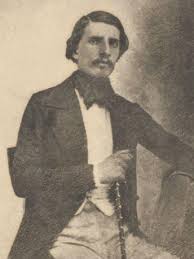
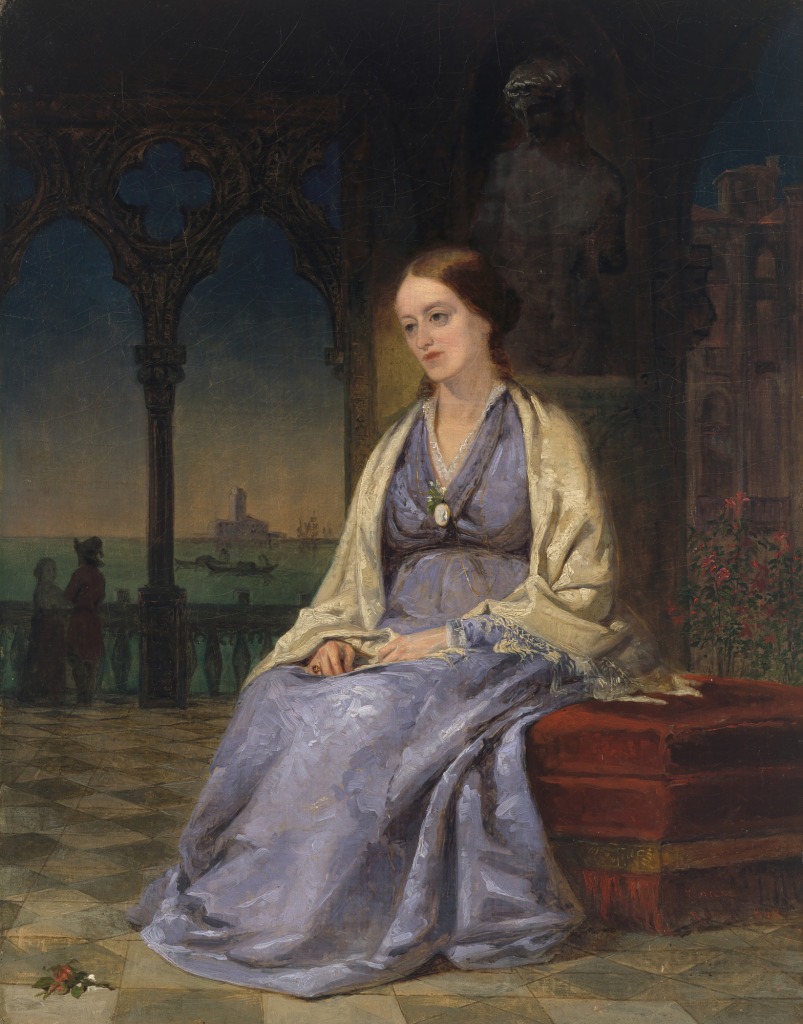
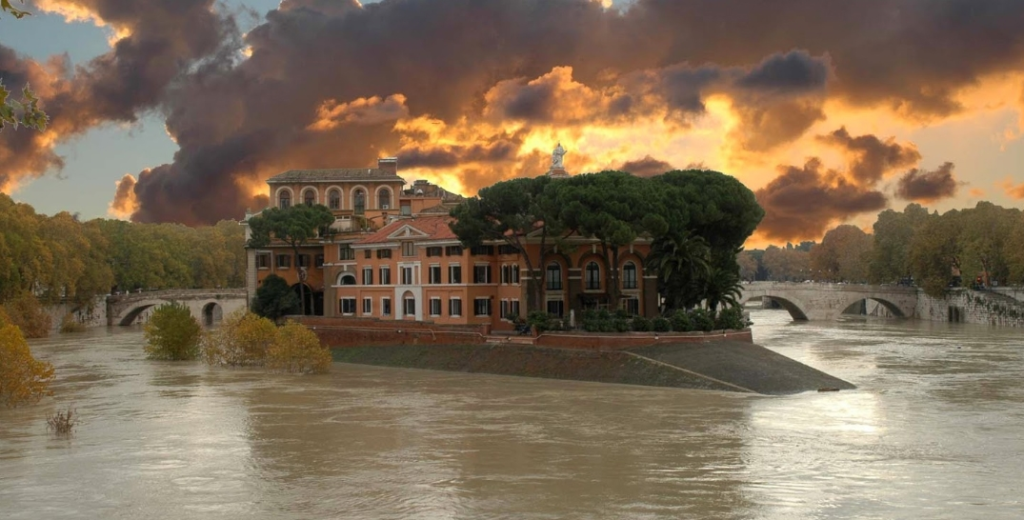
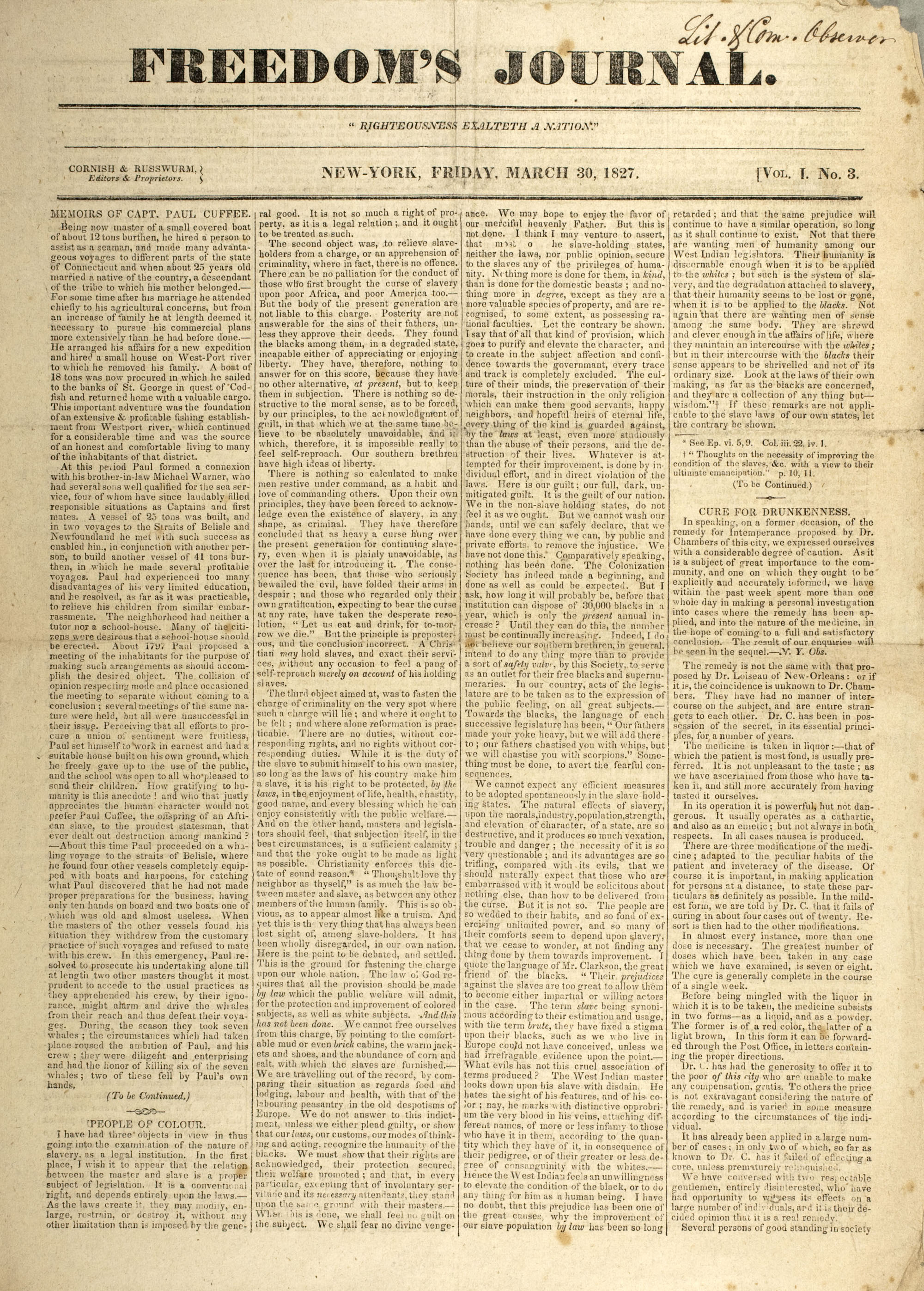
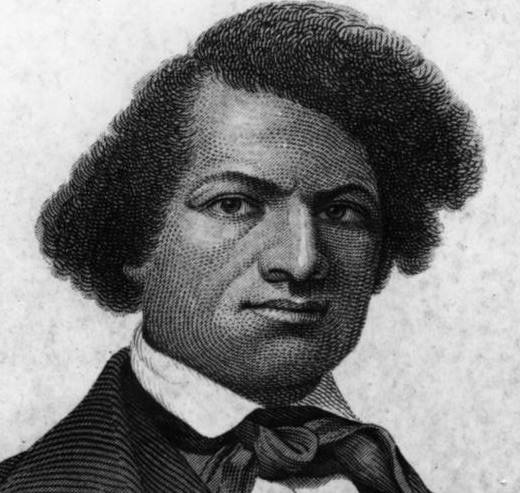
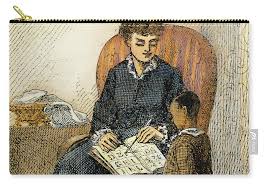
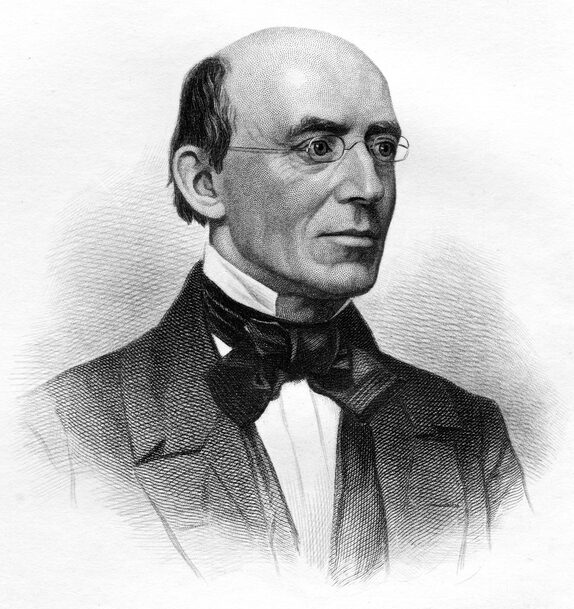
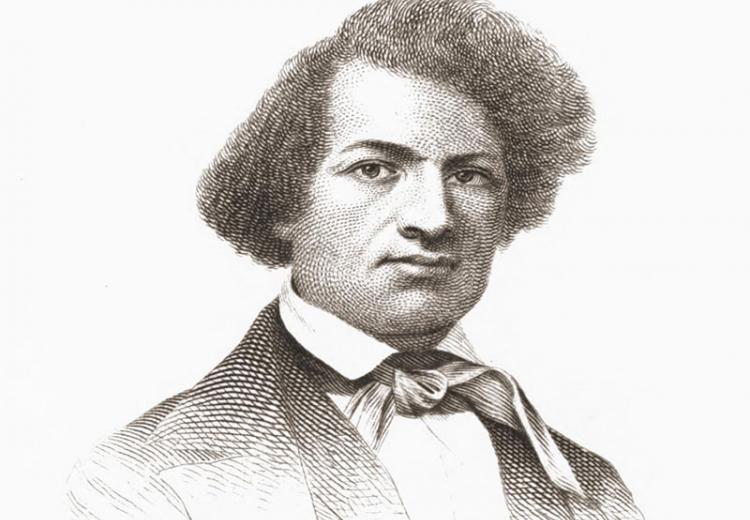

 be proud of their important work. But to make sure that journalism is not misunderstood or undermined by others, these times call for high standards and new approaches. Clearly, Trump cannot be counted on to elevate the discourse, so it will be up to members of the news media to impose discipline, standards, and new protocols.
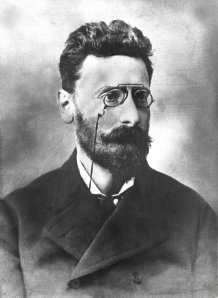 As Joseph Pulitzer, a great publisher and editor who did battle with presidents in his day, defined the stakes in this challenge: “Our republic and its press will rise or fall together.”

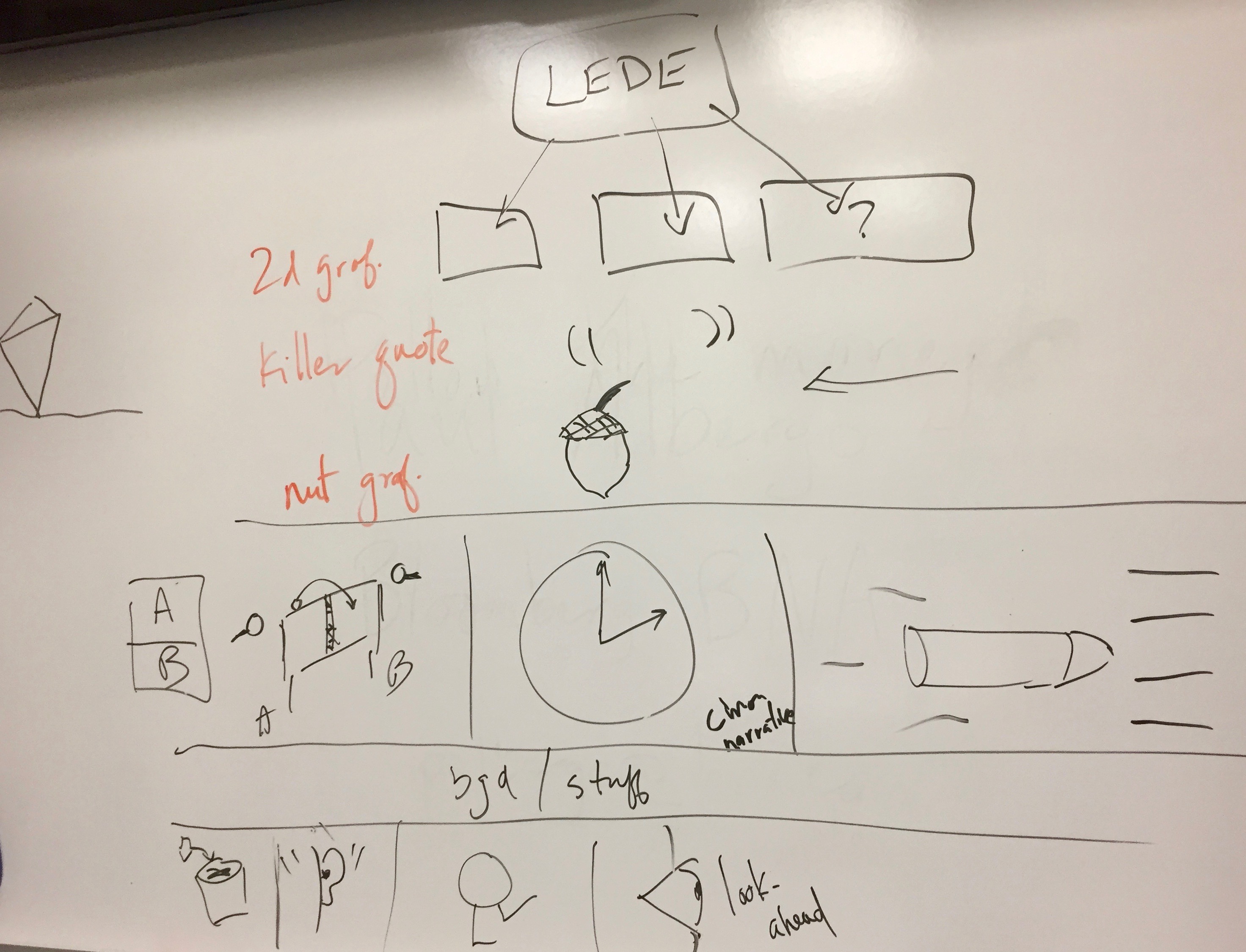
 Prof Chris Daly's Blog