Woody Sez: See this play

By Chris Daly

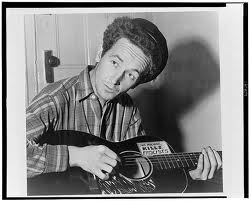
I had the pleasure of seeing a new play/musical revue about Woody Guthrie the other night at the A.R.T. Theater in Cambridge (Mass.). The show, called “Woody Sez,” is a fantastic telling of Woody’s amazing life, mainly through his own songs. It is nearly a one-man show, featuring David Lutken, who is charming and disarming. He is supported by Andy Teirstein, Darcie Deaville, and Helen Jean Russell — all playing a constantly shifting array of acoustic stringed instruments. All told, they use four guitars (including two old Martins), three fiddles, a viola, a dulcimer, a double bass, a mandolin, and a banjo — along with a bunch of non-string instruments, including autoharp, harmonica, pennywhistle, jaw harp and spoons.

The show is a real hoot. (A special treat: seeing more than a hundred or so egg-heads stomping their feet and clapping time to songs like “Union Made” and “Biggest Thing that Man has Ever Done.”)

There were big chunks of Woody’s life that were familiar from reading Woody’s own 1943 autobiography, Bound for Glory, as well as Joe Klein’s 1980 biography, Woody Guthrie: A Life. Still, “Woody Sez” managed to bring up material that was new to me.  I had never noticed how much Woody suffered. Like another great American original , Mark Twain, Woody knew terrible suffering, early and often throughout his life.

Many thanks to David Lutken and his collaborator, Nick Corley for putting this together, and for getting it on-stage in time for the centennial of Guthrie’s birth, which is coming up on July 12.

My only issue is that I would love to see this show break out of the confines of a pricey theater like the A.R.T. and get into every high school, dance hall, barn, and fire station in the country. That’s where this music really belongs.

Leave a comment

Filed under Uncategorized

AP Apologizes for WWII Blunder

By Chris Daly

I was very pleased to see that my old employer, The Associated Press, finally did the right thing and apologized to a great correspondent who was wronged in 1945 as he broke the news about the end of the fighting in Europe. The apology came earlier this week on the 67th anniversary of the surrender of Germany.

Settle in: There’s quite a story behind the story of the end of the fighting in World War II in Europe. The date of the official celebrations was May 8, 1945, known as V-E Day, for victory in Europe. Much fighting remained to be done in the Pacific, where Japan was still refusing to recognize the now-inevitable Allied victory.

Back to Europe.

In early May, 1945, the Supreme Headquarters of the Allied Expeditionary Forces (SHAEF) command selected 17 correspondents from the world’s press and flew them to Riems, France to witness the surrender on behalf of the rest of the press and the people of the world.

There were very few Americans in the group. The ones who were there represented the big wire services and syndicates. In fact, not a single reporter representing a U.S. newspaper was present.

According to the allied military commanders, the news was to be embargoed: that is, you had to accept a deal. In exchange for access to the event, you had to agree to hold the news until the Army said you could release it. The SHAEF press officer said: “I pledge each one of you on his honour as a correspondent and as an assimilated officer of the United States Army not to communicate [the news] until it is released on the order of hte Public Relations Director of SHAEF.”

It remains unclear what constitutes an “agreement” under such conditions (what were the correspondents supposed to do — get up and walk out of an airplane?), but they proceeded to witness the ceremony.

The surrender by the German high command came in the early hours of May 7. Ordinarily, you might expect that the surrender would touch off immediate celebrations.

Not so fast.

The press officer announced that orders had come “from a high political level” to impose a news blackout until 8 p.m. the next day, when the news would be announced simultaneously in Paris, London, Moscow and Washington. (Turned out, Stalin was insisting on the delay so he could make a show in Berlin.) In other words, all the correspondents who had been eyewitnesses would lose their scoops. Instead, some desk-bound rewrite man or editor would get all the glory. The reporters protested tothe SHAEF press officer, but to no avail. The political leaders had decided.
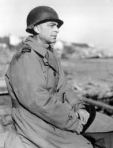
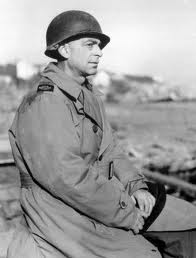
Ed Kennedy, the Paris bureau chief for the AP and a veteran of coverage of the North Africa and Italian campaigns.

Among the press corps, one of the most upset was Edward Kennedy — not the late Democratic senator from Massachusetts but a man by the same name who was the chief correspondent in Europe for the AP. Bear in mind, Kennedy was in a special position. He had been burned earlier in the war when he cooperated with military brass. In 1943, Kennedy had agreed to suppress a story about Gen. George Patton and had gotten scooped by someone else. (See my book, Covering America, pgs 269-70.) Kennedy also knew that his account of the German surrender could probably reach more people on the planet than any other. He knew, too, that the AP thrives on being first and that throughout the ages, AP men (and a tiny but growing number or women) had gone to great lengths to be first to deliver the news.

Besides, he figured, no embargo on such a momentous story could hold for that long. (Nor, perhaps should it.) He was still fuming when the correspondents were marched back onto the military plane. They were flown from Reims back to Paris. Still, the world knew nothing of the surrender. Still, soldiers in Europe kept shooting at each other.

When they landed, Boyd Lewis of United Press got the first jeep from the airport to the Hotel Scribe in Paris, which had been serving as the outpost for most of the press corps. When Lewis got to the press center, he tried to tid up all the available telegraph outlets. Next in line was James Kilgallen of INS, who had beaten Kennedy to the spot by throwing his typewriter at Kennedy’s legs, slowing him down.

Kennedy was beside himself. Then he heard that SHAEF had ordered German radio to announce the surrender.

Kennedy went to the censors and announced that he was breaking the embargo. Using a telephone, he called the AP bureau in London and dictated the following lead:

REIMS, France, May 7_Germany surrendered unconditionally to the Western Allies and the Soviet Union at 2:41 a.m. French time today.

The surrender took place at a little red schoolhouse that is the headquaters of Gen. Dwight D. Eisenhower…..

Within minutes, the news was flashed to the world, and wild celebrations began.

SHAEF was furious and suspended AP filing facilities throughout Europe. The rest of the press corps was furious, too. More than 50 correspondents signed a protest to SHAEF Supreme Commander Dwight Eisenhower, calling Kennedy’s action “the most disgraceful, deliberate and unethical double cross in the history of journalism.”AP’s president apologized to the nation. AP brass told Kennedy he could keep his job if he admitted he had done wrong. He wouldn’t and was fired.

What might seem amazing today — aside from the lack of cell phones and other forms of instant global communication — is how unanimously the correspondents fell in line with the military. Today, I dare say, U.S. reporters would be at least split about the ethics of something that they new to be both true and life-saving.

Two weeks later, writing in The New Yorker, A.J. Liebling, the great World War II reporter and press critic, took up the issue of Kennedy’s firing in his column “The Wayward Press.” (May 19, 1945) Liebling’s take:

The great row over Edward Kennedy’s Associated Press story of the signing of the German surrender at Reims served to point up the truth that if you are smart enough you can kick yourself in the pants, grab yourself by the back of the collar, and throw yourself out on the sidewalk. This is an axiom that I hope will be taught to future students of journalism as Liebling’s Law.

I certainly teach it that way. His piece continued:

I do not think that Kennedy imperiled the lives of any Allied soldiers by sending the story, as some of his critics have charged. He probably saved a few, because by withholding the announcement of an armistice you prolong the shooting, and, conversely, by announcing it promptly you make the shooting stop. Moreover, the Germans had broadcast the news of the armistice several hours before Kennedy’s story appeared on the streets of New York. . . The thing that has caused the most hard feeling is that Kennedy broke a “combination,” which means that he sent out a story after all the correspondents on the assignment had agreed not to. But the old-fashioned “combination” was an agreement freely reached among reporters and not a pledge imposed upon the whole group by somebody outside it.

There’s a lot more to learn from Liebling’s piece, but that’s the nub.

I wonder how Liebling would greet the news this week that the AP has finally apologized to Kennedy. I wonder how Kennedy, who died in 1963, would have greeted the news. (For more on Kennedy, see the newly published memoir Ed Kennedy’s War: V-E Day, Censorship, and the Associated Press.

As for me, I say the AP was late — 67 years late.


Leave a comment

Filed under history, Journalism, journalism history, Uncategorized

New Bradlee biography

By Chris Daly 

Disclaimer: I have not read the new biography of Ben Bradlee by Jeff Himmelman, called Yours in Truth. I am merely passing on a review, by Jack Shafer.

Shafer, who is hardly a sentimentalist, makes an important point midway through the review about the Woodward&Bernstein’s book All The President’s Men, which is their version of their Watergate reporting.

Here is the take-away from Shafer’s recent piece for Reuters:

Say what you will about Woodward and his reportorial techniques—and many journalists and scholars have weighed in—All the President’s Men has withstood rigorous scrutiny over the past four decades. Entire books have been dedicated to its examination. While its treatment of Watergate is not complete or perfect, the book is a powerful document of the investigation.

One of the more appealing aspects of All the President’s Men is the authors’ willingness to portray themselves in a less-than-flattering light. Bernstein is shown trampling ethics and possibly breaking the law by asking an employee at a credit card company, and another at a telephone company, to lift records. Woodward repeatedly expands his agreement with Deep Throat, phoning him after promising to stay away from the phone and quoting him anonymously in the paper after vowing never to do so. And by quoting Deep Throat at length, All the President’s Men violates the sourcing arrangement completely.

It needs to be said: after more than three decades, no jealous journalist (or bitter conservative) has poked any serious holes in ATPM or done anything like a knock-down. The story stands.

Leave a comment

Filed under Journalism, journalism history

Why don’t men wear hats?

By Chris Daly 

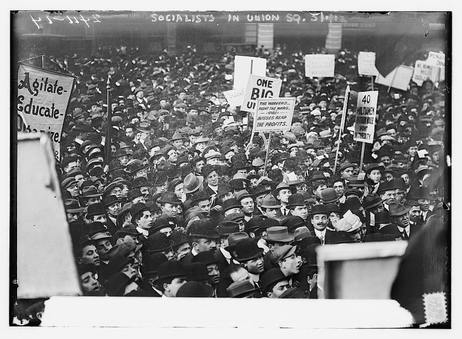
Union Square Rally, 1912 (Library of Congress)

Now, we have the answer — or at least, an answer — from the reliably delightful Robert Krulwich. The culprit: Dwight Eisenhower, who did in fact wear hats from time to time. Ike’s role in eliminating the hat was more roundabout, according to Krulwich. Ike is credited with launching the Interstate Highway system,which made the automobile the No.1 way of getting places. The automobile, in turn, actually did in the hat, because the typical car does not have enough room above the occupants’ heads to accommodate a real hat.

Seems plausible enough to merit a hat-tip for Krulwich.

3 Comments

Filed under Uncategorized

Another view of Murdoch

By Chris Daly

Don’t say this blog is one-sided, even on the subject of Rupert Murdoch. The British writer William Shawcross recently stuck up for Murdoch in this piece in the Guardian.

Shawcross, who wrote a 1992 biography of Murdoch, is in a position to comment. I just disagree.

Here’s the take-away from Shawcross:

Rupert Murdoch has been the bravest and most radical media owner in Britain in the last 40 years.

There are caveats. It is insupportable for any tabloid, whether the Sun, the NoW, the Mirror or the Mail to “monster” individuals. But tabloids are an essential part of a vibrant market and the Sun is an excellent paper, catering well to its audience.

Without Murdoch there could never have been such a varied newspaper market in Britain during the last 25 years. Newspapers were dying until he confronted and defeated the greedy print unions. Only after his victory at Wapping did newspapers – on the left as well as on the right – have the chance to flourish. Murdoch’s purchase of Times Newspapers saved that company. It’s hard to think of any other proprietor who would have sustained its huge losses year after year.

Leave a comment

Filed under broadcasting, Journalism, journalism history, publishing

CNN: the “E.R.” of TV news?

By Chris Daly

Insightful piece today by Brian Stelter in the Times. It raises the question: Is CNN like the emergency room of a hospital that cannot fill its inpatient beds? CNN is very busy during crises, but it becomes a lonely place during periods of routine news. That certainly rings true in my experience: on an election night, I’m a visitor of CNN for sure. If I hear a snatch of something startling on the radio and want to hear/see more right away, I will snap on CNN. If all hell is breaking loose somewhere, it’s usually my top choice (certainly far ahead of cable-news leader Fox News, which has so few correspondents who can jump on breaking news).

Fundamentally, this problem has been with CNN almost from the get-go. Here’s an excerpt from my book, Covering America, about the founding of CNN and its basic business problem. 

. . .By approaching cable news this way, [CNN founder Ted] Turner was coincidentally creating a new business model for TV journalism. Unlike the networks, CNN did not plan to build a huge entertainment division that would have to create or bid for programs. And unlike public television, CNN was not dependent on public subsidies, foundation grants, or donations from the audience. Instead, Turner was adapting an older business model from newspapers. In the CNN approach, TV news would be paid for through a “dual revenue stream.” Just as newspapers made money from two sources—advertising and subscriptions—so would CNN. The company would sell ads, and it would also have a steady stream of revenue coming in from the cable operators, who had to pay CNN a few pennies per customer per month, reflecting CNN’s share of the monthly cable TV bills that Americans were getting used to paying. With low costs and two fairly reliable streams of revenue, news on cable just might work.

Ready or not, on June 1, 1980, CNN made its debut. There were the inevitable mishaps (the cleaning lady who walked across the set behind the anchor while the cameras were rolling), but the impressive thing was that it worked. CNN started covering the news that day and has done so continuously ever since—days, nights, weekends, holidays. Only the AP could make a similar claim, (though it supplies news to the industry rather than directly to the public). Soon, Turner was showing the skeptics that it was in fact possible to put news on television round the clock. Yes, it was sometimes raggedy. And yes, there was a lot still to accomplish—including hammering out reciprocal video-sharing agreements with affiliates, hiring more and more staff, opening bureaus around the world. But it worked.

By the end of 1981, CNN was getting established. It was reaching 10 million households and was clawing its way to journalistic parity with the network news divisions.18 One key issue was what is known as “pool coverage.” This occurs in many settings when there is not enough room to accommodate all the media people who wish to cover some location or event, such as a courtroom, a presidential appearance with limited access, or the like. In those cases, the answer is a pool, in which all the journalists in each medium agree to cooperate. Typically, each medium gets to put one representative at the scene. In return for that access, the chosen journalist agrees to share the results with all the other members of the pool in the same medium. In addition, each member of the pool agrees to take a turn in providing the feed. This arrangement assumes, of course, that anyone participating in the pool will produce work of high enough quality to satisfy all the others. CNN was originally scorned by the networks, which refused to let CNN crews participate in the White House television pool coverage. It took a lawsuit (which cost Turner another $1 million), but eventually CNN was allowed in.

One of the early tests of CNN as a news organization came on March 30, 1981. President Reagan gave a speech that day to the AFL-CIO at the Washington Hilton. CNN covered the speech live and then, when it was over, switched to some filler material, about sewing in China. While that was airing, the police scanner in CNN’s Washington bureau barked: “Shots fired . . . Hilton Hotel.” Almost immediately, the veteran newscaster Bernard Shaw sat down in the anchor chair in the CNN Washington bureau and began reporting that shots had been fired at the president—a full four minutes before the networks. Shaw stayed in the chair for more than seven hours, and, with help from Dan Schorr, proved that the fledgling news service could keep up with the established networks. Through the evening, CNN kept breaking in with new details: a picture of the shooter’s home, a report on his motive, pictures of the vice president in Texas heading to Washington. According to one account of that day: “Such details were hitting the air in no particular sequence. CNN’s viewers got the story in the jumbled way a journalist receives fragments of information before transforming them into an orderly, polished report. The ‘process’ of gathering news determined the form in which that news was delivered.” Before CNN, viewers had received their news in measured doses at fixed times; now they were drinking straight from the fire hose.

For years, CNN cost more to produce than it brought in through the combined revenues of cable subscriptions and advertising. The network was burning through Ted Turner’s personal wealth at an unsustainable rate. The early years were a desperate race to get CNN included in enough viewers’ basic cable packages to pay for itself. Most of the costs of gathering and disseminating the news by cable were fixed; the great variable was the size of the audience. Beginning in 1978, from the pre-launch investments in people, property, satellite time, and equipment, CNN lost an estimated $77 million through 1984.20 But then in 1985, CNN began posting profits: $20 million that year and more in the coming years. In the grow-or-die spirit of modern capitalism, Turner soon started thinking about acquiring other businesses. At the same time, a profitable CNN was looking more attractive to other investors, who might try to take it over. By the end of the decade, CNN was earning almost $90 million a year and had an estimated value of $1.5 billion. At the decade mark, on June 1, 1990, it could be seen in 53 million homes in the United States and in eighty-four countries worldwide. CNN had nine U.S. bureaus and another eighteen overseas, with a global total of some 1,800 employees. CNN had arrived. . .


Leave a comment

Filed under broadcasting, CNN, Fox News, Journalism, journalism history, media

“Not a Fit Person”

By Chris Daly 

Well, now it’s official. Something that many people have thought for a long time is now part of the findings of a British parliamentary report: Rupert Murdoch is “not a fit person” to run a globe-straddling, influence-buying, phone-hacking, official-bribing media conglomerate.

Actually, the report released Tuesday may not be Murdoch’s biggest problem. He is already under investigation in the United States as well. Murdoch became a U.S. citizen in the mid-1980s, a move that facilitated his move into American broadcasting (since U.S. law requires that broadcasting remain in the hands of U.S. citizens). Perhaps more serious for Murdoch is the fact that his News Corp. (parent company of the British unit that is in trouble in Parliament) is a U.S. corporation, registered on the New York Stock Exchange. That means that News Corp. is subject to all the laws and regulations of the United States — including the Foreign Corrupt Practices Act. That law, dating to the 1970s, forbids U.S. companies from using their assets to pay bribes to officials in other countries. On the face of it, that would appear to make it a crime in the U.S. for News Corp. employees to do what they have already admitted under oath in Parliament: for years, they paid British police police officials for tips about their investigations.

If I were Murdoch (or even a shareholder in News Corp., which operates Fox News and the Wall Street Journal, among many others), that’s what I would be really worried about.

Recent stories are here, here and here.

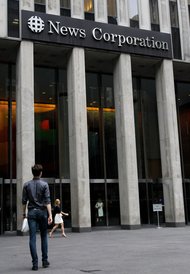
News Corp. world headquarters in Manhattan / Kathy Willens (AP)

Leave a comment

Filed under broadcasting, Fox News, Journalism, journalism history

My book on TV

By Chris Daly

Just learned that my book will be featured on C-Span’s BOOK-TV.

Tune in next Sunday, May 6, at 8 p.m.

Here’s the notice: http://cs.pn/ICYGY2

Sunday, April 29, 2012

U.S. History

“Covering America: A Narrative History of a Nation’s Journalism”

Christopher Daly

About the Program


Christopher Daly, journalism professor at Boston University recounts 300 years of reportage in the United States.  Mr. Daly examines the current arguments that journalism is in danger and points to the numerous obstacles that the news industry has faced throughout its history, which, according to the author, has presented reporters with opportunities to create innovative ways to collect and distribute the news.  Christopher Daly speaks with Nicholas Lemann, dean of the Columbia Journalism School at Columbia University Graduate School of Journalism in New York City.


About the Authors

Christopher Daly


Christopher Daly is the co-author of Like a Family: The Making of a Southern Cotton Mill World.  He has reported for the Associated Press and Washington Post and is currently an associate professor of journalism at Boston University.
Buy the author’s book from: Amazon | Barnes & Noble | Indiebound 

Program Information

"Covering America: A Narrative History of a Nation's Journalism"

Future Airings

  • Sunday, May 6th at 8pm (ET)
Shop C-SPAN Gifts!


Leave a comment

Filed under Uncategorized

New review of “Covering America” Thi –

New review of “Covering America” Thi – – New review of “Covering America” Thi – New review of “Covering America” Th… http://ow.ly/1jdINr

Leave a comment

Filed under Uncategorized

Murdoch scandal (cont.) By Chris Daly –

Murdoch scandal (cont.) By Chris Daly  – – Murdoch scandal (cont.) By Chris Daly  – Murdoch scandal (cont.) By Chri… http://ow.ly/1jdINw

Leave a comment

Filed under Uncategorized