Category Archives: Uncategorized

The war on drone secrecy (cont.)

By Christopher B. Daly

The use of unmanned drones may be a good thing or a bad thing (or, of course, something more complicated). Because that’s the case, the United States needs to conduct a big, loud debate about them — in hearings, in editorials and blogs, in speeches, in debates, on the airwaves, and online. After that, we need to have some elections that will clarify where the people stand.

None of that can happen, of course, if the whole program is a big secret. That is a point being made by a rising chorus of voices. The NYTimes Public Editor, Margaret Sullivan, is stressing it.

And today, NYT media columnist David Carr joins the crowd.

Carr’s column refers to a recent study by Harvard’s Shorenstein Center on the Press, Politics, and Public Policy. If ever there was an issue involving press, politics and public policy, the drone campaign is it. And the report, by Tara McKelvey, is a great primer on the whole issue and the coverage thereof.

Under the Obama administration, the targeted-killing program has
become the centerpiece of U.S. counterterrorism strategy. The Obama White House
program of targeted killing is unprecedented in its mission and scope; moreover, the
administration’s approach to fighting terrorists is likely to be adopted by presidents in
the future, whether Democratic or Republican. For these reasons, it makes sense to
examine the role of media in the public debate about the program and moreover to see
how journalists have fared in their efforts to cover the story of the targeted-killing
program.


imgres

3 Comments

Filed under Uncategorized

Fox News discovers Latinos

By Christopher B. Daly 

From TNR comes a story about Roger Ailes, the CEO of Fox News, and his newfound concern for the Latino viewer/voter.

“The fact is, we have a lot—Republicans have a lot more opportunity for them,” Ailes says. “If I’m going to risk my life to run over the fence to get into America, I want to win. I think Fox News will articulate that.”

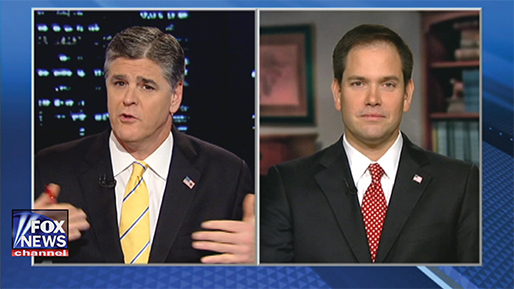
This new policy will require some pivoting by some of Fox’s top stars — notably Bill O’Reilly and Sean Hannity. Both of them were waging war on the air against immigrants for years, right up until the last election proved that there are not enough angry old white people in the United States to win national elections for the Republican Party.

Sean Hannity, appearing with Marco Rubio, now accepts a "path to citizenship" for Latinos and other immigrants.

Sean Hannity, appearing with Marco Rubio, now accepts a “path to citizenship” for Latinos and other immigrants.

In a sense, Fox is in the position that the “party papers” of the early Federal period were in. When a new kind of non-partisan paper came along in the 1830s trying to appeal to everyone, the editors of the party papers realized that their partisanship was placing an arbitrary ceiling on the universe of readers they could possibly appeal to. Therein lay the real origins of “neutral” or “objective” news — the desire to reach larger audiences. If Fox limits itself to Republicans, there is no room for growth. (Similarly, if the GOP limits itself to Fox viewers, there is no room for growth.)

Can moderate Latinos save them both?


Leave a comment

Filed under Uncategorized

How to break into the news business

By Christopher B. Daly

Well, here’s one way:

1. Start off with a career in modeling.

2. Become a Republican.

3. Never work as a reporter/editor/photographer.

4. Join FOX News as a highly paid on-air commentator.

That is the path reportedly being pursued by Scott Brown, according to a story in today’s Boston Globe and elsewhere. Now that Brown, the Republican who lost the 2012 race for U.S. Senate to Democrat Elizabeth Warren, is getting out of politics and becoming a big media star, he don’t need to talk to no stinkin’ reporters:

A Fox spokesman confirmed Brown is in talks to appear on the network, which recently announced it is not renewing contracts with big-name political commentators Sarah Palin and Dick Morris. It was unclear, however, what role Brown might have on the network. Though Brown has told several Republicans that he will have a gig on Fox, the spokesman said the talks are not final.

Brown would not comment to the Globe. When reached Wednesday night, he said, “I am right in the middle of dinner,” and hung up the phone.

All in all, Brown appears to be an example of the power of failing upward. Way to go, Scott.

Unknown

2 Comments

Filed under broadcasting, Uncategorized

Free speech in India

Here is a view from Suketu Mehta, the author of the wonderful book Maximum City, about Bombay.

The takeaway:

This year, the world’s largest democracy ranked a miserable 140th out of 179 countries in the Reporters Without Borders Press Freedom Index— falling nine places from last year. Today, Afghanistan and Qatar have a freer press than India.

In recent years, the government has cast a watchful eye on the Internet, demanding that companies like Google and Facebook prescreen content and remove items that might be deemed “disparaging” or “inflammatory,” according to technology industry executives there.

In November, police in Mumbai arrested a 21-year-old woman for complaining on Facebook about the shutdown of the city after the death of the nativist politician Bal K. Thackeray; another Facebook user was arrested for “liking” the first woman’s comment. The grounds for the arrests? “Hurting religious sentiments.”

Leave a comment

Filed under Uncategorized

Obama: Wrong on secrecy (cont.)

By Christopher B. Daly

Bully for the NYTimes for continuing to try to pry out the details of the Obama administration’s secret policy governing the secret use of drone weapons.

Shame on the Obama administration for continuing to try to stonewall the rationale for the policy. As a citizen, I feel entitled to see the argument for doing this. imgres3

Leave a comment

Filed under Journalism, President Obama, Uncategorized

Washington Post downsizes

By Christopher B. Daly 

Seeing that the Washington Post is planning to sell its downtown D.C. headquarters, I guess I feel like a kid whose parents sell the old family home to move into a condo. It was such a thrill to go there for meetings when I was the paper’s New England correspondent during the 1990s. The Post was still printing money in those days, and there was a great feeling of energy and clout about the place. 

Actually, I remember my very first visit. I was seriously disappointed about the drab appearance of the exterior. It met the street like a cheap commercial building — all concrete and shadows. It made me wish that Mrs. Graham had struck a deal with I.M. Pei to design a headquarters in the shape of a typewriter!

Anyway, all things must pass. And I am sure that the Post offices in DC are more valuable as real estate than as a home for a shrinking workforce.

imgres

Leave a comment

Filed under Journalism, journalism history, Uncategorized

First draft of history?

By Christopher B. Daly

Today’s NYTimes carries a fascinating piece about a subject that has to be a difficult issue for the paper — the New York Times itself. The piece opens with the observation that “Journalism is meant to be the first draft of history” — which is a paraphrase of a quotation usually attributed to Phil Graham, the one-time publisher of the Washington Post, who declared that “journalism is the first rough draft of history.” (It’s curious that today’s Times piece, by Leslie Kaufman, omitted the word “rough,” which certainly belongs in that formulation, as we shall see.)

At issue is a book written in 1964 about the notorious Kitty Genovese murder, by A.M. “Abe” Rosenthal, who is described in today’s news story in the Times Arts section as “a new and ambitious metropolitan editor.” (An aside: when a newspaper calls one of its own “ambitious,” that’s usually a code word for something closer to “ruthless.”) Rosenthal is a legendary figure at the Times, known for ruling the newsroom as the paper’s managing editor for most of the 1970s and executive editor for most of the 1980s. In 1964, Rosenthal had already won the Pulitzer Prize, for his foreign reporting.

Genovese, who was 28, was murdered around 3 a.m. as she was returning from work to her apartment in Queens. She was attacked, stabbed to death, and raped. What happened next imageshelped propel the Genovese case into the realm of urban myth and pop sociology.

Rosenthal, who was an editor, not a reporter, was having lunch one day with the NYC police commissioner, and they were naturally discussing the Genovese case. The commish mentioned that 38 people had witnessed the crime but did nothing to stop it or to summon help. That kind of a fact (if fact it be!) is catnip to a reporter, and Rosenthal was off to the races with a version of the Kitty Genovese story that was almost certainly exaggerated. According to today’s story:

Mr. Rosenthal quickly mapped out a series of articles centered around a tale of community callousness, and then followed in June with his quick-turnaround book, published by McGraw-Hill. National and international interest in the issue spiked, and soon the Kitty Genovese case became a sociological phenomenon studied intensely for clues to behavioral indifference.

Notice, in the above paragraph from today’s story, the use of the words “quickly,” “quick” and “soon.”
images-2In any case, the Rosenthal book about the Genovese case became an overnight  that helped to establish in the public mind the notion that big cities are scary collections of anonymous people who don’t care about each other.

Now comes a publisher, Melville House, which has re-released the Rosenthal book in a digital format, with the original — and misleading — material intact. Let’s not kid ourselves about “digital reissues.” They are a way for publishers to extract some more money out of their backlist titles. Those are books published long ago that they are probably out of print and no one is buying them any more. Along comes the Internet, and those books can get a second life on-line.

Trouble is, what about a non-fiction book that has known errors of fact or interpretation? Should it be re-issued in its original text? Should it be corrected, revised, or updated?

Here’s how the Times puts it today:

In the years since, however, as court records have been examined and witnesses reinterviewed, some facts of both the coverage and the book have been challenged on many fronts, including the element at the center of the indictment: 38 silent witnesses. Yet none of the weighty counter-evidence was acknowledged when Mr. Rosenthal’s book was reissued in digital form by Melville — raising questions of what, if any, obligation a publisher has to account for updated versions of events featured in nonfiction titles.

It could be argued that at a certain point, a work of journalism becomes valuable as an artifact of its own era. It becomes a document (or “primary source”) that allows later generations to look back and understand why people use to share certain beliefs, even if those beliefs are later discredited. So, a historian or anyone else who is curious about the changing perceptions of urban crime during the 1960s would want to read the Rosenthal book in its original form, because it sheds light on its period. That, it seems to me, is a perfectly valid way of thinking about historic works of journalism. All the publisher has to do is to say so.

Alternatively, of course, a publisher could commission someone to produce a “new, revised” version that would update, correct, or revise a flawed original. In that case, future historians will probably want to have access to both the original and the update.

For another perspective, here is a passage from Wikipedia:

In September 2007, the American Psychologist published an examination of the factual basis of coverage of the Kitty Genovese murder in psychology textbooks. The three authors concluded that the story is more parable than fact, largely because of inaccurate newspaper coverage at the time of the incident.[10] According to the authors, “despite this absence of evidence, the story continues to inhabit our introductory social psychology textbooks (and thus the minds of future social psychologists).” One interpretation of the parable is that the drama and ease of teaching the exaggerated story makes it easier for professors to capture student attention and interest.

So, it would appear that there is more revisionism to be done.

[Incidentally, today’s Times story omits another awkward fact: the Times is still something of a Rosenthal paper. Abe’s son, Andrew, is a “masthead editor” at the paper, where he is in images-1charge of the Times‘ editorial pages.]

Leave a comment

Filed under Uncategorized

Book notes

By Christopher B. Daly

A couple of updates from the world of letters:

–My B.U. colleague Amy Sutherland has a Q+A with the estimable Tracy Kidder in the Boston Globe. A brief highlight:

BOOKS: Anything else you avoid?

KIDDER: Most biographies are too long. But I loved “King Leopold’s Ghost” by Adam Hochschild. I don’t want to read any more memoirs about dysfunctional families. I don’t think it’s a form that should be condemmed. It’s just there’s been a surfeit of it.

I certainly agree with his point about biographies: they have become so vast that they are approaching the point where they are both un-readable and un-writable. There are a number of biographies I’d like to read and a handful I’d like to write, but the prospect of either is daunting. Bring back the short biography!

–My friend Amy Wilentz will be speaking this Friday at the Harvard Bookstore at 7 p.m. aboutWilentzAmy_creditPaulaGoldmanher new book on Haiti, which has been getting great reviews. Come if you can.


–I found this review in today’s NYTimes irritating. What bothers me is the premise that Adam Begley brought to his reading of a new history of Venice by Thomas F. Madden, titled Sunken Treasure. The reviewer takes the author to task for writing a book of history that tackles a great subject, synthesizes a tremendous amount of material, and writes a readable version for intelligent general readers. Where’s the harm?

But if it’s new, it’s not innovative. Madden has written a conventional narrative history, sweeping in scope and calmly, blandly authoritative. Though he’s a professional historian who teaches at St. Louis University, he seems more proud of his storytelling than his scholarship.

That view is what drives the mania among academic historians for writing books with novel arguments on arcane subjects. Later in the review, Begley calls Madden a “breezy, cheerful, evenhanded” debunker of myths. Begley begrudgingly allows that the last general history of Venice was written a generation ago, and that book dropped the tale in 1797. Madden has tapped newer research, brought the story up to the present, and done so in an engaging way. Why is that not enough?

Painting by Gentile Bellini/Galleria dell'Accademia, Venice (1496; detail)/Photographed by Erich Lessing, Art Resource, NY

Painting by Gentile Bellini/Galleria dell’Accademia, Venice (1496; detail)/Photographed by Erich Lessing, Art Resource, NY


Leave a comment

Filed under Uncategorized

Deadly weapons

By Christopher B. Daly

I have ready access to a device that can kill people. Sure, it was built for other purposes, but it can kill people — potentially lots of people.

This device is dangerous. Because it is so dangerous, people (acting through their governments) have taken steps to minimize the danger:

–As a user, I have to take lessons and prove to a police officer that I can handle this device.

–I have to submit to a government-run eye exam.

–I have to pay for a license and carry it any time I use this thing.

–I have to pay (a lot) for insurance in case I accidentally hurt someone.

–The device itself must be registered with the government.

–Every year, I have to let a stranger handle it and prove that it is in good working order.

–I have to take steps to make sure this thing is never stolen, by locking it and by installing special equipment to deter thieves.

–I have to pay taxes to help make these things safer.

–If I want to sell an old one, I can go to the private re-sale market, but the new owner has to have a license, pass inspection, etc.

–If I get too old to handle it or lose my eyesight, there goes my license.

–I cannot just hand one to a child.

–Every time I use this thing, I am subject to being watched by a police officer; if I do anything wrong or if any of my safety equipment is not working, I am subject to immediate detention.

What is it? It’s an automobile.

So, if we can live with these kinds of restrictions on our cars, why can’t gun owners accept some reasonable limits on their guns? (Not a ban, just some common-sense rules for safety.)

From the CDC’s latest national annual figures:

Deaths from motor vehicles:  34,485

Deaths from firearms:  31,347


2 Comments

Filed under Uncategorized

In China’s censorship struggle, who’s a liberal?

By Christopher B. Daly 

The struggle over censorship continues in China. While it plays out, American journalists are struggling over political nomenclature.

This has been a problem since early in the 20th Century, when first the Russians and later the Chinese and others had communist revolutions. After that point, those former insurgent leftists became the establishment (with a vengeance, to be sure). They often faced right-wing opposition, which wanted to reverse those revolutions and restore the old (dictatorial) regimes.

But at a certain point, those old communist regimes faced a new insurgency — call it “progressive” perhaps? — that was not counter-revolutionary but was not happy either.

In Russia, in eastern Europe and elsewhere and now in China, people began to challenge the regime on the grounds that they wanted real liberation. They demanded such things as:

–rule of law

–accountability of government officials

–free and fair elections

–transparency

–free speech & press

–economic opportunity

Many of these demands overlap with the cluster of values often associated with classical “liberalism” in the West. But the term “liberal” was re-purposed in the 20th Century to refer to people like FDR who support the use of government power to intervene in the industrial economy in the interest of full employment and economic security for all.

So, by either definition, it makes little sense to refer to those brave Chinese demanding press freedom as “liberals.” They are not exactly “leftists” either, at least not by most definitions. (Granted, they are, in some ways, to the left of the putatively leftist regime they are challenging, but in terms of political labels, it’s pretty hard to put these people to the left of Mao.)

They are certainly not Communists or communists, either.

It often makes sense to call them “critics,” but then China has right-wing critics too. Journalists often fall back on the all-purpose “dissident,” which has its uses and may not be the worst label, in a pinch.

But this is not a simple question, and it appears to need an answer, judging from the comments accompanying today’s Times story. But it will have to wait. Far more urgent, of course, is the issue of ending censorship.


2 Comments

Filed under Uncategorized