I’ll leave it to my friend
John Carroll
to analyze the dust-up between the Boston Globe and the Boston Herald over whether former senator Scott Brown is or isn’t still working for Fox News. (Short answer: he is.) No doubt that’s coming later today.
So just a quick observation. On Wednesday the Globe’s Joshua Miller quoted an unnamed source at Fox who told him that Brown was “out of contract,” thus fueling speculation that Brown was about to jump into New Hampshire’s U.S. Senate race. It turns out, according to the Herald’s Hillary Chabot and Miller’s follow-up report, that Brown was merely between contracts, and that he’s now re-upped.
If I were Miller or an editor at the Globe, I would love to be able to point to a named source at Fox for passing along information that may have been technically accurate but was not actually true. But…
A hat-tip to the now-estimable Southern Oral History Program, which once operated out of the smallest room on the campus of UNC-Chapel Hill, back in the early 1980s, when I worked there briefly as a researcher/cataloguer.
The program, founded 40 years ago and directed for decades by Prof. Jackie Hall, has grown into a powerhouse of teaching and conducting oral history. Among many projects is one involving journalism history. The SOHP’s “Media and the Movement” blog contains links to audio clips, photos, video, and more. It’s a great resource for anyone interested in the journalism of the “long civil rights movement” in the United States.
[p.s. So pleased to see that the motto of the SOHP is this quote from textile millworker Nell Sigmon: You don’t have to be famous for your life to be history. My co-authors and I used that very quote as an epigram in the Preface to our book Like A Family, a history of the industrialization of the South, which grew out of the SOHP in the 1980s.]
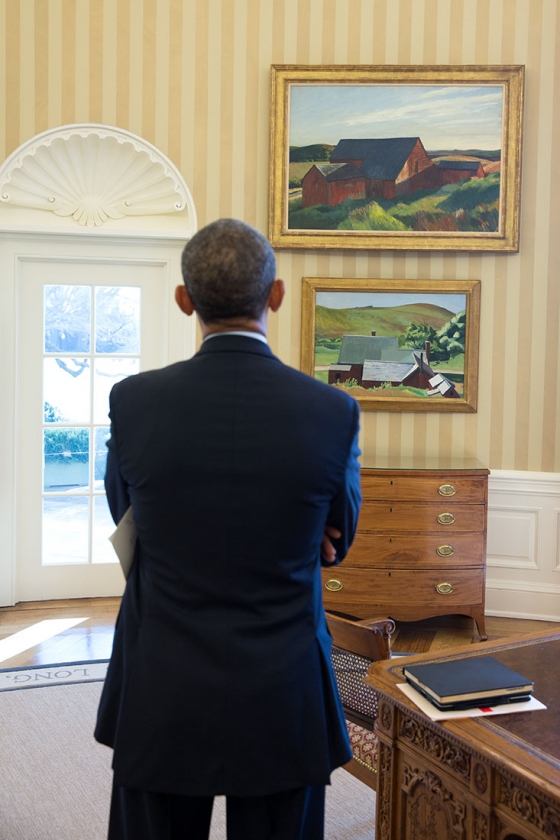
Without waiting for congressional approval, President Obama recently took an executive action to change up the art work that he looks at during his long work days in the Oval Office. Since last week, there have been two landscapes by Edward Hopper in the room — on loan from the Whitney Museum in NYC. The paintings, classic Hoppers from the 1930s, show the rural landscape on outer Cape Cod.
Wishing he could get away?
As it happens, I visited the Whitney myself a couple of weeks ago and roamed around in the permanent collection, which does indeed contain some terrific Hoppers. One of my favorites is this self-portrait, which I took a picture of. Here’s a detail:
I’m not sure it should hang in the Oval Office, though. I think I would find those eyes impossible to ignore, and I’d get nothing done.
Here’s the scoop on the Oval Office artwork, from William G. Allman, the White House curator, writing on the White House blog:
New Additions to the Oval Office
Two paintings by Edward Hopper (1882–1967), widely recognized as one of the most significant artists of the 20th century, were hung in the Oval Office on Friday, February 7, 2014. Cobb’s Barns, South Truro,and Burly Cobb’s House, South Truro — oil on canvas works painted in 1930-33 on Cape Cod — have been lent by the Whitney Museum of American Art in New York, the world’s largest repository of Hopper’s works.
Before building a house on Cape Cod in 1934, Hopper and his wife rented a hillside cottage for four summers. From that house, Hopper executed a series of paintings and drawings of the buildings on their landlord’s farm below, exploring the structures from several angles and at different times of the day.
Emblematic examples of his work, the two paintings lent by the Whitney Museum capture the strong sense of atmosphere and light as well as the empty stillness that characterize much of Hopper’s imagery. They also demonstrate Hopper’s fascination with the various forms of this country’s vernacular architecture — a subject he would return to again and again, resulting in some of the most enduring images of American art.
The Hopper paintings, hung one over the other at the southeast side of the room, add to the breadth of American paintings represented in the Oval Office today:
George Washington by Rembrandt Peale, c.1823 Abraham Lincoln by George Henry Story, c.1915 (from life studies painted in 1861) The Three Tetons by Thomas Moran, 1895 The Avenue in the Rain by Childe Hassam, 1917 Statue of Liberty by Norman Rockwell, 1946
All five of these works belong to the permanent White House collection, which does not include any works by Edward Hopper. Another notable change to the items hanging in the Oval Office is the removal of a rare printed copy of the Emancipation Proclamation signed by President Abraham Lincoln. As a document on paper, it needed prolonged rest from further exposure to light. As a loan to the White House, its preservation required its removal.
Here’s the most prominent part of the homepage for today’s Washington Post, the morning after a state dinner held at the White House for prominent French bachelor Francois Hollande.
That headline: “D.C. royalty turns out for state dinner” is a stunner.
Royalty? Really? The word is not even placed inside quote marks. Just presented as a matter of fact? Aw, c’mon.
We all know that Post editors intend it as a kind of shorthand for the American establishment (which, btw, includes a lot of people who live far from the District in such remote outposts as New York, Hollywood, and Kentucky).
It would be tiresome and pedantic to point to the U.S. Constitution, Article I, Sec. 9:
No Title of Nobility shall be granted by the United States: And no Person holding any Office of Profit or Trust under them, shall, without the Consent of the Congress, accept of any present, Emolument, Office, or Title, of any kind whatever, from any King, Prince, or foreign State.
That about covers it. How could anyone at the Post seriously entertain the notion that the guests at the White House constitute “royalty”? Have they been watching too much “Downton Abbey”? Or, do they really think they are that special? The Post certainly didn’t help itself today, especially among us citizens peasants out in the provinces.
Vive la Republique!
==========
In other social notes: I see that among the guests was Jill Abramson, the NYTimes executive editor. According to the official guest list from the White House, her escort was not her husband (Henry Griggs) because most guests are invited alone and paired with another guest. Jill was paired with a man named William Woodson, who was not further identified. Was it the author or the actor?
Journalism has been called (perhaps aspirationally) as a “discipline of verification.” In their very useful bookThe Elements of Journalism, Bill Kovach and Tom Rosenstiel devote a chapter to arguing that journalism, at its best, shares a methodology with such empirical disciplines as history, social science, and even the hard sciences. The point is that all those fields are trying to gather true data about the real world, and they all recognize the necessity to test and validate their findings.
Today’s NYTimes op-ed page brings two cases in point.
First, a column by Paul Krugman in which he cites a classic case of verification carried out in the wake of the (official) Republican response to the president’s State of the Union speech. Republican Rep. Cathy McMorris Rodgers, R-Wash., related an anecdote about “Bette in Spokane” as a cautionary tale against the president’s signature Health Care program. Turns out, Rep. Rodgers was presenting Americans with what might generously be considered an interpretation of the plight of “Bette from Spokane” — one that omitted some facts.
Some journalists decided to fact-check the congresswoman’s version of Bette’s story, and thank goodness there are some reporters around who can still handle such an assignment. As so often happens, the task fell to the local newspaper, The Spokesman-Review. In a recent story, reporter David Wasson tracked down the Republican poster gal and found the real-life Bette Grenier. So far, so good.
Here’s Krugman’s version of the paper’s findings:
Bette’s tale had policy wonks scratching their heads; it was hard to see, given what we know about premiums and how the health law works, how anyone could face that large a rate increase. Sure enough, when a local newspaper, The Spokesman-Review, contacted Bette Grenier, it discovered that the real story was very different from the image Ms. McMorris Rodgers conveyed. First of all, she was comparing her previous policy with one of the pricier alternatives her insurance company was offering — and she refused to look for cheaper alternatives on the Washington insurance exchange, declaring, “I wouldn’t go on that Obama website.”
Even more important, all Ms. Grenier and her husband had before was a minimalist insurance plan, with a $10,000 deductible, offering very little financial protection. So yes, the new law requires that they spend more, but they would get far better coverage in return.
So, a hat-tip to David Wasson and his paper for supplying the wider factual base from which we can all draw our own conclusions. In my view, it would seem that Bette and her husband were playing roulette with their old policy (with that $10,000 deductible, they were basically un-insured) and that they are now able to do much better.
Second case:
The Times carries an op-ed advocating for genetically modified wheat. The argument is made by a professor from Oklahoma State (Jayson Lusk, a GMO advocate) and a fellow at the conservative Hoover Institution (Henry I. Miller, a co-author of a book trying to debunk what he calls the “Frankenfood myth.”)
They are, of course, entitled to their views. But they are not entitled to their own facts. They begin their argument by stating that GMO versions of corn and soybeans are making money for U.S. farmers and boosting the productivity of American farmland. The way those plants to do that is by containing a gene inserted into them by ag-scientists that makes them resistant to herbicides such as Monsanto’s Round-Up.
The authors go on to note that while most corn and soybean have now been modified to allow them to survive herbicide treatments on their fields, wheat has not been subject to genetic modification — for the simple reason that a lot of American wheat is exported, and consumers in other countries don’t want to buy GMO wheat.
The authors go on to make the case for GMO wheat — not, however, on the grounds that it is resistant to herbicides but on the grounds that it is resistant to drought. That may well be true, and I would like to see some facts that bear on the question. But it is not really fair to switch the terms of the argument in the middle. I wish the Times‘ editors had raised some of these questions, and now I hope they will invite an op-ed reply from someone with a different perspective.
Farewell to a great American. His life was so big and not just because he lived to age 94. He had careers multiple careers, and regular people would be proud to had any one of them.
As a young man, he wanted to be a journalist (about which more later), but he had to settle for music. Oh, well.
After dropping out of Harvard, he helped Alan Lomax to capture and document the roots of American music, including “race” and “hillbilly” music.
He joined the show “Back Where I Come From” and performed with an integrated cast at the White House.
He served in the military during World War II on Saipan in the Pacific.
He founded two terrific folk music groups: The Almanac Singers and The Weavers, which had a chart-topping hit with Leadbelly’s “Goodnight, Irene” in 1950.
He was blacklisted as a suspected communist.
Pete’s banjo
He popularized the five-string banjo.
He wrote “If I Had a Hammer,” “Turn, Turn, Turn” and “Where Have all the Flowers Gone” and a bunch of other songs that are already classics. He also helped to revive “We Shall Overcome.”
He served as a bridge from Woody Guthrie to Bob Dylan, Bruce Springsteen, and a host of others.
He spearheaded the drive to clean up the Hudson River.
All the way, he kept on raising hell and fighting the good fight.
As I said, any one of those would serve as a claim to fame.
Back to journalism:
One of my favorite songs performed by Pete was “Newspapermen Meet Such Interesting People.”
Here’s a version:
Pete sang it, but he didn’t write it. It was written by an actual newspaperman, Vern Patlow. Here’s a version on which Patlow sings:
IN case you missed any, here are the lyrics:
Oh, newspapermen meet such interesting people!
He knows the low-down (now it can be told).
I’ll tell you quite reliably off the record
About some charming people I have known,
For I meet politicians, and grafters by the score,
Killers plain and fancy, it’s really quite a bore.
Oh, newspapermen meet such interesting people!
He wallows in corruption, crime, and gore.
Ting-a-ling-a-ling, city desk;
Hold the press, Hold the press;
Extra! Extra! Read all about it!
It’s a mess, meets the test.
Oh, newspapermen meet such interesting people!
It’s wonderful to represent the press.
Now, you remember Mrs. Sadie Smuggery.
She needed money for a new fur coat.
To get insurance, she employed skullduggery.
She up and cut her husband’s only throat.
She chopped him into fragments, she stuffed him in a trunk.
She shipped it all back yonder to her uncle in Podunk.
Now, newspapermen meet such interesting people!
It must have startled poor old Sadie’s unc.
Ting-a-ling-a-ling, city desk;
Hold the press, Hold the press;
Extra! Extra! Read all about it!
It’s a mess, meets the test.
Oh, a newspaperman meets such interesting people!
It’s wonderful to represent the press.
Now, newspapermen meet such interesting people!
I’ve met the gal with million-dollar knees.
Oh, so the guy who sat five years upon a steeple;
Just where the point was I could never see.
Yes, I’ve met Capone and Hoover, and lots of other fakes.
I’ve even met a genius who swallows rattlesnakes.
Oh, a newspaperman meets such interesting people!
The richest girl who could not bake a cake.
Ting-a-ling
Ting-a-ling
Ting-a-ling
Now, newspapermen are such interesting people!
They used to work like hell just for romance,
But finally, the movies notwithstanding,
They all got tired of patches on their pants.
They organized a union to get a living wage.
They joined with other actors upon a living stage.
Now newspapermen are such interesting people,
When they know they’ve got a people’s fight to wage.
Ting-a-ling-a-ling, Newspaper Guild,
got a free new world to build;
Meet the people, that’s a thrill,
All together fits the bill.
Now, newspapermen are such interesting people!
It’s wonderful to represent the Guild.
Oh, publishers are such interesting people!
Their policy’s an acrobatic thing.
They claim they represent the common people.
It’s funny Wall Street never has complained.
But the publishers have worries, for publishers must go
To working folks for readers, and big shots for their dough.
Now, are publishers are such interesting people!
It could be press-titution, I don’t know.
Ting-a-ling-a-ling, circulation.
Ting-a-ling-a-ling, advertising
Get those readers, get that payoff
What a headache, what a mess.
Oh, publishers are such interesting people!
Let’s give three cheers for freedom of the press.
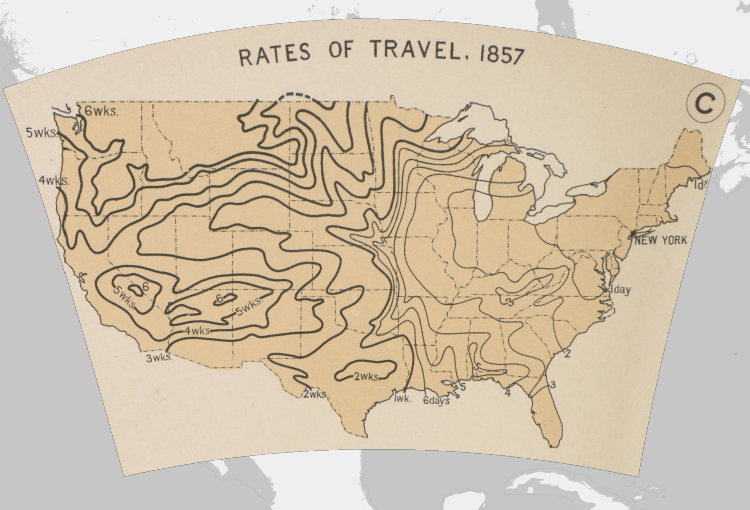
A big hat-tip to The University of Richmond for its excellent work in digitizing an important collection of historical maps of the United States. The source material is the great Atlas of the Historical Geography of the United States, published in 1932 by scholars Charles O. Paullin and John K. Wright. Now, the maps have been digitized, so they are much more accessible and actually more informative, since some of the changes those old maps documented can now be animated.
Credit goes to the Digital Scholarship Lab and the Mellon Foundation.
Here are two of my favorites:
1. This one shows rates of travel as of 1857, taking New York City as the starting point. It allows you to see how far apart different places in America were near the eve of the Civil War.
2. This one shows how wealth was distributed in 1880. Surprise: Nevada had the highest per-capita wealth, probably because it had so many silver mines and so few people.
Thanks to my colleague John Wihbey for this beautiful reminder of the life and work of Aaron Swartz, the Internet activist and transparency advocate who committed suicide a year ago as he was facing excessive federal criminal charges brought by an over-charging, over-zealous federal prosecutor. Wihbey, who runs the Journalist’s Resource at Harvard and teaches journalism at Boston University, wrote in his op-ed in today’s Boston Globe:
His posthumous celebrity aside, two ideas that guided much of his short life’s work are worth considering: academic open access and open government.
A powerful line of inquiry informed Swartz’s thinking: What should be in the public domain, and what might properly remain closed or proprietary? These are not abstract issues: Access to knowledge empowers people in a very real sense — and the lack of access disempowers them. Increasingly, the status of information becomes a question of equality, and a moral issue.
The concept of “open access” was born long before Swartz downloaded that first set of JSTOR articles in fall 2010, but has accelerated since. Research suggests that perhaps half of all new studies can be accessed for free, but important material remains costly. Even large libraries struggle to pay escalating fees from publishing companies.
The Pew Research Center has found that nearly three-quarters of Americans look for health care information online; a quarter of those report running into an online paywall. Only 2 percent end up paying the fee demanded by publishers, often $30 or more for a study. The National Institutes of Health database now houses more than 2 million open articles, but more than 20 million are locked away elsewhere.
Open government was also an area of intense interest to Swartz. He worked to improve access to public-domain materials — for example, downloading and providing free access to federal court records, for which the government had been charging. In the Obama era there has been much hype around open government, yet progress has been halting. A new investigation by the Center for Public Integrity found that the information practices of the Federal Election Commission, a crucial window into our political campaigns, remain woeful. Even good-faith technical efforts, such as Data.gov, have had mixed success.
To honor Aaron Swartz, we should all try to carry on his important work and help realize the promise of the internet for all.
You may think you are a sovereign citizen of a free country. You may think that “we, the people” rule through elected representatives who are accountable to us. But that would be wrong.
The latest affront to self-government is a ruling issued by a federal appeals court on Friday (beware of Friday rulings). Here’s the background:
Thanks to accused leaker Edward Snowden, we know that the U.S. government runs a secret program in which the government calls on the telephone companies to hand over information about you without a court order or subpoena, even if you are not suspected of any wrongdoing. You were not supposed to know about it, but that cat is now out of the bag.
So, you might want to know where the government gets off concocting such a scheme and how it could possibly square such massive, secret, peacetime spying on law-abiding citizens with the Constitution. Well, too bad. The Obama administration’s lawyers, who wrote a memo in 2010 attempting to justify the whole thing, decided that the memo itself should be kept secret, and President Obama agrees.
The Electronic Frontier Foundation and others filed suit seeking to get access to the memo. The government refused. On Friday, Judge Harry T. Edwards said no. EFF can’t see it and neither can we, the people. According to a link-rich story in today’s Times by the redoubtable Charlie Savage, the ruling seems likely to stand.
This is just the latest cause for disappointment in President Obama when it comes to transparency and press freedom. If he wanted to really serve those great causes, he could:
–stop prosecuting and issuing subpoenas to reporters at an unprecedented pace
–stop over-classifying new material as “secret”
–begin reducing the backlog of classified materials that can be de-classified with no harm
–adopt the common-sense reforms recommended by his own task force on surveillance issues.
There are many things to admire about Barack Obama, but his record in this area is not one of them Perhaps it confirms that the Founders were right to be suspicious of executive power per se, regardless of the individual wielding that power. They saw, rightly, that power is by its very nature aggressive, always seeking to expand and never yielding unless forced to do so.
Today’s NYTimes greets the new year with a dismaying (though hardly surprising) story about the ways in which the NCAA extends its corrupting reach into college classrooms. It’s an extreme version of a common practice — providing fluff courses for intercollegiate athletes so that they can maintain their student status even while they are spending all their time in training for their schools’ teams (which are nothing more than farm teams for professional leagues).
This story is particularly dismaying because it involves charges of academic abuse that are so egregious that they caught the attention of a criminal prosecutor. Not only that, but the case involves UNC-Chapel Hill, where I went to graduate school in history, which is actually a fine, serious, and improving university. Yes, it is also an NCAA powerhouse in football, basketball, lacrosse, and other sports that fill stadia and attract national TV distribution.
Again, I ask: What educational purpose does the NCAA serve?
In my experience, the practice of intercollegiate athletics not only contributes nothing to students who participate, it also detracts from educating young people. The only educational purpose I can imagine is to serve as an object lesson in what not to do in economics, law, and ethics.


 I’ll leave it to my friend
John Carroll
to analyze the dust-up between the Boston Globe and the Boston Herald over whether former senator Scott Brown is or isn’t still working for Fox News. (Short answer: he is.) No doubt that’s coming later today.
I’ll leave it to my friend
John Carroll
to analyze the dust-up between the Boston Globe and the Boston Herald over whether former senator Scott Brown is or isn’t still working for Fox News. (Short answer: he is.) No doubt that’s coming later today.







 Prof Chris Daly's Blog