Category Archives: Politics

Shameless self-promotion (Journalism history division)

By Christopher B. Daly

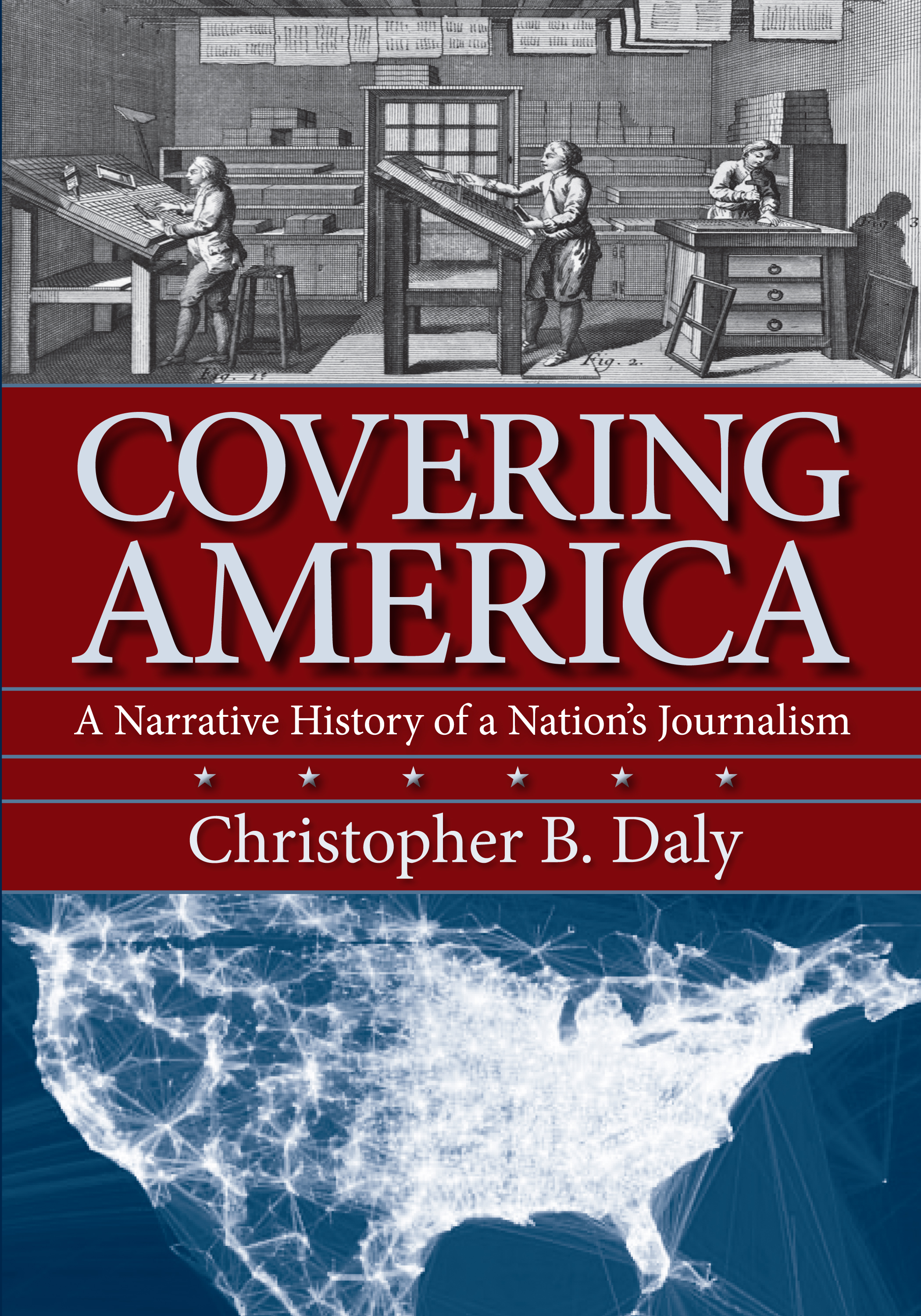
Finally, it’s here: the electronic version of my book about the history of U.S. journalism, Covering America.

Just in time for the anniversary of the rollout of the hardback, this prize-winning book is now available in all major formats:

Nook,

Kindle,

Apple iBook, (This is the format I am checking it out on, and it looks great.)

Google Play,

you name it.

I am very pleased because I know that some folks have been waiting for the e-book. These formats make the book quite a bit cheaper and dramatically lighter! For people who don’t feel drawn to the ~$50 hardcover, here’s your chance to read Covering America. The book won the 2012 Prose Award for Media and Cultural Studies, and it has been selling well and drawing rave reviews (except for one stinker on Amazon — sheesh).

Enjoy it, and write to me about your reactions. You can comment here, or email me: chrisdaly44@gmail.com

CA cover final


Leave a comment

Filed under broadcasting, CNN, Covering America, David Halberstam, FCC, First Amendment, Fox News, history, Huffington Post, Journalism, journalism history, leaks, Murdoch scandal, New York Times, NPR, Photography, Photojournalism, Politics, publishing, Supreme Court, The New Yorker

Inside the Meme Factory

By Christopher B. Daly 

The career of Michael Goldfarb, as described in today’s NYTimes, is a great example of the power of the conservative “meme factory” that sustains individuals, institutions, and ideas on the right. It’s the combination of right-wing think tanks and right-wing news media — all created since World War II as an alternative universe to the world of academia and mainstream journalism. It’s a subject I am researching and writing about for what I hope will be my next book.

To quote the Times:

His career was spawned, rather, in the conservative confines of The Weekly Standard and allied organizations, namely the Project for the New American Century, which is well known for promoting the war in Iraq. He has since gone on to thrive in the influential world of outside ideological groups. Mr. Goldfarb, known as a flamethrower on both sides of the aisle, has achieved unparalleled hybrid status in the process.

What this passage suggests is that the conservative Meme Factory is now into its second generation. Many of the key steps that created the Meme Factory in

Irving Kristol Wikipedia

Irving Kristol
Wikipedia

the first place were taken by Irving Kristol, neocon intellectual entrepreneur and founder of The Public Interest. His son, Bill Kristol, is the founder of The Weekly Standard, which gave Goldfarb his start. Bill Kristol is also the chair of the think tank Project for a New American Century.

At age 32, Goldfarb has passed several times through the revolving door connecting the think tanks and the media.


Leave a comment

Filed under Journalism, Politics

Monday roundup: awards, complaints, etc.

Christopher B. Daly 

As so often happens, Monday morning brings a bunch of things to consider:

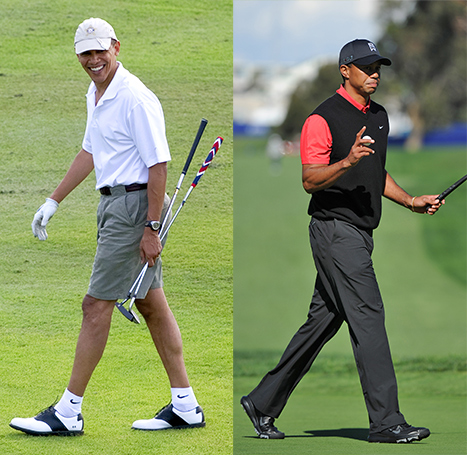
–The White House press corps is pissed about being kept away from Obama and Tiger Woods. Rightly so. Why schlep to Florida if you can’t go golfing?

This photo is a composite!

This photo is a composite!


–David Carr has a fascinating example of what I like to call The Power of Reporting. He tells how one reporter got out of the office to examine the apparent truth of a dramatic photo. 


Photo by Stephanie Sands


Photo by Stephanie Sands


–The new Polk Awards are out (they are something like the Golden Globes vis-a-vis the Academy Awards). 2012 was a good year to be reporting about the inexplicable fortunes amassed by the families of some of China’s most powerful men. Among the winners: David Corn of Mother Jones (for breaking the story about Mitt Romney’s fateful “47 percent” comment) and David Barboza of the New York Times for his series from China “Princelings.” Congrats to all winners. Good luck in the competition for the Pulitzer Prizes (due out in April).

–The NYTimes Public Editor, Margaret Sullivan, continues to explore the dust-up between Times auto writer John Broder and the head of Tesla Motors, Elon Musk.

[Full disclosure: I am wildly biased on this issue by my desire to own a Tesla some day.]


Leave a comment

Filed under Journalism, New York Times, Politics, President Obama

Math for journalists (cont.)

By Christopher B. Daly 

In their own words, Republican strategists explain one of the superficially puzzling results of the 2012 election: The total vote for all Republican candidates for the U.S. House combined were 1 million votes fewer than the total vote for Democratic candidates for the U.S. House. Yes, the Republicans won a majority of House seats, giving them the power to elect the House Speaker.

How?

In this memo, the Republican State Leadership Committee takes credit, saying that Republicans who control state governments used that power when they used the results of the 2010 census to redraw the lines that define House districts. (That job is a responsibility of the states, not Congress itself.) No surprise, Republicans drew districts that favored their own party’s candidates.

QED.

Here’s the takeaway:

The rationale was straightforward:  Controlling the redistricting process in these states would have the greatest impact on determining how both state legislative and congressional district boundaries would be drawn.  Drawing new district lines in states with the most redistricting activity presented the opportunity to solidify conservative policymaking at the state level and maintain a Republican stronghold in the U.S. House of Representatives for the next decade.


Leave a comment

Filed under Politics

The lure of owning a (whole) newspaper

By Christopher B. Daly 

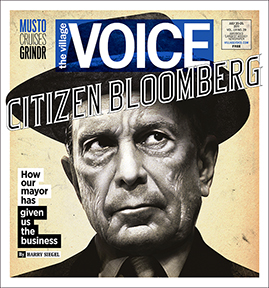
What would you do if you were worth a couple of billion dollars and were the mayor of New York City and (probably) banned from seeking a fourth term? If you are Michael Bloomberg, your thoughts might stray toward buying a newspaper. Not a copy of a newspaper, of course, but a whole newspaper company.

That’s the upshot of a story in today’s Times, which says that Bloomberg is reportedly considering buying Financial Times Ltd., which owns all of the Financial Times newspaper and a half interest in The Economist magazine. (FT Ltd is a division of the British media giant Pearson.)

You might ask: why?

Michael Bloomberg has made a fortune multiple times over from the “media” company that he bloomberg-terminalalready owns — Bloomberg L.P. The company is based on the phenomenally lucrative business of supplying patented terminals to stock traders, along with content from Bloomberg’s own company and other sources. In that business, Bloomberg made billions. But it’s not enough.

What follows is pure speculation (since I have never met him or interviewed him). I don’t believe Michael  Bloomberg wants any more wealth. Besides, getting into the printing of newspapers or magazines is hardly the road to riches. I suspect that what drives Bloomberg is the electricity that comes from power — the kind of power he now wields as mayor of the country’s biggest city but which will be passing from his hands.

Like many another media mogul before him (Greeley, Hearst), Bloomberg has toyed with the idea of offering the whole country his services, as president of the United States. There are many reasons to believe that will not happen, so what else is there? He probably does not want to go back to minding the store at a company that sells trading terminals to Wall Street types.

No, the only kind of activity that offers the promise of that much power (or at least influence) is owning an important publication. Since the time of the first truly mass-circulation daily newspapers in the 1830s, that has been the pattern throughout U.S. history (see my book Covering America on Bennett, Greeley, Pulitzer, Hearst, Luce, Murdoch, etc.) . Time and again, as publishers have connected with masses of people, they have convinced themselves that they are indispensable to the fate of the nation and start throwing their weight around.

Michael Bloomberg already has a record of accomplishment. He has come a long way from his origins in Medford, Mass. If he really wants to help our country, and if he really wants to boost the news business, he should buy a couple of newspapers — every day, at a newsstand — then take them home and read them.

29@200


1 Comment

Filed under Journalism, Politics

Why I am a Democrat

Why I am a Democrat

By Christopher B. Daly

It’s not because of the “gifts” that I supposedly get from the government, if we are to believe the recent confidential statements by Mitt Romney. Luckily, I have not needed the government very much in my life (so far) except for the blessings that good government brings to all the people – a terrific public education that lifted me to places I never thought I would go; safe streets and fire protection; clean drinking water and wholesome foods; confidence that my country would not be invaded and occupied by hostile armies.

The reason I am a Democrat is simple: on balance, over the long haul, the Democratic Party has been the single most effective agent for progressive change in America.

No, the party is not perfect. We have our own problems. We have our own corrupt and hypocritical leaders. Some Democratic leaders pander; some are slow to lead; a few are corrupt bozos. Democratic administrations sometimes screw up. Some Democratic voters do indeed have their hands out.

But look at the record. Since 1933, the Democratic Party has been the leading change-agent behind the following:

–the New Deal, including the right of workers to organize and the minimum wage

–Social Security

–the defeat of fascism in World War II

–the civil rights movement

–the (eventual) opposition to the War in Vietnam – and to all the subsequent unwise U.S. military adventures abroad

–the environmental movement, including global climate change

–the women’s movement

–the gay rights movement

–control of assault weapons and high-capacity ammo clips

–immigrant rights

Needless to say, the Republican Party, as an institution, has resisted each of these long, broad campaigns to recognize the essential humanity of all people and to ensure their rights under law. The issue is not handouts; it is dignity, decency, personal rights, and global peace.

And it’s not as though the Republicans don’t give out “gifts” to their own constituents. If we are talking about political parties that use government as a source of giveaways to their supporters, I would say Republicans do not make such a charge with clean hands.

Republicans spend vast amounts, for example, on defense contracting (even more than the generals ask for). Through tax breaks, they reduce the effective tax rate on many rich Americans to a level below that of the average worker. Through tax expenditures, they subsidize agribusiness, the fossil fuel industry, and a host of other businesses that donate to Republicans or hire lobbyists to look out for their interests. This is the activity that progressives denounce as “corporate welfare” – a charge that many Republicans seem not to even acknowledge.

All that said, I am happy to grant that there are many issues where reasonable Americans can disagree. I will even stipulate that most Americans love our country and have its best interests at heart.

–Should taxes be a little higher or a little lower?

–Should government be a little bigger or a little smaller?

–Should we pay our public bills now or later?

Those questions define the bulk of what we in this essentially conservative, centrist society argue about when we engage in politics. Does anyone seriously think we could not solve those problems if we really put our minds to it?

If Mitt Romney does not understand all this, then he never deserved a role in our public life.

Leave a comment

Filed under Politics, Uncategorized

Follow the money (cont.)

By Christopher B. Daly

Is political spending the same as political speech? Does it deserve the same constitutional protections? Is there anything that can be done to undo the 2010 Citizens United ruling by the Supreme Court?

Those are some of the questions raised by the 2012 elections. In the Times, Nicholas Confessore has been doing a good job keeping an eye on the money in politics, and today he weighs in with a “political memo.” (Is that reporting? analysis? opinion?)

One point the memo makes is that if you have a huge number of donors each giving a small amount, you can raise all the money you need to counter the impact of a small number of huge donors. Look at it this way:

100 wealthy donors give $1 million each.

100 x 1,000,000 = 100,000,000

1 million ordinary donors give $100 each:

1,000,000 x 100 = 100,000,000

So, it’s a tie. That shows the power of a million people acting together.

A question remains: How are we better off as a society with all that spending?


Leave a comment

Filed under Politics

Math for journalists (and everyone else too)

By Christopher B. Daly 

In the wake of last week’s election, many Republicans seems to be facing not only a political problem but also an epistemological one. Epistemology is the term philosophers use for the study of knowledge itself. It is an inquiry that asks: How do we know what we know? (or, How do we know what we think we know?)

Two recent pieces raise the issue.

David Carr,in his column in the New York Times, emphasizes the crisis that overtook Fox News on election night, when some professionals at the conservative news network were forced to choose — live, on television — between Republican orthodoxy and journalistic empiricism. Carr rightly applauds Megyn Kelly for insisting on a fact-based approach while she was on-air with Republican Party strategist, fund-raiser, consultant (have I left any roles out?) Karl Rove, who doubles as a paid news “analyst” for Fox. As the Ohio vote was being counted last Tuesday night, it was becoming clear that Obama would win the state and, thus, the country. Rove insisted that Fox set aside the facts and hold off on placing Ohio in the president’s camp.

Inexplicably, though, Carr did not cite the definitive quote in the exchange. Kelly turned to Rove and asked:

“Is this just math that you do as a Republican to make yourself feel better, or is this real?”

(Jon Stewart rightly pounced on it as a moment of political/journalistic/epistemological crisis, and you can see the video.)


How about math we do as Americans to determine reality?


Many of the same issues are raised in a searching piece in Politico today about the “cocooning” of many Republicans. On election night, some Republicans found it difficult to believe that Obama was actually winning, largely because they only watch Fox News and only hear the views of analysts like Karl Rove. The piece, by Jonathan Martin, points in the direction of the book I am working on about the rise of conservative media after WWII, with the working title: Inside the Meme Factory: The Rise of Conservative Media and Think Tanks. Stay tuned for that. (If you think that an idea/slogan like “the rich are job-creators” arises spontaneously, you got another think coming!)


Leave a comment

Filed under broadcasting, Fox News, Journalism, Politics

Politics: Bad for business?

By Christopher B. Daly 

If business executives and the titans of finance are so good at investing, why do they do so poorly in investing in politicians? Clearly, big business and Wall Street went all-in this time on Mitt Romney and other Republicans. Through direct donations and superPACs, they sank enormous amounts of money (which, by rights, should go to the stockholders) into the Romney campaign and now have nothing to show for it.

Actually, they may have less than nothing to show for it. Because in the process of investing in Romney, they also managed to antagonize the majority of Americans who prefer the other guy.

These thoughts were prompted by a timely piece in today’s Times Business Day section by columnist Eduardo Porter, who tries to follow the money in corporate political donations. Porter estimates that business interests spent about $2 billion and got nothing but ill will.

All of which reminds me of a remark attributed to former hoops wizard Michael Jordan. He became a wealthy businessman by getting into the sneaker business. Later, he was asked why he didn’t endorse Barack Obama. His answer: “Republicans buy shoes too.” (Just recently, Jordan had an apparent change of heart and endorsed Obama.)

For you activists: Some of the biggest donors to conservative candidates and causes are the Koch brothers. Here are some of the companies they own or products those companies make:

Georgia-Pacific

Brawny paper towels

Angel Soft toilet paper

Mardi Gras paper napkins

Vanity Fair paper products

Stainmaster carpets

Lycra fabric products.

And before you buy any oil pipelines, be sure to check the label.

Leave a comment

Filed under Politics

Is democracy for sale?

By Christopher B. Daly

A hat-tip to NPR. As a public service, NPR has compiled a list of the individuals and corporations who have donated $1 million or more to political campaigns or SuperPACs during this presidential election cycle.

Except for a handful of creative people and liberals, it is a conservative landslide. No surprise there. Wealthy people believe that they don’t need government and don’t deserve to be taxed. So, they tend to support the political party that supports their wishes.

I have not added up all the subtotals, but at a glance, here is a candidate for the biggest donor of them all: Sheldon Adelson. Here’s a guy who made a fortune off casino gambling — literally taking money from people who can almost never afford to lose it.

IN what way does all this spending help to strengthen our democracy or improve our society? What on earth gave the Supreme Court the idea that this kind of spending was protected by the Constitution? Do the individuals on the super-donor list love their country more than the rest of us? Do they have better ideas? Do they deserve the kind of giant megaphone that $30 million can buy?


Leave a comment

Filed under First Amendment, Politics