Category Archives: Politics

Whither MSNBC?

New York Times television reporter Bill Carter has a good piece today on MSNBC — not least because he quoted me.

[Fun fact: my quote includes an odd mistake. I sent him my quote by email. I meant to write that the size of the audience is “capped” by the size of the universe of people who agree with you. But I must have made a typo, and my computer auto-corrected it to “cajoled” — which is actually nonsensical in that context. Odder still: no one caught it. Well, at least, they spelled my name right. . . ]

MSNBC Is Close to Falling to Third Place in Cable News Ratings

By 
Published: September 26, 2011

How badly has MSNBC been hurt by the loss of Keith Olbermann? Enough, apparently, to be on the verge of falling back into third place among the cable news networks.

Justin Stephens/Current TV, via Associated Press

The time slot held by Keith Olbermann lost viewers.

Bennett Raglin/Getty Images

Anderson Cooper’s move seems to be working for CNN.

The ratings results for the month of September show that CNN, long relegated to third place in the prime-time cable news competition, is edging its way back up, while MSNBC is moving in the other direction.

For the month, CNN averaged 257,000 viewers in prime time in the category that counts most to the networks — viewers between the ages of 25 and 54 — because that is where the advertising money goes for news programming. MSNBC was just barely ahead with 269,000 viewers. (Neither approached the leader, Fox News, with 526,000).

Both CNN and MSNBC had one especially strong night because of the Republican presidential debates. With those excluded, however, CNN beat MSNBC, 219,000 to 207,000. A year ago, when Mr. Olbermann still occupied the 8 p.m. hour, MSNBC edged CNN by 83,000 viewers, with 256,000 viewers for MSNBC to 173,000 for CNN.

The change in the September ratings was most noticeable at 8 p.m., where CNN has moved its best-known host, Anderson Cooper. The network’s performance during that hour has improved by 38 percent over last year, growing to 215,000 viewers from 156,000.

On MSNBC, meanwhile, Lawrence O’Donnell has lost 100,000 viewers from the numbers Mr. Olbermann posted last September, with 185,000 viewers in the 25-to-54 age group, a drop of 35 percent. (Bill O’Reilly on Fox, as always, dwarfs his competitors with about three times as many viewers, 611,000.)

More ominously, the falloff for Mr. O’Donnell seems to be affecting MSNBC’s biggest name, Rachel Maddow. Her audience dropped 15 percent this year, to 245,000 from 289,000. She still beats Piers Morgan on CNN in the 9 p.m. hour, but his show has improved 18 percent over Larry King’s ratings last year, with 193,000 viewers to Mr. King’s 164,000.

MSNBC executives endured a contentious parting with Mr. Olbermann last January. Phil Griffin, the president of MSNBC, had a succinct answer to the question of whether the network is feeling the impact of Mr. Olbermann’s departure: “No.”

He added, “I’m confident that we will increase our ratings as politics become the dominant story over the next year.”

Mr. Olbermann is now on the air head-to-head against Mr. O’Donnell. The channel he appears on, Current TV, is not in the league of either CNN or MSNBC in terms of national profile, and his audience totals do not approach any of the other 8 p.m. competitors.

Mr. Olbermann averaged just over 50,000 viewers in the 25-to-54 measure in September, or less than 20 percent of what he attracted on MSNBC. Still, many of those 50,000 may have previously been viewers of MSNBC — and Mr. O’Donnell was 30,000 viewers behind Mr. Cooper in September.

Some industry analysts said the loss of viewers for MSNBC may have to do with strategic changes the network made in recent years.

“MSNBC may be rediscovering the downside of partisan news,” said Chris Daly, a professor of journalism at Boston University. “That is, the size of your audience is essentially cajoled by the size of the electorate that already agrees with you.”

Mr. Cooper is being compared at 8 p.m. against what was hardly a powerhouse CNN entry last year — “Rick’s List,” which featured Rick Sanchez, who was subsequently fired. But Mr. Cooper’s move to 8, which was questioned by some critics, seems to be paying off for CNN. He has made the network much more competitive in that time slot while not losing any momentum for the second show he hosts at 10 p.m.

Ken Jautz, the head of CNN’s domestic news operation, said the network had “been making changes to several hours of our programming in order to grow CNN’s audience during both breaking news and nonbreaking news periods. The fact that our prime-time audience increased this month by 49 percent is certainly gratifying.”

The replay of “Anderson Cooper 360,” which includes news updates but mostly material from the 8 p.m. show, remains CNN’s strongest hour, with 274,000 viewers, well ahead of “The Ed Show” on MSNBC with 200,000 (though both also are well behind Greta Van Susteren on Fox, who had 415,000.)

Leave a comment

Filed under broadcasting, Journalism, media, MSNBC, New York Times, Olbermann, Politics

The nature of revolution

A thought for a revolutionary era:

All successful revolutions are the kicking in of a rotten door. — J. K. Galbraith

Here’s confirmation:


5 Comments

Filed under Politics

Wikileaks, cont.

For handy reference, here is the New Yorker profile of WikiLeaks founder Julian Assange, which ran back in June.

Leave a comment

Filed under computers, Journalism, leaks, media, Politics, publishing, Wikileaks

Wiki-flood

Not to be missed among the deluge of “cables” is this statement by Times executive editor Bill Keller.

A Note to Readers: The Decision to Publish Diplomatic Documents

The articles published today and in coming days are based on thousands of United States embassy cables, the daily reports from the field intended for the eyes of senior policy makers in Washington. The New York Times and a number of publications in Europe were given access to the material several weeks ago and agreed to begin publication of articles based on the cables online on Sunday. The Times believes that the documents serve an important public interest, illuminating the goals, successes, compromises and frustrations of American diplomacy in a way that other accounts cannot match.

The Source of the Material

The documents — some 250,000 individual cables, the daily traffic between the State Department and more than 270 American diplomatic outposts around the world — were made available to The Times by a source who insisted on anonymity. They were originally obtained byWikiLeaks, an organization devoted to exposing official secrets, allegedly from a disenchanted, low-level Army intelligence analyst who exploited a security loophole. Beginning Sunday, WikiLeaks intends to publish this archive on its Web site in stages, with each batch of documents related to a particular country or topic. Except for the timing of publication, the material was provided without conditions. Each news organization decided independently what to write about the cables.

Reporting Classified Information

About 11,000 of the cables are marked “secret.” An additional 9,000 or so carry the label “noforn,” meaning the information is not to be shared with representatives of other countries, and 4,000 are marked “secret/noforn.” The rest are either marked with the less restrictive label “confidential” or are unclassified. Most were not intended for public view, at least in the near term.

The Times has taken care to exclude, in its articles and in supplementary material, in print and online, information that would endanger confidential informants or compromise national security. The Times’s redactions were shared with other news organizations and communicated to WikiLeaks, in the hope that they would similarly edit the documents they planned to post online.

After its own redactions, The Times sent Obama administration officials the cables it planned to post and invited them to challenge publication of any information that, in the official view, would harm the national interest. After reviewing the cables, the officials — while making clear they condemn the publication of secret material — suggested additional redactions. The Times agreed to some, but not all. The Times is forwarding the administration’s concerns to other news organizations and, at the suggestion of the State Department, to WikiLeaks itself. In all, The Times plans to post on its Web site the text of about 100 cables — some edited, some in full — that illuminate aspects of American foreign policy.

The question of dealing with classified information is rarely easy, and never to be taken lightly. Editors try to balance the value of the material to public understanding against potential dangers to the national interest. As a general rule we withhold secret information that would expose confidential sources to reprisals or that would reveal operational intelligence that might be useful to adversaries in war. We excise material that might lead terrorists to unsecured weapons material, compromise intelligence-gathering programs aimed at hostile countries, or disclose information about the capabilities of American weapons that could be helpful to an enemy.

On the other hand, we are less likely to censor candid remarks simply because they might cause a diplomatic controversy or embarrass officials.

Government officials sometimes argue — and the administration has argued in the case of these secret cables — that disclosures of confidential conversations between American diplomats and their foreign counterparts could endanger the national interest by making foreign governments more wary of cooperating with the United States in the fight against terrorists or other vital activities.

Providing an Analysis

Of course, most of these documents will be made public regardless of what The Times decides. WikiLeaks has shared the entire archive of secret cables with at least four European publications, has promised country-specific documents to many other news outlets, and has said it plans to ultimately post its trove online. For The Times to ignore this material would be to deny its own readers the careful reporting and thoughtful analysis they expect when this kind of information becomes public.

But the more important reason to publish these articles is that the cables tell the unvarnished story of how the government makes its biggest decisions, the decisions that cost the country most heavily in lives and money. They shed light on the motivations — and, in some cases, duplicity — of allies on the receiving end of American courtship and foreign aid. They illuminate the diplomacy surrounding two current wars and several countries, like Pakistan and Yemen, where American military involvement is growing. As daunting as it is to publish such material over official objections, it would be presumptuous to conclude that Americans have no right to know what is being done in their name.

In the coming days, editors and reporters will respond to readers on the substance of this coverage and the decision to publish. We invite questions at askthetimes@nytimes.com.


Leave a comment

Filed under history, Journalism, leaks, media, New York Times, Politics, Wikileaks

Olbermann Gave Lots Less than his Boss

By Chris Daly

So, Keith Olbermann of MSNBC has already nearly served his sentence for donating a total of $7,200 to Democrats.

First things first: The conditions under which he works are not a matter of theory, or constitutional interpretation, or wishful thinking, or anything else. He has a contract, which requires him to abide by NBC News policies. Any time a journalist accepts a check in return for full-time employment, he or she is no longer a free agent. If you take the money, you accept the rules. If you don’t like them, you can quit (and regain all your freedoms, except the freedom to cash those paychecks). So, that part of this flap is a no-brainer.

Still, we may want to step back from that and ask the broader question: In general, is it a good idea for journalists to donate to political candidates? (And a corollary: is it an equally good idea for reporters as for columnists or other opinion-mongers?)

Opinions vary (as they should). Some journalists have never bought into the ideal of political neutrality. There is a long tradition of advocacy journalism in America — in fact, it goes back much further in our history than the professional/objective model.

Fox News, for example, apparently does not impose a no-giving rule on its talent. Thus, not only did Rupert Murdoch donate to conservatives this season, so did Sean Hannity — without any punishment.

Back to Olbermann and MSNBC. He broke a company policy and got punished. That was the company’s prerogative, but was it a good idea? Was it hypocritical?

I would say there is a blatant double-standard, based on the track record of political donations by NBC executives. Find out about NBC president Robert Wright here. Go to the FEC records to see the donation record of Wright’s boss, Jeffrey Immelt, the chairman and CEO of GE  (which still owns NBC).


It seems to me that an argument can be made for banning and for allowing donations. What I can’t see is why it is OK to ban donations by the help but allow donations by the top brass.


Leave a comment

Filed under Fox News, Journalism, media, Olbermann, Politics

Over-exposed?

By Chris Daly

On the morning after the election, here is a question about the news media’s coverage of this election season:

What do the following all have in common?

Meg Whitman

Tom Tancredo

Carl Paladino

Carly Fiorina

Linda McMahon

Christine O’Donnell

Sharron Angle

Joe Miller*

For one thing, they are all Republicans.

For another thing, they all lost.

They all also enjoyed a bump from the news media that touted their candidacies. Each one was presented at one point or another as a serious contender for an important statewide office. Granted, some of these races were close. But it has to be asked: how is it that as recently as last weekend, someone could have gotten the impression from major media outlets that most or all of these people were going to win? Did reporters not understand the electorate in those states? Did they know but prefer a different narrative?

Hmmm…


*In Alaska, they are still counting votes, but Miller was running well behind the write-in candidate.


Leave a comment

Filed under Journalism, media, Politics

No comment

The latest on Fox News.

Here, in Politico. And here, in the Times.

Actually, I will venture to ask this question:

Is Fox News the fourth U.S. television network, or the third U.S. political party?

What do you think?

Leave a comment

Filed under Fox News, Journalism, New York Times, Politics

A tip of the hat…

. . . to David Frum, the Canadian-American former speechwriter for George W. Bush (despite his robust credentials as a member of the “elite,” based on his degrees from Yale and Harvard Law).

I don’t agree with him about much, but I was impressed by the points he made in this recent talk.

Well put.

Leave a comment

Filed under David Frum, Journalism, journalism history, Politics

Ouch !

By Chris Daly

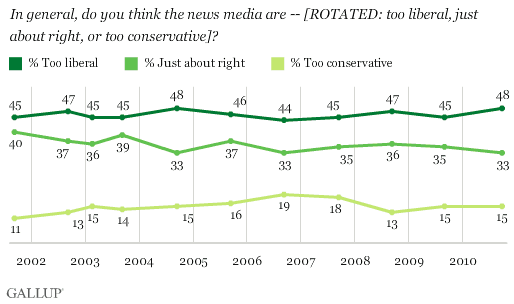
This new study from Gallup really hurts. It suggests that the people who are waging war on the news media are winning.

Possible hidden headline (based on the second chart):

“Number of Americans Who Say Media

Are ‘Too Conservative’ Rises 36% Since 2002″

What do you think?

Leave a comment

Filed under Journalism, journalism history, Politics

A Tea Party news nugget

By Chris Daly

Today’s New York Times features a story and charts on the findings of the latest Times/CBS News poll — this one about the demographics of the Tea Party movement.

One finding that caught my eye had to do with where Tea Party members get their news. No surprise, they get “most” of their news from Fox News. In fact, the preference for Fox News was the biggest skew in all the findings that I could find. Comparing Tea Party members to a category defined as “all adults” (is this like contrasting them to “normal Americans”?), there was a 40-point spread in news consumption. Even compared to Republicans, the Tea Party folks favor Fox over other news sources.

Maybe we should just call it the Fox Party.

Leave a comment

Filed under Politics