Category Archives: New York Times

Abolish the NCAA (cont.)

By Christopher B. Daly

The NYTimes adds to the pile of reasons to abolish the NCAA. The athletes who play for big-time imgres-1college teams sign a letter when they are in high school declaring the name of the school where they intend to play. This was originally meant to signal to recruiters from other schools to cease and desist. But, under the iron law of unintended consequences, today’s story indicates that these letters have morphed into what amounts to a “reserve clause,” like the one that used to tie professional baseball players to their team owners. Increasingly, college players are thwarted in their attempts to transfer.

I have a certain amount of sympathy for the “student athletes” who want to switch schools, but then I realize: they are not transferring to find a better English department or more-advanced physics labs. They are acting like professional athletes in any sport who want to do what’s best for their athletic careers (not their educations).

Proponents of transfer limits say that they are put in place to prevent coaches from continually attempting to lure athletes from other universities, which could create a never-ending recruiting cycle. Critics counter that the rules make it much too easy for coaches to act punitively, penalizing athletes for changing their minds about decisions made when they were teenagers.

Coaches cannot fully prevent athletes like Lunt from transferring to any university they want. But if a coach does not grant an athlete a release, the player must forfeit any scholarship opportunity, pay his own way to the new university and sit out the next season. Meanwhile, Gundy, whose contract pays him $30.3 million over eight years, and other coaches can routinely move from one college to another with minimal consequence, often for bigger contracts after arranging a buyout with the first college.

Not only that, but the article includes the startling figure that nearly 500 mens basketball players transferred from one college to another last year.

500 basketball players switching schools!

(That’s one sport, one gender, from a sport with a fairly small roster. How many total athletic transfers take place in a year?)

Now, let’s acknowledge that, on average, these are not the strongest students on our campuses, and let’s acknowledge that transferring is disruptive and probably sets most students back somewhat.

How much sense does this make?

Again, I ask: what educational purpose does the NCAA serve?


1 Comment

Filed under NCAA, New York Times

Politico goes on a hiring spree

By Christopher B. Daly 

imagesWith all due respect, I think the Times “buried the lead” in today’s story about Politico. The story focuses on the hiring of Susan Glasser, who, the Times notes diplomatically, “was known as a polarizing figure among national reporters during her tenure at The Washington Post.”

I don’t know. I was a regional correspondent for the Post, covering New England, from 1989 to 1997. Glasser did not join the Post until 1998, so we did not overlap. What I do know is that at the Post, she would have had few role models for images-1newsroom management, because the Post newsroom was terribly mismanaged during that period. With one notable exception (the estimable Bill Elsen), the editors I had to work with at the Post were not up to the job.

In a story from 2008, the Times described with happened to Glasser when she crashed as an AME (asst. managing editor, a powerful job at the Post) in charge of national news and had to be sacked by Len Downie.

When she was named an assistant managing editor in November 2006, Ms. Glasser was praised by Mr. Downie as “one of our most talented and visionary journalists.” Several Post reporters who spoke about Ms. Glasser on Tuesday said that they agreed with that description, and that Ms. Glasser, while often demanding, recognized that newspapers had to think more imaginatively had the era of declining circulation and the rise of the Internet.

But morale suffered under Ms. Glasser’s leadership, to the extent that in recent weeks a high-ranking Post editor surveyed people on the national staff to gauge just how bad feelings were running, people at the newspaper said. The morale report was conveyed recently to Mr. Downie, who was said to have been dismayed by the findings.

What is not to be missed there and what is so typical of the Post is that things were allowed to get so bad in the first place.

It’s also a bit of a mystery to me how Glasser was supposed to oversee national news when the Post had closed all its domestic bureaus.

Anyway, she left the Post later in 2008 and became the editor in chief of Foreign Policy. Now, she is jumping to Politico, where she will be in charge of two initiatives: long-form non-fiction (a new area for Politico, which has the journalistic equivalent of ADHD) and posting of opinion pieces by outside contributors. Both of those are welcome experiments for Politico, in my book, and I wish them well.

But the real headline in the Times story about Politico was in the literally final graf:

Mr. VandeHei said the site was putting “several million” dollars behind the new operations and would seek to hire a dozen new reporters.

Now, that is definitely good news. A serious digital news source is making enough money to expand and hire more reporters. Bravo.

Here is Politico’s own coverage of the move.

0          0        0        0       0

FYI, here’s what Susan Glasser said about herself on the Foreign Policy website:

Susan Glasser is editor in chief of Foreign Policy, the magazine of global politics, economics, and ideas. A longtime foreign correspondent and editor for the Washington Post, Glasser joined Foreign Policy in 2008 and has been spearheading the magazine’s ambitious expansion in print and online at ForeignPolicy.com. During her tenure, the magazine has won numerous awards for its innovative coverage, including the 2012 award for online general excellence from the Overseas Press Club and three National Magazine Awards, for digital excellence in reporting, blogging, and multimedia. FP’s ten nominations for the awards including being a 2011 finalist for “Magazine of the Year,” the industry’s highest honor.

Glasser spent four years as co-chief of the Post‘s Moscow bureau and covered the wars in Afghanistan and Iraq for the Post in the immediate aftermath of 9/11, including the battle of Tora Bora and the invasion of Iraq. After returning to Washington, she edited the Post’s weekly Outlook section and led its national news coverage. Together with her husband, New York Times White House correspondent Peter Baker, she wrote Kremlin Rising: Vladimir Putin’s Russia and the End of Revolution. Glasser previously worked for eight years at the Capitol Hill newspaper Roll Call, where she rose to be the top editor. She has served as chair of the Pulitzer Prize jury for international reporting and is a member of the World Economic Forum’s Global Agenda Council on the United States. A graduate of Harvard University, Glasser lives in Washington with Baker and their son.

Leave a comment

Filed under Journalism, journalism history, New York Times, Politics, publishing

A shield law for reporters? Thanks, but no thanks!

By Christopher B. Daly

First, the Obama administration antagonized the news media by seizing the phone records of The AP-logoAssociated Press. Now, in an effort to make up, the president has thrown his support behind a Senate bill that would create a federal “shield law” that would allow journalists to legally protect their confidential sources.

A lot of journalists have embraced the idea. But I believe that journalists should say, “Thanks, but no thanks.”

Tempting as it might be, a federal shield law is a bad idea for journalists. We do not need it, and we may ultimately regret it. The relevant part of the First Amendment to the Constitution says: Congress shall make no law abridging the freedom of the press. That powerful simple phrase “no law” means just that – no law, period. It means Congress simply cannot legislate in this area.

As a near-absolutist about the First Amendment, I think that part is clear and simple. Furthermore, I believe that a proper reading of the First Amendment makes a shield law superfluous. We almost got such a reading in 1972, in the Supreme Court case known as Branzburg v. Hayes. In that case, the nation’s highest court said that when prosecutors haul reporters in front of federal grand juries and demand to know the names of their sources, the reporters must reveal their sources or face going to jail for contempt of court. In other words, reporters do not enjoy a legal “privilege” against having to testimony such as those enjoyed by doctors, lawyers, or clergy.

The ruling in Branzburg, while wrong, was nearly right. It was a 5-4 ruling, and one of the majority justices was clearly ambivalent about the issue. Justice Lewis F. Powell, as the New York Times reported in 2007, wrote some handwritten notes while the case was being decided. Powell (no friend of the news media) went right up to the line of agreeing with the minority instead of the majority. He wrote:

I will make clear in an opinion . . . that there is a privilege analogous to an evidentiary one, which courts should recognize and apply on case by case to protect confidential information. . . . My vote turned on my conclusion . . . that we should not establish a constitutional privilege.

Those notes are fairly opaque, but they do suggest that reporters very nearly got the recognition they deserve. [Brief digression: Powell’s notes were written on a court form captioned U.S. vs. Caldwell. That’s not a mistake. The Branzburg case was combined with two others in 1972, including a federal subpoena ordering NYTimes reporter Earl Caldwell to testify before a federal grand jury and name his confidential sources among the Black Panthers. For more, see chap XX of my book, Covering America.] The reasoning for granting reporters a “testimonial privilege” is pretty straightforward. Through the First Amendment, the Constitution gives the practice of journalism a 1007LIPTAK.1100.1065special status that recognizes the vital role that a free and independent press plays in the ability of the American people to govern themselves. If the people are to make informed votes and policy choices, they need good sources of information — especially about the performance of the government itself. But like many powerful institutions (corporations, the clergy, and others), government officials like to control the flow of news and information. So, they regularly try to intimidate and chill the practices of journalism.

The practice of journalism includes both a news-gathering function and a news-disseminating function. Neither one is of much use without the other. That is, if journalists are free to disseminate news but not to gather it, they will have nothing of value to share with the people. Conversely, if they are free to gather news but not to disseminate it, the people will again be thwarted in their ability to learn the things they need to know to govern themselves. Thus, journalists must be free to gather news (by reporting) and to disseminate news (by printing, broadcasting or posting).

In the normal course of news-gathering, journalists seek information in all quarters. They observe some events first-hand, they examine documents, and they interview people. Often, the most sensitive and valuable kinds of news come to journalists from sources who need to remain anonymous to avoid retaliation such as being fired or prosecuted. In those cases, journalists promise the source confidentiality. They say something along these lines: Please give me the important information you have, and in return, I will promise to keep your identity a secret.

These kinds of promises are not routine, but they are fairly commonplace — especially in certain kinds of fields, such as reporting about the military, our spy agencies, or any sort of abuse of power. The source wants to blow the whistle on a secret that the source considers illegal, immoral, or just plain wrong. Often, the reporter is indifferent on that question, but the reporter can see that the material should reach the general public, so that the American people can decide the issue.

Should we, for example, use drones to kill American citizens abroad? That’s an important question, but we could not even debate it without “leaks” from confidential sources. Without a constitutional privilege, reporters make such promises to their sources at their peril. It is perfectly predictable that those in power (from either party) will reflexively attempt to control the flow of information to the people. One attractive mechanism for doing that is to force journalists to name their confidential sources and then to go after the sources and punish them. If I were a tyrant seeking to use the limited powers of government to create unlimited personal power, that is one of the ways I would go about it.

Gilbert_Stuart_Thomas_Jeffersen(5)That is exactly what Thomas Jefferson and his supporters among the Founders foresaw and sought to prevent. One of the remedies they came up with was an absolute guarantee of press freedom. That’s why I believe we journalists do not need to ask Congress to bestow such protections on the practice of journalism. Indeed, we should be wary of inviting Congress to legislate about the press at all, because once legislators start writing laws, it is exceedingly difficult to get them to stop. Today, they may say they are proposing to do us a favor by granting us a shield. Tomorrow, having established the precedent, they may decide to improve that law by “clarifying” just who is a journalist. Before long, Congress might decide to license journalists or protect confidential sources in the Executive branch but deny such protection to their own staffers. There would be no end to it.

Instead, I believe that journalists should stand firm and insist on the rights we already have under the First Amendment. That was essentially the view expressed by one of the dissenters in the Branzburg case. In an eloquent and penetrating opinion, Justice William O. Douglas argued that the First Amendment exists for the ultimate benefit of the American people. When reporters do their jobs, Douglas wrote, “the press is often engaged in projects that bring anxiety and even fear to the bureaucracies, departments, or officials of government.” But if journalists can be intimidated into giving up their confidential sources, he warned, then “the reporter’s main function in American society will be to pass on to the public the press releases which the various departments of government issue.”

[Full disclosure: I worked for The Associated Press for a total of 10 years, between 1976 and 1989, in the NYC world headquarters and in the Boston bureau.]




18 Comments

Filed under First Amendment, Journalism, journalism history, New York Times, Supreme Court

Readers to the rescue! NYTimes gains in circulation

By Christopher B. Daly 

Yes, the New York Times company reported a sharp drop in earnings this week.

Yes, the figures for advertising revenue were wretched and getting worse.

BUT, buried in the financial details, there is some potentially important good news: Money coming in from circulation is rising. In fact, it rose 6.5% in the first quarter of this year compared to the same quarter a year ago. Therein may lie the salvation of the most important news organization in the country.

The reason is that “circulation revenue” is all the money coming in from the subscriptions to the traditional print edition, the dollars paid by folks picking up a copy of the Times at newsstands, and — most important of all — the money coming in from digital subscribers who bumped into the Times “paywall” and decided to pony up and pay for full access to the Times online. They are important because they are the future. In the digital era, the key metric is whether you can make money online. Historically, newspapers depended on a “dual revenue stream” of money coming from both circulation and advertising. For more than a century, both sources increased, and they fluctuated around a ratio of 50/50 in terms of total revenues.

If the Times can continue to gain readers who will pay, then there is no reason it could not sustain itself mainly on the basis of its own readers — who are, ultimately, a better base for journalism than advertisers. Thank you, Tiffany and Bloomingdales, and may your ad spending continue. But ultimately, the Times might be better off if it were funded like the old PM newspaper, or I.F. Stone’s Weekly, or NPR, or the AP or other news organizations that do not depend on advertising.

According to the latest figures, readers now account for a majority of the Times revenues.

Here’s a chart from the company’s press release.


First Quarter
2013 2012 % Change
Revenues
Circulation $ 241,789 $ 226,994 6.5 %
Advertising 191,167 215,234 -11.2 %
Other(a) 32,977 33,204 -0.7 %
Total revenues 465,933 475,432 -2.0 %

When I looked at the numbers more closely, here’s what I found on a percentage basis:

First quarter

[                                 2013               2012

Revenues

Circulation             51.8%          47.7%

Advertising            41.0%          45.2%

Other                          7.1%             6.9%

So, it appears that “the people formerly known as the audience” are pointing the ( or a?) way forward.

Readers to the rescue!

chart

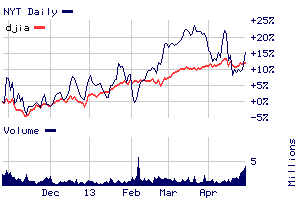
This chart (which I customized using a tool on the NYTCo corporate site) shows how the NYTCo stock has performed in the last six months, compared to the Dow Jones average, which has been on a tear. 

Leave a comment

Filed under business, Journalism, journalism history, New York Times, Uncategorized

Un-bundling the media

By Christopher B. Daly 

In his latest column, the New York Times‘ David Carr makes a smart argument about how the media — both entertainment and news — are coming apart under pressure from the Web. That’s coming apart, not falling apart. They are coming apart in the sense that the “bundles” of material that arose during the pre-digital era no longer make sense. 

Here’s his lead:

For the longest time in the media business, the concept of the bundle has been foundational. Ads go with editorial content in print, commercials go with programming on television and the channels you desire are paired with ones you did not in your cable package.
People were free to shop for what they wanted, as long as they were willing to buy a bunch of other stuff they did not. The box score last night for your home team? It was wrapped inside a bundle of paper that included everything from foreign news to ads for lingerie. If you liked a song, you generally had to buy an album full of others to get the goods.


I think he’s on the right track. Consider the newspaper, for example, as I did in my book Covering America. Here’s an excerpt from Chapter 13:

Another problem besetting newspapers (and, to a great extent, magazines and television news as well) was even more existential. When seen against the backdrop of the Internet, one fact about newspapers becomes painfully obvious: a newspaper is a fixed bundle of coverage that is good but ultimately second rate. Offering readers no choice, a newspaper presents coverage of a set matrix of topics: politics, crime, business, sports, arts, and something called lifestyle. In each case, though, people who really know or care about those fields understand that they are not going to find the absolute best, most detailed, most passionate coverage of their favorite topic in a daily newspaper. They know that the best coverage will be in some niche on the Web where obsessive amateurs or professional experts gather. And with the coming of the Web, the absolute best coverage is available to everyone, everywhere, all the time, for free. In politics, for example, readers can find pretty good coverage in the Times or Newsweek. But if they really live and breathe politics, they will want it faster and at a much higher level of granularity, so they will log on to a site like Politico or Real Clear Politics instead and get what they are looking for. The same is true for business, sports, even crosswords and recipes. Thus the question arises: What is the remaining value of reading merely pretty good coverage (and paying for it) when readers can unbundle the newspaper, go online, and plunge into first-rate coverage, written by real aficionados and provided at a price of zero?

One way to understand the decline of the newspaper is to ask the ultimate question: If newspapers did not exist, would it make any sense to invent them?

I wrote that about two years ago. The only change I would make now would be to drop the reference to Newsweek. The venerable weekly print newsmagazine went broke in 2012 trying to sell a fixed bundle of pretty-good coverage and was absorbed into a born-digital enterprise, The Daily Beast. I might also amend the statement that all the high-quality niches are free, since a small but possibly growing number do charge something.

Leave a comment

Filed under broadcasting, Journalism, journalism history, New York Times, publishing, software

Shameless self-promotion (Journalism history division)

By Christopher B. Daly

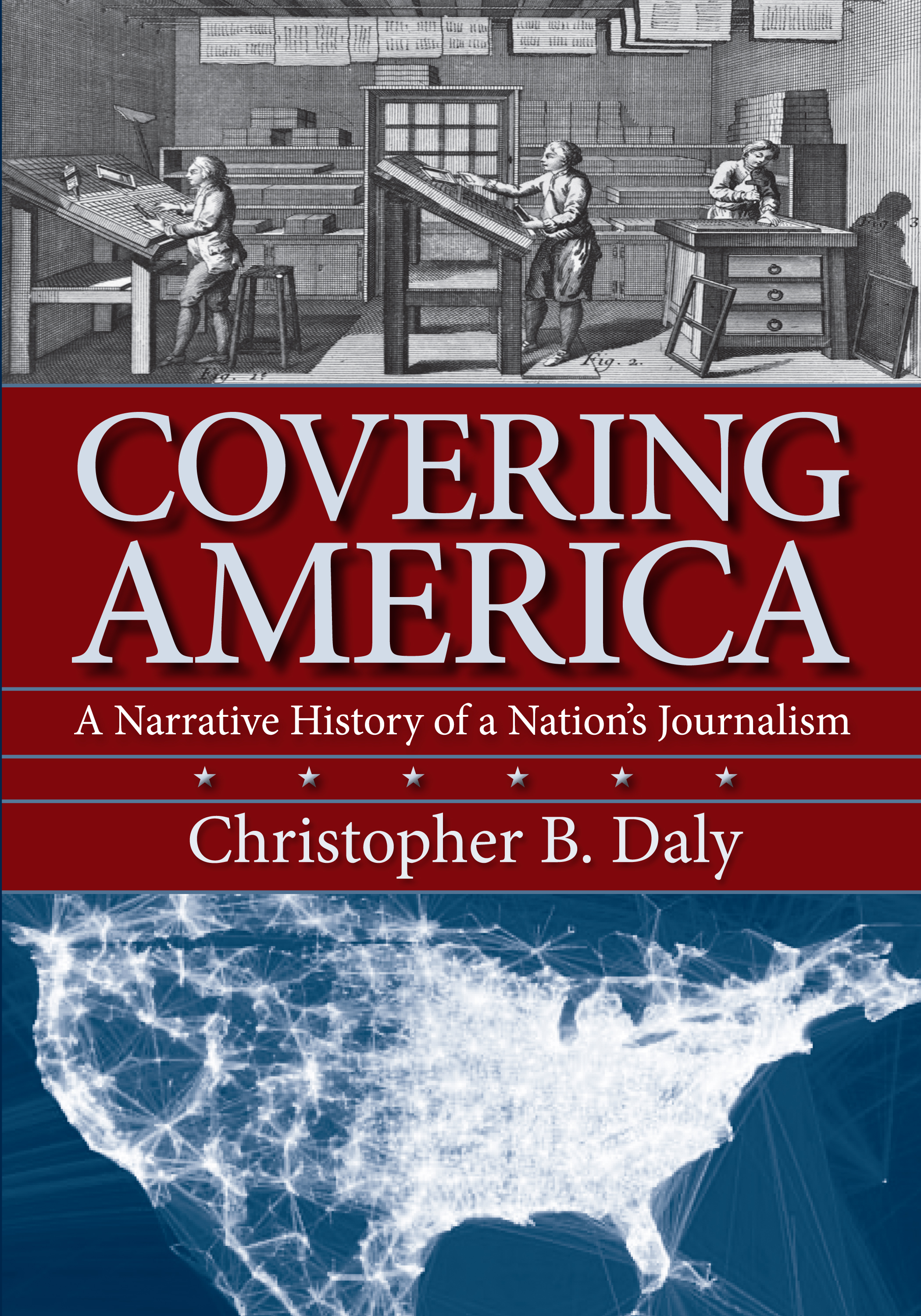
Finally, it’s here: the electronic version of my book about the history of U.S. journalism, Covering America.

Just in time for the anniversary of the rollout of the hardback, this prize-winning book is now available in all major formats:

Nook,

Kindle,

Apple iBook, (This is the format I am checking it out on, and it looks great.)

Google Play,

you name it.

I am very pleased because I know that some folks have been waiting for the e-book. These formats make the book quite a bit cheaper and dramatically lighter! For people who don’t feel drawn to the ~$50 hardcover, here’s your chance to read Covering America. The book won the 2012 Prose Award for Media and Cultural Studies, and it has been selling well and drawing rave reviews (except for one stinker on Amazon — sheesh).

Enjoy it, and write to me about your reactions. You can comment here, or email me: chrisdaly44@gmail.com

CA cover final


Leave a comment

Filed under broadcasting, CNN, Covering America, David Halberstam, FCC, First Amendment, Fox News, history, Huffington Post, Journalism, journalism history, leaks, Murdoch scandal, New York Times, NPR, Photography, Photojournalism, Politics, publishing, Supreme Court, The New Yorker

NYTimes: going global with the brand

By Christopher B. Daly

If you ran the New York Times and enjoyed the prestige that comes with doing great journalism and having a large, talented staff, why would you run any of your enterprises under another name? That seems to be the thinking behind the latest business move by the Times: renaming the venerable International Herald Tribune into The International New York Times. It makes sense, particularly if the Times executives have already made the decision to hang onto the old IHT and not spin it off, as they recently chose to to with the Boston Globe and Worcester Telegram & Gazette.

The IHT — which the Times has owned outright since it bought out its partner The Washington Post Co. in 2003 — is already subtitled “The global edition of the New York Times,” so it is only a short step to turn that into the new name.

From the Times’ own story about the change:

Stephen Dunbar-Johnson, publisher of The International Herald Tribune, noted that for most of the newspaper’s long history, it has had New York in its name. The paper (www.ihtinfo.com) was first published in 1887 as the European edition of The New York Herald. Through a series of ownership changes, it became The New York Herald Tribune in 1959.

The paper became The International Herald Tribune in 1967 when The Washington Post Company and the Times Company invested in the paper to keep it afloat after the New York Tribune folded. In 1991, the Post and Times companies became co-owners of the paper. The Times Company bought out The Washington Post Company’s share and became its sole owner in 2003.

The announcement is part of the company’s larger plan to focus on its core brand and building its international presence, the spokeswoman said. On Feb. 20, the Times Company said it was exploring offers to sell The Boston Globe and its other New England media properties. Last year, the company sold its stake in Indeed.com, a jobs search engine, and the About Group, the online resource company.

imgres

1 Comment

Filed under Journalism, New York Times

Monday roundup: awards, complaints, etc.

Christopher B. Daly 

As so often happens, Monday morning brings a bunch of things to consider:

–The White House press corps is pissed about being kept away from Obama and Tiger Woods. Rightly so. Why schlep to Florida if you can’t go golfing?

This photo is a composite!

This photo is a composite!


–David Carr has a fascinating example of what I like to call The Power of Reporting. He tells how one reporter got out of the office to examine the apparent truth of a dramatic photo. 


Photo by Stephanie Sands


Photo by Stephanie Sands


–The new Polk Awards are out (they are something like the Golden Globes vis-a-vis the Academy Awards). 2012 was a good year to be reporting about the inexplicable fortunes amassed by the families of some of China’s most powerful men. Among the winners: David Corn of Mother Jones (for breaking the story about Mitt Romney’s fateful “47 percent” comment) and David Barboza of the New York Times for his series from China “Princelings.” Congrats to all winners. Good luck in the competition for the Pulitzer Prizes (due out in April).

–The NYTimes Public Editor, Margaret Sullivan, continues to explore the dust-up between Times auto writer John Broder and the head of Tesla Motors, Elon Musk.

[Full disclosure: I am wildly biased on this issue by my desire to own a Tesla some day.]


Leave a comment

Filed under Journalism, New York Times, Politics, President Obama

Tesla v. NYTimes

By Christopher B. Daly

I have been hanging fire on this one, but now comes a terrific blogpost by Dave Weinberger that not only has a wise take on the whole thing, but it also contains most of the relevant links. That way, you can see all the original contributions to this fascinating dust-up between  the New York Times and Tesla Motors. My problem is, I want them both to be right (and adult about it), so I am waiting for more data to emerge.

Vroom or bust?

Vroom or bust?

Leave a comment

Filed under Journalism, New York Times, Uncategorized

Times’ paywall is paying very well

By Christopher B. Daly

Buried in the business section of today’s New York Times is a story with some very encouraging news about the future of quality journalism. The story concerns the New York Times Company itself. There’s a lot of noise in there about the sales of assets such as About.com. There’s also the usual gloomy news about the continuing declines in print advertising (down 5.6 percent).

But there are also two positive signals in all the details:

1. Digital advertising revenues rose 5.1 percent. That’s the money the Times makes from selling the electronic ads that appear in the online version. They are rising from a small base, to be sure, but they represent the ad dollars of the future.

2. The biggest good news: revenue from circulation grew 16.1 percent. In other words, the Times‘ paywall is paying very well. I would say this story “buried the lead” — because this is the biggest news in a while. The increase in circulation revenue is certainly not coming from a surge in subscriptions to the old-fashioned print version of the paper; nor is it from an upswing in newstand sales. It is coming from people who bump into the Times‘ online “paywall” and decide that it’s worth paying for the Times‘ content online. That may well turn out to be the paper’s salvation: the readers.

Here’s an excerpt from the NYTCo official earnings statement:

Paid subscribers to The New York Times and the International Herald Tribune digital subscription packages, e-readers and replica editions totaled approximately 640,000 as of the end of the fourth quarter of 2012, an increase of approximately 13 percent since the end of the third quarter of 2012.

That’s impressive. Readers in those numbers (plus some more, of course) could carry the paper into the digital future.

Can a restored dividend be far behind?


Here’s a chart of the company’s stock performance. NYTCo stock is up today, but it has a long way to go to get back to the glory days of a decade ago.

NYTCo stock

NYTCo stock

Leave a comment

Filed under Journalism, New York Times, publishing