Category Archives: media

The Mobster and the Tipster

By Chris Daly 

More reasons to enjoy life in one of the last remaining two-newspaper cities in America. The Globe and the Herald continue to bash each other (as they should), sometimes at the risk of sounding silly.

A brief re-cap: The Globe began this round with a major piece on Sunday about mobster Whitey Bulger. The Herald, acting in reflexive opposition to its bitter rival and perhaps in a bit of pique about not having done that story themselves, let fly on Monday with what looked like a news story in which the FBI expressed its shock (shock, shock, shock!) over the Globe’s decision to divulge the identity of the tipster who led the FBI to Bulger. Since then, it has been back and forth all week with each newspaper using news articles, columns, and editorials to dump on the other.

Here are today’s updates from the Globe and the Herald. As a public service, I am also providing a link to the FBI statement that both papers are bickering over. It is a head-spinning experience to read all three documents in quick succession.

FWIW, here’s my take: The FBI is trying to tell each paper what it thinks they want to hear. Each paper is interpreting the same material in a way that conforms to its own gloss on the story. And on it goes.

In this case, it is not hard to imagine each paper working up just as much outrage over the opposite set of facts. Once a newspaper war breaks out, there are no neutrals. The winner (if any) will be the one that gets more readers out of it.


1 Comment

Filed under Boston, Journalism, leaks, media

Whither MSNBC?

New York Times television reporter Bill Carter has a good piece today on MSNBC — not least because he quoted me.

[Fun fact: my quote includes an odd mistake. I sent him my quote by email. I meant to write that the size of the audience is “capped” by the size of the universe of people who agree with you. But I must have made a typo, and my computer auto-corrected it to “cajoled” — which is actually nonsensical in that context. Odder still: no one caught it. Well, at least, they spelled my name right. . . ]

MSNBC Is Close to Falling to Third Place in Cable News Ratings

By 
Published: September 26, 2011

How badly has MSNBC been hurt by the loss of Keith Olbermann? Enough, apparently, to be on the verge of falling back into third place among the cable news networks.

Justin Stephens/Current TV, via Associated Press

The time slot held by Keith Olbermann lost viewers.

Bennett Raglin/Getty Images

Anderson Cooper’s move seems to be working for CNN.

The ratings results for the month of September show that CNN, long relegated to third place in the prime-time cable news competition, is edging its way back up, while MSNBC is moving in the other direction.

For the month, CNN averaged 257,000 viewers in prime time in the category that counts most to the networks — viewers between the ages of 25 and 54 — because that is where the advertising money goes for news programming. MSNBC was just barely ahead with 269,000 viewers. (Neither approached the leader, Fox News, with 526,000).

Both CNN and MSNBC had one especially strong night because of the Republican presidential debates. With those excluded, however, CNN beat MSNBC, 219,000 to 207,000. A year ago, when Mr. Olbermann still occupied the 8 p.m. hour, MSNBC edged CNN by 83,000 viewers, with 256,000 viewers for MSNBC to 173,000 for CNN.

The change in the September ratings was most noticeable at 8 p.m., where CNN has moved its best-known host, Anderson Cooper. The network’s performance during that hour has improved by 38 percent over last year, growing to 215,000 viewers from 156,000.

On MSNBC, meanwhile, Lawrence O’Donnell has lost 100,000 viewers from the numbers Mr. Olbermann posted last September, with 185,000 viewers in the 25-to-54 age group, a drop of 35 percent. (Bill O’Reilly on Fox, as always, dwarfs his competitors with about three times as many viewers, 611,000.)

More ominously, the falloff for Mr. O’Donnell seems to be affecting MSNBC’s biggest name, Rachel Maddow. Her audience dropped 15 percent this year, to 245,000 from 289,000. She still beats Piers Morgan on CNN in the 9 p.m. hour, but his show has improved 18 percent over Larry King’s ratings last year, with 193,000 viewers to Mr. King’s 164,000.

MSNBC executives endured a contentious parting with Mr. Olbermann last January. Phil Griffin, the president of MSNBC, had a succinct answer to the question of whether the network is feeling the impact of Mr. Olbermann’s departure: “No.”

He added, “I’m confident that we will increase our ratings as politics become the dominant story over the next year.”

Mr. Olbermann is now on the air head-to-head against Mr. O’Donnell. The channel he appears on, Current TV, is not in the league of either CNN or MSNBC in terms of national profile, and his audience totals do not approach any of the other 8 p.m. competitors.

Mr. Olbermann averaged just over 50,000 viewers in the 25-to-54 measure in September, or less than 20 percent of what he attracted on MSNBC. Still, many of those 50,000 may have previously been viewers of MSNBC — and Mr. O’Donnell was 30,000 viewers behind Mr. Cooper in September.

Some industry analysts said the loss of viewers for MSNBC may have to do with strategic changes the network made in recent years.

“MSNBC may be rediscovering the downside of partisan news,” said Chris Daly, a professor of journalism at Boston University. “That is, the size of your audience is essentially cajoled by the size of the electorate that already agrees with you.”

Mr. Cooper is being compared at 8 p.m. against what was hardly a powerhouse CNN entry last year — “Rick’s List,” which featured Rick Sanchez, who was subsequently fired. But Mr. Cooper’s move to 8, which was questioned by some critics, seems to be paying off for CNN. He has made the network much more competitive in that time slot while not losing any momentum for the second show he hosts at 10 p.m.

Ken Jautz, the head of CNN’s domestic news operation, said the network had “been making changes to several hours of our programming in order to grow CNN’s audience during both breaking news and nonbreaking news periods. The fact that our prime-time audience increased this month by 49 percent is certainly gratifying.”

The replay of “Anderson Cooper 360,” which includes news updates but mostly material from the 8 p.m. show, remains CNN’s strongest hour, with 274,000 viewers, well ahead of “The Ed Show” on MSNBC with 200,000 (though both also are well behind Greta Van Susteren on Fox, who had 415,000.)


Leave a comment

Filed under broadcasting, Journalism, media, MSNBC, New York Times, Olbermann, Politics

On photography in a disaster

I am posting the following essay by Tyler Hicks — an award-winning news photographer for the New York Times (and B.U. Journalism alum). It was sent by the Times via email, “exclusively to Times subscribers.” But I cannot imagine that the newspaper would mind my posting it here:


The New York Times | THE STORY BEHIND THE STORY : Exclusively for Times Subscribers

The Faces of Famine

BY TYLER HICKS

A malnourished child at Banadir Hospital in Mogadishu, Somalia. More than 500,000 Somali children are verging on starvation.

Photo by Tyler Hicks


Famine is sweeping across southern Somalia and sending a stream of desperate people into Mogadishu. Tens of thousands of children are said to be dying there, and there’s not enough help to meet the demand for food and medical care. The Shabab, the Islamic militant group with ties to Al-Qaeda, has made delivery of aid to remote areas, and even to the capital Mogadishu, not only difficult but also unreasonably slow, further reinforcing the crisis.

I was recently on assignment to photograph the crisis in Mogadishu. Just a few miles from where our plane landed I was taken to a refugee camp where hundreds of new arrivals, those who walked there with their belongings – and children – on their backs, waited for help and a place to settle. The sight of foreigners, and their hope that help had arrived, created a steady appeal for help. A bundle under a woman’s arm revealed an emaciated child, then another in the same state carried by someone else. I motioned to my camera in an attempt to show I was with the news media and couldn’t help them with what they needed: food, clean water, medicine, mosquito nets, shelter.

The worst cases were at the crowded hospital. That’s where I found the hardest hit, mostly children, some unable to walk or even sit up, others vomiting and all suffering from dysentery. In the hallway every available surface was used for another sick child. I’ve seen bad conditions in hospitals, but this was one of the worst. Swarms of flies infested the mouths and eyes of children too weak to move. Their parents spent the day swatting the flies away from them and doing whatever else they could to keep them alive. I photographed a father carrying his lifeless daughter, wrapped in cloth, out of the hospital for burial.

Mogadishu is unsafe for foreigners, and journalists rely on local fixers and security to help do our job. Time on the street is very limited, and you’re never left in one place for long before moving. This means you’re forced to work quickly, even inside the hospital. I found this frustrating, but I reminded myself to trust our guides and allow them to make those decisions.

In early August, The New York Times ran a front-page photograph of a child who was reduced to the frail framework of a starved body. The image showed the child in a fetal position, arms wrapped around the head, almost in a protective gesture. I could see that this image, however disturbing to view, would give proof of how desperate the situation had become.

I enthusiastically support the image chosen for Page 1. The public reaction was overwhelmingly positive, and a reminder of the impact The Times can generate – not only among our readers, but also among other news media organizations and humanitarian aid groups. This is an example of the raw, unfiltered definition of news photography. It doesn’t happen every day, and it might not come your way in the course of a year. But sometimes you land on a story, a cause, something that has meaning to you, and the resulting photographs have an impact. They are seen and spur reaction. In a digital age, that’s when you’re reminded of the impact that a still, motionless photograph can have.

Leave a comment

Filed under Journalism, media, New York Times

New Boston Globe website

By Chris Daly 

After months of planning, the Boston Globe unveiled its new website today. On first impression, I am impressed. I have tried it on a desktop, on a laptop, and on an iPhone, and it worked well across all platforms. (I will try my iPad as soon as I get home.)

The look is, as promised, very sharp and uncluttered. It looks a lot like the version of its parent publication NYTimes when viewed through a special extension on Chrome called Ochs.

Early reviews of the Globe site are in from Nieman Journalism Lab, from my friend and Northeastern journalism professor Dan Kennedy, and from my BU colleague and online guru Michelle Johnson.

For now, all I will add is these two thoughts:

–I wish the Globe well in tapping a new revenue stream. (They need one!) Original reporting ain’t cheap, and it should not be free.

–For now, I would say it is a good start, but it’s probably too soon to really judge.


Stay tuned.


Leave a comment

Filed under Boston, Journalism, media, publishing

Covering America: the book

By Chris Daly 


My publisher, UMass Press, has produced this flier about my book, which includes the all-important ORDER FORM for advance orders.

DALY_flyer

Leave a comment

Filed under Covering America, journalism history, media

A Bottom at Last?

By Chris Daly

Probably too soon to tell, but the latest figures from ASNE on the annual census of newsroom employees are actually up a little bit.

The bad news: the percentage of minorities slipped, again.

Amazing: 441 US newspapers have no minorities on the the full-time staff. Zero. The editors of those papers should take a look at the US Census.


Leave a comment

Filed under Journalism, media

News about the news

By Chris Daly

It’s a busy Monday for news about the news business. Here goes:


–Happily, the four talented, experienced journalists from the NYTimes captured by the Libyan government have been released.

From London comes word of limited progress in addressing some of the worst features of British libel law (presumption of guilt, unlimited jurisdiction, etc.)

David Carr peers inside Google and sees a “media company.”

Foreign news matters again inside big news organizations that have been hollowing out their “foreign desks” and closing overseas bureaus.

–I’m not even sure what this story about Thrillist is all about, but it’s the most emailed business story, so here goes.

(Thrillist looks like a retailing site to me, not a media site. But what do I know?)


Leave a comment

Filed under Journalism, media

NY Times pay wall

By Chris Daly


So often, the field of media criticism/analysis partakes of the spirit of sports journalism. If you watch ESPN a lot, you realize that most of the people on the screen have a very specific skill set: the ability to make bold, provocative statements about the near future. (There is a similar skill set involved in politics and military analysis, too.)


I will admit that this is an activity I am not very good at, so I will not try. Instead, I take a more agnostic and empirical approach (more in keeping, I think, with the genius of journalism and history, which are essentially backward-looking enterprises). I am applying it now to the NY Times newly announced pay-for-news plan.


To its credit, the paper has started covering the issue a bit better, including a piece today.

Some of those people who are gifted with knowledge of the future are already weighing, as here.

I say: let’s get some data first, then try to figure out what it means.

Until then, I must say I wish the Times good luck in figuring this out.


NYT publisher Arthur Sulzberger Jr. last week.


.

Leave a comment

Filed under media, New York Times, publishing

Whose press freedom?

By Chris Daly

Today’s Times includes a “sidebar” piece (column?) by legal correspondent Adam Liptak. I found it frustrating for a couple of reasons. For one thing, it is a bit of a mystery why it is running now (except for the thin reed of the anniversary of the Citizens United ruling from the Supreme Court). There is no discernible “news peg.” But that’s not really important.

What is more frustrating is that the piece provides so few links to the scholarly literature on this vast subject. That’s where the Times could have really used the Web to help its readers go deeper. I am going to try to find some of this material and post those links here.

Meanwhile, let me throw out a thought: At the time the Founders enshrined the idea of “freedom of the press” in the Bill of Rights, the press of the day was small, local, independent, and opinionated. The typical form of ownership was a “sole proprietorship” — that is, the printer who ran the press owned the business entirely himself. But even then, many “job printers” handled printing chores for all manner of customers, including customers whom they disagreed with. So, in that scenario, who enjoyed press freedom? The owner of the business that facilitated the mass communication? The author of the words? Both?

Keep in mind, the main goal of the founders was to prevent “prior restraint” — the use of government power to prevent certain facts or ideas from ever getting published in the first place. That seems like as worthy a goal as ever. Therefore, the rights of all individual human beings who want to communicate with other individual human beings should be protected from government interference. That, it seems to me, ought to be the operating principle here.

Comments?


Leave a comment

Filed under history, Journalism, media, New York Times, Supreme Court

Watchdog or cheerleader?

By Chris Daly 

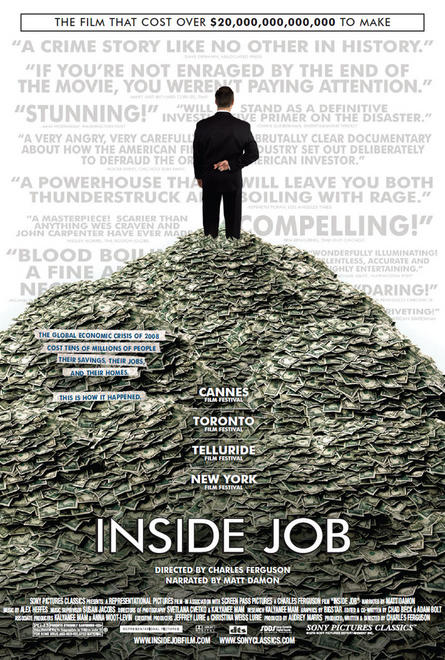
After watching the recent documentary “Inside Job,” about the U.S. economic collapse in 2008, I couldn’t help wondering: Where was the business press during all the run-up to the edge of the cliff?

The film is not shy about pointing fingers at villains: greedy bankers, revolving-door  government officials who go to Washington to look out for Wall Street, academic economists who write “studies” that “show” that whatever Wall Street wants to do is rational, efficient, etc.

But while the film allocates plenty of blame to markets and to feckless regulators, it says nothing about an institution that is supposed to help protect consumers, investors, and the general public: the media that cover business. The well-paid reporters and editors work for newspapers, magazines, television and websites — everybody from the NYT and WSJ to the Economist and Forbes to CNBC. Where were they?

–Did they explain the rotten core of CDO’s before they imploded (i.e., when the information would have been really timely and useful)?

–Did they spot the housing bubble?

–Did they reveal how bogus the standards had become for subprime loans?

Or, did they do what they usually do — admire executives who had a good quarter, cheer for the Dow to rise, and repeat pro-business dogmas about low taxes?

Hmm… If any academics are looking for a topic to study, that might be a good place to start.


Leave a comment

Filed under business, CNBC, media, New York Times