Category Archives: media

JFK shooting: TV news grows up fast

By Christopher B. Daly 

With the approach of the 50th anniversary of that fateful day in Dallas, I thought it might be worth re-visiting my account of the assassination. Here is an excerpt from Covering America that looks at the media response to the shooting:

During the Kennedy presidency, television news became more powerful than ever. In the years since the quiz show scandals of the 1950s, television executives had been atoning by lavishing resources on their news divisions. Television sets were in the vast majority of homes by 1960, and the audience for the TV networks dwarfed that of any newspaper and even the readership of the entire Time-Life empire. The media president, Jack Kennedy, also introduced live television coverage of presidential news conferences and proceeded to thrive in the new forum. Television carried more news than ever, to more people.

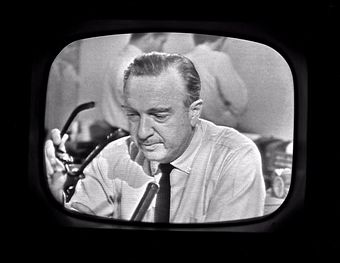
On November 22, 1963, television was the medium by which many Americans first got the news about the shooting. There it was, right on TV. The president and his wife were in a motorcade with Governor John Connally and his wife. Shots rang out, and the president was rushed to the hospital. No word on the shooter’s identity. It may not have been apparent to viewers, but television executives were scrambling to keep up. The networks did not have the equipment and staff needed to “go live” and put news on the air as it was unfolding. Just off camera it was pandemonium, as executives met to decide how to cover a presidential shooting in the new medium. Eventually they reached a consensus: they would stay with the story, without interruptions and without ads, for the duration. So it was that for three or four days the American people did something they had never done before: they stayed home and attended a funeral via television. If they were watching CBS, they saw Walter Cronkite dab at his eye when he announced the bulletin confirming Kennedy’s death. No matter what network they watched, viewers saw Jack Ruby shoot Lee Harvey Oswald; they saw the flag-draped caisson and the riderless horse; and they saw the salute given by the president’s young son. For the first time (and almost the last, as it happened), nearly the entire country had nearly the same experience at the same time.

CBS News anchor Walter Cronkite struggles to keep his composure on-camera as he announces the news of the death of President John F. Kennedy live on the air on November 22, 1963.     —Getty Images.

CBS News anchor Walter Cronkite struggles to keep his composure on-camera as he announces the news of the death of President
John F. Kennedy live on the air on November 22, 1963.
—Getty Images.


In the New York Times, on Monday, November 25, 1963, the front page featured a banner headline across the entire page, stacked three decks deep:

PRESIDENT’S ASSASSIN SHOT TO DEATH

IN JAIL CORRIDOR BY A DALLAS CITIZEN;

GRIEVING THRONGS VIEW KENNEDY BIER

The funeral was planned for later that day. Below the big headline was a photo (from the AP) of Jackie Kennedy and Caroline kneeling next to the president’s flag-draped casket. Underneath was a little single-column story headlined:

JOHNSON AFFIRMS

AIMS IN VIETNAM

Then, this ominous subhead:

Retains Kennedy’s Policy

of Aiding War on Reds


[To read my book, order Covering America from Amazon.]
 

Leave a comment

Filed under broadcasting, history, Journalism, journalism history, media, New York Times

Long live the obit!

By Christopher B. Daly 

An often under-appreciated journalistic form is the humble obituary, known as the obit. The best kind of obit, when well done, is a kind of snap profile. The subject of the ideal profile is a person you did not know when alive but should have — or whom you now wish you had known before it was too late.

These are not to be confused with paid death notices, which are horribly formulaic. (I know, obits can be formulaic too, but I am not talking about those here.)  A true obituary, by definition, is a story about a dead person written by a journalist. The best ones convey the news about the timing and manner of death, then go on to tell a story about an interesting life.

I wish to celebrate two obits that appear by coincidence today.

In the Boston Globe, Bryan Marquard salutes the late Sam McCracken — a obit-big“character” of the first order. I did not know McCracken despite his many years at Boston University, but now I wish I had.


In the New York Times, the redoubtable Robert D. McFadden opens a world — that of the favored few who not only lived in the apartments at Carnegie Hall SHERMAN1-obit-articleLargebut paid almost no rent for the privilege. The occasion is the recent death of another “character,” Editta (cq) Sherman, who made it to age 101.


Either of these obits could have stood on its own as a feature story in either paper. These sorts of efforts renew my faith in the obit, which is under pressure from the hollowing out of newspaper staffs and from the relentless pressure of the Internet. They remind me why we continue to teach our students in journalism schools how to write obits — and why they should want to.

Leave a comment

Filed under Journalism, journalism history, media, New York Times, Uncategorized

Keller v. Greenwald debate: Reporting v. Advocacy

By Christopher B. Daly

Bill Keller, former executive editor of The New York Times and keeper of the flame of traditional reporting, has squared off with Glenn Greenwald, the journalist who disclosed the Snowden leaks and an avatar of advocacy, in a debate over the meaning and future of journalism. Their debate is well worth reading and contemplating. 

Here’s my take: they are actually talking past each other. Each participant represents a different definition of journalism and cannot fathom the other’s values. As I argue in my book, Covering America, they come from competing visions of the essence of journalism, each of which has a long record.

Keller stands squarely for the tradition of responsible, dispassionate, nonpartisan, factual reporting. This was articulated forcefully by Adolph Ochs, the great-grandfather of the current Times publisher, when he bought the Times in 1896. Keller seems to believe that this tradition is the only legitimate one and that all others represent a deformation or corruption of “real” journalism.

Greenwald stands squarely for the tradition of journalism that prizes journalism for its ability to change the world. This is the polemical, analytical, interpretive form of journalism that considers advocacy the essence of journalism. Practitioners like Greenwald often look down on the reporting tradition as a weak, hypocritical, trouble-avoiding compromise.

It may come as a surprise that the advocacy tradition is actually older (much older) than the reporting tradition. In America, the first newspaper launched in 1704, and for more than a century after that, most journalism in America was a fact-free zone of argument and advocacy carried out by the likes of Sam Adams and Tom Paine.

The first full-time reporter in America (the obscure figure George Wisner of the New York Sun– pgs 61-62 in Covering America) wasn’t hired until 1833, and it took decades to establish the idea that the proper contents of a newspaper were value-free “facts” gathered by non-partisan professionals.

Personally, I don’t think one tradition is inherently more virtuous or more valuable than the other. I admire the best in both worlds.


2 Comments

Filed under blogging, history, Journalism, journalism history, media, New York Times, Politics

Revealed: Justice Scalia’s news diet. (No NYT allowed!)

Here is an excerpt from a recent interview in New York magazine with Justice Antonin Scalia, in which he discusses his news consumption habits with interviewer Jennifer Senior.

What’s your media diet? Where do you get your news?
Well, we get newspapers in the morning.

“We” meaning the justices?

No! Maureen and I.

Oh, you and your wife …

I usually skim them. We just get The Wall Street Journal and the Washington Times. We used to get the Washington Post, but it just … went too far for me. I couldn’t handle it anymore.

What tipped you over the edge?

It was the treatment of almost any conservative issue. It was slanted and often nasty. And, you know, why should I get upset every morning? I don’t think I’m the only one. I think they lost subscriptions partly because they became so shrilly, shrilly liberal.

So no New York Times, either?

No New York Times, no Post.

And do you look at anything online?

I get most of my news, probably, driving back and forth to work, on the radio.

Not NPR? 

Sometimes NPR. But not usually.

Talk guys?

Talk guys, usually.

Do you have a favorite?

You know who my favorite is? My good friend Bill Bennett. He’s off the air by the time I’m driving in, but I listen to him sometimes when I’m shaving. He has a wonderful talk show. It’s very thoughtful. He has good callers. I think they keep off stupid people.

That’s what producers get paid for.

That’s what’s wrong with those talk shows.

Let’s talk about the state of our politics for a moment. . . 


I don’t know about you, but I cannot believe that a Supreme Court justice — any Supreme Court justice — can get by without reading the Times. For Scalia not to know what just a single Times reporter, Charlie Savage, is reporting is either not true or it is not professional. If we take him at his word, Scalia confines himself to

(1) a Murdoch paper,

(2) a paper that may be the worst in the country (the Washington Times, owned by a crazy Korean religious cult figure), and

(3) a radio talk show run by his friend Bill Bennett.

Talk about living in a bubble. Sheesh.

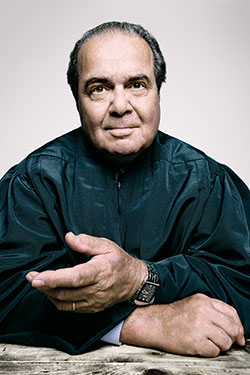
An embarassment Photo by Platon

Antonin Scalia: An embarrassment
Photo by Platon

Leave a comment

Filed under Journalism, media, New York Times, Supreme Court

Digital news expanding

By Christopher B. Daly

That’s one message to take from the decision by Politico (which is virtually online-only) to expand its brand of political coverage to Albany and the state government of New York.

It’s interesting to note in today’s story, that the publisher of Politico, Robert Allbritton, recently divested himself of his family’s longstanding involvement in one form of “legacy media” — television broadcasting. He recently sold the Allbritton family’s stake in seven TV stations for something like $1 billion. Rather than sit on it, he is investing in the future by branching out from Politico’s base in Washington to New York City, where Capital New York is based. From there, the online news operation covers one of the biggest state capitals in the country. Now, just 49 to go!

Here’s the Politico version.

images

Leave a comment

Filed under broadcasting, Journalism, media, Politics

Should the Internet be regulated?

By Christopher B. Daly 

And, if so, for whose benefit?

Those were some of the issues swirling in the U.S. Circuit Court of Appeals in Washington as lawyers argued over a case that could have far-reaching impacts on the future of Internet access and the Web.

On one side is the FCC, which is asserting that it has the power to regulate the Internet just as it regulates over forms of electronic communication like radio, TV, and telephone.

On the other side is Verizon, a major internet service provider (ISP), which says the FCC has never been granted that power by Congress and cannot just assert it because it wants to.

A major point of conflict: can ISPs be forced to treat all their customers the same when it comes to upload/download speeds, pricing, and the like? Or, are they free to devise their own pricing structures that penalize heavy users of bandwidth?

If the ISPs have that right, how would they use that power? Would they impose high rates on start-ups like Zipcar and end up thwarting innovation?

Here’s today’s version in the Times.

The takeaway:

Consumers could experience a significant change in the Internet if the United States Court of Appeals for the District of Columbia Circuit strikes down the F.C.C.’s requirement, called the Open Internet Order.

Currently, companies that offer goods or services online do not have to pay anything to get their content to consumers. If Internet service providers started charging fees to reach customers more quickly, large, wealthy companies like Google and Facebook would have an edge, the F.C.C. says. The government argued that such a tiered service could cause small, start-up companies with little money to pay for their access — the next Google orFacebook, perhaps — to wither on the vine.

In any case, the added costs would be likely to be passed on to consumers.

The case, which is expected to be decided late this year or early next year, has attracted enormous interest. On Monday, telecommunications lawyers began lining up to get into the courtroom two and a half hours before the session was scheduled to start. The session was standing room only, with many others left to listen in an adjacent overflow room.

To be continued. . .

Leave a comment

Filed under blogging, Journalism, journalism history, media

Charlie Savage dominates NYT coverage

By Christopher B. Daly 

Is there only one Charlie Savage? The New York Times reporter, who patrols the intersection of national security and legal issues, has no fewer than three bylines in today’s paper. Whew! He is on a tear trying to keep up with — and propel — the cascade of disclosures coming out about the apparatus of the surveillance state.

topics-savage-pic-articleInlineSavage, a Harvard grad and former editor of the Harvard Crimson, earned his stripes at the Boston Globe,where he won a Pulitzer Prize for reporting that called out President George W. Bush for his abuse of the presidential power to ignore the will of Congress by issuing “signing statements.”


Here are today’s offerings from Charlie Savage (great by-line, btw).

–Chief Justice Roberts has been packing the secret FISA court with conservatives. Hardly a surprise, but it needed to be documented.

–As part of his continuing coverage of the Wikileaks case involving the court martial of Pfc. Bradley Manning, Savage gives us a glimpse of the military’s approach to justice:

While Major Fein made his arguments, reporters watched the trial on a closed-circuit feed at the media center. Two military police officers in camouflage fatigues and armed with holstered handguns paced behind each row there, looking over the journalists’ shoulders, which had not happened during the trial. No explanation was given.

Yikes.

–Savage also shared a byline with legal correspondent Adam Liptak on a piece about the Justice Dept’s plans to enforce voting rights. (BTW, I think the Justice Dept should just lay back and wait for some racist, right-wing legislature to write some horrible law, then sue them so fast their heads spin. That way, minority voters can see who is really on the side — and who is not.)

UPDATE: Just in the last two hours, Charlie Savage struck again: Turns out, the top Pentagon guy in charge of GITMO is stepping down.


Leave a comment

Filed under Journalism, journalism history, media, New York Times

Let cameras into court

By Christopher B. Daly 

As I recently argued, we the people deserve to have cameras in all our courtrooms (except maybe juvenile court) and our legislative bodies.

The latest case in point: the appearance in U.S. District Court in Boston yesterday by Dzhokhar Tsarnaev, the surviving suspect in the Boston Marathon bombing case. Radiating out from downtown Boston, millions of people have a keen interest in this case, and they all have a right to see this defendant. We have a right to hear him say “Not guilty.” We have a right to observe the performance of the government parties — the prosecutors, the judge, the guards, etc. We have the right to watch our government.

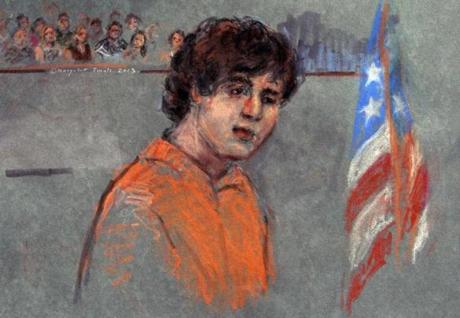
Instead, what we get is a chalk sketch like this one:

Suspected terrorist Margaret Small/AP

Suspected terrorist
Margaret Small/AP

We can do better, and we the people deserve better. 

If anybody knows of a good argument for continuing to ban cameras from federal courts, please leave a comment.


6 Comments

Filed under Boston, broadcasting, journalism history, media, Photojournalism, Supreme Court

NSA Leak: Is Greenwald a journalist or activist? (Does it matter?)

By Christopher B. Daly

In his NYTimes column today, David Carr raises a somewhat misleading question about Glenn Greenwald, who broke the story about the illegal, secret NSA spying on innocent Americans. Carr poses the question: is Greenwald a journalist or an activist?

I think that’s the wrong question, for several reasons.

First, as a historian of journalism, I start with looking at the history of American journalism. For more than a century, back in the early days of newspapers in Colonial America and during the first few decades of the early national period, there was no such thing as “objectivity” in the newspaper business, and there were no full-time reporters.

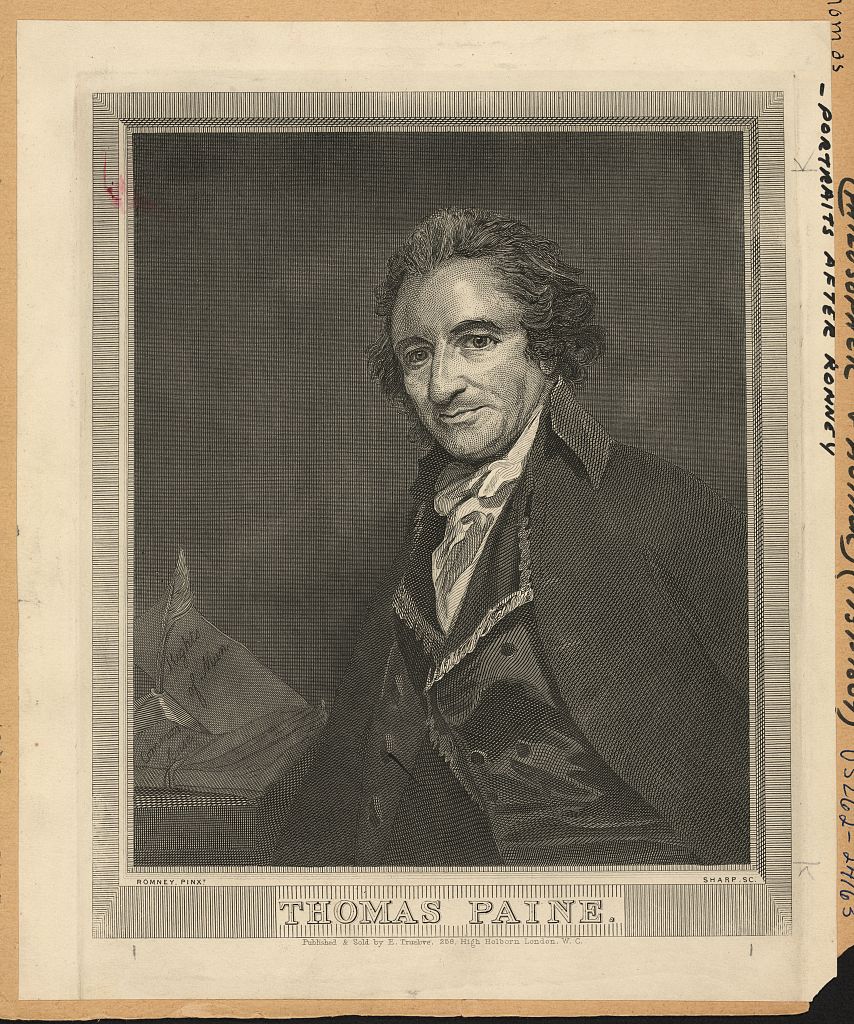
Thomas Paine (Library of Congress)

Thomas Paine (Library of Congress)

That is, the entire industry was based on content created by people with an ax to grind. Often, they were political activists (like Sam Adams or Tom Paine) or surrogates for office-holders (like James Callender).

The idea that a journalist should be defined as a full-time, professional fact-gatherer who has no political allegiances is not only unrealistic, but it is already a historical artifact. If that definition of a journalist ever made sense, it was during a period (the mid and late 20th century) that is now over. Today, the term “journalist” embraces all sorts of folks with different business models, different priorities, and different media. So be it.

Glenn Greenwald is actually a case in point for this new media landscape. He is not just a reporter. He is a lawyer-litigator, an author, a columnist, a blogger, and an advocate. He is also gay and living in a DOMA-induced exile in Brazil. In all he does, he appears to have strong convictions (or biases, if you prefer). He makes no bones about his allegiances. In a sense, he is the compleat modern journalist — global, multi-platform, high-impact.

I don’t agree with him on everything, but I value what he does. And I appreciate knowing where he’s coming from — unlike some journalists who actually have an agenda but deny it.


1 Comment

Filed under history, journalism history, media, Uncategorized

Who will own the Boston Globe?

An update on the bidding for the Boston Globe (and other properties being sold by the New York Times Co.).

The deadline for bidding was yesterday. The Globe itself reports that there were at least six bids submitted — including one that I did not preview in my earlier post: Red Sox co-owner John Henry and his Fenway Sports Group. (Wow — could the Globe pay any more attention to the Sox than they do now?)

According to the Globe, the Kraft group dropped out of the bidding, which means the region’s newspaper will not be owned by the region’s NFL franchise owner. Phew.

Here’s the Reuters version.

Stay tuned.

3 Comments

Filed under media, New York Times, publishing