Category Archives: media

Globe owner John Henry: A man of few words?

By Christopher B. Daly

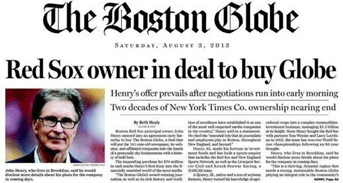
Former commodities trader and current pro-sports franchise owner John Henry has also owned the Boston Globe newspaper since last summer, when he bought it for a mere $70 million. Since then, he has said little about his plans, his political views, or his philosophy of journalism. That’s his prerogative, of course, but all the readers of the Globe around New England and beyond, may start to tire of his taciturn approach.

Boston-Globe-and-Henry


Last October, Henry published a 3,000-word op ed in his own newspaper under the headline “Why I Bought the Globe.” Among other high-minded points he made was this passage:


This much is clear: The overriding mission of The Boston Globe will be to ensure that its readers are getting news they can trust. The Globe will place its emphasis on hard-hitting, investigative accountability that readers can rely on. Not only will the Globe seek to hold people and institutions accountable for their actions, we will hold ourselves accountable for fairness, balance, and fact-checking.

Today, reliable information has never been more valuable. A newspaper needs to provide the breadth of perspective and diligent analysis that gets to the heart of what is going on in our world. The Globe will never be the prisoner of any ideology or political agenda.

Our enterprise reporting will shed new light on important issues of the day, with intellectual honesty and discipline. We will provide our readers with the assurance that if they read the Globe, they will know that time, effort, and thought were put into each and every report.

In this way, Henry sounds like many other American publishers who have issued similar declarations upon taking over newspapers: political independence, a commitment to service, a sense of public trust, etc. His statement was similar in spirit and tone to that of Adolph Ochs when he took over the New York Times in 1896. Here’s the heart of Ochs’ declaration:

It will be my earnest aim that The New-York Times give the news, all the news, in concise and attractive form, in language that is parliamentary in good society, and give it as early, if not earlier, than it can be learned through any other reliable medium; to give the news impartially, without fear or favor, regardless of party, sect, or interests involved; to make of the columns of The New-York Times a forum for the consideration of all questions of public importance, and to that end to invite intelligent discussion from all shades of opinion.

Since his op-ed last fall, Henry has said little, other than a speech to the Greater Boston Chamber of Commerce last month. He has removed the Globe’s publisher, Chris Mayer, and given himself that job. Now comes a bit more insight, in an article from Boston magazine, written by senior editor Jason Schwartz. In the piece, Schwartz reveals that Henry would not grant him an interview, but “instead agreed to exchange emails” — without saying how many. The piece includes interviews from other key players (including Globe editor Brian McGrory) but adds little to our understanding of Henry and his intentions.

One reveal: Henry confirmed that he plans to sell most of the Globe’s property in Dorchester and move the newsroom into a prominent place closer to downtown — a good idea that I have thought the Globe should have done years ago. The sale of all that land should reap at least $70 million, which would mean that Henry got the newspaper as such for free.

Still, questions persist. Here are some I have:

–How can the Globe return to profitability?

–How long will the Globe continue in print?

–When you start to make money from the Globe, what will you do with it?

–Is it important to even try maintaining a separation between the paper’s editorial page and its news pages?

–If you have money to invest in the Globe, what are your top priorities for expanded coverage?

–Is there a comparable news operation anywhere in the world that you admire?

–If you had to choose between watching the Red Sox in the World Series or the Liverpool Football Club in a championship game, which would it be?

BONUS: My estimable colleague Dan Kennedy has written about this same topic today, including a warning about the possible return of Mike Barnicle. Well worth a read.


4 Comments

Filed under Boston, Journalism, journalism history, media, publishing

Boston Globe owner begins making his moves

By Christopher B. Daly 

It’s no great surprise that John Henry, the wealthy former investor who bought the Boston Globe late last October for less than $70 million, has named a new publisher: himself. This is a step that has many precedents in the history of American journalism. And it makes sense: why spend the money to buy a whole newspaper if you don’t plan to run it?

The more interesting development announced by the Globe is that the paper will have a new CEO: veteran ad man Mike Sheehan. A longtime executive with the Boston advertising powerhouse Hill Holliday, Sheehan now takes on the responsibility for making enough money to rebuild the Globe’s reporting strength to the point where it can fulfill its goal of being a robust regional news organization.

Personally, I wish them all the luck. Get cracking, do good work, and start hiring more journalists.

Here's the Globe's caption on this double portrait: John Henry (left) and Mike Sheehan hope to boost ad revenue at the Globe.

Here’s the Globe’s caption on this double portrait: John Henry (left) and Mike Sheehan hope to boost ad revenue at the Globe.


Leave a comment

Filed under Boston, Journalism, journalism history, media

Surveillance state: NSA chief sees threats everywhere

By Christopher B. Daly 

In what universe does it make sense that DNI James Clapper still has his job?

He should have been charged with contempt of Congress for lying under oath and sacked by his boss, President Obama. Instead, there he was yesterday testifying to Congress.

He used the platform Congress gave him to denounce Edward Snowden, the former NSA contractor who spilled the beans on the illegal and questionable programs and tactics run by imgres3our intelligence agencies. Of course, he blamed Snowden for serious but vague damage done to America. On examination, what he really means is that Snowden made life difficult for our spy agencies. Whether he caused any other kind of damage is unclear. (transcript, anyone?)

To quote the Times:

Mr. Clapper did not give specific examples to bolster his assessment about the damage Mr. Snowden had done. He also did not say whom he believed Mr. Snowden’s accomplices to be.

But he wasn’t finished. Turns out, he sees “threats” everywhere. There are bogeymen all over Asia, the Mideast and Africa. Everywhere he looks, he sees nukes, bio-chem weapons, conspiracies, and an ever-mutating array of threats. Most of these threats are either hypothetical, localized in some faraway place, or intramural disputes between people who are no friends of ours. At the risk of sounding like some kind of neo-isolationist (which I am not), I have to observe that almost none of the threats hinted at by Clapper involve real, credible, imminent attacks on the territory of the United States.

But that’s not the standard for our military-intelligence complex. There, the issue is whether someone presents a threat (of any kind) to something known as “American interests” — a term that has no specific definition. It is so vague and all-encompassing that it could mean almost anything — a kidnapping threat against a U.S. citizen anywhere in the world, for example, or an apolitical piracy operation that menaces U.S. shipping anywhere in the world.

The fact is, not every problem in the world is an American problem, and not every problem in the world has an American solution. But if you are seeking to justify the existence of your agency and get more money for your budget, it behooves you to play up all these “threats.”

Thanks to Sen. Ron Wyden, D-Oregon, who has emerged as the great skeptic in Congress. (He’s the one Clapper lied to, face to face, last year.) At this week’s hearing, Wyden

said that the dealings between spy agencies and their congressional overseers were crippled by a “culture of misinformation.”

Speaking of executive actions, this is one problem Obama could solve today, without needing an act of Congress. Fire Clapper.


Leave a comment

Filed under Journalism, leaks, media, Politics, President Obama, surveillance

MEDIA: David Carr has seen the future

By Christopher B. Daly 

And the future for journalism is . . .

  DIGITAL. . .

                                           PROFITABLE . . .

                                                                 AND HERE NOW!

Focusing on the recent decision by Ezra Klein to decamp from the old-school Washington Post

Ezra Klein, pointing to his major asset.  AP photo

Ezra Klein, pointing to his major asset.
AP photo

when the legacy medium could not accommodate his demands, Carr sees an array of “digital natives” who are managing to do good (or at least decent) journalism and make money at the same time.


If true, three cheers for those on-line winners!


Here’s Carr’s take:

In making the switch, Mr. Klein is part of a movement of big-name journalists who are migrating from newspaper companies to digital start-ups. Walter Mossberg and Kara Swisher left Dow Jones to form Re/code with NBC. David Pogue left The New York Times for Yahoo and Nate Silver for ESPN. At the same time, independent news sites like Business Insider, BuzzFeed and Vox have all received abundant new funding, while traffic on viral sites like Upworthy and ViralNova has exploded.

All the frothy news has led to speculation that a bubble is forming in the content business, but something more real is underway. I was part of the first bubble as a journalist at Inside.com in 2001 — an idea a decade ahead of its time — and this feels very different.

The web was more like a set of tin cans and a thin wire back then, so news media upstarts had trouble being heard. With high broadband penetration, the web has become a fully realized consumer medium where pages load in a flash and video plays without stuttering. With those pipes now built, we are in a time very similar to the early 1980s, when big cities were finally wired for cable. What followed was an explosion of new channels, many of which have become big businesses today.

Still, some things don’t change all that much. As Carr points out, it still takes some serious money (about $25 million, he says) to launch a big site, and it takes time (5+ years, he estimates) to work out the kinks, find your audience, build a staff, and earn a reputation for being worth a visit.

[FULL DISCLOSURE: David Carr is no longer just the most influential columnist writing about media and the web, but he is also a new colleague of mine on the Journalism faculty at Boston University, where is the new, inaugural Andrew Lack Professor in the economics of journalism.]


Leave a comment

Filed under blogging, Journalism, journalism history, media, publishing

New biography of Roger Ailes

By Christopher B. Daly 

Looking forward to reading the new biography of Roger Ailes, the driving force behind Fox News, by Gabriel Sherman. It sounds like this is the one worth waiting for, rather than the earlier version published last year by Zev Chafets, which had Ailes’ cooperation (which can only mean one thing).

Sherman, a contributing editor at New York mag (and Newton, Mass. native), has been working on this book for years, and he certainly has the journalistic credentials to pull it off.

Today’s story in the Times features this quote from Ailes:

“I want to elect the next president.”

As if that were a shocking ambition for a news executive. The same could have been said of Benjamin Bache at the Philadelphia Aurora in the election of 1796 or of Henry Raymond of the The New-York Daily Times (as it was originally known) in 1856 or William Randolph Hearst every year from 1896 to his death in 1951. American publishers and broadcasters have usually seen themselves as king-makers (it not candidates, a la Hearst). It appears to be one of the major appeals of the job.

Another curious passage from today’s story:

Last year, lawyers from Fox News met with lawyers from Random House to discuss Mr. Sherman’s book. Fox requested the meeting because it had heard about allegations that might be in the book that it said were inaccurate, and to emphasize that the book had not been fact-checked by Fox News.

Well, why would the book be “fact-checked by Fox News”? It should be fact-checked by its own publisher, Random House, not the subject. Isn’t that the essence of editorial responsibility? Sheesh.

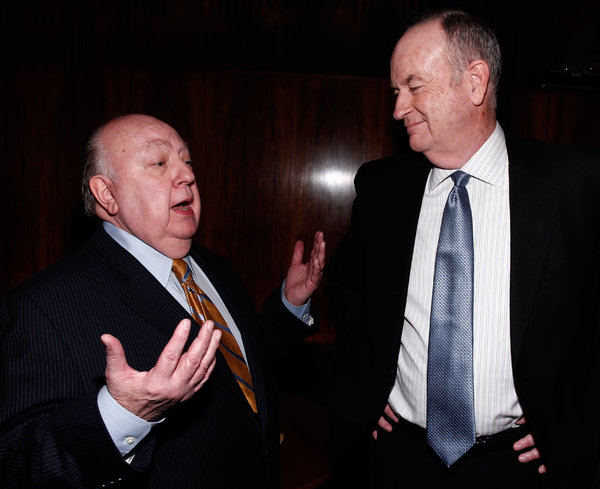
Fun fact: Ailes is quoted as calling Bill O'Reilly "a book salesman with a TV show."

Fun fact: Ailes is quoted as calling Bill O’Reilly “a book salesman with a TV show.”

Photo: Brian Ach/Associated Press Images for The Hollywood Reporter

Leave a comment

Filed under broadcasting, Fox News, Journalism, journalism history, media, Politics, publishing

Partisanship in journalism: a discussion

By Christopher B. Daly

For readers’ convenience, I am posting some material that airs out the issue of partisanship in the news media. In sequence, here are:

1. A NYTimes invitation to a Sunday Dialogue, a feature of the paper’s Sunday Review section in which readers are asked to respond to a short essay.

2. My reply as published on Dec. 7, 2013.

3. A thoughtful email that I got from a reader, who gave me permission to post his ideas here.

4. The Sunday Dialogue replies by people other than me.

5. The original author’s reply to the replies.

6. My reply to that reply.
08letters-articleLarge


How Fox News, MSNBC and others present the news.

 To the Editor:

An autobiography gives an intimate account of a life, but to get the larger picture, you also need the biography.

The same goes for news. Relying on one source, or even on several sources with the same bias, will leave you with only part of the story.

That’s why the much maligned right-wing media is just as important as the so-called mainstream press. Fox News and others on the right certainly have a deeply embedded conservative bias, but the liberal bias on the other side is just as pervasive. Taken together, they roughly fill each other’s omissions.

Fox, for example, spent a good part of the past year digging into the Benghazi attack and I.R.S. tax-exempt status stories and talking hopefully about smoking guns, while the mainstream press was determined to take the Obama administration’s word for it that it did nothing wrong in either case.

More recently, when the president’s pronouncement about keeping your health insurance proved false, it was reported as a lie by the right and as a simple misstatement by the left.

And when the Obamacare website failed so miserably that not even the mainstream press could cover for it, the networks were obliged to sound like Fox for a while, although noticeably lacking was the appetite for pursuit that characterizes their coverage of Republicans.

Fairness in journalism requires not that every story or point of view receive equal weight but that every valid position receive equal respect. Thus the pro-life position should be treated with the same validity as pro-choice; small-government conservatives with the same respect as tax-and-spend liberals; Republicans as more compassionate than they sound and Democrats as less omniscient than they think.

But since journalists and news organizations are partisan at heart, one must sift through the best reporting and punditry from each side of the journalistic divide and take all the biases and agendas into account to arrive at an informed understanding of any story.

MARK R. GODBURN
North Canaan, Conn., Dec. 2, 2013

The writer is an antiquarian bookseller.

Here’s my comment:

In his lament about bias in the news media, Mr. Godburn assumes that unbiased journalism is possible and desirable. History suggests otherwise.

In the 18th and early 19th centuries, American journalism was highly political, often polemical and openly biased. That was the kind of journalism in which the likes of Sam Adams and Thomas Paine gloriously argued for liberty, and it was the form of journalism that was on the founders’ minds when they enshrined the doctrine of a free press in the First Amendment.

Only later, beginning with Benjamin Day’s Sun newspaper in 1833, did American journalists begin to develop a strong tradition of factual reporting. In part, this was the result of Day’s ambition to sell his paper to every reader (“It Shines for All”) and not limit his audience to members of any one political party.

In the 20th century, the major broadcast network news divisions, first in radio and then in television, reinforced this idea. They not only wanted the highest possible ratings, but were also operating as publicly traded corporations and were regulated by the Federal Communications Commission.

Nowadays, from within the turbulence of the digital age, we can begin to see that the years when big media companies were purveying what they described as nonpartisan, factual reporting were actually a historical period that is already fading into the past. The Internet has reinvigorated the “advocacy tradition” in journalism, and it has also made possible new forms of reporting such as crowd-sourcing, reporting that enlists the audience and the like. The spirit of innovation lives.

CHRISTOPHER B. DALY
Boston, Dec. 4, 2013

The writer is a professor of journalism at Boston University and the author of “Covering America: A Narrative History of a Nation’s Journalism.”

Here’s the email I got from blogger Steve Claflin:

Professor Daly:

Thank you for “Partisanship in the Media” in the December 8 New York Times letters.

The revived “advocacy tradition” problem you mention might be easier to manage if we had a form of majority rule that allows the general public to have more influence.

In the old days, the House was able to vote on any bill and the majority would prevail. Until an important bill recently passed by a wide margin, a Tea Party minority could usually intimidate other members, especially the Speaker, and prevent legislation that would easily pass from even getting to the floor. The minority party in the Senate can routinely block action on bills, because minority rule is built into Senate procedures. 60 votes are needed, with the help of a fickle minority, to pass legislation.

Is there anything more vital to democracy than majority rule? Is this what distinguishes democracy from autocracy? Is this what a democracy needs in order to succeed? We have the elections we normally associate with a democratic process. We reassure ourselves by going through the motions.

But the active ideological minorities in Congress, and the members who are owned and operated by special interests that donate large sums of money, are repeatedly able to slow or block or derail changes those few oppose and the rest of us generally favor. As such repeated occurrences so rudely remind us, we can have the structure, the trappings, the proceedings, the appearance of democracy without having majority rule.

Here are the other comments published in the Times:

Readers React

In an ideal world, graced by Enlightenment ideals, Mr. Godburn’s recommendation that citizens sift through biases of diverse news media outlets to form a complete perspective would be warmly endorsed. However, in this far-from-ideal world, individuals live in media echo chambers, selecting out viewpoints that agree with their own and sometimes avoiding conflicting ones.

Research finds that conservatives gravitate to Fox News and liberals to MSNBC — as well as to like-minded websites. A Pew Research Center study reported that from August to October of 2012, just 6 percent of Fox News’s election stories about President Obama were positive, while only 3 percent of MSNBC stories about the Republican presidential candidate Mitt Romney were positive.

Exposure to biased media strengthens partisan biases, exacerbating political polarization rather than producing the more informed understanding that Mr. Godburn desires.

RICHARD M. PERLOFF
Cleveland, Dec. 4, 2013

The writer is a professor of communication at Cleveland State University.

I read The New York Times every morning. I also watch more MSNBC than I like to admit. Occasionally, for entertainment, I’ll wander to Fox for a Bill O’Reilly moment or two.

Mr. Godburn’s thesis is an example of false equivalence. The Times is real journalism. But even The Times sometimes stretches too far in the service of “journalistic objectivity.” When one perspective is true and the other is propaganda, they should not be presented as equally valid.

As to MSNBC and Fox: The MSNBC host Rachel Maddow, for example, is surely dramatic. But I have never encountered an instance in which she was fundamentally dishonest. On the other hand, Fox is frequently and outrageously untethered from the truth, and its talking heads are attack dogs. Anyone consuming equal doses of this “news” will have intellectual indigestion.

If you bend over too far in the effort to be balanced, you’ll fall flat on your face.

STEVE NELSON
New York, Dec. 4, 2013

Well said, Mr. Godburn. Political correctness and a pervasive left-wing media bias are corrosive and do immense harm to the democratic process. People eventually find out that they have been misled. This breeds cynicism and mistrust. The left and the right learn to develop their own separate versions of the “truth.”

But while most right-wing news sources acknowledge their bias, those on the left deny their bias. Left-wing news sources are suffering a fallout in ratings because people are waking up to these facts and don’t like being manipulated.

FRANK COOK
Wayne, Pa., Dec. 5, 2013

Mr. Godburn makes a telling point, but he doesn’t go nearly far enough. His assertion that liberal and conservative news outlets “roughly fill each other’s omissions” assumes that there are exactly two reasonable points of view toward any given social issue; that these viewpoints are locked in a zero-sum game whereby each one can be validated only to the degree that the opposing one is impeached; and that they happen to correspond to the platforms of our two leading political parties.

Both parties are only too eager to promote this theory themselves, since it implies that together they have a monopoly on the truth. So a responsibility of both a free press and its readers is to examine both contrary viewpoints critically and consider other viewpoints — a third, fourth or fifth perspective — that have not been embraced by either side.

THOMAS LEITCH
Newark, Del., Dec. 4, 2013

Balanced news media is essential in any democracy. But let’s remember what brought us to the present situation — the 1987 repeal of the Fairness Doctrine, which required the airing of contrasting views on public issues, and the loosening of regulations on media concentration, allowing many media outlets to fall under the control of a few corporate-owned conglomerates.

Both have created a situation in which media is not only biased and unbalanced, but overwhelmingly influenced by the opinions and wishes of its corporate masters.

DOMINIC QUINTANA
Astoria, Queens, Dec. 4, 2013

Having recently returned from a trip to Brussels, I found the evening news there to be refreshing and professional. One subject wasn’t beaten to death 24/7 as it is here. You didn’t have to flip from channel to channel to see the “whole” picture, and the news was international in nature. In the United States you rarely hear about what is going on in Africa, Australia and, actually, most of the world.

It is a shame.

BONNIE CHALEK
Ridgewood, N.J., Dec. 4, 2013

I agree with Mr. Godburn that we need different perspectives. I would like to point out that Fox News is the No. 1 news source in America. Surely, that should qualify Fox as “mainstream.”

Studies have also shown that, for many Americans, Fox News is their only source of news. Those viewers are getting a slanted perspective — not balance. Defenders of Fox News often portray it as an underdog struggling to have a voice in the crowd of “mainstream” outlets, but that depiction simply isn’t consistent with its ratings.

I commend Mr. Godburn for admitting that news outlets he identifies as left-leaning did report on the problems with Obamacare. I find that so-called left-leaning news outlets, including The New York Times, are frequently critical of Democrats and their policies.

Mr. Godburn would have a much more difficult time finding comparable examples of Fox News criticizing the G.O.P. — except perhaps when it criticizes moderate Republicans for not being in lock step with the rest of their party.

TOBY PLEWAK
Easton, Mass., Dec. 4, 2013

It may be a fool’s errand to think that we can overcome media bias. The media is ultimately a collection of voices of various people, who generally stick to certain biases and opinions. The answer instead may be to encourage media outlets to be more forthcoming about their biases.

If we, as media consumers, know that a mainstream news outlet typically holds a certain viewpoint, then we can take in the news with a better understanding of what information may be missing or may be shaded one way or another. As it is, given the rather obvious political positions held by certain newspapers and television news divisions, many of us have already begun interpreting the news in this way.

MATTHEW K. KERFOOT
New York, Dec. 4, 2013

Here is Godburn’s last word:

The Writer Responds

Professor Perloff reinforces my point by noting that conservatives gravitate to right-leaning news sources and liberals to left-leaning ones, often without being exposed to contrary views or inconvenient facts.

But then he says that going to such biased sources only exacerbates the problem, as if he thinks there are reliably unbiased sources that one can go to instead. There are not, and that is why it is necessary to mine a variety of biased ones.

Mr. Nelson engages in the cheap liberal tactic of Fox-bashing. If Fox’s talking heads are attack dogs, they are poodles compared with the pit bulls he favors at MSNBC. Simply calling one’s favored sources true journalism and the other side propaganda doesn’t make it so. And if too much news causes intellectual indigestion, too little causes intellectual blinders.

Mr. Leitch is correct that there are more than two points of view. And examining all of them will not necessarily allow one to arrive at some desired middle ground. Just because you have one foot in hot water and the other in cold doesn’t mean you’re comfortable.

Professor Daly’s claim that I assume unbiased journalism is possible and desirable may have been a good lead-in for his journalistic history lesson, but that’s not what I said. The problem is not that journalists are biased — it’s that they claim they aren’t.

MARK R. GODBURN
North Canaan, Conn., Dec. 5, 2013

And, of course, since this is my blog, here’s my final, final word:

I will grant that maybe I misread his original post. When he wrote that all journalists and news organizations are partisan at heart, I thought he considered that a flaw. Perhaps inevitable, perhaps correctable (by reading multiple sources from different perspectives) but still a problem. If he says he doesn’t think so, then who am I to argue? I would say that many people (including a lot of journalists) do consider partisanship some kind of original sin of journalism.

Comments?

Leave a comment

Filed under blogging, broadcasting, First Amendment, history, Journalism, journalism history, media, New York Times, Politics

Surveillance State: An old-school leak of FBI docs

By Christopher B. Daly

History keeps happening.

Thanks to a new book by former Washington Post journalist Betty Medsger called The Burglary, 51HydAvzamL._AA160_Americans can now see another example of principled, patriotic, non-violent dissenters who made America a better place by risking jail to bring important truths to light. The New York Times has a good story today about it, including a terrific video. More is at NPR.

To set the scene:

–It was a time in American history when we were fighting an undeclared war halfway around the world.

–We were fighting against people whose history, culture, and language we did not understand.

–We could not tell friend from foe.

–With each passing year, the insurgency grew stronger and we never managed to “pacify” any territory.

–American citizens tried to stop the war and were castigated as disloyal, unpatriotic.

–The government engaged in a secret, illegal campaign to find and crush people it considered terrorists.

The year was 1971, at the height of the American war in Vietnam, not 2003 or 2004, at the height of the U.S. “war on terror.” (Instead of al Qaeda, the FBI was targeting domestic “terrorists” like the Weathermen and the Black Panthers) After years of peaceful protests, a small group of anti-war activists decided to try a new tactic: break into an FBI office, remove the files, and divulge the secret contents to the news media.

Here is a template for national security leakers. The break-in described in the new book took place in the Philadelphia suburb of Media, Pa., on March 8, 1971. That very same week, Daniel Ellsberg made his first contact with New York Times reporter Neil Sheehan to discuss divulging the massive secret files that became known as the Pentagon Papers. In both cases, people who found that they could not change policy through normal politics and who could not legally blow the whistle on wrongdoing decided to go outside the law — risking prosecution and jail — in the hope that disclosing secrets would lead to a desirable change.

The comparisons to Edward Snowden are obvious. As a contract employee for the NSA, Snowden learned that the government has built a vast spying operation since 9/11/01 that includes secret top-secret-stampsurveillance of millions of law-abiding Americans in peacetime and that officials hid and lied about.

The anti-war burglars in the Media FBI break-in hurt no one and did almost no property damage (they had to jimmy a lock to get in). As a result of their disclosures, no one died and the sky did not fall. Instead, the disclosures added fuel to the anti-war movement and provided vital clues to the wider disclosures that led to the Church Committee investigation and reforms.

In the Media break-in, the only apparent crime was simple burglary, and the statute of limitations expired long ago. So, there is no question of penalties as these American heroes emerge from the shadows.


Leave a comment

Filed under Journalism, journalism history, leaks, media, surveillance

NY court issues a major ruling for press freedom

By Christopher B. Daly 

Invoking journalism history, New York state’s highest court has ruled that under New York’s state constitution and the state’s version of a “shield law,” a journalist cannot be forced to divulge the identity of a confidential source — even if another U.S. state is trying to extract the information. The ruling, issued Tuesday, was a major victory for press freedom, and not just in New York. But it will have its greatest impact in New York, where so much of the news media operate, because now the highest court in that state has ruled that New York’s own laws grant complete immunity to journalists from any attempts to force them to reveal their sources. Since that court is the ultimate interpreter of the New York state constitution, it is a landmark.

It remains to be seen if a New York journalist can use this new ruling as a shield against federal prosecutors. Federal courts are not obligated to follow the New York state court ruling, of course, but any person who gains more rights under a state constitution or law does not forfeit those rights just because federal law has not caught up. The U.S. Constitution and federal laws establish legal minimums that must be afforded to all Americans, but they do not establish maximums. When it comes to our rights, federal law is a floor, not a ceiling.

Briefly, the case involves Jana Winter, a reporter for FoxNews.com. She went to Colorado in 2012 to report on the horrific mass shooting at a movie theater in Aurora. Expecting a media frenzy, the local Colorado court imposed a “gag order” — that is, a pre-trial order that tries to limit disclosures to the news media in advance of a trial. During the investigation into the crime, police got hold of a notebook that belonged to the suspect, James Holmes, which he had shared with his psychiatrist. Someone divulged the existence of the notebook to the reporter, along with a summary or description of its contents. Colorado authorities consider that a breach of the gag order, and they are stamping their feet to see who disobeyed. All the cops in Colorado say “it wasn’t me,” so the authorities are turning to the journalist and demanding that she rat out her source so they can punish that person. For that, they want to make her travel 2,000 miles to violate a promise she made to her source(s). If she stands firm and refuses to name names, she goes to jail. If she gives them up, she is ruined as a reporter, and the whole enterprise of news-gathering is undermined because all sources will doubt all reporters when they promise confidentiality. [Winter has absolutely no information that is exclusive to her and based on confidential sources that has any bearing on the commission of the crime itself. All she knows about is which Colorado cop (or cops) violated the gag order. Please.]

Many, many courts would rule against the journalist in these circumstances. Judges normally sympathize with their fellow judges and see things their way. Judges normally do not like to see anyone violate their rulings and get away with it. Judges like the idea that what they say, goes. All of which makes this ruling even more remarkable. It was a win-win: the court expanded legal protections for reporters, and it relied in part on a famous case involving an 18th-century partisan journalist to do so.

Here are versions by the New York Times (which should have put this on page 1, not inside the business section) The New Yorker, TVNewser, and Poynter. (Even Fox News had to come down on the side of press freedom in this case.)

Here is the text of the decision, written by Judge Victoria Graffeo. Among the stories I saw, only Poynter actually linked to the decision, which is disappointing — hey, people, there’s this thing called the Internet; let’s take advantage of it. Besides, the decision is well worth reading in full. It is a pro-freedom primer on the history of the freedom to gather news. Here are some key excerpts:

New York has a long tradition, with roots dating back to the colonial era, of providing the utmost protection of freedom of the press. Our recognition of the importance of safeguarding those who provide information as part of the newsgathering function can be traced to the case of “John Peter Zenger who . . . was prosecuted for publishing articles critical of the New York colonial Governor after he refused to disclose his source” (Matter of Beach v Shanley, 62 NY2d 241, 255 [1984] [Wachtler concurrence]). A jury comprised of colonial New Yorkers refused to convict Zenger — an action widely viewed as one of the first instances when the connection between the protection of anonymous sources and the maintenance of a free press was recognized in the new world. In acknowledging the critical role that the press would play in our democratic society, New York became a hospitable environment for journalists and other purveyors of the written word, leading the burgeoning publishing industry to establish a home in our state during the early years of our nation’s history.

That is an important point: New York did indeed become the nation’s media capital. I doubt that the New York State Constitution was much of a causal factor (compared to all the economic ones), but the fact that the industry is now centered in New York City means that many, many journalists enjoy the favored status granted by this new ruling. And the ruling holds that a New York-based journalist is protected by New York’s constitution even when he or she roams into another state or online to do reporting. What remains to be seen is what might happen when a New York-based journalist attempts to use the new ruling in the Winter case against a federal prosecutor who comes around with a subpoena seeking to force a journalist to name a confidential source in a federal investigation or trial.

Judge Graffeo wrote that the protections offered to journalists in New York are ancient, robust, and multiply determined.

To begin with, she wrote, there is the matter of common law. Before New York was even a state, the jury in the 1735 image-crown-zenger-tryal-pageseditious libel case against the printer John Peter Zenger  established through its not-guilty verdict that Zenger did not have to reveal the identity of the author of the offending article. The Zenger case is usually cited as a precedent for the idea that truth is a valid defense in libel cases, but if Judge Graffeo finds the germ of a “shield law” in there, so be it. (For more on Zenger, see “Covering America,” chap 1)


Later, New York citizens wrote and ratified a state constitution. It says, in part:

“Every citizen may freely speak, write and
publish his or her sentiments on all subjects
. . . and no law shall be passed to restrain
or abridge the liberty of speech or of the
press” (NY Const, art I, § 8).

In her reading, that language from 1831 constitutes a shield for journalists all by itself, saying it is more expansive than even the First Amendment to the U.S. Constitution and thus affords more protections to New Yorkers than other Americans enjoy under the First Amendment alone.

In addition, Graffeo cites New York state law. In 1970, the New York Legislature adopted a “shield law” that includes an absolute legal privilege for journalists who want to protect the identity of their confidential sources. She said that after considering the views of the likes of Walter Cronkite and Mike Wallace, the Legislature decided to throw its weight into the balance on the side of reporters. The relevant part of that law says:

no professional journalist or newscaster . . .
shall be adjudged in contempt by any court in
connection with any civil or criminal
proceeding . . . for refusing or failing to
disclose any news obtained or received in
confidence or the identity of the source of
any such news coming into such person’s
possession in the course of gathering or
obtaining news for publication

So, Judge Graffeo concludes, journalists in New York are protected by common law, constitutional law, and statutory law. Now, how hard was that? Why do so many judges fail to understand this reasoning? The ruling holds that all these sources of protection for journalists combine to provide evidence of a clear “public policy” in New York state to encourage the practice of journalism within its borders.

But Judge Graffeo was not finished. She noted that the testimony of the journalists that the New York legislators relied upon arose from another case — that of NYTimes reporter Earl Caldwell. In a footnote, she observed

The affidavits were prepared in connection with a motion
to quash a subpoena in a case that was pending when the Shield
Law was under consideration by the Legislature and which involved
an investigative reporter from the New York Times who was
subpoenaed by a Federal Grand Jury in California to testify
concerning knowledge he obtained about the Black Panther
organization. Two lower courts held that the First Amendment
protected the reporter from being compelled to reveal his sources
or disclose information provided to him in confidence, differing
only on whether the reporter could avoid appearing at the Grand
Jury altogether (Caldwell v United States, 434 F2d 1081 [9th Cir
1970] [reporter could not be compelled to appear at Grand Jury],
vacating 311 F Supp 358 [ND Cal 1970][although required to appear

Caldwell, left, with MLK in Memphis, 1968.

Caldwell, left, with MLK in Memphis, 1968.

at Grand Jury, reporter was entitled to protective order
precluding questioning concerning confidential sources or

information]). However, deciding the case with Branzburg v Hayes
(408 US 665 [1972]), the United States Supreme Court disagreed,
holding that the reporter could not rely on the First Amendment
to avoid appearing and giving evidence in response to a Grand
Jury subpoena.

That was a regrettable decision that journalists lost by an eyelash, only because five judges on the U.S. Supreme Court did not understand the U.S. Constitution as well as these New York judges understand the New York constitution. For more on Caldwell, see Covering America, chap 12. For more on the Supreme Court’s ruling, see earlier blog posts here and here.)


The new ruling also sends a message to prosecutors in all the other states: don’t bother going on fishing expeditions. If you send us requests to compel a New York journalist to appear in your state’s courts, those will be denied. The opinion says New York will not tolerate harassment of journalists by subpoenaing them to show up halfway across the country just to assert their immunity under the New York shield law. That would be terribly disruptive to their work. Just leave them alone, the court said. Quoting an earlier case, the ruling states:

“Journalists should be spending their time in newsrooms, not in courtrooms as participants in the litigation process”

It’s thrilling to read a judicial opinion written by a judge who actually understands the meaning of a free press and appreciates its value to society. It’s rare — and therefore, I suppose, all the more thrilling.

0      0       0       0       0       0


Finally, a hat-tip to the judge, Victoria Graffeo, the former solicitor general for the state of New York who was appointed to the Court of Appeals by Republican Gov. George Pataki to a 14-year term in 2000. No liberal, Graffeo was expected to be a moderate conservative voice on that important bench. Labels aside, she gets credit for getting the point.

1 Comment

Filed under blogging, broadcasting, Covering America, First Amendment, Fox News, Journalism, journalism history, leaks, media, New York Times, publishing, Supreme Court

What China really fears: a free press

By Christopher B. Daly 

[Update: TNR weighs in with a piece stressing the perils of self-censorship.]

Through their statements and actions, the leaders of China are showing their true colors. For all their talk about moving toward a more modern, open, accountable society, China’s leaders refuse to budge on one issue. Their policies indicate that what they fear above all — even more than U.S. fighter jets cruising through contested air space — is a free press. Specifically, they fear a U.S.-style press that insists on afflicting the powerful by investigating them.

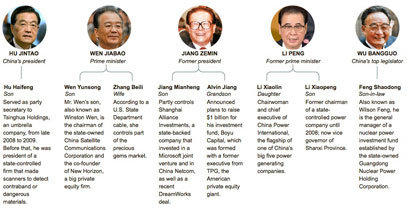
The evidence is in the Chinese handling of recent revelations by reporters for the New York Times and Bloomberg. American journalists who cover China have made dramatic disclosures about how the families who hold power in China manage to use that power to enrich themselves personally. The bar for this kind of reporting was set by David Barboza of the Times (and a Boston University alumnus, BTW), whose series “The Princelings” won a Pulitzer Prize earlier this year.

The Chinese reaction was characteristically blunt: the government in Beijing pulled the plug on the NYTimes in China, banning the print and electronic editions. Now the government is dragging its heels on renewing the visas that journalists like Barboza need to stay in the country and continue their work.

Here is a quote from a Chinese Foreign Ministry official that captures the issue perfectly:

“As for foreign correspondents’ living and working environments in China, I think as long as you hold an objective and impartial attitude, you will arrive at the right conclusion.”

What this reveals is an outlook that holds that there is a “right conclusion” — which is determined by the Communist Party — and that the task of journalists is to discern the party’s views and stick to them. In other words, don’t rock the boat.

The issue is such an irritant between the U.S. and China that vice president Joe Biden put it on the agenda during his visit to China this week. From today’s NYT version:

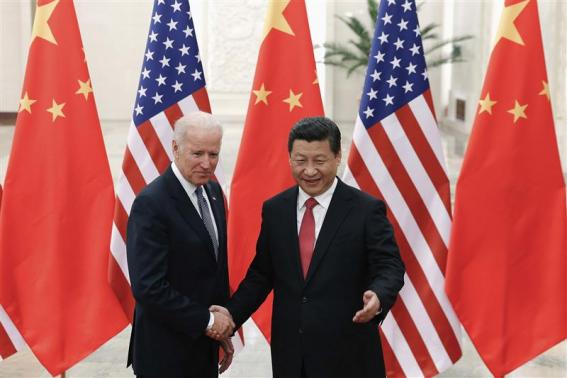
Vice President Joseph R. Biden Jr. raised the issue here in meetings with President Xi Jinping and other top Chinese leaders, and then publicly chastised the Chinese on Thursday for refusing to say if they will renew the visas of correspondents and for blocking the websites of American-based news media.Chinese President Xi Jinping shakes hands with U.S. Vice President Joe Biden inside the Great Hall of the People in Beijing

“Innovation thrives where people breathe freely, speak freely, are able to challenge orthodoxy, where newspapers can report the truth without fear of consequences,” Mr. Biden said in a speech to an American business group.

At a meeting on Thursday with Beijing-based reporters from The New York Times and Bloomberg, Mr. Biden said that he warned Chinese leaders, in a formal session and over dinner, that there would be consequences for China, especially in the Congress, if it forced out the journalists. But he said Mr. Xi appeared unmoved, insisting that the authorities treated reporters according to Chinese law.

If only the U.S. had some good options for pressuring the Chinese. We could exclude Chinese journalists from working in the United States, but that’s a terrible idea. We do not want to sink to the level of unprincipled tactics used by the Chinese, and we want to encourage more coverage of America in China, not less.

I don’t have a great answer here, except for patience. It is an article of faith with me that the truth will out and that in the long run, the power of the press will win out. Besides, I have one other reason for optimism: I teach a lot of young Chinese students about American journalism — its history, its principles, its techniques. Most of them go back to China, and when they return they bring some lessons they are unlikely to unlearn.

princelings-landing-page-jumbo

Leave a comment

Filed under business, Journalism, media, New York Times

David Carr on the media: Content for sale

By Christopher B. Daly 

In his latest weekly column, David Carr identifies a growing trend: the paid creation of “content” (formerly known as stories, pieces, etc.) for clients who want to “tell a story” that also happens to advance their commercial interests. He highlights a leader in this new mutation, a website called Contently, which functions as a kind of dating service for journalists and companies. If you visit

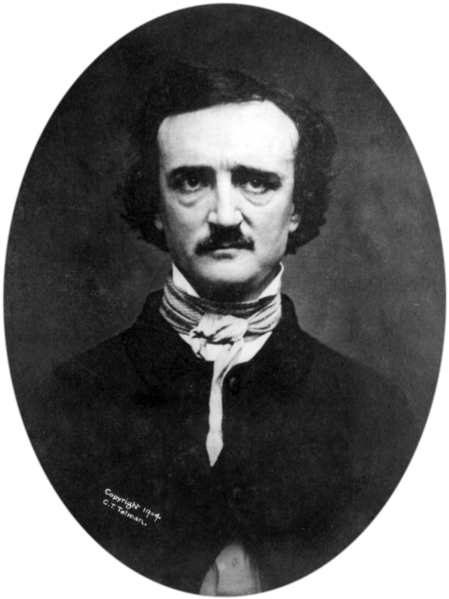
Poe (minus the sunglasses)

Poe (minus the sunglasses)

the homepage, which features a full-screen background image of Edgar Allan Poe in aviator sunglasses, you are invited to proceed through one of two portals: “Journalist” or “Company.” In the “manifesto,” the founders explain their win-win proposition:

Those who tell and promote the best stories—in the best ways—will increase in reputation and trust, fans and influence. Journalists will build their personal brands. Businesses will make a difference. Media companies will thrive.

In writing about this phenomenon, Carr shrewdly sidesteps a category problem: what is this kind of material, exactly?

It’s not journalism, that’s for sure. It’s not journalism because it is not produced by independent people who are working for the good of their audience. They are hired guns working for the good of whoever is paying them.

It’s not P.R., exactly, either, because it appears in disguise — sporting a trenchcoat and a fedora borrowed (or stolen, if you will) from journalism. The reason to look and feel like journalism, of course, is to try to cadge some of journalism’s credibility, to bolster the sales pitch buried in these messages. I suppose it is the inevitable result of an over-supply of writers and the ceaseless demand for material that can fool people into buying stuff.

I am inclined to say “Judge not” when anybody can find a way to get a paycheck into a writer’s hands, but I have to say that I don’t have a good feeling about how this story ends.


1 Comment

Filed under Journalism, journalism history, media, New York Times