Category Archives: journalism history

“Quote approval”: A new low in journalism?

By Christopher B. Daly 

When a journalist interviews someone (anyone), the normal ground rules that govern the interaction amount to this:

I am a journalist working on a story. I want to talk to you and use the things you say in my story, based on my judgment of what is important. I will use none, some, or all of what you say, as I choose, to further the pursuit of the truth. Whatever quotations I use will be verbatim — nothing added, nothing left out. I will also use your real name (and title, if you have one).

This is the essence of the standard known as “on the record.” Journalists prefer it because we believe that, on the whole, it holds people accountable for the things they say. In certain (ideally rare) situations, however, journalists will negotiate some lower standard. Almost always, these retreats from the “on the record” standard come at the initiative of the people we are speaking to. These other arrangements are known by a bewildering array of terms, which do not always mean the same thing in different cities or beats. The problem is that these departures usually serve the source rather than the audience.

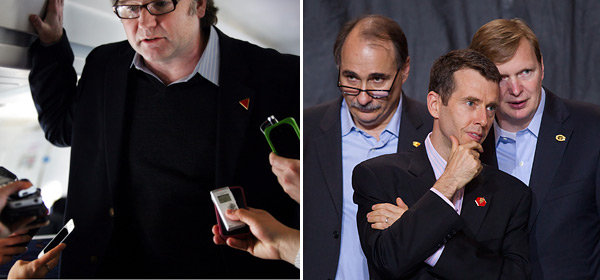
Today comes word from the Times that political reporters for all the major news organizations have adopted a new — and, I think, pernicious — practice. They allow the people they are interviewing to get a look at their own quotes before publication and censor them. That is, the big shots around Obama and Romney routinely demand and get the power to edit themselves before their words appear in print or online.

Well, you can hardly blame them for trying. Who wouldn’t want that option?

But the journalists should never have agreed to it. These spokespeople, senior officials, and top aides get paid lots of money for their ability to think on their feet and choose their words carefully.

At the very least, having agreed to this arrangement, the journalists have a professional duty to reveal the terms. What about transparency? I, for one, could live without stories in which members of the political class get to “clean up” their quotes.

Another question: in what other fields does this practice apply? Sports reporting? Business news?

(Props to Jeremy Peters of the Times for blowing the whistle on this practice.)
3 Comments

Filed under Journalism, journalism history, New York Times, Politics

Noting the loss of Little Bear’s creator

By Christopher B. Daly

How fondly I remember. . .

. . .reading the Little Bear stories to my boys when they were

like little cubs. So, here’s a gentle wave good-bye to Else Holmelund Minarik, who wrote the Little Bear series, so perfectly illustrated by her collaborator, the recently deceased Maurice Sendak. Today’s Times says in an obituary that she died at home in Sunset Beach, NC, at the age of 91. Sounds like her.

 

A journalistic footnote: This gentle soul was married for a while to Homer Bigart, one of the toughest war correspondents ever. A real reporter’s reporter and a two-time Pulitzer Prize winner, Bigart covered WWII, the Korean War, and the American war in Vietnam. Bigart, who was her second husband, died in 1991.

Leave a comment

Filed under Journalism, journalism history

Watergate: Lessons learned and un-learned

By Christopher B. Daly

The Boston Globe’s estimable, veteran political reporter Brian Mooney has a front-page story addressing the question: what has happened to the “Watergate reforms” in the 40 years since the Watergate break-in that began the fall of Republican President Richard Nixon.

Turns out, one of the great post-Watergate reforms — the public financing of elections — is all but dead.

Not only that, but the larger trend of political changes in recent years mark a move away from the lessons learned in Watergate.

One lesson was that power corrupts. Therefore, the power that comes from making big donations to a politician was limited by the caps placed on individual giving. The Supreme Court, however, decided to get rich people back into the business of financing elections, through the Citizens United ruling.

Another lesson was that sunlight is the best disinfectant. Therefore, Congress required all candidates for federal office to account publicly for every dollar raised and every dollar spent. Not so for the new Super-PACs.

Another lesson was that money corrupts. Therefore, Congress almost got up the courage to ban all private donations and institute a system of 100% publicly funded elections. But they blinked and created a hybrid by which politicians had to opt in or out. When the amounts available through public financing failed to keep pace with the amounts candidates could get through private fund-raising, almost every serious mainstream candidate rejected public financing and started holding fund-raisers with wealthy donors.

It appears that the past is prologue.

graphic/ Boston Globe

graphic/ Boston Globe

1 Comment

Filed under Journalism, journalism history, Politics, Supreme Court

Happy Birthday, Ms.

By Christopher B. Daly 

Happy birthday to Ms. magazine. Hard to believe it is 40 years old.

The Times had a nice anniversary party story in the New York section, complete with this photo of Gloria Steinem.

Kristen Luce / NYTimes

Kristen Luce / NYTimes


For a lot more detail about the founding of Ms. in late 1971 and the launch in June 1972, go to chapter 11 in my new book, Covering America. It’s there on pages 348-351. Check it out.

Leave a comment

Filed under Journalism, journalism history

Inside the Meme Factory

By Christopher B. Daly

That phrase, Inside the Meme Factory, is the working title of my next book. It refers to an idea that is well illustrated in a piece on page 1 of today’s Times by the estimable James B. Stewart (lawyer, book author, contributor to both the New Yorker and the Times — is there more than one of him?). In his article, Stewart seizes on a comment made by Supreme Court Justice Antonin Scalia and tries to walk it back to its origins. The phrase involved a rhetorical question raised from the bench by Scalia during arguments over the national health care law, asking whether the government could make Americans do other things that are good for them, such as eating broccoli. Here’s the nub:

It turns out that broccoli did not spring from the mind of Justice Scalia. The vegetable trail leads backward through conservative media and pundits. Before reaching the Supreme Court, vegetables were cited by a federal judge in Florida with a libertarian streak; in an Internet video financed by libertarian and ultraconservative backers; at a Congressional hearing by a Republican senator; and an op-ed column by David B. Rivkin Jr., a libertarian lawyer whose family emigrated from the former Soviet Union when he was 10.

 Stewart’s painstaking track-back shows that the idea of challenging the limits of the Commerce Clause originated with libertarian thinkers and was sustained in a series of hand-offs by other libertarians and conservatives, all working within the universe of conservative institutions (Cato, Reason, Limbaugh, the Wall Street Journal op-ed page, Reagan-appointed judges, a former Clarence Thomas law clerk, et al.) And, as so often happens, several of those institutions get crucial amounts of funding from the Kochs and the Scaifes.

The “broccoli” story exemplifies a much larger truth: most of the themes, slogans, argument-stoppers, images, and jokes that shape our politics and much of our public conversation don’t come from nowhere. Many of them are the fruits of deliberate efforts, especially among conservatives, and many of those efforts take place in a nearly hidden network of institutions. Those institutions include an array of think tanks, publishers, and conservative media outlets that generate and amplify conservative “memes.” In my book, I trace the deliberate campaign to fund and build this network of interlocking conservative institutions in the decades after World War II.

Stay tuned.

Leave a comment

Filed under Journalism, journalism history, media, New York Times, Supreme Court

Journalism on film

By Christopher B. Daly

Fun piece by columnist Dan Barry in the Times about the portrayal of journalists in U.S. feature films.

Two questions:

–How did he do this whole piece without ever mentioning the essential resource in this field: the Image of the Journalist in Popular Culture program at USC? Either he didn’t do a whole lot of research, or he didn’t want to steer readers to a more authoritative source?

–The Times piece is illustrated by a still b+w photo from the iconic film comedy “His Girl Friday.” So far, so good. But the photo is credited to “New York Public Library.” Now, the paper may have found the photo there, but that doesn’t mean the Library has the rights to it. In researching the illustrations for my book, Covering America, I found (to my regret) that the rights are owned by Sony Pictures Entertainment, which does not give away the right to reprint those images for free. For use of a different still from “His Girl Friday” in my book, Sony charged me $75.

[Note to Sony lawyers: I consider it “fair use” to post a copy of the version I paid for in this non-profit context for the purpose of illustrating my point.]

Still from the film classic “His Girl Friday,” set in a newsroom.

Leave a comment

Filed under Journalism, journalism history

Leaks investigation

By Christopher B. Daly

The Times editors probably should have slapped an “Analysis” label on this piece (which it carries online, but not in today’s print version) or put in the Sunday Review section. In any case, Charlie Savage has an intelligent analysis of why “leaks” investigations so often come to nought.

He makes a key legal point here:

Many people are surprised to learn that there is no law against disclosing classified information, in and of itself. The classification system was established for the executive branch by presidential order, not by statute, to control access to information and how it must be handled. While officials who break those rules may be admonished or fired, the system covers far more information than it is a crime to leak.

Instead, leak prosecutions rely on a 1917 espionage statute whose principal provision makes it a crime to disclose, to persons not authorized to receive it, national defense information with knowledge that its dissemination could harm the United States or help a foreign power.

And he goes on to make the point that prosecutors have a difficult showing the harm that flows from disclosures of classified information. It is almost never the case that a news media participant in a leak will divulge real, active military secrets. Instead, the practice of leaking is usually someone’s way of trying to win or shape a policy debate. It is the pursuit of politics by other means.


Leave a comment

Filed under First Amendment, Journalism, journalism history, leaks, New York Times, President Obama

On national security leaks

By Christopher B. Daly

Here we go again.

According to today’s Times, members of Congress (especially Republicans?) are outraged at the leaks on national security matters that they believe the administration is committing. Not only that, they are shocked (shocked, I tell ya) that such leaks might be carried out to advance the president’s political fortunes. Reading between the lines, it appears that they are upset that Obama officials go off the record and whisper disclosures to the Times and other news media informing the media and thus, the public as well, of their successes in the secret drone campaign and in the secret cyberwarfare we are apparently waging against Iran.

Imagine that: Could it really be that the Obama administration has invented a tactic that no other president (such as his immediate predecessor) ever thought of? Hmmm… Ever since the passage of the Espionage Act in 1917 and especially since the rise of the National Security state after WWII, this issue has been a chronic point of friction at the intersection of law, military operations, spying, and politics.

In all these situations, I believe the first question that any honest citizen should ask is this: Where is the harm?

Who, exactly, is harmed by knowing what the government is doing in our name around the world? There is no indication that any operational details have been compromised. (Surely, the remnants of al Qaeda know that we are gunning for them; just as surely, the Iranians know that we are trying to mess up the computers that run their nuclear program. So what?)

Look at it this way: with the leaks, the American people know enough to debate whether these are good ideas or not (and whether we want to re-hire the guy who is ordering them).

Without the leaks, we would be ignorant.

Leave a comment

Filed under Journalism, journalism history, media, New York Times, Wikileaks

The glass is half-empty AND half-full

By Christopher B. Daly 

In light of the recent announcement that the New Orleans Times-Picayune will scale back the frequency of its print editions, the following chart bears studying:

This chart was part of a recent presentation by Mary Meeker of Kleiner Perkins. (I got hold of it through Poynter.)

So, what’s the takeaway? If you extend those trend lines any further, you can see that the revenue won’t be there in the future to support a printed newspaper. If newspapers want to stay in the news business, they better have a plan to get out of the paper business.

2 Comments

Filed under Journalism, journalism history

Glass half full?

By Chris Daly

The latest American newspaper to take a step back from daily print publication is the venerable Times-Picayune of New Orleans. Today’s New York Times reports that the 175-year-old newspaper is scaling back to printing three days a week. By doing so, the managers hope to capture the bulk of the advertising revenue they get from display ads in the print version, while reducing some of the “legacy” costs that go along with printing: the extra salaries for full-time printers and drivers; the cost of the newsprint paper; the overhead, etc.

The good news: the folks at the Times-Picayune have taken the first steps along the narrow, rickety, wobbly, rope bridge to the digital future. The Times-Picayune is not going out of business. Far from it. The cutback in printing is part of a larger strategy to save the paper, not destroy it. Just about every newspaper in the country is somewhere along that same timeline, whether they recognize it or not. They are all groping their way into the future — without a map (such as the map of New Orleans below, which was created by the Times-Picayune).

Bonus question: What does picayune mean? (answer below)


Picayune

From Wikipedia, the free encyclopedia
This article is about the obsolete Spanish coin. For other uses, see Picayune (disambiguation).

picayune was a Spanish coin, worth half a real. Its name derives from the French picaillon, which is itself from the Provençal picaioun, meaning “small coin.” By extension, picayune can mean “trivial” or “of little value.”

Aside from being used in Spanish territories, the picayune and other Spanish currency was used throughout colonial AmericaSpanish dollars were made legal tender in the United States by an act on February 9, 1793 until it was demonetized on February 21, 1857.[1] The coin’s name first appeared in Florida and Louisiana where its value was worth approximately six and a quarter cents, and whose name was sometimes used in place of the U.S. nickel.[2][3]

A daily newspaper published in the New Orleans market, the Times-Picayune, is named after the picayune.[4]

[edit]References

Wikisource has the text of the1911 Encyclopædia Britannicaarticle Picayune.
Look up picayune in Wiktionary, the free dictionary.
  1. ^ Spanish Silver: General Introduction Coin and Currency Collections – University of Notre Dame, Retrieved on April 7, 2008
  2. ^ Picayune, Probert Encyclopedia, Retrieved on April 10, 2008
  3. ^ Picayune, World Wide Words, Retrieved on April 8, 2008
  4. ^ McLeary, Paul (2005-09-12). “The Times-Picayune: How They Did It.”Columbia Journalism Review. Retrieved 2010-07-27.

2 Comments

Filed under Journalism, journalism history