
By Chris Daly
It’s good to see the news media agreeing to close ranks on something. In the latest case, it is an attempt by the U.S. Justice Department to force a prominent, respected journalist to reveal the identity of his source. The government wants that identity revealed so that it can go ahead and punish the “leaker.”
According to a story in today’s NYTimes by Charlie Savage, just about every major U.S. news organization joined in urging a federal appeals court to “shield” the journalist, the indispensable James Risen, a Times reporter on national security issues who also wrote a book in 2006 called State of War. In his book, Risen, using confidential sources, embarrassed the CIA by detailing the agency’s failed attempts to sabotage the Iranian nuclear-weapons program. To my mind, that seems like valuable information that a free people ought to have access to, so that we can debate the wisdom of what it being done in other countries in our name. Without reporting like that done by Risen, we would all just be kept in the dark.
The story in the Times has plenty of valuable links to the original documents, including the media’s amicus brief. Here is a link to the key Supreme Court ruling on the issue (and be sure to read down to Justice Douglas’s stirring dissent, which gets it right).
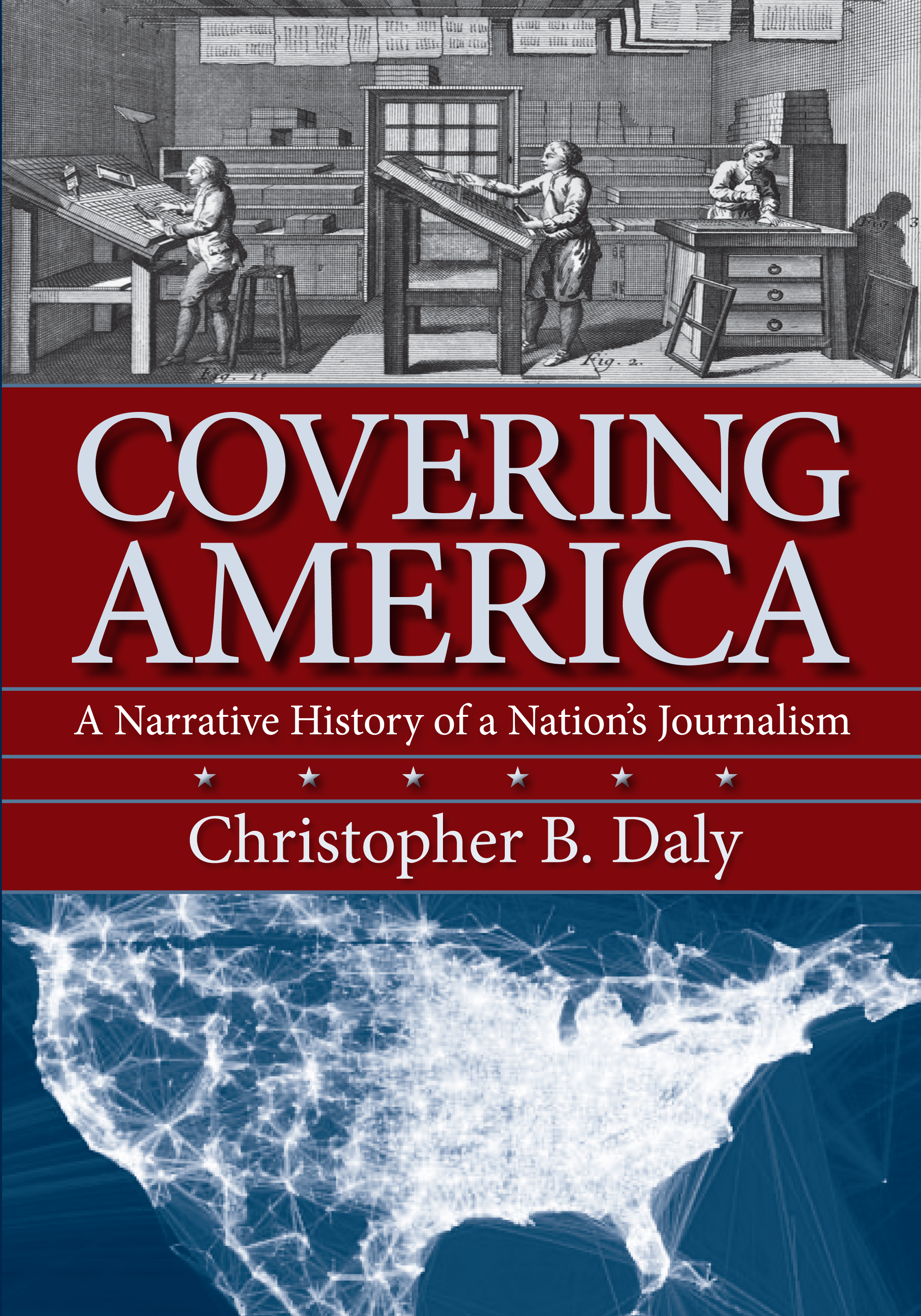
For a fuller understanding of the historical backdrop of the case, here is an excerpt from my new book (due out in about a week) that details the U.S. Supreme Court’s handling of the landmark Branzburg case in 1972. Branzburg v. Hayes was the case that has shaped the legal, political, and constitutional debate over whether journalists should have a “shield law” to allow them to protect confidential sources.
From Covering America © Christopher B. Daly:
(pardon the formatting issues)
In the spring of 1968, [New York Times reporter Earl] Caldwell traveled to Memphis to cover the strike being waged by the city’s sanitation workers, supported by the Reverend Martin Luther
King Jr. Caldwell was in the Lorraine Motel on April 4 when a loud shot rang out.
The only journalist present at the scene, Caldwell immediately called the Times
newsroom and began dictating details of the King assassination, which the editors
spread across the top of page one. According to Caldwell, King had spent
most of the day in his room, then emerged around 6 p.m. onto the balcony, wearing
a black suit and a white shirt. Caldwell’s report continued:
Dr. King, an open-faced genial man, leaned over a green iron railing to
chat with an associate. . . .
The Rev. Ralph W. Abernathy, perhaps Dr. King’s closest friend, was
just about to come out of the motel room when the sudden loud noise
burst out.
Dr. King toppled to the concrete second-floor walkway. Blood
gushed from the right jaw and neck area. His necktie had been ripped
off by the blast.
King’s murder touched off a fresh round of violence in cities across America, and
Caldwell returned to the “riot beat” for much of the summer (fig. 12.5).
That fall, Caldwell went to San Francisco to become a West Coast correspondent
for the Times. Through his contacts among the few black reporters in the Bay
Area, he gained access to Black Power advocate Eldridge Cleaver, and by the end
of 1968, Caldwell was the most knowledgeable reporter in the mainstream press
about the emerging Black Panther Party, based across the bay in Oakland. As it
turned out, the Panthers were shrewd enough about the media to want coverage
in the New York Times, and they gave Caldwell access, as well as what reporters
call “color” (atmospheric details), on-the-record interviews, just about anything
he might want. His stories established that the Panthers were heavily armed and
were talking about violent revolution. Caldwell worried about how Cleaver and
the other Panthers would react to his reporting, but he didn’t need to. “The Panthers
wanted people to know what they were doing. They wanted me to write in
the paper about them having guns.”24 His reporting also attracted the attention of
the FBI, which was waging a nationwide campaign of surveillance and intimidation
against radical groups both black and white. That attention would develop
into one of the landmark Supreme Court rulings affecting reporters and their
ability to protect confidential sources.
The legal case began when FBI agents paid a visit to Caldwell and told him
that they wanted a lot more information about the Panthers. Caldwell told the
agents that everything he knew was right there in the newspaper, including the
fact that the Panthers were armed and that they were threatening to kill the president.
Even so, the government wanted more from Caldwell. He refused to talk,
however, believing that any appearance in secret before a grand jury would make
him look like an informant and dry up his sources. The agents were not satisfied,
and the Bureau turned up the pressure, warning him that he would be forced to
testify in court—a step that would not only destroy his relationship with the Black
Panthers but jeopardize his value as a reporter on any other beat as well. Facing
a possible court appearance, Caldwell destroyed most of his Panther files, but
there was still the matter of his testimony. In February 1970 he was served with
a subpoena ordering him to appear before a federal grand jury investigating the
Black Panthers. The subpoena did not name the Times, but the newspaper hired a
prestigious San Francisco law firm to represent Caldwell. Their advice: cooperate.
Hearing that, Caldwell tapped his network of black journalists, who steered him
toward a Stanford law professor, Anthony Amsterdam, a brilliant defense lawyer,
who agreed with Caldwell’s decision not to testify and offered to represent him pro
bono.25
After he continued to refuse to testify about his news sources, Caldwell was
found in contempt of court and ordered to jail, but he was allowed to remain free
while his case went to the Ninth U.S. Circuit Court of Appeals. The higher court
sided with Caldwell, but then the federal government appealed that ruling. Enroute
to the U.S. Supreme Court, Caldwell’s case was combined with two others
and filed under the heading Branzburg v. Hayes. Paul Branzburg was a reporter
for the Louisville Courier-Journal who had been an eyewitness to a drug crime.
(Thus he was not, strictly speaking, protecting a confidential source.) Paul Pappas
was a television news photographer working for a TV station in New Bedford,
Massachusetts, who had gone to nearby Providence to cover the local Black Panthers
chapter and spent several hours inside their headquarters. Like Caldwell,
Branzburg and Pappas were both journalists who had been ordered to testify
before grand juries; like Caldwell, they had refused on professional grounds.
In all three cases, the issue was not a classic instance of protecting the identity
of a confidential source. It was more a matter of preserving the journalists’ access
to sources, which would be destroyed if the people who were being reported on
suspected that the reporters had cooperated with law enforcement. All three cases
involved a constitutional claim that the First Amendment includes not only the
right to publish (and withhold) information freely but also the right to gather news
freely. Recognizing the stakes, news executives threw their institutional weight
behind Caldwell and the other reporters. Supporting briefs were filed by the Washington
Post Company, the Chicago Tribune Company, the American Newspaper
Publishers Association, the American Society of Newspaper Editors, the American
Newspaper Guild, the Radio and Television News Directors Association, the
Press Photographers Association, and the ACLU—along with affidavits from such
respected journalists as Anthony Lukas, Walter Cronkite, and Marvin Kalb.
In a decision handed down on June 29, 1972, the Supreme Court narrowly
ruled against the journalists.26 Writing for the 5–4 majority, Justice Byron White
held that the First Amendment had to be balanced against the Fifth Amendment,
which guarantees criminal defendants the right to have their cases presented to
a grand jury before indictment. In his opinion White invoked the ancient legal
doctrine that “the public . . . has a right to every man’s evidence.” The only exceptions,
he said, are those instances in which the states have adopted laws specifically
granting certain categories of people a legal privilege against having to testify.
Such a “testimonial privilege” might protect a wife from testifying about her
husband, a doctor about a patient, or a priest about a penitent. In such cases,
legislatures determined that some other social good was worth the cost of allowing
the privileged category of people to avoid the grand jury. But, White said,
the Court could not take seriously the idea “that it is better to write about crime
than to do something about it.” If reporters know things that prosecutors want to
find out, they must tell what they know. Besides, the justice wrote, if the Court
created a special privilege for journalists, it would soon have to define who is
(and is not) a journalist—a task that raised the specter of government licensing
of journalists, which would be far more murky than determining who is a doctor
or a priest. “Almost any author may quite accurately assert that he is contributing
to the flow of information to the public,” White wrote, warning that just about
anybody could claim to be a journalist of one variety or another. Finally, White
observed that the U.S. attorney general had written a set of guidelines governing
the issuance of subpoenas to reporters, which the high court thought ought to
suffice for the bulk of cases.27 The majority opinion also included an invitation
to legislatures to create a “testimonial privilege” for reporters, and many state
legislatures went ahead and passed versions of what are known as “shield laws.”
In a brief concurring opinion, Justice Lewis Powell, though voting with the
majority, very nearly came down on the other side. He warned prosecutors that
“no harassment of newsmen will be tolerated,” and he wrote that if reporters feel
they are being abused by overzealous prosecutors seeking the names of confidential
sources, then those reporters should go to court and seek a protective order. “The
asserted claim to privilege should be judged on its facts by the striking of a proper
balance between freedom of the press and the obligation of all citizens to give relevant
testimony with respect to criminal conduct,” Powell wrote, saying it is up to the
courts to handle such claims on a case-by-case basis. Nevertheless, his joining with
the majority had the effect of denying journalists’ claims to a constitutional privilege.
Among the dissenters, Justice William O. Douglas wrote one of the most eloquent
statements of press freedom in history. Having staked out a position as a
First Amendment fundamentalist, Douglas saw the Caldwell and related cases
in clear-cut terms. “My belief is that all of the ‘balancing’ was done by those who
wrote the Bill of Rights,” he said, adding that “by casting the First Amendment
in absolute terms, they repudiated timid, watered-down, emasculated versions
of the First Amendment. . . .” The key to understanding the First Amendment,
Douglas argued, is to recognize that it exists for the benefit of the American people
as a whole. If the people are to govern themselves, they must have reliable,
independent sources of information. “Effective self-government cannot succeed
unless the people are immersed in a steady, robust, unimpeded, and uncensored
flow of opinion and reporting which are continuously subjected to critique,
rebuttal, and re-examination,” he wrote. In Douglas’s view, the free press cases
that come before the Court are not really about the press per se; they are about the
rights of the American people, the ultimate sovereigns of our system. The press,
which serves as the agent of its audience, is incidental to the greater purpose
of self-government. Douglas continued: “The press has a preferred position in
our constitutional scheme, not to enable it to make money, not to set newsmen
apart as a favored class, but to bring to fulfillment the public’s right to know.
. . . There is no higher function performed under our constitutional regime. Its
performance means that the press is often engaged in projects that bring anxiety
and even fear to the bureaucracies, departments, or officials of government.” He
concluded by warning that the Court’s majority opinion would reduce journalists
to stenographers, and that without the right to protect confidential sources, “the
reporter’s main function in American society will be to pass on to the public the
press releases which the various departments of government issue.”
The majority, however, did not see it that way. As a result of the Court’s 5–4
ruling against the journalists, reporters and their sources have operated in legal
jeopardy ever since, at least in federal courts.
On the state level, the Branzburg ruling had the effect of spurring many legislatures
around the country to enact shield laws to protect reporters in state courts, but Congress has steadfastly
refused to recognize the same right on the federal level. Ironically, the Branzburg
ruling also had another impact: it dried up what was probably the FBI’s greatest
source of information about the Black Panthers—the reporting that anybody
could read in the pages of the New York Times. Of course, by the time Caldwell’s
case was resolved, the Justice Department had lost much of its interest in the
Black Panthers. Most of Caldwell’s contacts were in jail, in exile, or dead.
* * *
Meanwhile, by the late 1960s, more and more people. . .




 Prof Chris Daly's Blog