Category Archives: Journalism

New Bradlee biography

By Chris Daly 

Disclaimer: I have not read the new biography of Ben Bradlee by Jeff Himmelman, called Yours in Truth. I am merely passing on a review, by Jack Shafer.

Shafer, who is hardly a sentimentalist, makes an important point midway through the review about the Woodward&Bernstein’s book All The President’s Men, which is their version of their Watergate reporting.

Here is the take-away from Shafer’s recent piece for Reuters:

Say what you will about Woodward and his reportorial techniques—and many journalists and scholars have weighed in—All the President’s Men has withstood rigorous scrutiny over the past four decades. Entire books have been dedicated to its examination. While its treatment of Watergate is not complete or perfect, the book is a powerful document of the investigation.

One of the more appealing aspects of All the President’s Men is the authors’ willingness to portray themselves in a less-than-flattering light. Bernstein is shown trampling ethics and possibly breaking the law by asking an employee at a credit card company, and another at a telephone company, to lift records. Woodward repeatedly expands his agreement with Deep Throat, phoning him after promising to stay away from the phone and quoting him anonymously in the paper after vowing never to do so. And by quoting Deep Throat at length, All the President’s Men violates the sourcing arrangement completely.

It needs to be said: after more than three decades, no jealous journalist (or bitter conservative) has poked any serious holes in ATPM or done anything like a knock-down. The story stands.

Leave a comment

Filed under Journalism, journalism history

Another view of Murdoch

By Chris Daly

Don’t say this blog is one-sided, even on the subject of Rupert Murdoch. The British writer William Shawcross recently stuck up for Murdoch in this piece in the Guardian.

Shawcross, who wrote a 1992 biography of Murdoch, is in a position to comment. I just disagree.

Here’s the take-away from Shawcross:

Rupert Murdoch has been the bravest and most radical media owner in Britain in the last 40 years.

There are caveats. It is insupportable for any tabloid, whether the Sun, the NoW, the Mirror or the Mail to “monster” individuals. But tabloids are an essential part of a vibrant market and the Sun is an excellent paper, catering well to its audience.

Without Murdoch there could never have been such a varied newspaper market in Britain during the last 25 years. Newspapers were dying until he confronted and defeated the greedy print unions. Only after his victory at Wapping did newspapers – on the left as well as on the right – have the chance to flourish. Murdoch’s purchase of Times Newspapers saved that company. It’s hard to think of any other proprietor who would have sustained its huge losses year after year.

Leave a comment

Filed under broadcasting, Journalism, journalism history, publishing

CNN: the “E.R.” of TV news?

By Chris Daly

Insightful piece today by Brian Stelter in the Times. It raises the question: Is CNN like the emergency room of a hospital that cannot fill its inpatient beds? CNN is very busy during crises, but it becomes a lonely place during periods of routine news. That certainly rings true in my experience: on an election night, I’m a visitor of CNN for sure. If I hear a snatch of something startling on the radio and want to hear/see more right away, I will snap on CNN. If all hell is breaking loose somewhere, it’s usually my top choice (certainly far ahead of cable-news leader Fox News, which has so few correspondents who can jump on breaking news).

Fundamentally, this problem has been with CNN almost from the get-go. Here’s an excerpt from my book, Covering America, about the founding of CNN and its basic business problem. 

. . .By approaching cable news this way, [CNN founder Ted] Turner was coincidentally creating a new business model for TV journalism. Unlike the networks, CNN did not plan to build a huge entertainment division that would have to create or bid for programs. And unlike public television, CNN was not dependent on public subsidies, foundation grants, or donations from the audience. Instead, Turner was adapting an older business model from newspapers. In the CNN approach, TV news would be paid for through a “dual revenue stream.” Just as newspapers made money from two sources—advertising and subscriptions—so would CNN. The company would sell ads, and it would also have a steady stream of revenue coming in from the cable operators, who had to pay CNN a few pennies per customer per month, reflecting CNN’s share of the monthly cable TV bills that Americans were getting used to paying. With low costs and two fairly reliable streams of revenue, news on cable just might work.

Ready or not, on June 1, 1980, CNN made its debut. There were the inevitable mishaps (the cleaning lady who walked across the set behind the anchor while the cameras were rolling), but the impressive thing was that it worked. CNN started covering the news that day and has done so continuously ever since—days, nights, weekends, holidays. Only the AP could make a similar claim, (though it supplies news to the industry rather than directly to the public). Soon, Turner was showing the skeptics that it was in fact possible to put news on television round the clock. Yes, it was sometimes raggedy. And yes, there was a lot still to accomplish—including hammering out reciprocal video-sharing agreements with affiliates, hiring more and more staff, opening bureaus around the world. But it worked.

By the end of 1981, CNN was getting established. It was reaching 10 million households and was clawing its way to journalistic parity with the network news divisions.18 One key issue was what is known as “pool coverage.” This occurs in many settings when there is not enough room to accommodate all the media people who wish to cover some location or event, such as a courtroom, a presidential appearance with limited access, or the like. In those cases, the answer is a pool, in which all the journalists in each medium agree to cooperate. Typically, each medium gets to put one representative at the scene. In return for that access, the chosen journalist agrees to share the results with all the other members of the pool in the same medium. In addition, each member of the pool agrees to take a turn in providing the feed. This arrangement assumes, of course, that anyone participating in the pool will produce work of high enough quality to satisfy all the others. CNN was originally scorned by the networks, which refused to let CNN crews participate in the White House television pool coverage. It took a lawsuit (which cost Turner another $1 million), but eventually CNN was allowed in.

One of the early tests of CNN as a news organization came on March 30, 1981. President Reagan gave a speech that day to the AFL-CIO at the Washington Hilton. CNN covered the speech live and then, when it was over, switched to some filler material, about sewing in China. While that was airing, the police scanner in CNN’s Washington bureau barked: “Shots fired . . . Hilton Hotel.” Almost immediately, the veteran newscaster Bernard Shaw sat down in the anchor chair in the CNN Washington bureau and began reporting that shots had been fired at the president—a full four minutes before the networks. Shaw stayed in the chair for more than seven hours, and, with help from Dan Schorr, proved that the fledgling news service could keep up with the established networks. Through the evening, CNN kept breaking in with new details: a picture of the shooter’s home, a report on his motive, pictures of the vice president in Texas heading to Washington. According to one account of that day: “Such details were hitting the air in no particular sequence. CNN’s viewers got the story in the jumbled way a journalist receives fragments of information before transforming them into an orderly, polished report. The ‘process’ of gathering news determined the form in which that news was delivered.” Before CNN, viewers had received their news in measured doses at fixed times; now they were drinking straight from the fire hose.

For years, CNN cost more to produce than it brought in through the combined revenues of cable subscriptions and advertising. The network was burning through Ted Turner’s personal wealth at an unsustainable rate. The early years were a desperate race to get CNN included in enough viewers’ basic cable packages to pay for itself. Most of the costs of gathering and disseminating the news by cable were fixed; the great variable was the size of the audience. Beginning in 1978, from the pre-launch investments in people, property, satellite time, and equipment, CNN lost an estimated $77 million through 1984.20 But then in 1985, CNN began posting profits: $20 million that year and more in the coming years. In the grow-or-die spirit of modern capitalism, Turner soon started thinking about acquiring other businesses. At the same time, a profitable CNN was looking more attractive to other investors, who might try to take it over. By the end of the decade, CNN was earning almost $90 million a year and had an estimated value of $1.5 billion. At the decade mark, on June 1, 1990, it could be seen in 53 million homes in the United States and in eighty-four countries worldwide. CNN had nine U.S. bureaus and another eighteen overseas, with a global total of some 1,800 employees. CNN had arrived. . .


Leave a comment

Filed under broadcasting, CNN, Fox News, Journalism, journalism history, media

“Not a Fit Person”

By Chris Daly 

Well, now it’s official. Something that many people have thought for a long time is now part of the findings of a British parliamentary report: Rupert Murdoch is “not a fit person” to run a globe-straddling, influence-buying, phone-hacking, official-bribing media conglomerate.

Actually, the report released Tuesday may not be Murdoch’s biggest problem. He is already under investigation in the United States as well. Murdoch became a U.S. citizen in the mid-1980s, a move that facilitated his move into American broadcasting (since U.S. law requires that broadcasting remain in the hands of U.S. citizens). Perhaps more serious for Murdoch is the fact that his News Corp. (parent company of the British unit that is in trouble in Parliament) is a U.S. corporation, registered on the New York Stock Exchange. That means that News Corp. is subject to all the laws and regulations of the United States — including the Foreign Corrupt Practices Act. That law, dating to the 1970s, forbids U.S. companies from using their assets to pay bribes to officials in other countries. On the face of it, that would appear to make it a crime in the U.S. for News Corp. employees to do what they have already admitted under oath in Parliament: for years, they paid British police police officials for tips about their investigations.

If I were Murdoch (or even a shareholder in News Corp., which operates Fox News and the Wall Street Journal, among many others), that’s what I would be really worried about.

Recent stories are here, here and here.

News Corp. world headquarters in Manhattan / Kathy Willens (AP)

Leave a comment

Filed under broadcasting, Fox News, Journalism, journalism history

New review of “Covering America”

This recently appeared in the Midwest Book Review:

The Journalism Shelf

Covering America
Christopher B. Daly
University of Massachusetts Press
PO Box 429
Amherst, MA 01004
9781558499119 $49.95 http://www.umass.edu/umpress

Award-winning author Christopher B. Daly, a veteran journalist as well as an instructor of history and journalism at Boston University, presents Covering America: A Narrative History of a Nation’s Journalism. Covering America lives up to its title with an exhaustively researched, scholarly, and in-depth chronicle of the art and craft of journalism in America, from 1705 to the present day. Chapters discuss the foundations of the American Press including Ben Franklin and his contemporaries, the rise of newspapers; how journalism covered slavery and the Civil War, the Great Depression, World War II, and other monumental historical events; the twentieth century rise of major media conglomerates; and much more. “Whether for-profit or not, the institutions that engage in mass communication have been almost entirely in private hands, separate form the government… From a small-scale shop to a factory-sized corporation to a global conglomerate, the news business as a business has kept pace with broader trends. That process has in turn created a recurring set of crises in which the values of journalism have come into conflict with the values of business.” A handful of vintage black-and-white photographs illustrate this meticulous, methodical, and absolutely invaluable contribution to history and journalism shelves, worthy of the highest recommendation especially for public and college library collections.

Leave a comment

Filed under Journalism, journalism history

Murdoch scandal (cont.)

By Chris Daly 

Gee, I guess I have been wrong about Rupert Murdoch all along. Turns out he’s just a simple publisher striving always to do the right thing.

Here’s the latest from London.

Rupert Murdoch / pool photo

Leave a comment

Filed under Journalism

Keeping up with the Murdochs

By Chris Daly

It’s not easy keeping track of the unfolding Murdoch scandal(s), with developments multiple times a day on both sides of the Atlantic.

Here is

The New York Times has assigned two-time Pulitzer Prize winner John F. Burns, which is a sign of the paper’s institutional commitment to the story, which is of course meant to torment the Times‘ chief antagonist, Rupert M. Here’s the lastest from Burns (and his co-author, Alan Cowell):

In Testimony, Murdoch Plays Down His Political Pull

By  and 
Published: April 25, 2012

LONDON — With a political firestorm cascading over the British government’s ties to his media empire, Rupert Murdoch faced rare public scrutiny about his relationships with elected officials on Wednesday, and sought to deflect suggestions that he tried to use his links to powerful public figures to further corporate commercial interests.. . .

Here is the latest from the Guardian, which is live-blogging from the Leveson inquiry:

  • Wednesday 25 April 2012

  • Rupert Murdoch at the Leveson inquiryRupert Murdoch at the Leveson inquiry: ‘Do I have an aura or charisma? I don?t think so.’ Photograph: Reuters

    Join us as News Corp’s Rupert Murdoch gives evidence to the inquiry set up in the wake of the phone-hacking scandal. By Josh Halliday andJohn Plunkett

    Continue reading…213 comments

    Posted by

    10.19 EDT

  • Tuesday 24 April 2012

  • James Murdoch gives evidence at the Levenson inquiry at the High Court in LondonJames Murdoch gives evidence at the Leveson inquiry today

    Full coverage of James Murdoch’s evidence to the Leveson inquiry. ByJosh Halliday and John Plunkett

    Continue reading…

    Posted by

    18.59 EDT

  •  And here is the latest from the Wall Street Journal, which is of course, owned by Murdoch, which makes this a miserable assignment for the three Journal staffers who share the byline today:

    News Corp. Chief Faces Inquiry

    LONDON—With a fresh political scandal swirling around his global media conglomerate here, News Corp. NWSA +0.62% Chairman and Chief Executive Rupert Murdoch faced questioning Wednesday before a public press-ethics inquiry about whether he used the company to call in political favors and push his commercial interests.

    The media mogul repeatedly said he hadn’t asked prime ministers, and would-be prime ministers, for favors, and said that his commercial interests didn’t influence where his newspapers stood on issues or political parties.

    Rupert Murdoch, News Corp. chairman and chief executive, appeared before the Leveson Inquiry, a judge-led examination into British media practices. WSJ’s Bruce Orwall discusses this and the fallout from James Murdoch’s testimony yesterday.

    At the same time, he conceded “abuses” have occurred at his own company—which has been battered by a long-running scandal over illicit reporting tactics—though he added: “I would say there are many other abuses, but we can go into that in time.” Mr. Murdoch also distanced himself from some of the activities: “”We have a very large company and I do run that company with a great deal of decentralization.”

Leave a comment

Filed under Journalism

Review of “The Columnist”

By Chris Daly 

A new play about to open on Broadway takes us back, not only to a different era but to a different America. The play is “The Columnist,” by playwright David Auburn, who also wrote the marvelous drama “Proof” in 2000.
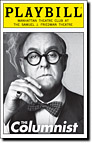
The Columnist, by David Auburn

His latest play tells a version of the story of Joe Alsop, who was one of the mandarins of the Washington pundit class during its heyday. Indeed, one of the remarkable things about “The Columnist” is how deftly it reminds us of what a different media world it was in the 1950s and 1960s from today. It’s not just the period details — Alsop’s smoking or his typing (on a real typewriter!~). What is most telling is the way Alsop thinks of his role and the way he is treated by other powerful figures.

Alsop, who teamed up for periods with his brother, Stewart, knew everyone in Washington, of course. But his most strategic alliance was probably with John F. Kennedy, who, on the night of his inaugural in 1961, said good night to Mrs. Kennedy, then headed over to Joe Alsop’s for a nightcap. This was all very pre-Watergate, in an era when journalists and politicians actually knew each other, spoke off the record, and even drank together.

To his credit, Auburn wastes no time on nostalgia. Yes, his play acknowledges, something has been lost in the distance that now separates journalists from political leaders, but “The Columnist” also makes the point in several ways that something has been gained too.

At the same time, the play makes the point that the Democratic Party was a militaristic, center-right party not much different from the Republican Party of that era. Without saying so, the play hints at how much effort it would take in the 1960s and 1970s to turn the Democratic Party into more of a progressive, inclusive, anti-war party.

As played by the marvelous John Lithgow, this portrayal of Alsop pulls no punches. Yes, he could be witty, perceptive,  and disarmingly charming. At the same time, Alsop was a martinet, a bully, and a war hawk. Lithgow deserves high praise for a smashing portrayal in a role that has him on stage for every scene and that requires him to age about 2o years in two hours. Witty, mannered, polished — Lithgow is the perfect embodiment of Alsop.

In the play, Alsop has several shouting matches (via telephone; Lithgow does all the shouting) with Scotty Reston, the Washington bureau chief and lead political columnist for the New York Times for much of the Cold War. Many of them help to advance the play because they involve Alsop’s fury at Reston’s protege, David Halberstam. So, it is quite natural and historically accurate that Alsop is portrayed teeing off on Reston.

But from the standpoint of the history of journalism, a better foil for Joe Alsop would  have been Walter Lippmann. After all, Lippmann was, like Alsop, a syndicated columnist whose beat was The Big Picture. Like Alsop, Lippmann was a pillar of the American Establishment. In the post-War years, there was no office-holder or opinion-shaper who would not drop everything to take a phone call from Walter Lippmann. Yet unlike Alsop, Lippmann was a critic of Kennedy’s involvement in Vietnam and warned the president repeatedly (and publicly) to get out.

When I was writing my book on the history of journalism, Covering America, I considered including Joe Alsop, and I very nearly did. But in the end, I decided that he did not make the cut because he was not enough of an innovator. I wanted to focus on those men and women who changed the field of journalism or who used journalism to make some kind of broader change. Joe Alsop struck me as one of those who dedicated his life to holding off change. More’s the pity.


Leave a comment

Filed under Journalism, journalism history

Titanic’s role in journalism

By Chris Daly 

On the eve of the centennial of the sinking of the Titanic, I am posting an excerpt from my new book, Covering America, about the impact of the Titanic on the emerging field of “wireless telegraphy.”

First, here is an image of a wireless distress signal sent that night from the Titanic to the Marconi company.

Telegram from the Titanic: "require assistance. . . struck iceberg"
(Courtesy: Museum of the History of Science, Oxford)

From Covering America: A Narrative History of Nation’s Journalism, chap 7:

In the decades following its invention, the telegraph became a fact of life and an indispensable tool in business, in the military, and in journalism. Still, it had some drawbacks: it could carry a message, but the contents had to be sent in code; messages could be sent only from one point to another, and those two points had to be connected by a copper wire. For these reasons among others, the telegraph was not a popular means of communication but remained a special tool used mainly by businesses.42 In the late nineteenth century, a flurry of scientific and engineering breakthroughs started to overcome those limitations. In 1876 a Boston University professor named Alexander Graham Bell invented a machine, the telephone, which allowed the human voice to be carried over a wire. Nikola Tesla, a Serbian immigrant to America and the inventor of the alternating-current electric motor, contributed the idea that electromagnetic waves could carry messages. Soon it was proven that such waves could pass through walls. They could scale mountains, even cross the ocean. This created the promise of an amazing possibility: a telegraph without wires! A young Italian, Guglielmo Marconi, became a pioneer in the new field, devoting himself to working on a way to use radio waves to transmit signals carrying Morse code.43 Marconi had the resources to tinker with the idea; his mother was an heir to the Jameson family Irish whisky fortune. Rebuffed at home, Marconi went to England, where he formed the Wireless Telegraph Signal Company in 1897, to be followed by an American division of British Marconi a few years later. In 1901, Marconi even managed to send a wireless signal across the Atlantic Ocean, but he struggled to find a business model for his invention. The early applications of the new technology were in the military and in the shipping business, where the ability to send messages without wires had an obvious appeal. At first the technology was referred to as wireless telegraphy, or simply “wireless,” but a new term—radio—first popularized in the U.S. Navy, soon won out. In 1906 an American inventor named Reginald Fessenden demonstrated that radio signals could transmit more than just long and short pulses. They could carry music and even the human voice. In the end, that discovery proved indispensable for making radio a truly popular medium. One of the first big tests of radio, one that made a lasting impact on the public imagination, came in 1912, when the world’s greatest luxury ocean liner, the state-of-the-art Titanic, made its initial voyage from England to New York.44 As the great ship crossed the North Atlantic on April 14, it struck an iceberg, and the crew immediately used the ship’s wireless equipment to call for help. Some of the other ships in the vicinity had wireless equipment that was turned on and monitored at all times; others had turned their sets off for the night. As a result, Copyright 2012 NOT FOR SALE [ 204 ] CHAPTER 7 the closest ship, the Californian, which could have saved all of the Titanic’s 1,522 passengers, lay at anchor just nineteen miles away and never responded. The Carpathia, which was fifty-eight miles away when the Titanic started sinking, took two hours to arrive, and by then, many passengers had drowned in the frigid waters of the North Atlantic. Rescue efforts were also hampered by the many amateur radio operators who filled the airwaves that night with rumors, questions, and interference from their overlapping signals. In the aftermath of the Titanic disaster, the U.S. Congress quickly adopted legislation requiring that all American oceangoing ships and all those entering U.S. ports be equipped with radios, and that the radios be kept on and staffed at all times. Congress also required radio operators to get a license from the U.S. Department of Commerce, and it relegated amateur operators to the bottom of the radio spectrum (the shortwave end) while giving priority to the navy and to commercial companies like Marconi’s.45 Significantly, Congress chose not to follow the European model, in which new technologies including telegraph, telephone, and radio were successively grafted onto a government monopoly such as the postal service, resulting in public communication monopolies like the BBC. In the United States, Congress operated on the principle that radio would be a private enterprise—regulated, to be sure, but private nonetheless. In retrospect, this was one of the constitutive moments shaping the eventual architecture of broadcasting in America, combining elements of technology, law, and economics into a new model.46 On the night of the Titanic disaster, one of the radio operators in New York handling reports of the sinking was a young man named David Sarnoff. (He was not the only one, as he often claimed.) A Russian immigrant who never made it past the eighth grade, Sarnoff would become one of the titans of broadcasting in the twentieth century as president of RCA, the Radio Corporation of America.47 While working for Marconi, Sarnoff demonstrated great foresight. In 1915, when he was just twenty-four years old, Sarnoff wrote a memo to his boss, giving his thoughts on the business. He envisioned a future for radio that went far beyond transmitting coded messages from point to point. “I have in mind,” he wrote, “a plan of development which would make radio a ‘household utility’ in the same sense as the piano or the phonograph. The idea is to bring music into the home by wireless. . . . The same principle can be extended to numerous other fields as, for example, receiving lectures at home which can be made perfectly audible; also, events of national importance can be simultaneously announced and received.”48 Sarnoff projected a market of 15 million American families. The Marconi company did not think much of Sarnoff’s scheme, but Sarnoff clung to the idea that radios could be a popular mass commodity, provided they became easier to use. Never much of engineer, Sarnoff was already showing his true talent: marketing. He switched to management. While Sarnoff and others were pondering the future of radio, most Americans Copyright 2012 NOT FOR SALE Jazz Age Journa lism, 1920–1929 [ 205 ] still had never heard a radio broadcast. A few license-holders were beginning to transmit signals through the airwaves (or into “the ether,” as it was called), where they could be heard by anyone with a receiving set. But hardly anyone had one yet. A few corporations, such as United Fruit, were using radio to coordinate their shipping fleets. And of course the army and navy remained deeply involved in radio. But before about 1920, radio remained largely in the hands of the amateurs— most of them young men who were inclined to tinker. Those early adapters usually built their own radio sets. They set up friendly competitions to see who could pull in the faintest or most distant signal (which they called “DXing”). They often traded information and parts in a wave of enthusiasm that had nothing to do with patents, profits, or licenses. Participants in the new movement sometimes referred to what they were doing as “citizen radio.”49 An editorial in one of the first radio journals put it this way: “Do you realize that our radio provides about the only way by which an individual can communicate intelligence to another beyond the sound of his own voice without paying tribute to a government or a commercial interest?”50 Soon others joined in—women as well as men, universities, stores, even the famous Dr. Brinkley of Kansas, who used radio to promote his theory that implanting goat glands would cure “male trouble.” Radio was wide open— diverse, local, nonprofit, and utterly unpredictable. But not for long. World War I transformed radio, as it did so many other institutions.

Leave a comment

Filed under broadcasting, Journalism, journalism history

Newspaper jobs

By Chris Daly 

This just in: The number of jobs for reporters in U.S. newspapers has probably bottomed out. That’s one takeaway from the latest survey of the country’s newsrooms released by the American Society of Newspaper Editors. The ASNE, which has been meeting in Washington and played host to both Obama and Romney (on different days!), conducts an annual survey of who is working in the newsroom.

Here’s a key passage (imho):

Despite this year’s loss in newsroom positions, the decline in jobs that began in 2006-07 appears to be stabilizing. The loss this year is not as drastic as the losses between 2007 and 2010.

So, if things are no longer getting worse, does that mean that they are getting better?

Leave a comment

Filed under Journalism