Category Archives: Journalism

On national security leaks

By Christopher B. Daly

Here we go again.

According to today’s Times, members of Congress (especially Republicans?) are outraged at the leaks on national security matters that they believe the administration is committing. Not only that, they are shocked (shocked, I tell ya) that such leaks might be carried out to advance the president’s political fortunes. Reading between the lines, it appears that they are upset that Obama officials go off the record and whisper disclosures to the Times and other news media informing the media and thus, the public as well, of their successes in the secret drone campaign and in the secret cyberwarfare we are apparently waging against Iran.

Imagine that: Could it really be that the Obama administration has invented a tactic that no other president (such as his immediate predecessor) ever thought of? Hmmm… Ever since the passage of the Espionage Act in 1917 and especially since the rise of the National Security state after WWII, this issue has been a chronic point of friction at the intersection of law, military operations, spying, and politics.

In all these situations, I believe the first question that any honest citizen should ask is this: Where is the harm?

Who, exactly, is harmed by knowing what the government is doing in our name around the world? There is no indication that any operational details have been compromised. (Surely, the remnants of al Qaeda know that we are gunning for them; just as surely, the Iranians know that we are trying to mess up the computers that run their nuclear program. So what?)

Look at it this way: with the leaks, the American people know enough to debate whether these are good ideas or not (and whether we want to re-hire the guy who is ordering them).

Without the leaks, we would be ignorant.

Leave a comment

Filed under Journalism, journalism history, media, New York Times, Wikileaks

News about the News

By Christopher B. Daly

As so often happens, the Monday business section of the New York Times delivers an array of stories about journalism and media worth reading. (Why doesn’t the paper have a “media” tab on its homepage?)

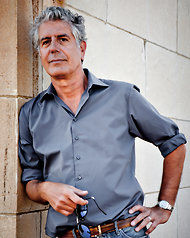
1. David Carr reports on talks between CNN, the ratings-challenged cable news pioneer, and Anthony Bourdain, the macho chef/traveler of Travel Channel fame. CNN execs are trying to address a problem I discuss in my new book (Covering America), which is much easier to formulate than to solve: what can a news-oriented cable channel do to fill all those hours when all hell is not breaking loose?

Bourdain could be part of the answer.

What else might help CNN? You comment; you decide!


2. Following up on the recent cutback in printing by the New Orleans Times-Picayune, comes a look at the broader trend, including some pros and cons.

3. From London, word that Rupert Murdoch’s troubles extend into an area he really cares about: the circulation figures of his newspapers.

4. From Shantou, a piece about how tricky it can be for Westerners to teach journalism to Chinese students in China. As a Westerner who teaches journalism to Chinese students in Boston, I can certainly sympathize. This piece also includes a bonus: an answer to the question of what Peter Arnett has been up to since he was forced out of CNN (in a failed attempt to pump up CNN’s prime-time audience ratings — see item #1 above).

So, there you go. (Just a typical Monday at the Times: four original, reported stories from across the globe that other people will be talking about for a week. )

Leave a comment

Filed under CNN, Journalism, publishing

The glass is half-empty AND half-full

By Christopher B. Daly 

In light of the recent announcement that the New Orleans Times-Picayune will scale back the frequency of its print editions, the following chart bears studying:

This chart was part of a recent presentation by Mary Meeker of Kleiner Perkins. (I got hold of it through Poynter.)

So, what’s the takeaway? If you extend those trend lines any further, you can see that the revenue won’t be there in the future to support a printed newspaper. If newspapers want to stay in the news business, they better have a plan to get out of the paper business.

2 Comments

Filed under Journalism, journalism history

The Warren-Brown Senate Race: “Organized Hatred”?

By Christopher B. Daly

The 19th Century historian Henry Adams – who was no dope – once shrewdly described Massachusetts politics as “the systematic organization of hatreds.” That was certainly true in his day. A question raised by the current U.S. Senate campaign is whether it is still true today.

Here’s why I say that. The presumptive Democrat, Elizabeth Warren, has had to spend weeks defending herself from the revelation by the Boston Herald that she once, long ago, gave the impression that she was part Cherokee.  The resulting brouhaha has changed the subject in the campaign and presumably worked to the advantage of the presumptive Republican candidate, Scott Brown.

Where did the original disclosure come from?

Let me emphasize that I don’t know what happened.

In fact, it is probably unknowable at present, due to the code of omerta that prevails among political operatives and political reporters. That code is something I do know a little about, having spent a few years as a political reporter covering Massachusetts politics.

In that role, I was the recipient of calls from parties unknown who, for reasons best known to them, decided to “drop a dime” into an untraceable payphone (I am dating myself here, I realize) and share some precious intelligence. I was sometimes invited to “take a walk” by a gimlet-eyed young operative; we would end up on a bench on the Common, and the guy would lean in close and give me the phone number of a divorce lawyer representing some disgruntled ex-spouse of a politician or cabinet member. I was invited to lunch at restaurants in the vicinity of Beacon Hill and slipped manila envelopes with documents inside, detailing the names of political donors whose relationships to each other were not obvious but turned out to be quite interesting once the tipster connected the dots. I got to know the system, thanks to these then-young political operatives.

So, here is what I surmise happened in the Senate race.

The Brown campaign did what all well-financed modern campaigns do: the candidate took a sliver of the millions he has raised and hired a team tasked with conducting “opposition research.” That is, you get a bunch of brainy young people together and you tell them to research everything about the political opposition.

And when they say everything, they mean everything: every indiscretion and every discrepancy. Every tax or mechanic’s lien. Every divorce, adoption, or inheritance. Every real estate transaction, including mortgage notes. Every arrest and every traffic violation. Every grade in school, every bad date, every expensive hairdo – EVERYthing.

The fruits of all that research are then handed over to the campaign’s senior aides and advisers, who stockpile them like ammunition. When they see an opportunity to use the information to their tactical advantage, they fire away. The campaign has some options. In one scenario, they can use the material directly and have their own candidate make a public accusation.

Or, they can play it “cute” and aim for a bank shot. They might decide to “leak” the information to the news media. That approach has several advantages. One is that the damaging material has the added credibility of reaching the public in the form of a news story. Another advantage of the leak is that the campaign can deny involvement or feign ignorance, safe in the knowledge that the reporter they went to will never rat them out.

           This can be especially effective if the campaign aides don’t even tell the candidate. Then, when the “news” breaks in the media, the candidate can act sincerely shocked and outraged and call for further investigations into the “troubling questions” raised by the news reports. That way, the story gains what we call “legs” – that is, it has the capacity to sustain itself as a continuing “story” involving denials, “fresh details,” and so on.

Did that happen in the case of the disclosure about Warren’s heritage? As I said, I don’t know. But it has all the hallmarks.

And what’s troubling about it is this: somebody knows. Quite likely, somebody in the campaign knows. If that’s the case, then there’s your real scandal right there. I say that because it points a finger at someone on Brown’s staff who must have gone through a thought process something like this:

            Oh, boy! This is great. We can leak this baby to the Herald, which we can depend on to slap it on Page 1. It will look on the surface like a “gotcha” story about a candidate’s hypocrisy. But as an added bonus, this story comes with a dog whistle: For those who can hear it, this is really a story about affirmative action. It’s a smear, intended to leave the impression that Elizabeth Warren is some kind of race whore, who gamed the system that so many white ethnics still hate.

            In their view, affirmative action is a big con game designed to put unqualified blacks, Hispanics and other minorities in line ahead of qualified white ethnics for the few good things in life. If we can get Warren associated with affirmative action, we can stir up those resentments, organize those hatreds, and peel off a couple thousand white ethnics who are independents or even some who are still Democrats. If we’re lucky, the “story” will get picked up by the echo chamber of right-wing talk radio. The eight ball drops into the corner pocket.


Did all that happen? I don’t know.

But someone does.

Leave a comment

Filed under Journalism, Politics, Uncategorized

News beyond newspapers

By Chris Daly

I heard a terrific piece today on WBUR, the local NPR affiliate. It was about “Toys for Elephants” — a project by students from the Massachusetts College of Art who took up the challenge of designing play objects for two mature elephants who live at the Buttonwood Park Zoo in New Bedford.

Here’s a link to the story by reporter Vicki Croke and producer George Hicks. (I hope I have that division of labor right, but it’s probably murkier than that.) It presents a really rich blend of multi-media: sound, still photos, video, and words.

Try that with your print newspaper!

[Actually, the Boston Globe did a version of the same story back in April, then posted a video version on the paper’s website. It’s a fine piece, too, but not as rich as the ‘BUR version.)

I don’t know anything about elephants, but these seem like two happy, engaged creatures.

Ruth and Emily /  photo by Susan Hagner for WBUR

Ruth, 54, and Emily, 49. / photo by Susan Hagner for WBUR

Leave a comment

Filed under broadcasting, Journalism

Buffett on newspapers

By Chris Daly

Guess what super-investor Warren Buffett thinks about the future of newspapers?

Hint: he’s buying them. (And not just copies of papers; he’s buying whole newspaper companies.)

 Via Omaha.com

Warren Buffett’s letter to publishers and editors

p. 1

«

AP Photo

AP Photo


Leave a comment

Filed under Journalism, local news, publishing

Glass half full?

By Chris Daly

The latest American newspaper to take a step back from daily print publication is the venerable Times-Picayune of New Orleans. Today’s New York Times reports that the 175-year-old newspaper is scaling back to printing three days a week. By doing so, the managers hope to capture the bulk of the advertising revenue they get from display ads in the print version, while reducing some of the “legacy” costs that go along with printing: the extra salaries for full-time printers and drivers; the cost of the newsprint paper; the overhead, etc.

The good news: the folks at the Times-Picayune have taken the first steps along the narrow, rickety, wobbly, rope bridge to the digital future. The Times-Picayune is not going out of business. Far from it. The cutback in printing is part of a larger strategy to save the paper, not destroy it. Just about every newspaper in the country is somewhere along that same timeline, whether they recognize it or not. They are all groping their way into the future — without a map (such as the map of New Orleans below, which was created by the Times-Picayune).

Bonus question: What does picayune mean? (answer below)


Picayune

From Wikipedia, the free encyclopedia
This article is about the obsolete Spanish coin. For other uses, see Picayune (disambiguation).

picayune was a Spanish coin, worth half a real. Its name derives from the French picaillon, which is itself from the Provençal picaioun, meaning “small coin.” By extension, picayune can mean “trivial” or “of little value.”

Aside from being used in Spanish territories, the picayune and other Spanish currency was used throughout colonial AmericaSpanish dollars were made legal tender in the United States by an act on February 9, 1793 until it was demonetized on February 21, 1857.[1] The coin’s name first appeared in Florida and Louisiana where its value was worth approximately six and a quarter cents, and whose name was sometimes used in place of the U.S. nickel.[2][3]

A daily newspaper published in the New Orleans market, the Times-Picayune, is named after the picayune.[4]

[edit]References

Wikisource has the text of the1911 Encyclopædia Britannicaarticle Picayune.
Look up picayune in Wiktionary, the free dictionary.
  1. ^ Spanish Silver: General Introduction Coin and Currency Collections – University of Notre Dame, Retrieved on April 7, 2008
  2. ^ Picayune, Probert Encyclopedia, Retrieved on April 10, 2008
  3. ^ Picayune, World Wide Words, Retrieved on April 8, 2008
  4. ^ McLeary, Paul (2005-09-12). “The Times-Picayune: How They Did It.”Columbia Journalism Review. Retrieved 2010-07-27.

2 Comments

Filed under Journalism, journalism history

A news blog evolves

By Chris Daly 

In my recent book, Covering America, I ended my 300+ year narrative of journalism in America on an optimistic note. One reason for that optimism is the success of Josh Marshall and his Talking Points Memo.


I admire Marshall, and I wish him well. So I was pleased to see this item in the Nieman

Josh Marshall (I would credit this photo, but I can’t find the source.)

Journalism Lab website, which suggests that Marshall is trying to figure out what a blog looks like when it grows up. After 12 years in business, TPM has expanded in several stages, reaching 28 full-time employees recently. That makes it a medium-sized newsroom, based entirely on the Web. TPM has no legacy in traditional media; it was born on-line and grew up there.


Now, the growing seems to mean branching out into all kinds of media, especially video, as well as mobile apps. Here’s the take-away, from Marshall himself:

“If someone were to ask me a year ago, I would have said, ‘Well, yeah, we’re not just a website — it’s this, and we have that, and the other.’ But I think it was when I saw mobile growing as fast as it was that it just sort of hit me at a different level,” Marshall told me. “Inevitably, as long as mobile was something like five percent of traffic, it was just something you made available on the side. But you start to see,this is going to be half of our audience. We can’t be approaching it in a way that the website is the thing, and we’re making imitations of it — because this thing is losing its primacy. In a lot of ways, it wasn’t until late last year that it hit me at a different level. It hit me as more than a concept. It was really true.”

 Keep up the good work. (But I must say I don’t care for pre-roll ads and usually bail out when I encounter one.)

Leave a comment

Filed under blogging, Journalism, journalism history

Horst Faas, great news photographer, dies at 79

By Chris Daly

One of the most important photographers and photo editors of the last century has died. Horst Faas, a two-time Pulitzer Prize-winner during his long career at The Associated Press, was 79.

Obits are here and here and here.

Horst Faas in a heroic pose / AP Photo

Faas really made his mark in Vietnam, where he was stationed from 1962 through 1973. There, he planned the coverage, trained new photographers and photo stringers, edited many of the most memorable images of the war, and shot photos himself. From the tiny darkroom in the bathroom of the AP’s Saigon bureau, he was responsible for much of the “look” of the war.

Two photos are always associated with Faas and his constant efforts to disseminate photos that would show the reality of war:

–in 1968, during the Tet Offensive, the AP photographer Eddie Adams snapped a photo of a South Vietnamese officer executing a Vietcong prisoner. The photo caught the very moment when the bullet entered the prisoner’s head and captured something about the offhand violence of the war.

Eddie Adams / AP Photo

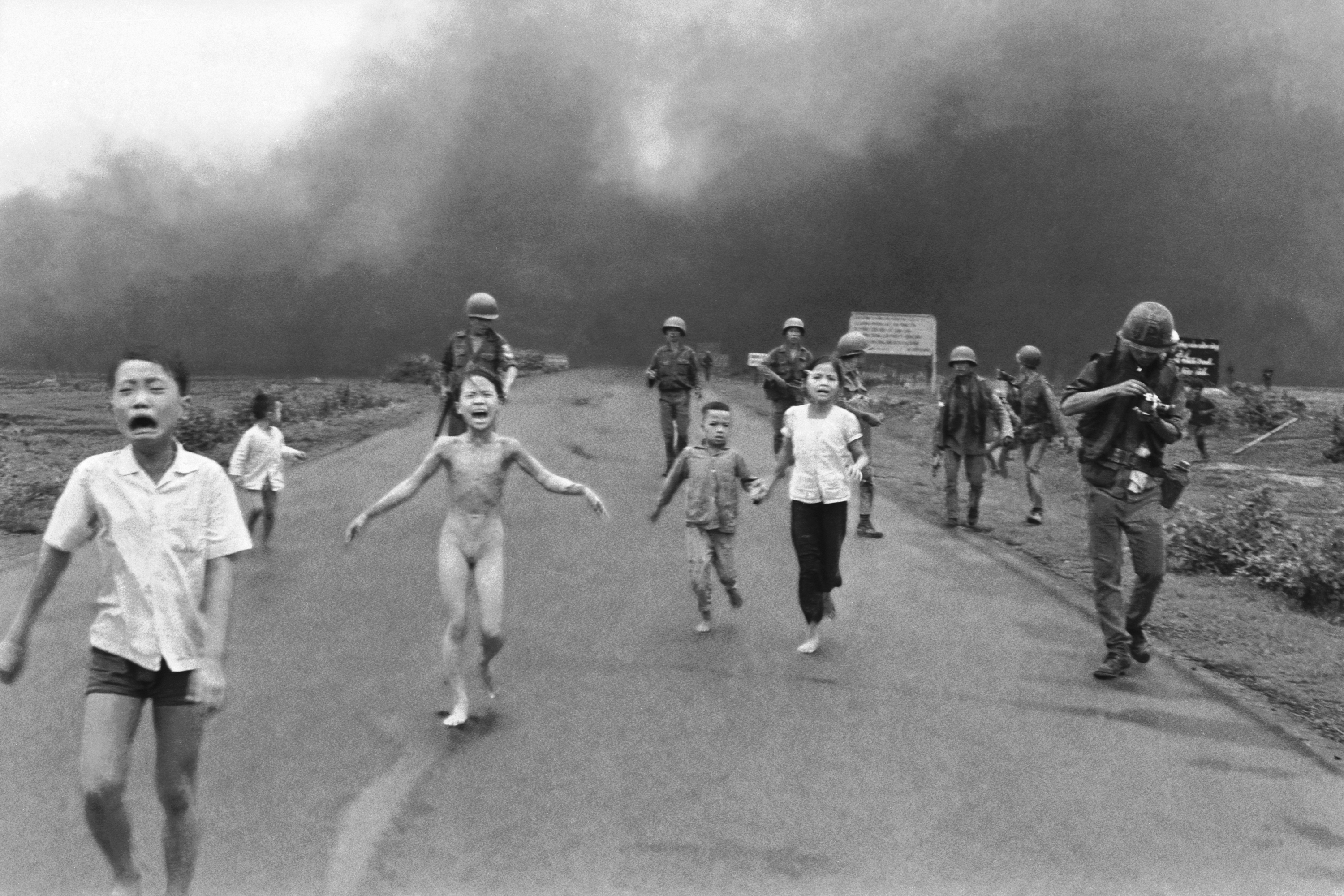
–in 1972, he fought to transmit the unforgettable image of a young girl fleeing naked and screaming from a napalm attack. The picture was shot by Nick Ut, a Vietnamese photographer trained by Faas, and the decision to send it out was one that Faas fought hard for. I remember seeing it on the front page of the Boston Globe on the day it was published in 1972 and never could forget it.

Nick Ut / AP Photo

As I discovered in researching my new book on the history of journalism, Covering America, Faas was also responsible for another of the most emblematic photos of the Vietnam War, the photo from 1962 of a monk burning himself to death in protest against the government of South Vietnam. The photo was taken by AP correspondent Malcolm Browne. But Browne was a reporter/writer, not a photographer. The only reason he was carrying a camera that day was that Faas insisted that all AP correspondents learn to take photos and carry cameras with them. Back at home, union rules forbade AP correspondents from shooting photos, but in Vietnam, those rules didn’t apply, and Faas wisely turned everyone into a photographer.

Recently, while researching the photos for my book, I came across Faas photo. This is a photo that I knew I wanted for my book, but I had a devil of a time figuring out who owned the rights to it. I had seen it variously credited to TIME and the New York Times (both wrong) and to the AP (not quite right either). It is a photo that shows three of the key U.S. correspondents stationed in Saigon during the early years of the war: David Halberstam of the Times, Mal Browne of the AP, and Neil Sheehan of UPI (later of the Times). They are standing around in front of a helicopter. Browne is smoking and Sheehan holds a big map.


According to Faas, he took the photo himself. And he told me that he took it with his own personal camera and that it never belonged to AP. But rather than rile the AP and its lawyers, he sent me the image directly via email and said to go ahead and use it with his blessing. Here’s what he wrote late last year:

I took the photo at the time as a personal picture and should have it in my personal computer files. I will look for it beginning next week: No time now – I am off for a quick trip (without my computer). Since all my material at the time was officially AP material I don”t want to get in conflict with AP and would give you the photo “courtesy of..” i.e. free of charge, In return I would be interested in a copy of your book once it is published. OK?

Best regards, Horst Faas

Thanks again, Horst.

I also want to share another photo that Faas sent me (“courtesy of” the photographer). It shows the press corps in Saigon in 1963:

2 Comments

Filed under Journalism, journalism history

AP Apologizes for WWII Blunder

By Chris Daly

I was very pleased to see that my old employer, The Associated Press, finally did the right thing and apologized to a great correspondent who was wronged in 1945 as he broke the news about the end of the fighting in Europe. The apology came earlier this week on the 67th anniversary of the surrender of Germany.

Settle in: There’s quite a story behind the story of the end of the fighting in World War II in Europe. The date of the official celebrations was May 8, 1945, known as V-E Day, for victory in Europe. Much fighting remained to be done in the Pacific, where Japan was still refusing to recognize the now-inevitable Allied victory.

Back to Europe.

In early May, 1945, the Supreme Headquarters of the Allied Expeditionary Forces (SHAEF) command selected 17 correspondents from the world’s press and flew them to Riems, France to witness the surrender on behalf of the rest of the press and the people of the world.

There were very few Americans in the group. The ones who were there represented the big wire services and syndicates. In fact, not a single reporter representing a U.S. newspaper was present.

According to the allied military commanders, the news was to be embargoed: that is, you had to accept a deal. In exchange for access to the event, you had to agree to hold the news until the Army said you could release it. The SHAEF press officer said: “I pledge each one of you on his honour as a correspondent and as an assimilated officer of the United States Army not to communicate [the news] until it is released on the order of hte Public Relations Director of SHAEF.”

It remains unclear what constitutes an “agreement” under such conditions (what were the correspondents supposed to do — get up and walk out of an airplane?), but they proceeded to witness the ceremony.

The surrender by the German high command came in the early hours of May 7. Ordinarily, you might expect that the surrender would touch off immediate celebrations.

Not so fast.

The press officer announced that orders had come “from a high political level” to impose a news blackout until 8 p.m. the next day, when the news would be announced simultaneously in Paris, London, Moscow and Washington. (Turned out, Stalin was insisting on the delay so he could make a show in Berlin.) In other words, all the correspondents who had been eyewitnesses would lose their scoops. Instead, some desk-bound rewrite man or editor would get all the glory. The reporters protested tothe SHAEF press officer, but to no avail. The political leaders had decided.
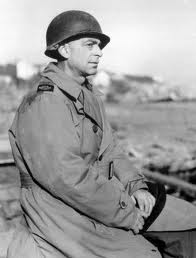
Ed Kennedy, the Paris bureau chief for the AP and a veteran of coverage of the North Africa and Italian campaigns.

Among the press corps, one of the most upset was Edward Kennedy — not the late Democratic senator from Massachusetts but a man by the same name who was the chief correspondent in Europe for the AP. Bear in mind, Kennedy was in a special position. He had been burned earlier in the war when he cooperated with military brass. In 1943, Kennedy had agreed to suppress a story about Gen. George Patton and had gotten scooped by someone else. (See my book, Covering America, pgs 269-70.) Kennedy also knew that his account of the German surrender could probably reach more people on the planet than any other. He knew, too, that the AP thrives on being first and that throughout the ages, AP men (and a tiny but growing number or women) had gone to great lengths to be first to deliver the news.

Besides, he figured, no embargo on such a momentous story could hold for that long. (Nor, perhaps should it.) He was still fuming when the correspondents were marched back onto the military plane. They were flown from Reims back to Paris. Still, the world knew nothing of the surrender. Still, soldiers in Europe kept shooting at each other.

When they landed, Boyd Lewis of United Press got the first jeep from the airport to the Hotel Scribe in Paris, which had been serving as the outpost for most of the press corps. When Lewis got to the press center, he tried to tid up all the available telegraph outlets. Next in line was James Kilgallen of INS, who had beaten Kennedy to the spot by throwing his typewriter at Kennedy’s legs, slowing him down.

Kennedy was beside himself. Then he heard that SHAEF had ordered German radio to announce the surrender.

Kennedy went to the censors and announced that he was breaking the embargo. Using a telephone, he called the AP bureau in London and dictated the following lead:

REIMS, France, May 7_Germany surrendered unconditionally to the Western Allies and the Soviet Union at 2:41 a.m. French time today.

The surrender took place at a little red schoolhouse that is the headquaters of Gen. Dwight D. Eisenhower…..

Within minutes, the news was flashed to the world, and wild celebrations began.

SHAEF was furious and suspended AP filing facilities throughout Europe. The rest of the press corps was furious, too. More than 50 correspondents signed a protest to SHAEF Supreme Commander Dwight Eisenhower, calling Kennedy’s action “the most disgraceful, deliberate and unethical double cross in the history of journalism.”AP’s president apologized to the nation. AP brass told Kennedy he could keep his job if he admitted he had done wrong. He wouldn’t and was fired.

What might seem amazing today — aside from the lack of cell phones and other forms of instant global communication — is how unanimously the correspondents fell in line with the military. Today, I dare say, U.S. reporters would be at least split about the ethics of something that they new to be both true and life-saving.

Two weeks later, writing in The New Yorker, A.J. Liebling, the great World War II reporter and press critic, took up the issue of Kennedy’s firing in his column “The Wayward Press.” (May 19, 1945) Liebling’s take:

The great row over Edward Kennedy’s Associated Press story of the signing of the German surrender at Reims served to point up the truth that if you are smart enough you can kick yourself in the pants, grab yourself by the back of the collar, and throw yourself out on the sidewalk. This is an axiom that I hope will be taught to future students of journalism as Liebling’s Law.

I certainly teach it that way. His piece continued:

I do not think that Kennedy imperiled the lives of any Allied soldiers by sending the story, as some of his critics have charged. He probably saved a few, because by withholding the announcement of an armistice you prolong the shooting, and, conversely, by announcing it promptly you make the shooting stop. Moreover, the Germans had broadcast the news of the armistice several hours before Kennedy’s story appeared on the streets of New York. . . The thing that has caused the most hard feeling is that Kennedy broke a “combination,” which means that he sent out a story after all the correspondents on the assignment had agreed not to. But the old-fashioned “combination” was an agreement freely reached among reporters and not a pledge imposed upon the whole group by somebody outside it.

There’s a lot more to learn from Liebling’s piece, but that’s the nub.

I wonder how Liebling would greet the news this week that the AP has finally apologized to Kennedy. I wonder how Kennedy, who died in 1963, would have greeted the news. (For more on Kennedy, see the newly published memoir Ed Kennedy’s War: V-E Day, Censorship, and the Associated Press.

As for me, I say the AP was late — 67 years late.


Leave a comment

Filed under history, Journalism, journalism history, Uncategorized