Monthly Archives: April 2012

Copy, right?

By Chris Daly

Our wacky legal system at work.

Here is what our founders wrote in the Constitution (Article 1, Sec. 8):

The Congress shall have power . . . to promote the Progress of Science and useful Arts, by securing for limited Times to Authors and Inventors the exclusive Right to their respective Writings and Discoveries.

Here is what it has come to (from a piece by Patricia Cohen in today’s Times):

Art Is Long; Copyrights Can Even Be Longer

 Filmmakers are not the only ones who sometimes run afoul of artists’ copyright law. In recent weeks Google Art Project, which just expanded its online collection of images to more than 30,000 works from 151 museums, agreed, because of copyright challenges, to remove 21 images it had posted.Artists’ copyright is frequently misunderstood. Even if a painting (or drawing or photograph) has been sold to a collector or a museum, in general, the artist or his heirs retain control of the original image for 70 years after the artist’s death.

Can someone explain how locking up these rights for 70 years after the creator has died is supposed to benefit society by spurring new creative efforts? How does it “promote the Progress of Science and the useful Arts”?

As an author, I am all for giving writers a temporary right to earn money from our creations. Without it, I might still write stuff like this, but I would not have written my book. So, a reasonable copyright is a good thing, in my book (and for my book!). But Picasso is not creating any new Demoiselles no matter how long his family gets to dine out on it.


Leave a comment

Filed under publishing

Review of “The Columnist”

By Chris Daly 

A new play about to open on Broadway takes us back, not only to a different era but to a different America. The play is “The Columnist,” by playwright David Auburn, who also wrote the marvelous drama “Proof” in 2000.
The Columnist, by David Auburn

His latest play tells a version of the story of Joe Alsop, who was one of the mandarins of the Washington pundit class during its heyday. Indeed, one of the remarkable things about “The Columnist” is how deftly it reminds us of what a different media world it was in the 1950s and 1960s from today. It’s not just the period details — Alsop’s smoking or his typing (on a real typewriter!~). What is most telling is the way Alsop thinks of his role and the way he is treated by other powerful figures.

Alsop, who teamed up for periods with his brother, Stewart, knew everyone in Washington, of course. But his most strategic alliance was probably with John F. Kennedy, who, on the night of his inaugural in 1961, said good night to Mrs. Kennedy, then headed over to Joe Alsop’s for a nightcap. This was all very pre-Watergate, in an era when journalists and politicians actually knew each other, spoke off the record, and even drank together.

To his credit, Auburn wastes no time on nostalgia. Yes, his play acknowledges, something has been lost in the distance that now separates journalists from political leaders, but “The Columnist” also makes the point in several ways that something has been gained too.

At the same time, the play makes the point that the Democratic Party was a militaristic, center-right party not much different from the Republican Party of that era. Without saying so, the play hints at how much effort it would take in the 1960s and 1970s to turn the Democratic Party into more of a progressive, inclusive, anti-war party.

As played by the marvelous John Lithgow, this portrayal of Alsop pulls no punches. Yes, he could be witty, perceptive,  and disarmingly charming. At the same time, Alsop was a martinet, a bully, and a war hawk. Lithgow deserves high praise for a smashing portrayal in a role that has him on stage for every scene and that requires him to age about 2o years in two hours. Witty, mannered, polished — Lithgow is the perfect embodiment of Alsop.

In the play, Alsop has several shouting matches (via telephone; Lithgow does all the shouting) with Scotty Reston, the Washington bureau chief and lead political columnist for the New York Times for much of the Cold War. Many of them help to advance the play because they involve Alsop’s fury at Reston’s protege, David Halberstam. So, it is quite natural and historically accurate that Alsop is portrayed teeing off on Reston.

But from the standpoint of the history of journalism, a better foil for Joe Alsop would  have been Walter Lippmann. After all, Lippmann was, like Alsop, a syndicated columnist whose beat was The Big Picture. Like Alsop, Lippmann was a pillar of the American Establishment. In the post-War years, there was no office-holder or opinion-shaper who would not drop everything to take a phone call from Walter Lippmann. Yet unlike Alsop, Lippmann was a critic of Kennedy’s involvement in Vietnam and warned the president repeatedly (and publicly) to get out.

When I was writing my book on the history of journalism, Covering America, I considered including Joe Alsop, and I very nearly did. But in the end, I decided that he did not make the cut because he was not enough of an innovator. I wanted to focus on those men and women who changed the field of journalism or who used journalism to make some kind of broader change. Joe Alsop struck me as one of those who dedicated his life to holding off change. More’s the pity.


Leave a comment

Filed under Journalism, journalism history

E-books

By Chris Daly

In the letters to the Times today about ebooks and the future of publishing, I am struck trying to figure out the answer to this question:

In all this upheaval, who is on the side of writers? (without whom, need it be said, there would be no books, in any format)

It feels kinda lonely here in the writer’s corner.


2 Comments

Filed under publishing

Terror or Fear? (cont.)

By Chris Daly 

In trying to assess the troubling verdict in the Tarek Mehanna case, I am impressed by the analysis provided by one of the witnesses. Yale political scientist Andrew F. March is on the right track in his analysis, which appears in today’s Times Sunday Review section.

Like Prof. March, I just cannot find any evidence or testimony in Mehanna’s recent trial in U.S. District Court in Boston that unambiguously links him to any actions that  are crimes.

He may have wished to be a terrorist.

He may have sympathized with some terrorists.

He may have thought and spoken and blogged in favor of anti-American causes.

But I do not see where he ever did anything to harm an American. That is what remains so troubling about this case. It appears that the federal prosecutors over-reached in charging him with unpopular thoughts and speech, and — equally troubling — the jury went along with it.

I guess the moral is: watch what you think. . .

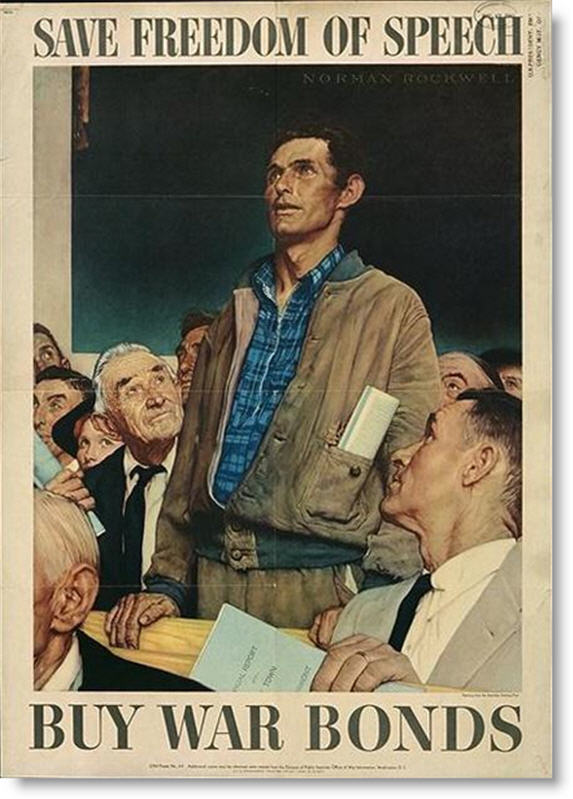
Norman Rockwell


Leave a comment

Filed under Uncategorized

Titanic’s role in journalism

By Chris Daly 

On the eve of the centennial of the sinking of the Titanic, I am posting an excerpt from my new book, Covering America, about the impact of the Titanic on the emerging field of “wireless telegraphy.”

First, here is an image of a wireless distress signal sent that night from the Titanic to the Marconi company.

Telegram from the Titanic: "require assistance. . . struck iceberg"
(Courtesy: Museum of the History of Science, Oxford)

From Covering America: A Narrative History of Nation’s Journalism, chap 7:

In the decades following its invention, the telegraph became a fact of life and an indispensable tool in business, in the military, and in journalism. Still, it had some drawbacks: it could carry a message, but the contents had to be sent in code; messages could be sent only from one point to another, and those two points had to be connected by a copper wire. For these reasons among others, the telegraph was not a popular means of communication but remained a special tool used mainly by businesses.42 In the late nineteenth century, a flurry of scientific and engineering breakthroughs started to overcome those limitations. In 1876 a Boston University professor named Alexander Graham Bell invented a machine, the telephone, which allowed the human voice to be carried over a wire. Nikola Tesla, a Serbian immigrant to America and the inventor of the alternating-current electric motor, contributed the idea that electromagnetic waves could carry messages. Soon it was proven that such waves could pass through walls. They could scale mountains, even cross the ocean. This created the promise of an amazing possibility: a telegraph without wires! A young Italian, Guglielmo Marconi, became a pioneer in the new field, devoting himself to working on a way to use radio waves to transmit signals carrying Morse code.43 Marconi had the resources to tinker with the idea; his mother was an heir to the Jameson family Irish whisky fortune. Rebuffed at home, Marconi went to England, where he formed the Wireless Telegraph Signal Company in 1897, to be followed by an American division of British Marconi a few years later. In 1901, Marconi even managed to send a wireless signal across the Atlantic Ocean, but he struggled to find a business model for his invention. The early applications of the new technology were in the military and in the shipping business, where the ability to send messages without wires had an obvious appeal. At first the technology was referred to as wireless telegraphy, or simply “wireless,” but a new term—radio—first popularized in the U.S. Navy, soon won out. In 1906 an American inventor named Reginald Fessenden demonstrated that radio signals could transmit more than just long and short pulses. They could carry music and even the human voice. In the end, that discovery proved indispensable for making radio a truly popular medium. One of the first big tests of radio, one that made a lasting impact on the public imagination, came in 1912, when the world’s greatest luxury ocean liner, the state-of-the-art Titanic, made its initial voyage from England to New York.44 As the great ship crossed the North Atlantic on April 14, it struck an iceberg, and the crew immediately used the ship’s wireless equipment to call for help. Some of the other ships in the vicinity had wireless equipment that was turned on and monitored at all times; others had turned their sets off for the night. As a result, Copyright 2012 NOT FOR SALE [ 204 ] CHAPTER 7 the closest ship, the Californian, which could have saved all of the Titanic’s 1,522 passengers, lay at anchor just nineteen miles away and never responded. The Carpathia, which was fifty-eight miles away when the Titanic started sinking, took two hours to arrive, and by then, many passengers had drowned in the frigid waters of the North Atlantic. Rescue efforts were also hampered by the many amateur radio operators who filled the airwaves that night with rumors, questions, and interference from their overlapping signals. In the aftermath of the Titanic disaster, the U.S. Congress quickly adopted legislation requiring that all American oceangoing ships and all those entering U.S. ports be equipped with radios, and that the radios be kept on and staffed at all times. Congress also required radio operators to get a license from the U.S. Department of Commerce, and it relegated amateur operators to the bottom of the radio spectrum (the shortwave end) while giving priority to the navy and to commercial companies like Marconi’s.45 Significantly, Congress chose not to follow the European model, in which new technologies including telegraph, telephone, and radio were successively grafted onto a government monopoly such as the postal service, resulting in public communication monopolies like the BBC. In the United States, Congress operated on the principle that radio would be a private enterprise—regulated, to be sure, but private nonetheless. In retrospect, this was one of the constitutive moments shaping the eventual architecture of broadcasting in America, combining elements of technology, law, and economics into a new model.46 On the night of the Titanic disaster, one of the radio operators in New York handling reports of the sinking was a young man named David Sarnoff. (He was not the only one, as he often claimed.) A Russian immigrant who never made it past the eighth grade, Sarnoff would become one of the titans of broadcasting in the twentieth century as president of RCA, the Radio Corporation of America.47 While working for Marconi, Sarnoff demonstrated great foresight. In 1915, when he was just twenty-four years old, Sarnoff wrote a memo to his boss, giving his thoughts on the business. He envisioned a future for radio that went far beyond transmitting coded messages from point to point. “I have in mind,” he wrote, “a plan of development which would make radio a ‘household utility’ in the same sense as the piano or the phonograph. The idea is to bring music into the home by wireless. . . . The same principle can be extended to numerous other fields as, for example, receiving lectures at home which can be made perfectly audible; also, events of national importance can be simultaneously announced and received.”48 Sarnoff projected a market of 15 million American families. The Marconi company did not think much of Sarnoff’s scheme, but Sarnoff clung to the idea that radios could be a popular mass commodity, provided they became easier to use. Never much of engineer, Sarnoff was already showing his true talent: marketing. He switched to management. While Sarnoff and others were pondering the future of radio, most Americans Copyright 2012 NOT FOR SALE Jazz Age Journa lism, 1920–1929 [ 205 ] still had never heard a radio broadcast. A few license-holders were beginning to transmit signals through the airwaves (or into “the ether,” as it was called), where they could be heard by anyone with a receiving set. But hardly anyone had one yet. A few corporations, such as United Fruit, were using radio to coordinate their shipping fleets. And of course the army and navy remained deeply involved in radio. But before about 1920, radio remained largely in the hands of the amateurs— most of them young men who were inclined to tinker. Those early adapters usually built their own radio sets. They set up friendly competitions to see who could pull in the faintest or most distant signal (which they called “DXing”). They often traded information and parts in a wave of enthusiasm that had nothing to do with patents, profits, or licenses. Participants in the new movement sometimes referred to what they were doing as “citizen radio.”49 An editorial in one of the first radio journals put it this way: “Do you realize that our radio provides about the only way by which an individual can communicate intelligence to another beyond the sound of his own voice without paying tribute to a government or a commercial interest?”50 Soon others joined in—women as well as men, universities, stores, even the famous Dr. Brinkley of Kansas, who used radio to promote his theory that implanting goat glands would cure “male trouble.” Radio was wide open— diverse, local, nonprofit, and utterly unpredictable. But not for long. World War I transformed radio, as it did so many other institutions.

Leave a comment

Filed under broadcasting, Journalism, journalism history

Newspaper jobs

By Chris Daly 

This just in: The number of jobs for reporters in U.S. newspapers has probably bottomed out. That’s one takeaway from the latest survey of the country’s newsrooms released by the American Society of Newspaper Editors. The ASNE, which has been meeting in Washington and played host to both Obama and Romney (on different days!), conducts an annual survey of who is working in the newsroom.

Here’s a key passage (imho):

Despite this year’s loss in newsroom positions, the decline in jobs that began in 2006-07 appears to be stabilizing. The loss this year is not as drastic as the losses between 2007 and 2010.

So, if things are no longer getting worse, does that mean that they are getting better?

Leave a comment

Filed under Journalism

“Covering America” reviewed

By Chris Daly

Delighted to see this review just out from Publisher’s Weekly.

Covering America: A Narrative History of a Nation’s Journalism.
Christopher B. Daly. Univ. of Massachusetts, $49.95 (544 p) ISBN 978-1-55849-911-9

In this scholarly yet readable volume, Daly (Like a Family: The Making of a Southern Cotton Mill World), a professor of history and journalism at Boston University, presents a surprisingly spirited and detailed account of American journalism and the many ways in which the press has impacted the trajectory of American history, and vice versa. Beginning in the early 1700s with the institution of a postal service and continuing through the advent of the Internet and its implications for the “dinosaurs” of big media, the book is full of colorful portraits of American media icons such as Benjamin Franklin and late New York Times reporter David Halberstam. Any history book runs the risk of being bland, but Daly peppers the text with amusing anecdotes and intriguing facts (e.g., the idea for the first journalism courses, offered at Washington & Lee University, came from defeated Confederate General Robert E. Lee). Daly divides the major time periods in American journalism into five categories: politicization (1704-1832), commercialization (1833-1900), professionalization (1900-1974), conglomeration (1965-1995), and digitization (1995-present). These divisions make the narrative easy to follow for both students of journalism and casual enthusiasts. In addition to the interesting stories, Daly makes many cogent arguments about what the press has meant to the country’s shared history and identity. Illus.

Reviewed on: 04/09/2012
If you’ve read it, please leave a comment of your own. If you haven’t, get off-line, pick it up, and read!


Leave a comment

Filed under history, Journalism

Shameless promotion

By Chris Daly

Just back from a talk I gave at the Columbia Journalism School on Tuesday. The dean, Nick Lemann, is an old friend who graciously hosted a discussion of my new book, Covering America

The video should be shown on C-Span’s Book TV in a few days. (I will post the link when it’s definite.)

Here’s proof that I was there, standing in front of Joseph Pulitzer himself.

Photo by Anne Fishel

Photo by Anne Fishel

Leave a comment

Filed under Journalism, journalism history