
On the death of William Calley,
a time to reflect on U.S. war crimes.
By Christopher B. Daly
NOTE: William Calley, a notorious figure in the late 1960s, died back in April. For some reason, the news was covered up until this week, when the New York Times got wind of his death. Here is the story of how the war crimes committed by Calley and other U.S. soldiers in Vietnam in 1968 first came to light, through the efforts of investigative journalist Seymour Hersh. This is a free excerpt from the 2018 edition of my book Covering America: A Narrative History of a Nation’s Journalism.
On March 16, 1968, a company of U.S. soldiers in the Army’s Americal Division entered the village of My Lai (which Americans pronounced “mee lie”), near Da Nang in South Vietnam. There had been reports of hostile fire coming from the area, and several U.S. soldiers had been killed near there in recent days. The men in C Company were being led by Lt. William L. Calley Jr.
Under orders from Calley, troops gathered villagers into groups and “wasted” them with machine- gun fire. Anyone who survived was picked off with rifle fire. At least 90 people, and possibly as many as 130 or more, were killed—all civilians. The army even had a combat photographer on hand that day, who took plenty of pictures.
Afterward, nothing happened.
More than a year later, the stories and rumors about the events at My Lai reached a soldier named Ronald Ridenhour. Just on the basis of what he’d heard, Ridenhour was so disturbed that he started writing letters. He wrote to the president, members of Congress, anyone he thought might do something. Again, nothing happened. Then a single congressman, liberal Democrat Mo Udall of Arizona, promised to look into the matter. He prodded the army to do so.
In September 1969, just days before Calley was due to be discharged, the army filed charges against him, accusing him of the murder of “more than 100 Oriental human beings.” The army, seeking to minimize the impact, released the news about the impending court-martial out of Fort Benning, Georgia, where Calley was being held pending trial. The Associated Press ran a brief item, picked up by a few newspapers and printed on inside pages. The New York Times carried it on September 8, at the bottom of page 38. And that might have been the end.
Except that a reporter named Seymour Hersh got a call from a friend alerting him to the case. Sy Hersh, who was then 32, had cut his teeth in Chicago at the famous City News Bureau. He went on to work for the Associated Press, where he spent some time covering the Pentagon. In the fall of 1969 he was working as a freelancer. As a result of that career path, he was in a rare position to report on My Lai: he knew his way around the Pentagon, but he was not bound by the institutional culture or the editorial caution of the major news organizations, which probably kept journalists employed by those organizations from seeing the massacre for what it was. Most news organizations were very wary of saying such damning things about the military, and many in-country correspondents knew all about similar atrocities in Vietnam but had never reported them because they did not seem like “news.”
In any case, Hersh, who opposed the war, dropped everything and plunged into the My Lai story. He made a lot of phone calls before he found Calley’s atto ney, who agreed to talk with him. Fortified by a grant of $2,000 from the Fund for Investigative Journalism, Hersh kept digging. At the same time, he called Life to see if the magazine was interested. The editors turned him down flat, saying a massacre story was out of the question. He tried Look and got the same answer.
Even so, Hersh pressed on, flying to Georgia so he could try to find Calley in the vastness of Fort Benning. After a lengthy runaround, during which Hersh used every trick in his bag (schmoozing, impersonating, bluffing), he finally located Calley. After a lengthy face-to-face interview, Hersh banged out a 1,500-word story about the My Lai massacre and found a buyer, the obscure left-wing Dispatch News Service, which sent the story out to its client newspapers.
Some three dozen papers, including the Boston Globe and the Times of London, bought the story (paying $100 apiece for it) and ran it on page one on November 13, 1969. And that seemed to be that. The story got little attention at first, especially compared to the Apollo 12 space mission and Vice President Spiro Agnew’s attacks on the media’s supposed liberalism. My Lai got another bump when Hersh sent out a second story based on interviews with members of C Company.
One thing the story lacked was photos. Without dramatic pictures, the facts of the massacre did not seem to register with the public. But as it turned out, there were photos. They were in the possession of former sergeant Ronald Haeberle, the army combat photographer who had been at My Lai during the massacre. Haeberle had had his official army camera with him that day, but he’d also had his personal camera on a strap around his neck, and he had brought some of his own photos home with him. When he heard about the interest in My Lai, he approached his local newspaper, the Cleveland Plain Dealer. On November 20, 1969, the paper published the first photos of the massacre.
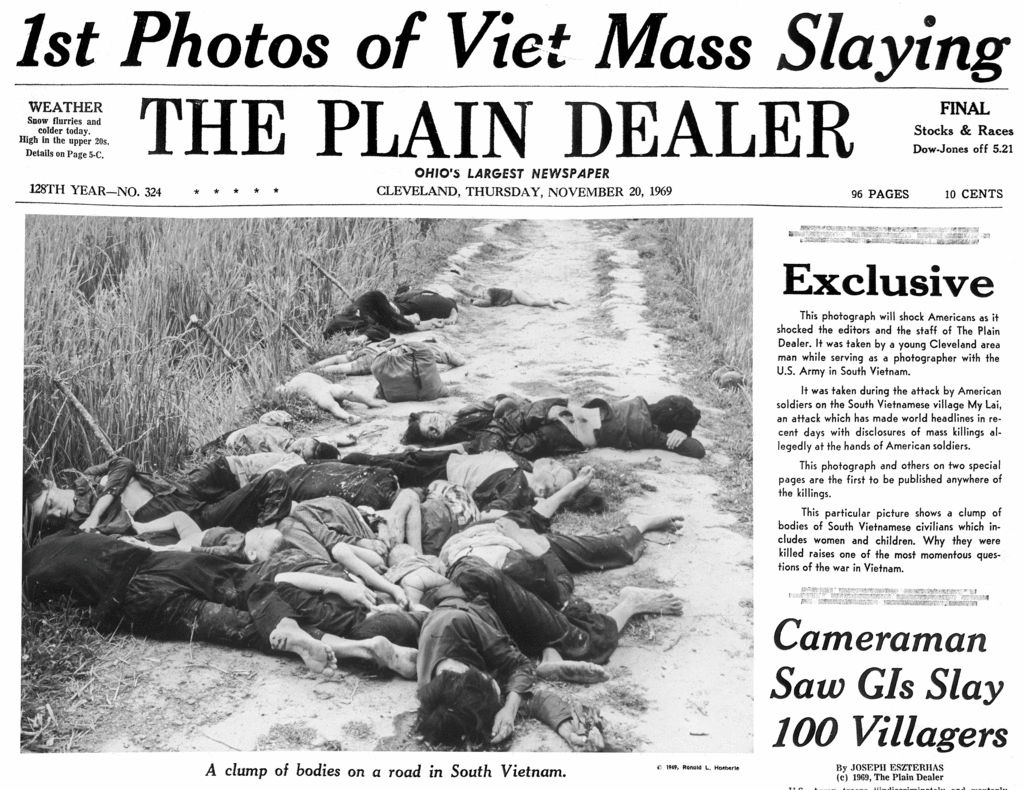
Disturbing photographs of civilians massacred by U.S. soldiers first appeared on the front page of the Cleveland Plain Dealer on November 20, 1969. The photos were taken the year before by Army photographer Ronald L. Haeberle. ©1974, The Plain Dealer. All Rights Reserved. Used with permission of the The Plain Dealer.
The photos were gruesome, but what was most troubling was that they clearly showed the bodies of Vietnamese civilians—lots of them, jumbled atop and beside one another—but no enemy soldiers. Suddenly Time, Life, and Newsweek were all interested, and the story became a certified big deal. The December 5, 1969, issue of Life, for example, featured an extensive display of Haeberle’s photos, plus a story by Joe Eszterhas, a young reporter for the Plain Dealer.
Next, television joined the pack, offering dramatic interviews with members of C Company. One former soldier went on television to confess his role in My Lai and to say he was sorry. His mother blamed the army. She looked into the camera and declared, “I sent them a good boy, and they made him a murderer.”
In the following months, as the Calley court-martial unfolded, the My Lai case kept the issue of atrocities on the public agenda. Some in the military and their supporters in the media tried to downplay the charges, or to chalk the incident up to the “war-is-hell” philosophy. But the vast majority of editorial commentary was critical, blaming the army and raising new questions about the nature of the war in Vietnam. Coming after the coverage of the Tet Offensive the previous year, the My Lai story was another hammer blow against American enthusiasm for the war.
The My Lai story not only caused a sensation but also broke a journalistic taboo. In almost all previous wars, it was unheard of for any country’s press to report on its own side’s atrocities, especially while the fighting was still going on. Reader’s Digest, for example, offered Americans a steady drumbeat of stories about atrocities blamed on communists in Vietnam but never found a single case among U.S. troops. My Lai changed that, too.
Suddenly, there were stories appearing everywhere in the media about U.S. atrocities in Vietnam—rape, murder, torture, and a particularly shocking form of execution: pushing a prisoner out of a helicopter. There were stories that some American soldiers made a practice of cutting the ears off dead VC soldiers, drying them, and stringing them into ghoulish necklaces. In July 1970, Americans learned about the notorious “tiger cages,” a brutal prison maintained by South Vietnamese authorities on an off- shore island. When a congressional delegation visited, a young aide took photos, which were promptly published in Life magazine.




 Prof Chris Daly's Blog