Tag Archives: Obama

Obama: Media Critic?

By Christopher B. Daly

Even on vacation, I couldn’t help noticing this piece in today’s Times about President Obama’s news-reading habits and his criticisms of some of the coverage. 

As a media critic myself, I am not sure how I feel about adding this new guy to the ranks. But he does seem to have a grasp on some major issues. From the Times:

The news media have played a crucial role in Mr. Obama’s career, helping to make him a national star not long after he had been an anonymous state legislator. As president, however, he has come to believe the news media have had a role in frustrating his ambitions to change the terms of the country’s political discussion. He particularly believes that Democrats do not receive enough credit for their willingness to accept cuts in Medicareand Social Security, while Republicans oppose almost any tax increase to reduce the deficit.

Privately and publicly, Mr. Obama has articulated what he sees as two overarching problems: coverage that focuses on political winners and losers rather than substance; and a “false balance,” in which two opposing sides are given equal weight regardless of the facts.

Mr. Obama’s assessments overlap with common critiques from academics and journalism pundits, but when coming from a sitting president the appraisal is hardly objective, the experts say.

Irony alert: after quoting Obama on the problem of false balance and explaining the concept, the piece goes on to engage in the very practice.

To his credit, Obama seems to read a lot, and that can’t be a bad thing.

Now, back to the beach.
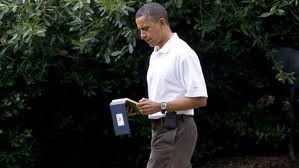
Obama reads his iPad while walking. ABC News.com

Obama reads his iPad while walking. ABC News.com
Leave a comment

Filed under broadcasting, Journalism, Politics, President Obama

Can the president execute U.S. citizens?

By Christopher B. Daly 

A hat-tip to Charlie Savage of the Times for sticking with the story of one of the major constitutional, diplomatic, and military issues of our times:

Does the president of the United States have the constitutional authority to order the killings of U.S. citizens without so much as a trial?

That is the issue at heart of a lawsuit going forward in U.S. District Court in Washington. The suit was filed by survivors of Anwar al-Awlaki, the notorious America-hater who did so much to help al Qaeda before he was taken out last September in a drone attack in Yemen.

Things to keep in mind:

–al-Awlaki (although a rotten bastard for sure) was a U.S. citizen, born in New Mexico.

–al-Alawki was not bearing arms against the U.S. at the time.

–the president ordered his execution.

–al-Awlaki was never tried, convicted or sentenced in a U.S. court.

He was treated like a foreign enemy wearing a military uniform, only he wasn’t. This is the most troubling issue in the developing, high-tech, long-distance war on terror.


Leave a comment

Filed under Uncategorized

Grammar for journalists

By Christopher B. Daly

One of the most popular “memes” of this week in politics has been the idea that Barack Obama hates business. The supposed evidence for this is something that the president said in a recent appearance in a fire station in Roanoke,Va. Here’s part of what he said:

“If you were successful, somebody along the line gave you some help. There was a great teacher somewhere in your life. Somebody helped to create this unbelievable American system that we have that allowed you to thrive. Somebody invested in roads and bridges. If you’ve got a business, you didn’t build that. Somebody else made that happen. The Internet didn’t get invented on its own. Government research created the Internet so that all the companies could make money off the Internet. The point is, that when we succeed, we succeed because of our individual initiative, but also because we do things together.”

Now, let’s examine that statement, shall we? At the risk of sounding like a university professor (oh, wait!), I feel compelled to point out that the problem in that passage arises, as so often happens, from a pronoun whose antecedent is not clear. The president was saying that before anyone can start a new business, the public has already invested tax dollars in an array of public goods that make that private enterprise possible. Public schools probably educated most of the workforce and customers. Police and fire departments provide a safe, orderly environment. Public roads bring supply trucks and customers to the new business. And so on. That is what Obama meant when he said, “If you’ve been successful, you didn’t get there on your own.” (Think, for a minute, about the chances of starting a business like Staples on a desert island, or in the tribal areas of NW Pakistan. Not gonna happen.)

The president went on to say, “Somebody invested in roads and bridges.” In other words, taxpayers funded the infrastructure.

In the very next sentence, the president said: “If you’ve got a business, you didn’t build that.”

Question is: in that last sentence, what does that refer to?

Does that refer to the noun that immediately precedes it? In that case, the president is saying: If you have a business, you didn’t build it. 

Or, does that refer to the previous concept of “roads and bridges” (in which case, grammatically speaking, the pronoun should be them not that) or the broader point of infrastructure?

Personally, I think the president’s meaning was plain: If you run a successful business today, your success is based on the earlier investment in infrastructure.

But that’s my personal conclusion. Fox News and Mitt Romney have come to a different conclusion (surprise!) and have chosen to lift one sentence out of context as “proof” that the president is hostile to business. People who use the English language in their professional lives should know how to parse it.

1 Comment

Filed under Fox News, Journalism, Politics

NYT error: Fox News is not top rated

By Christopher B. Daly 

Today’s Times has an interesting (though somewhat thin) story about the relationship between president Obama and Fox News.

One thing caught my eye:

But now, with the presidential campaign entering its most competitive phase, the simmering tensions between Mr. Obama and the country’s highest-rated news channel threaten their fragile détente.

Problem is, Fox News is NOT the “country’s highest-rated news channel.” It is the highest-rated cable news channel, with about 1.3 million viewers. But it comes nowhere near the size of even the lowest-rated broadcast news channel. And it is still a tiny fraction of the combined audiences of ABC, NBC, CBS, and PBS, which have well over 20 million viewers in all.

(Yes, there is a bit of an apples/oranges issue here, but, come on: Fox is in a different universe from the broadcast networks.)

(A further thought: in a nation of 300+ million people, does Fox News with 1.3 million viewers deserve the attention it gets?)


3 Comments

Filed under broadcasting, Fox News, New York Times

“Quote approval”: A new low in journalism?

By Christopher B. Daly 

When a journalist interviews someone (anyone), the normal ground rules that govern the interaction amount to this:

I am a journalist working on a story. I want to talk to you and use the things you say in my story, based on my judgment of what is important. I will use none, some, or all of what you say, as I choose, to further the pursuit of the truth. Whatever quotations I use will be verbatim — nothing added, nothing left out. I will also use your real name (and title, if you have one).

This is the essence of the standard known as “on the record.” Journalists prefer it because we believe that, on the whole, it holds people accountable for the things they say. In certain (ideally rare) situations, however, journalists will negotiate some lower standard. Almost always, these retreats from the “on the record” standard come at the initiative of the people we are speaking to. These other arrangements are known by a bewildering array of terms, which do not always mean the same thing in different cities or beats. The problem is that these departures usually serve the source rather than the audience.

Today comes word from the Times that political reporters for all the major news organizations have adopted a new — and, I think, pernicious — practice. They allow the people they are interviewing to get a look at their own quotes before publication and censor them. That is, the big shots around Obama and Romney routinely demand and get the power to edit themselves before their words appear in print or online.

Well, you can hardly blame them for trying. Who wouldn’t want that option?

But the journalists should never have agreed to it. These spokespeople, senior officials, and top aides get paid lots of money for their ability to think on their feet and choose their words carefully.

At the very least, having agreed to this arrangement, the journalists have a professional duty to reveal the terms. What about transparency? I, for one, could live without stories in which members of the political class get to “clean up” their quotes.

Another question: in what other fields does this practice apply? Sports reporting? Business news?

(Props to Jeremy Peters of the Times for blowing the whistle on this practice.)

3 Comments

Filed under Journalism, journalism history, New York Times, Politics

“Wait, wait”: Would someone please impose an embargo on the news media

By Christopher B. Daly 

Kudos to the SCOTUSblog for this remarkable tick-tock on what went wrong in the initial reporting about the Supreme Court ruling on the Obama health care plan back on June 28. Tom Goldstein, the publisher of SCOTUSblog, has put together a 7,000-word reconstruction of the first half hour of reporting, focusing on the screw-ups  at CNN and Fox News. He has done us all a service with his meticulous, minute-by-minute (and sometimes second-by-second) narrative of that day’s hits, balks, run-downs, and errors.

What this post-game review suggests to me is that, first and foremost, the news business needs to do better. As a former wire service reporter (10 years with the AP, both on desks and in the field), I appreciate the need for speed. SCOTUS decisions move markets; they sometimes hand the White House to one party over the other. Often, they are the epitome of breaking news. That said, it is insane for reporters to cover Supreme Court opinions on the fly. No one benefits. In Goldstein’s tick-tock, the description of the gyrations of the front-line legal correspondents reminds me of nothing so much as an episode of “Iron Chef” — in which highly talented people are subjected to insanely artificial difficulties (“OK, now you have two minutes to make a three-course meal out of kale and strawberries. GO!”). There is absolutely no reason to turn this scheduled event into a speed-reading contest.

The Supreme Court also has some lessons to learn. It is insane that the Court does not post its opinions, in full, on the Web at 10:00:01. Why should the White House and Congress have to wait? Why should citizens have to wait? Why should prisoners facing execution or stock traders or anyone have to wait? In this day and age, to hand out paper decisions is an affront.

But most important of all, after reading Goldstein’s report, I am strengthened in my belief that the Court and the news business need to get together on a slow day and figure out a better system for these kind of hand-offs. The answer is staring them in the face: an old-fashioned news embargo. The Court could simply identify 10-20 of the top court reporters — all vetted, credentialed experts — and invite them to come to the building at 8 a.m. The journalists could all then be locked in a room (like jurors) with no wi-fi access. They could then take their time to read the opinion (in full), digest it, and craft a coherent and accurate story. At 10:00, those stories could all be released, all at once. That way, all the news organizations that care about speed would have a multi-way tie and the issue of who was “first” would be moot. That way, the first version would also be the right version. That way, the public gets a full, careful, accurate version at the earliest possible moment.

P.S.: The world would certainly be a better place if people would stop posting comments just to gloat. Goldstein mentions a couple of these kind of comments that SCOTUSblog received from readers rubbing it in that CNN and Fox were right and SCOTUSblog was wrong. In retrospect, they look like the doofuses they are.

Twitter postings / Topsy

Twitter postings / Topsy

Leave a comment

Filed under blogging, CNN, Fox News, Journalism, Supreme Court

Leaks (cont.)

By Christopher B. Daly

The able legal-affairs reporter Charlie Savage and Scott Shane have an interesting update in today’s Times about the issue of national-security leaks. The upshot is that the Obama administration has (surprisingly perhaps) emerged as the all-time record-holder among all U.S. presidential administrations for prosecuting leaks. (The piece has a helpful sidebar — which was better looking in print than online — that summarizes nine known leaks cases.)

A couple of related questions:

–Which administration holds the record for generating leaks? (probably a two-term president like Nixon, Reagan, G.W.Bush? or like Clinton?)

–Isn’t it worthwhile to distinguish between different types of leaks?

A. We might differentiate between authorized and unauthorized leaks.

B. We might differentiate between leaks to journalists and leaks to others.

C. We might differentiate between leaks that do harm and those that do not.

For example, it is one thing for a traitor to steal operational secrets and sell or give them to agents of a hostile power. That’s the kind of leak that should properly trigger Congressional outrage and lead to criminal prosecutions. That kind of leak raises no First Amendment issues.

It is quite a different thing for a troubled official to tell a journalist about a secret policy so that the public can debate whether that policy is a good idea. It is this kind of leak that usually induces partisan posturing and leak investigations that fizzle. It is also the kind of leak that requires a careful weighing of the First Amendment implications.

Leave a comment

Filed under First Amendment, Journalism, leaks, New York Times, publishing

Questioning the President

By Christopher B. Daly 

Right-wing media are naturally having a field day over Neil Munro (not the Scottish writer and critic, but the person affiliated with the conservative website The Daily Caller who recently interrupted President Obama to shout questions about the president’s immigration policy). This part is really rich: What he shouted was something like, “Why do you favor foreigners over American workers?” [which is not only a loaded question, but one that sounds more like a provocation or a taunt than a question to which he seeks a real answer].

Turns out, Munro himself is a “foreigner” (born in Ireland) who is therefore enjoying a job that could be filled by an American.

The right-wing media say Bully for him! and take delight in anyone who disrespects this president (but god help anyone who disrespects the office, the flag, etc.). They say the rest of the media are a bunch of lapdogs who spend all day bowing down to the president.

I am actually of two minds about this one. My ambivalence is based on my experience. For a couple of years, I regularly took part in the state-level equivalent of the Rose Garden event. In fact, as the AP’s bureau chief, I usually asked the first question at the governor’s press conferences in Boston.

In that setting, pretty much everyone is a professional who is there to work. The chief executive has a message to convey, and reporters have questions to which they really need answers. Generally, there are ground rules that ensure that the working press can actually get its work done. Generally, those ground rules exclude grandstanding, taunting, heckling, and the rest, because those kind of activities are inimical to Q+A.

I have no objection to those activities, per se. I think our leaders need a good heckling from time to time. I just don’t see where this guy gets off breaking the ground rules and then acting as if he’s the injured party. There are reporters working at the White House who do not want to have to explain to their bosses that the reason they don’t have a story is that some bozo decided to turn the event into a shouting match.

I guess I come down this way:

If you want to heckle the president, go to a public event.

If you need to ask him a question, go to a press conference.

Leave a comment

Filed under Journalism, Politics

Media hypocrisy check

By Christopher B. Daly 

With gasoline prices dropping, here’s my question:

If conservative media personalities really love this country and if they are really rooting for America, then why don’t they hail the good news of lower gas prices if those prices drop under a Democrat?

Hmmm. . .


Leave a comment

Filed under Journalism, Politics

Leaks investigation

By Christopher B. Daly

The Times editors probably should have slapped an “Analysis” label on this piece (which it carries online, but not in today’s print version) or put in the Sunday Review section. In any case, Charlie Savage has an intelligent analysis of why “leaks” investigations so often come to nought.

He makes a key legal point here:

Many people are surprised to learn that there is no law against disclosing classified information, in and of itself. The classification system was established for the executive branch by presidential order, not by statute, to control access to information and how it must be handled. While officials who break those rules may be admonished or fired, the system covers far more information than it is a crime to leak.

Instead, leak prosecutions rely on a 1917 espionage statute whose principal provision makes it a crime to disclose, to persons not authorized to receive it, national defense information with knowledge that its dissemination could harm the United States or help a foreign power.

And he goes on to make the point that prosecutors have a difficult showing the harm that flows from disclosures of classified information. It is almost never the case that a news media participant in a leak will divulge real, active military secrets. Instead, the practice of leaking is usually someone’s way of trying to win or shape a policy debate. It is the pursuit of politics by other means.


Leave a comment

Filed under First Amendment, Journalism, journalism history, leaks, New York Times, President Obama