Whether you agreed with her or not, it must be acknowledged that Ada Louise Huxtable elevated the practice of American journalism just by being in it. I recall how many of her pieces were events in themselves.
Thank you, Ada.
Whether you agreed with her or not, it must be acknowledged that Ada Louise Huxtable elevated the practice of American journalism just by being in it. I recall how many of her pieces were events in themselves.
Thank you, Ada.
Filed under Journalism, journalism history, New York Times
By Christopher B. Daly
David Carr has a worthwhile column today in the New York Times, making the point that many of the brand-name “legacy media” that were so recently written off are quietly staging a comeback. According to Carr, the dinosaurs are learning to dance. (In the final chapter of my book, COVERING AMERICA, I used a slightly different metaphor: I said the dinosaurs had to learn to ice skate!)
Here’s an excerpt:
In the last year, the Standard & Poor’s 500-stock index was up 13.4 percent, which was a significant advance, but legacy media giants like Comcast, News Corporation and Time Warner absolutely surpassed it in terms of share price.
Viacom, which has had serious ratings trouble with MTV and Nickelodeon, still managed to be up 16.1 percent on the year. We keep hearing how traditional networks are getting clobbered, but Viacom’s sibling, CBS, was up a whopping 40.2 percent.
News Corporation, despite being racked by scandal, was up 43 percent, and fellow global media conglomerates like Disney and Time Warner were up more than 32 percent. And Comcast, which has both the pipes and programming — cable and NBCUniversal — soared 57.6 percent.
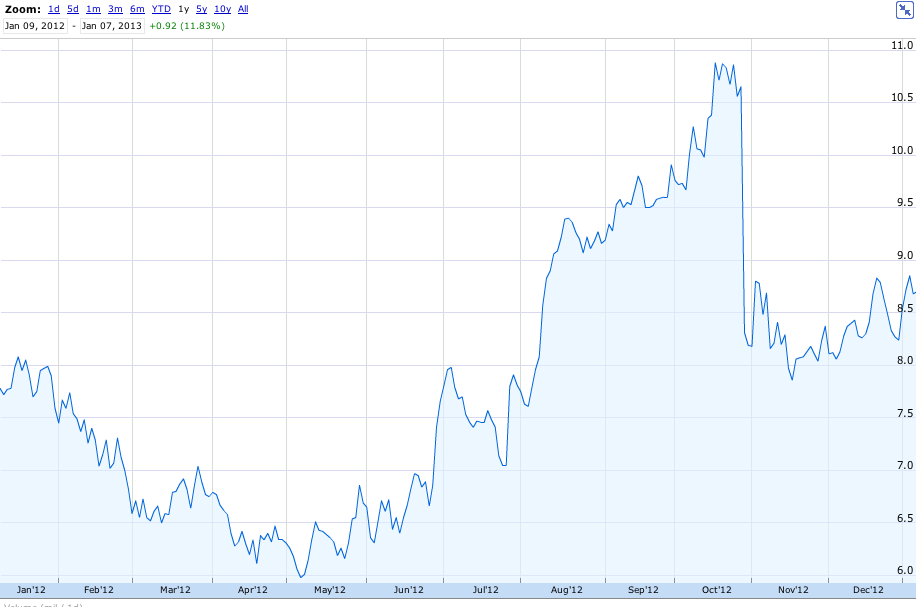
One piece of data that Carr did not cite is the recent history of the market fortunes of his own employer, the New York Times Co. So, here it is:
Turns out, the value of Times Co. stock has been on a roller-coaster track over the past 12 months. The company had a terrific six months, from May to October, during which the value of a share of NYTCo stock almost doubled. Somewhere around Halloween, the stock cratered, and it has been basically crawling sideways since then. So, the Times Co. experience does not fit Carr’s trend story. I would say that would be a good subject for him to take up next: why doesn’t the Times‘ journalistic excellence translate into financial success?
It’s an important question to answer, because without making money, the Times will not long be able to dance or ice skate. Like other dinosaurs, it will die out.
Filed under Journalism, New York Times
By Christopher B. Daly
Just catching up with a landmark in multimedia journalism: the New York Times project titled “Snow Fall: The Avalanche at Tunnel Creek,” which was originally posted just before Christmas. IMHO, it is very nearly the state of the art in using multimedia to tell a story, especially a narrative.
The piece (if that’s the right word… project?) was a success in many ways — it was beautiful (in a terrifying sort of way), it was deeply informative, and it brought the Times a whole lot of welcome traffic from new visitors.
It remains to be seen if any of those drop-in readers become regulars or subscribers. I would say “Snow Fall” is on a par with the best work done by MediaStorm or NatGeo, or even one of my all-time favorites, Bear71.
That said, could the Times have done a better job on Snow Fall? I hasten to say I could not have done better but I can think of two suggestions: First, the Times took some well-deserved flak for annoying subscribers by sending out a “breaking news” alert about Snow Fall, when it was clearly not breaking news. I trust they will not do that again.
More important, I would venture to say that the essential story could have been stronger. There were a lot of protagonists, and we barely met a few of them before they were all engaged in dramatic actions, and it was hard to keep them straight. It is very hard to drive a narrative without a clear hero or villain, and I found the focus wavering. Still, a salute to the lead reporter/writer, John Branch. And, thanks to the Times for tackling the whole project.
Courtesy of Jim Romenesko, here is a comment to the Times staff from the paper’s executive editor, Jill Abramson.
Filed under Journalism, New York Times
By Christopher B. Daly
Today presents a good example of what makes the New York Times so valuable. When the “controversy” over the anti-Muhammad movie called “Innocence of Muslims” broke a couple of months ago, many news organizations covered it for a few days. Eventually, to judge by the evidence so far, they all threw in the towel and gave up trying to get to the bottom of the story of the Coptic deadbeat/activist Nakoula Basseley Nakoula (if that really is his name). All except the Times. In today’s edition, the paper presents a page-1 story with a double byline. Top billing went to Pulitzer-winner Serge Kovaleski, backed up by Brooks Barnes. But that’s not all. At the bottom of the story is a credit line that mentions four more people:
Ana Facio-Krajcer and Noah Gilbert contributed reporting from Los Angeles, and Mai Ayyad from Cairo. Jack Begg contributed research.
So, that is six journalists and counting. All of which is not to mention the folks on the photo desk and the several layers of editors who worked on this piece as well. In all, I would estimate that the full team was in the low double digits.
That is real reporting power. That is the Times’s way of saying: We don’t care how long it takes or how many people it takes, if we get interested in something, we are going to pursue it.
Is the Times perfect? Does the Times pursue every story you would like it to. Obviously not, but where would we be without it?
Filed under Journalism, New York Times
By Christopher B. Daly
It was the only decision they could have made, but credit New York Times executives with deciding to ban the pernicious practice of “quote approval.”
In an announcement made Thursday, the paper said it would no longer allow its reporters to grant their sources the power to approve their own quotes before they appear in news stories. The Times was slow in figuring this out, but a right decision is always welcome.
Here’s the takeaway:
. . .starting now, we want to draw a clear line on this. Citing Times policy, reporters should say no if a source demands, as a condition of an interview, that quotes be submitted afterward to the source or a press aide to review, approve or edit.
That should have been self-evident.
Filed under Journalism, New York Times, Uncategorized
By Christopher B. Daly
Exhibit A: today’s New York Times politics section.
The on-line version shows the rapid evolution of a news organization from what used to be a print-only operation into a full-fledged multimedia operation.
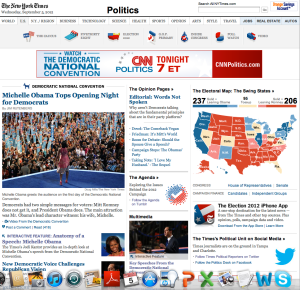
Among the many features:
–A dynamic map of the Electoral College vote totals.
–Many color photos, including a slideshow. Plus, a trip through the Times photo archives with a b&w slideshow from 1968.
–Videos of the key speeches.
–Blog posts by beat reporters discussing their specialties.
–An old-fashioned “lede-all” main story, but one that has 416 comments (and counting).
–A behind-the scenes “TimesCast” in which a Times editor interviews a Times reporter.
–More than a dozen sidebars.
–Lots of old-fashioned “eat-your-peas” civics information, including a helpful side-by-side comparison of the two party platforms.
–Material carried forward from the GOP convention (which newspapers could never do when they were print-only).
–An interactive feature about undecided voters.
–An iPhone App, twitter feeds, a Facebook page. . .
It just goes on and on. All of which raises a question: which business is the New York Times really in? After more than 150 years in the newspaper business, I would say the Times can say it is in the news business, period.
Well, almost. That politics homepage that has so many features (and which reflects the work of I don’t know how many trained professionals — many dozens, certainly, maybe in the low hundreds) has mighty few ads. I see:
–a banner near the top from CNN,
–a second ad from CNN in a box in the right column.
–a couple of “house ads” touting NYTimes services, which bring in no money.
–a small ad from Corcoran Real Estate about waterfront estates in Delray Beach
–A “GoogleAd” for Trader Joe’s coupons.
I have no idea how much revenue those ads are bringing in. All told, however, I am sure that they don’t amount to a fraction of the cost of putting all those reporters and editors in Charlotte, NC, plus the cost of the team in NYC who are helping out.
For now, then, it must be acknowledged: the tools and the philosophy of online news have outrun the business model. This is impressive but not sustainable. Yet.
Will it be self-supporting by 2016?
Filed under Journalism, New York Times, Uncategorized
By Christopher B. Daly
Today’s Times has an interesting (though somewhat thin) story about the relationship between president Obama and Fox News.
One thing caught my eye:
But now, with the presidential campaign entering its most competitive phase, the simmering tensions between Mr. Obama and the country’s highest-rated news channel threaten their fragile détente.
Problem is, Fox News is NOT the “country’s highest-rated news channel.” It is the highest-rated cable news channel, with about 1.3 million viewers. But it comes nowhere near the size of even the lowest-rated broadcast news channel. And it is still a tiny fraction of the combined audiences of ABC, NBC, CBS, and PBS, which have well over 20 million viewers in all.
(Yes, there is a bit of an apples/oranges issue here, but, come on: Fox is in a different universe from the broadcast networks.)
(A further thought: in a nation of 300+ million people, does Fox News with 1.3 million viewers deserve the attention it gets?)
Filed under broadcasting, Fox News, New York Times
By Christopher B. Daly
The Times editors probably should have slapped an “Analysis” label on this piece (which it carries online, but not in today’s print version) or put in the Sunday Review section. In any case, Charlie Savage has an intelligent analysis of why “leaks” investigations so often come to nought.
He makes a key legal point here:
Many people are surprised to learn that there is no law against disclosing classified information, in and of itself. The classification system was established for the executive branch by presidential order, not by statute, to control access to information and how it must be handled. While officials who break those rules may be admonished or fired, the system covers far more information than it is a crime to leak.
Instead, leak prosecutions rely on a 1917 espionage statute whose principal provision makes it a crime to disclose, to persons not authorized to receive it, national defense information with knowledge that its dissemination could harm the United States or help a foreign power.
And he goes on to make the point that prosecutors have a difficult showing the harm that flows from disclosures of classified information. It is almost never the case that a news media participant in a leak will divulge real, active military secrets. Instead, the practice of leaking is usually someone’s way of trying to win or shape a policy debate. It is the pursuit of politics by other means.
Filed under First Amendment, Journalism, journalism history, leaks, New York Times, President Obama
I am posting the following essay by Tyler Hicks — an award-winning news photographer for the New York Times (and B.U. Journalism alum). It was sent by the Times via email, “exclusively to Times subscribers.” But I cannot imagine that the newspaper would mind my posting it here:
|
||||||||||
Filed under Journalism, media, New York Times
By Chris Daly
As usual, it is worth reading what Dan Gillmor has to say — this time about the results to date of the New York Times‘ experiment with its paywall. Here’s his recent post from the Guardian.
I agree with him that it’s too soon to render any real verdict, but I think the Times might be doing a bit better than “not failing.” In any case, I wish them well.
Filed under Journalism, New York Times, publishing