Tag Archives: media

News about the News

By Christopher B. Daly

As so often happens, the Monday business section of the New York Times delivers an array of stories about journalism and media worth reading. (Why doesn’t the paper have a “media” tab on its homepage?)

1. David Carr reports on talks between CNN, the ratings-challenged cable news pioneer, and Anthony Bourdain, the macho chef/traveler of Travel Channel fame. CNN execs are trying to address a problem I discuss in my new book (Covering America), which is much easier to formulate than to solve: what can a news-oriented cable channel do to fill all those hours when all hell is not breaking loose?

Bourdain could be part of the answer.

What else might help CNN? You comment; you decide!


2. Following up on the recent cutback in printing by the New Orleans Times-Picayune, comes a look at the broader trend, including some pros and cons.

3. From London, word that Rupert Murdoch’s troubles extend into an area he really cares about: the circulation figures of his newspapers.

4. From Shantou, a piece about how tricky it can be for Westerners to teach journalism to Chinese students in China. As a Westerner who teaches journalism to Chinese students in Boston, I can certainly sympathize. This piece also includes a bonus: an answer to the question of what Peter Arnett has been up to since he was forced out of CNN (in a failed attempt to pump up CNN’s prime-time audience ratings — see item #1 above).

So, there you go. (Just a typical Monday at the Times: four original, reported stories from across the globe that other people will be talking about for a week. )
Leave a comment

Filed under CNN, Journalism, publishing

Media bias? Not so much

By Chris Daly 

Michelle Bachmann, a former flavor-of-the-week in the lengthy, fickle Republican primary campaign for the presidential nomination, has a gripe. Not surprisingly, she is complaining about the media.

This, of course, is a time-tested tactic for Republicans, especially when they are feeling politically desperate. Bachmann claims to have caught CBS News in a “gotcha” moment that she believes confirms her suspicions of liberal bias at CBS. Now, it may well be that there are liberals at CBS, but this episode does not prove her point. In fact, I believe it proves the opposite point.

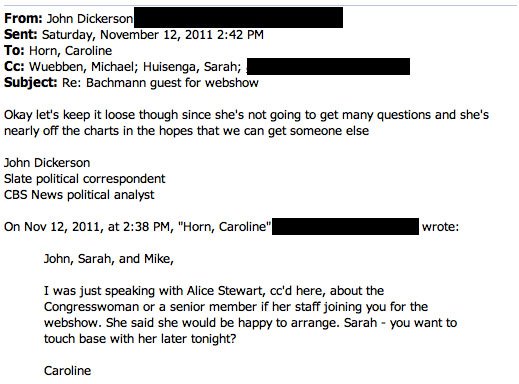
Briefly. . . As recounted in today’s NYTimes, the guy in charge of political coverage at CBS, John Dickerson, was caught doing his job. He was trying to find an online guest for a show he was orchestrating that would follow the latest Republican debate on Saturday night. In an email to colleagues, he said he would rather “get someone else” other than Bachmann.

His reason? She was “not going to get many questions” and “she’s nearly off the charts” in the polling of voters’ preferences.

(Dickerson’s big mistake was that he included a Bachmann aide among the people in the list of addresses for that particular email, so his thinking went unfiltered to the Bachmann communication director, who then did the professional thing and tried to make hay out of it, in a Facebook blast and elsewhere.)


Back to Dickerson’s email.

If we look at what he actually said, it appears that his criteria for choosing the guests to pursue were non-political, non-partisan, and non-ideological.

Like any good producer, he wanted a “hot” guest — hot in the sense of someone who is trending, someone who is going to create or amplify buzz, someone who is going to add to CBS’s ratings. He does not want someone who was last week’s news. Simple as that.

And the facts bear him out: Bachmann did indeed get few questions in the debate and little air time, and she is dying in the latest polls. (CBS’s own latest poll had her in 6th place with just 4% support.) That is not to say that she could not surge again; if she does, Dickerson and every producer, host, and booker in politics will be chasing her. Not because they like or dislike her and not because they agree or disagree with her. It will be all about blowing on the hot coals.

In his email, Dickerson could be properly charged with telling “vicious truths.”

Was he ruthless? Yes.

Was he liberal? No.

Even the awful site Big Journalism almost got this right. In fact, the blogger

p.s. For another day: What about Bachmann’s implicit claim? Do the news media formulate common policies, then execute them in concert? (Hint: people in the news media can’t agree on whether to capitalize “president” !)


1 Comment

Filed under broadcasting, Journalism, media, Politics

OPTIMISM AND JOURNALISM (in the same headline!)

By Chris Daly

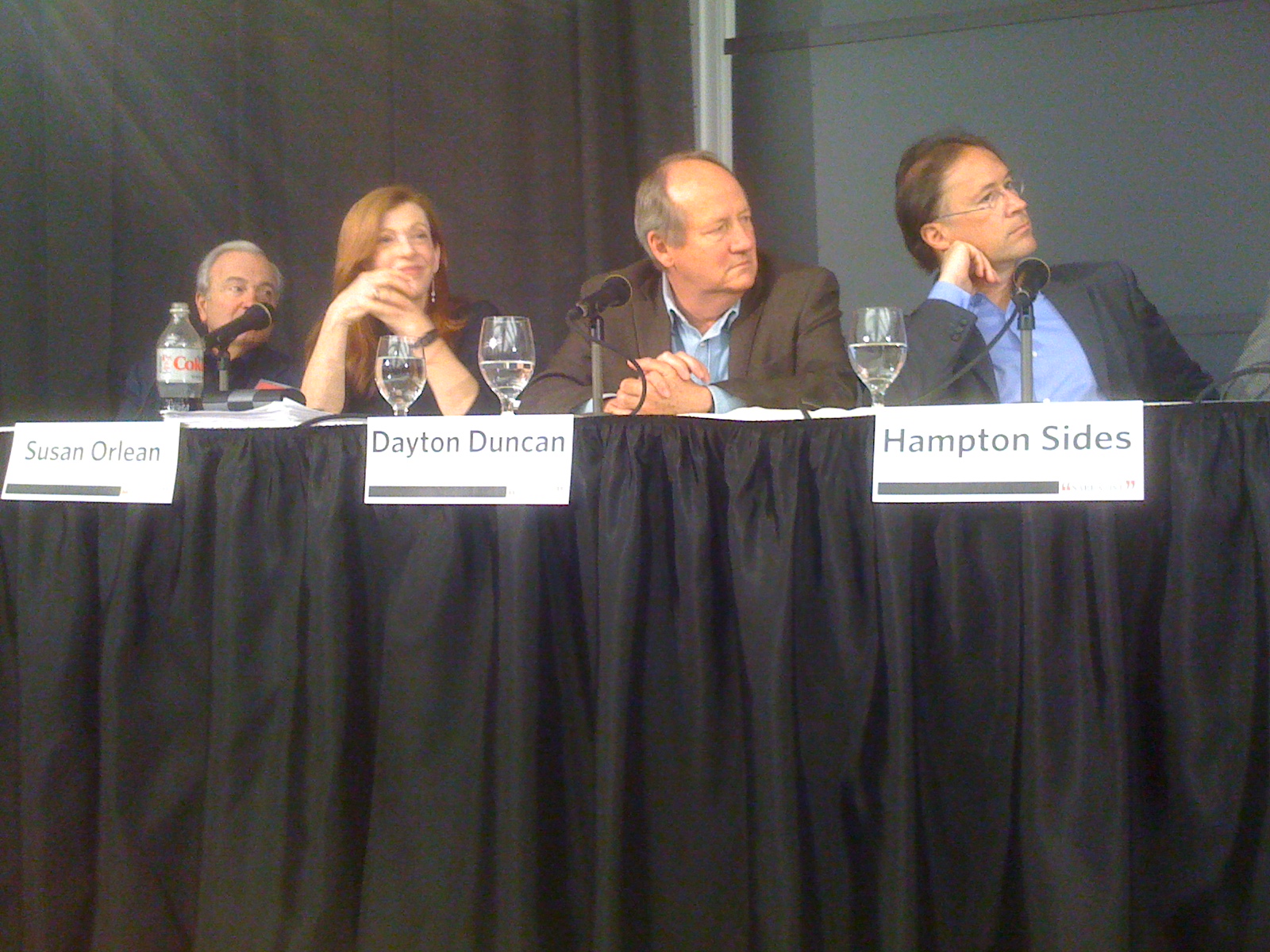
I had the good fortune to attend the annual Conference on Narrative Non-Fiction, hosted at Boston University. It was a gathering of the tribe of people who do (and think about and care about) narrative non-fiction, long-form journalism, or any of the allied arts.

I was struck by the comments of Ken Auletta, the indispensable chronicler of the media business. Unlike a lot of the panelists, Auletta, a veteran New Yorker writer, said he saw reasons for optimism in the current situation. With his permission, I want to share his 14 reasons to look on the bright side:

1. e-books (which eliminate all the impediments associated with printing and distributing books — plus, no returns!)

2. (Apologies: I can’t read Auletta’s handwriting on this one, and it didn’t register as a separate item in my own notes.)

3. The Web puts a virtual library at every writer’s fingertips, greatly speeding up the pace and bringing down the cost of doing research.

4. Google books, which is bringing out-of-print books back to life.

5. Apps, which are teaching people that they should expect to pay for content.

6. Multimedia tools for story-tellers. (Auletta cited the pioneering use of video by the NYT in Art Buchwald’s obit)

7. The old media are beginning to “lean in” and engage with new tools and social media, rather than always deciding to “lean back” and feel sorry for themselves.

8. Writers have more platforms than ever before, so writers can pick the one that best fits a particular project.

9. The media have become more democratic, since readers now have a voice, which they can use for (among other things) contributing reports from places where there are no journalists.

10. Because the media are two-way, readers can help with fact-checking.

11. Because the media are two-way, readers can also help with suggesting story ideas. (“Hey, Auletta, why don’t you look into …”)

12. Blogging gives content-creators more options.

13. Links allow readers to find our work in all sorts of ways; they can stumble on something they didn’t already “subscribe” to.

14. The speed of publication allows some old media (like books) to keep up with developments in a way they never could hope to when it took 12 months to get a book into stores.

It’s quite a list, and many thanks to Ken Auletta for A), coming up with it, and B), sharing it.

Photos next:

Leave a comment

Filed under Journalism

News about the news

By Chris Daly

It’s a busy Monday for news about the news business. Here goes:


–Happily, the four talented, experienced journalists from the NYTimes captured by the Libyan government have been released.

From London comes word of limited progress in addressing some of the worst features of British libel law (presumption of guilt, unlimited jurisdiction, etc.)

David Carr peers inside Google and sees a “media company.”

Foreign news matters again inside big news organizations that have been hollowing out their “foreign desks” and closing overseas bureaus.

–I’m not even sure what this story about Thrillist is all about, but it’s the most emailed business story, so here goes.

(Thrillist looks like a retailing site to me, not a media site. But what do I know?)


Leave a comment

Filed under Journalism, media

“Corrupt Bastards” context

Perhaps worth noting is this bit of context for Sarah Palin’s denunciation of the media. This suggests that the phrase “corrupt bastards” has a history in Alaska politics.
Also perhaps worth noting: According to Wikipedia, the one prominent Alaska Republican who was NOT implicated in the scandal was Lisa Murkowski — the very figure Palin is trying to defeat by backing Joe Miller.
For a state with a tiny population, Alaska sure generates some complicated political conflicts.

Leave a comment

Filed under Uncategorized