Tag Archives: journalism

OPTIMISM AND JOURNALISM (in the same headline!)

By Chris Daly

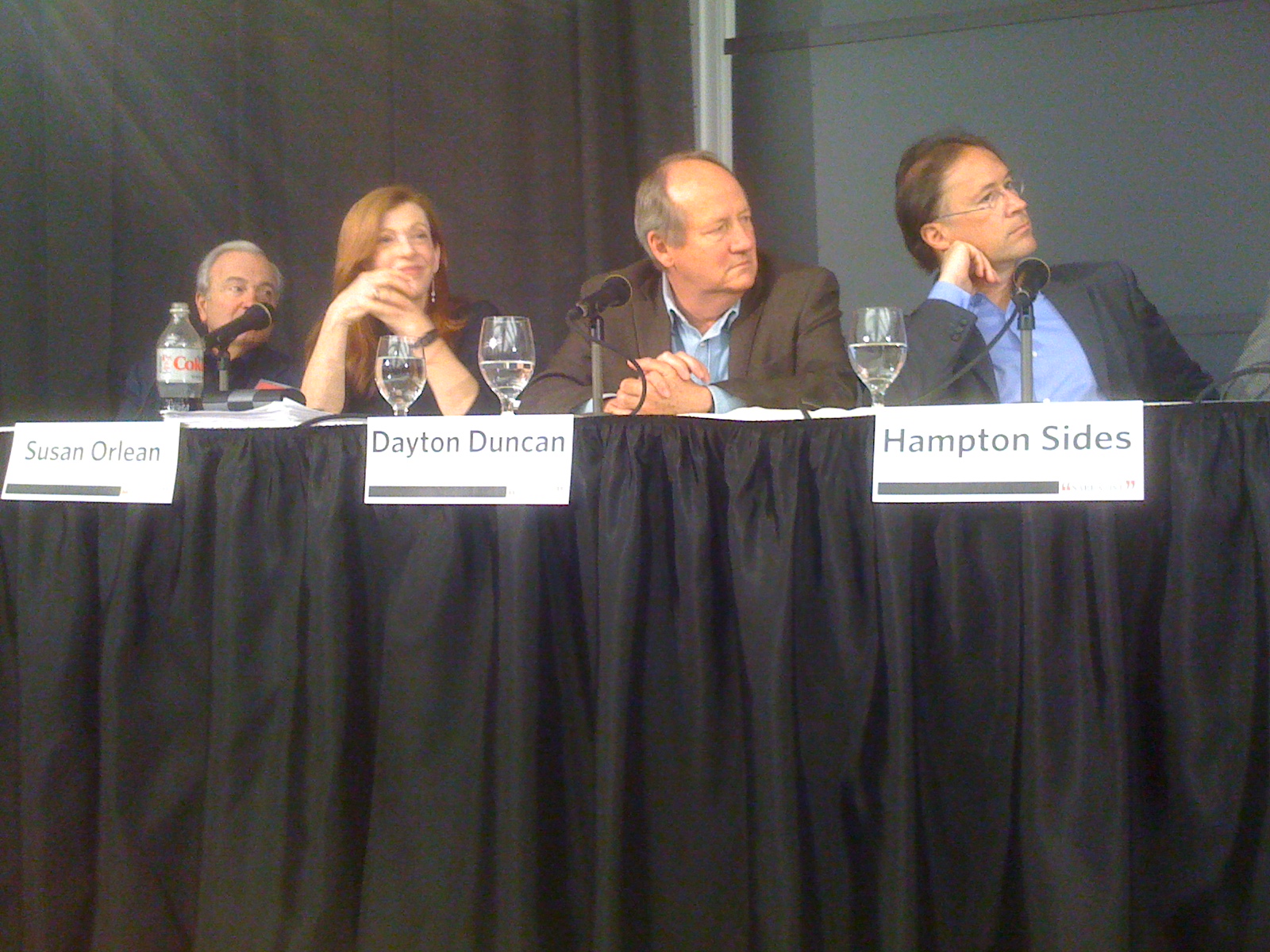
I had the good fortune to attend the annual Conference on Narrative Non-Fiction, hosted at Boston University. It was a gathering of the tribe of people who do (and think about and care about) narrative non-fiction, long-form journalism, or any of the allied arts.

I was struck by the comments of Ken Auletta, the indispensable chronicler of the media business. Unlike a lot of the panelists, Auletta, a veteran New Yorker writer, said he saw reasons for optimism in the current situation. With his permission, I want to share his 14 reasons to look on the bright side:

1. e-books (which eliminate all the impediments associated with printing and distributing books — plus, no returns!)

2. (Apologies: I can’t read Auletta’s handwriting on this one, and it didn’t register as a separate item in my own notes.)

3. The Web puts a virtual library at every writer’s fingertips, greatly speeding up the pace and bringing down the cost of doing research.

4. Google books, which is bringing out-of-print books back to life.

5. Apps, which are teaching people that they should expect to pay for content.

6. Multimedia tools for story-tellers. (Auletta cited the pioneering use of video by the NYT in Art Buchwald’s obit)

7. The old media are beginning to “lean in” and engage with new tools and social media, rather than always deciding to “lean back” and feel sorry for themselves.

8. Writers have more platforms than ever before, so writers can pick the one that best fits a particular project.

9. The media have become more democratic, since readers now have a voice, which they can use for (among other things) contributing reports from places where there are no journalists.

10. Because the media are two-way, readers can help with fact-checking.

11. Because the media are two-way, readers can also help with suggesting story ideas. (“Hey, Auletta, why don’t you look into …”)

12. Blogging gives content-creators more options.

13. Links allow readers to find our work in all sorts of ways; they can stumble on something they didn’t already “subscribe” to.

14. The speed of publication allows some old media (like books) to keep up with developments in a way they never could hope to when it took 12 months to get a book into stores.

It’s quite a list, and many thanks to Ken Auletta for A), coming up with it, and B), sharing it.

Photos next:

Leave a comment

Filed under Journalism

Who reports?

By Chris Daly

Here is a really worthwhile follow-up to the recent posting about Nate Silver and his study of original reporting. It develops several points that I think are solid and worth further research.

It’s from Nick Baumann of Mother Jones. Like Nate Silver, he is an interested party in all this — trying to make sure that Mother Jones’s original reporting is reckoned properly. Fair enough.

Thanks to my son Gabe for sending it along!


Leave a comment

Filed under Journalism, New York Times

A Bottom at Last?

By Chris Daly

Probably too soon to tell, but the latest figures from ASNE on the annual census of newsroom employees are actually up a little bit.

The bad news: the percentage of minorities slipped, again.

Amazing: 441 US newspapers have no minorities on the the full-time staff. Zero. The editors of those papers should take a look at the US Census.


Leave a comment

Filed under Journalism, media

Who reports?

By Chris Daly

The always-interesting Nate Silver, in a recent post, put his finger on a really key issue in journalism: who does the reporting that everyone else fights over, analyzes, re-purposes, aggregates, or just steals?

Silver did some back-of-the-envelope calculations and came up with this chart:

(I must say I am very gratified to see that two of the top 10 — The AP and The Washington Post — are the places were I spent most of my years as a journalist.)

As anyone in the news business could tell you, there are no real surprises here. Silver is trying to identify who does the bulk of the original reporting about national and international affairs for American audiences. (He is not looking here at local news, which is another story.)

Two news organizations in particular stand out, almost in a class by themselves.

First is the AP, the enormous but nearly invisible news organization that still operates in every state in America and most countries around the world. The non-profit cooperative functions as a giant wholesaler of news — gathering, re-writing, shooting, editing, and distributing vast amounts of stories, images, sound, and data every hour of every day. Almost all of AP’s output is delivered to other news organizations, and not directly to the public. So, most people think they “get their news” from whatever retail outlet they happen to frequent, rather than from the ultimate source, which is often the AP.


Number Two on the list is The New York Times. Again, no real surprise. Say what you will about its management, business model, stock price and all the rest, the Times has no real peer among “general news” organizations. (By that, I mean organizations that have a broader sweep than a particular topical niche like business, sports, or celebrities).

The point is worth making again: reporting is expensive (and sometimes dangerous), and the world would be a better place if more people got out, walked around, took notes, made photos, and shared what they found.

‘Nuf said.

2 Comments

Filed under Journalism, New York Times

More news about the news

By Chris Daly

More news today about journalism.

~First, an update from the NYTimes about the harrowing captivity of four of its own journalists (including Tyler Hicks, a BU alum who will be the commencement speaker this spring at BU’s College of Communication — assuming he stays out of any further serious trouble). And thanks to Joe Klein, on today’s “Morning Joe” on MSNBC, for pointing out that when certain people (he mentioned Sarah Palin) whine about the “lame-stream media,” they should realize that they are disrespecting people who deserve better. 


Photo by John Moore/Getty Images


~Whither Glenn Beck? Who the heck knows?


~Thanks to Michael Miller for pointing this out, here are some interesting further thoughts on the NYTimes pay model (including bold assertions about the future) from John Gruber at Daring Fireball. (With a name like Daring Fireball, no wonder he’s so confident about his predictions…)


~A happy prospect: help-wanted from Talking Points Memo, which is seeking to fill a new position, that of associate editor for Washington news. Here’s the take-away:

Crackerjack news judgment, experience as an editor and deep familiarity with politics and political news are each a must. Competitive salary for qualified applicants; health care, three weeks annual vacation and 401k benefits provided.


Glad to see health care benefits being offered. Wonder what is meant by “competitive salary”. . .


Leave a comment

Filed under broadcasting, Fox News, Glenn Beck, Journalism, New York Times

News about the news

By Chris Daly

It’s a busy Monday for news about the news business. Here goes:


–Happily, the four talented, experienced journalists from the NYTimes captured by the Libyan government have been released.

From London comes word of limited progress in addressing some of the worst features of British libel law (presumption of guilt, unlimited jurisdiction, etc.)

David Carr peers inside Google and sees a “media company.”

Foreign news matters again inside big news organizations that have been hollowing out their “foreign desks” and closing overseas bureaus.

–I’m not even sure what this story about Thrillist is all about, but it’s the most emailed business story, so here goes.

(Thrillist looks like a retailing site to me, not a media site. But what do I know?)


Leave a comment

Filed under Journalism, media

A real “curveball”

By Chris Daly

This story was, I suppose, inevitable. But it is important to establish the historical record of the Bush years.

Here’s the nub of what the Iraqi source known by his nickname “Curveball” told the Guardian this week:

Everything he had said about the inner workings of Saddam Hussein’s biological weapons programme was a flight of fantasy – one that, he now claims was aimed at ousting the Iraqi dictator. Janabi, a chemical engineering graduate who had worked in the Iraqi industry, says he looked on in shock as Powell’s presentation revealed that the Bush administration’s hawkish decisionmakers had swallowed the lot. Something else left him even more amazed; until that point he had not met a US official, let alone been interviewed by one.

“I had the chance to fabricate something to topple the regime,” he told the Guardian in a series of interviews carried out in his native Arabic and German. “I and my sons are proud of that, and we are proud that we were the reason to give Iraq the margin of democracy.”


What’s missing are comments from:

President George W. Bush

Secretary of State Colin Powell

National Security Adviser Condoleeza Rice

CIA Director George Tenet

Defense Secretary Donald Rumsfeld.

Journalists should be staking out every one of these people and demanding answers.

Leave a comment

Filed under Uncategorized

“Corrupt Bastards” context

Perhaps worth noting is this bit of context for Sarah Palin’s denunciation of the media. This suggests that the phrase “corrupt bastards” has a history in Alaska politics.
Also perhaps worth noting: According to Wikipedia, the one prominent Alaska Republican who was NOT implicated in the scandal was Lisa Murkowski — the very figure Palin is trying to defeat by backing Joe Miller.
For a state with a tiny population, Alaska sure generates some complicated political conflicts.

Leave a comment

Filed under Uncategorized

Is Obama Reading Journalism History?

by Chris Daly

It looks that way, judging from his new interview in Rolling Stone. He was asked by RS founder/editor Jann Wenner for his opinion about Fox News. Here’s the relevant chunk:

What do you think of Fox News? Do you think it’s a good institution for America and for democracy?
[Laughs] Look, as president, I swore to uphold the Constitution, and part of that Constitution is a free press. We’ve got a tradition in this country of a press that oftentimes is opinionated. The golden age of an objective press was a pretty narrow span of time in our history. Before that, you had folks like Hearst who used their newspapers very intentionally to promote their viewpoints. I think Fox is part of that tradition — it is part of the tradition that has a very clear, undeniable point of view. It’s a point of view that I disagree with. It’s a point of view that I think is ultimately destructive for the long-term growth of a country that has a vibrant middle class and is competitive in the world. But as an economic enterprise, it’s been wildly successful. And I suspect that if you ask Mr. Murdoch what his number-one concern is, it’s that Fox is very successful.

Leave a comment

Filed under Fox News, journalism history, President Obama

Journalism Myths

Great discussion today on NPR’s show “On Point” about myths that have grown up in the history of journalism. The guest was the estimable Prof. W. Joseph Campbell, talking about his book, “Getting it Wrong: Ten of the Greatest Misreported Stories in American Journalism.”

Have a listen.

Leave a comment

Filed under history, Journalism